Volume 2009, Article ID 164019,12pages doi:10.1155/2009/164019
Research Article
RVM-Based Human Action Classification in Crowd through
Projection and Star Skeletonization
B. Yogameena, S. Veeralakshmi, E. Komagal, S. Raju, and V. Abhaikumar
Department of Electronics and Communication Engineering, Thiagarajar College of Engineering, Madurai 625015, Tamil Nadu, India
Correspondence should be addressed to B. Yogameena,[email protected]
Received 1 February 2009; Revised 17 May 2009; Accepted 26 August 2009
Recommended by Amit Roy-Chowdhury
Detection of abnormal human actions in the crowd has become a critical problem in video surveillance applications like terrorist attacks. This paper proposes a real-time video surveillance system which is capable of classifying normal and abnormal actions of individuals in a crowd. The abnormal actions of human such as running, jumping, waving hand, bending, walking and fighting with each other in a crowded environment are considered. In this paper, Relevance Vector Machine (RVM) is used to classify the abnormal actions of an individual in the crowd based on the results obtained from projection and skeletonization methods. Experimental results on benchmark datasets demonstrate that the proposed system is robust and efficient. A comparative study of classification accuracy between Relevance Vector Machine and Support Vector Machine (SVM) classification is also presented.
Copyright © 2009 B. Yogameena et al. This is an open access article distributed under the Creative Commons Attribution License, which permits unrestricted use, distribution, and reproduction in any medium, provided the original work is properly cited.
1. Introduction
Security of citizens in public places such as Hotels, Markets, Airports, and Train stations is increasingly becoming a cru-cial issue. A number of video surveillance systems for multi-ple peomulti-ple detection and tracking in a crowded environment have been reported in literature [1–3]. Describing an unusual activity or behaviour from a video is a challenging problem. It involves representation and interpretation of the visual information for behaviour learning and recognition [4–8]. Turaga et al. have summarized the approaches that have been pursued over the last 20 years to address the problem of activity recognition. They have discussed the problem at two levels of complexity: “actions” and “activities.” “Actions” are characterized by simple motion patterns typically executed by an individual whereas “activities” involve coordinated actions among a group [9].
Though alternate methods are available, background subtraction continues to be a method of importance in video surveillance. Piccardi has reviewed a number of background subtraction approaches [10]. Wren et al. [11] have proposed a statistical method, in which a single Gaussian function was used to model the distribution of background. Later
Mittal and Paragios have proposed a novel kernel-based multivariate density estimation technique that adapts the bandwidth according to the uncertainties [12]. Yet there are issues like the robustness to illumination changes, the effectiveness in suppressing shadows, and the smoothness of foreground’s boundary which need to be addressed in indoor and outdoor environments [13].
between individuals, so that the motion-segmented image contains enough visual information to separate individuals moving as a group. However, this is not always true in dense groups, when people are visually inseparable. A novel approach to segment individual in the crowd is required which reduces the effects of certain problems like occlusions and overlap which are faced by conventional techniques.
Many action recognition methods have been applied to classify an individual’s action as normal or abnormal. Most frequent activities like walking and sitting are considered as normal and the activities like jumping, running, waving hand, bending, and fighting are considered as abnormal. A method to tackle activity recognition using descriptive local features of actions performed by humans at multiple scales and temporal speeds has been proposed [16]. Song et al.[17] used a triangular lattice of grouped point features to encode layout. Lee and Xu proposed a method using the velocity of body parts for learning human actions [18]. Stauffer
and Grimson [19] proposed a system which accumulates joint cooccurrence statistics to create a hierarchical binary-tree classification of the representations for classifying sequences, as well as individual instances of activities in a site. The feature selection also plays an important role for any classification system. In [20] the authors proposed Hidden Markov Models for action classification using the features based on the position and velocity of body parts for learning. Wu et al. proposed a method which employs optical flow for detecting abnormal human blobs and Principal Component Analysis for feature selection and Support Vector Machine for classification of human actions. The number of primary features, the selection of primary features, and loss in the original information content formulate the PCA feature selection to be more complex [21]. Therefore features which significantly improve the classification accuracy with reduced complexity are essential.
There are many types of neural networks that can be used for a binary classification problem, such as Support Vector Machines, Radial Basis Function Networks, Nearest Neigh-bor Algorithm, and Fisher Linear Discriminant. Machine learning techniques can be considered as linear methods in a high-dimensional feature space nonlinearly related to the input space. Using appropriate kernel functions, it is possible to compute the hyperplane which separates the two classes. Consequently a machine learning technique which minimizes the number of active kernel functions to reduce computation time is required [22–24]. The objective of this paper is to classify normal and abnormal actions of an individual in a crowd using appropriate feature selection and classification technique to improve the classification accuracy. Hence a novel system is proposed to classify the action of an individual. First the foreground blobs are detected using a background subtraction technique which is to be robust to illumination changes and shadows. Then projection is used to segment an individual in the crowd even in the presence of occlusion. Finally skeleton features and RVM are used to improve the classification accuracy and thereby reducing the computational complexity by selecting
Video sequence Background subtraction
Projection
Group Yes
No Segmenting individual from group Feature selection
RVM classifier
Normal action Abnormal action
Figure1: The block diagram of the Video Surveillance System.
an appropriate kernel. Experimental results demonstrated that the proposed approach is robust in classifying human actions.
The remainder of this paper is organized as follows.
Section 2 describes the methodology. Section 3 describes background subtraction and projection techniques to iden-tify individuals in groups and explains star skeleton fea-ture extraction method. Section 4 depicts RVM learning system for classification of human actions. Section 5 dis-cusses the experimental results. Finally, the conclusion is presented.
2. Methodology
Camera
Head plane C1
L2 C2 L1 Ground plane
Intersected area between two planes
Figure2: Intersected area between the ground plane and the head plane projection of an individual.
3. Action Analysis
3.1. Background Subtraction and Projection. In this work,
background substraction is accomplished in real-time using the adaptive mixture of Gaussians method proposed by Atev et al. [25]. There are some of the practical issues concerning the use of the existing algorithm based on mixtures of Gaussians for background segmentation in outdoor scenes, including the choice of parameters [26]. The proposed system analyzes the choice of different parameter values and their performance impact is obtained to get robust background model. In addition, the motivation for adopting this method stems from its simplicity and efficiency in meeting with sudden global illumination changes based on the contrast changes over time.
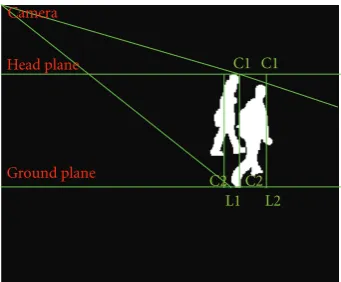
Subsequently, the individual is to be identified for further analysis leading to action classification. An extracted blob in a frame, representing an individual is subjected to action analysis described in subsequent sections. If there exists more than one blob, but with connectivity, there is a likelihood to be considered as single entity. This results in the identification of a group as “individual.” This makes recognition of individual’s action in a crowd more difficult. Therefore, a geometric projection on the blob is proposed to separate an individual from the group for analysing his or her actions. The blob is projected to head and ground plane from the camera view point leading to intersected area in world coordinates. Such projection shown inFigure 2
eliminates the variation of area with the distance from the camera so that it identifies only humans [27]. The success of human identification lies on segmentation of individual human in a given frame as a single blob. However, there is a chance of multiple blobs representing an individual human due to oversegmentation. But, since the projection of a blob is accomplished from head plane to ground plane, any discontinuity in a blob representing an individual is achieved by linking discontinuous blobs covered by bounding rectangle.
3.2. Individual and Group Identification. The head plane is
fixed such that all the individuals in the scene are detected.
G1 G1
Figure3: Examples for Labelled as “Group.”
Having a head plane height too large will result in zero-intersected area for shorter people. On the other hand, setting very small head plane heights will result in detecting shorter objects. Therefore, a head plane height of 160 cm is assumed as a balancing height for the intersected area computation [27]. This makes the method robust to false detections from other objects commonly found in urban environments and also reduces the effects of shadows on the ground plane in cases where the shadow of a person or group appears shorter in the image than the height of the person or group. For all blobs a rectangular area is formed by connecting the opposite points C1 and C2. If this area is less than the area threshold, then the region is classified as an individual. Subsequently, the classified individual foreground blobs are tracked using the centroid. The blobs whose projected area exceeds a threshold are classified as a group and are shown inFigure 3. The threshold is selected to be just under the area corresponding to two individuals in the real world. The individuals in a group are recognized and labelled by (1), (2) and (3).
Projected Area in the Head Plane=C1−L2, (1)
Projected Area in the Ground Plane=L1−C2, (2)
Resultant (overlapped) Intersected portion=C1−C2, (3)
where C1 and L2 are the projected points of the head and Leg on the Head Plane, respectively; L1 and C2 are the projected points of the head and Leg on the Ground Plane, respectively. Given the intersected area of the group being labelled, the count estimation is applied for this current frame using (4) and is shown inFigure 4:
Count=Area
K , (4)
whereKis the individual’s intersected area.
Camera
Head plane C1 C1
C2 C2 Ground plane
L1 L2
Figure4: Intersected area between the ground plane and the head plane projection.
I1 I2
Figure5: Segmented Individual.
3.3. Star Skeletonization. Consequently the individual is
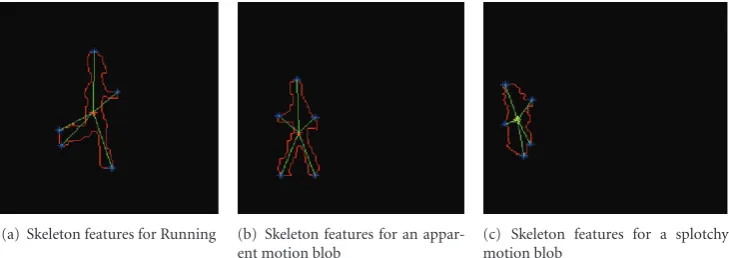
labelled then the system tracks consecutive blobs for that individual. Fujiyoshi et al. propose the use of star skeletoniza-tion procedure for analysing the moskeletoniza-tion of human targets. The standard star skeleton techniques for skeletonization such as distance transformation and thinning are compu-tationally expensive and moreover are highly susceptible to noise in the target boundary. The method adapted in this paper provides a simple way of detecting only the gross extremities of the target to produce star skeleton. It also reduces the noise for the splotchy motion blobs such as
Figure 2 by smoothing the distance from the centroid to contour points,diplot by moving average. The main idea is, the simple form of skeletonization extracts the broad internal motion features of a target and is employed to analyze the target’s motion [28]. Then the contour for a human blob is extracted as shown inFigure 6. The centroid (xc,yc) of the human blob is determined by using the following (5) and (6) and is also shown inFigure 6:
xc= 1
N
N
j=1
xi, (5)
yc= 1
N
N
j=1
yi, (6)
(a) Apparent motion blob (b) Splotchy motion blob
Figure6: Border points and Centroid for motion blobs.
400 350 300 250 200 150 100 50 0
Border positioni
Max points Min points 0
10 20 30 40 50 60
di
Figure7: Plot of skeleton extreme points.
where (xc, yc) represent the average contour pixel position, (xi,yi) represent the points on the human blob contour and there are a total of N number of points on the contour. The distancedi from the centroid to contour points is given by (7):
di =
(xi − xc)2 +
yi − yc 2
. (7)
From thediplot, the local maximum points are collected and their corresponding plot is shown inFigure 7.
(a) Skeleton features for Running (b) Skeleton features for an appar-ent motion blob
(c) Skeleton features for a splotchy motion blob
Figure8: Skeleton features for different motion blobs.
20 18 16 14 12 10 8 6 4 2 0
Frame −0.5
0 0.5 1 1.5 2 2.5
θ
(r
ad)
(a) Motion analysis plot using leg angle for walking
25 20
15 10
5 0
Frame −1.6
−1.4 −1.2 −1 −0.8 −0.6 −0.4 −0.2 0
θ
(r
ad)
(b) Motion analysis plot using leg angle for running
Figure9: Star skeletonization motion cues.
the same leg is detected at all times, because the cyclic structure of the motion will still be evident from this point’s motion. If {(xis,yis)}is the set of extreme points, (lx,ly) is chosen according to the following condition given in (8) and (9):
lx,ly
=xis,ysi
:xsi=min ys
i<yc
xis. (8)
Then, the leg angleθis calculated by making use of the values of (lx,ly), such as
θ=tan−1lx−xc
ly−yc.
(9)
A further cue to determine the posture of moving human is the inclination of the torso. This can be approximated by the angle of upper-most extreme point of the target. This torso angleΦcan be determined in exactly the same manner asθ and the leg angle for walking and running is shown in
Figure 9. Another feature which can be clearly observed is
that the frequency of the cyclic motion point is clearly higher in the case of running person; so this can be used as a good metric for the classification. The cutofffrequency was set as 0.1 to get appropriate extreme points in this proposed work. At last the leg angleθ, torso angleΦ, and the skeleton motion in a sequence are given as input vectors for the Relevance Vector Machine.
4. Classification Using RVM Learning
Table1: Datasets from different outdoor sequences.
Dataset Indoor/outdoor Sequence length Frame size An individual bends
down while most of walking-DS-I(DS represents Dataset)
Indoor/outdoor 1628 240×320
College campus A person waving hand
in a group-DS-II Indoor/outdoor 864 240×320 Running human in a
group-DS-III outdoor 1320 240×320
A person carrying a
bar in a group DS-IV outdoor 920 240×320
Benchmark dataset
IBM Dataset Two persons walking Indoor 781 240×320
Weizmann Dataset
Eli-Walk Outdoor 645 240×320
Eli-Run Outdoor 712 240×320
Moshe-Bend Outdoor 786 240×320
Eli-Jump Outdoor 855 240×320
CMU Dataset
Person A fights with
person B Indoor 1234 240×320
Person A pulls the
person B Indoor 1065 240×320
CAVIAR An individual with his
hand lifted up Indoor 1187 240×320
human actions, the computational action models built inside the trained machines can automatically identify whether the action is normal or abnormal. The action classification system proposed in this paper is trained for both normal and abnormal actions so that testing becomes a two class hypothesis problem. SVM is classical training algorithm because it has stronger theory-interpretation and better generalization than the other neural networks mentioned earlier. The decision function of the SVM classification system cannot be much sparser; that is, the number of support vectors can be much larger. This problem can be partially overcome by the state-of-the-art model RVM.
The proposed Relevance Vector Machine (RVM) clas-sification technique has been applied in many different areas of pattern recognition, including functional neuro images analysis [33], facial expressions recognition [34], and pose estimation [35]. The RVM is a Bayesian regression framework, in which the weights of each input vector are governed by a set of hyper parameters. These hyperparame-ters describe the posterior distribution of the weights and are estimated iteratively during training. Most hyper parameters approach infinity, causing the posterior distributions of the corresponding weights to zero. The remaining vectors with nonzero weights are called relevance vectors. RVM does not need the tuning of a regularization parameter and also the inversion of a large matrix is not required during the training phase. This makes this methodology appropriate for large datasets. In this paper, Relevance Vector Machine (RVM) technique is used for the classification of human action such as normal or abnormal.
5. Results and Discussion
The efficiency of the proposed system has been evaluated by carrying out extensive works on the simulation of the algorithm on benchmark datasets. In this paper the video files used are taken in both indoor and outdoor. It is assumed that according to the camera view point, people move on the ground plane in the real world. The method processes about 24 frames per second for colour images. To demonstrate the performance of the proposed method, different abnormal action sequences are taken and shown inTable 1. They are taken from Weizmann (http://www.wisdom.weizmann.ac.il) and CAVIAR (http://groups.inf.ed.ac.uk/vision/CAVIAR/ CAVIARDATA1/) datasets for the action of an individual such as walking, running, jumping, bending, and a person lifting his hand. In order to reveal complexity, IBM dataset having multiple people walking and ( http://dom-ino.research.ibm.com/comm/research projects.nsf/pages/s3 .performanceevaluation.html) CMU (http://mocap.cs.cmu .edu) database which contains two persons are fighting with each other in one sequence and in another sequence a person pulling up the hands of other person is used.
15 10
5 0
K
0 0.1 0.2 0.3 0.4 0.5 0.6 0.7 0.8 0.9 1
FP
and
F
N
0 0.1 0.2 0.3 0.4 0.5 0.6 0.7 0.8 0.9 1
T
0 0.1 0.2 0.3 0.4 0.5 0.6 0.7 0.8 0.9 1
FP
and
F
N
0 0.1 0.2 0.3 0.4 0.5 0.6 0.7 0.8 0.9 1
α
FN FP 0 0.1 0.2 0.3 0.4 0.5 0.6 0.7 0.8 0.9 1
FP
and
F
N
Figure10: Parameter settings for GMM.
(a) Foreground image (b) Skeleton image
4
(c) Abnormal classified image
Figure11: A bending down movement of the person classified as abnormal action.
foreground, FP) caused by the change of one parameter while keeping the others unchanged. The measurements were performed on different video sequences.Figure 10illustrates the FN and FP for different parameter values and clearly shows that 4 is suitable value for K (number of Gaussian mixtures) and 0.004 is an appropriate value forT. The proper values for the learning rateβand the match threshold are 0.001 and 0.4, respectively.
As mentioned in Table 1 dataset DS I, along with a person bending down blob two other foreground blobs were detected and in DS III five fore ground blobs were obtained including the running person’s blob. Here, in DS I and in DS III, the car was in the static position. Hence it has been considered as background. Even when the datasets were taken in different illumination conditions, the foreground blobs obtained as shown in Figure 16 are robust. After
foreground blobs were detected, using projection they were separated as individuals and groups. In DS II the persons away from the camera view point were easily identified as individuals and the remaining as group. Using the intersected area the individuals were separated from group and labeled as individuals. As illustrated inFigure 16all individuals were clearly projected and also in the CMU Fighting dataset the individual who holds the stool and the other plunged down were separated.
Table2: The results of RVM classification.
Vectors
Datasets Actions SVM RVM
Multiclass SVM with PCA features
Multiclass SVM with skeleton Features
Multiclass RVM with skeleton Points
College Campus
Normal Walking 186 145 11
Abnormal
Running 146 123 18
Carrying Bar 212 133 23
Bending 137 120 12
Waving hand 174 118 16
Benchmark Datasets
Normal IBM 183 138 12
Eli-Walk 179 124 15
Abnormal
Eli-Run 154 116 18
Moshe-Bend 132 98 20
Eli-Jump 145 112 16
CMU1 157 87 19
CMU2 165 76 14
CAVIAR 176 94 12
I1 I2 I3
(a) One person bending down
I1 I2 I3 I4 I5
(b) One person waving hand
I1 I2 I3
I4 I5
(c) One person running in the crowd
Figure12: Results of classified abnormal actions for College Campus dataset.
where as Figure 11(b)shows the skeleton points of a man “bending.” But in the CMU meeting dataset both were clearly skeletonized. However in the CMU Fighting dataset the person who holds the stool is skeletonized including the stool because of the connectivity. Finally the skeleton features and the motion cues were given as input for the relevance vector machine algorithm to classify the abnormal action from the normal one which was indicated in red color as shown in
Figure 11and Figures 12(a),12(b), and12(c)and also for benchmark datasets as shown inFigure 16.
Relevance Vector Machine uses a suitable kernel for the classification task. In this paper Gaussian kernel was used. To determine the fine-tuning parameters of the RVM classifier model for optimal performance, a tenfold cross validation (CV) has been applied in the training dataset. In each dataset, 80% of the sequence has been used for training and the remaining 20% for testing. The best error level 6.89% was
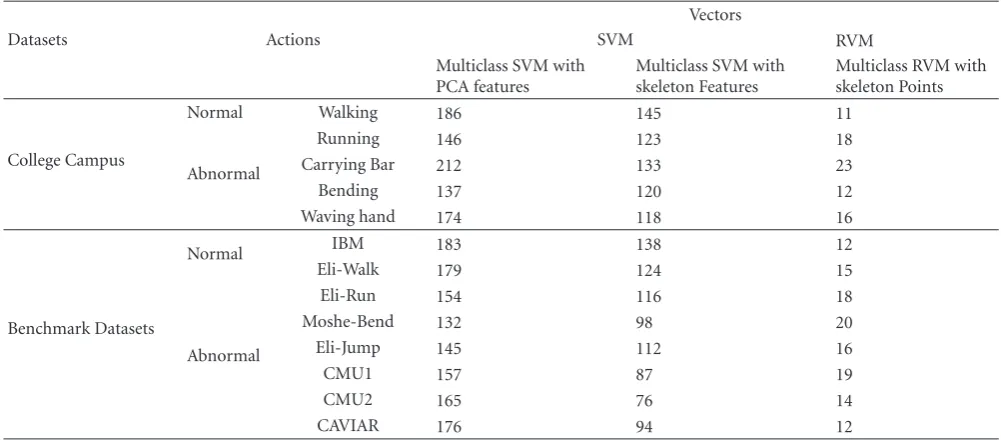
obtained by using the Gaussian kernel. Gaussian kernel was the best with around 100.0% for training, 94.0% for CV, and 96.0% for testing the given feature vectors. The error rate of the Gaussian kernel was lower than that of other kernels in terms of classification rate. For comparison, an SVM classifier is trained using the same dataset. Indeed, the RVM classifier is much sparser than the SVM. The number of relevance vectors (produced during training) was found to be minimal for the RVM classifier, while comparing with SVM and is shown inTable 2. On an average, six datasets have been tested for classifying each activity like running, jumping, waving hand, and bending from weizmann dataset containing a total of 4 actions performed by 9 people totalling 36 videos.
The error levels for the above mentioned datasets are compared between the SVM and RVM classifiers as shown in
CA VIAR CMU2 CMU1 Eli-J u mp Mo sh e-B en d Eli-R u n Eli-W alk IBM W av ing hand Be nd Car ry ing bar Ru n Datasets 0 5 10 15 20 25 Er ro r le vel (%) SVM RVM
Figure13: Comparison of RVM and SVM errors.
Input feature vector
Output (input + w eig ht)
(a) Initial stage
Input feature vector
Output (input + w eig ht)
(b) Sixth iteration
Figure14: Relevance vector obtained after training.
training and testing sequences of the dataset in terms of True Positive and False Negative. Higher error level leads to poor action classification. In all the datasets the percentage of error level of SVM is higher than proposed RVM classification. Moreover it is inferred from Figures 14(a)and 14(b) that as the number of iteration increase the better conver-gence of relevance vectors is achieved for the experimental datasets. 93.53 84.67 95.33 92.7 91.7 84.72 84.4 81.17 71.72 62.96 81.5 86.83 Sa var ese et.al. Ni eb le s et .a l. Ke et .a l. Sc h uldt et.al. Doll’ar et.al. Ji ang et.al. N o w o zin et.al. Jh uang et.al. Sc hindler et.al. Ki m et .a l. Dhillon et.al.[36] Pro p o se d m et h o d Datasets 50 60 70 80 90 100 A ccur acy (%)
Figure15: Comparative results of action classification.
To evaluate the proposed approach the classification accuracy has been computed and compared with existing state-of-the-art methods. On an average the performance of the linear SVM classifier [36] was 84.67%, for all activities, with a standard deviation of 0.56%, and the performance of the proposed method was 93.53% as shown inFigure 15. The majority of the abnormal actions are classified except the Weizmann bending and CMU pulling as illustrated in Figure 16. Weizmann bending is classified as normal action (may be walking) and also in CMU pulling dataset both individuals were considered as walking.
6. Conclusion
Dataset Original frame
Background subtracted
image Projection
Skeleton image
Classified image
IBM dataset
Weizmann dataset Eli-Walking
Eli-Running
Moshe-Bending
Eli-Jumping
CMU Fighting
CMU Pulling
CAVIAR
References
[1] M. A. Ali, S. Indupalli, and B. Boufama, “Tracking multiple people in the context of video surveillance,” inProceedings of the 1st International Workshop on Video Processing for Security
(VP4S ’06), Quebec City, Canada, June 2006.
[2] M. Andriluka, S. Roth, and B. Schiele, “People-tracking-by-detection and people-“People-tracking-by-detection-by-tracking,” in Proceedings of the IEEE Conference on Computer Vision and Pattern
Recognition (CVPR ’07), 2007.
[3] T. Zhao and R. Nevatia, “Tracking multiple humans in crowded environment,” inProceedings of the IEEE Computer Society Conference on Computer Vision and Pattern Recognition
(CVPR ’04), vol. 2, pp. 406–413, 2004.
[4] J. K. Aggarwal and Q. Cai, “Human motion analysis: a review,”
Computer Vision and Image Understanding, vol. 73, no. 3, pp.
428–440, 1999.
[5] C. C´edras and M. Shah, “Motion-based recognition a survey,”
Image and Vision Computing, vol. 13, no. 2, pp. 129–155, 1995.
[6] D. M. Gavrila, “The visual analysis of human movement: a survey,”Computer Vision and Image Understanding, vol. 73, no. 1, pp. 82–98, 1999.
[7] W. Hu, T. Tan, L. Wang, and S. Maybank, “A survey on visual surveillance of object motion and behaviors,” IEEE
Transactions on Systems, Man and Cybernetics Part C, vol. 34,
no. 3, pp. 334–352, 2004.
[8] B. T. Morris and M. M. Trivedi, “A survey of vision-based trajectory learning and analysis for surveillance,”IEEE
Transactions on Circuits and Systems for Video Technology, vol.
18, no. 8, pp. 1114–1127, 2008.
[9] P. Turaga, R. Chellappa, V. S. Subrahmanian, and O. Udrea, “Machine recognition of human activities: a survey,” IEEE
Transactions on Circuits and Systems for Video Technology, vol.
18, no. 11, pp. 1473–1488, 2008.
[10] M. Piccardi, “Background subtraction techniques: a review,”
inProceedings of the IEEE International Conference on Systems,
Man and Cybernetics, vol. 4, pp. 3099–3104, October 2004.
[11] C. Wren, A. Azarbayejani, T. Darrell, and A. Pentland, “Pfinder: real-time tracking of the human body,”IEEE
Trans-actions on Pattern Analysis and Machine Intelligence, vol. 19,
no. 7, pp. 780–785, 1997.
[12] A. Mittal and N. Paragios, “Motion-based background sub-traction using adaptive kernel density estimation,” in Proceed-ings of the IEEE Computer Society Conference on Computer
Vision and Pattern Recognition (CVPR ’04),, vol. 2, pp. 302–
309, 2004.
[13] J.-S. Hu and T.-M. Su, “Robust background subtraction with shadow and highlight removal for indoor surveillance,”
EURASIP Journal on Advances in Signal Processing, vol. 2007,
14 pages, 2007.
[14] I. Haritaoglu, D. Harwood, and L. S. Davis, “W4: a real time system for detecting and tracking people,” inProceedings of the IEEE Computer Society Conference on Computer Vision and
Pattern Recognition, pp. 962–968, 1998.
[15] T. Zhao and R. Nevatia, “Bayesian human segmentation in crowded situations,” in Proceedings of the IEEE Computer Society Conference on Computer Vision and Pattern Recognition
(CVPR ’03), vol. 2, pp. 459–466, 2003.
[16] A. Gilbert, J. Illingworth, and R. Bowden, “Scale invariant action recognition using compound features mined from dense spatio-temporal corners,” in Proceedings on the 10th
European Conference on Computer Vision (ECCV ’08), D.
Forsyth, P. Torr, and A. Zisserman, Eds., vol. 5302 ofLecture
Notes in Computer Science, pp. 222–233, Springer, Berlin,
Germany, 2008.
[17] Y. Song, L. Goncalves, and P. Perona, “Unsupervised learning of human motion,”IEEE Transactions on Pattern Analysis and
Machine Intelligence, vol. 25, no. 7, pp. 814–827, 2003.
[18] K. K. C. Lee and Y. Xu, “Modeling human actions from learn-ing,” inProceedings of the IEEE/RSJ International Conference
on Intelligent Robots and Systems (IROS ’04), vol. 3, pp. 2787–
2792, October 2004.
[19] C. Stauffer and W. E.L. Grimson, “Learning patterns of activity using real-time tracking,”IEEE Transactions on Pattern
Analysis and Machine Intelligence, vol. 22, no. 8, pp. 747–757,
2000.
[20] J. Ben-Arie, Z. Wang, P. Pandit, and S. Rajaram, “Human activity recognition using multidimensional indexing,”IEEE
Transactions on Pattern Analysis and Machine Intelligence, vol.
24, no. 8, pp. 1091–1104, 2002.
[21] X. Wu, Y. Ou, H. Qian, and Y. Xu, “A detection system for human abnormal behaviour,” inProceedings of the IEEE/RSJ International Conference on Intelligent Robots and Systems
(IROS ’05), vol. 2, pp. 1204–1208, Edmonton, Canada, August
2005.
[22] M. E. Tipping, “Sparse Bayesian learning and the relevance vector machine,”Journal of Machine Learning Research, vol. 1, no. 3, pp. 211–244, 2001.
[23] M. E. Tipping and A. Faul, “Fast marginal likelihood maxi-mization for sparse Bayesian models,” inProceedings of the 9th
International Workshop on Artificial Intelligence and Statistics,
Key West, Fla, USA, January 2003.
[24] O. Williams, A. Blake, and R. Cipolla, “A sparse probabilistic learning algorithm for real-time tracking,” inProceedings of the
9th IEEE International Conference on Computer Vision, vol. 1,
pp. 353–360, Nice, France, October 2003.
[25] S. Atev, O. Masoud, and N. Papanikolopoulos, “Practical mix-tures of gaussians with brightness monitoring,” inProceedings of the IEEE Conference on Intelligent Transportation Systems
(ITSC ’04), pp. 423–428, October 2004.
[26] C. Stauffer and W. E.L. Grimson, “Adaptive background mixture models for real-time tracking,” inProceedings of the IEEE Computer Society Conference on Computer Vision and
Pattern Recognition (CVPR ’99), vol. 2, pp. 246–252, 1999.
[27] P. Kilambi, E. Ribnick, A. J. Joshi, O. Masoud, and N. Papanikolopoulos, “Estimating pedestrian counts in groups,”
Computer Vision and Image Understanding, vol. 110, no. 1, pp.
43–59, 2008.
[28] H. Fujiyoshi, A. J. Lipton, and T. Kanade, “Real-time human motion analysis by image skeletonization,”IEICE Transactions
on Information and Systems, vol. E87-D, no. 1, pp. 113–120,
2004.
[29] R. Chellappa, A. K. Roy-Chowdhury, and S. K. Zhou,
Recogni-tion of Humans and Their Activities Using Video, Morgan and
Claypool, San Francisco, Calif, USA, 1st edition, 2005. [30] H. Ren and G. Xu, “Human action recognition in smart
classroom,” inProceedingsof the 5th IEEE International
Confer-ence on Automatic Face and Gesture Recognition, pp. 399–404,
Washington, DC, USA, May 2002.
[31] A. Mittal, L. Zhao, and L.S. Davis, “Human body pose estimation using silhouette shape analysis,” in Proceedings of the IEEE International Conference on Advanced Video and
Signal Based Surveillance (AVSS ’03), 2003.
[32] R. Cucchiara, A. Prati, and R. Vezzani, “Posture classification in a multi-camera indoor environment,” inProceedings of the
International Conference on Image Processing (ICIP ’05), vol. 1,
[33] D. G. Tzikas, A. Likas, N. P. Galatsanos, A. S. Lukic, and M. N. Wernick, “Relevance vector machine analysis of functional neuroimages,” in Proceedings of the 2nd IEEE International
Symposium on Biomedical Imaging, vol. 1, pp. 1004–1007,
2004.
[34] H. C. Lian and B. L. Lu, “Multi-view gender classification using local binary patterns and support vector machines,” in
Proceedings of the 5th International Conference on Artificial
Neural Networks (ISNN ’06), vol. 2, pp. 202–209, Chengdu,
China, 2006.
[35] A. Thayananthan, R. Navaratnam, B. Stenger, P. H. S. Torr, and R. Cipolla, “Pose estimation and tracking using multivariate regression,” Pattern Recognition Letters, vol. 29, no. 9, pp. 1302–1310, 2008.
[36] P. S. Dhillon, S. Nowozin, and C. Lampert, “Combining appearance and motion for human action classification in videos,” in Proceedings of the 1st International Workshop on
Visual Scene Understanding (ViSU ’09), Miami, Fla, USA,