Page 606
INVESTIGATION OF THE REALIZABILITY LEVELS OF MOVEMENTS REQUIRING DISPLACEMENT AND OBJECT CONTROL BY CHILDREN WITH LEARNING
DISABILITY
Nevzat Demirci1, Pervin Toptaş Demirci2
1Mersin University, Department of Physical Education and Sport, Turkey 2Mersin University, Department of Tourism, Animation Programme, Turkey
Abstract
In this study, it was aimed to investigate the realizability levels of movements requiring displacement and object control by children with learning disability. 24 students with learning disability studying in special education subclasses in the schools of Ministry of National Education in Kars participated in the study. The required approval was received for the study and the permission letters for the study were collected from the children's families. “Basic Movements Check Lists” (BMCL), the reliability and validity studies of which were performed by (Gürsel and Yıldız 2008), was developed as a data collection tool. This form consists of 2 sections. The data were collected using Displacement Movements in Section I and the Movements Requiring Object Control in Section II. Data were summarized by giving the mean and standard deviation. T-test analysis was performed in the associations, and 0.05 significance level was taken into account in the interpretation of results. According to findings, when the experimental and control groups were compared before and after the application, it was concluded that the movements requiring displacement and object control could be realized by the children with learning disability in the experimental group, and this was significant at p<0.01 level.
Key words: learning disability, movement education, displacement, object control
1. INTRODUCTION
The most significant aim of education system is to help solving all children’s potential problems during their development process and provide them with education in the fields they need. Special education under this system intends to create equal opportunities in terms of education for the individuals that aren’t able to benefit from normal education processes for any reason. To achieve this, various studies are going on to define the individuals who need special education, establish and inspect special education institutions, prepare special education programs according to the development traits and personal competences of the individuals requiring special education and adapt the existing program accordingly (Demirci and Toptaşdemirci, 2014). The individuals that need special education must definitely be provided with education service which is their fundamental right at every age and gender no matter what incompetence, defect and disability they have. Countries are required to prepare education programs suitable for the individuals needing special education. While providing the convenient education under the basic education service, the following principles should be taken as basis: individuality, having education together with the same age group, early perception of disability, enabling these individuals to get such special service, continuity of education service, cooperation and centralized planning and execution of programs (Koparan, 2003).
Page 607
movements requiring displacement such as running, jumping, stepping, hopping, side stepping and galloping as well as the movements requiring object control such as throwing, gripping, kicking and shooting a ball with an object in addition to the balancing movements such as straightening, stretching, twisting, bending, stopping, pushing and pulling. The fundamental skills may be affected by the presence of incapability. Connor-Kuntz and Dummer, (1996); Goodway and Rudisil, (1997); Hamilton et al. (1999) discovered in their studies that disadvantaged children show developmental retardation in terms of fundamental skills.
Another contribution of multi-dimensional movement education to children is no doubt about development of balance. Coordinated movement requires a certain balance system. Balance is briefly defined as the capability of moving body to provide the balance between the changing status and conditions (Taşkıran, 2003; Dündar, 1998). Balance capability is a considerably important factor in respect of acquisition of such skills as walking, running and jumping (Guven, 2006). Children needing special education aren’t able to develop the knowledge, skills and attitudes required for an active and healthy life themselves. Such development is possible only within a learning process. Therefore, learning is required to start in childhood period and educators have the role to prepare the learning environment and enable disabled students to render daily physical activity a life-long habit and gain a healthy life style (Education, 2006). The fundamental movement skills including the movements requiring displacement such as walking, running, jumping and rolling as well as the balancing movements such as stooping, stretching, turning and weight-bearing in addition to the movements requiring object control such as throwing, gripping and dribbling should be rendered usable in a suitable form (suitable bio-mechanical form of movement) for students (Housner, 2009). Many studies (Connor-Kuntz and Dummer, 1996; Goodway and Branta 2003; Goodway et al. 2003; Valentini 1997; Zittel and Mc Cubin, 1996) discovered that disadvantaged children show developmental retardation in terms of fundamental movement skills. To prevent transformation of incapability into disability, the specialists in different disciplines should cooperate and work together to execute education process based on a common plan and program. A well-planned physical education and sports program can contribute positively to all development areas of children with mental disabilities (winnick,1990). This study intends to investigate the realizability levels of movements requiring displacement and object control by children with learning disability.
2. MATERIALS AND METHODS 2.1. Participants
12 students, as experimental group, and 12 students, as control group, participated in our study which was carried out in order to investigate the realizability levels of movements requiring displacement and object control by children with learning disability for 8 weeks. The students involved in the experimental group (n:12) were given multi-dimensional movement education for 8 weeks. A movement education program was applied for the experimental group for 8 weeks including one course hour for three days in a week. The control group (n:12) didn’t attend any activity. “Fundamental Movements Checklists” were developed for both control and experimental groups before and after the movements requiring displacement and object control for 8 weeks. This form consists of two parts. The first part includes the data collected regarding the movements requiring displacement and the second one for the movements requiring object control (Gürsel and Yıldız 2008). The necessary approval was obtained for the study and the permission letters of the children’s families were collected. Conducted in line with the relevant directive specified in Helsinki Declaration.
2.2. Data Collection Tool
Page 608
Motor Development II” of Ulrich (7) and Fundamental Movement Pattern Assessment Instrument” of Gallahue and Ozmun (6) were inspired. According to Gallahue and Ozmun (6), a skill is performed at initial, elementary and mature levels. The skills were analysed according to mature levels of movements in this study. The observation items were created by three specialists in their fields taking into account the concepts of “movements requiring displacement” and “movements requiring object control”.
The observation items were created by three specialists in their fields taking into account the concepts of “movements requiring displacement” and “movements requiring object control”. While the Checklists were being prepared, it was paid attention to using a language easily comprehendible by physical education teachers, class teachers and primary education students. Therefore, a reviewer group consisting of a class teacher, a child development specialist and a Turkish Philology specialist was asked to assess the checklists in terms of suitability of the expressions and directions included in the checklists for the Turkish language. In line with the written and oral feedback, some items were amended in respect of language and clarity. Then, the final form of the checklist was created by a linguistic specialist and an assessment-evaluation specialist.
2.3. Collection of Data
Before 8-week application, the displacement movements of children with learning disability including walking, running, stepping-hopping, vertical jumping, horizontal jumping, galloping and side stepping were videotaped in monitorable way. The checklists created by the specialists for the analysis of each movement were given to three specialists including a physical education teacher and two academic members. The specialists watched the video images and put a tick on the checklists based on whether the movement parts were realized or not and hence they performed the first assessment. The same images were watched again after 8 weeks and then the final test data were collected in the same way. This study was planned in order to investigate the realizability levels of movements requiring displacement and object control by children with learning disability in the schools under MEB (The Ministry of National Education) in the city of Kars for 8 weeks. 12 students, as experimental group, and 12 students, as control group, participated in this study. The study was executed for 8 weeks. In the study, a class teacher assisted the researcher during whole study. The study was conducted for one course hour on three days in a week. Each course lasted for 40 minutes including a) 5 minutes for introduction, b) 20 minutes for activities of movement education, c) 5 minutes for a game (e.g. running) regarding the “fundamental movement” of the related week and d) 5 minutes for cooling and finishing. After the movements were shown by the teachers, the children were asked to repeat them. Individual and corrective feedback was provided.
2.4. Statistical Analysis
SPSS 22.0 statistics package program was used in this study to test the significance of the difference between preliminary and final test values of children’s movements requiring displacement and object control and to assess the data. The data were summarized by giving the average values and standard deviations. Whether the data have a normal distribution was tested via One-Sample Kolmogorov-Smirnov test and it was found out that the data had normal distribution. Since the data has normal distribution, Paired-Samples T was used to determine the difference between dependent variables while Independent-Samples T test was used for the difference between independent variables. The significance level was accepted as p <.05
3. RESULTS
Page 609
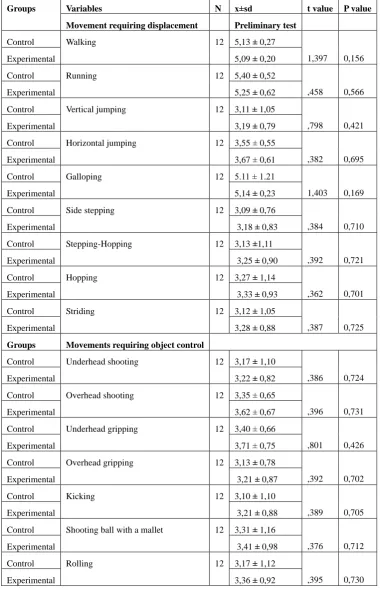
difference at the level of p>0,05 between the preliminary test scores of control and experimental group of the 8-week program (Table 1).
Table 1. Comparison of preliminary test scores of movements requiring displacement and object control between the control and experimental group of children with learning disability
Groups Variables N x±sd t value P value
Movement requiring displacement Preliminary test
Control Walking 12 5,13 ± 0,27
1,397 0,156
Experimental 5,09 ± 0,20
Control Running 12 5,40 ± 0,52
,458 0,566
Experimental 5,25 ± 0,62
Control Vertical jumping 12 3,11 ± 1,05
,798 0,421
Experimental 3,19 ± 0,79
Control Horizontal jumping 12 3,55 ± 0,55
,382 0,695
Experimental 3,67 ± 0,61
Control Galloping 12 5.11 ± 1.21
1,403 0,169
Experimental 5,14 ± 0,23
Control Side stepping 12 3,09 ± 0,76
,384 0,710
Experimental 3,18 ± 0,83
Control Stepping-Hopping 12 3,13 ±1,11
,392 0,721
Experimental 3,25 ± 0,90
Control Hopping 12 3,27 ± 1,14
,362 0,701
Experimental 3,33 ± 0,93
Control Striding 12 3,12 ± 1,05
,387 0,725
Experimental 3,28 ± 0,88
Groups Movements requiring object control
Control Underhead shooting 12 3,17 ± 1,10
,386 0,724
Experimental 3,22 ± 0,82
Control Overhead shooting 12 3,35 ± 0,65
,396 0,731
Experimental 3,62 ± 0,67
Control Underhead gripping 12 3,40 ± 0,66
,801 0,426
Experimental 3,71 ± 0,75
Control Overhead gripping 12 3,13 ± 0,78
,392 0,702
Experimental 3,21 ± 0,87
Control Kicking 12 3,10 ± 1,10
,389 0,705
Experimental 3,21 ± 0,88
Control Shooting ball with a mallet 12 3,31 ± 1,16
,376 0,712
Experimental 3,41 ± 0,98
Control Rolling 12 3,17 ± 1,12
,395 0,730
Page 610
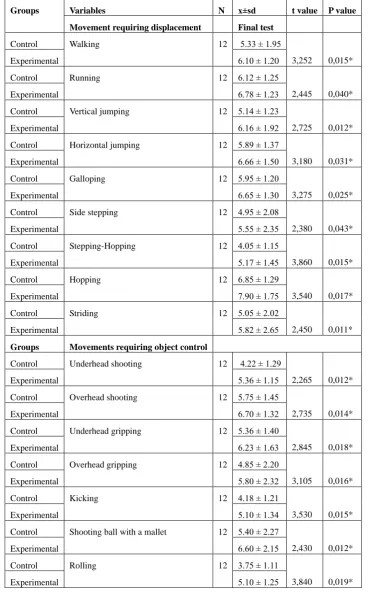
Table 2. Comparison of final test scores of movements requiring displacement and object control between the control and experimental group of children with learning disability
Groups Variables N x±sd t value P value
Movement requiring displacement Final test
Control Walking 12 5.33 ± 1.95
3,252 0,015*
Experimental 6.10 ± 1.20
Control Running 12 6.12 ± 1.25
2,445 0,040*
Experimental 6.78 ± 1.23
Control Vertical jumping 12 5.14 ± 1.23
2,725 0,012*
Experimental 6.16 ± 1.92
Control Horizontal jumping 12 5.89 ± 1.37
3,180 0,031*
Experimental 6.66 ± 1.50
Control Galloping 12 5.95 ± 1.20
3,275 0,025*
Experimental 6.65 ± 1.30
Control Side stepping 12 4.95 ± 2.08
2,380 0,043*
Experimental 5.55 ± 2.35
Control Stepping-Hopping 12 4.05 ± 1.15
3,860 0,015*
Experimental 5.17 ± 1.45
Control Hopping 12 6.85 ± 1.29
3,540 0,017*
Experimental 7.90 ± 1.75
Control Striding 12 5.05 ± 2.02
2,450 0,011*
Experimental 5.82 ± 2.65
Groups Movements requiring object control
Control Underhead shooting 12 4.22 ± 1.29
2,265 0,012*
Experimental 5.36 ± 1.15
Control Overhead shooting 12 5.75 ± 1.45
2,735 0,014*
Experimental 6.70 ± 1.32
Control Underhead gripping 12 5.36 ± 1.40
2,845 0,018*
Experimental 6.23 ± 1.63
Control Overhead gripping 12 4.85 ± 2.20
3,105 0,016*
Experimental 5.80 ± 2.32
Control Kicking 12 4.18 ± 1.21
3,530 0,015*
Experimental 5.10 ± 1.34
Control Shooting ball with a mallet 12 5.40 ± 2.27
2,430 0,012*
Experimental 6.60 ± 2.15
Control Rolling 12 3.75 ± 1.11
3,840 0,019*
Page 611
According to these results, there is a significant difference at the level of p<0,01 between the final test scores of eight-week program among the children with learning disability (Table 2). Based on these data, it can be stated that the eight-week program has leaded to a significant difference between the final test scores of the movements requiring displacement and object control in the experimental group compared to the control group.
4. DISCUSSION AND CONCLUSION
Totally 24 students including 12 students as experimental group and 12 as control group participated in this study in which the realizability levels of movements requiring displacement and object control by children with learning disability were investigated. Development of fundamental movement skills enables body to be used more efficiently in life. These movements constitute the movement background of more complex games and sports to be performed in the future by the students needing special education. Therefore, effective and safe use of movement skills is important for the development of children at the age of primary school education (Graham et al. 2010; Housner 2009). According to the results obtained, there is not a significant difference statistically between the preliminary tests (initial values) of the experimental and control group based on Table 1. It is seen that the development performances of the movements requiring displacement and object control are the same. Nonetheless, based on Table 2, there is a significant and positive difference statistically in favour of experimental group in terms of the final test scores of the control and experimental groups. This finding demonstrates that 8-week education program related to the movements requiring displacement and object control has a positive effect on the fundamental movement development of the children with learning disability. One of the studies conducted show that if children are encouraged to learn fundamental movement skills (motor development), their skills undergo a development stage faster than expected according to their age. Intervention in fundamental movement development doesn’t only accelerate motor development but it also prevents possible delays and ensures suitable-value skill development (Ersöz, 2012). Karagöz (2009), following the program applied, obtained significant results in favour of the experimental group in the running, long jumping, hopping and gripping tests of the control and experimental groups. These findings show similarity with those of our study.
Page 612 5. CONCLUSIONS
The fundamental movement models requiring displacement and object control are seen by the children with learning disability as a part of their education and learning experience. In that period, the skills learnt will be life-long and constitute a foundation for new skills. Therefore, it has been concluded in this study that 8-week movement education requiring displacement and object control has a positive effect on the fundamental movement development of the children with learning disability. Nonetheless, failure to give children the opportunity to move and try or limiting them may affect children’s motor skill performance adversely and cause them to be unwilling and shy against learning more complex skills.
REFERENCES
Connor-Kuntz F, Dummer G (1996). Teaching across the Curriculum: Language-Enriched Physical Education for Preschool Children. Adapted Physical Activity Quarterly. 13, 302-315.
Demirci N, Toptaşdemirci P (2014). Analysis of the Attainments Gained by the Students in Need of Specıal Education during the Course of Games and Physical Activities Inonu University, Journal of Physical Education and Sport Sciences, 2014, 1(1), 25-34
Dummer GM, Haubenstricker JL, Stewart DA (1996). Motor skill performance of children who are deaf. Research Quarterly for Exercise and Sport. 13, 400-414.
Dündar, U (1998). Training Theory. Bağırgan Yayınevi, Ankara.
Education, A (2006). Daily Physical Activity: A Hand Book For Grades 1- Schools. Alberta, Canada. Ersoz Y (2012). The effect of multiple-skill sports education program on the motor development of the boys at the age of 7-10, İzmir, Master’s Thesis, Dokuz Eylül University, Health Sciences Institute, Department of Sports Physiology.
Gallahue D, Ozmun J (1996). Childhood. Understanding motor development: Infants, children, adolescents, adults. Boston: McGraw-Hill.
Goodway JD, Branta CF (2003) Influence of motor skill development of disadvantaged preschool children. Research Quarterly for Exercise and Sport. 74 (1), 36-46.
Goodway JD, Crowe H, Word P (2003). Effects of motor skill instruction on fundamental motor skill development. Adapted Physical Activity Quarterly. 20, 298-314.
Goodway JD, Rudisill ME (1997). Perceived Physical Competence And Actual Motor Skill Competence Of African-American Preschool Children. Adapted Physical Activity Quarterly. 14, 314-326.
Graham G, Holt-Hale S.A, and Parker M (2010). Children Moving: A Reflective Approach to Teaching Physical Education (8 thed.) New York: Mc Graw Hill.
Güven, G (2006). Investigation and Assessment of Games and Sports Programs Applied in Preschool Education Institutions in Kütahya. Master’s Thesis, Kütahya Dumlupınar University, Social Sciences Institute, Department of Physical Education and Sports, p.26.
Hamilton ML, Goodway JD, Haubenstricker J (1999). Parent-assisted instruction in a motor skill program for at-risk preschool children. Adapted Physical Activity Quarterly. 16, 415-426.
Housner, L.D (2009). Integrated Physical Education: A Quide for Theele Mentary Classroom Teacher. 2nd ed.,Morgan Town, WV: Fitness Information Technology.
Page 613
Kayapınar FÇ, Pehlivan A (2002). The Effect of Movement Education Program on Double Hand-Eye Coordination and Reaction Periods of Children at the Age of 6-7. 7th International Sports Sciences
Congress, Antalya
Koparan, Ş. (2003). Sports for Children with Special Needs. Uludağ University, The Journal of Education Faculty, 17 (1), 153-160.
Sarı ÇS. (2005). Preschool Development and Education of Movement, Bilim ve Aklın Aydınlığında Eğitim Dergisi (The Journal of Education in the Light of Science and Mind) . 6, 62-66.
Taskıran, Y (2003). Classical Training Theory. Yayıncı Yayınları, Đzmit, s193. Ulrich, DA (2000). Test of Gross Motor Development II. Austin. TX:Pro-Ed.
Valentini N (1997). The influence of two motor skill interventions on the motor skill performance perceived physical competence, and intrinsic motivation of kindergarten children, Unpublished master’s thesis, Auburn University, Auburn, AL.
Winnick, J.P (Ed) (1990). Adapted physical Education and Sport, Human Kinetics Books, Champaign Illinois.
Yarımkaya E, Ulucan H (2015). The Effect of Movement Education Program on The Motor Development of Children International Journal of New Trends in Arts, Sports &ScienceEducation - 2015, volume 4, issue 1.
Yıldız E, Gürsel F (2008). Investigate of Locomotor Movement with 8 Week Training at Children Who is Deaf Hacettepe J. of Sport Sciences, 19 (2), 111-124.