DOI: 10.1051/epjconf/20135307001 C
Owned by the authors, published by EDP Sciences, 2013
Missing energy estimate in the light of the muon discrepancy
M. Tueros
1,afor the Pierre Auger Collaboration
2,b1Departamento de Fisica de Particulas, Universidad de Santiago de Compostela 2Pierre Auger Observatory, Av. San Martín Norte 304, 5613 Malargüe, Argentina
Abstract. The determination of the primary energy of extensive air showers using the fluorescence
technique requires an estimation of the energy carried away by the particles that do not deposit all their energy in the atmosphere. This estimation is typically made using Monte Carlo simulations and thus depends on the model predictions for neutrino and muon production. In this contribution we describe a new method that could be used to obtain the missing energy directly from events measured simultaneously with the fluorescence and the surface detectors of the Pierre Auger Observatory, based on a toy model of the shower cascade. The method is applied to a synthetic sample of events to show its robustness and we discuss how the results could be used to make an estimation of the number of high energy muons in the cascade.
1. INTRODUCTION
In the fluorescence technique for the detection of ultra high energy cosmic rays (UHECRs), the relationship between the air fluorescence yield and the local energy deposit is exploited to estimate the total energy deposited in the atmosphere by the particle cascade that the UHECR produces. To get the total energy of the primary particle, a correction needs to be applied to take into account the energy carried away by neutrinos, neutrons and high energy muons. This correction is usually referred to as the “missing energy” (EMiss), and accounts for more than 10% of the total energy at 1 EeV, according to air shower simulations done with QGSJet01 for a 50% proton-iron mixture [1].
Due to its origin, the EMiss can not be measured directly and has to be estimated using Monte Carlo simulations. This estimation varies between different models and primary masses, representing a systematic uncertainty in the determination of the primary energy close to 4% at 1 EeV [2].
Current high energy interaction models have been reported to be unable to reproduce simultaneously relevant shower observables like the depth of maximum development and the muon density at ground [3]. In particular, it has been established that in cascade simulations there is a deficit in the number of muons arriving at ground level [4] and that ad-hoc modifications must be introduced in the models to solve this discrepancy [5,6]. Since the muon content of the cascade is directly related to
EMiss, its estimation might also be amiss.
In this article we try to address this problem using a model that lets us identify a relationship between measurable quantities (the signal at ground level and the depth of the shower maximum) andEMiss. We will show that this relationship is robust to a change of the chosen hadronic interaction model and that its dependence on the primary particle mass is reduced. We also show how the method could be used on real events to get information on the aforementioned muon discrepancy.
ae-mail:[email protected]
bFor the full authorlist see Appendix “Collaborations” in this volume.
2. A HEITLER-MATTHEWS MODEL FOR THE MISSING ENERGY
The energy carried away by neutrinos and high energy muons account for more than 95% of the total missing energy. These two components are correlated, as they are both produced in the decay of+/− in the shower core.
Independently of the number and spectrum of the pions produced in the first hadronic interactions, the shower will evolve producing more pions until the pion critical energy is reached. After this point the pions are less likely to produce new pions and will decay, giving high energy muons. Any change in the hadronic model that modifies the amount of energy transferred to the pionic component of the cascade will modifyEMiss, but it will also modify proportionally the number of high energy muons produced, reflecting the relationship betweenEMissand the number of muons at ground.
Even if this is a very simple picture, Nyklicek et al. have shown using detailed Monte Carlo Simulations [7] that the total number of muons at ground level is closely correlated toEMissin a model independent way. This result implies that, given an observable sensitive to the number of muons at ground, a model independent estimation ofEMisscan be made.
In this article we will use a shower observable measured with the surface detectors of the Pierre Auger Observatory [8], the signal at 1000 m from the shower core (S1000). The surface detectors of
the Observatory are sensitive to muons and to the electromagnetic component of the shower. The relationship between the total signal and the number of muons depends on the distance from the shower maximum to the ground (DX) [9,10], which is measured by the Observatory fluorescence detectors.
To find the relationship betweenS1000 andEMiss, we use the Heitler model extended to hadronic
cascades by Matthews [11]. In this model the primary energyE0is distributed between electromagnetic
particles and muons
E0=ecNeMax+cNMax, (1)
where ec is the critical energy for the electromagnetic particles,NeMax is the number of electrons in the shower maximum development, c is the pion critical energy andNMax is the number of muons produced in+/−decays, that are assumed here to eventually reach ground level. Assigning the pion critical energy to the muons accounts for the fact that muons originate on pion decays, where all energy goes to the invisible channel independently of how much energy goes to each muon. With this in mind the second term of the equation can be identified directly as the missing energy, i.e.
EMiss =cNmax.
Although the number of pions (and thus muons) generated in the shower depends on the hadronic interaction model, the pion critical energy is a well established quantity that depends on the medium density where the pion cascade maximum takes place and logarithmically on the multiplicity [12], making this relationship robust to changes in the hadronic interaction model.
Following the Heitler-Matthews model for hadronic cascades, we assume that the total number of muons is a power law of the primary energy,
Nmax
=
E0
c
· (2)
The primary energy is also a power law of S1000for a fixed angle (S38◦) [13], or for a fixed stage of
shower development using universality inDX[9]. This leads to
Nmax
=
(DX)(S1000)
c
[VEM])
1000
(S
10
log
0.5 1 1.5 2 2.5 3
[GeV])
Miss
(E
10
log
8 8.5 9 9.5 10
Models
QGSJET-II Proton QGSJET-II Iron
0
)/E
Miss Param
- E
Miss MC
(E
-0.1 -0.05 0 0.05 0.1
A.U.
0 20 40 60 80 100
Hadronic Model & Primary Mass
QGSJet-II proton: 0.0093 rms
QGSJet-II iron: 0.0084 rms
Figure 1. Fit of log(EMiss[GeV]) vs. log(S1000[V EM]) (left) and its residues (right) for a fixedDXbin.
where the function(DX) takes into account the signal attenuation withDX. The missing energy can now be expressed as a function ofS1000andDXas
log(EMiss(S1000,DX))=A(DX)+B log(S1000) A(DX)=log(c)+log
(DX)
c
(4)
B=.
For the determination of the parameters A(DX) and B from eq. (5), we used showers simulated with CORSIKA [15] using the QGSJet-II(03) [16] hadronic interaction model. The showers were subsequently used as input in the detector simulation code, and reconstructed using the official reconstruction software of the Pierre Auger Observatory [17].
The showers were divided in 16 equidistant bins ofDX, ranging from 75 to1100 g cm−2. For each
bin ofDX, the missing energy is fitted using equation (5). A representative example of these fits and the corresponding residuals are shown in Fig.1.
The behaviour ofB as a free parameter in the fit was studied for different primaries and hadronic interaction models, and it was found to be within 5% of 0.98 in the rangeDX=75–1100. To preserve the simplicity of the model,Bwas fixed to its average value. Asis usually within 10% of 0.9 [11] and is in the 1.06–1.09 range [14], this is considered a good aproximation.
The variation of the parameterAwithDXwas then parameterized with a third degree polynomial, as shown in Fig.2(left). This parameter has a slight dependence with mass and the mean between proton and iron will be used.
3. PERFORMANCE OF THE MODEL
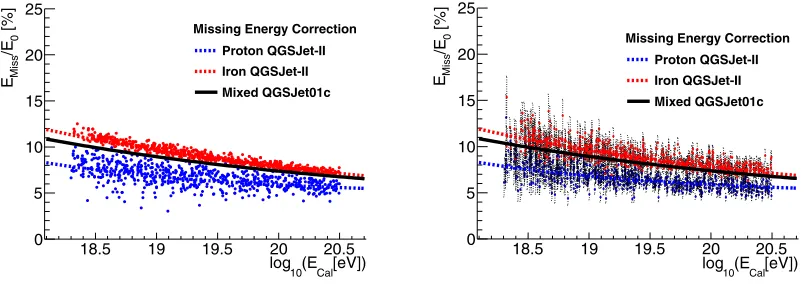
The missing energy of a random sub-sample of the Monte Carlo shower library and its estimation made using eq. (5) are presented as a function of the calorimetric energy (ECal) in Fig.3 (left) and (right) respectively. It can be seen that our method reproduces the average Monte Carlo value, albeit with increased fluctuations due to the fluctuations inS1000. The difference betweenEMiss(S1000,DX) and the
actualEMissof all the QGSJet-II showers is presented in Fig.2(right). As we use the average for proton and iron as the reference, a small bias of less than 1% of the primary energy appears, positive for proton and negative for iron.
It is common practice to parameterize the average EMiss fraction as a function of
ECal(EMiss(ECal)) [1]. This parameterization depends on the hadronic model and the primary mass.
] -2 DX [g.cm 0 200 400 600 800 1000
F
it Pa
ra
me
te
r
A
7 7.2 7.4 7.6 7.8 8
0 )/E Miss Param - E Miss MC (E
-0.1 -0.05 0 0.05 0.1
A.U.
0 0.05 0.1 0.15 0.2
0.25 Hadronic Model & Primary Mass
σ QGSJet-II hadrons:1.3E-04 0.0100
σ QGSJet-II proton:-4.3E-03 0.0093
σ QGSJet-II iron:5.0E-03 0.0082
Figure 2. Variation of the calibration parameterA(DX) of equation (5) withDXand mass (left) and residues of
the method applied to the wholeDXrange (right).
[eV])
Cal
(E
10
log 18.5 19 19.5 20 20.5
[%]0
/E
Miss
E
0 5 10 15 20 25
Missing Energy Correction Proton QGSJet-II Iron QGSJet-II Mixed QGSJet01c
[eV])
Cal
(E
10
log 18.5 19 19.5 20 20.5 [%]0
/E
Miss
E
0 5 10 15 20 25
Missing Energy Correction Proton QGSJet-II Iron QGSJet-II Mixed QGSJet01c
Figure 3. Missing energy EMiss as a function of the calorimetric energyECal for a subset of the QGSJet-II
simulated showers (left) and the reconstructed EMiss(S1000,DX) for the same events (right). The lines indicate EMiss(ECal) parameterizations of the average value at 45◦ zenith angle for the indicated hadronic models and
primary masses.
reconstruction. The difference between hadronic models is taken as part of the systematic error in the determination ofE0[14].
SinceECalis not closely related to theEMissfraction, usingEMiss(ECal) on events simulated with an hadronic model different from the one used to make the parameterization can lead to significant biases. To show this, the correlation between the values given by QGSJet01cEMiss(ECal) and the trueEMiss
value for a random sample of QGSJet-II proton events is presented in Fig. 4(left). For comparison, the correlation plot from the EMiss(S1000,DX) prediction for the same events is shown in Fig. 4
(left).
To test howEMiss(S1000,DX) performs with a change in the hadronic model, the parameterization
derived with the QGSJet-II showers was applied to a set of EPOS 1.99 [19] simulations. EPOS 1.99 is significantly different from QGSJet-II and produces more muons than the other models, giving a higher
EMiss fraction. This makes the bias of theEMiss(ECal) parameterization even higher, as can be seen
in Fig.5 (left). When we useEMiss(S1000,DX), the description is still very good (see Fig.5(right)),
showing the robustness of the method.
[%] 0 /E MC Miss E
3 4 5 6 7 8 9 10
[%] 0 )/E Cal (E Miss E 4 6 8 10 12 14 Proton QGSJet-II [%] 0 /E MC Miss E
3 4 5 6 7 8 9 10
[%] 0 ,DX)/E 1000 (S Miss E 4 6 8 10 12 14 Proton QGSJet-II
Figure 4. Correlation plot ofEMiss(ECal) from QGSJet01c (left) andEMiss(S1000,DX) from QGSJet-II (right)
withEMissfor a random sample of simulated QGSJet-II proton showers. For reference, the black continuos line indicates the 1:1 correlation line, and the dotted lines the±2% range.
[%] 0 /E MC Miss E 9 10 11 12 13 14 15 16
[%] 0 )/E Cal (E Miss E 4 6 8 10 12 14 16 18 20
Iron EPOS 1.99
[%] 0 /E MC Miss E 9 10 11 12 13 14 15 16
[%] 0 ,DX)/E 1000 (S Miss E 4 6 8 10 12 14 16 18 20
Iron EPOS 1.99
Figure 5. Correlation plot ofEMiss(ECal) from QGSJet01c (left) andEMiss(S1000,DX) from QGSJet-II (right)
withEMissfor a random sample of simulated EPOS 1.99 iron showers with discrete values ofE0. For reference, the
black continuos line indicates the 1:1 correlation line, and the dotted lines the±2% range.
in Fig. 5(left), as events with the same E0 have only a small relative change inECal giving similar EMiss(ECal), while having big fluctuations in the true EMiss due to the intrinsic shower to shower
fluctuations of the neutrino and muon production.
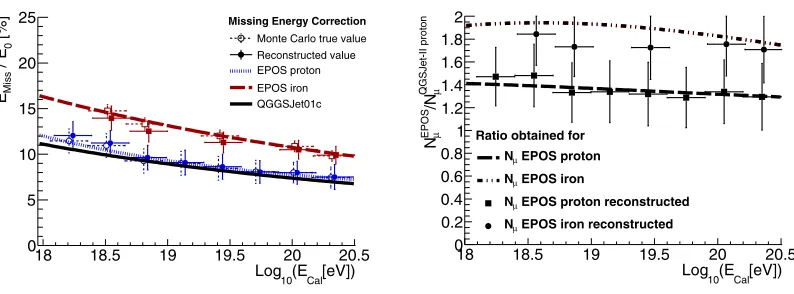
Finally, the average value ofEMiss (empty squares) andEMiss(S1000,DX) (full squares) of all the
EPOS 1.99 showers is presented in Fig.6(left). The averageEMissis reconstructed to within 1%, with no additional biases even if theEMiss(S1000,DX) used for the reconstruction was done using completely
different hadronic model.
4. IMPLICATIONS ON THE DETERMINATION OF THE SHOWER MUON CONTENT
We have shown in previous sections thatEMiss(S1000,DX) enables us to estimateEMissof almost any
event with a good reconstruction ofS1000andXmax, without big dependences on the primary mass or the
[eV]) Cal (E 10 Log
18 18.5 19 19.5 20 20.5
[%]0
/ E
Miss
E
0 5 10 15 20
25 Missing Energy Correction
Monte Carlo true value Reconstructed value EPOS proton EPOS iron QGGSJet01c
[eV]) Cal (E 10 Log
18 18.5 19 19.5 20 20.5
µ
QGSJet-II proton
/N
µ
EPOS
N
0 0.2 0.4 0.6 0.8 1 1.2 1.4 1.6 1.8 2
Ratio obtained for EPOS proton
µ
N
EPOS iron
µ
N
EPOS proton reconstructed
µ
N
EPOS iron reconstructed
µ
N
Figure 6. Left: averageEMiss(S1000,DX) (full symbols) and the actual EMiss (empty symbols) of the simulated
EPOS showers. The lines indicate predictions of the average value for the corresponding hadronic model and primary mass. Right: ratio of the average number of muons in EPOS event samples with respect to QGSJet-II proton simulations, computed as the ratio of the average value ofEMissfor reconstructed for each energy bin. On both figures, points where slightly shifted in x to allow for a better visualization.
model. This can be quantified using the ratio
EEvents Miss
EMC
Miss =
(Events)
c NEvents
(MC)
c NMC
= NNEventsMC
(5) where we assumed thatcis well described in the reference Monte Carlo simulations.
As a validation of this approach, we calculated the ratio treating EPOS 1.99 proton and iron simulations as an independent event sample with a known muon ratio to QGSJet-II proton that we could compare with. The results are shown in fig.6(right). The results obtained gave the expected value within the method uncertainties.
5. CONCLUSIONS
The method presented in this article and its underlying model exploits the hybrid nature of the Pierre Auger Observatory to make an estimation of EMiss that shows little dependence on the hadronic interaction model and that has a limited primary mass dependence, unlike theEMiss(ECal) parameterization currently in use. The proposed method would allow us to make a direct determination of the shower missing energy on hybrid events of the Pierre Auger Observatory. Making the assumption that the pion critical energy is described correctly by the Monte Carlo simulations, the model gives us a way to use this measurement to determine the muon content of the cascades, at least on average, giving useful information about the muon deficit that Monte Carlo simulations currently have.
References
[1] H. Barbosa et al., Astropart. Phys. 22 (2004) 159–166
[2] A. Mariazzi for the Pierre Auger Collaboration, Proc. 32nd ICRC, Beijing, China (2011) [3] Abu-Zayyad T. et al.[HiRes/MIA Collaboration], Phys. Rev. Lett. 84 (2000) 4276 [4] J. Allen for the Pierre Auger Collaboration, Proc. 32nd ICRC, Beijing, China (2011) [5] T. Pierog et al., Phys. Rev. Lett 101 (2008) 171101
[6] R. D. Parsons et al., Astropart. Phys. 34 (2011) 832 [7] M. Nyclicek et al., Proc. 31st ICRC Łód´z, Poland (2009)
[9] F. Schmidt et al., Astropart. Phys. 29 Issue 6 (2008) 355 [10] A. Yushkov et al., Phys. Rev. D 81 (2010) 123004 [11] J. Matthews, Astropart. Phys. 22 (2005) 387–397
[12] K.-H. Kampert & M. Unger, Astropart. Phys. 35 (2012) 660
[13] R. Pesce for the Pierre Auger Collaboration, Proc. 32nd ICRC, Beijing, China (2011) [14] The Pierre Auger Collaboration, Phys. Rev. Lett. 101 (2008) 061101
[15] D. Heck et al., FZKA 6019, Forschungszentrum Karlsruhe (1998) [16] S. Ostapchenko, Phys. Rev. D 74 (2006) 014026
[17] S. Argiro et al, Nucl. Instrum. Meth. A 580 (2007) 1485
![Figure 1. Fit of log(EMiss[GeV ]) vs. log(S1000[V EM]) (left) and its residues (right) for a fixed DX bin.](https://thumb-us.123doks.com/thumbv2/123dok_us/8743097.1434433/3.595.109.482.125.255/figure-fit-emiss-gev-left-residues-right-xed.webp)