STEADY STATE VISUALLY EVOKED POTENTIALS
FRAMEWORK IN BRAIN COMPUTER INTERFACE
Chetan Bondre
1, Deeppak Kapgate
21
P.G. Scholar,
2Asst. Prof., Department of Computer Science & Engg., G.H.R.A.E.T, Nagpur (India)
ABSTRACT
Development of framework for steady state evoked potentials (SSVEP) using electroencephalogram (EEG) signals has been discussed in this paper. Signals from the brain for SSVEP application are captured and then after processing signals we can get desired output. Using classification algorithms k-fold cross validation test and Common spatial filter (CSP) we tried to increase information transfer rate. This study introduces a technique for classifying different frequencies separately so that accuracy is high. We can get more ITR if we get more accuracy as ITR is dependent on ITR. Using Wolpaw’s Method ITR can be calculated. The focus of
this paper is proposing the development of framework that can capture the EEG signals classify them in the SSVEP signals. These SSVEP signals then are used to train the user and application can be used by will of the user.
Keywords: Brain Computer Interface (BCI), Electroencephalogram (EEG), Information Transfer
Rate(ITR), Steady state visually evoked Potentials(SSVEP).
I. INTRODUCTION
Brain computer Interface uses an uncommon way of communication between brain and computer. Even though
it is uncommon way it is most direct as intentions are directly sent to the computer from human brain. With
Brain Computer Interface subjects ideally need not to use common output pathways like peripheral nerves or
muscles, which is the main function of a BCI system. With the help of electroencephalography (EEG),
Cerebro-electrical brainwaves can be measured. These brainwaves in the past used for the clinical purposes, with
amplification and fed into a system. Under certain circumstances and with proper algorithms we can process
these waves to satisfy application needs [1].
We can categorize brain computer interface in two parts depending on the input given to the system as
synchronous BCI and asynchronous BCI. This categorization can be done on the basis of the time intervals.
There is time window defined in the system for synchronous BCI for time variant. If any of the signals are
generated from the brain outside this time interval, it gets ignored or rejected. This means that application must
be used by user in a specific time window specified by the BCI system. The main advantage for the synchronous
BCI is only predefined signals are allowed in the system no other artifacts can be generated because of the
user’s fault. This makes the system more simple and reliable.
Asynchronous BCI on other hand is more demanding and complex. Asynchronous BCI needs continuous
processing of the data. Even though user action is not a proper command system will continue the process [2].
To collect data from the brain we need to use headsets. These headsets use electrodes to sense the brain waves
and collect them. There are generally two types of headsets are used for collections of data. They are 10-10 and
10-20 headsets [3]. The name is given to these headsets according to their separation of the electrodes.
Electrodes in 10-10 system are having distance among them as that of 10% of the total headset while 10-20
system is having distance between electrodes as 10% for boundary electrodes and 20% for other electrodes of
the headset. 10-10 system may have 31-38 electrodes while 10-20 system may have up to 21 electrodes. We use
less power for electrodes in 10-20 headsets, as they are having more no of the electrodes. Most of the 10-10
system electrodes are covered by the 10-20 headsets by heir functionalities. 10-10 system is more complex
compared to 10-20 system. Because of these attributes generally 10-20 system is most commonly used [4][5].
Fig. 1 10-20 and 10-10 electrode positions
SSVEP-BCI offers the classification of a large number of symbols simultaneously and hence we can say that
SSVEP BCI is multiclass in nature and provides high performance. Visual evoked potentials (VEPs) are
electrical potential differences; those can be derived from the scalps after a visual stimulus, for example a
flash-light [6].
There is a very high possibility of information transfer rate with minimal training time to the subject and very
low requirements in SSVEP base BCI. Secondly if the system is carefully designed then it can be relatively
robust with respect to noise and artifacts. The very important advantage is that we can easily extend the
commands of the system because of the input process and short timing phase. The aim is to detect the reliably of
frequency with the high accuracy. Furthermore the aim is to detect when the frequency do not appear, hence
when the person or subject does not look at the stimulus.
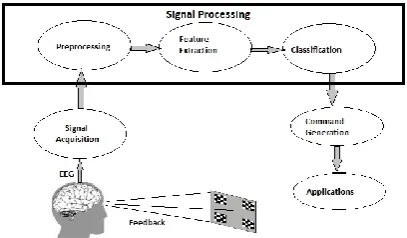
Open-Vibe is software which is used for interfacing computer and EEG capturing device. We are using Open
vibe to capturing and storing the EEG signals. These signals are processed by the framework and then final
application can run after the training is provided to the subject. We have used different modules to create the
framework for example configuration of signals, training, classification and final application.
2.1 Preprocessing
After the signal acquisition from the headset, signals will be processed to identify the SSVEP response.
However, before processing there are several things needed to be done to isolate the occipital channels and
sanitize the signal to preprocess the data. The SSVEP response should appear in all the channels and averaging
to eliminate some of the noise and non-important differences between all the channels. This common average
reference is an average number for all used electrodes of the required headset over the course of the signals for
time. This eliminates the unimportant signals from the needed signal by expressing lobe signal as variation from
the in general EEG activity [7].
Artifactsare unwanted signals present in BCI. Artifacts have various origins, which include the utility frequency
like noise, body and eye movements, or attention blinks. We can handle artifacts by three main approaches:
avoidance, rejection and removal. By artifact avoidance the user should not execute any movement which may
result in EEG artifacts. This can reduce artifacts, but obviously we cannot stop eye movements and blinks, so
sometimes these artifacts may occur. Because of constant restraining from blinking by user can cause fatigue.
Another approach is the rejection of all trials which are introduced by artifacts. This can be done in any way
manually or automatically. By a manual artifact rejection procedure, we determine which of the trials are
introduced through visual examination and in automatic artifact rejection an algorithm may be implemented
which is able to determine contamination of artifacts. Artifact rejection may reduce the size of the training set;
this can lead to consequences in the classification accuracy [8].
High-pass filtering of the signal is the simplest method for artifact removal. The eye artifacts generally occur in
the low frequency range of 0–4 Hz, we may reduce the EOG artifacts by filtering these components out.
There are two types of signal processing methods can be used in the SSVEP generation according to filtering
types for preprocessing. Those are frequency filtering and spatial filtering. We can use any of these in our
second step of preprocessing.
2.1.1 Frequency Filtering
The signals are filtered according to the characteristics of the frequencies related signals. We have two types
frequency filtering we can use for the preprocessing of the SSVEP signals. They are Band pass filter and Notch
filter.
Band pass Filter: In Band pass filter frequency range is designed according to the frequency harmonics or to the
simulation frequencies. Band pass filter is relatively simple to implement but the drawback is that it may be very
stringent for explaining the time-varying signals [9].
Notch Filter : Usually notch filter is used for removing the power line interference.
2.1.2 Spatial Filtering
In spatial filtering there is combination of signals from different channels to magnify the SSVEP responses. This
can be done with the reduction of the interference of the noise. Signals from multiple channels are less affected
by noise. The most affected signals are either unipolar or bipolar systems. This technique also can be used for
the feature extraction techniques. Spatial filtering is classified techniques those are explained below:
i) Maximum contrast combinations (MCC): MCC is most frequently used method for spatial filtering. MCC
ii) Principle component analysis (PCA): For the decomposition of signals into components of SSVEP signals
and brain activity we need to use PCA. The dimension of the original data can be reduced by the help of
PCA.
iii) A common spatial pattern method based on the (ACSP): ACSP method is based on the analytical
representation of signals. Based on CSP method ACSP reflects amplitude as well as phase information of
SSVEPs.
iv) Component average filter (CAR): The average values of all the electrodes is subtracted from the channel of
interest to make EEG recording nearly reference free.
v) Canonical correlation analysis (CCA): The relation between two multivariable data sets are computed by
CCA after linear combinations of linear data. Other methods are KCCA, Multiway CCA and p-CCA.
KCCA is used for the high dimension data sets. Multiway CCA uses optimal reference signals while
p-CCA uses the phase information in reference signals.
2.2 Feature Extraction
Feature extraction is an important step in getting emotion assessment, because features with very high
discriminative power are very crucial for efficient in pattern recognition. These are the most often used features
which are computed from the signal’s power spectrum [10]. The power of the EEG signals is used by the
researchers at several frequency bands which may often range from 2 Hz to 45 Hz or a combination of the
energy to different frequency bands, as it may be done by computing the ratio of energies with the help of left
and right lobes to obtain indexes. ERP is only moderately using for a BCI as it is necessary to take the average
of the signals over several trials of the same emotional class for obtaining reliable ERP [11],[12].
Feature extraction is key issue in the signal processing. A variety of feature extraction methods can be used for
the system. Some of the newer feature extractions filters other than band pass filters can be used in the designing
of the framework are standard moving average filter (MA) and Savitzky-Golay filter. MA is used to analyze
data points by creating calculations of a series of averages of different subsets of data sets. MA is also called a
moving mean (MM). A Savitzky–Golay filter is a digital filter. This filter can be applied to a set of digital data
points. This can be done for the purpose of smoothing the data by doing this, there is increase the SNR without
greatly distorting the signal.
2.3 Classification
There are many classification algorithms can be used for the SSVEP generation process, but most effective are
LDA, SVM and ANN. Linear discriminant analysis (LDA) is method used in pattern recognition and machine
learning to find linear combinations of features those are characterized or separated by two or more classes of
events or objects. The result may be used as a linear classifying combination or for dimensionality reduction
before later classification [13].
Support vector machines (SVMs) supervise learning models along with associated learning algorithms in
machine learning those analyze data and recognize patterns which used for classification and regression
analysis. Within the given set of training examples, each marked as belongings to one of given categories [14].
In artificial neural network algorithm with the help of Supervised Learning the perception can be trained. It can
be done by adjusting the weights of the inputs. In this learning technique, the patterns to be recognized are
known in advance by subjects, and a training set of input values is already classified with the desired output
[16],[17].
III. THEORETICAL BACKGROUND
3.1 Information Transfer Rate
BCI performance might affected by two important task parameters. First is the number of targets. A large no. of
targets may increase system performance, as more targets provide more information. Alternatively, a greater no.
of targets may decrease system performance by decreasing its accuracy. The other is the rapidity of frequency
change. Because of this user may feel tired after continuously watching at the screen. Jonathon Wolpaw
proposed a formula to calculate the ITR
where N is the no. of possible targets. P is the probability that the target hit (accuracy). Bit rate can be calculated
by dividing S by the trial . In case of this project N=3. Accuracy and S is varying.
Electrode Positions: This is the important aspect in any BCI system. The positions of the electrodes play an
important role in the capturing the signals accurately. It means the quality of signals depend on the placement of
electrodes [18]. The positions used in this project are CPz, POz, Oz, Iz, O1,O2. The signals individually can be
captured and then processed individually for each frequency.
K-fold Cross Validation Test : k-fold cross validation is a common technique for estimating the performance
of a classifier. a single run of k-fold cross validation proceeds as follows:
1. Arrange the training examples in a random order.
2. Divide the training examples into k folds. (k chunks of approximately m/k examples each.)
3. For i = 1, . . . , k:
• Train the classifier using all the examples that do not belong to Fold i. • Test the classifier on all the examples in Fold i.
• Compute ni , the number of examples in Fold i that were wrongly classified.
4. Return the following estimate to the classifier error.
IV. PROPOSED SYSTEM
The Project is developed in Open-Vibe software. The EEG signals are captured by the OpenBCI headset V-3 32
bit kit. There are different modules say scenarios are used in the system are Acquisition of signals, Training to
user, CSP filtering and Classification, Online testing.
Acquisition of signals and configuration: Signals are tested in this module. Continuity of signals and quality
Fig 3 Signal Display of various electrode positions on brain.
This module contains FFT of average of all the signals and various boxes like acquisition client, temporal filter
spatial filter for averaging, spectral analysis and signal display. Configuration of the framework can be
configured SSVEP experiment [19]. There are two boxes of configuration parameters for peripheral and
experimental settings. These settings are for stimulus and refresh rate of the screen.
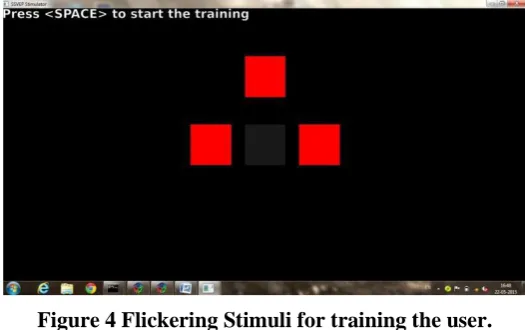
Training of user: This SSVEP module uses Common Spatial Pattern (CSP) spatial filter which automatically
selects the best characteristics. This means that user can place the electrodes on the occipital area’s any part of
the scalp [20]. This module is used for acquisition of the training data necessary to train the SSVEP classifiers.
In order to run correctly it has to be configured by the SSVEP Training Controller. Boxes used in this module
are SSVEP training controller, stimulation control, acquisition client, and stream writer to write the data
captured by the headset.
Figure 4 Flickering Stimuli for training the user.
CSP Training and Classification: CSP training is used for training of the Common Spatial Pattern filters.
These enable user to use any set of electrodes and will automatically select the best combination of them for
user. Signal processing is done on 3 different stimulation frequencies separately. Boxes used in the module are
temporal filter, stimulation based epoching CSP spatial filter training, player controller and generic stream
reader which loads the data written in previous module. Classification process contains boxes as generic stream
reader, spatial filter, Target stimulator for different frequencies, time based epoching, DSP, Signal Average and
classifier trainer. This module calculates the accuracy of the system which is useful for the calculation of ITR.
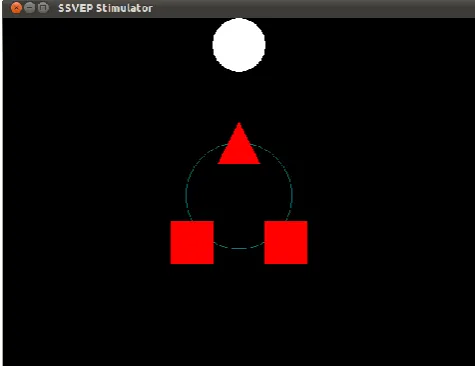
Online Testing: This module is used for the online testing of the framework. The trained data is used for
scenario control of the system. This is in form of a game in which a ship is designed. It is having two wings
which are flickering in two different frequencies which are used to rotate the ship in clockwise or anticlockwise.
It also has a cannon which is used to fire the target. The cannon flicker with different frequency with respect to
the two wings. The ship works in a way user concentrates on the flickering stimuli. This scenario contains boxes
Fig 5 SSVEP stimulator online game
V. RESULTS
After running all the modules explained above we get the accuracy ranging from 78% to 92%. Which leads to
calculation of ITR.ITR is calculated manually and we get it from 24 bits/min to 40 bits/min with the feedback.
The signals captured from the EEG headset are unstable with the software we used but most of the times signals
captured were continuous and having great quality. The SSVEP stimulation is an online shoot game which is
use for the testing of the system. It is running accurately with OpenBCI headsets. If user concentrates at right
wing the ship rotates in clockwise direction. If user concentrates at right wing the ship rotates in anticlockwise
direction. If user concentrates at cannon ship fires. After one target is vanished other target appears. There are
total 8 targets to be vanished to finish the game.
VI. CONCLUSIONS
In BCI mostly there is preference to the SSVEP system. As it is Exogenous BCI and it requires very low
training to use, it is possible for user to perform actions on the system by their convenience. Furthermore
SSVEP gives high information transfer rate so it is possible to use in real life also. Control signals can set up
very easily so it is possible to use many options in one system using SSVEP. In this project ITR is increased
then many of other frameworks used in past. There are some disadvantages for the system; flickering visual
stimuli may cause some tiredness or fatigue to the subject if used for a long time. If the subject is having some
neurological disorders like color blindness or similar disorder, it is not appropriate for a person to identify the
color, frequency or pattern in the system.. There is possibility of combining SSVEP signals with other
Exogenous or Endogenous BCI signals. This can be done for the better performance, reliability of the system,
robustness and more options to user.
References
[1] G. Bin, X. Gao, B. Hong, Z. Yan and S. Gao, “An online multi-channel SSVEP-based brain-computer
interface using a canonical correlation analysis method,” Journal of Neural Engineering, vol. 6, no. 4,
[2] Xin-an Fan, Ke Jie, Teng Teng, Hongsheng Ding, and Yili Liu, “Using a Head-up Display-Based Steady-
State Visually Evoked Potential Brain–Computer Interface to Control a Simulated Vehicle,” IEEE Trans.
Human Mach. Syst., vol. 43, no. 2, pp. 161–176VOL. 15, NO. 3, JUNE 2014
[3] Muller, S.M.T.” Using a SSVEP-BCI to command a robotic wheelchair” ; Comput. Eng. Dept., Fed. Univ.
of Espirito Santo UFES , S o Mateus, Brazil, Industrial Electronics (ISIE), 2011 IEEE International
Symposium on 27-30 June 2011
[4] Z. D. Deng, X. Q. Li, K. H. Zheng and W. T. Yao, “A humanoid robot control system with SSVEP-based
asynchronous brain-computer interface,” Jiqiren/Robot, 33: 129-135, 2011.
[5] G. Garcia-Molina, D. H. Zhu and S. Abtahi, “Phase detection in a visual-evoked-potential based brain
computer interface,” Proc.18thEuropean Signal Processing Conf., 949-953, 2010.
[6] Yijun Wang, Zhiguang Zhang, Xiaorong Gao, Shangkai Gao,” Lead selection for SSVEP-based
brain-computer interface”, Proceedings of the 26th Annual International Conference of the IEEE EMBS San Francisco, CA, USA • September 1-5, 2004
[7] P.L. Lee, J. J. Sie, Y. J. Liu, C. H. Wu, M. H. Lee, C. H. Shu, P. H. Li, C. W. Sun and K. K. Shyu, “An
SSVEP-actuated brain computer interface using phase-tagged flickering sequences: a cursor system,” Ann.
Biomed. Eng., 38: 2383-2397, 2010.
[8] S. G. Mason and G. E. Birch, “A general framework for brain-computer interface design,” IEEE Trans.
Neural Syst. Rehabil. Eng., 11: 70-85, 2003.
[9] Y. J. Wang, R. P. Wang, X. R. Gao, B. Hong and S. K. Gao, “A practical VEP-based brain-computer
interface,” IEEE Trans. Neural Syst. Rehabil. Eng., 14: 234-239, 2006.
[10] Holzapfel H., Nickel K., Stiefelhagen R(2004). Implementation and Evaluation of a ConstraintBased
Multimodal Fusion System for Speech and 3D Pointing Gestures. Interactive Systems Laboratories
Universität Karlsruhe (TH) Germany, German Research Foundation,2004
[11] Minkyu Ahn, Mijin Lee, Jinyoung Choi and Sung Chan Jun, “A Review of Brain-Computer Interface
Games and an Opinion Survey from Researchers, Developers and Users”, Sensors 2014.
[12] Hartwig Holzapfel, Kai Nickel, Rainer Stiefelhagen,” Implementation and Evaluation of a
ConstraintBased Multimodal Fusion System for Speech and 3D Pointing Gestures” Interactive Systems
Laboratories Universität Karlsruhe (TH) Germany, German Research Foundation,2004
[13] Alexandre Barachant, St´ephane Bonnet, “Channel Selection Procedure using Riemannian distance for
BCI Applications” MINATEC Campus December 17, 2010.
[14] Shangkai Gao, Yijun Wang, Xiaorong Gao, Bo Hong Members, IEEE” Visual and Auditory Brain-
Computer Interfaces” September 23, 2013
[15] Pierre Gergondet, Abderrahmane Kheddar, Christoph Hinterm• uller, Christoph Guger, and Mel Slate
“Multitask Humanoid Control with a Brain-Computer Interface: user experiment with HRP-2” European
Union FP7 Integrated Project VERE
[16] Bakkama Srinath Reddy, “Evidential Reasoning for Multimodal Fusion in Human Computer Interaction”
thesis Master of Applied Science Waterloo, Ontario, Canada, 2007
[18] Nataliya Kos’myna, Franck Tarpin-Bernard,” Evaluation and Comparison of a Multimodal Combination
of BCI Paradigms with Consumer-Grade Hardware and Eye Tracking” CHI’13, April 27 – May 2, 2013,
Paris, France.
[19] Luis Fernando Nicolas-Alonsoand Jaime Gomez-Gil “Brain Computer Interfaces, a Review” Sensors
2012, 12, 1211-1279; doi:10.3390/s120201211
[20] Danhua Zhu,Jordi Bieger, Gary GarciaMolina, and RonaldM. Aarts” A Survey of StimulationMethods
Used in SSVEP-Based BCIs” Hindawi Publishing Corporation Computational Intelligence and