1
1
i n t r o d u c t i o n a n d
m e t h o d o l o g y
This first chapter introduces some of the fundamental ideas underlying design of modern digital systems. We cover quite a lot of ground, but at a fairly basic level. The idea is to set the context for more detailed discus-sion in subsequent chapters.
We start by looking at the basic circuit elements from which digital systems are built, and seeing some of the ways in which they can be put together to perform a required function. We also consider some of the nonideal effects that we need to keep in mind, since they impose con-straints on what we can design. We then focus on a systematic process of design, based on models expressed in a hardware description language. Approaching the design process systematically allows us to develop com-plex systems that meet modern application requirements.
1.1
D I G I TA L S Y S T E M S A N D
E M B E D D E D S Y S T E M S
This book is about digital design. Let’s take a moment to explore those two words. Digital refers to electronic circuits that represent informa-tion in a special way, using just two voltage levels. The main rainforma-tionale for doing this is to increase the reliability and accuracy of the circuits, but as we will see, there are numerous other benefits that flow from the digital approach. We also use the term logic to refer to digital circuits. We can think of the two voltage levels as representing truth values, leading us to use rules of logic to analyze digital circuits. This gives us a strong mathematical foundation on which to build. The word design refers to the systematic process of working out how to construct circuits that meet given requirements while satisfying constraints on cost, performance, power consumption, size, weight and other properties. In this book, we focus on the design aspects and build a methodology for designing complex digital systems.
Ch01-P369527.indd 1
Digital circuits have quite a long and interesting history. They were preceded by mechanical systems, electromechanical systems, and analog electronic systems. Most of these systems were used for numeric com-putations in business and military applications, for example, in ledger calculations and in computing ballistics tables. However, they suffered from numerous disadvantages, including inaccuracy, low speed, and high maintenance.
Early digital circuits, built in the mid-twentieth century, were con-structed with relays. The contacts of a relay are either open, blocking current flow, or closed, allowing current to flow. Current controlled in this manner by one or more relays could then be used to switch other relays. However, even though relay-based systems were more reliable than their predecessors, they still suffered from reliability and performance problems.
The advent of digital circuits based on vacuum tubes and, sub-sequently, transistors led to major improvements in reliability and performance. However, it was the invention of the integrated circuit (IC), in which multiple transistors were fabricated and connected together, that really enabled the “digital revolution.” As manufacturing technol-ogy has developed, the size of transistors and the interconnecting wires has shrunk. This, along with other factors, has led to ICs, containing billions of transistors and performing complex functions, becoming commonplace now.
At this point, you may be wondering how such complex circuits can be designed. In your electronic circuits course, you may have learned how transistors operate, and that their operation is determined by numerous parameters. Given the complexity of designing a small circuit containing a few transistors, how could it be possible to design a large system with billions of transistors?
The key is abstraction. By abstraction, we mean identifying aspects that are important to a task at hand, and hiding details of other aspects. Of course, the other aspects can’t be ignored arbitrarily. Rather, we make assumptions and follow disciplines that allow us to ignore those details while we focus on the aspects of interest. As an example, the digital
abstraction involves only allowing two voltage levels in a circuit, with
transistors being either turned “on” (that is, fully conducting) or turned “off” (that is, not conducting). One of the assumptions we make in sup-porting this abstraction is that transistors switch on and off virtually instantaneously. One of the design disciplines we follow is to regulate switching to occur within well-defined intervals of time, called “clock periods.” We will see many other assumptions and disciplines as we pro-ceed. The benefit of the digital abstraction is that it allows us to apply much simpler analysis and design procedures, and thus to build much more complex systems.
Ch01-P369527.indd 2
The circuits that we will deal with in this book all perform functions that involve manipulating information of various kinds over time. The information might be an audio signal, the position of part of a machine, or the temperature of a substance. The information may change over time, and the way in which it is manipulated may vary with time.
Digital systems are electronic circuits that represent information in
discrete form. An example of the kind of information that we might rep-resent is an audio sound. In the real world, a sound is a continuously vary-ing pressure waveform, which we might represent mathematically usvary-ing a continuous function of time. However, representing that function with any significant precision as a continuously varying electrical signal in a circuit is difficult and costly, due to electrical noise and variation in circuit parameters. A digital system, on the other hand, represents the signal as a stream of discrete values sampled at discrete points in time, as shown in Figure 1.1. Each sample represents an approximation to the pressure value at a given instant. The approximations are drawn from a discrete set of values, for example, the set {⫺10.0, ⫺9.9, ⫺9.8, . . . , ⫺0.1, 0.0, 0.1, . . . , 9.9, 10.0}. By limiting the set of values that can be represented, we can encode each value with a unique combination of digital values, each of which is either a low or high voltage. We shall see exactly how we might do that in Chapter 2. Furthermore, by sampling the signal at regular intervals, say, every 50s, the rate and times at which samples arrive and must be processed is predictable.
Discrete representations of information and discrete sequencing in time are fundamental abstractions. Much of this book is about how to choose appropriate representations, how to process information thus rep-resented, how to sequence the processing, and how to ensure that the assumptions supporting the abstractions are maintained.
The majority of digital systems designed and manufactured today are
embedded systems, in which much of the processing work is done by one
F I G U R E 1 . 1 A pressure waveform of a sound, continuously varying over time, and the discrete representation of the waveform in a digital system.
Ch01-P369527.indd 3
or more computers that form part of the system. In fact, the vast majority of computers in use today are in embedded systems, rather than in PCs and other general purpose systems. Early computers were large systems in their own right, and were rarely considered as components of larger systems. However, as technology developed, particularly to the stage of IC technology, it became practical to embed small computers as compo-nents of a circuit and to program them to implement part of the circuit’s functionality. Embedded computers usually do not take the same form as general purpose computers, such as desktop or portable PCs. Instead, an embedded computer consists of a processor core, together with memory components for storing the program and data for the program to run on the processor core, and other components for transferring data between the processor core and the rest of the system.
The programs running on processor cores form the embedded
soft-ware of a system. The way in which embedded softsoft-ware is written bears
both similarities and differences with software development for general purpose computers. It is a large topic area in its own right and is beyond the scope of this book. Nonetheless, since we are dealing with embedded systems in this book, we need to address embedded software at least at a basic level. We will return to the topic as part of our discussion of interfac-ing with embedded processor cores in Chapters 8 and 9.
Since most digital systems in use today are embedded systems, most digital design practice involves developing the interface circuitry around processor cores and the application-specific circuitry to perform tasks not done by the cores. That is why this book deals specifically with digital design in the context of embedded systems.
1.2
B I N A R Y R E P R E S E N TAT I O N A N D
C I R C U I T E L E M E N T S
The simplest discrete representation that we see in a digital system is called a binary representation. It is a representation of information that can have only two values. Examples of such information include:
whether a switch is open or closed whether a light is on or off
whether a microphone is active or muted
We can think of these as logical conditions: each is either true or false. In order to represent them in a digital circuit, we can assign a high voltage level to represent the value true, and a low voltage level to represent the value false. (This is just a convention, called positive logic, or active-high logic. We could make the reverse assignment, leading to
negative logic, or active-low logic, which we will discuss in Chapter 2.)
We often use the values 0 and 1 instead of false and true, respectively. 왘
왘 왘
Ch01-P369527.indd 4
The values 0 and 1 are binary (base 2) digits, or bits, hence the term binary representation.
The circuit shown in Figure 1.2 illustrates the idea of binary representation. The signal labeled switch_pressed represents the state of the switch. When the push-button switch is pressed, the signal has a high voltage, representing the truth of the condition, “the switch is pressed.” When the switch is not pressed, the signal has a low voltage, representing the falsehood of the condition. Since illumination of the lamp is controlled by the switch, we could equally well have labeled the signal lamp_lit, with a high voltage representing the truth of the condition, “the lamp is lit,” and a low voltage representing the falsehood of the condition.
A more complex digital circuit is shown in Figure 1.3. This circuit includes a light sensor with a digital output, dark, that is true (high volt-age) when there is no ambient light, or false (low voltvolt-age) otherwise. The circuit also includes a switch that determines whether the digital signal
lamp_enabled is low or high (that is, false or true, respectively). The sym-bol in the middle of the figure represents an AND gate, a digital circuit element whose output is only true (1) if both of its inputs are true (1). The output is false (0) if either input is false (0). Thus, in the circuit, the signal lamp_lit is true if lamp_enabled is true and dark is true, and is false otherwise. Given this behavior, we can apply laws of logic to analyze the circuit. For example, we can determine that if there is ambient light, the lamp will not light, since the logical AND of two conditions yields falsehood when either of the conditions is false.
The AND gate shown in Figure 1.3 is just one of several basic digital logic components. Some others are shown in Figure 1.4. The AND gate, as
F I G U R E 1 . 3 A digital circuit for a night-light that is only lit when the switch is on and the light sensor shows that it is dark. lamp_enabled dark lamp_lit sensor +V switch_pressed +V F I G U R E 1 . 2 A circuit in which a switch controls a lamp.
Ch01-P369527.indd 5
we mentioned above, produces a 1 on its output if both inputs are 1, or a 0 on the output if either input is 0. The OR gate produces the “inclusive or” of its inputs. Its output is 1 if either or both of the inputs is 1, or 0 if both inputs are 0. The inverter produces the “negation” of its input. Its output is 1 if the input is 0, or 0 if the input is 1. Finally, the multiplexer selects between the two inputs labeled “0” and “1” based on the value of the “select” input at the bottom of the symbol. If the select input has the value 0, then the output has the same value as that on the “0” input, whereas if the select input has the value 1, then the output has the same value as that on the “1” input.
We can use these logic gates to build digital circuits that implement more complex logic functions.
e x a m p l e 1 . 1 Suppose a factory has two vats, only one of which is used at a time. The liquid in the vat in use needs to be at the right temperature, between 25˚C and 30˚C. Each vat has two temperature sensors indicating whether the temperature is above 25˚C and above 30˚C, respectively. The vats also have low-level sensors. The supervisor needs to be woken up by a buzzer when the temper-ature is too high or too low or the vat level is too low. He has a switch to select which vat is in use. Design a circuit of gates to activate the buzzer as required.
s o l u t i o n For the selected vat, the condition for activating the buzzer is “temperature not above 25˚C or temperature above 30˚C, or level low.” This can be implemented with a gate circuit for each vat. The switch can be used to control the select input of a multiplexer to choose between the circuit outputs for the two vats. The output of the multiplexer then activates the buzzer. The complete circuit is shown in Figure 1.5.
AND gate OR gate
inverter multiplexer 0 1 F I G U R E 1 . 4 Basic digital logic gates. >30°C low level buzzer >25°C >30°C low level >25°C 0 1 vat 0
vat 1 select vat 1
select vat 0
+V F I G U R E 1 . 5 The vat buzzer
circuit.
Ch01-P369527.indd 6
Circuits such as those considered above are called combinational. This means that the values of the circuit’s outputs at any given time are determined purely by combining the values of the inputs at that time. There is no notion of storage of information, that is, dependence on val-ues at previous times. While combinational circuits are important as parts of larger digital systems, nearly all digital systems are sequential. This means that they do include some form of storage, allowing the values of outputs to be determined by both the current input values and previous input values.
One of the simplest digital circuit elements for storing information is called, somewhat prosaically, a flip-flop. It can “remember” a single bit of information, allowing it to “flip” and “flop” between a stored 0 state and a stored 1 state. The symbol for a D flip-flop is shown in Figure 1.6. It is called a “D” flip-flop because it has a single input, D, representing the value of the data to be stored: “D” for “data.” It also has another input, clk, called the clock input, that indicates when the value of the
D input should be stored. The behavior of the D flip-flop is illustrated in the timing diagram in Figure 1.7. A timing diagram is a graph of the values of one or more signals as they change with time. Time extends along the horizontal axis, and the signals of interest are listed on the vertical axis. Figure 1.7 shows the D input of the flip-flop changing at irregular intervals and the clk input changing periodically. A transition of clk from 0 to 1 is called a rising edge of the signal. (Similarly, a transi-tion from 1 to 0 is called a falling edge.) The small triangular marking next to the clk input specifies that the D value is stored only on a rising edge of the clk input. At that time, the Q output changes to reflect the stored value. Any subsequent changes on the D input are ignored until the next rising edge of clk. A circuit element that behaves in this way is called edge-triggered.
While the behavior of a flip-flop does not depend on the clock input being periodic, in nearly all digital systems, there is a single clock signal that synchronizes all of the storage elements in the system. The system is composed of combinational circuits that perform logical functions on the values of signals and flip-flops that store intermediate results. As we
D Q
clk
F I G U R E 1 . 6 A D fl ip-fl op.
F I G U R E 1 . 7 Timing diagram for a D fl ip-fl op.
D 01 clk 01
Q 01
rising edge falling edge
Ch01-P369527.indd 7
shall see, use of a single periodic synchronizing clock greatly simplifies design of the system. The clock operates at a fixed frequency and divides time into discrete intervals, called clock periods, or clock cycles. Modern digital circuits operate with clock frequencies in the range of tens to hundreds of megahertz (MHz, or millions of cycles per second), with high-performance circuits extending up to several gigahertz (GHz, or billions of cycles per second). Division of time into discrete intervals allows us to deal with time in a more abstract form. This is another example of abstraction at work.
e x a m p l e 1 . 2 Develop a sequential circuit that has a single data input sig-nal, S, and produces an output Y. The output is 1 whenever S has the same value over three successive clock cycles, and 0 otherwise. Assume that the value of S
for a given clock cycle is defi ned at the time of the rising clock edge at the end of the clock cycle.
s o l u t i o n In order to compare the values of S in three successive clock cycles, we need to save the values of S for the previous two cycles and compare them with the current value of S. We can use a pair of D fl ip-fl ops, connected in a pipeline as shown in Figure 1.8, to store the values. When a clock edge occurs, the fi rst fl ip-fl op, ff 1, stores the value of S from the preceding clock cycle. That value is passed onto the second fl ip-fl op, ff 2, so that at the next clock edge, ff 2
stores the value of S from two cycles prior.
The output Y is 1 if and only if three successive value of S are all 1 or are all 0. Gates g1 and g2 jointly determine if the three values are all 1. Inverters g3, g4
and g5 negate the three values, and so gates g6 and g7 determine if the three values are all 0. Gate g8 combines the two alternatives to yield the final output. D Q clk D Q clk Y S clk ff1 S1 S2 Y1 Y0 ff2 g1 g2 g6 g7 g8 g3 g4 g5 F I G U R E 1 . 8 A sequential circuit for comparing successive bits of an input.
Ch01-P369527.indd 8
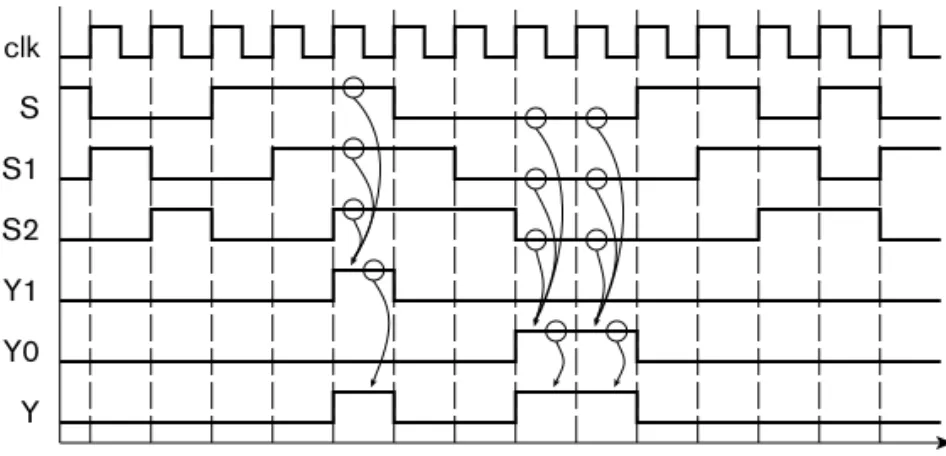
Figure 1.9 shows a timing diagram of the circuit for a particular sequence of input values on S over several clock cycles. The outputs of the two fl ip-fl ops follow the value of S, but are delayed by one and two clock cycles, respectively. This timing diagram shows the value of S changing at the time of a clock edge. The fl ip-fl op will actually store the value that is on S immediately before the clock edge. The circles and arrows indicate which signals are used to determine the values of other signals, leading to a 1 at the output. When all of S, S1 and S2
are 1, Y1 changes to 1, indicating that S has been 1 for three successive cycles. Similarly, when all of S, S1 and S2 are 0, Y0 changes to 1, indicating that
S has been 0 for three successive cycles. When either of Y1 or Y0 is 1, the output
Y changes to 1.
1. What are the two values used in binary representation?
2. If one input of an AND gate is 0 and the other is 1, what is the output value? What if both are 0, or both are 1?
3. If one input of an OR gate is 0 and the other is 1, what is the output value? What if both are 0, or both are 1?
4. What function is performed by a multiplexer?
5. What is the distinction between combinational and sequential circuits?
6. How much information is stored by a fl ip-fl op?
7. What is meant by the terms rising edge and falling edge?
1.3
R E A L - W O R L D C I R C U I T S
In order to analyze and design circuits as we have discussed, we are making a number of assumptions that underlie the digital abstraction. We have assumed that a circuit behaves in an ideal manner, allowing us to think in
K N O W L E D G E
T E S T Q U I Z
K N O W L E D G E
T E S T Q U I Z
S S1 S2 clk Y1 Y0 Y F I G U R E 1 . 9 Timing diagram for the sequential comparison circuit.Ch01-P369527.indd 9
terms of 1s and 0s, without being concerned about the circuit’s electrical behavior and physical implementation. Real-world circuits, however, are made of transistors and wires forming part of a physical device or package. The electrical properties of the circuit elements, together with the physical properties of the device or package, impose a number of constraints on circuit design. In this section, we will briefly describe the physical structure of circuit elements and examine some of the most important properties and constraints.
1.3.1 I N T E G R AT E D C I R C U I T S
Modern digital circuits are manufactured on the surface of a small flat piece of pure crystalline silicon, hence the common term “silicon chip.” Such circuits are called integrated circuits, since numerous components are integrated together on the chip, instead of being separate components. We will explore the process by which ICs are manufactured in more detail in Chapter 6. At this stage, however, we can summarize by say-ing that transistors are formed by depositsay-ing layers of semiconductsay-ing and insulating material in rectangular and polygonal shapes on the chip surface. Wires are formed by depositing metal (typically copper) on top of the transistors, separated by insulating layers. Figure 1.10 is a photo-micrograph of a small area of a chip, showing transistors interconnected by wires.
The physical properties of the IC determine many important operat-ing characteristics, includoperat-ing speed of switchoperat-ing between low and high voltages. Among the most significant physical properties is the minimum size of each element, the so-called minimum feature size. Early chips had minimum feature sizes of tens of microns (1 micron⫽1m⫽10⫺6m). Improvements in manufacturing technology has led to a steady reduction in feature size, from 10m in the early 1970s, through 1m in the mid 1980s, with today’s ICs having feature sizes of 90nm or 65nm. As well as affecting circuit performance, feature size helps determine the number of transistors that can fit on an IC, and hence the overall circuit complexity. Gordon Moore, one of the pioneers of the digital electronics industry, noted the trend in increasing transistor count, and published an article on the topic in 1965. His projection of a continuing trend continues to this day, and is now known as Moore’s Law. It states that the number of transistors that can be put on an IC for minimum component cost doubles every 18 months. At the time of publication of Moore’s article, it was around 50 transistors; today, a complex IC has well over a billion transistors.
One of the first families of digital logic ICs to gain widespread use was the “transistor-transistor logic” (TTL) family. Components in this family use bipolar junction transistors connected to form logic gates.
F I G U R E 1 . 1 0 Photomicro-graph of a section of an IC.
Ch01-P369527.indd 10
The electrical properties of these devices led to widely adopted design standards that still influence current logic design practice. In more recent times, TTL components have been largely supplanted by com-ponents using “complementary metal-oxide semiconductor” (CMOS) circuits, which are based on field-effect transistors (FETs). The term “complementary” means that both n-channel and p-channel MOSFETs are used. (See Appendix B for a description of MOSFETS and other circuit components.) Figure 1.11 shows how such transistors are used in a CMOS circuit for an inverter. When the input voltage is low, the n-channel transistor at the bottom is turned off and the p-channel tran-sistor at the top is turned on, pulling the output high. Conversely, when the input voltage is high, the p-channel transistor is turned off and the n-channel transistor is turned on, pulling the output low. Circuits for other logic gates operate similarly, turning combinations of transistors on or off to pull the output low or high, depending on the voltages at the inputs.
1.3.2 L O G I C L E V E L S
The first assumption we have made in the previous discussion is that all signals take on appropriate “low” and “high” voltages, also called
logic levels, representing our chosen discrete values 0 and 1. But what
should those logic levels be? The answer is in part determined by the characteristics of the electronic circuits. It is also, in part, arbitrary, provided circuit designers and component manufacturers agree. As a consequence, there are now a number of “standards” for logic levels. One of the contributing factors to the early success of the TTL family was its adoption of uniform logic levels for all components in the family. These TTL logic levels still form the basis for standard logic levels in modern circuits.
Suppose we nominate a particular voltage, 1.4V, as our threshold
voltage. This means that any voltage lower than 1.4V is treated as a “low”
voltage, and any voltage higher than 1.4V is treated as a “high” voltage. In our circuits in preceding figures, we use the ground terminal, 0V, as our low voltage source. For our high voltage source, we used the positive power supply. Provided the supply voltage is above 1.4V, it should be satisfactory. (5V and 3.3V are common power supply voltages for digital systems, with 1.8V and 1.1V also common within ICs.) If components, such as the gates in Figure 1.5, distinguish between low and high volt-ages based on the 1.4V threshold, the circuit should operate correctly. In the real world, however, this approach would lead to problems. Manufac-turing variations make it impossible to ensure that the threshold volt-age is exactly the same for all components. So one gate may drive only slightly higher than 1.4V for a high logic level, and a receiving gate with
output input +V F I G U R E 1 . 1 1 CMOS circuit for an inverter. Ch01-P369527.indd 11 Ch01-P369527.indd 11 8/7/07 2:32:55 PM8/7/07 2:32:55 PM
0.5V 1.0V 1.5V nominal 1.4V threshold receiver threshold F I G U R E 1 . 1 2 Problems due to variation in threshold voltage. The receiver would sense the signal as remaining low.
0.5V 1.0V 1.5V 2.0V 2.5V
logic low threshold logic high threshold driven signal
signal with added noise
F I G U R E 1 . 1 3 Problems due to noise on wires.
a threshold a little more above 1.4V would interpret the signal as a low logic level. This is shown in Figure 1.12.
As a way of avoiding this problem, we separate the single thresh-old voltage into two threshthresh-olds. We require that a logic high be greater than 2.0V and a logic low be less than 0.8V. The range in between these levels is not interpreted as a valid logic level. We assume that a signal transitions through this range instantaneously, and we leave the behav-ior of a component with an invalid input level unspecified. However, the signal, being transmitted on an electrical wire, might be subject to external interference and parasitic effects, which would appear as voltage noise. The addition of the noise voltage could cause the signal voltage to enter the illegal range, as shown in Figure 1.13, leading to unspecified behavior.
The final solution is to require components driving digital signals to drive a voltage lower than 0.4V for a “low” logic level and greater than 2.4V for a “high” logic level. That way, there is a noise margin for up to 0.4V of noise to be induced on a signal without affecting its interpretation as a valid logic level. This is shown in Figure 1.14. The symbols for the voltage thresholds are
VOL: output low voltage—a component must drive a signal with a voltage below this threshold for a logic low
VOH: output high voltage—a component must drive a signal with a voltage above this threshold for a logic high
왘
왘
Ch01-P369527.indd 12
VIL: input low voltage—a component receiving a signal with a voltage below this threshold will interpret it as a logic low VIH: input high voltage—a component receiving a signal with a voltage above this threshold will interpret it as a logic high
The behavior of a component receiving a signal in the region between VIL and VIH is unspecified. Depending on the voltage and other factors, such as temperature and previous circuit operation, the component may interpret the signal as a logic low or a logic high, or it may exhibit some other unusual behavior. Provided we ensure that our circuits don’t violate the assumptions about voltages for logic levels, we can use the digital abstraction.
1.3.3 S TAT I C L O A D L E V E L S
A second assumption we have made is that the current loads on compo-nents are reasonable. For example, in Figure 1.3, the gate output is acting as a source of current to illuminate the lamp. An idealized component should be able to source or sink as much current at the output as its load requires without affecting the logic levels. In reality, component outputs have some internal resistance that limits the current they can source or sink. An idealized view of the internal circuit of a CMOS component’s output stage is shown in Figure 1.15. The output can be pulled high by closing switch SW1 or pulled low by closing switch SW0. When one switch is closed, the other is open, and vice versa. Each switch has a series resistance. (Each switch and its associated resistance is, in practice, a transistor with its on-state series resistance.) When SW1 is closed, current is sourced from the positive supply and flows through R1 to the load con-nected to the output. If too much current flows, the voltage drop across R1 causes the output voltage to fall below VOH. Similarly, when SW0 is closed, the output acts as a current sink from the load, with the current flowing through R0 to the ground terminal. If too much current flows in this direction, the voltage drop across R0 causes the output voltage to rise above VOL. The amount of current that flows in each case depends on the 왘 왘 output R1 SW1 SW0 R0 +V F I G U R E 1 . 1 5 An idealized view of the output stage of a CMOS component. 0.5V 1.0V 1.5V 2.0V 2.5V VIL VOL VIH VOH driven signal noise margin signal with added noise
noise margin
F I G U R E 1 . 1 4 Logic level thresholds with noise margin.
Ch01-P369527.indd 13
output resistances, which are determined by component internal design and manufacture, and the number and characteristics of loads connected to the output. The current due to the loads connected to an output is referred to as the static load on the output. The term static indicates that we are only considering load when signal values are not changing.
The load connected to the AND gate in Figure 1.3 is a lamp, whose current characteristics we can determine from a data sheet or from measurement. A more common scenario is to connect the output of one gate to the inputs of one or more other gates, as in Figure 1.5. Each input draws a small amount of current when the input voltage is low and sources a small amount of current when the input is high. The amounts, again, are determined by component internal design and manufacture. So, as designers using such components and seeking to ensure that we don’t overload outputs, we must ensure that we don’t connect too many inputs to a given output. We use the term fanout to refer to the number of inputs driven by a given output. Manufacturers usually publish current drive and load characteristics of components in data sheets. As a design discipline when designing digital circuits, we should use that information to ensure that we limit the fanout of outputs to meet the static loading constraints.
e x a m p l e 1 . 3 The data sheet for a family of CMOS logic gates that use the TTL logic levels described earlier lists the characteristics shown in Table 1.1. Currents are specifi ed with a positive value for current fl owing into a terminal and a negative value for current fl owing out of a terminal. The
p a r a m e t e r t e s t c o n d i t i o n m i n m a x VIH 2.0V VIL 0.8V IIH 5A IIL ⫺5A VOH IOH⫽⫺12mA 2.4V IOH⫽⫺24mA 2.2V VOL IOL⫽ 12mA 0.4V IOL⫽ 24mA 0.55V IOH ⫺24mA IOL 24mA TA B L E 1 . 1 Electrical characteristics of a family of logic gates. Ch01-P369527.indd 14 Ch01-P369527.indd 14 8/7/07 2:32:56 PM8/7/07 2:32:56 PM
parameters IIH and IIL are the input currents when the input is at a logic high or low, respectively, and IOH and IOL are the static load currents at an output driving logic high or low, respectively. What is the maximum fanout for an output driving multiple inputs using this logic family, taking account of static loading only?
s o l u t i o n For both high and low logic levels, an output can source or sink up to 24mA of current, and an input load is 5A. Thus each output can drive up to 24mA/5A ⫽ 4800 inputs. However, in sourcing that much current in the high level, the output voltage may drop to 2.2V, and in the low level, the output voltage may rise to 0.55V. This gives a noise margin of only 0.2V for a high level and 0.15V for a low level. If we want to preserve our 0.4V noise margins, we need to limit the output currents to 12mA, in which case the maximum fanout would be 2400 inputs.
In practice, we cannot connect anywhere near as many inputs to an output as this example might suggest. Static loading is only one factor that determines maximum fanout. In the next part of this section, we will describe another factor that limits fanout more significantly in most designs.
1.3.4 C A PA C I T I V E L O A D A N D P R O PA G AT I O N D E L AY
A further assumption we’ve made in the preceding discussion has been that signals change between logic levels instantaneously. In practice, level changes are not instantaneous, but take an amount of time that depends on several factors that we shall explore. The time taken for the signal voltage to rise from a low level to a high level is called the rise time, denoted by tr, and the time for the signal voltage to fall from a high level to a low level is called the fall time, denoted by tf. These are illustrated in Figure 1.16.
One factor that causes signal changes to occur over a nonzero time interval is the fact that the switches in the output stage of a digital com-ponent, illustrated in Figure 1.15, do not open or close instantaneously. Rather, their resistance changes between near zero and a very large value over some time interval. However, a more significant factor, especially in CMOS circuits, is the fact that logic gates have a significant amount of capacitance at each input. Thus, if we connect the output of one
1.0V 2.0V 3.0V VOL VOH tr tf
F I G U R E 1 . 1 6 Rise time and fall time for a signal whose value is changing.
Ch01-P369527.indd 15
output input Cin R1 SW1 SW0 R0 +V F I G U R E 1 . 17 Connection of an output stage to a capacitively loaded input.
component to the input of another, as shown in Figure 1.17, the input capacitance must be charged and discharged through the output stage’s switch resistances in order to change the logic level on the connecting signal.
If we connect a given output to more than one input, the capacitive loads of the inputs are connected in parallel. The total capacitive load is thus the sum of the individual capacitive loads. The effect is to make transitions on the connecting signal correspondingly slower. For CMOS components, this effect is much more significant than the static load of component inputs. Since we usually want circuits to operate as fast as possible, we are constrained to minimize the fanout of outputs to reduce capacitive loading.
A similar argument regarding time taken to switch transistors on and off and to charge and discharge capacitance also applies within a digital component. Without going into the details of a component’s circuit, we can summarize the argument by saying that, due to the switching time of the internal transistors, it takes some time for a change of logic level at an input to cause a corresponding change at the output. We call that time the propagation delay, denoted by tpd, of the component. Since the time for the output to change depends on the capacitive load, component data sheets that specify propagation delay usually note the capacitive load applied in the test circuit for which the propagation delay was measured, as well as the input capacitance.
e x a m p l e 1 . 4 For a collection of CMOS gate components, the manufacturer’s data sheet specifi es a typical input capacitance, Cin, of 5pF. The AND gate compo-nent has a maximum propagation delay, tpd, of 4.3ns measured with a load capaci-tance, CL, of 50pF. What is the maximum fanout for the AND gate that can be used without causing the propagation delay to exceed the specifi ed maximum?
Ch01-P369527.indd 16
s o l u t i o n Allowing only for the capacitive loading effect of the inputs, the maximum fanout is
CL / Cin⫽ 50pF / 5pF ⫽ 10
In practice, other stray capacitance between the output and the inputs would limit the maximum fanout to a smaller value.
In many components, the propagation delay differs depending on whether the output is changing from 0 to 1 or from 1 to 0. If it is impor-tant to distinguish between the two cases, we can use the symbol tpd01 for the propagation delay when the output changes from 0 to 1, and tpd10 for the propagation delay when the output changes from 1 to 0. If we don’t need to make this distinction, we usually use the largest of the two values, that is,
tpd⫽ max (tpd01, tpd10)
1.3.5 W I R E D E L AY
Yet another assumption we’ve made about the behavior of digital systems is that a change in the value of a signal at the output of a component is seen instantaneously at the input of other connected components. In other words, we’ve assumed that wires are perfect conductors that propa-gate signals with no delay. For very short wires, that is, wires of a few centimeters on a circuit board or up to a millimeter or so within an IC, this assumption is reasonable, depending on the speed of operation of the circuit. For longer wires, however, we need to take care when designing high-speed circuits. Problems can arise from the fact that such wires have parasitic capacitance and inductance that are not negligible and that delay propagation of signal changes. Such wires should be treated as transmis-sion lines and designed carefully to avoid unwanted effects of reflection of wavefronts from stubs and terminations. A detailed treatment of design techniques in these cases is beyond the scope of this book. However, we need to be aware that relatively long wires add to the overall propagation delay of a circuit. Later, we will describe the use of computer-based tools that can help us to understand the effects of wire delays and to design our circuits appropriately.
1.3.6 S E Q U E N T I A L T I M I N G
In our discussion of sequential digital systems in Section 1.2, we assumed that a flip-flop stores the value of its data input at the moment the clock input rises from 0 to 1. Moreover, we assumed that the stored value is reflected on the output instantaneously. It should not be surprising now
Ch01-P369527.indd 17
that these assumptions are an abstraction of realistic sequential circuit behavior, and that we must observe design disciplines to support the abstraction. Real flip-flops require that the value to be stored be present on the data input for an interval, called the setup time, before the rising clock edge. Also, the value must not change during that interval and for an interval, called the hold time, after the clock edge. Finally, the stored value does not appear at the output instantaneously, but is delayed by an interval called the clock-to-output delay. These timing characteristics are shown in Figure 1.18. In this timing diagram, we have drawn the rising and falling edges as sloped, rather than vertical, to suggest that the transi-tions are not instantaneous. We have also drawn both 0 and 1 values for the data input and output, suggesting that it is not the specific values that are relevant, but the times at which values change, shown by the coinci-dent rising and falling values. The diagram illustrates the constraint that changes on the data input must not occur within a time window around the clock rising edge, and that the data output cannot be assumed correct until after some delay after the clock edge.
In most sequential digital circuits, the output of one flip-flop is either connected directly to the data input of another, or passes through some combinational logic whose output is connected to the data input of another flip-flop. In order for the circuit to operate correctly, a data output result-ing from one clock edge must arrive at the second flip-flop ahead of a setup interval before the next clock edge. This gives rise to a constraint that we can interpret in two ways. One view is that the delays in the circuit between flip-flops are fixed and place an upper bound on the clock cycle time, and hence on the overall speed at which the circuit operates. The other view is that the clock cycle time is fixed and places an upper bound on the permissi-ble delays in the circuit between flip-flops. According to this view, we must ensure that we design the circuit to meet that constraint. We will examine timing constraints for sequential circuits in much more detail in Chapter 4, and describe a design discipline that ensures that we meet the constraints, thus allowing us to use the timing abstraction of periodic clock cycles. 1.3.7 P O W E R
Many modern applications of digital circuits require consideration of the power consumed and dissipated. Power consumption arises through current being drawn from a constant-voltage power supply. All gates and other digital electronic components in a circuit draw current to operate the transistors in their internal circuitry, as well as to switch input and output transistors on and off. While the current drawn for each gate is very small, the total current drawn by millions of them in a complete system can be many amperes. When the power supply consists of batteries, for example, in portable appliances such as phones and notebook computers, reducing power consumption allows extended operating time.
tsu tout th D clk Q F I G U R E 1 . 1 8 Setup, hold and clock-to-output times for a fl ip-fl op.
Ch01-P369527.indd 18
The electrical power consumed by the current passing through resistance causes the circuit components to heat up. The heat serves no useful purpose and must be exhausted from the circuit components. Designers of the physical packaging of ICs and complete electronic systems determine the rate at which thermal energy can be transferred to the surroundings. As circuit designers, we must ensure that we do not cause more power dissipation than can be handled by the thermal design, otherwise the circuit will overheat and fail. Puffs of blue smoke are the usual sign of this happening!
There are two main sources of power consumption in modern digital components. The first of these arises from the fact that transistors, when turned off, are not perfect insulators. There are relatively small leakage
currents between the two terminals, as well as from the terminals to
ground. These currents cause static power consumption. The second source of power consumption arises from the charging and discharging of load capacitance when outputs switch between logic levels. This is called
dynamic power consumption. To a first approximation, the static power
consumption occurs continuously, independent of circuit operation, whereas dynamic power consumption depends on how frequently signals switch between logic levels.
As designers, we have control over both of these forms of power consumption. We can control static power consumption of the circuit by choosing components with low static power consumption, and, in some cases, by arranging for parts of circuits that are not needed for periods of time to be turned off. We can control dynamic power consumption by reducing the number and frequency of signal transitions that must occur during circuit operation. This is becoming an increasingly important part of the design activity, and computer-based tools for power analysis are gaining increased use. We will discuss the topic of power analysis in more detail throughout this book.
1.3.8 A R E A A N D PA C K A G I N G
In most applications of digital electronics, cost of the final manufactured product is an important factor, particularly when the product is to be sold in a competitive market. There are numerous factors that influence cost, many of them based on business decisions rather than engineering design decisions. However, one factor over which designers have control and that strongly affects the final product cost is circuit area.
As we mentioned earlier, digital circuits are generally implemented as integrated circuits, in which transistors and wires are chemically formed on the surface of a wafer of crystalline silicon (see Figure 1.19). The more transistors and wires in our circuit, the more surface area it consumes. The manufacturing process for ICs is based on wafers of a fixed size, up to 300mm in diameter, with a fixed cost of manufacture. Multiple ICs
F I G U R E 1 . 1 9 A silicon wafer, on which multiple ICs are manufactured.
Ch01-P369527.indd 19
are manufactured on a single wafer in a series of steps. The wafer is then broken into individual ICs, which are encapsulated in packages that can be soldered onto the circuit board of a complete system (see Figure 1.20). Thus, the larger the individual IC, the fewer there are per wafer, and so the greater their cost. Unfortunately, the manufacturing process is not perfect, so defects occur, distributed across the surface of the wafer. Those ICs that have a defect that cause them not to function correctly are discarded. Since the cost of manufacturing a wafer is fixed, the functional ICs must bear the cost of those that are nonfunctional, increasing the final product cost of the IC. The larger an individual IC, the greater the proportion that have defects. So the final cost of an IC is disproportionately dependent on area.
Since each IC is packaged individually, the cost of the package is a direct cost of the final product. The package serves two purposes. One is to provide connection pins, allowing the wires of the IC to be connected to external wires in the larger digital system, as well as providing for power supply and ground connections. An IC with more external con-nections requires more pins and, thus, a more costly package. Therefore, the pin count of the IC is a factor that constrains our designs. The other purpose served by the IC package is to transfer heat from the IC to the surroundings so that the IC does not overheat. If the IC generates more thermal power than the package can dissipate, additional cooling devices, such as heat sinks, fans or heat pipes, are required, adding to cost. Thus, thermal concerns arising from packaging also constrain our designs.
As we have suggested, a packaged IC may not be the final product of a design. The IC may be one of several components on a printed cir-cuit board, which, in turn, is assembled with other items into a complete packaged product. Similar arguments to those above can be made about the cost of a printed circuit board based on the number of ICs and other components, the number of external connections, the area or size of the board and package, and heat dissipation in the enclosing case or cabinet. 1. What are the TTL output voltage levels, input threshold voltages
and noise margins?
2. What is meant by the term fanout?
3. How is the propagation delay of a component defi ned? 4. Why do we try to minimize fanout of components? 5. Do wires contribute to delay in a circuit?
6. What is meant by the terms setup time, hold time and clock-to-output
time of a fl ip-fl op?
7. What are the two sources of power consumption in a digital component? 8. Is the cost of an IC proportional to the area of the IC?
K N O W L E D G E
T E S T Q U I Z
K N O W L E D G E
T E S T Q U I Z
F I G U R E 1 . 2 0 A packaged IC soldered onto a printed circuit board.
Ch01-P369527.indd 20
1.4
M O D E L S
As children, many of us will have made or played with models of real-world things, for example, model airplanes. One way of thinking of a model is that it is a representation of an object that incorporates aspects of interest for a particular purpose while omitting aspects that are not rel-evant. In other words, it is an abstraction of an object. A model airplane may, for example, have the look of a real airplane, but does not have the scale or detailed mechanical aspects of the real thing. The model incorporates just those aspects that satisfy a child’s wish to play with an airplane.
Now that we’ve grown up (mostly!) and turned to digital circuit design, our task is to design circuits that perform certain required func-tions while meeting various constraints. We could try to build a prototype circuit to check that it performs as required, but that would be costly and time consuming, since we would usually need to work through numer-ous versions before we get things right. A more effective approach is to develop models of our designs and to evaluate them. A model of a digital circuit is an abstract expression in some modeling language that captures those aspects that we are interested in for certain design tasks and omits other aspects. For example, one form of model may express just the func-tion that the circuit is to perform, without including aspects of timing, power consumption or physical construction. Another form of model may express the logical structure of the circuit, that is, the way in which it is composed of interconnected components such as gates and flip-flops. Both of these forms of model may be conveniently expressed in a
hard-ware description language (HDL), which is a form of computer language
akin to programming languages, specialized for this purpose.
Functional models may also be expressed in mathematical notations, such as Boolean equations and finite state machine notations, that we will introduce in later chapters. Structural models may also be expressed in the form of graphical circuit schematics, such as those in earlier figures in this chapter. We will use all of these forms of models where appropriate, but we will focus on models expressed in an HDL, since that allows us to take advantage of computer-aided design (CAD) tools to help us with design tasks. Designing electronic circuits using CAD tools is also called
electronic design automation (EDA).
In this book, we will introduce and use an HDL called Verilog. Verilog was originally developed by Phil Moorby at a company called Gateway Design Automation, which was subsequently acquired by Cadence Design Systems. Since then, the specification of Verilog has been standardized in the United States by the Institute of Electrical and Electronic Engineers (IEEE) and internationally by the International Electrotechnical Commis-sion (IEC), and the language has been widely adopted by designers and tool developers.
Ch01-P369527.indd 21
Verilog is not the only HDL used for digital system design. The other main HDL in widespread use is VHDL. Fairly recently, SystemVerilog has been developed as an extension to Verilog, aimed at design and verification of complex digital systems. Also, SystemC, an extension of the C⫹⫹ programming language, is gaining increased usage. While these languages have many basic features in common, they vary in their more advanced features. Moreover, they are all evolving, with new features being added in successive revisions to meet evolving design challenges. Choice among them is often dictated by tool availability and organizational culture, as well as the kind of design work to be performed.
e x a m p l e 1 . 5 Develop a Verilog model that expresses the logical structure of the gate circuit in Figure 1.5. Assume that the sensor signals and the switch signal are inputs to the model, and that the buzzer signal is the output from the model.
s o l u t i o n The Verilog model consists of a module definition, describing the inputs and output of the circuit and the implementation of the circuit:
module vat_buzzer_struct ( output buzzer,
input above_25_0, above_30_0, low_level_0, input above_25_1, above_30_1, low_level_1, input select_vat_1 );
wire below_25_0, temp_bad_0, wake_up_0; wire below_25_1, temp_bad_1, wake_up_1; // components for vat 0
not inv_0 (below_25_0, above_25_0);
or or_0a (temp_bad_0, above_30_0, below_25_0); or or_0b (wake_up_0, temp_bad_0, low_level_0); // components for vat 1
not inv_1 (below_25_1, above_25_1);
or or_1a (temp_bad_1, above_30_1, below_25_1); or or_1b (wake_up_1, temp_bad_1, low_level_1);
mux2 select_mux (buzzer, select_vat_1, wake_up_0, wake_up_1); endmodule
The module in this case is named vat_buzzer_struct. The module has ports, named in the port list of the module declaration. Each port is given a name and is either an output or an input.
The remainder of the module definition contains the details of the circuit model. In this case, the circuit is modeled as a collection of interconnected components.
Ch01-P369527.indd 22
We use the term structural model to refer to a model in this form. A number of named nets are declared, introduced by the keyword wire, for connecting the components together. In this case, Verilog would allow us to omit the net decla-rations, since each net is a simple wire carrying just a 0 or 1 value. We introduce the declarations in this example to illustrate where they can occur in a module, but will omit them in subsequent examples where Verilog permits.
Following the net declarations are a number of instances. Each has a name to distinguish it, and specifies which kind of component is instantiated. For example,
inv_0 is an instance of the not component, representing the inverter for vat 0 in the circuit. Some components, such as the or and not components, are built into Verilog. Others, such as the mux2 component, are defined as separate modules that we instantiate. (The source code of the mux2 module, along with other source code and documentation, is provided on the companion website for this book.) Within parentheses, the nets and circuit outputs and inputs connected to the ports of each component are listed. For example, the inverter inv_0 has the net below_25_0 con-nected to its first port and the input above_25_0 connected to its second port. The built-in primitive components all have the output port first in the list, followed by the input ports. When we write our own modules, we can choose the order of input and output ports. However, in this book, we largely follow the convention of listing output ports before input ports, for consistency with the built-in primitives.
We have also included some comments in this module to provide documentation. One form of comment, shown here, starts with two slash characters and extends to the end of the line. Another form starts with the characters /* and extends to the characters */. This form can extend over more than one line. Figure 1.21 shows the vat buzzer circuit again with the net and component names included for reference.
>30°C low level buzzer >25°C >30°C low level >25°C 0 1 above_25_0 below_25_0 temp_bad_0 below_25_1 above_30_0 inv_0 or_0a or_1a or_0b select_mux or_1b inv_1 wake_up_0 wake_up_1 low_level_0 above_25_1 above_30_1 low_level_1 select_vat_1 buzzer temp_bad_1 +V
F I G U R E 1 . 2 1 The vat buzzer circuit, showing net and component names.
Ch01-P369527.indd 23
e x a m p l e 1 . 6 Develop a Verilog model that expresses the function per-formed by the gate circuit in Figure 1.5.
s o l u t i o n We can use the same port list and port declarations as for the structural model, since the inputs and outputs are the same. We simply need to revise the body of the module:
module vat_buzzer_behavior ( output buzzer,
input above_25_0, above_30_0, low_level_0, input above_25_1, above_30_1, low_level_1, input select_vat_1 );
assign buzzer =
select_vat_1 ? low_level_1 | (above_30_1 | ~above_25_1) : low_level_0 | (above_30_0 | ~above_25_0); endmodule
A model of this form, in which we describe the function performed by the circuit, is called a behavioral model. (Some people also use this term for more abstract models of functionality, but in the absence of a better term, we will use it as described here.) Within the module, we have a single assignment statement that determines the value of the output port using the values of the input ports. The operators | and ~ correspond in function to the OR gates and inverters, respectively, in the circuit. The choice of value to assign to the output port depends on the condition in the . . . ? . . . : . . . else construct, corresponding to the multiplexer in the circuit. The value before the ? character is tested. If it is 1, the value of the expression after the ? character is used, otherwise the value after the : character is used.
The examples above illustrate the general organization of structural and behavioral Verilog models. The Verilog tutorial and reference material included on the companion website for this book provide more detailed information on the specifics of writing Verilog models. The source code for all of the example models in this book is also provided on the com-panion website. We follow the convention of naming each source code file after the module it contains. This makes it easier to locate the file contain-ing a given model.
There are three principal design tasks that benefit from the use of Verilog. The first of these is design entry, that is, expressing a model in a form that can be input to a CAD tool. For simple circuits, design entry can also be done using graphical schematics, and many CAD tools provide for that form of input. However, schematics for larger and more complex circuits can be cumbersome, particularly when they are annotated with
Ch01-P369527.indd 24
information such as the types of signals. Moreover, a textual form, such as Verilog, allows for richer forms of expression, as we shall see in later examples. It also works better with other computer tools, such as script-ing tools and source-code control tools. For these reasons, we shall focus on Verilog descriptions of circuits and use circuit schematics for illustra-tive purposes in this book.
The second design task that benefits from use of Verilog is verification, that is, ensuring that the design meets its requirements and constraints. There are several aspects to verification. Functional verification involves ensuring that the design performs the required function. Timing
verifica-tion involves ensuring that the design meets its timing constraints. Timing
constraints are ultimately derived from the performance requirements of the circuit. For example, in a circuit that processes a digital representation of an audio signal, the processing steps must be performed at the sam-pling rate of the signal. Other verification tasks include power
verifica-tion (ensuring that the circuit meets power consumpverifica-tion and dissipaverifica-tion
constraints); manufacturability verification (ensuring that the circuit will operate correctly for all variations that might arise in the manufacturing processes); and test verification (ensuring that the manufactured circuit can be tested to identify defective parts). All of these forms of verification involve analysis of models of the circuit to determine the relevant proper-ties and checking that the property values are acceptable.
Functional verification is often the most time consuming part of the entire design process. One approach to functional verification is
simula-tion, in which the model is interpreted as an executable computer program
by a CAD tool called a simulator. This involves applying different com-binations and sequences of values to the input ports, executing the model code, and ensuring that it produces the required values on the output ports. For behavioral models, the expressions in assignment statements can be executed directly. For structural models, each component instance must have a corresponding behavioral model that can be invoked by the simula-tor. The simulator passes values produced at the outputs of components along the interconnecting signals to the inputs of other components.
The problem with simulation, particularly for large and complex models, is that covering all possible combinations and sequences of values that might arise in the real circuit is time consuming and resource inten-sive, and is generally not feasible. An alternative to simulation is formal
verification, which involves mathematical proof of properties of the
design. The properties take the form of logical statements relating values of inputs and outputs, or sequences of values of inputs and outputs, that express the functional requirements, usually in a more abstract form than that of the model being verified. The analysis of the model and proof of the properties is performed by a CAD tool called a model checker. Formal verification is a relatively new technology, and can require significant computational resources. In practice, functional verification of
Ch01-P369527.indd 25
real-world circuits is most effectively done using a combination of simula-tion and formal verificasimula-tion. We will return to this issue in more detail in our discussions of design methodology in Section 1.5 and Chapter 10.
The third design task that benefits from use of Verilog is synthesis. This involves automatic refinement and optimization of a model at a higher level of abstraction into a structural model at a lower level of abstraction. For example, the register transfer level (RTL) of abstraction in Verilog involves expressing behavior in terms of assignment statements and expressions, such as those in Example 1.6, as well as procedural
blocks, that we shall come to later. An RTL synthesis CAD tool
automati-cally refines an RTL model into an optimized gate-level model, that is, a structural model using gate components such as that of Example 1.5. Since a synthesis tool automates a task that we would otherwise have to perform manually, it greatly improves our productivity. In particular, it makes more complex designs tractable.
Since hardware description languages such as Verilog help so signifi-cantly with these design tasks, they have become central to modern design methods. Throughout this book, as we introduce digital components and circuits, we will also show Verilog models that describe them. As we intro-duce design methods, we will show how CAD tools that process models help us perform these methods.
1. What does a Verilog module defi ne?
2. What information is specifi ed for each port in a Verilog module? 3. What is meant by the terms structural model and behavioral
model?
4. What are functional verifi cation and timing verifi cation? 5. Identify two approaches to functional verifi cation. 6. What is meant by synthesis?
1.5
D E S I G N M E T H O D O L O G Y
Designing a digital system of any significant complexity is a large under-taking, requiring a systematic approach. This is especially important when many people are collaborating on a design, as is usually the case. Depending on the complexity of the product, design teams can range in size from a handful of engineers for a relatively simple product, to several hundred people for a complex IC or packaged system. We use the term
design methodology to refer to the systematic process of design,
verifica-tion and preparaverifica-tion for manufacture of a product. A design methodology specifies the tasks undertaken, the information required and produced by
K N O W L E D G E
T E S T Q U I Z
K N O W L E D G E
T E S T Q U I Z
Ch01-P369527.indd 26 Ch01-P369527.indd 26 8/7/07 2:32:59 PM8/7/07 2:32:59 PMeach task, the relationships between the tasks, including dependencies and sequencing, and the CAD tools used. A mature design methodology will also be reflective, specifying measurements that will be made of the design process, such as adherence to schedule and budget, and numbers of design errors detected and missed. Accumulated data from previous projects can be used to improve the design methodology for subsequent projects. The benefit of a good methodology is that it makes the design process more reliable and predictable, thus reducing risk and cost. Even a small design project benefits from a design methodology, though perhaps on a reduced scale.
Given its importance, we will focus on design methodology through-out this book. We will start by through-outlining a relatively simple methodology, since we are in the early stages of learning digital design. In Chapter 10, we will see what’s involved in a more complete methodology for real-world systems.
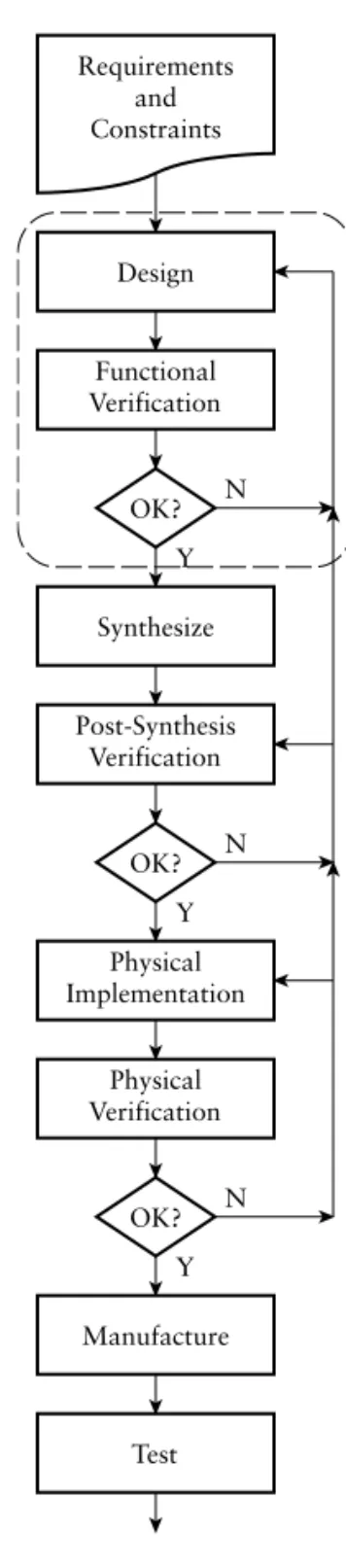
Figure 1.22 illustrates a simple design methodology. The starting point is a collection of requirements and constraints. These are usually generated externally to the design team, for example, by the marketing group of a company or by a customer for whom a product develop-ment is undertaken. They usually include function requiredevelop-ments (what the product is to do), performance requirements (how fast it is to do it), and constraints on power consumption, cost and packaging. The design methodology specifies three tasks—design, synthesis and physical implementation—each of which is followed by a verification task. (The design and functional verification tasks are outlined to indicate that they are actually a bit more involved than is shown on the diagram. We will come back to this shortly.) If verification fails at any stage, we must revisit a previous task to correct the error. Ideally, we would like to revisit only the immediately preceding task and make a minor correction. However, if the error is severe enough, we may need to backtrack further to make more significant changes. Hence, when performing a given design task, it is worth keeping in mind the constraints applying in subsequent tasks, so as to avoid introducing errors that will be detected later. Once the tasks and associated verification activities have been performed, the product can be manufactured, and each unit tested to ensure that it is functional. We will now spend a little time examining the stages in this methodology in more detail.
The design task involves understanding the requirements and con-straints and developing a specification of a digital circuit that meets the requirements and constraints. The information produced by this task is a collection of models that describe the design. The methodology then specifies that we verify the function of the design, using techniques such as simulation and formal verification. In preparation for the verification task, we should prepare a verification plan that identifies what input and output cases should be verified, and what CAD tools should be used. We
Requirements and Constraints Design N Y N Y N Y Functional Verification OK? Synthesize Post-Synthesis Verification OK? Physical Implementation Physical Verification Manufacture Test OK? F I G U R E 1 . 2 2 A simple design methodology. Ch01-P369527.indd 27 Ch01-P369527.indd 27 8/7/07 2:32:59 PM8/7/07 2:32:59 PM
will illustrate development of verification plans in parallel with design tasks throughout this book.
We’ve already discussed use of abstractions to make the design task more manageable, and the need to adhere to design disciplines to ensure that we don’t violate assumptions underlying the abstractions. However, for a system of any significant complexity, that is still not sufficient to make the task tractable. Another form of abstraction that allows us to manage design complexity is hierarchical composition. This involves developing a subcircuit that performs some relatively simple function, then treating it as a “black box.” Provided we adhere to assumptions made in designing the subcircuit, we can then use it in a larger circuit that performs a more complex function. As an example, the subcircuit might be a small liquid-crystal display (LCD) controller, which is used as part of the user interface of a cordless phone. We can repeat the step of using one subcircuit as part of a more complex circuit. For example, the user-interface subcircuit might be used as a black box within the cordless phone handset. At each level of the hierarchical design, we can focus on the aspects that are relevant and hide the details of the lower-level compo-nents. Using abstraction in this way makes the task of designing complex systems tractable. It also allows us to re-use subcircuits, either from previ-ous projects or from third-party providers. Design re-use can potentially save significant design effort and cost.
Hierarchical composition in a design also makes functional verifica-tion more tractable. We can first verify each of the most primitive subcir-cuits as independent units. Next, we can verify a subsystem that uses the subcircuits by treating the subsystem as a collection of black boxes. In particular, we can use more abstract models of the black box subcircuits instead of detailed models that describe their internal composition. This approach means that the verification tools have less work to do, allowing them to verify more input/output cases for the subsystem. We can repeat this process until we have verified the entire system.
Returning to the design and verification tasks shown in Figure 1.22, we can expand the design and functional verification tasks to illustrate use of hierarchical composition, as shown in Figure 1.23. This approach is often called top-down design. Architectural design involves analyzing the requirements and developing the overall organization of a digital system to meet them. One of the main tools used for this level of design is a white board, on which system architects draw (and redraw) block diagrams describing the main subsystems and their interconnections. The next step is unit design, in which the subsystems and sub-subsystems are designed. Each unit can then be verified, possibly requiring some rede-sign if any of the units fail verification. Finally, the units can be inte-grated and the subsystems and entire system verified, as we described above. Again, if verification fails, units may need to be redesigned. If the Unit Design Unit Verification Architecture Design OK? Integration Verification OK? N Y N Y F I G U R E 1 . 2 3 Hierarchical design and verifi cation.
Ch01-P369527.indd 28