http://dx.doi.org/10.4236/ijg.2013.49119
Lateral Stress Concentration in Localized Interlayer Rock
Stratum and the Impact on Deep Multi-Seam Coal Mining
Mingwei Zhang*, Hideki Shimada, Takashi Sasaoka, Kikuo Matsui Department of Earth Resources Engineering, Faulty of Engineering, Kyushu University, Fukuoka, Japan
Email: *[email protected]
Received August 21, 2013; revised September 22, 2013; accepted October 24, 2013
Copyright © 2013 Mingwei Zhang et al. This is an open access article distributed under the Creative Commons Attribution License, which permits unrestricted use, distribution, and reproduction in any medium, provided the original work is properly cited.
ABSTRACT
To explore the impact of lateral stress concentration in interlayer rock stratum on the exploitation of protected coal seam, a field experiment was carried out in a multi-seam mining structure. Lateral stress redistribution and interlayer rock failure behavior were surveyed. Then an assistant numerical investigation was implemented to evolve the effect of liberated seam mining and its influence on stress reconstruction in surrounding rock mass. The cause of lateral stress concentration and its impact were discussed finally. Key findings turn out that a certain lateral stress increases in inter- layer rock stratum and concentrates on its lower region. Lateral stress concentration and interlayer rock failure are in- teractional. The former is an inducing factor of the latter; the latter promotes the increase of concentration degree. Ex- tent of lateral stress concentration increases to the maximum as seam distance is about 50 m. But the efficacy of liber- ated seam mining decreases as the seam spacing gets larger. Protected seam mining is then classified based upon the impact of lateral stress concentration, which helps to prevent the rock burst hazard and then to achieve a reliable mining in deep mines.
Keywords: Lateral Stress Concentration; Interlayer Rock Stratum; Multi-Seam Coal Mining; Stress Relaxation Zone; Floor Failure Behavior
1. Introduction
Many geological hazards distinguished from the conven- tional ones occur gradually in the underground coal mines with the increase of mining depth [1-3], for in- stance, the high temperature, high ground pressure, seis- mic hazard, and rock burst. Among them, rock burst hazard greatly hampers the aim of safe production [4,5]. How to effectively prevent and control rock burst is be- coming a challenging subject for the mining researchers worldwide [6,7]. In recent years, multi-seam coal mining is treated as an effectively precautionary approach for the deep geologic hazard prevention, especially, for the rock burst [5,8,9]. It changes the initial distribution of in-situ stress, improves the plastic deformation of coal and rock mass, weakens the stress concentration in mining region and finally makes the subsequent seams easier to be ex- tracted [10]. One of the multiple coal seams is suggested to be extracted firstly so long as it is relatively nonhaz- ardous or low-hazardous. For the rock burst mines, the firstly extracted coal seam is usually called liberated
seam. The others are called protected seam. As its ad- vantages, application of multi-seam coal mining enlarges gradually in deep coal mines if only the geological con- ditions are allowable. It is given the higher priority to control rock burst hazard in application [11].
2. Three “Zones” of the Multi-Seam Coal
Mining Structure
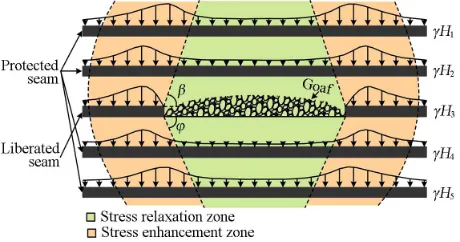
When multi-seam mining method is used in the preven- tion of rock burst hazard, the mining region influenced is always divided artificially into several disparate zones based upon the reconstructed stress in the surrounding rock mass of liberated seam extracted [9]. One com- monly recognized division is consisted of stress relaxa- tion zone, stress enhancement zone and stress stabiliza- tion zone, or other similar definition [12]. The partition is as shown in Figure 1.
[image:2.595.57.287.558.679.2]Vertical stress in the region that is under and above the extracted coal seam is decreased greatly as the stress transfer [13]. Because of so, this region is called the main stress relaxation zone. Protected seam that locates in this zone is thought to be safely extracted. It is incontroverti- ble that liberated seam exploitation dramatically lowers the stress concentration degree, weakens the elastic strain energy, and creates positive conditions for the subse- quent protected seam mining. Accordingly, rock burst hazard is relieved. With the steeply exploitation in liber- ated coal seam, dynamic development process of stress redistribution and coal deformation in protected seam wins much attention in current researches, which mainly concentrates on the stress evolution surrounding working
Figure 1. Stress division of the mining region after the lib- erated seam exploitation. Coal seam in the middle is the liberated seam. Coal seams under and above liberated seam are the protected seams. β and φ are the upper and lower pressure releasing angle, respectively.
worthy of exploitation in this field. Mining depth of up- per seam is about −620 m in average. Occurrence thick- ness of both seams is 2.85 m and 5.0 m. The vertical in- terlayer spacing is about 42.7 m. Lithology of the inter- layer rock mass is the grizzly compact sandstone with a little fracture developed. Its coefficient of hardness is 6 - 8. Face US-04, neighboring the face US-02 to the east and the face US-06 to the west, is located in the central field. It is the first working face extracted. Its mining length and width are 2770 m and 180 m, respectively.
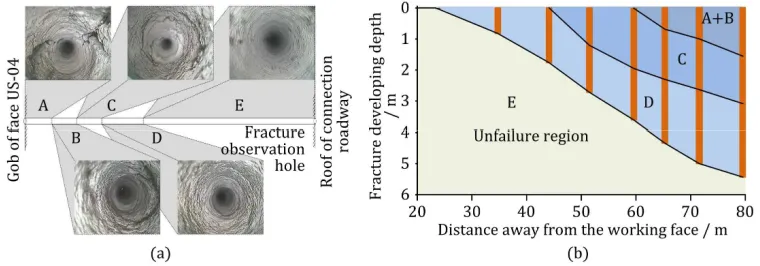
Some connection roadways were tunneled for ventila- tion requirements during the roadway excavation in pro- tected seam. A stress monitoring hole was drilled in one connection roadway that was ahead of the US-04 work- ing face in horizontal distance. Five stress detectors were installed in the central position then. Lateral stress was monitored during the mining process of Face US-04 until the investigation site was 250 m behind. Meanwhile, four fracture observing holes were drilled with 20 m interval spacing to cooperate with the stress monitoring. Initial fractures of their inner wall were recorded by borehole imaging instrument, and fracture developing situation was observed until the investigation was terminated. In- vestigation scheme for this field experiment was shown in Figure 2.
3.2. Results of Lateral Stress Changes and Interlayer Rock Failure
Observation results of lateral stress redistribution and interlayer rock failure behavior in these boreholes are shown in Figures 3 and 4.
Figure 2. Lateral stress investigation in a multi-seam coal mining structure.
Figure 3. Lateral stress changes in different interlayer rock stratum with the liberated seam exploitation.
Figure 4. Plastic failure of interlayer rock mass after the liberated seam exploitation.
upper stratum decreases sharply to 16 Mpa, while stress in the lower stratum rises gradually to 26 Mpa. It implies that the lateral stress is concentrating in the low region. While as the stress detectors are behind of and away from the working face (45 - 80 m), lateral stress be- comes stable gradually at a high level of 26 Mpa in av- erage. Field investigation results indicate that lateral stress increases in the stress relaxation zone after liber- ated seam mining, and gradually results in stress concen- tration in the lower region of interlayer rock stratum. The lower the rock stratum, the greater the degree of stress concentration gets.
Beside, plastic failure of interlayer rock mass also
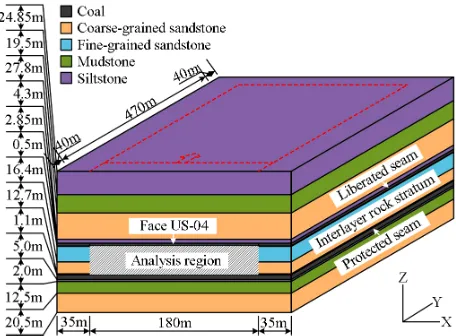
[image:3.595.109.489.421.554.2]ence algorithm and large deformation, this software is particularly appropriate for the researches on rock mass, and has become one of the most important tools in min- ing engineering. The mechanical properties of coal and rock specimen applied are listed in Table 1.
4.2. Stress Redistribution in Interlayer Rock Stratum
[image:4.595.59.287.378.546.2]Simulated results are shown in Figure 6. It indicates that, as the mining disturbance, in-situ stress reconstructs in a wide region and finally reaches to a new balanced state [18]. In the stress relaxation zone of interlayer rock stra-
[image:4.595.58.286.610.737.2]Figure 5. Numerical analysis model of the multi-seam coal mining structure.
Table 1. Basic mechanical properties of coal and rock specimen used in the simulation.
Density kg·m−3
Elastic modulus GPa
Poisson ratio
Shear modulus
GPa
Cohesion Mpa
Coal 13.8 6.1 0.30 2.3 1.0
Mudstone 21.4 11.5 0.25 4.8 4.2
Coarse-grained
sandstone 23.5 19.8 0.23 8.5 5.2
Fine-grained
sandstone 24.8 20.2 0.23 9.4 5.1
Siltstone 25.7 22.4 0.22 10.2 5.0
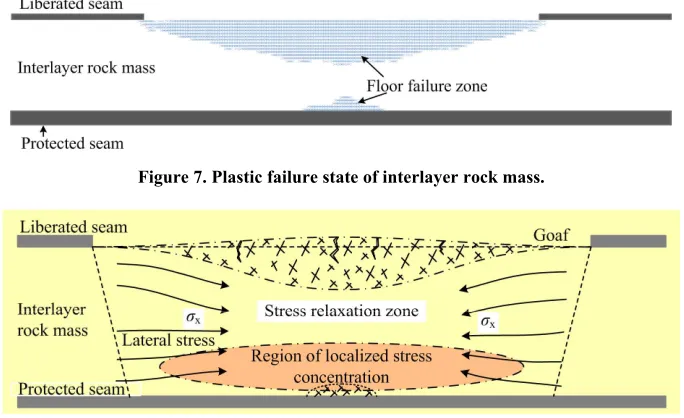
Simultaneously, the failure state of interlayer rock mass is shown in Figure 7. As the impact of upper seam min- ing, plastic failure of interlayer rock mass mainly occurs in two regions: the upper one close to the goaf of liber- ated seam and the lower one in the immediate roof of protected seam. The former is more serious than the lat- ter. Failure behavior breaks the integrity of interlayer rock mass and changes with the redistributed stress [19,20]. It indicates that numerical results are well coin- cident with the field experiment results.
4.4. Interaction of Lateral Stress Changes and Interlayer Rock Failure
Above discussion indicates that lateral stress concentra- tion and interlayer rock failure are interactional. Failure extent of interlayer rock mass depends on the recon- structed lateral stress. Rock failure phenomenon in the bottom of rock stratum does not mean that the lateral stress transfers to other regions. On the contrary, it hap- pens just as the greater action of lateral stress. Under their interaction, lateral stress itself gradually enhances with the increase of occurrence depth, and finally results in the lateral stress concentration in the lower half region (see Figure 8). This interaction continues until an equi- librium state is achieved. In a word, lateral stress recon- struction provides mechanical requirements for the fail- ure of interlayer rock mass, and this plastic rock failure behavior further promotes the lateral stress concentration in stress relaxation zone. Lateral stress concentration increases the elastic strain energy in unbroken interlayer rock mass. Once protected seam is extracted, the inter- layer rock mass will cave spontaneously as its roof. In this case, large amount of elastic energy release instantly along with the caving process [21,22]. It undoubtedly induces the hidden accidents and threatens the safe pro- duction.
5. Impact of Lateral Stress Concentration on
Protected Seam Exploitation
Figure 6. Vertical and lateral stress redistribution in the interlayer rock stratum after liberated seam mining. The value of stress contours is pressure releasing coefficient, which is calculated by the formula: r = (δ −δ')/δ . δ and δ' are the initial stress and reconstructed stress, respectively. The less the value, the higher the current stress is.
Figure 7. Plastic failure state of interlayer rock mass.
Figure 8. Lateral stress concentration in interlayer rock mass.
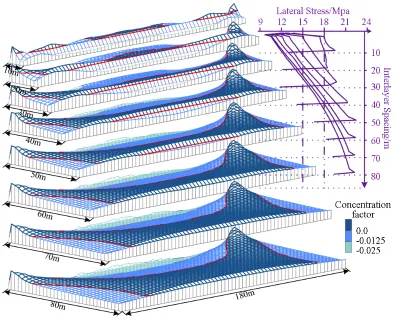
with distinct interlayer spacing, 10 m to 80 m, interval 10 m, were created to explore the impact of lateral stress concentration on protected seam mining, which is as- sessed by:
'
100%
l l
c l
S S
f S
(1)
( 0) '
100%
c
f c
C r
C
(2)
where Sl is the initial lateral stress, Sl' is the reconstructed
lateral stress; C is the coverage of stress relaxation zone, and C' is the coverage of lateral stress concentration zone; fc and rc are the extent and scope of lateral stress concen-
tration, respectively. Lateral stress redistribution results
and its concentration scope and degree in distinct inter- layer spacing are shown as Figures 9 and 10.
[image:5.595.127.469.322.531.2]Figure 9. Extent and scope of lateral stress concentration in stress relaxation zone with different spacing.
Figure 10. Assessment of lateral stress concentration in distinct interlayer spacing and the corresponding pressure releasing effect.
protected seam as interlayer spacing is between 35 m and 65 m, and the general mining in protected seam as inter- layer spacing is greater than 65 m.
It indicates that lateral stress concentration in the stress relaxation zone of interlayer rock mass is greatly affected by the interlayer spacing of coal seams. On the one hand, principal stress transfers and reconstructs surrounding the
[image:6.595.91.507.429.611.2]be relative securely extracted, lateral stress concentration in the interlayer rock mass certainly brings adverse im- pact to its extraction. The greater the extent and scope of lateral stress concentration is, the higher the potential threaten to protected seam gets.
6. Conclusions
Based on the above discussion about the lateral stress concentration in stress relaxation zone of interlayer rock stratum, the following points can be concluded:
1) After liberated seam mining, protected coal seam in its stress relaxation zone is not always safe enough to be extracted as it is generally expected. Decreased vertical stress provides it favorable mechanical environment. However, especially in deep conditions, lateral stress increases instead and can result in a certain extent of stress concentration in the lower half part of interlayer rock stratum. Lateral stress concentration increases elas- tic strain energy in the unbroken rock mass, and then induces some potential accidents during protected seam mining. This situation is less optimistic for rock burst prevention.
2) The cause that induces the lateral stress concentra- tion in stress relaxation zone is closely related with the interlayer rock failure behavior. Lateral stress concentra- tion and interlayer rock failure are interactional. Lateral stress is also the primary inducing factor of unstable in- terlayer rock failure. In general, the increased lateral stress provides mechanical requirements for the failure process of interlayer rock mass. Meanwhile, interlayer rock failure further promotes the lateral stress concentra- tion in its stress relaxation zone.
3) Lateral stress concentration occurs in all of the deep multi-seam mining structure. It is affected by the inter- layer spacing between coal seams. The stress concentra- tion extent reaches to the maximum as spacing is 50 m. In this case, coal exploitation in protected seam is the most hazardous. The degree of mining safety in protected seam is divided into three types: safe mining as interlayer spacing is less than 35 m, risky mining as interlayer spacing is 35 - 65 m, and the general mining as inter- layer spacing is greater than 65 m. Besides, the pressure releasing effect decreases as the increase of interlayer spacing.
7. Acknowledgements
Financial support for this work provided by the Labo- ratory of Rock Engineering and Mining Machinery, and the G-COE Program in Novel Carbon Resource Sciences, Kyushu University, is gratefully acknowledged.
REFERENCES
[1] B. B. Tati, “Multi-Seam Coal Mining,” Journal of The
South African Institute of Mining and Metallurgy, Vol. 111, No. 4, 2011, pp. 231-242.
[2] S. Khare, Y. V. Rao, C. S. Murthy and H. Vardhan, “Multiple Seam Mining: A Critical Review,” Journal of Mines, Metals and Fuels, Vol. 54, No. 12, 2006, pp. 327- 329.
[3] Z. K. Lin, J. P. Du, J. L. Xu and G. M. Feng, “The Coal Mining Method,” China University of Mining and Tech-nology Press, Xuzhou, 2009.
[4] T. V. Lobanova, “Geomechanical State of the Rock Mass at the Tashtagol Mine in the Course of Nucleation and Manifestation of Rock Bursts,” Journal of Mining Sci-ence, Vol. 44, No. 2, 2008, pp. 146-154.
[5] L. M. Dou and X. Q. He, “Theory and Technology of Rock Burst Prevention,” China University of Mining and Technology Press, Xuzhou, 2001.
[6] L. M. Dou and X. Q. He, “Mining Geophysics,” China Science and Culture Press, Beijing, 2002.
[7] R. X. Shen, E. Y. Wang, Z. T. Liu and Z. H. Li, “Rock- burst Prevention Mechanism and Technique of Close-Dis- tance Lower Protective Seam Mining,” Journal of China Coal Society, Vol. 36, No. S1, 2011, pp. 63-67. (In Chi- nese)
[8] T. H. Yang, T. Xu, H. Y. Liu, C. A. Tang, B. M. Shi and Q. X. Yu, “Stress-Damage-Flow Coupling Model and Its Application to Pressure Relief Coal Bed Methane in Deep Coal Seam,” International Journal of Coal Geology, Vol. 86, No. 4, 2011, pp. 357-366.
[9] X. Q. Wu, L. M. Dou, C. G. Lv, A. Y. Cao and M. W. Zhang, “Research on Pressure-Relief Effort of Mining Upper-Protective Seam on Protected Seam,” Procedia Engineering, Vol. 26, 2011, pp. 1089-1096.
[10] D. A. Beck and B. H. Brady, “Evaluation and Application of Controlling Parameters for Seismic Events in Hard- Rock Mines,” International Journal of Rock Mechanics and Mining Sciences, Vol. 39, No. 5, 2002, pp. 633-642. [11] Ministry of Coal Industry, “National Provisional Rules of
Safe Mining in Rock Burst Seam,” 1987.
[12] W. Yang, B. Q. Lin, Y. A. Qu, Z. W. Li, C. Zhai, L. L. Jia and W. Q. Zhao, “Stress Evolution with Time and Space during Mining of a Coal Seam,” International Journal of Rock Mechanics and Mining Sciences, Vol. 48, No. 7, 2011, pp. 1145-1152.
[13] B. H. G. Brady and E. T. Brown, “Rock Mechanics for Underground Mining,” Kluwer Academic Publishers, 2004.
[14] W. Yang, B. Q. Lin, Y. A. Qu, S. Zhao, C. Zhai, L. L. Jia and W. Q. Zhao, “Mechanism of Strata Deformation un-der Protective Seam and Its Application for Relieved Methane Control,” International Journal of Coal Geology, Vol. 85, No. 3-4, 2010, pp. 300-306.
neering, Vol. 16, No. 4, 2010, pp. 341-346.
[18] H. Guo, L. Yuan, B. T. Shen, Q. D. Qu and J. H. Xue, “Mining-Induced Strata Stress Changes, Fractures and Gas Flow Dynamics in Multi-Seam Longwall Mining,” International Journal of Rock Mechanics and Mining Sciences, Vol. 54, 2012, pp. 129-139.
[19] A. A. Nasedkina, A. V. Nasedkin and G. Iovane, “A Model for Hydrodynamic Influence on a Multi-Layer