International Journal of Advanced Research in
Computer Science and Software Engineering
Research Paper
Available online at:
www.ijarcsse.com
Development of Decision Support System Model as a Liaison for
Virtuous Customer Relationship Management
Sreedhar Appalabatla Telkapalli Murali Krishna Nirmala Mungamuru* Department of CS&IT Department of CS&IT Department of Computing Woliata Sodo University Woliata Sodo University Adama Science and Technology University Ethiopia Ethiopia Ethiopia
Abstract: -In this contemporary technology era, organizations are designing and developing the dimensional models to better understand their customer’s behavior. In this context, customer relationship data models helps the organizations to find out how the customers are solicited, their response, the magnitude of their response etc., This paper emphasizes on developing a decision support system for CRM .The scope of the base project extends from designing a data warehouse, populating, implementing the prototype and helping it evolve subsequently. CRM is about the customer-business relationship, and that means maintaining existing relationships as well as forming new ones. With the right strategy, CRM can help any company, make the most out of the relationships it already have, using the data on hand. CRM is operational and analytical process that focuses on better understanding and servicing of customers in order to maximize beneficial relationships with the customers. Its major role is analyzing customer data across multiple business process, analyzing data in the database and generating the reports based on the organizations requirements which maximizes the understanding and relationship with the customer. In the CRM Analysis, Oracle 9i database is used as backend and the data warehousing tools Platinum Erwin, Informatica and Cognos for Data Modeling, Extraction, Transformation and Loading and finally reports are generated.
Keywords: CRM, Data modelling, Customer Satisfaction, Liaison, Data Mining
I. INTRODUCTION
Customer Relationship Management is a total management information system, which provides all the information about the customer of an organization, stores data in the warehouse; then the data is mined, analyzed based on the organization requirements resulting in reports which ultimately aids in decision making.Why the organizations take more interest on CRM? Because customer's plays a very important role in every business. So, the organizations must develop single, integrated view of each customer. In many organizations, the view of the customer varies depending on the product line, business unit, business function, or geographic location. Each group may use different customer data in different ways with different results. CRM requires the right integration of the business processes, people resources, and application technology to be effective.
In the bygone few years, customer choice has exploded in almost every business sector and industry. From cars to heavy machinery, holidays and travel to pharmaceuticals, customers are besieged with choice and it has somehow changed the business environment as everyone is aware of it.In this new epoch, when customers are far more educated about products and services, businesses have begun to recognize the power shift from the seller to the buyer. Good and successful marketing is no longer about helping the seller sell, but rather helping the buyer buy which requires marketers and business owners to look at their activity with different eyes which ultimately shifted the focus to multifaceted CRM.
II. PROBLEM DESCRIPTION
It has been estimated that the amount of information in the world doubles every 20 months. The size and number of databases probably increases even faster. The automation of business activities produces an ever-increasing stream of data because even simple transactions, are typically recorded in a computer. In today’s world, the competitive edge is coming less from optimization and more from the proactive use of the information that these systems have been collecting over the years. Companies began to realize the vast potential of the information that they hold in their organizations.
If they can tap into this information, they can significantly improve the quality of their decision making and the profitability of the organization through focused actions. The problem for most companies, though, is that their operational systems were never designed to support multidimensional business activities, and probably never can be. They were all designed using Relational Database Management System, which is much slower to support both operational and multidimensional requirements cost-effectively. Operational systems also tend to be numerous, with overlapping and sometimes contrary definitions. In order to rapidly respond to the needs of business and be competitive on the market, companies are moving towards structures which allow their managers to rapidly and efficiently make decisions.
March - 2015, pp. 53-57
III. OBJECTIVES OF STUDY
The main objectives of this study are as follows: -
Analyzing customer data across multiple business processes. Better customer understanding and servicing.
Maximize the relationship with the customers.
Analyzing data and generate the reports based on the organizations requirements.
IV. PROPOSED SOLUTION
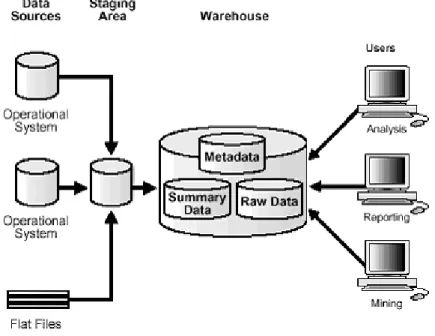
A solution for this is to design a new breed of system, which is capable to support both the operational and multidimensional requirements cost-effectively. Thus, evolved a new solution called Data warehouse on particular fields. Companies are re-organizing the data of operational systems into systems structured for decisional support; Data Warehouse.
Fig 1. Physical Architecture Model
Industry analysts expect this to represent a substantial percentage of all new spending on computer systems in the next 20 years. Data warehouse solutions are fundamentally different from operational systems because they have to evolve and grow as the business requirements for information changes over a period of time. Data warehouse are never static, in the same way that business needs are never static.
V. SYSTEM DESIGN
Design is maintaining a record proof design division and provides a blueprint for the implementation phase. Design is the bridge between system analysis and system implementation. The design is a solution, a “how to” approach to the creation a new system. This is composed of several steps. It provides an understanding and procedural details necessary for implementing the system recommended in the feasibility study. Design goes through logical and physical stages of development; logical designs review the present physical system, prepare input and an output specification, detail the implementation plan, and prepare a logical design walkthrough.
A. Database Design
The database tables are designed by analyzing various functions involved in the system along with appropriate formats. The fields in the database table defines their role in the system. The unnecessary fields should be avoided as it may lead to deviations in analysis and reporting ultimately resulting in off beam decisions. Care is to be taken to encode the lengthy names. Then in the input and the output screen design, the design should be made user friendly. The menu should be precise and compact.This phase covers:
Designing the database, including fact tables, relationship tables. De-normalizing the data.
Identifying keys.
Developing aggregation strategies. Developing partitioning strategies. Refine capacity planning estimates.
March - 2015, pp. 53-57
Fig 2. Dimensional Model B. Mapping Creation
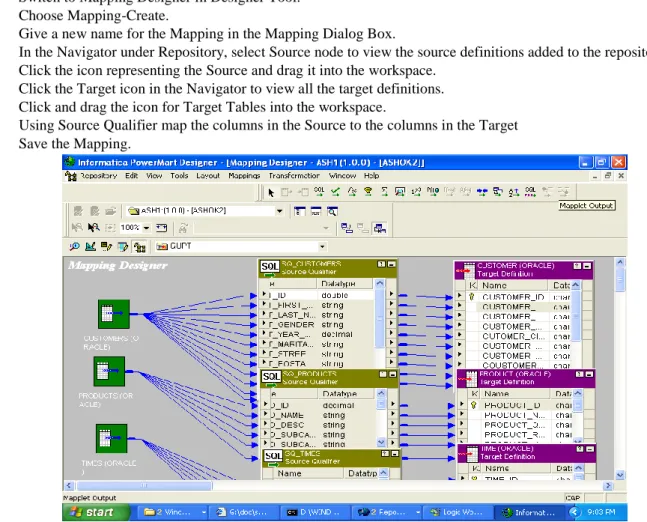
The mapping designer used to create the mapping between source and targets. In this, we design the dataflow between source and target, specifying each column in the target table receive the data from source tables. The mapping is to depict the flow of data between source and target. To create and edit mapping, mapping designer mode of the Designer is used. The mapping interface in the Designer is component-based, i.e. it shows every step in the process of moving data between source and targets.
Switch to Mapping Designer in Designer Tool. Choose Mapping-Create.
Give a new name for the Mapping in the Mapping Dialog Box.
In the Navigator under Repository, select Source node to view the source definitions added to the repository Click the icon representing the Source and drag it into the workspace.
Click the Target icon in the Navigator to view all the target definitions. Click and drag the icon for Target Tables into the workspace.
Using Source Qualifier map the columns in the Source to the columns in the Target Save the Mapping.
March - 2015, pp. 53-57 C. Interface Design
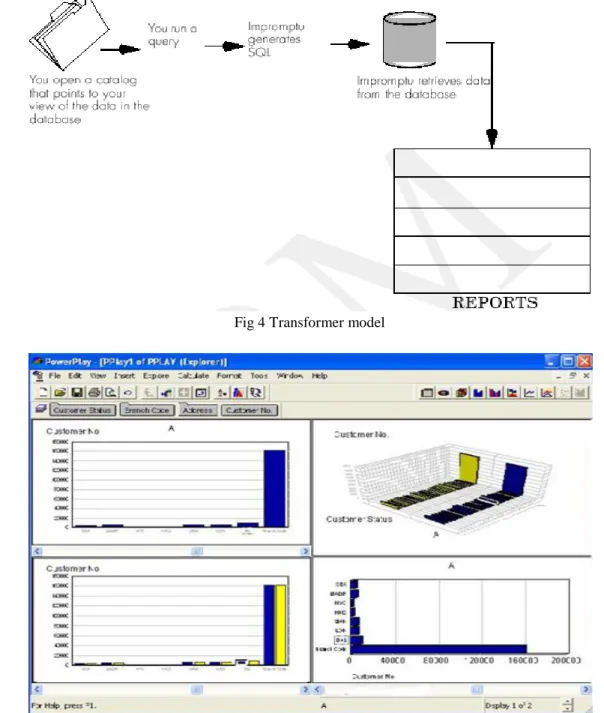
Impromptu reports show information retrieved from the database. When a report requires information, Impromptu accesses the database via a catalog.
Fig 4 Transformer model
Fig 5. Customer Details Report
VI. CONCLUSION
CRM is operational and analytic process that focusses on better understanding and servicing customers in order to maximize beneficial relationships with each customer. CRM helps the firm to build a very good relation with the customers. All the customers are not the same; CRM helps the firm to treat different customers differently and it should be implemented properly. Proper usage of CRM increases the market share of the firm. If CRM is not properly used in the firm, then the firm will go on a big loss. CRM should be maintained and updated properly. A wrong entry in the CRM makes a complete different approach to the customer.Showing your appreciation is a milestone to achieving customer satisfaction.
REFERANCE
[1] Ralph Kimball & Margy Ross “The Data Warehouse Toolkit” Willey Computer Publishing.
[2] Buttle. F (2004). Customer relationship management, concepts and tools. Oxford: Elsevier Butterworth-Heinemann.
[3] RAAB, G., et al., (2008). Customer relationship management, a global perspective. Aldershot: Gower Publishing Limited.
March - 2015, pp. 53-57 [4] Hamid, N.R. and Kassim.N. (2004). Internet Technology as a Tool in Customer Relationship Management. The
Journal of American Academy of Business, Vol. 4(1/2). Available via: Business Source Premiere. [5] Sam Anahory & Dennis Murray “Data Warehousing in the Real World”, Addison-Wesley Publishing.
[6] Fahey, Linking E-business and operating processes: the role of knowledge management, IBM Systems Journal, 40, 4, 889-907.
[7] Knowledge Assets at IBM, Decision Support Systems, 32, 2, 155-170.
[8] Winer, R. S. (2001) A Framework for Customer Relationship Management, California Management Review, 43, 4, 89- 105.
[9] Bose, R. and Sugumaran, V. (2003) Application of Knowledge Management Technology in Customer Relationship Management, Knowledge and Process Management.
[10] Bull.C, (2003). Strategic issues in customer relationship management (CRM) implementation. Business Process Management Journal, Vol.9 (5), pp.592-602. Available via: Emerald [Accessed on 4 January 10].