Bariatric Surgery and Long-term
Cardiovascular Events
Lars Sjo¨stro¨m, MD, PhD Markku Peltonen, PhD Peter Jacobson, MD, PhD C. David Sjo¨stro¨m, MD, PhD Kristjan Karason, MD, PhD Hans Wedel, PhD Sofie Ahlin, MD A˚sa Anveden, MD Calle Bengtsson, MD, PhD Gerd Bergmark, BMA Claude Bouchard, PhD Bjo¨rn Carlsson, MD, PhD Sven Dahlgren, MD, PhD Jan Karlsson, PhD Anna-Karin Lindroos, PhD Hans Lo¨nroth, MD, PhD Kristina Narbro, PhD Ingmar Na¨slund, MD, PhD Torsten Olbers, MD, PhD Per-Arne Svensson, PhD Lena M. S. Carlsson, MD, PhDM
OST EPIDEMIOLOGICALstudies have shown that obesity is associated with increased cardiovascu-lar morbidity and mortality.1,2Weight loss improves diabetes and other inter-mediate risk factors for cardiovascular disease,3-6suggesting that weight loss could also reduce the incidence of car-diovascular events. However, weight loss has been paradoxically associated
For editorial comment see p 88.
Author Affiliations:Institutes of Medicine (Drs L. Sjo¨stro¨m, Jacobson, C. Sjo¨stro¨m, Karason, Ahlin, An-veden, B. Carlsson, Svensson, and L. Carlsson and Ms Bergmark), Surgery (Drs Lo¨nroth and Olbers), Pri-mary Health Care (Dr Bengtsson), and Health and Care Sciences (Dr Karlsson), The Sahlgrenska Academy, Uni-versity of Gothenburg, Gothenburg, Sweden; Chronic Disease Epidemiology and Prevention Unit, National Institute for Health and Welfare, Helsinki, Finland (Dr Peltonen); Nordic School of Public Health, Gothen-burg, Sweden (Dr Wedel); Pennington Biomedical Re-search Center, Louisiana State University System,
Baton Rouge (Dr Bouchard); Department of Surgery, Umea˚ University Hospital, Umea˚, Sweden (Dr Dahl-gren); Nutrition Department, National Food Admin-istration, Uppsala, Sweden (Dr Lindroos); Depart-ment of Health Care, Region Va¨stra Go¨taland, Gothenburg, Sweden (Dr Narbro); and Department of Surgery, University Hospital, O¨ rebro, Sweden (Dr Na¨slund).
Corresponding Author:Lars Sjo¨stro¨m, MD, PhD, In-stitute of Medicine, Vita Straket 15, Sahlgrenska Uni-versity Hospital, S-413 45 Gothenburg, Sweden (lars [email protected]).
Context Obesity is a risk factor for cardiovascular events. Weight loss might protect against cardiovascular events, but solid evidence is lacking.
Objective To study the association between bariatric surgery, weight loss, and car-diovascular events.
Design, Setting, and Participants The Swedish Obese Subjects (SOS) study is an ongoing, nonrandomized, prospective, controlled study conducted at 25 public surgical departments and 480 primary health care centers in Sweden of 2010 obese participants who underwent bariatric surgery and 2037 contemporaneously matched obese controls who received usual care. Patients were recruited between September 1, 1987, and January 31, 2001. Date of analysis was December 31, 2009, with median follow-up of 14.7 years (range, 0-20 years). Inclusion criteria were age 37 to 60 years and a body mass index of at least 34 in men and at least 38 in women. Exclusion criteria were identical in surgery and control patients. Sur-gery patients underwent gastric bypass (13.2%), banding (18.7%), or vertical banded gastroplasty (68.1%), and controls received usual care in the Swedish pri-mary health care system. Physical and biochemical examinations and database cross-checks were undertaken at preplanned intervals.
Main Outcome Measures The primary end point of the SOS study (total mortal-ity) was published in 2007. Myocardial infarction and stroke were predefined second-ary end points, considered separately and combined.
Results Bariatric surgery was associated with reduced number of cardiovascular deaths (28 events among 2010 patients in the surgery group vs 49 events among 2037 patients in the control group; adjusted hazard ratio [HR], 0.47; 95% CI, 0.29-0.76;P= .002). The number of total first time (fatal or nonfatal) cardiovascular events (myocardial infarction or stroke, whichever came first) was lower in the sur-gery group (199 events among 2010 patients) than in the control group (234 events among 2037 patients; adjusted HR, 0.67; 95% CI, 0.54-0.83;P⬍.001). Conclusion Compared with usual care, bariatric surgery was associated with re-duced number of cardiovascular deaths and lower incidence of cardiovascular events in obese adults.
with an increased incidence of cardio-vascular events in most epidemiologi-cal studies,7-9even in participants who were overweight or obese at base-line.10Some observational studies sug-gest that self-reported intentional weight loss is associated with a de-creased incidence of cardiovascular events.11Other studies suggest the op-posite.12,13Results of these studies might be confounded by inclusion of partici-pants with unintentional weight loss.11-13
Lifestyle interventions to prohibit diabetes14have not prevented cardio-vascular events, not even after 10 to 20 years of follow-up.15,16Similarly lifestyle interventions combined with antiobesity medications have either shown no effect on primary cardio-vascular end points17 or an increased incidence of cardiovascular events in
the drug treatment group.18 Taken
together, nonsurgical weight loss trials in obese participants have failed to yield a benefit in terms of cardiovascular event rates.15-18
Retrospective cohort studies of bar-iatric surgery demonstrated an associa-tion between bariatric surgery with a re-duced incidence of cardiovascular events.19,20However, these studies were limited because of incomplete infor-mation about the participants causing uncontrolled, confounding condi-tions that might have influenced the re-sults of these studies. To date, care-fully controlled, prospective analyses on cardiovascular events in patients who have had bariatric surgery and matched obese participants have not been re-ported.
Two prospective, controlled, long-term studies examining the relation-ship between weight loss and cardio-vascular outcomes are ongoing (Look AHEAD [Actions for HEAlth
in Diabetes]2 1 and SOS [Swedish
O b e s e S u b j e c t s ] ) .5 , 2 2 - 2 4 L o o k AHEAD’s 4-year results on weight loss and risk factors were recently published,21but the 12-year results of lifestyle intervention on cardiovas-cular events are not yet available in the 5145 participants.
The rationale for the nonrandom-ized, prospective, controlled SOS study was to fill the knowledge gap regard-ing the association between type of treatment (bariatric surgery vs usual care) and hard end points (primarily mortality). For ethical reasons related to the high postoperative mortality in the 1980s, a randomized design was not approved and a matched study was therefore undertaken.5,22-24We have pre-viously reported that bariatric surgery is associated with reduced incidence of diabetes (median follow-up time, 2 years)5and cancer (10.9 years)24and with reduced overall mortality (10.9 years),23the primary end point of the SOS study.
In this article, we test the hypoth-esis that bariatric surgery is associated with a reduced incidence of cardiovas-cular events. These were defined as a combination variable of fatal and non-fatal acute myocardial infarction (MI) and stroke, whichever came first. Myo-cardial infarction and stroke were also examined as separate end points. These secondary end points were predefined in 1987 in the original study protocol. Because current guidelines and posi-tion statements for selecposi-tion of pa-tients undergoing bariatric sur-gery25-28are based on expert opinions and not on treatment effects in pro-spective, controlled interventions, we have undertaken post hoc analyses to explore if baseline characteristics in the SOS study predict the surgical treat-ment benefit with respect to cardiovas-cular events. In addition, we have ex-amined the relationship between weight change and the incidence of cardiovas-cular events.
METHODS
Study Design and Participants T h e o n g o i n g , n o n r a n d o m i z e d , matched, prospective, controlled Swedish Obese Subjects (SOS) inter-vention study has previously been described in detail.5,22-24 The SOS study is an academically initiated and implemented study run by the SOS secretariat at the Institute of
Medicine, University of Gothenburg, Gothenburg, Sweden. The 4047 obese participants were enrolled between September 1, 1987, and January 31, 2001. Myocardial infarc-tion and stroke were predefined sec-ondary end points but the cutoff date for the analysis (December 31, 2009) was not prespecified in the original protocol.
Recruitment campaigns were under-taken in mass media and at 25 public surgical departments and 480 primary health care centers. The same sites have been responsible for data collection dur-ing follow-up. A matchdur-ing examina-tion (eTable 1, available at http://www .jama.com) was completed by 6905 individuals, 5335 of which were eli-gible (eFigure 1). Among the elieli-gible patients, 2010 individuals electing sur-gery constituted the sursur-gery group and a contemporaneously matched con-trol group of 2037 participants was cre-ated by an automatic matching pro-gram using 18 matching variables (eTable 1).
Baseline examinations took place approximately 4 weeks before the start of the intervention (eTable 1). The inclusion criteria, which were identi-cal in both study groups,22,24were aged 37 to 60 years and having a body mass index (BMI, calculated as weight in ki-lograms divided by height in meters squared) of at least 34 for men and at least 38 for women. The exclusion cri-teria of both groups were earlier sur-gical operation for gastric or duodenal ulcer, earlier bariatric surgery, gastric ulcer during the past 6 months, ongo-ing malignancy, active malignancy dur-ing the past 5 years, MI durdur-ing the past 6 months, bulimic eating pattern, drug or alcohol (⬎0.75 L 40% liquor per week or corresponding amount of etha-nol) abuse, psychiatric or cooperative problems contraindicating bariatric sur-gery, and other contraindicating con-ditions, such as continuous glucocor-ticoid or anti-inflammatory treatment. Laboratory examinations were under-taken at the Central Laboratory, Sahl-grenska University Hospital, Gothen-burg, Sweden (accredited according to
European Norm 45001).5,22-24 Psycho-social variables were evaluated with methods described previously (eTable 1).29
All regional ethical review boards in Sweden approved the study protocol, and all patients gave informed con-sent to participate.
Interventions
In the surgery group, 376 individuals (18.7%) underwent nonadjustable or adjustable banding, 1369 (68.1%) un-derwent vertical banded gastroplasty, and 265 (13.2%) underwent gastric by-pass.30Control participants were given the customary treatment for obesity at their centers of registration (ie, essen-tially the standard obesity care in Swe-den, ranging from advanced lifestyle ad-vice at many sites to no treatment in other sites). During the 13 years of re-cruitment, the dominant technology changed from open to laparoscopic sur-gery. With this exception, the meth-ods were not changed since study start.
Data Collection Intervals
Physical examinations and question-naires were completed at matching and baseline and after 0.5, 1, 2, 3, 4, 6, 8, 10, 15, and 20 years. Centralized labo-ratory examinations were performed at the matching and baseline examina-tions and after 2, 10, 15, and 20 years. The SOS study database was cross-checked annually against public data-bases.
Outcome Measures
The primary end point (overall mor-tality) of the entire SOS project was published in 2007.23 The study had 80% power (at␣=.05) to detect a 23% difference in mortality between 2000 surgically treated patients and 2000 controls followed up for 10 years.23 We have also published results on some secondary end points (diabetes5 and gall bladder disease3 1). This article reports on the predefined sec-ondary end points, MI and stroke, considered separately and combined. Fatal and total incidence rates are given. These end points have not been
changed during the course of the
study. The following International
Classification of Diseases, Ninth Revision/International Statistical Classi-fication of Diseases, Tenth Revision codes were used (for MI: codes 410/ I21, I22; for intracerebral bleeding: codes 431/I61; for cerebral artery occlusion: codes 433, 434/I63, I65, I66; and for acute but nondefined stroke in terms of bleeding or occlu-sion: codes 436/I64).
Angina pectoris, claudication, tran-sitory ischemic attacks, and subarach-noidal bleeding were not included in the analyses. The incidence of MI and s t r o k e w a s o b t a i n e d b y c r o s s -checking the SOS database with the Swedish National Patient Register, the Cause of Death Registry, and the Reg-istry of the Total Population. Cur-rently (as of October 26, 2011), the Swedish National Patient Register, which limits this follow-up, is com-plete until December 31, 2009.
Statistics
The statistical procedures in the SOS study have previously been described in detail.23,24In brief, the methods in-cludedttest, Fisher exact test, Kaplan-Meier method estimates of cumula-tive incidence, log-rank test, and univariable and multivariable Cox pro-portional hazard regression models. In multivariable Cox proportional haz-ard regression models, missing base-line values on covariates were re-placed by sex and treatment group specific medians. For all end points (cardiovascular events, MI, and stroke) in this study, the time⫻treatment in-teraction was nonsignificant, indicat-ing that the proportional hazard as-sumption was not violated.
In subgroup⫻ treatment
interac-tion calculainterac-tions, dichotomous vari-ables could have 1 of 2 values (eg, men/ women; diabetes, yes/no). For other variables, the interaction tests were con-ducted using the original continuous variables. The risk factor⫻treatment interactions included participants with or without the metabolic syndrome at baseline,32and individuals with
differ-ent values on the European SCORE for risk of cardiovascular events.33In total,
we performed 20 post hoc subgroup⫻
treatment analyses in men and women combined. No adjustment for mul-tiple testing was performed. With 20 performed tests, one statistically sig-nificant interaction test (P⬍.05) would be expected due to chance alone. The expected number of surgeries needed to prevent 1 cardiovascular event over 15 years (numbers needed to treat [NNT]) was calculated as the recipro-cal of the absolute risk difference (ob-tained from Kaplan-Meier cardiovas-cular risk estimates over 15 years) between individuals in the surgery and control groups.
AllPvalues are 2-sided andP⬍.05 was considered statistically signifi-cant. In all calculations, the intention-to-treat principle was applied. Statisti-cal analyses were performed using the Stata statistical package version 10.1 (StataCorp LP).
RESULTS
Characteristics at Study Baseline Descriptions of patients at the match-ing and the baseline examinations are given in eTable 1. Between the 2 ex-aminations, body weight increased in the surgery group but decreased in the control group. At baseline, mean BMI was 40.1 in the control group and 42.4 in the surgery group, and most risk fac-tors were less favorable in the surgery group.
Follow-up Rate and Changes in Body Weight
On the date of analysis (December 31, 2009), the median follow-up was 14.7 years (range, 0-20 years). On this date, we had information on the time until the first MI or first stroke (fatal or non-fatal) after study baseline in 2022 of 2037 controls (99% follow-up) and in 1993 of 2010 patients receiving sur-gery (99% follow-up) (eFigure 1). The mean changes in body weight after 2, 10, 15, and 20 years were −23%, −17%, −16%, and −18% in the surgery group and 0%, 1%, −1%, and −1% in the con-trol group (FIGURE1).
Baseline Risk Factors and Cardiovascular Events During Follow-up
In univariable Cox proportional haz-ard regression analyses, the majority of classic baseline risk factors were asso-ciated with the incidence of cardiovas-cular events (eTable 2). However, in this obese population, baseline BMI was not related to cardiovascular events dur-ing follow-up.
Incidence of Fatal and Nonfatal Cardiovascular Events
There were 49 cardiovascular deaths among the 2037 patients in the con-trol group and 28 cardiovascular deaths among the 2010 patients in the sur-gery group (unadjusted hazard ratio [HR], 0.56; 95% CI, 0.35-0.88; log-rankP= .01) (FIGURE2). In total (fatal and nonfatal), there were 234 cardio-vascular events among 2037 patients in the control group and 199 cardiovas-cular events among 2010 patients in the surgery group (unadjusted HR, 0.83; 95% CI, 0.69-1.00; log-rankP= .05) (Figure 2). After multivariable adjust-ments for baseline conditions, bariat-ric surgery was associated with
re-duced number of fatal cardiovascular deaths (adjusted HR, 0.47; 95% CI, 0.29-0.76;P= .002) and lower inci-dence of total cardiovascular events (ad-justed HR, 0.67; 95% CI, 0.54-0.83; P⬍.001) (TABLE1).
S u r g e r y w a s a s s o c i a t e d w i t h reduced number of fatal MI (22
deaths in the surgery group vs 37 deaths in the control group; HR, 0.58; 95% CI, 0.34-0.98; log-rank
P= .04) (eFigure 2). In unadjusted
analyses, surgery was not associated with the incidence of total MI cases (122 in the surgery group vs 136 in the con-trol group; HR, 0.88; 95% CI,
0.69-Figure 1.Mean Weight Change Percentages From Baseline for Controls and the 3 Surgery Groups Over 20 Years in the Swedish Obese Subjects Study
Control Banding
Vertical banded gastroplasty Gastric bypass 5 –15 –10 0 –5 –20 –25 –30 –35 No. of patients Control Banding
Vertical banded gastroplasty Gastric bypass 0 2037 376 1369 265 1 2 3 4 1490 333 1086 209 6 8 1242 284 987 184 10 1267 284 1007 180 15 556 150 489 37 20 176 50 82 13 Follow-up, y Mean W eight Change, %
Data shown for controls obtaining usual care and for surgery patients obtaining banding, vertical banded gas-troplasty, or gastric bypass at baseline. Percentage weight changes from the baseline examination and on-ward are based on data available on July 1, 2011. Error bars represent 95% CIs.
Figure 2.Kaplan-Meier Unadjusted Cumulative Incidence of Fatal and Total Cardiovascular Events in the Control and Surgery Groups of the Swedish Obese Subjects Study
0.035 0.020 0.025 0.030 HR, 0.56; 95% CI, 0.35-0.88; Log-rank P = .01 0.015 0.010 0.005 0 No. at risk Control Surgery 0 2037 2010 6 1993 1970 12 1423 1557 18 405 412 Follow-up, y
Fatal cardiovascular events
Cumulative Incidence Control (49 events) Surgery (28 events) 0.16 0.08 0.10 0.14 0.12 HR, 0.83; 95% CI, 0.69-1.00; Log-rank P = .05 0.06 0.04 0.02 No. at risk Control Surgery 0 2037 2010 6 1945 1921 12 1326 1468 18 361 375 Follow-up, y
Total cardiovascular events
Cumulative Incidence
Control (234 events) Surgery (199 events)
0
The combined end point of myocardial infarction and stroke, whichever came first, with fatal cardiovascular events and total (fatal and nonfatal) cardiovascular events are shown. The incidence data are based on observations until December 31, 2009. Follow-up time is truncated at 18 years, because number of persons at risk beyond this point was low. All persons are included in the calculation of hazard ratios (HRs). The incidence rates per 1000 person-years for fatal cardiovascular events were 0.9 (95% CI, 0.6-1.3) in the surgery group and 1.7 (95% CI, 1.3-2.2) in the control group; and for total cardiovascular events, 6.9 (95% CI, 6.0-8.0) and 8.3 (95% CI, 7.3-9.4), respectively. Y-axis regions shown in blue indicate range from 0 to 0.035.
1.12; log-rankP= .30) (eFigure 2). However, after multivariable adjust-ments for baseline conditions, bariat-ric surgery was related both to re-duced fatal MI incidence (HR, 0.52; 95% CI, 0.31-0.89;P=.02) and total MI incidence (HR, 0.71; 95% CI, 0.54-0.94;P= .02) (Table 1).
In unadjusted analyses, bariatric sur-gery was not related to fatal stroke in-cidence (6 events in the surgery group vs 12 events in the control group; HR, 0.49; 95% CI, 0.18-1.30; log-rank P= .14) or to total number of stroke events (93 events in the surgery group vs 111 events in the control group; HR, 0.82; 95% CI, 0.62-1.08; log-rank
P=.15) (eFigure 3). However, after ad-justments for baseline conditions, bar-iatric surgery was associated both with reduced number of fatal stroke events (HR, 0.34; 95% CI, 0.12-1.00;P= .05) and total stroke events (HR, 0.66; 95% CI, 0.49-0.90;P= .008) (Table 1).
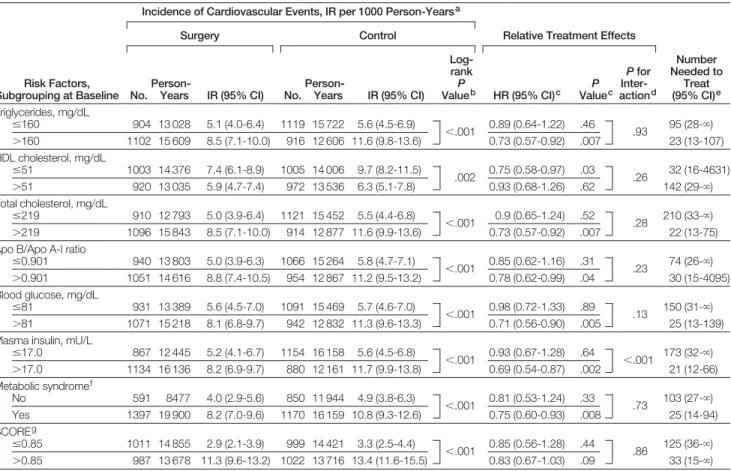
Secondary Subgroup Analyses In the control group, most classic high-risk subgroups at baseline (eg, men vs women, high vs low triglycer-ides) had higher incidence of total car-diovascular events compared with the corresponding low-risk subgroups (TABLE 2 and TABLE 3). The only exceptions were high vs low BMI
(P= .49) and low vs high hip circum-ference (P= .24), in which no differ-e n c differ-e s c o u l d b differ-e d differ-e m o n s t r a t differ-e d (Table 2). The surgical treatment ben-efit with respect to cardiovascular events was significantly associated with baseline plasma insulin (Pfor interaction⬍.001), with greater rela-tive treatment benefit in participants with higher insulin (Table 3). The NNT was 21 (95% CI, 12-66) in par-ticipants with baseline plasma insulin concentrations above the median
(⬎17.0 mU/L) and 173 (95% CI,
32-⬁) in individuals below or at the median (ⱕ17.0 mU/L) insulin concen-tration (Table 3).
Table 1.Multivariable Cox Proportional Hazards Regression Models for Fatal and Total Cardiovascular End Points in the Swedish Obese Subjects Studya
Cardiovascular Eventsb MI Stroke
Hazard Ratio (95% CI) P Value Hazard Ratio (95% CI) P Value Hazard Ratio (95% CI) P Value Fatal Cardiovascular End Points
Surgery, yes vs no 0.47 (0.29-0.76) .002 0.52 (0.31-0.89) .02 0.34 (0.12-1.00) .05 Male sex, yes vs no 3.23 (1.93-5.41) ⬍.001 3.28 (1.80-5.98) ⬍.001 3.12 (1.10-8.81) .03 Age, per 6.1 y 1.48 (1.14-1.91) .003 1.56 (1.18-2.08) .002 1.24 (0.68-2.26) .49 MI or stroke before baseline, yes vs no 3.11 (1.52-6.35) .002 3.24 (1.47-7.13) .003 2.09 (0.32-13.8) .44 Diabetes at baseline, yes vs noc 1.44 (1.21-1.73) ⬍.001 1.38 (1.13-1.68) .002 1.68 (1.16-2.42) .006
Smoking at baseline, yes vs no 1.47 (1.19-1.81) ⬍.001 1.40 (1.11-1.78) .005 1.76 (1.17-2.65) .007 Systolic BP, per 18.7 mm Hg 1.18 (0.92-1.51) .19 1.11 (0.84-1.47) .47 1.44 (0.88-2.36) .14 Total cholesterol, per 42.4 mg/dL 1.32 (1.05-1.66) .02 1.47 (1.15-1.88) .002 0.90 (0.56-1.45) .66 HDL cholesterol, per 12.3 mg/dL 1.07 (0.83-1.38) .60 0.88 (0.64-1.20) .41 1.81 (1.20-2.72) .005
Total Cardiovascular End Points
Surgery, yes vs no 0.67 (0.54-0.83) ⬍.001 0.71 (0.54-0.94) .02 0.66 (0.49-0.90) .008 Male sex, yes vs no 1.78 (1.38-2.29) ⬍.001 1.91 (1.36-2.67) ⬍.001 1.49 (1.05-2.12) .03 Age, per 6.1 y 1.45 (1.30-1.61) ⬍.001 1.46 (1.27-1.68) ⬍.001 1.43 (1.21-1.68) ⬍.001 MI or stroke before baseline, yes vs no 2.83 (1.93-4.16) ⬍.001 3.64 (2.35-5.63) ⬍.001 1.51 (0.76-3.03) .24 Diabetes at baseline, yes vs nob 1.71 (1.35-2.18) ⬍.001 1.73 (1.27-2.36) .001 1.68 (1.20-2.37) .003 Insulin, per 12.7 mU/L 1.12 (1.05-1.20) .001 1.12 (1.04-1.21) .005 1.04 (0.93-1.17) .48 Smoking at baseline, yes vs no 1.92 (1.55-2.38) ⬍.001 2.05 (1.57-2.69) ⬍.001 1.81 (1.31-2.50) ⬍.001 BMI, per 4.7 units 1.06 (0.87-1.28) .57 1.05 (0.81-1.36) .71 1.02 (0.78-1.33) .90 Waist circumference, per 11.5 cm 1.11 (0.92-1.35) .28 1.12 (0.87-1.43) .39 1.25 (0.95-1.66) .11 Hip circumference, per 10.2 cm 0.82 (0.69-0.98) .03 0.84 (0.67-1.04) .11 0.81 (0.63-1.03) .09 Systolic BP, per 18.7 mm Hg 1.36 (1.23-1.50) ⬍.001 1.31 (1.15-1.50) ⬍.001 1.46 (1.27-1.68) ⬍.001 Total cholesterol, per 42.4 mg/dL 1.30 (1.17-1.43) ⬍.001 1.49 (1.32-1.69) ⬍.001 1.03 (0.89-1.18) .69 HDL cholesterol, per 12.3 mg/dL 0.94 (0.84-1.06) .31 0.85 (0.73-0.98) .03 1.03 (0.87-1.21) .76 Triglycerides, per 131.2 mg/dL 0.97 (0.88-1.06) .47 0.95 (0.84-1.06) .34 0.96 (0.84-1.11) .60 Lipid-lowering medication, yes vs no 1.52 (0.92-2.53) .10 2.11 (1.22-3.64) .008 0.68 (0.22-2.04) .49 Antihypertensive medication, yes vs no 1.18 (0.95-1.46) .13 1.03 (0.77-1.36) .86 1.41 (1.05-1.89) .02 Abbreviations: BMI, body mass index (calculated as weight in kilograms divided by height in meters squared); BP, blood pressure; HDL, high-density lipoprotein; MI, myocardial infarction. SI conversions: To convert total and HDL cholesterol to mmol/L, multiply by 0.0259; triglycerides to mmol/L, multiply by 0.0113; and insulin to pmol/L, multiply by 6.945.
aHazard ratios for continuous variables are expressed per 1-SD difference at baseline in the study population with men and women combined. For fatal cardiovascular end points, the
number of events for surgery and control groups were 28 and 49, respectively, for cardiovascular events; 22 and 37, respectively, for MI; and 6 and 12, respectively, for stroke. For total cardiovascular end points, the number of events for surgery and control groups were 199 and 234, respectively, for cardiovascular events; 122 and 136, respectively, for MI; and 93 and 111, respectively, for stroke.
bCardiovascular events included MI and stroke combined, whichever came first.
In contrast, the surgical treatment benefit with respect to cardiovascular events was not related to baseline BMI (Pfor interaction=.58) (Table 2). The NNT was 52 (95% CI, 20-⬁) in par-ticipants below or at median BMI (ⱕ40.8) and 81 (95% CI, 24-⬁) in
i n d i v i d u a l s a b o v e m e d i a n B M I (⬎40.8) (Table 2). Similarly no sig-nificant risk factor⫻treatment inter-actions were observed with respect to waist-hip ratio, waist circumference, hip circumference, or metabolic vari-ables other than insulin (Table 2 and
Table 3). The insulin⫻treatment and
BMI ⫻ treatment interactions are
shown inFIGURE3.
The association between weight change and the incidence of cardio-vascular events was examined sepa-rately in the surgery and control
Table 2.Demographic and Anthropometric Risk Factor Treatment Interaction Analyses in the Swedish Obese Subjects Study
Risk Factors, Subgrouping at Baseline
Incidence of Cardiovascular Events, IR per 1000 Person-Yearsa
Relative Treatment Effects
Number Needed to Treat (95% CI)e Surgery Control No.
Person-Years IR (95% CI) No.
Person-Years IR (95% CI) Log-rank
P
Valueb HR (95% CI)c ValueP c
Pfor Inter-actiond Total 2010 28 695 6.9 (6.0-8.0) 2037 28 350 8.3 (7.3-9.4) 0.83 (0.69-1.00) .05 50 (24-⬁) Sex Men 590 8052 12.2 (10.0-14.8) 590 7980 14.4 (12.0-17.3) ⬍.001 0.85 (0.65-1.11) .22 .92 28 (12-⬁) Women 1420 20 643 4.9 (4.0-5.9) 1447 20 370 5.8 (4.9-7.0) 0.82 (0.63-1.07) .15 83 (30-⬁) Age, y ⱕ47.8 1106 16 123 4.8 (3.8-6.0) 919 13 417 5.1 (4.1-6.5) ⬍.001 0.92 (0.67-1.28) .63 .76 161 (32-⬁) ⬎47.8 904 12 573 9.7 (8.1-11.6) 1118 14 933 11.0 (9.5-12.9) 0.86 (0.68-1.09) .22 46 (18-⬁) Systolic BP, mm Hg ⱕ140 1014 14 467 3.9 (3.0-5.1) 1308 18 337 6.3 (5.2-7.5) ⬍.001 0.63 (0.46-0.86) .004 .31 25 (16-61) ⬎140 991 14 159 10.0 (8.4-11.7) 725 9943 12.0 (10.0-14.3) 0.82 (0.64-1.04) .10 46 (17-⬁) Diastolic BP, mm Hg ⱕ88 830 11 735 4.0 (3.0-5.3) 1225 16 886 6.3 (5.2-7.6) ⬍.001 0.63 (0.45-0.89) .008 .71 24 (15-55) ⬎88 1174 16 895 8.9 (7.6-10.4) 805 11 352 11.3 (9.5-13.4) 0.78 (0.62-0.99) .04 39 (17-⬁) Smoking No 1490 21 498 6.2 (5.3-7.4) 1605 22 538 6.8 (5.8-8.0) ⬍.001 0.9 (0.72-1.14) .39 .10 127 (33-⬁) Yes 518 7172 9.1 (7.1-11.6) 422 5691 13.9 (11.1-17.3) 0.65 (0.47-0.90) .009 14 (8-53) Diabetesf No 1658 23 902 5.7 (4.8-6.7) 1771 25 035 6.7 (5.8-7.8) ⬍.001 0.84 (0.67-1.06) .14 .20 64 (28-⬁) Yes 345 4715 13.4 (10.4-17.1) 262 3266 19.9 (15.6-25.4) 0.63 (0.45-0.90) .01 12 (6-127) Previous MI or stroke No 1964 28 189 6.6 (5.7-7.6) 1988 27 832 7.7 (6.8-8.8) ⬍.001 0.84 (0.69-1.02) .08 .71 55 (26-⬁) Yes 46 506 27.7 (16.4-46.7) 49 519 36.6 (23.4-57.4) 0.79 (0.40-1.56) .49 13 (3-⬁) BMI ⱕ40.8 795 11 318 7.9 (6.4-9.7) 1229 17 205 8.6 (7.3-10.1) .49 0.91 (0.70-1.18) .48 .58 52 (20-⬁) ⬎40.8 1215 17 377 6.3 (5.3-7.6) 808 11 145 7.7 (6.2-9.5) 0.8 (0.60-1.06) .12 81 (24-⬁) Body weight, kg ⱕ116 885 12 726 6.3 (5.0-7.8) 1165 16 446 7.4 (6.2-8.8) .04 0.85 (0.64-1.13) .26 .96 64 (23-⬁) ⬎116 1125 15 969 7.5 (6.2-8.9) 872 11 904 9.5 (7.9-11.4) 0.77 (0.59-0.99) .04 33 (16-⬁) Waist-hip ratio ⱕ0.985 939 13 767 4.0 (3.1-5.2) 1083 15 486 5.2 (4.2-6.5) ⬍.001 0.75 (0.53-1.06) .10 .73 61 (25-⬁) ⬎0.985 1065 14 840 9.6 (8.2-11.4) 954 12 864 11.9 (10.2-13.9) 0.8 (0.64-1.00) .06 28 (14-1272) Waist circumference, cm ⱕ122 812 11 829 5.6 (4.4-7.1) 1213 17 135 6.8 (5.7-8.2) .001 0.81 (0.60-1.09) .17 .86 45 (20-⬁) ⬎122 1193 16 798 7.9 (6.6-9.3) 824 11 215 10.4 (8.7-12.5) 0.74 (0.57-0.94) .02 29 (15-1276) Hip circumference, cm ⱕ124 853 12 182 8.0 (6.6-9.8) 1198 16 701 8.8 (7.5-10.3) .24 0.9 (0.70-1.17) .44 .38 50 (20-⬁) ⬎124 1151 16 424 6.1 (5.0-7.4) 839 11 649 7.5 (6.1-9.2) 0.8 (0.60-1.07) .13 86 (25-⬁) Abbreviations: BMI, body mass index (calculated as weight in kilograms divided by height in meters squared); BP, blood pressure; HR, hazard ratio; IR, incidence rate; MI, myocardial
infarction.
aAcute MI and stroke combined in high-risk and low-risk subgroups. For continuous variables, subgrouping is based on median baseline values. bDifference in IR between high-risk and low-risk subgroups among the control group only.
cHR andPvalue for treatment effect in surgery vs control subjects of indicated subgroup.
dFor each continuous variable, the test of interaction was calculated using the original continuous variable. Dichotomous variables could have 1 of 2 values (eg, men vs women; diabetes,
yes vs no). The interactionPvalue reflects difference in relative treatment effect between indicated high-risk and low-risk subgroups.
eNumber of patients who needed to be operated on to prevent 1 cardiovascular event over 15 years. No significant difference in any of the subgroups with respect to number of
indi-viduals needed to operate on to prevent 1 cardiovascular event.
groups. In the control group, unad-justed calculations suggested that weight loss during the first 2 years was related to increased cardiovascu-lar events from year 4 and onward (P= .046), but after adjustments for baseline conditions, no significant relationships remained (P=.79) (eTable 3). In the surgery group, no signifi-cant unadjusted (P= .09) or adjusted (P= .28) relationships between weight change and cardiovascular events could be demonstrated (eTable 3).
Adverse Events
Within 90 days from the start of the study, 5 of 2010 patients (0.2%) in the
surgery group and 2 of 2037 patients (0.1%) in the control group had died. As reported elsewhere for 1164 pa-tients having surgery,24151 (13%) had 193 postoperative complications.
COMMENT
In this nonrandomized, controlled, prospective, matched intervention study, bariatric surgery was associated with reduced incidence of fatal and total cardiovascular events, MI, and stroke after adjustment for baseline conditions. In post hoc analyses, a higher baseline insulin concentration was associated with a more favorable outcome of bariatric surgery on
car-diovascular events, while no signifi-cant interactions could be demon-strated for BMI or other metabolic and anthropometric variables.
The increased incidence of cardio-vascular events after nonsurgically induced weight loss in observational s t u d i e s7 - 1 0 , 1 2 , 1 3 h a s o f t e n b e e n explained by unintentional weight loss, the presence of illness associated with weight loss, or both. However, the few controlled, prospective life-style interventions that have been per-formed in obese individuals have all failed to show favorable effects on
pri-mary cardiovascular outcomes.15-18
Negative results of nonsurgically
Table 3.Metabolic Risk Factor Treatment Interaction Analyses in the Swedish Obese Subjects Study
Risk Factors, Subgrouping at Baseline
Incidence of Cardiovascular Events, IR per 1000 Person-Yearsa
Relative Treatment Effects
Number Needed to Treat (95% CI)e Surgery Control No.
Person-Years IR (95% CI) No.
Person-Years IR (95% CI) Log-rank
P
Valueb HR (95% CI)c ValueP c
Pfor Inter-actiond Triglycerides, mg/dL ⱕ160 904 13 028 5.1 (4.0-6.4) 1119 15 722 5.6 (4.5-6.9) ⬍.001 0.89 (0.64-1.22) .46 .93 95 (28-⬁) ⬎160 1102 15 609 8.5 (7.1-10.0) 916 12 606 11.6 (9.8-13.6) 0.73 (0.57-0.92) .007 23 (13-107) HDL cholesterol, mg/dL ⱕ51 1003 14 376 7.4 (6.1-8.9) 1005 14 006 9.7 (8.2-11.5) .002 0.75 (0.58-0.97) .03 .26 32 (16-4631) ⬎51 920 13 035 5.9 (4.7-7.4) 972 13 536 6.3 (5.1-7.8) 0.93 (0.68-1.26) .62 142 (29-⬁) Total cholesterol, mg/dL ⱕ219 910 12 793 5.0 (3.9-6.4) 1121 15 452 5.5 (4.4-6.8) ⬍.001 0.9 (0.65-1.24) .52 .28 210 (33-⬁) ⬎219 1096 15 843 8.5 (7.1-10.0) 914 12 877 11.6 (9.9-13.6) 0.73 (0.57-0.92) .007 22 (13-75) Apo B/Apo A-I ratio
ⱕ0.901 940 13 803 5.0 (3.9-6.3) 1066 15 264 5.8 (4.7-7.1) ⬍.001 0.85 (0.62-1.16) .31 .23 74 (26-⬁) ⬎0.901 1051 14 616 8.8 (7.4-10.5) 954 12 867 11.2 (9.5-13.2) 0.78 (0.62-0.99) .04 30 (15-4095) Blood glucose, mg/dL ⱕ81 931 13 389 5.6 (4.5-7.0) 1091 15 469 5.7 (4.6-7.0) ⬍.001 0.98 (0.72-1.33) .89 .13 150 (31-⬁) ⬎81 1071 15 218 8.1 (6.8-9.7) 942 12 832 11.3 (9.6-13.3) 0.71 (0.56-0.90) .005 25 (13-139) Plasma insulin, mU/L
ⱕ17.0 867 12 445 5.2 (4.1-6.7) 1154 16 158 5.6 (4.5-6.8) ⬍.001 0.93 (0.67-1.28) .64 ⬍.001 173 (32-⬁) ⬎17.0 1134 16 136 8.2 (6.9-9.7) 880 12 161 11.7 (9.9-13.8) 0.69 (0.54-0.87) .002 21 (12-66) Metabolic syndromef No 591 8477 4.0 (2.9-5.6) 850 11 944 4.9 (3.8-6.3) ⬍.001 0.81 (0.53-1.24) .33 .73 103 (27-⬁) Yes 1397 19 900 8.2 (7.0-9.6) 1170 16 159 10.8 (9.3-12.6) 0.75 (0.60-0.93) .008 25 (14-94) SCOREg ⱕ0.85 1011 14 855 2.9 (2.1-3.9) 999 14 421 3.3 (2.5-4.4) ⬍.001 0.85 (0.56-1.28) .44 .86 125 (36-⬁) ⬎0.85 987 13 678 11.3 (9.6-13.2) 1022 13 716 13.4 (11.6-15.5) 0.83 (0.67-1.03) .09 33 (15-⬁) Abbreviations: Apo, apolipoprotein; HDL, high-density lipoprotein; HR, hazard ratio; IR, incidence rate.
SI conversions: To convert triglycerides to mmol/L, multiply by 0.0113; total and HDL cholesterol to mmol/L, multiply by 0.0259; blood glucose to mmol/L, multiply by 0.0555; and plasma insulin to pmol/L, multiply by 6.945.
aAcute myocardial infarction and stroke combined in high-risk and low-risk subgroups. For continuous variables, subgrouping is based on median baseline values. bDifference in IR between high-risk and low-risk subgroups among the control group only.
cHR andPvalue for treatment effect in surgery vs control subjects of indicated subgroup.
dFor each continuous variable, the test of interaction was calculated using the original continuous variable. Dichotomous variables could have 1 of 2 values (eg, men vs women; diabetes,
yes vs no). The interactionPvalue reflects difference in relative treatment effect between indicated high-risk and low-risk subgroups.
eNumber of patients who needed to be operated on to prevent 1 cardiovascular event over 15 years. No significant difference in any of the subgroups with respect to number of
indi-viduals needed to operate on to prevent 1 cardiovascular event.
fComponents of IDF 2009 criteria (ⱖ3 of the following cutoffs: waist circumference, glucose, triglycerides, HDL cholesterol, blood pressure).34
induced weight loss were unantici-pated because modest weight loss (5-10 kg) typically improves cardio-vascular risk factors over 1 to 4 years.3,4,6,34,35However, cardiovascular events are the consequence of progres-sive vascular disease that develops over time. The SOS study has shown that risk factor improvement over 10 years requires sustained and very large (10-40 kg) weight loss36that typically cannot be achieved with lifestyle inter-vention.
Bariatric surgery prevents cardiovas-cular events, as demonstrated by our prospective, controlled outcomes. Our results confirm in a prospectively stud-ied group of patients that were matched on 18 variables what was suggested in prior retrospective bariatric surgery studies. The cardiovascular morbidity and mortality study by Christou et al19 compared 1305 patients with bariatric surgery with 5746 matched controls over up to 5 years. The HR was 0.18 (95% CI, 0.12-0.22) in favor of sur-gery. Similarly, in a cardiovascular mor-tality analysis by Adams et al,20which compared 7925 patients with bariatric surgery with the same number of matched controls, the HR calculated over 7 years was 0.51 (95% CI, 0.36-0.73). Our observed HR of the cardio-vascular benefit from bariatric surgery of 0.67 (95% CI, 0.54-0.83) probably reflects better matching between sur-gery and control groups than what was possible in these prior studies. To our knowledge, no other controlled pro-spective bariatric surgery interven-tions are available for comparison.
Given the known association be-tween obesity and cardiovascular dis-ease, intuition would have predicted that the reduced incidence of cardio-vascular events would be related to weight loss. However, in the surgery group of the SOS study, we were un-able to detect a significant association between weight loss and cardiovascu-lar events. The lack of association be-tween weight loss and reduction of car-diovascular events in our study could be related to inadequate statistical power to detect this relationship.
Al-ternatively, following relatively mod-est weight loss induced by bariatric sur-gery, there is no further risk reduction attributable to greater, subsequent weight loss. Our negative findings also emphasize the need to explore weight loss independent effects of bariatric sur-gery.37
When the relationship between base-line characteristics and the surgical treatment benefit were examined, there
was no BMI⫻ treatment interaction
with respect to cardiovascular events (Pfor interaction=.58). We have shown the lack of a BMI⫻surgical treatment interaction also for overall mortality (Pfor interaction = .60)23 and cancer (P= .90).24 Taken together these post hoc findings may demonstrate that among the obese a higher baseline BMI is not associated with a greater health benefit of bariatric surgery. The ben-efit of bariatric surgery in obese indi-viduals with higher and lower BMIs has not previously been examined in stud-ies other than the SOS study, in spite of the widespread use of BMI as the main criterion for eligibility for bariat-ric surgery in guidelines and position statements.25-28
Our current post hoc results may also suggest that high insulin may be a better selection criterion for bariatric surgery than high BMI, as far as car-diovascular events are concerned. How-ever, before insulin can be generally rec-ommended as a predictor of treatment success, the relationships between base-line insulin and other end points, in-cluding overall mortality, diabetes, and cancer, need to be documented.
In the SOS study, obese men and women of white race with or without diabetes, previous MI, stroke, and can-cer were recruited from all over Swe-den, making it likely that our results are generalizable for middle-aged obese in-dividuals in most western countries. Ideally, our post hoc findings on rela-tive and absolute treatment benefits should be confirmed by prospective controlled trials specifically designed to study treatment effects on predefined end points, such as well-documented cardiovascular events or death in high-risk subgroups specified at baseline. It may well take at least 10 years to ob-tain such results, and meanwhile, clini-cal decisions must be based on best evi-dence available.
Figure 3.Age and Sex Standardized Incidence Rates of Cardiovascular Events per 1000 Person-Years by Treatment Group and by Quintiles of Baseline Insulin Concentrations and Baseline BMI in the Swedish Obese Subjects Study
18 16 8 10 14 Interaction P = .58 12 6 4 2 0 <11.0 11.0-14.8 14.9-19.4 19.5-26.3 >26.3 Quintile of Baseline Insulin, mU/L
Cardiovascular events by baseline insulin
Incidence Rate of Car
diovascular
Events per 1000 Person-Y
ears Control Surgery 18 16 8 10 14 Interaction P<.001 12 6 4 2 0 <37.6 37.6-39.7 39.8-41.9 42.0-44.8 >44.8 Quintile of Baseline BMI
Cardiovascular events by baseline BMI
Incidence Rate of Car
diovascular
Events per 1000 Person-Y
ears
Cardiovascular events include fatal and nonfatal myocardial infarction and stroke events combined. Error bars represent 95% CIs. BMI indicates body mass index (calculated as weight in kilograms divided by height in meters squared). For the 5 quintiles (⬍11.0, 11.0-14.8, 14.9-19.4, 19.5-26.3, and⬎26.3 mU/L) of interac-tion between control and surgery groups for baseline insulin, the mean values were 8.3, 12.9, 17.0, 22.6, and 38.0 mU/L, respectively. To convert insulin to pmol/L, multiply by 6.945. For the 5 quintiles (⬍37.6, 37.6-39.7, 39.8-41.9, 42.0-44.8, and⬎44.8) of interaction between control and surgery groups for baseline BMI, the mean values were 35.3, 38.7, 40.8, 43.1, and 48.3, respectively.
The main limitation of the SOS study is that the intervention was not ran-domized, and this was due to the high postoperative mortality in the 1980s.38 At baseline, the prevalence of previ-ous cardiovascular events was not sig-nificantly different in the surgery and control groups but several risk factors were less favorable in the surgery group. Nevertheless, the subsequent ad-justed cardiovascular event incidence was lowest in the surgery group.
In conclusion, this is the first pro-spective, controlled intervention to our knowledge reporting that bariatric sur-gery is associated with reduced inci-dence of cardiovascular deaths and car-diovascular events. These results— together with our previously reported associations between bariatric surgery and favorable outcomes regarding long-term changes of body weight,5 cardio-vascular risk factors,5quality of life,39 diabetes,5cancer,24and mortality23— demonstrate that there are many ben-efits to bariatric surgery and that some of these benefits are independent of the degree of the surgically induced weight loss.
Author Contributions:Dr Peltonen had full access to all of the data in the study and takes responsibility for the integrity of the data and the accuracy of the data analysis.
Study concept and design:L. Sjo¨stro¨m, Peltonen, Karason, Wedel, Bengtsson, Bouchard, Dahlgren, Karlsson, Na¨slund, L. Carlsson.
Acquisition of data:L. Sjo¨stro¨m, Jacobson, C. Sjo¨stro¨m, Karason, Bengtsson, Bergmark, Dahlgren, Lindroos, Lo¨nroth, Narbro, Na¨slund, Olbers, Svensson, L. Carlsson.
Analysis and interpretation of data:L. Sjo¨stro¨m, Peltonen, C. Sjo¨stro¨m, Karason, Wedel, Ahlin, Anveden, Bengtsson, Bouchard, B. Carlsson, Dahlgren, Karlsson, Na¨slund, Svensson, L. Carlsson.
Drafting of the manuscript:L. Sjo¨stro¨m, Peltonen, L. Carlsson.
Critical revision of the manuscript for important in-tellectual content:L. Sjo¨stro¨m, Peltonen, Jacobson, C. Sjo¨stro¨m, Karason, Wedel, Ahlin, Anveden, Bengtsson, Bergmark, Bouchard, B. Carlsson, Dahlgren, Karlsson, Lindroos, Lo¨nroth, Narbro, Na¨slund, Olbers, Svensson, L. Carlsson.
Statistical analysis:Peltonen, Wedel.
Obtained funding:L. Sjo¨stro¨m, Jacobson, C. Sjo¨stro¨m, Karason, Svensson, L. Carlsson.
Administrative, technical, or material support:
L. Sjo¨stro¨m, Jacobson, Karason, Ahlin, Anveden, Bergmark, Dahlgren, Lindroos, Lo¨nroth, Narbro, Svensson, L. Carlsson.
Study supervision:L. Sjo¨stro¨m, Karason, Dahlgren, L. Carlsson.
Conflict of Interest Disclosures:All authors have com-pleted and submitted the ICMJE Form for Disclosure of Potential Conflicts of Interest. Dr L. Sjo¨stro¨m re-ported obtaining unrestricted Swedish Obese
Sub-jects grants from sanofi-aventis and Johnson & John-son since 2007; receiving lecture and consulting fees from AstraZeneca, Biovitrum, Bristol-Myers Squibb, GlaxoSmithKline, Johnson & Johnson, Lenimen, Merck, Novo Nordisk, Hoffmann LaRoche, sanofi-aventis, and Servier; and holding stocks in Lenimen and being chair-man of its board. Dr Jacobson reported receiving re-search grants from Hoffmann LaRoche. Dr C. Sjo¨stro¨m reported being employed by AstraZeneca and receiv-ing consultreceiv-ing and/or lecture fees from sanofi-aventis, MSD, and Ethicon. Dr Wedel reported receiv-ing consultreceiv-ing fees from AstraZeneca, Pfizer, Novartis, and Hoffmann LaRoche without relation to the sub-mitted work. Dr Bouchard reported receiving consult-ing fees from the Weight Watchers Scientific Advi-sory Board and unrestricted grants from Bristol-Myers Squibb. Dr B. Carlsson reported being employed by and holding stocks in AstraZeneca. Dr Karlsson ported serving as consultant for Pfizer. Dr Lindroos re-ported serving as a consultant for Abbott. Dr Na¨s-lund reported receiving lecture fees from Johnson & Johnson. Dr Olbers reported receiving lecture fees on speakers bureaus from Johnson & Johnson and Co-vidien and receiving travel expenses from Johnson & Johnson. Dr L. Carlsson reported serving as a consul-tant for AstraZeneca and holding stocks in Sahltech. All other authors declared no conflicts of interest. Funding/Support:This study was supported by grants from the Swedish Medical Research Council, the Swed-ish Research Council (K2010-55X-11285-13), the Swedish Foundation for Strategic Research to Sahl-grenska Centre for Cardiovascular and Metabolic Re-search, and the Swedish federal government under the LUA/ALF agreement (Dr L. Sjo¨stro¨m). These re-search grants applied for as ordinary Rere-search Coun-cil grants are paid by the Swedish State to the univer-sity hospitals as compensation for teaching costs. Unconditional support was also obtained from Hoff-mann LaRoche, AstraZeneca, Cederroths, sanofi-aventis, and Johnson & Johnson.
Role of the Sponsors:Funding organizations and in-dustrial sponsors were not involved in the design and conduct of the study or in the collection, manage-ment, analysis, and interpretation of the data. Simi-larly, funding organizations and industrial sponsors were not involved in the preparation, review, or approval of the manuscript. Medical writers have not been used. Online-Only Material:The 3 eFigures and 3 eTables are available at http://www.jama.com.
Additional Contributions:We thank the staff mem-bers at 480 primary health care centers and 25 sur-gical departments in Sweden who participated in the study. Lisbeth Ericsson (The Swedish Obese Subjects administrative secretary) provided invaluable admin-istrative support and is employed by the Institute of Medicine, University of Gothenburg.
REFERENCES
1.Whitlock G, Lewington S, Sherliker P, et al; Pro-spective Studies Collaboration. Body-mass index and cause-specific mortality in 900 000 adults: collabora-tive analyses of 57 prospeccollabora-tive studies.Lancet. 2009; 373(9669):1083-1096.
2.Tirosh A, Shai I, Afek A, et al. Adolescent BMI tra-jectory and risk of diabetes versus coronary disease.
N Engl J Med. 2011;364(14):1315-1325. 3.Sjo¨stro¨m L, Rissanen A, Andersen T, et al; Euro-pean Multicentre Orlistat Study Group. Randomised placebo-controlled trial of orlistat for weight loss and prevention of weight regain in obese patients.Lancet. 1998;352(9123):167-172.
4.Torgerson JS, Hauptman J, Boldrin MN, Sjo¨stro¨m L. XENical in the prevention of diabetes in obese sub-jects (XENDOS) study: a randomized study of orlistat as an adjunct to lifestyle changes for the prevention of type 2 diabetes in obese patients.Diabetes Care. 2004;27(1):155-161.
5.Sjo¨stro¨m L, Lindroos AK, Peltonen M, et al; Swed-ish Obese Subjects Study Scientific Group. Lifestyle, diabetes, and cardiovascular risk factors 10 years af-ter bariatric surgery.N Engl J Med. 2004;351(26): 2683-2693.
6.Despre´s JP, Golay A, Sjo¨stro¨m L; Rimonabant in Obesity-Lipids Study Group. Effects of rimonabant on metabolic risk factors in overweight patients with dyslipidemia.N Engl J Med. 2005;353(20):2121-2134.
7.Lee IM, Paffenbarger RS Jr. Change in body weight and longevity.JAMA. 1992;268(15):2045-2049. 8. Walker MWG, Wannamethee G, Whincup PH, Shaper AG. Weight change and risk of heart attack in middle-aged British men.Int J Epidemiol. 1995; 24(4):694-703.
9.Nilsson PM, Nilsson JA, Hedblad B, Berglund G, Lindga¨rde F. The enigma of increased non-cancer mor-tality after weight loss in healthy men who are over-weight or obese.J Intern Med. 2002;252(1):70-78.
10.Pamuk ER, Williamson DF, Serdula MK, Madans J, Byers TE. Weight loss and subsequent death in a cohort of U.S. adults.Ann Intern Med. 1993;119 (7 pt 2):744-748.
11.Williamson DF, Thompson TJ, Thun M, Flanders D, Pamuk E, Byers T. Intentional weight loss and mor-tality among overweight individuals with diabetes. Dia-betes Care. 2000;23(10):1499-1504.
12.Yaari S, Goldbourt U. Voluntary and involuntary weight loss: associations with long term mortality in 9,228 middle-aged and elderly men.Am J Epidemiol. 1998;148(6):546-555.
13. Wannamethee SG, Shaper AG, Whincup PH, Walker M. Characteristics of older men who lose weight intentionally or unintentionally.Am J Epidemiol. 2000; 151(7):667-675.
14.Yamaoka K, Tango T. Efficacy of lifestyle educa-tion to prevent type 2 diabetes: a meta-analysis of ran-domized controlled trials.Diabetes Care. 2005; 28(11):2780-2786.
15. Uusitupa M, Peltonen M, Lindstro¨m J, et al; Finn-ish Diabetes Prevention Study Group. Ten-year mor-tality and cardiovascular morbidity in the Finnish Dia-betes Prevention Study: secondary analysis of the randomized trial.PLoS One. 2009;4(5):e5656. 16.Li G, Zhang P, Wang J, et al. The long-term ef-fect of lifestyle interventions to prevent diabetes in the China Da Qing Diabetes Prevention Study: a 20-year follow-up study.Lancet. 2008;371(9626):1783-1789.
17. Nissen SE, Nicholls SJ, Wolski K, et al; STRADIVARIUS Investigators. Effect of rimonabant on progression of atherosclerosis in patients with ab-dominal obesity and coronary artery disease: the STRADIVARIUS randomized controlled trial.JAMA. 2008;299(13):1547-1560.
18.James WP, Caterson ID, Coutinho W, et al; SCOUT Investigators. Effect of sibutramine on cardiovascular outcomes in overweight and obese subjects.N Engl J Med. 2010;363(10):905-917.
19. Christou NV, Sampalis JS, Liberman M, et al. Sur-gery decreases long-term mortality, morbidity, and health care use in morbidly obese patients.Ann Surg. 2004;240(3):416-423.
20.Adams TD, Gress RE, Smith SC, et al. Long-term mortality after gastric bypass surgery.N Engl J Med. 2007;357(8):753-761.
21.Wing RR; Look AHEAD Research Group. Long-term effects of a lifestyle intervention on weight and cardiovascular risk factors in individuals with type 2 diabetes mellitus: four-year results of the Look AHEAD trial.Arch Intern Med. 2010;170(17):1566-1575. 22.Sjo¨stro¨m L, Larsson B, Backman L, et al. Swedish obese subjects (SOS): recruitment for an interven-tion study and a selected descripinterven-tion of the obese state.
Int J Obes Relat Metab Disord. 1992;16(6):465-479.
23.Sjo¨stro¨m L, Narbro K, Sjo¨stro¨m CD, et al; Swed-ish Obese Subjects Study. Effects of bariatric surgery on mortality in Swedish obese subjects.N Engl J Med. 2007;357(8):741-752.
24.Sjo¨stro¨m L, Gummesson A, Sjo¨stro¨m CD, et al; Swedish Obese Subjects Study. Effects of bariatric sur-gery on cancer incidence in obese patients in Sweden (Swedish Obese Subjects Study): a prospective, con-trolled intervention trial.Lancet Oncol. 2009;10 (7):653-662.
25.National Institutes of Health. Gastrointestinal sur-gery for severe obesity: National Institutes of Health Consensus Development Conference Statement.Am J Clin Nutr. 1992;55(2)(suppl):615S-619S. 26.Summary of revisions for the 2009 Clinical Prac-tice Recommendations.Diabetes Care. 2009;32 (suppl 1):S3-S5.
27.Rubino F, Kaplan LM, Schauer PR, Cummings DE; Diabetes Surgery Summit Delegates. The Diabetes Sur-gery Summit consensus conference: recommenda-tions for the evaluation and use of gastrointestinal sur-gery to treat type 2 diabetes mellitus.Ann Surg. 2010; 251(3):399-405.
28.Dixon JB, Zimmet P, Alberti KG, Rubino F; Inter-national Diabetes Federation Taskforce on Epidemi-ology and Prevention. Bariatric surgery: an IDF
state-ment for obese type 2 diabetes.Diabet Med. 2011; 28(6):628-642.
29. Karlsson J, Sjo¨stro¨m L, Sullivan M. Swedish Obese Subjects (SOS)—an intervention study of obesity: measuring psychosocial factors and health by means of short-form questionnaires: results from a method study.J Clin Epidemiol. 1995;48(6): 817-823.
30.Sjo¨stro¨m L. Surgical intervention as a strategy for treatment of obesity.Endocrine. 2000;13(2):213-230.
31.Torgerson JS, Lindroos AK, Na¨slund I, Peltonen M. Gallstones, gallbladder disease, and pancreatitis: cross-sectional and 2-year data from the Swedish Obese Subjects (SOS) and SOS reference studies.Am J Gastroenterol. 2003;98(5):1032-1041.
32.Alberti KG, Eckel RH, Grundy SM, et al. Harmo-nizing the metabolic syndrome: a joint interim state-ment of the International Diabetes Federation Task Force on Epidemiology and Prevention; National Heart, Lung, and Blood Institute; American Heart Associa-tion; World Heart FederaAssocia-tion; International Athero-sclerosis Society; and International Association for the Study of Obesity.Circulation. 2009;120(16):1640-1645.
33.Conroy RM, Pyo¨ra¨la¨ K, Fitzgerald AP, et al; SCORE
project group. Estimation of ten-year risk of fatal car-diovascular disease in Europe: the SCORE project.Eur Heart J. 2003;24(11):987-1003.
34.Goldstein DJ. Beneficial health effects of modest weight loss.Int J Obes Relat Metab Disord. 1992; 16(6):397-415.
35.Poobalan A, Aucott L, Smith WC, et al. Effects of weight loss in overweight/obese individuals and long-term lipid outcomes: a systematic review.Obes Rev. 2004;5(1):43-50.
36.Sjo¨stro¨m CD, Lystig T, Lindroos AK. Impact of weight change, secular trends and ageing on cardio-vascular risk factors: 10-year experiences from the SOS study.Int J Obes (Lond). 2011;35(11):1413-1420.
37. Rubino F, Schauer PR, Kaplan LM, Cummings DE. Metabolic surgery to treat type 2 diabetes: clinical out-comes and mechanisms of action.Annu Rev Med. 2010;61:393-411.
38.Brolin RE. Results of obesity surgery. Gastroen-terol Clin North Am. 1987;16(2):317-338. 39.Karlsson J, Taft C, Ryde´n A, Sjo¨stro¨m L, Sullivan M. Ten-year trends in health-related quality of life af-ter surgical and conventional treatment for severe obe-sity: the SOS intervention study.Int J Obes (Lond). 2007;31(8):1248-1261.
The test of real and vigorous thinking, the thinking which ascertains truths instead of dreaming dreams, is successful application to practice.