A GRAPH ANALYTICS FRAMEWORK FOR KNOWLEDGE DISCOVERY
A Dissertation IN
Computer Science and
Telecommunications and Computer Networking Presented to the Faculty of the University of Missouri–Kansas City in partial fulfillment of
the requirements for the degree DOCTOR OF PHILOSOPHY
by
FEICHEN SHEN
M. S., University of Missouri - Kansas City, Missouri, USA, 2012 B. S., Nanjing University, Jiangsu, China, 2010
Kansas City, Missouri 2016
© 2016 FEICHEN SHEN ALL RIGHTS RESERVED
A GRAPH ANALYTICS FRAMEWORK FOR KNOWLEDGE DISCOVERY
Feichen Shen, Candidate for the Doctor of Philosophy Degree University of Missouri–Kansas City, 2016
ABSTRACT
In the current data movement, numerous efforts have been made to convert and normalize a large number of traditionally structured and unstructured data to semi-structured data (e.g., RDF, OWL). With the increasing number of semi-structured data coming into the big data community, data integration and knowledge discovery from heterogeneous do-mains become important research problems. In the application level, detection of related concepts among ontologies shows a huge potential to do knowledge discovery with big data. In RDF graph, concepts represent entities and predicates indicate properties that connect different entities. It is more crucial to figure out how different concepts are re-lated within a single ontology or across multiple ontologies by analyzing predicates in different knowledge bases. However, the world today is one of information explosion, and it is extremely difficult for researchers to find existing or potential predicates to
per-analysis to partition heterogeneous ontologies into closer small topics and generate query to discover cross domains knowledge from each topic. In this work, we present such a model that conducts predicate oriented pattern analysis based on their close relationship and generates a similarity matrix. Based on this similarity matrix, we apply an innovative unsupervised learning algorithm to partition large data sets into smaller and closer topics that generate meaningful queries to fully discover knowledge over a set of interlinked data sources.
In this dissertation, we present a graph analytics framework that aims at providing semantic methods for analysis and pattern discovery from graph data with cross domains. Our contributions can be summarized as follows:
• The definition of predicate oriented neighborhood measures to determine the neigh-borhood relationships among different RDF predicates of linked data across do-mains;
• The design of the global and local optimization of clustering and retrieval algo-rithms to maximize the knowledge discovery from large linked data: i) top-down clustering, called the Hierarchical Predicate oriented K-means Clustering; ii) bottom-up clustering, called the Predicate oriented Hierarchical Agglomerative Clustering; iii) automatic topic discovery and query generation, context aware topic path find-ing for a given source and target pair;
• The implementation of an interactive tool and endpoints for knowledge discovery and visualization from integrated query design and query processing for cross do-mains;
• Experimental evaluations conducted to validate proposed methodologies of the frame-work using DBpedia, YAGO, and Bio2RDF datasets and comparison of the pro-posed methods with existing graph partition methods and topic discovery methods. In this dissertation, we propose a framework called the GraphKDD. The GraphKDD is able to analyze and quantify close relationship among predicates based on Predicate Oriented Neighbor Pattern (PONP). Based on PONP, the GraphKDD conducts a Hierar-chical Predicate oriented K-Means clustering (HPKM) algorithm and a Predicate oriented Hierarchical Agglomerative clustering (PHAL) algorithm to partition graphs into seman-tically related sub-graphs. In addition, in application level, the GraphKDD is capable of generating query dynamically from topic discovery results and testing reachability be-tween source target nodes. We validate the proposed GraphKDD framework through comprehensive evaluations using DBPedia, Yago and Bio2RDF datasets.
APPROVAL PAGE
The faculty listed below, appointed by the Dean of the School of Graduate Studies, have examined a dissertation titled “A Graph Analytics Framework for Knowledge Discovery,” presented by Feichen Shen, candidate for the Doctor of Philosophy degree, and hereby certify that in their opinion it is worthy of acceptance.
Supervisory Committee
Yugyung Lee, Ph.D., Committee Chair
Department of Computer Science & Electrical Engineering Zhiqiang Chen, Ph.D.
Department of Civil & Mechanical Engineering Baek-Young Choi, Ph.D.
Department of Computer Science & Electrical Engineering Praveen Rao, Ph.D.
Department of Computer Science & Electrical Engineering Cui Tao, Ph.D.
School of Biomedical Informatics
The University of Texas Health Science Center at Houston Yuji Zhang, Ph.D.
Epidemiology & Public Health University of Maryland School of Medicine
Yongjie Zheng, Ph.D.
CONTENTS ABSTRACT . . . iii ILLUSTRATIONS . . . x TABLES . . . xv ACKNOWLEDGEMENTS . . . xvii Chapter 1 INTRODUCTION . . . 1 1.1 Problem Statement . . . 1 1.2 Motivation . . . 2 1.3 Contribution . . . 4
2 PREDICATE ORIENTED NEIGHBORHOOD PATTERNS . . . 6
2.1 Introduction . . . 6
2.2 Related Work . . . 7
2.3 Formal Definition of Pattern and Topic . . . 13
2.4 Association Measurements for Predicate Oriented Neighborhood Patterns 22 2.5 Evaluation and Results . . . 30
2.6 Summary . . . 47
3 UNSUPERVISED LEARNING ON PONP ASSOCIATION MEASUREMENT 50 3.1 Introduction . . . 50
3.3 Related Work . . . 55
3.4 Hierarchical Predicate Oriented K-Means Clustering . . . 57
3.5 Predicate Oriented Hierarchical Agglomerative Clustering . . . 65
3.6 Evaluation and Results . . . 73
3.7 Summary . . . 118
4 QUERY GENERATION AND TOPIC AWARE LINK DISCOVERY . . . 122
4.1 Introduction . . . 122
4.2 Related Work . . . 122
4.3 The GraphKDD System . . . 126
4.4 Query Generation . . . 129
4.5 Topic Aware Link Discovery . . . 132
4.6 Complexity Analysis . . . 138
4.7 Evaluation and Results . . . 139
4.8 Summary . . . 164
5 THE GRAPHKDD ONTOLOGY LEARNING FRAMEWORK . . . 165
5.1 Introduction . . . 165
5.2 Related Work . . . 165
5.3 Methods . . . 169
5.4 Evaluation and Results . . . 175
5.5 Summary . . . 193
6 CONCLUSION AND FUTURE WORK . . . 199
6.2 Future Work . . . 202 REFERENCE LIST . . . 203 VITA . . . 222
ILLUSTRATIONS
Figure Page
1 The GraphKDD Framework . . . 8
2 Share Patterns . . . 16
3 Connectivity Patterns . . . 17
4 PONP and Similarity Matrix (Directional Based) . . . 28
5 Concept based Neighborhood Similarity (Directional Based) . . . 29
6 Top Concepts and Predicates: (a) Top 10 Concepts (b) Top 25 Predicates . 33 7 Cross Domain Concept and Predicate Ranking: (a) Top 40 Concepts (b) Top 40 Predicates . . . 35
8 Cross Domain Topic Ranking: (a) Feature-based Ranking (b) Pattern-Based Ranking . . . 36
9 Ontology Provider Pattern . . . 38
10 Topic 25: Provider Pattern Graph . . . 38
11 Ontology Consumer Pattern . . . 40
12 Topic 15: Consumer Pattern Graph . . . 40
13 Ontology Reacher Pattern . . . 42
14 Topic 22: Reacher Pattern Graph . . . 42
15 Ontology Directional Connector Pattern . . . 44
17 Ontology Non-Directional Connector Pattern . . . 46
18 Topic 23: Non-Directional Connector Pattern Graph . . . 46
19 Workflow of the GraphKDD Framework . . . 51
20 Silhouette Width and Number of Topics in Topic Hierarchy . . . 60
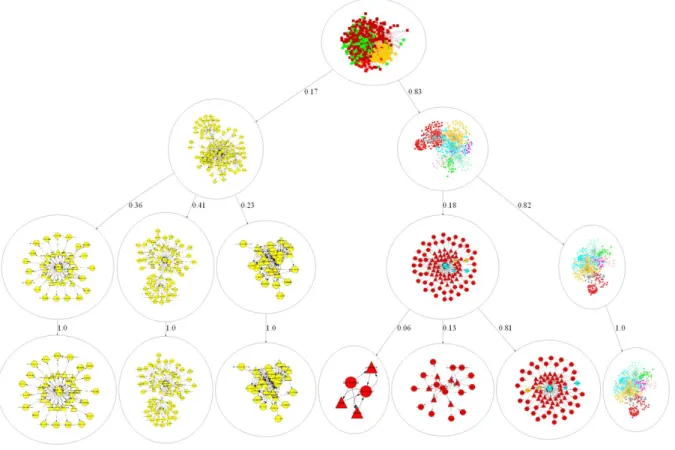
21 Top-Down Topic Hierarchy . . . 66
22 Bottom-Up Topic Hierarchy . . . 67
23 DrugBank Topic Hierarchy. . . 78
24 Optimal K Validation using Multiple Clustering Techniques. . . 82
25 Topic Rankings for DrugBank. . . 83
26 Optimal Radius with Silhouette Width . . . 84
27 Optimal Radius with Number of Topic . . . 85
28 Optimal Radius with Topic Size . . . 85
29 DBpedia:Optimal Branching with Clustering Algorithms . . . 86
30 YAGO:Optimal Branching with Clustering Algorithms . . . 87
31 DBpedia Topic Hierarchy . . . 87
32 YAGO Topic Hierarchy . . . 88
33 DBpedia Topic Summary . . . 89
34 YAGO Topic Summary . . . 89
35 DBpedia Topic Ranking . . . 90
36 YAGO Topic Ranking . . . 90
39 DBpedia Similarity Measurement with GraphKDD . . . 95
40 YAGO Similarity Measurement with GraphKDD . . . 96
41 DBpedia SimRank Similarity Measurement . . . 99
42 YAGO SimRank Similarity Measurement . . . 100
43 GraphKDD vs. Graph Partition on DBpedia . . . 101
44 GraphKDD vs. Graph Partition on YAGO . . . 102
45 GraphKDD vs. LDA . . . 104
46 Bio2RDF 13 domain Topic Visualization with HPKM and PHAL . . . 110
47 Bio2RDF Topic Statistics with HPKM and PHAL . . . 111
48 Bio2RDF Topic Ranking with HPKM and PHAL . . . 112
49 Bio2RDF Dominant Topic Visualization with HPKM and PHAL . . . 113
50 Bio2RDF Dominant Topic Content with HPKM and PHAL . . . 114
51 Bio2RDF Topic Similarity with HPKM . . . 116
52 Bio2RDF Topic Similarity with PHAL . . . 117
53 Bio2RDF Topic Similarity with HPKM and PHAL . . . 118
54 SPARQL Endpoint: Query Example. . . 127
55 GraphKDD Interactive Query Tool . . . 127
56 Automatic Query Generation . . . 131
57 Topic Aware Link Discovery . . . 134
58 Topic 3 4 (T3 4) Graph in DrugBank. . . 141
59 Query-1 SPARQL in DrugBank. . . 141
61 Topic 3 7 (T3 7) Graph in DrugBank. . . 143
62 Query-2 SPARQL in DrugBank. . . 144
63 Results of Query-2 in DrugBank. . . 145
64 Topic 3 6 (T3 6) Graph in DrugBank. . . 146
65 Query-3 SPARQL in DrugBank. . . 147
66 Results of Query-3 in DrugBank. . . 148
67 Topic 3 2 (T3 2) Graph in DrugBank. . . 149
68 Query-4 SPARQL in DrugBank. . . 150
69 Results of Query-4 in DrugBank. . . 151
70 Size for Each dataset . . . 153
71 Pre-Processing Performance for GraphKDD . . . 154
72 Pre-Processing Performance between GraphKDD and LIMES . . . 155
73 Processing Performance between GraphKDD and LIMES . . . 155
74 Bio2RDF 9 Domains Topic 16 . . . 157
75 Bio2RDF 9 Domains Topic 27 . . . 158
76 Path between Topic 16 and 27 . . . 159
77 Drug Target Association Query. . . 160
78 Drug Target Association Query Results. . . 161
79 The SLAP Interface . . . 161
80 The GraphKDD Framework . . . 166
83 Visualization of Hierarchical Fuzzy C-Means Clustering . . . 178
84 Detailed Information for Topic 1 . . . 180
85 Detailed Information for Topic 2 . . . 181
86 Detailed Information for Topic 3 . . . 182
87 Detailed Information for Topic 4 . . . 183
88 Detailed Information for Topic 5 . . . 185
89 Detailed Information for Topic 6 . . . 186
90 Detailed Information for Topic 7 . . . 187
91 Detailed Information for Topic 8 . . . 188
92 Predicate Oriented Clustering Decision Making on Different Levels (A) . 189 93 Predicate Oriented Clustering Decision Making on Different Levels (B) . 190 94 Predicate Oriented Clustering Decision Making on Different Levels (C) . 190 95 Predicate Oriented Clustering Decision Making on Different Levels (D) . 191 96 Correlation Matrices for Golden Standard . . . 192
97 Cross Complications Queries . . . 194
TABLES
Tables Page
1 Comparison among Graph Analysis Approaches . . . 9
2 RDF Notation . . . 14
3 Summary of Patterns . . . 23
4 Datasets Summary . . . 31
5 Average Similarity Measurement . . . 31
6 Top 3 Predicates for 5 Top Topics with Bio2RDF 9 Domains . . . 34
7 Top 2 Unique Predicates for 5 Top Topics Bio2RDF 9 Domains . . . 34
8 Provider Pattern in Topic 25 . . . 39
9 Consumer Pattern in Topic 15 . . . 41
10 Reacher Pattern in Topic 22 . . . 43
11 Directional Connector Pattern in Topic 16 . . . 45
12 Non-Directional Connector Pattern in Topic 23 . . . 49
13 The GraphKDD with Graph Partition Algorithms . . . 56
14 The GraphKDD with Clustering Algorithms . . . 56
15 Data Statistics . . . 74
16 DrugBank Ontology . . . 75
19 Duplicated Concepts and their Topic ID in DrugBank Ontology . . . 80
20 Clustering Comparison . . . 86
21 Average Topic Similarity Comparison for GraphKDD . . . 97
22 Average Topic Similarity Comparison for SimRank . . . 98
23 Cross Domain Clustering: PHAL vs. HPKM . . . 106
24 Cross Domain Concepts and Predicates before/after Clustering . . . 107
25 Cross Domain Neighborhood Patterns . . . 108
26 Bio2RDF HPKM vs. PHAL . . . 109
27 Average Topic Similarity Comparison for Cross Domain GraphKDD . . . 115
28 Classification Evaluation . . . 118
29 Case Study Datasets: Ontologies . . . 121
30 Complexity for HPKM and PHAL . . . 139
31 Topic Awareness Statistics for GraphKDD . . . 156
32 Top 5 Drug Instances . . . 162
33 Comparison Results Between GraphKDD and SLAP . . . 164
34 Clinical Free Text . . . 173
35 Mapping among Clinical Free Text, MedTagger Terms and RDF Triples . 174 36 Definition of Colorectal Post-surgical Complication . . . 197
ACKNOWLEDGEMENTS
First of all, I’d like to give sincere thanks to my research advisor, Dr. Yugyung Lee. Dr. Yugyung Lee gave me the best guidance in doing my research and in helping me to solve problems as well as overcome difficulties. She always encouraged me to pursue the highest quality of research work in terms of writing paper and experimental evaluations.
I also want to thank my other Ph.D. committee members Drs. Baek-Young Choi, Cui Tao, Praveen Rao, Yongjie Zheng, Yuji Zhang and Zhiqiang Chen. As a co-displine committee member, Dr. Choi gave me a good insight in the network area and made me think more in many different aspects. Dr. Tao was my previous supervisor at the Mayo Clinic when I did my 2012 summer Ph.D. internship. She trained me wonderfully in ontology management and data normalization. Dr. Rao’s team and our group shared the same lab room, which increased the opportunity of having conversations with him. His intelligence and valuable feedback always helped me in research, job searching, and my personal life. Dr. Zheng and I collaborated on a class entitled “Software Method and Tools”. At that time, I was his teaching assistant. During his class, I learned how to become an outstanding lecturer and how to make students interested in the class. On research sites, Dr. Zheng’s word always inspired me: “doing research is just like climbing a circling mountain. Sometimes we are facing sunshine, but most of the time we are facing
Dr. Yuji Zhang was also my previous supervisor from the Mayo Clinic when I did my 2013 summer internship there. She trained me how to use CytoScape, a visualization tool that is commonly used in the biomedical domain. With the help of CytoScape, I was able to generate all visualizations throughout my research. Dr. Chen and I collaborated on mobile cloud computing research in the past. His dedication and great insight influenced me tremendously. I’d like to give thanks again to all the committee members for their support and help throughout the formation of my dissertation and academic endeavors.
Moreover, I’d like to give thanks to the UMKC School of Graduate Studies (SGS) for awarding me the research grant to support my academia research from 2014 to 2015 and training me as a leader in the Graduate Student Professional Development Program. I also want to thank School of Computing and Engineering (SCE) for supporting me with Research/Teaching Assistant Scholarship, Travel Grant and giving me the Outstanding Doctoral Student Award in 2014.
In addition, I want to give thanks to all members of UMKC Distributed Intelligent Computing (UDIC) Group for their help on my study and research.
Finally, I would like to thank my family. My wonderful wife, You Wan has always given me support during my Ph.D. work. My parents gave me not only financial support but they also encouraged my spirit even though they live in China. I would like to thank each of them for making this possible.
CHAPTER 1 INTRODUCTION
In this chapter, we first give a basic overview of current approaches and solutions on big graph knowledge discovery and analysis. We then elaborate the motivation for developing the GraphKDD framework and the contributions we have made.
1.1 Problem Statement
Today, the main challenge we are facing in knowledge discovery research is the big data problem associated with large, complex, and dynamic variations of formats. There is no capacity to carry out analysis of these datasets, because we do not have the appropriate tools and computational infrastructure that can be fully understood and uti-lized by involved personnel. As the demand for the integration and analysis of such data has been growing steadily, the first effort toward connecting scattered data materialized as a data movement by a different community, i.e., the Linked Open Data (LOD) [8].
In order to extract a cohesive structure and semantics, it is essential to know what information exists and what significant relationships are among the related domains. The Semantic Web is able to provide a platform of information exchanges for different knowl-edge bases. Increasingly, we are also seeing the emergence of cross domains among different datasets. Especially, in the biomedical informatics domain, data normalization
Bio2RDF [10], OBO [112], LinkedCT [50]). For example, the Semantic Web Health Care and Life Sciences Interest Group (HCLSIG [23]) was formed to “improve collaboration, research and development, and innovation in the information ecosystem of the health care and life science domains using Semantic Web technologies.” Under this drive, the large amounts of data have been specified and shared via machine-readable formats, such as a Resource Description Framework (RDF) [66] and Ontology Web Language (OWL) [9]. The ontologies are developed to easily extend the work of others and share across different domains. The Semantic Web technologies make it easier and more practical to integrate, query, and analyze the full scale of relevant data from various domains.
1.2 Motivation
To make seamless interoperability and interchanges among heterogeneous datasets, significant difficulties still exist. There are some existing promising semantic approaches for linking different datasets; however, they are computationally expensive and imprac-tical for large scale ontologies since these works may still require human intervention. Furthermore, as the size of data increases drastically, it is difficult to discover informa-tion from structured/unstructured data in a single domain or cross domains, especially for those researchers with expertise in a specific domain. Thus, we need to reduce human intervention with the help of process automation in the extraction and integration of se-mantics from structured or unstructured data.
For extraction of a cohesive structure and semantics from structured or unstruc-tured data, identification of meaningful linking, either together within or across a large
number of ontologies, is necessary. Especially in biomedical informatics domains, vS-parQL [105] was introduced to enable application ontologies to be derived from these large, fragmented sources such as the FMA [104]. A series of queries might be generated using large ontologies like the NCI thesaurus by extracting relevant information that is desired for applications [83]. The GLEEN project aims to develop a useful service for simplified, materialized views of complex ontologies [30]. However, these works are lim-ited due to the lack of the comprehensive semantic analysis of large sources and the usage of the knowledge for query processing. We need to connect related information through a reference ontology that becomes a platform to link together multiple ontologies that cover a broad range of related information. Advanced techniques are needed to analyze these larger reference ontologies, rather than simply getting a slice of a reference ontology and applying it for a query process or decision support [83]. There is also some related work on using K-Means and Fuzzy C-Means for clustering microarray data [114] [29], but nei-ther of them are concerned about the semantics of data nor hierarchical clustering.
Today is the world of information explosion. With the increase of research in big data, more and more datasets from different domains have been added to the existing LOD (e.g., DBPedia [12]), which makes highly complex relationships and condensed in-terlinks among the large number of these knowledge bases. To some extent, the speed of data growing in terms of multiple domains is much faster than that of the large amount of knowledge people can acquire and consume in their daily lives. In other words, since different datasets are physically grouped instead of semantically clustered, it is extremely
difficult for people without expertise to extract knowledge from various domains nowa-days. Therefore, there is a big gap between human limited knowledge and the large amount of knowledge that can be discovered from this huge amount of data.
1.3 Contribution
In this work, we apply a RDF predicate oriented pattern analysis methodology and combine the advantages of Machine Learning with the added rigor of machine-readable semantics in extracting information and generating queries applicable for knowledge dis-covery. A pattern based predicate oriented similarity measurement gives a close rela-tionship among predicates and generates a similarity matrix. An unsupervised learning algorithm works on the similarity matrix to build smaller topics that hold the closest do-main and knowledge inside. In addition, queries are evaluated by measuring the content of information, identifying possible extensions or compositions of queries and making a comparison with an existing query benchmark. We develop a prototype of the GraphKDD system and evaluate the proposed query model based on predicate oriented clustering with different domains of datasets. More specifically, the contributions of this work are as fol-lows:
• A Predicate Oriented Neighborhood Patterns (PONP) analysis model to quantify the close relationship among different RDF predicates with cross domains knowledge bases (Chapter 2);
• A Hierarchical Predicate oriented K-Means clustering (HPKM) and a Predicate ori-ented Hierarchical Agglomerative clustering (PHAL) approach to partition graphs
into small semantically related sub-graphs with different purposes (Chapter 3); • A dynamic query generation algorithm from outputs of topic discovery (Chapter 4); • A topic aware link discovery algorithm to efficiently find paths with a context
be-tween the source and target nodes (Chapter 4);
• An ontology learning framework is proposed to extract keywords from unstructured data with a natural language processing technique and build an ontology based on retrieved words for further analysis (Chapter 5);
• Comprehensive experiments and evaluations for the proposed framework using DB-Pedia [12], Yago [115] and Bio2RDF [10] datasets (Chapters 2-5).
The rest of this dissertation is organized as follows. We first define primary con-cepts that are the basic building blocks of the Predicate Oriented Neighborhood Patterns (PONP) and present evaluation results related to the similarity measurement and pat-tern analysis in Chapter 2. In addition, we elaborate Hierarchical Predicate oriented K-Means clustering (HPKM) and Predicate oriented Hierarchical Agglomerative clustering (PHAL) approaches in detail and demonstrate their different features and running pur-poses in Chapter 3. Moreover, we introduce automatic query generation and topic aware linking discovery tools with experiment results in Chapter 4. Furthermore, we extend the functionality of the GraphKDD framework to make it suitable for retrieving information from unstructured data and adopting ontology building and learning as a further analysis
CHAPTER 2
PREDICATE ORIENTED NEIGHBORHOOD PATTERNS 2.1 Introduction
We develop a pattern-based approach, called Predicate Oriented Neighborhood Patterns (PONP) to measure the similarity of graph. Fig. 1 shows the framework of the GraphKDD. The fundamental technique of the GraphKDD framework is PONP and its association similarity. PONP measures predicates similarity and quantifies relationship among predicates. Basically, the further two predicates locate, the less similarity score they are assigned.
On top of this base, we apply a top-down and a bottom-up unsupervised learn-ing approaches to conduct a cluster analysis with similarity matrices generated accordlearn-ing to PONP. Specifically, the top-down approach focuses on global optimization while the bottom-up approach is suitable for finding local optimization. Based on this observation, the top-down approach is suitable for single domain dataset clustering and the bottom-up approach is suitable for cross domains dataset clustering. Both of these techniques play an important role in divide a predicate space into several topics with similar contexts.
The GraphKDD framework supports full-fledged features of knowledge discov-ery including topic discovdiscov-ery from ontology, qudiscov-ery generation from topics, source target reachability testing and path finding with context awareness. The topic discovery tool helps users to find related topics with similar contexts. Queries automatically generated
from topics can be used to guide users to discover interesting topics of domains. The path finding tool generates all possible paths between the source and the target nodes based on the results from topic discovery process. More useful information can be found through the analysis of the paths starting from the source to the target.
In the GraphKDD framework, the underlying representation of data is based on “RDF that is a standard model for data interchange on the Web. RDF has features that fa-cilitate data merging even if the underlying schemas differ, and it specifically supports the evolution of schemas over time without requiring all the data consumers to be changed.” As Fig. 1 shows, data from heterogeneous data sources will be converted, integrated and represented in RDF in GraphKDD. In this chapter, we first conduct a thorough survey of previous work on graph analysis and compare them with our PONP approach. Further-more, we give a formal definition of the PONP approach and explain how to measure the PONP association in details.
2.2 Related Work
In this section, we present the state-of-the-art in graph analytics and then compare them with our work. In addition, the design of the PONP pattern will be justified.
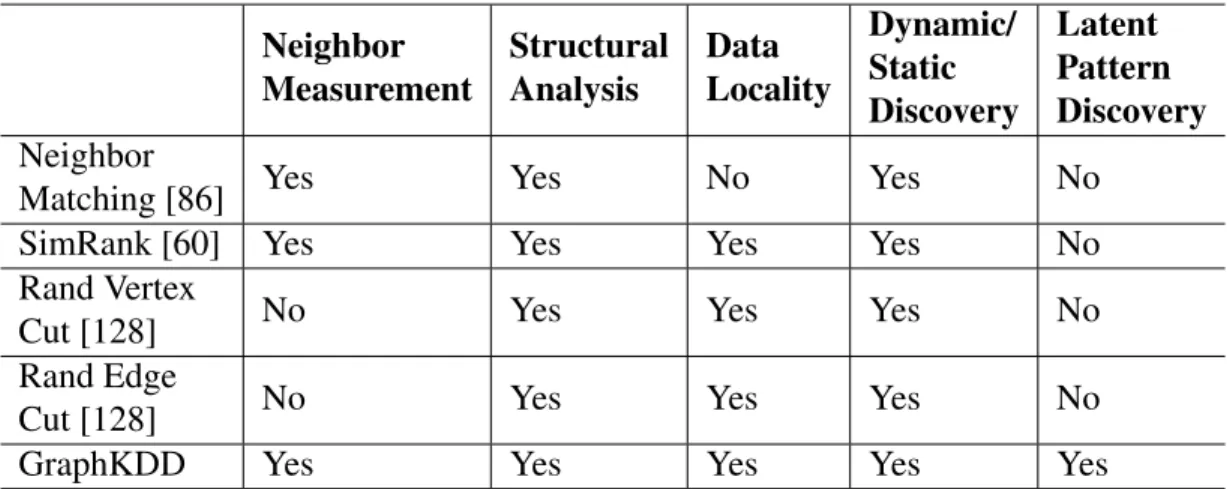
Among some graph partition algorithms, SEDGE [130] provided a complemen-tary partition approach to eliminate cross domain edges to facilitate query performance. SEDGE also proposed an on-demand partition to handle unbalanced query workload. Unfortunately, the partition is mainly based on physical relationships rather than
Table 1: Comparison among Graph Analysis Approaches
Research Methods Limitation
SEDGE [130] Complementary partition, On-demand partition ->query Physical partition non-semantic Mizan [64] Dynamic graph partitioning
strategies ->load balance
Physical partition non-semantic GoFFish [111]
Subgraph centric. Connected
component ->graph analytics
Physical partition non-semantic Similarity-Driven Semantic Role Induction via Graph Partitioning [69]
Unsupervised method for semantic role induction.
Vertex centric clustering to partition No
cross domain
Bulk Synchronous Parallel (BSP) [40] programming model. Mizan focused on dynam-ically efficient load balancing in terms of computation and communication among all worker nodes. It achieved load balancing by using fine-grained vertex migration in a distributed manner. In Mizan, a vertex centric model was designed, mainly focused on the size balance load of the graph rather than design of data migration by analyzing the contexts of work. Goffish [111] is a distributed approach that is sub-graph centric with connected components and furthermore makes abstraction for a large scale graph for an efficient graph analytics. This model combined the advantages of both the vertex centric approach and the shared-memory algorithms. However, Goffish does not support any con-text awareness. Similarity Driven Semantic Role Induction via Graph Partitioning [69] is a vertex centric unsupervised method for semantic role induction. But in this work, cross
Compared to the existing approaches, the PONP pattern not only provide structure-based graph analysis but also support context awareness by analysis of topic information and description. In this sense, the PONP approach provides a better solution to partition both homogeneous and heterogeneous graphs in a different manner by grouping semanti-cally related contents as well as similar contexts in sub-graphs.
Pattern based approaches were introduced for data mining and knowledge discov-ery. Specifically in biomedical informatics domain, Warrender and Lord [125] proposed an axiom based generalized and localized pattern driven approach in biomedical ontol-ogy engineering. Wang et al., [124] designed a biomedical pattern discovery algorithm based on a supervised learning approach. Rafiq et al., [91] developed an algorithm to discover temporal patterns in genomic databases. Van Leeuwen and Matthijs proposed an interactive way to do data mining by applying pattern mining in [121]. Gotz et al., [44] used electronic health record data as a use case to introduce an approach to perform data mining and visual analysis on clinical event pattern. Meanwhile, WHIDE [44] is a tool for colocation pattern mining in multivariate bioimages. Huang et al., [55] accomplished the goal of clinical pathway pattern discovery by using probabilistic topic models. Lasko et al., [70] introduced a computational phenotype pattern discovery with unsupervised learning on clinical data.
There are also many related work in general computer science research on pat-tern analysis and knowledge discovery. Trinity [132] performed graph mining on web scale RDF data by decomposing SPARQL queries into smaller subsets of triple patterns and then applied a sequence of graph explorations to come up with the combination of
different triple patterns. k2-Triples provided a compressed indexing approach to handle large RDF data in memory. It can also support triple pattern queries on such indexed RDF representation. RDFPeers [15] is a P2P based scalable distributed repository that supports disjunctive query pattern and conjunctive query pattern that were built based on atomic triple patterns. SPARQ2L [3] defined a formal syntax for path pattern expression to extract subgraph and find path in RDF databases.
However, our approach is different from these work. None of these techniques support measuring association among nodes. Moreover, none of these approaches handle both homogeneous and heterogeneous context. In this perspective, the PONP approach can find patterns within a defined boundary and support different strategies for discov-ering knowledge in a single domain as well as cross domains. What is more, the PONP focuses on a more general approach for graph structural pattern analysis and discovery. In addition, we have combined an unsupervised learning algorithm with a pattern discovery technique to provide a more dynamic way of knowledge discovery from large amount of ontologies.
Similar to our approach, there are also several research focus on predicate oriented approach to perform graph analysis. Shi, Baoxu, and Tim Weninger provided a predi-cate oriented path finding approach to do fact checking in large knowledge graph [110]. VEPathCluster [134] proposed a combination of vertex-centric and edge-centric approach for meta path graph analysis to enhance clustering quality of cross domains datasets. In addition to the path finding feature, the PONP approach formulates the relationship among
RDF predicates which form the prerequisite of topic discovery and federated query gen-eration.
Besides predicate oriented graph analysis, there are also many work on concept based approach. Alani et al., [1] proposed a concept structure based ontology ranking system. Stuckenschmidt et al., [113] gave a graph partition solution by applying concept hierarchy. Formica and Anna [39] measured the formal concept analysis similarity by using ontology based approach. However, we decide to use predicate oriented approach for the reasons that i) predicate is easy to connect multiple domains which brings more information; ii) predicate is unique only referring to the unique context in a domain; iii) predicate maintains the same representation for both schema and data level, which leads to a easier way to apply schema level learning results to data level.
What is more, some researchers have conducted study on similarity measurements to do graph analysis and graph partition. Rouzbeh Meymandpour et al., [80] proposed a feature based semantic information content measurement for linked open data. Positive Matching Index (PMI) was given by Daniel et al., to measure similarity with optimal lists of attributes [33]. Other popular similarity measurement approaches such as Sim-Rank [60] and [86] provided the idea of using neighborhood similarity to define node similarity, which is similar to PONP. However, our approach mainly focuses on a dy-namic similarity assignment mechanism based on the boundary and distance of predi-cates’ neighborhood.
Based on literature review and related work comparison, we propose Predicate Oriented Neighborhood Patterns (PONP). This approach specifies high connectivity on
the RDF/OWL graph for information sharing and integration. A predicate P is represent-ing a binary relation between two concepts (c1 and c2) in ontology. In RDF/OWL, P is represented as a property to express a kind of relationship (e.g., rdfs:subClassOf) between domain (subject) and range (object). The subject and object can be either from the same ontology or from different ontologies. In our study, relationships are defined by the empir-ical analysis of ontology data. We are particularly interested in predicates (relationships) that are different from existing approaches like PSPARQL [20] and SPARQLer [21].
Apart from being similar, predicates may share other aspects, e.g., sharing the same subjects or the same objects as well as the connectivity between predicates. This forces not only on concepts among graphs but also relationships of the concepts.
2.3 Formal Definition of Pattern and Topic
This research mainly focuses on doing knowledge discovery and ontology learn-ing from the information network. Here we formally define some related terms that cov-ered by this research.
• Information Network: The network with the ability to do content information ex-change and holds complex linked relationship.
• Homogeneous Information Network: The information network shared the same context and resource. Referred as single domain datasets in this work.
con-Table 2: RDF Notation Shape Meaning Circle RDF Concept Triangle RDF Predicate Line Relationship Arrow Direction
In the GraphKDD framework, the knowledge model is defined by levels of ab-straction: (i) the smallest component is a predicate (relation) from a information network (RDF graphs), (ii) the intermediate component is a pattern that is defined by groups of predicates, (iii) at a higher abstraction level, a topic can be discovered from groups of patterns, and (iv) the highest level of abstraction that can be presented as an analytical view of multiple ontologies (cross domains). The relationships of ontologies (domains) can be determined from a comprehensive analysis of the discovered topics and patterns of predicates.
As the predicates define the relationships between subjects and objects, it is inter-esting to see that the relationships among subjects and objects are nicely defined through patterns and topics. In this research, we define the Predicate Oriented Neighborhood Pat-terns (PONP) that describes the association and collaboration among different predicates (relationships) and concepts in information networks. There are basically two types of the PONP patterns: Share PatternandConnectivity Pattern.
For different patterns introduced below, graph visualization notation is shown in Table 2.
Definition 1: Share Pattern This pattern describes the resources sharing relationships between predicates where the resources are concepts from a information network (RDF
graphs). Given two tripleshSi, Pi, Oii,hSj, Pj, Oji, the conditions of the share pattern are
defined as follows:
∀Si ∈Di,∀Pi ∈Di,∀Oi ∈Diand∀Sj ∈Dj,∀Pj ∈Dj,∀Oj ∈Dj
(Pi 6=Pj)&&(Si ==Sj||Oi == Oj)&&(Di 6=Dj).
where the logical OR operator (||) returns the Boolean value true if either or both operands is true and returns false otherwise, the logical AND operator (&&) returns the Boolean value true if both operands are true and returns false otherwise. For all (denoted by∀)Si,
for allPiand for allOi are in a domainDi and for allSj, for allPj, and for all Oj are in
a domainDj, but these two domainsDi andDj are different.
There are three types of Share patterns are defined as follows:
• TheProviderpattern describes the relationship with a pair of predicates sharing a common object, describes the provider role of entity giving information to Con-sumers. This role has more out-degree edges than in-degree edges.
• TheConsumerpattern describes the relationship with a pair of predicates sharing a common subject, describes the role of entity receiving information from Providers. Consumer has more in-degree edges than out-degree edges.
• The Reacher pattern describes the relationship with a pair of predicates having a same concept as a subject and object, describes the role connecting the Provider
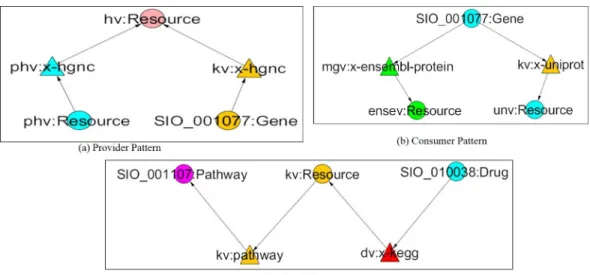
Figure 2: Share Patterns
Three share patterns (Provider, Consumer, Reacher) are shown as an example. In this diagram, the circle represents a concept and the triangle represents a predicate. Different colors indicate
various domains they come from
Fig. 2 shows the share patterns from Bio2RDF datasets such that (a) Provider pattern: the objecthv:resourceis shared through two predicatespv:x-hgncandkv:x-hgnc (b) Consumer pattern: the subjectSIO 001077:Geneis shared with two predicates mgv:x-ensembl-proteinandkv:x-uniprot(c) Reacher pattern: a conceptkv:Resourceis shared by two predicatesdv:x-keggandkv:pathway.
Definition 2: Connectivity PatternThis pattern describes the connectivity relationships at least three predicates in a information network. This Connectivity pattern is defined using the Reacher pattern from Definition 1. A subject (Si) in a source domain (Di) is
connected to an object (Oi) in a target domain (Dj) through cross domains connectivity
predicates (Pi, Pj ∈ Pc and Di 6= Dj). The pattern of the source domain or the target
Figure 3: Connectivity Patterns
Two connectivity patterns (DC and NDC) are shown as an example. In this diagram, the circle represents a concept and the triangle represents a predicate. Different colors indicate various
Directional Connector(DC) andNon-Directional Connector(NDC).
• TheDCpattern describes the connectivity pattern considering the direction of the edges between predicates whose distance is higher than equal to 2.
• TheNDCpattern is same with the DC pattern in terms of the predicate collaboration for indirect connectivity, however, the edge directions are not considered in this NDC pattern.
This Connectivity pattern is formally defined as follows: Given aReacherpattern hSs, Ps, Osiand a new triplehSi, Pi, Oii, the conditions of the connectivity pattern are as
follows:
∀Ss ∈Ds,∀Ps ∈Ds,∀Os ∈Dsand∀Si ∈Di,∀Pi ∈Di,∀Oi ∈Di
(Ps 6=Pi)&&(Os ==Si)&&(Ds6=Di).
where the logical AND operator (&&) returns the Boolean value true if both operands are true and returns false otherwise. For all (denoted by∀)Ss, for allPs and for allOs are
in a domainDsand for allSi, for allPi, and for allOi are in a domainDi, but these two
domainsDsandDiare different.
Fig. 3 shows the Connectivity patterns in Bio2RDF datasets such that the subject and object are connected through three predicates: (a) Directional Connector (DC) among three predicates dv:x-hgnc, hv:x-omim, ommimv:x-mgi (b) Non-Directional Connector (NDC) among three predicatesmgv:x-refseq-transcript,ctdv:pathway, and ctdv:disease.
We build topics based on different pattern predicates draw. We formally define topic and topic boundary in Definition 3 and 4.
Definition 3: TopicThetopicdescribes bounded contexts through association patterns of both shared and connected predicates in a information network. Different topics may have completely different associations among any common predicates. In a graph to represent the topic (called the topic graph), a group of predicates collaborate each other to share and connect information through the predicates of the PONP patterns.
Definition 4: Topic Boundary The topic boundary (denoted as B) defines the scope of context in which the information can be associated and shared, and connected in a information network. The association and collaboration of information is described in terms of sets of concepts and relations within the given boundary on the information network.
Topic boundary can be depicted by topic radius and topic centrality defined by Definition 5 and 6.
Definition 5: Topic RadiusThe topic radius(denoted asR) defines the distance D be-tween topic center to any other target nodes within one topic.
Definition 6: Topic Centrality The topic centrality (denoted as C) defines the center node for each topic. The center is calculated as the mean value of all predicate nodes within one topic. BoundaryB can be determined by centralityCand radiusR.
Boundaries between contexts (topics) can be determined by various factors. Usu-ally the dominant one is strongly associated with others so that this can be measured
be set differently depending on the domains of interest. Multiple contexts can be found within the same domain context and similarly a single context can be found across multi-ple domains.
Based on five basic patterns, we give Theorem 1 and 2 with proof to demonstrate the relationship among different patterns.
Theorem 1. For∀ReacherpatternR andDCpatternD . ifR andD share the same predicateP, thenR $D .
Proof. Suppose ∀ concepts C, Pa and predicate P form a Reacher pattern, so that
Pa→C→P and
C, P, Pa =
R . Suppose ∀ concepts C, Cb and predicate P, Pa,
Pb form aDCpattern, so thatPb→Cb→Pa→C→P and Pb, Cb, Pa,C,P = D . Be-causeC, P, Pa ⊂ Pb, Cb, Pa, C, P , therefore, R ⊂
D . Because the number of predicates inR is less than k, and the number of predicates inD is larger than or equal to k, soR 6=
D . Therefore,R $D .
Theorem 2. For∀Provider patternV andConsumer patternC , andNDC pattern
N , if they share the same predicateP, thenV $N andC $N .
Proof. Suppose ∀ concept Ca and predicates P, Pa form a Provider pattern, so that
Pa→Ca←P and
Ca,P,Pa =
V . Suppose∀conceptCband predicatesP,Pb form a
Consumerpattern, so thatP←Cb→Pb and
Cb, P, Pb =
C . Suppose∀conceptsCa,
Cband predicatesPa,Pb,P form aNDCpattern, so thatPa→Ca←P←Cb→Pband Ca, Cb, P, Pa, Pb = N . Because Ca, P, Pa ⊂ Ca, Cb, P, Pa, Pb , Cb, P, Pb ⊂ Ca,Cb,P,Pa,Pb , so V ⊂ N andC ⊂
inV andC is less than k, and the number of predicate inN is larger than or equal to k, soV 6=
N andC 6=
N . Therefore,V $N andC $N .
Based on Theorem 1 and 2, we also give Lemma 1, which indicates that DC pattern must be composed by Reacher pattern and NDC pattern must be composed by Provider or Consumer patterns.
Lemma 1. DCpattern must be composed byReacher pattern andNDCpattern must be composed byProviderorConsumerpatterns.
Proof. if ∃ a DC pattern, as Theorem 1 shows, there must be a Reacher pattern share a common predicate P with DC pattern. Therefore, DC pattern must be composed by Reacher pattern. Similarly, if ∃ a NDC pattern, as Theorem 2 shows, there must be a Provider pattern or Consumer pattern share a common predicate P with NDC pattern. Therefore,NDCpattern must be composed byProviderorConsumerpattern.
Based on Theorem 1, 2 and Lemma 1, we conclude that in any RDF graph, Predi-cate oriented Patterns can cover all the prediPredi-cate neighborhood cases as shown in Theorem 3.
Theorem 3. In ∀ RDF graph, predicate oriented Provider pattern, Consumer pattern, Reacherpattern,DCpattern andNDCpattern cover all the predicate neighborhood cases. Proof. In ∀ RDF graph G, the basic component is triplet. Suppose ∀ predicate neigh-borhood triplet in G as Pa, C, Pb , there are four cases with different combination of
Case 1) and 4) belong toReacher pattern. Therefore, three shared patterns cover all the basic cases. In addition, as Lemma 1 shows,DCpattern is composed byReacher pattern, NDC patterns can be composed by Provider, ConsumerandReacher pattern, therefore, five patterns are enough to cover all predicate neighborhood cases.
As a summary, Table 3 gives notations of each pattern. In this table, S denotes subject, P denotes predicate and O denotes object. In general, there are two patterns: Share pattern and Connectivity pattern. Specifically, general patterns involves Provider pattern, Consumer pattern and Reacher pattern. Triple properties examples for these three patterns are described in Table 3. Similarly, Connectivity pattern includes a Directional Connector pattern and a Non-directional Connector pattern. In Table 3, we use examples with three predicate notations to demonstrate them.
2.4 Association Measurements for Predicate Oriented Neighborhood Patterns
We now define the measurement for the Predicate Oriented Neighborhood Patterns (PONP) in terms of sets of concepts and relations (predicates) within a single domain or cross domains. For this purpose, we describe how to quantify associations between dif-ferent predicates. It is based on the PONP pattern describing the relationships between predicatesPiandPj through a conceptC.
The association measurement for the PONP patterns varies based on different neighboring levels for each pair of predicates. Basically, we give a higher shared score to predicates with more shared concepts and lower scores to predicates with less shared concepts. Similarly, we give a higher connection similarity score to closer predicates and
Table 3: Summary of Patterns
General Pattern Specific Patterns Triple Properties
Share Pattern Provider
Si->Pi->Oi & Sj->Pj->Oj & Oi = Oj Consumer
Si->Pi->Oi & Sj->Pj->Oj & Si = Sj Reacher Si->Pi->Oi & Sj->Pj->Oj & Oi = Sj|Oj = Si
Connectivity Pattern Directional Connector Pattern
Si->Pi->Oi & Sj->Pj->Oj & Sk->Pk->Ok & (Oi = Sj, Oj =Sk)| (Oj = Si, Oi = Sk)| (Oi = Sk, Ok = Sj)| (Oj = Sk, Ok = Si)
Non-Directional Connector Pattern
Si->Pi<-Oi & Sj->Pj->Oj & Sk->Pk<-Ok & (Oi = Sj, Oj =Sk)| (Oj = Si, Oi = Sk)| (Oi = Sk, Ok = Sj)| (Oj = Sk, Ok = Si) lower scores to further predicates.
The patterns are discovered with the bounded contexts which are a central concept in knowledge discovery. The clustering technique is applied to partition a large and com-plex network into multiple smaller topics in the same context in an optimal manner. The bounded contexts are specifically tailored for a set of cross domains patterns. The bound-aryB is determined based on the distanceL(without considering direction) between any
We formally define the association measurement and its related concepts in Defi-nition 7-12.
Definition 7: Degree of AssociationThedegree of associationis defined to measure the degree of the association between predicates in a information network. The degree is de-fined with a weight assigned to links between predicates. The weight can differentiate the degree of the association between predicates. The rationale is to capture cross domains relations between predicates by giving a higher weight to the links across domains while giving a lower weight to links in a single domain. The degree is strongly related to the topic boundaryB. As we are mainly interested in the relationships within the boundary, the weight strategy will be changed depending on the topic boundary.
In this research, we set the topic boundaryB as 3 after heuristic evaluation and testing. In other words, the maximum distance between predicates (without considering the direction) in a topic is 3. Formal definition of ontology association and association distance are shown in Definition 8 and 9.
Definition 8: Ontology Association The Ontology Association defines the association among ontologies that depicts a high level of views on cross domains collaboration. Based on the predicate collaboration in the PONP patterns, the ontology association and collab-oration model can be defined. For each pattern, the top K predicates are considered to build the ontology association model that represents the abstract relationships between these topics.
Definition 9: Topic Association The Topic Association indicates the distance between topics that describes the relationship and association among topics. It is calculated by
measuring the distance or dissimilarity between center nodes for each topic.
Definition 10: Association Distance The association distance defines the distance be-tween associated predicates in a information network. Given a directed graphG(C,P), conceptsC denote subject S and objectO andP predicate in a RDF schema graph, re-spectively. Letd(Pi,Pj) represent the number of conceptsCbetweenPiandPj. r(Pi,Pj)
determines if a predicatePiis reachable from another predicatePj where the domainDi
ofPi is not the same from the domainDj ofPj, i.e.,Di 6=Dj, without considering the
direction of links). l(Pi,Pj) indicates the shortest distance betweenPi andPj.
l(Pi, Pj) = 0 Pi =Pj 1 d(Pi, Pj) = 1 L1+L2 L1 =d(Pi, Pk), L2 =d(Pk, Pj)
r(Pi, Pk) =true, r(Pk, Pj) =true, r(Pi, Pj) =true
(2.1)
The direct association describes the direct relationship between Pi andPj in the
distance L = 1 that is within the boundary B. The indirect association describes any relationship betweenPi andPj in distanceLcomputed by Eq. (2.1) within the boundary
B, i.e.,1 < L ≤ B. The share pattern is the directed association while the Connectivity pattern is the indirect association. We now define these two probability based similarity scores: i) [SA](Pi, Pj) is defined a share pattern of any two predicates Pi and Pj ii)
[CA](Pi, Pj)for a Connectivity pattern of any two predicates.
Definition 11: Share AssociationGiven predicatesPi andPj in a directed RDF schema
betweenPiandPj. SA(Pi, Pj) = 1 l(Pi, Pj) = 0 0 l(Pi, Pj)→ ∞(nolink) (|C(Pi)|∩|C(Pj)|)2 |C(Pi)|∗|C(Pj)| otherwise (2.2)
Definition 12: Connectivity AssociationFor a connectivity pattern of any two predicates Pi andPj,CA(Pi, Pj)defines the probability-based association for a connectivity pattern
betweenPiandPj based on the share pattern. For the given share associationsSA(Pi, Pk)
andSA(Pk, Pj)and the distance between the predicatesl(Pi, Pj), the connectivity
asso-ciation can be computed as follows: CA(Pi, Pj) = SA(Pi, Pk).SA(Pk, Pj) l(Pi, Pj) = 2 max1≤k<jCA(Pi, Pk).CA(Pk, Pj)) l(Pi, Pj)>2 (2.3) The definition is influenced by the chain matrix multiplication problem (a kind of dynamic programming) of determining the optimal sequence for performing a series of operations. After we get the similarity score for all pairs of predicates, we use the formula in Eq. (2.2) and Eq. (2.3) to generate a predicate association matrix for clustering.
Definition 13: Predicate Association MatrixGiven the total number of predicatesnand the probability-based association score for share patterns SA(Pi, Pj) and connectivity
patterns CA(Pi, Pj) between predicatesPi and Pj, P A[Pi, Pj] indicates an association
matrix for all pairs of predicatesPi andPj
P A[Pi, Pj] = CA(Pi, Pj) l(Pi, Pj)>= 2 SA(Pi, Pj) Otherwise (2.4) Fig. 4 shows an example of the predicate similarity computation for shared pat-terns and connection patpat-terns with the consideration of direction. In this example, a shared
pattern is identified between predicatesP1 and P2 and connection patterns are identified betweenP1 andP3, P1 and P4, P1 and P5. Based on the PONP patterns, P A[Pi, Pj] is
computed as shown in Fig. 4.
Similarly, we apply the same strategy on concept to conduct the comparison study. In the same RDF graph, Fig. 5 gives a simple example to explain how to compute con-cept oriented similarity in level1, level2 and level3. In this example, we use notationNk
to indicate nodek. N1 andN4, N4 and N6 are located on the first level because there is only one predicate between a pair of concepts. Based on Eq. (2.2), the similarity score P Ss(N1, N4)andP Ss(N4, N6)are 0.5 and 0.25, respectively. N1 andN6 are in the sec-ond level, their similarity score is calculated by combineP Ss(N1, N4)andP Ss(N4, N6), which is 0.125. N1 and N7 are in the third level, their similarity score P Sc(N1, N7) is the maximum score fromP Ss(N1, N4)∗P Sc(N4, N7),P Sc(N1, N6)∗P Ss(N6, N7)and P Sc(N1, N8)∗P Ss(N8, N7), which is 0.03125.
Specifically, for cross domains datasets, we give weight optimization to predicate neighborhood association in order to make cross domains predicates relationship out-standing. Cross domains weight optimization is defined below.
Definition 13: Cross Domains Weight OptimizationFor∀topic Ti with average
sim-ilarity association score Ti, if predicates pair Pi,Pj forms a cross domains relationship
with association scoretij, we definet 0
ij as an optimized association score betweenPi and Pj, such that
2.5 Evaluation and Results
In this evaluation, we first conduct a comparison experiment between predicate based similarity association and concept based similarity association. We then analyze the patterns we discover in the GraphKDD framework.
2.5.1 Data Specification
In this study, we use DBpedia, YAGO and Bio2RDF 9 domains datasets as use cases. All datasets schema are downloaded from the datahub repository, which is at the addresshttps://datahub.io/dataset/. Format of each dataset is RDF N-triple. A summary of predicates, concepts, schema and instance for each dataset is given in Table 4. From the table, it is obvious that DBpedia has a dominant number of predicates but maintain a relative small number of concepts. YAGO also contains more predicates than concepts. Bio2RDF 9 domains dataset has more concepts than predicates.
2.5.1.1 Predicate oriented Similarity and Concept oriented Similarity
We compare the predicate association scores with the concept association scores for each dataset. Both the predicate oriented and the concept oriented approaches are evaluated in the GraphKDD framework. For each approach, we calculate the similarity association matrix. We compute the average similarity score for predicate and concept based approach as shown in Table 5. In general, we find that the predicate based similarity holds a higher association score than concept based approach for all three cases. However, for DBpedia and YAGO, the predicate based average similarity score is low. Compared
Table 4: Datasets Summary
# Predicates # Concepts # Schema Triple # Instance Triple
DBpedia 943 104 1837 3,000,000,000
YAGO 119 30 943 120,000,000
Bio2RDF 9 domains 330 374 126 795,329,244
Table 5: Average Similarity Measurement Average Predicate Similarity Average Concept Similarity Average Predicate Similarity (SimRank) Average Concept Similarity (SimRank) DBpedia 0.07 0.01 0.0075 0.0058 YAGO 0.12 0.04 0.0346 0.0285 Bio2RDF 9 domains 0.51 0.04 0.43 0.01
to the high similarity score with Bio2RDF 9 domains datasets, the reason is that DBpedia and YAGO are single domain dataset, so there are not much association among nodes. In addition, it is because both predicate and concept based similarity are not directly proportional to the size of predicates and concepts. From the evaluation, we found out that the large number of predicates or concepts does not mean there is a high level of interconnection among them.
The SimRank based experiment with predicate and concept oriented similarity measurements is also conducted. The results are shown in Table 5. Similar to the PONP outputs, the predicate oriented approach performs better than the concept based approach, and Bio2RDF 9 domains datasets show the highest similarity score. The GraphKDD framework performs a lot better than SimRank in all cases.
2.5.1.2 Ranking of Patterns and Topics in Cross Domains
We also conduct an analysis experiment to illustrate each specific pattern involved in cross domains ontology. In this study, we use Bio2RDF with 9 domains datasets to interpret the pattern based evaluation. First of all, we compute the rankings of predicates, patterns, and topics discovered from our knowledge discovery process and also summa-rize the relationships among ontologies based on the discovered patterns and topics. Predicate and Concept Ranking: The predicates, the primary atomic component in
GraphKDD, and their associated concepts are ranked based on their in-degree and out-degree. From this analysis, we find out the roles of ontologies for cross domains collab-oration in a information networks. As shown in Fig. 6(b), among 330 predicates, top predicates such asdv:sourceanddv:calculated.propertiesare from three ontologies such as DrugBank, ClinicalTrials, and PharmGKB. Similarly, among 374 concepts, top con-cepts such as clinv:Resource, kv:Resource, dv:Resource, phv:Resource are shown in in Fig. 6(a). These predicates and concepts are mainly from the primary ontologies includ-ing ClinicalTrials, KEGG, DrugBank, and PharmGKB.
Cross Domains Predicate and Concept Ranking: The contents of cross domains are
ranked based on the in-degree/out-degree of cross domains concepts and predicates. We observe the cross domains rankings with predicates and concepts is different from the previous ranking. However, the ontologies playing important roles are similar. Fig. 7 shows 40 cross domains concepts and predicates. Among them, SIO:Drug, kv:Resource and SIO:Gene are top 3 cross domains concepts of PharmGKB (SIO normalized), KEGG, and DrugBank (SIO normalized). kv:pathway, clinv:arm.groupand dv:x.kegg are top 3
Figure 6: Top Concepts and Predicates: (a) Top 10 Concepts (b) Top 25 Predicates
The prefixes describe the domain of the concepts and predicates. clinv:
http://bio2rdf.org/clinicaltrials vocabulary dv: http://bio2rdf.org/drugbank vocabulary kv: http://bio2rdf.org/kegg vocabulary mgv: http://bio2rdf.org/mgi vocabulary omimv:
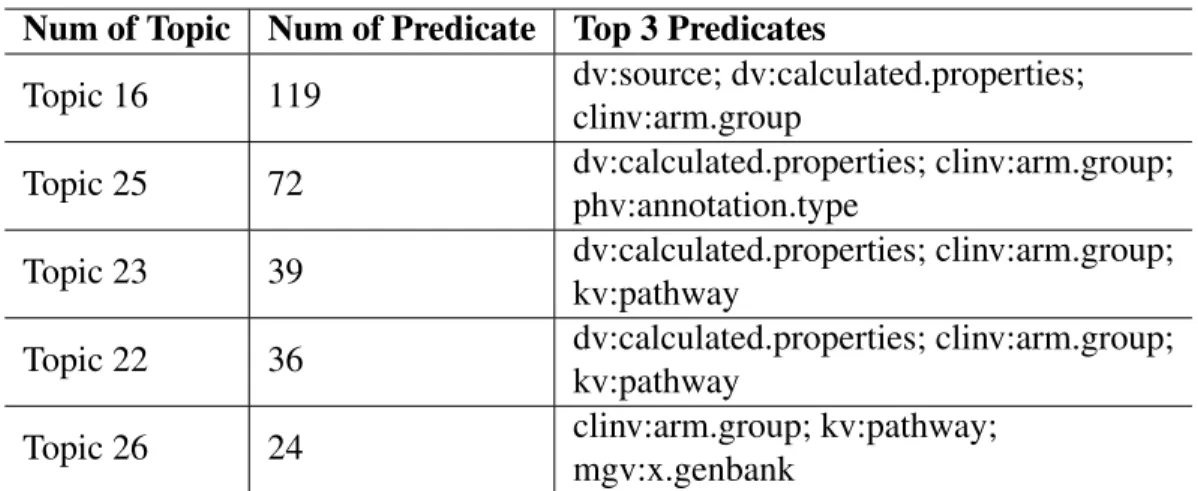
Table 6: Top 3 Predicates for 5 Top Topics with Bio2RDF 9 Domains Num of Topic Num of Predicate Top 3 Predicates
Topic 16 119 dv:source; dv:calculated.properties; clinv:arm.group
Topic 25 72 dv:calculated.properties; clinv:arm.group; phv:annotation.type
Topic 23 39 dv:calculated.properties; clinv:arm.group; kv:pathway
Topic 22 36 dv:calculated.properties; clinv:arm.group; kv:pathway
Topic 26 24 clinv:arm.group; kv:pathway;
mgv:x.genbank
Table 7: Top 2 Unique Predicates for 5 Top Topics Bio2RDF 9 Domains Num of Topic Num of Predicate Top 2 Unique Predicates
Topic 16 119 phv:drug; phv:disease
Topic 25 72 phv:association; phv:article
Topic 23 39 clinv:group; kv:module
Topic 22 36 pathway; dv:x.uniprot
Topic 26 24 dv:transporter; dv:target
cross domains predicates of KEGG, ClinicalTrials, and DrugBank, respectively.
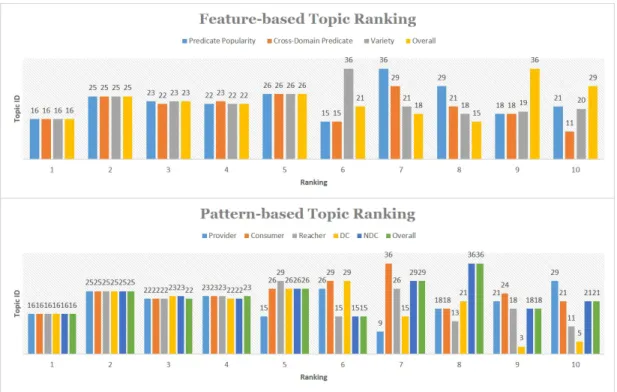
Topic Ranking with Cross Domain Features: These patterns are ranked according to
primary features such as cross domains predicates, predicate popularity (in-degree/out-degree of the predicates), and domain verity (the number of ontologies in which the pat-terns are captured). Fig. 8(a) shows top 5 topics (Topic 16, Topic 25, Topic 23, Topic 22 and Topic 26) computed by the cross domains features. Table 6 and 7 show the top 3 predicates and top 2 unique predicates of these topics.
Topic Ranking with Cross Domain Neighborhood Patterns: Topics are ranked based
Figure 7: Cross Domain Concept and Predicate Ranking: (a) Top 40 Concepts (b) Top 40 Predicates
The prefixes describe the domain of the concepts and predicates. clinv: http://bio2rdf.org/clinicaltrials vocabulary ctdv:http...bio2rdf.org.ctd vocabulary dv: http://bio2rdf.org/drugbank vocabulary hv: http://bio2rdf.org/hgnc vocabulary kv: http://bio2rdf.org/kegg vocabulary mgv: http://bio2rdf.org/mgi vocabulary omimv: http://bio2rdf.org/omim vocabulary phv: http://bio2rdf.org/pharmgkb vocabulary sider: http://bio2rdf.org/sider vocabulary
Figure 8: Cross Domain Topic Ranking: (a) Feature-based Ranking (b) Pattern-Based Ranking
Popularity is measured by In-degree/Out-degree of predicates. Verity is measured by the number of ontologies involved. The numbers in the bar graph are the topic ID (ranged: 1 - 43).
22 and Topic 26). The ranking based on the counts of the PONP patterns (Provider, Consumer, Reacher, CDand NCDpatterns) is very similar to the ranking computed by the predicate popularity, cross domains predicate, and variety shown in Fig. 8(a). This confirms that the proposed pattern-based approach reflects an excellent understanding of the important features of the network such as density, verity, and popularity.
2.5.1.3 Ontology Patterns in Cross Domains
Based on top five PONP patterns (Provider, Consumer, Reacher, Directional Con-nector, Non-Directional Connector) as case studies, we analyze the collaboration between ontologies as shown in Fig. 9, 11, 13, 15 and 17. Topic graphs are depicted in 10, 12, 14, 16 and 18. In each graph, a color is assigned to each ontology as follows: DrugBank: Red; HGNC: Pink; MGI: Green; PharmGKB: Cyan; ClinicalTrials: Yellow; OMIM: Sky Blue; SIDER: Gray; KEGG: Orange; CTD: Magenta. Semanticscience Integrated Ontology (SIO) represents the normalized name for integrated medical ontologies. For each case study, we now show its topic pattern graph of concepts and predicates and the instances of concepts/predicates in this topic graph.
Case 1: Provider Patterns in Ontology Collaboration Five ontologies (DrugBank, PharmGKB, ClinicalTrials, KEGG and CTD) are involved in the collaboration of the provider pattern. In this collaboration, we find that DrugBank and KEGG are aProvider, CTD is aBalancer, and PharmGKB is a Consumeras well as a Bridger. ClinicalTrials is its Consumer. Fig. 9 shows an ontology collaboration graph for the given provider
Figure 9: Ontology Provider Pattern
Table 8: Provider Pattern in Topic 25
phv:Resource hv:Resource SIO 001077:Gene
epidermal growth factor receptor
Gene Symbol for EGFR EGFR, ERBB,
ERBB1, HER1, PIG61, mENA; epidermal growth factor receptor (EC:2.7.10.1); K04361 epidermal growth factor receptor [EC:2.7.10.1] complement component 1,
r subcomponent Gene Symbol for C1R
C1R; complement component 1, r subcomponent (EC:3.4.21.41); K01330 complement component 1, r subcomponent [EC:3.4.21.41] complement component 1,
q subcomponent, B chain Gene Symbol for C1QB
C1QB; complement component 1, q subcomponent, B chain;
K03987 complement C1q subcomponent subunit B complement component 1,
s subcomponent Gene Symbol for C1S
C1S; complement component 1, s subcomponent (EC:3.4.21.42); K01331 complement component 1, s subcomponent [EC:3.4.21.42] interleukin 2 receptor, beta Gene Symbol for IL2RB
IL2RB, CD122, IL15RB, P70-75; interleukin 2 receptor, beta;
K05069 interleukin 2 receptor beta pattern. Fig. 2(a) shows a provider pattern in Topic 25. This pattern describes the collab-oration of two predicates, namelyphv:x-hgncandkv:x-hgncto integrate information from three domains. Specifically, PharmGKBResourcelinks to KEGGGene(SIO normalized) through HGNCGene symbol. Table 8 shows 5 instances of the concepts in the provider pattern of Topic 25.
Figure 11: Ontology Consumer Pattern
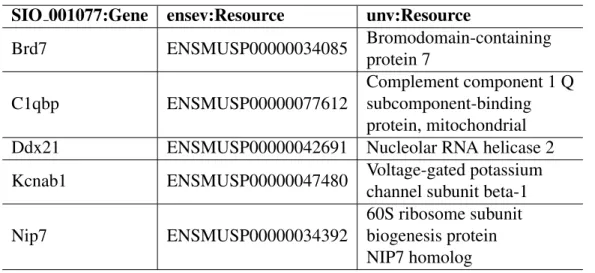
Table 9: Consumer Pattern in Topic 15 SIO 001077:Gene ensev:Resource unv:Resource
Brd7 ENSMUSP00000034085 Bromodomain-containing protein 7 C1qbp ENSMUSP00000077612 Complement component 1 Q subcomponent-binding protein, mitochondrial Ddx21 ENSMUSP00000042691 Nucleolar RNA helicase 2 Kcnab1 ENSMUSP00000047480 Voltage-gated potassium
channel subunit beta-1
Nip7 ENSMUSP00000034392
60S ribosome subunit biogenesis protein NIP7 homolog
of KEGG, OMIM and PharmGKB. DrugBank are a balancer with KEGG. Fig. 11 shows an ontology collaboration graph for the consumer pattern,CTD. Fig. 2(b) shows a con-sumer pattern in Topic 15. This concon-sumer pattern shows the collaboration between pred-icatesmgv:x-ensembl-proteinandkv:x-uniprotas a consumer of the PharmGKB concept (SIO normalized), SIO 001077:Gene. The collaboration is established across three do-mains such as KEGG, MGI and PharmGKB. In this pattern, due to the collaboration of these two consumer predicates, the Uniprot conceptresource is linked to the Ensemble conceptResourcethrough PharmGKB conceptGene(SIO normalized). Table 9 shows 5 instances of the concepts in the consumer pattern of Topic 15.
Case 3: Ontology Collaboration with Reacher PatternsOnly two predicates from two ontology PhargGKB and ClinicalTrials are involved in the Reacher pattern. From this pattern analysis, we find that PharmGKB plays aProviderand ClinicalTrials aConsumer
Figure 13: Ontology Reacher Pattern
Table 10: Reacher Pattern in Topic 22
SIO 010038:Drug kv:Resource SIO 001107:Pathway L-Lysine L-Lysine; Lysine acid;
2,6-Diaminohexanoic acid ABC transporters Succinic acid
Succinate; Succinic acid; Butanedionic acid; Ethylenesuccinic acid
Citrate cycle (TCA cycle) Glycine Glycine; Aminoacetic acid; Gly Biosynthesis of
amino acids Pyruvic acid
Pyruvate; Pyruvic acid; 2-Oxopropanoate; 2-Oxopropanoic acid; Pyroracemic acid
Pentose phosphate pathway
L-Glutamic Acid L-Glutamate; L-Glutamic acid; L-Glutaminic acid; Glutamate
Biosynthesis of secondary metabolites
This reacher pattern is generated by predicates kv:pathway and dv:x-kegg, across four domains (PharmGKB, DrugBank, KEGG, CTD). Through the collaboration of these two predicates in this pattern, the PharmGKB conceptDrug(SIO normalized) is linked to the KEGG conceptResourceand the KEGG conceptResourceis linked to the CTD concept Pathway (SIO normalized). Table 10 shows 5 instances of the concepts in the reacher pattern of Topic 22.
Case 4: Ontology Collaboration with Directional Connector PatternsFrom the pat-tern analysis with top 40 predicates, all nine ontologies have the Directional Connect (DC) patterns. Fig. 15 shows the ontology collaboration through the DC patterns with 54 links among these ontologies. We find that CliniclalTrials, DrugBank and SIDER play the role ofProviderand CTD, HGNC, KEGG, MGI, OMIM, PharmGKBConsumer.
Fur-Figure 15: Ontology Directional Connector Pattern
Table 11: Directional Connector Pattern in Topic 16
SIO 010343:Enzyme hv:Resource omimv:Resource mgv:Resource Prostaglandin G/H synthase 2 Gene Symbol for PTGS2 PROSTAGLANDIN-ENDOPEROXIDE SYNTHASE 2; PTGS2 Ptgs2 Vitamin K-dependent protein C Gene Symbol
for PROC PROTEIN C; PROC Proc
Cytochrome P450 2C9 Gene Symbol for CYP2C9 CYTOCHROME P450, SUBFAMILY IIC, POLYPEPTIDE 9; CYP2C9 Cyp2c65
CYP3A Gene Symbol
for CYP3A7 CYTOCHROME P450, SUBFAMILY IIIA, POLYPEPTIDE 7; CYP3A7 Cyp3a13 Cob(I)yrinic acid a, c-diamide adenosyltransferase, mitochondrial Gene Symbol
for MMAB MMAB GENE; MMAB Mmab
pattern in Topic 16. In this DC pattern of Topic 16, three predicates such as dv:x-hgnc, hv:x-omimand omimv:x-mgiare used to connect concepts across five domains (KEGG, DrugBank, HGNC, OMIM, MGI). In this pattern, the KEGG conceptEnzyme(SIO nor-malized) links to the HGNC concept Resource. The HGNC concept Resource links to the OMIM concept Resource, and the OMIM concept Resource links to the MGI con-ceptResource. All the paths within the bounded context (the maximum distance between predicates, B = 3) can be determined by the DC patterns. From this pattern, we find many paths. One of them is the pathhSIO 010343:Enzyme→dv:x-hgnc→hv:Resource →hv:x-omim→omimv:Resource→omimv:x-mgi→mgv:Resourcei. Table 11 shows 5 instances of the concepts in the DC pattern of Topic 16.
Figure 17: Ontology Non-Directional Connector Pattern
Non-directional Connector (NDC) patterns discovery, all the 9 ontologies are fully par-ticipated. Fig. 17 shows the ontology collaboration through the NDC patterns. These 9 ontologies are connected with 72 links, which means all of them are fully connected. In-terestingly, all of them have the same number of in-degree and out-degree, so that they are well balanced. Thus, no bridge pattern is required in this collaboration. Fig. 3(b) shows an ontology collaboration graph generated from the non-directional connector pattern (NDC) in Topic 23. This NDC pattern is composed with four predicates such as mgv:x-refseq-transcript, ctdv:pathway and ctdv:diseasethat are used to connect nine different domains (KEGG, DrugBank, MGI, HGNC, SIDER, PharmGKC, ClinicalTrials, OMIM, CTD). Specifically, in this pattern, those three predicates are used to connect six concepts such asKEGG Gene(SIO normalized),Refseq resource,KEGG Resource, CTD Chemi-cal,KEGG Pathway(SIO normalized) andCTD Chemical-disease-association. Table 12 shows 5 instances of the NDC pattern in Topic 23.
2.6 Summary
We have defined five different patterns to elaborate the structural relationship for predicates in RDF graph based on basic Share pattern and Connectivity pattern. In ad-dition, we have defined topic and topic boundary in information network based on pat-terns. Moreover, we have designed a Predicate Oriented Neighborhood Patterns (PONP) to measure the similarity among predicates. A dynamic programming based algorithm is designed to calculate the similarity association according to the distance and
probabil-datasets, we also developed an optimization solution to enhance