Semantics for Computing
Word Associations
by
Shahida Jabeen
A thesis
submitted to the Victoria University of Wellington in fulfilment of the
requirements for the degree of Doctor of Philosophy in Computer Science. Victoria University of Wellington
Semantic association computation is the process of automatically quan-tifying the strength of a semantic connection between two textual units based on various lexical and semantic relations such as hyponymy (car
andvehicle) and functional associations (bankandmanager). Humans
have can infer implicit relationships between two textual units based on their knowledge about the world and their ability to reason about that knowledge. Automatically imitating this behavior is limited by restricted knowledge and poor ability to infer hidden relations.
Various factors affect the performance of automated approaches to com-puting semantic association strength. One critical factor is the selection of a suitable knowledge source for extracting knowledge about the im-plicit semantic relations. In the past few years, semantic association com-putation approaches have started to exploit web-originated resources as substitutes for conventional lexical semantic resources such as thesauri, machine readable dictionaries and lexical databases. These conventional knowledge sources suffer from limitations such as coverage issues, high construction and maintenance costs and limited availability. To overcome these issues one solution is to use the wisdom of crowds in the form of collaboratively constructed knowledge sources. An excellent example of such knowledge sources is Wikipedia which stores detailed information not only about the concepts themselves but also about various aspects of the relations among concepts.
The overall goal of this thesis is to demonstrate that using Wikipedia for computing word association strength yields better estimates of hu-mans’ associations than the approaches based on other structured and un-structured knowledge sources. There are two key challenges to achieve
different aspects of Wikipedia in developing new measures of semantic associations; and second, to evaluate these measures compared to human performance in a range of tasks. The focus of the thesis is on exploring two aspects of Wikipedia: as a formalknowledge source, and as an informal text corpus.
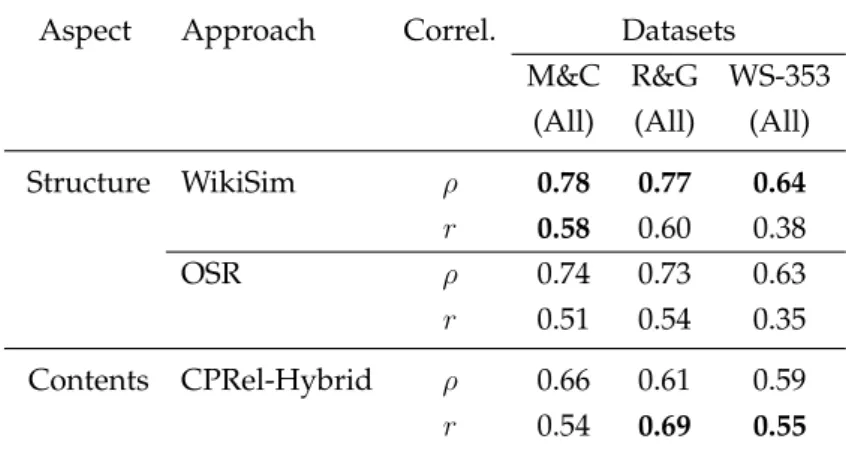
The first contribution of the work included in the thesis is that it ef-fectively exploited the knowledge source aspect of Wikipedia by devel-oping new measures of semantic associations based on Wikipedia hyper-link structure, informative-content of articles and combinations of both elements. It was found that Wikipedia can be effectively used for comput-ing noun-noun similarity. It was also found that a model based on hybrid combinations of Wikipedia structure and informative-content based fea-tures performs better than those based on individual feafea-tures. It was also found that the structure based measures outperformed the informative-content based measures on both semantic similarity and semantic related-ness computation tasks.
The second contribution of the research work in the thesis is that it ef-fectively exploited the corpus aspect of Wikipedia by developing a new measure of semantic association based on asymmetric word associations. The thesis introduced the concept of asymmetric associations based mea-sure using the idea of directional context inspired by the free word asso-ciation task. The underlying assumption was that the assoasso-ciation strength can change with the changing context. It was found that the asymmetric-association based measure performed better than the symmetric measures on semantic association computation, relatedness based word choice and causality detection tasks. However, asymmetric-associations based mea-sures have no advantage for synonymy-based word choice tasks. It was also found that Wikipedia is not a good knowledge source for capturing verb-relations due to its focus on encyclopedic concepts specially nouns.
dis-for finding deeper and semantically more meaningful associations in a wide range of application areas based on humans’ estimates of word asso-ciations.
“The difference between a successful person and others is not a lack of strength, nor a lack of knowledge, but rather a lack of will”. Three years ago, this will motivated me to leave my family, my job and my country to pursue my career in research. Three precious years of my life in New Zealand have been full of experiences that taught me the value of hard work in life. This thesis is an outcome of the support, help and sacrifice of many priceless people who have had a great influence on my life and studies over the last three years. I greatly admire my supervisors, Dr. Sharon Gao and Dr. Peter Andreae, for believing in me. I am indebted to them for their outstanding support and mentoring. Our weekly meetings have undoubtedly been key in keeping me focused and giving me the courage to achieve my goals. I would also like to express my gratitude to Prof. Mengjie Zhang, for being very supportive and encouraging. His success celebrations and Christ-mas BBQ’s have always been wonderfully exciting. I wish to thank ECRG group for creating an insightful and friendly research environment. I am also grateful to Peter D. Turney (National Research Council of Canada) for providing me datasets for the word choice task. I also want to thank Thomas K. Landauer (LSA and NLP Lab, University of Colorado) for pro-viding the TOEFL dataset.
Last but not the least, I want to thank my family for their continuous support, help and prayers and my beloved husband for his unconditional love. It would not have been possible for me to complete my journey without his support and encouragement.
2.1 Correlation of the association strength of three terms of se-mantic associations. . . 20 2.2 Statistics of Benchmark datasets used for evaluation of
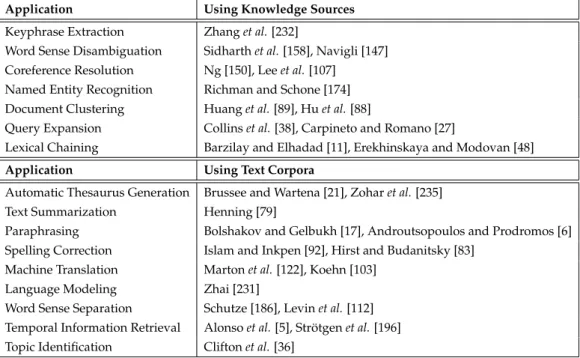
se-mantic association measures. . . 28 2.3 Examples of approaches using knowledge-sources and text
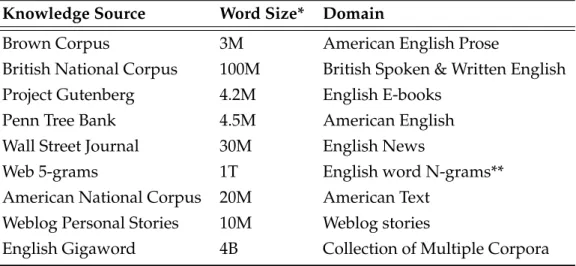
corpora in various applications. . . 33 2.4 Some well-known text corpora used by corpus-based
ap-proaches. . . 37 3.1 Performance comparison of the semantic measures on
all-terms (All)versions of M&C, R&G and WS-353 datasets. . . . 87 3.2 Performance comparison of the semantic measures on
Non-Missing (NM)versions of M&C, R&G and WS-353 datasets. . 88 3.3 Performance comparison of semantic measures with WLM
measure onall-terms (All) versions of M&C, R&G and WS-353 datasets. . . 88 3.4 Performance comparison of the semantic measures on M&C,
R&G and WS-353 datasets using manual and automatic dis-ambiguations. . . 90 3.5 Performance comparison of the semantic measures on
all-termsversions of similarity 353-(S)) and relatedness (WS-353-(R)) based subsets of the WS-353 dataset. . . 93
3.6 Performance comparison of the semantic measures on Non-Missing (NM) versions of similarity (WS-353-(S)) and relat-edness (WS-353-(R)) based subsets of the WS-353 dataset. . . 94 3.7 Performance of the semantic measures on three biomedical
datasets: MiniMayo, MeSH and MayoMeSH datasets. . . 96 4.1 Performance comparison of the DCRM measure with the
previously best measure WikiSim on domain independent datasets. Bold values indicate the best correlation-based performance of any measure on a specific dataset. . . 114 5.1 Performance comparison of four classifiers using the hybrid
model based on the 3-feature combination (f123). . . 125 5.2 A comparison of averaged feature ranking on all datasets.
The highest rank corresponds to the lowest correlation-based performance of a feature and vice versa. . . 129 5.3 Performance comparison of both hybrid models with
pre-viously best performing approaches on three benchmark datasets: M&C, R&G and WS-353. . . 130 6.1 Performance comparison of symmetric and asymmetric
as-sociation based measures on two subsets of WS-353: WS353-Sim and WS353-Rel using proximity window withw= 10. . 146 6.2 Performance comparison of APRM avg measure with
exist-ing state-of-art measures on the MTURK-771 dataset. . . 148 7.1 The Performance of APRM on various word choice datasets.
The best performance on each dataset is shown in bold. . . . 161 7.2 Performance comparison of APRM with state-of-art approaches
on the RDWP dataset. The best performance is shown in bold.162 7.3 The performance of APRM on the synonymy-based word
choice task using two datasets: ESL and TOEFL. The best performance is shown in bold. . . 166
8.1 Examples of two types of COPA question format. . . 176 8.2 Accuracy-based performance of existing approaches on the
COPA-test benchmark dataset. . . 180 8.3 Performance comparison of Wikipedia-based semantic
as-sociation measures using window Size withw=10 on three
1.1 The growth statistics of English Wikipedia [214]. . . 5 1.2 Thesis layout and connectivity of main chapters. . . 14 2.1 Effect of outlier on the Pearson’s correlation computation . . 32 2.2 The landscape of semantic association computation approaches 44 3.1 Wikipedia hyperlink structure . . . 72 3.2 Semantic orientation of theshared associatesof two concepts
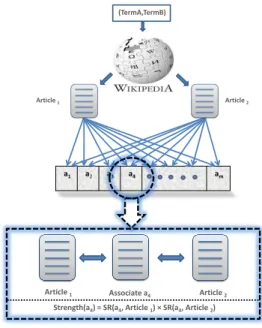
carandGasoline. . . 74 3.3 A set of Wikipedia features used byArticle Comparer[140] . . 75 3.4 The framework for computing theOverlapping Strength-based
Relatedness (OSR)score for a given term pair. . . 76 3.5 The framework for computing the CPRel score of a given
term pair. . . 78 3.6 Performance comparison of three variants of CPRel on
non-missingversions of three datasets: M&C, R&G and WS-353 datasets. . . 86 3.7 Effect of linearity on the performance of three measures on
MeSH dataset. . . 97 4.1 A comparison of top fiveResponse wordsof givenCue words
BookandLibrary. . . 106 4.2 The framework for computing semantic relatedness based
on directional contexts. . . 110 xi
4.3 A comparison of Spearman’s correlation and Pearson’s Cor-relation on stimulus words of FAN subset. . . 117 5.1 Hybrid features based model for computing semantic
asso-ciations. . . 122 5.2 Performance comparison of hybrid models based on
indi-vidual features and their combinations on three benchmark datasets using 10-fold and Leave-one-out cross validations. 127 6.1 The framework for computing term relatedness using the
APRM measure. . . 136 6.2 Performance comparison of three variants of APRM on
dif-ferent window sizes using all datasets. . . 142 6.3 Effect of changing window size on the performance of
vari-ous relatedness measures on all datasets. . . 145 7.1 Correlation of the window size with performance
evalua-tion metrics of the word choice task on the Reader’s Digest Word Power(RDWP) dataset. . . 163 8.1 Effect of changing window size on the performance of PMI
and the APRM measures on COPA evaluation benchmarks using verbal-pattern model. . . 188 1 Process flow diagram of the APRM-based semantic
associ-ation computassoci-ation system. . . 211 2 Process flow diagram of the APRM-based word choice
sys-tem. . . 212 3 Process flow diagram of the APRM-based causality
APRM- Asymmetry-based Probabilistic Relatedness Measure
CFP- Context-Filtered Profile
COPA- Choice of Plausible Alternatives
CPRel- Context profile based Relatedness
DCRM- Directional Context based Relatedness Measure
GP- Gaussian Process
KS- Knowledge Source
L-1-O CV- Leave-One-Out Cross Validation
LE- Link Estimation
LP- Link Probability
NTF- Normalized Term Frequency
OSR- Overlapping Strength based Relatedness
PMI- Pointwise Mutual Information
SVM- Support Vector Machines
WLM- Wikipedia Link based Measure
Acknowledgment v
List of Abbreviations xiii
1 Introduction 1 1.1 Motivation . . . 1 1.2 Problem Statement . . . 7 1.3 Research Goals . . . 9 1.4 Thesis Outline . . . 14 2 Background 17 2.1 Fundamentals of Semantic Associations . . . 17
2.1.1 Terms and Definitions . . . 18
2.2 Applications of Semantic Measures . . . 20
2.3 Can Humans Estimate Semantic Associations? . . . 24
2.4 Evaluating Semantic Measures . . . 28
2.4.1 Correlation with Manual Judgments . . . 29
2.4.2 Task-Oriented Evaluation . . . 33
2.5 Background Knowledge Sources . . . 34
2.5.1 Informal Knowledge Sources . . . 35
2.5.2 Formal Knowledge Sources . . . 36
Wikipedia . . . 41
2.6 Existing Approaches to Computing Semantic Associations . 43 2.6.1 Knowledge-Lean Approaches . . . 44
Corpus-based Approaches . . . 46 Web-based Approaches . . . 49 2.6.2 Knowledge-Rich Approaches . . . 53 Structure-based Approaches . . . 53 Content-based Approaches . . . 55 2.6.3 Hybrid Approaches . . . 56
2.7 Limitations of Existing Approaches . . . 59
2.7.1 Limitations of Knowledge-Lean Approaches . . . 59
2.7.2 Limitations of Knowledge-Rich Approaches . . . 61
2.8 Performance Indicators . . . 63
2.9 Chapter Summary . . . 65
3 Mining Wikipedia for Computing Semantic Relatedness 67 3.1 Wikipedia as a Semantic Knowledge Source . . . 68
3.2 Mining Structural Semantics from Wikipedia . . . 71
3.2.1 WikiSim . . . 73
3.2.2 Overlapping Strength based Relatedness (OSR) . . . 73
3.3 Mining Informative-Content based Semantics from Wikipedia 77 3.3.1 Context Profile-based Relatedness (CPRel) . . . 77
Context Filtering . . . 79
Weighting Schemes . . . 80
3.4 Domain-Independent Evaluation . . . 82
3.4.1 Statistical Significance Test . . . 84
3.4.2 Results and Discussion . . . 85
3.4.3 Impact of Disambiguation . . . 89
3.4.4 Further Analysis . . . 90
3.4.5 Similarity Vs. Relatedness . . . 92
3.5 Domain-Specific Evaluation: Biomedical Data . . . 93
3.5.1 Datasets . . . 94
3.5.2 Results and Discussion . . . 95
3.6 Chapter Summary . . . 98
4 Directional Context Helps! 101 4.1 Word Associations . . . 102
4.1.1 Applications of Word Associations . . . 103
4.2 Semantics of Free word Associations . . . 106
4.2.1 Guiding Semantic Association Computation . . . 107
4.3 Methodology . . . 109
4.3.1 Directional Context Mining . . . 110
4.3.2 Inverted Index Generation . . . 111
4.3.3 Semantic Relatedness Computation . . . 112
4.4 Evaluation Setups . . . 113
4.5 Results and Discussions . . . 113
4.5.1 Asymmetric Relatedness Evaluation . . . 115
4.6 Chapter Summary . . . 118
5 Hybrid Model for Semantic Association Computation 119 5.1 Hybrid Features Vs. Single Features . . . 120
5.2 Hybrid Features based Model . . . 121
5.2.1 Feature Generation . . . 122
5.2.2 Validation and Learning of Semantic Associations . . 124
5.3 Evaluation . . . 125
5.4 Results and Discussion . . . 125
5.4.1 Performance Comparison of Features . . . 126
5.4.2 Hybrid Model with Maximum Function . . . 130
5.5 Chapter Summary . . . 131
6 Probabilistic Associations as a Proxy for Semantic Relatedness 133 6.1 Probabilistic Associations . . . 134
6.2 Asymmetry-based Probabilistic Relatedness Measure . . . . 135
6.2.1 Inverted Index generation . . . 135
6.2.3 Symmetry-based Relatedness Measures . . . 138
6.3 Evaluation . . . 140
6.4 Experimental Results and Discussion . . . 140
6.4.1 Combining Directional Association Strengths . . . 141
6.4.2 Effect of Window Size . . . 144
6.4.3 Symmetry Vs. Asymmetry . . . 144
6.4.4 Similarity Vs. Relatedness . . . 146
6.4.5 Comparison with State-of-art Approaches . . . 147
6.5 Chapter Summary . . . 149
7 Task-driven Evaluation 151 7.1 Selection of an Association Measure . . . 152
7.2 The Word Choice Task . . . 153
7.3 Related Work . . . 154
7.4 Evaluation . . . 157
7.4.1 Performance Evaluation Metrics . . . 158
7.4.2 Datasets . . . 159
7.5 Results and Discussion . . . 160
7.5.1 Relatedness-based Word Choice Problems . . . 160
Comparison with Existing Approaches . . . 161
Further Analysis . . . 163
7.5.2 Synonymy-based Word Choice Problems . . . 165
7.6 Chapter Summary . . . 167
8 Common Sense Causality Detection 169 8.1 Common Sense Causal Reasoning . . . 170
8.2 Choice Of Plausible Alternatives . . . 175
8.2.1 COPA Evaluation Setup . . . 176
8.2.2 COPA Vs. Textual Entailment . . . 177
8.2.3 Existing Approaches to COPA Evaluation . . . 178
8.3 APRM-based Causality Detection System . . . 180
Unigram Model . . . 181
Bigram Model . . . 181
Verbal-Pattern Model . . . 183
8.3.2 Causality Computation . . . 184
8.4 Results and Discussion . . . 184
8.4.1 Statistical Significance . . . 187 8.4.2 Further Analysis . . . 189 8.5 Chapter Summary . . . 193 9 Conclusions 195 9.1 Main Contributions . . . 195 9.2 Future Work . . . 198
Appendix
203
List of Publications 203 Glossary 205Process Flow Diagrams 211
Introduction
1.1
Motivation
Thinking is a dynamic process of human cognition and is based on human knowledge and experience of the real world. Furthermore, knowledge is a product of human interpretation of objects and phenomena of reality and manifest itself in words. Humans can infer implicit relationships between words based on their knowledge about the world and their ability to rea-son about that knowledge. Humans’ word associations can be interpreted by the principle of learning by contiguity. According to this principle, ob-jects once experienced together tend to be linked to each other in the hu-man imagination, so that if one of the objects is thought of then the other object is likely to be thought of also [218]. Association by contiguity ex-ists when objects are situated close together in time or space e.g. king and queen. Humans can compare and judge semantic associations of different words even if they do not know the formal definition and boundaries of associations. For instance, they can tell that Potato and Chips have stronger association than Potato and Pen. Moreover, dissimilar or
op-posite words can also be strongly associated. So if a person is told a word
day, his first response word might benightwhich is opposite in meaning
to the wordday but is still closely associated. Associating such words is 1
generally an easy task for humans but imitating the same phenomenon us-ing automated approaches is limited by shallow and restricted knowledge, poor ability to infer hidden relations and lack of sufficient understanding of the complex relations that exist between real word objects.
There is no formal definition of semantic association but generally it is referred to as the semantic connection between two textual units (words, phrases, n-grams, sentences or even documents) [76, 129]. Accordingly, semantic association computation is the task of automatically quantify-ing the strength of a semantic connection between two textual units based on different kinds of semantic relations. It takes two pieces of text as in-put and produces a real number representing the strength of the semantic connection between them as output.
With the exponential growth of the World Wide Web and ever increas-ing importance of retrievincreas-ing relevant information from the web, semantic association computation has become a critical research area. Semantic as-sociation computation is a key component of many applications belong-ing to a multitude of fields such as computational lbelong-inguistics, cognitive psychology, information retrieval and artificial intelligence. Examples of such applications include information extraction [209], text summariza-tion [11], opinion mining [155], quessummariza-tion answering [146], text classifica-tion [57], query expansion [212], topic identificaclassifica-tion [78, 18, 39], automatic keyphrase extraction [139], topic indexing [127], word sense disambigua-tion [2, 158, 132], document clustering [193, 78, 195] and spelling correcdisambigua-tion [22, 91].
The process of semantic association computation quantifies the associ-ation strength between two concepts by identifying a chain of possible lex-ical and semantic connections between them. It requires an understand-ing of the implicit relations of concepts based on deeper level of world knowledge about the entities in consideration. For instance, consider the following pair of text fragments.
• Teeth
• Crime
To correctly assess that these two concepts are related, background knowledge on Forensic Science is required but this knowledge can not be found in the text fragments themselves. The task of computing se-mantic associations of natural language concepts relies on the knowledge of a broad range of real world concepts and their implicit as well as ex-plicit relations [225]. A major limiting factor for computing semantic asso-ciations is undoubtedly the requirement of a good background knowledge source.
The choice of background knowledge source plays a critical role in the performance of the semantic association measure relying on it. Back-ground knowledge sources vary from domain specific thesauri to lexical dictionaries and from hand crafted taxonomies to knowledge bases. A knowledge source should have the following three attributes to effectively support semantic association computation.
• Coverage: The coverage of a knowledge source is the extent of its collected knowledge. It should be broad enough to provide infor-mation about all relevant concepts. Also, it should have sufficient depth to discover the hidden chains of various lexical and semantic connections among related concepts.
• Quality: The information contained by a knowledge source should be of high encyclopedic quality. Moreover, the information provided by a knowledge source should be accurate, authentic and up-to-date.
• Semantic Richness: A knowledge source should be semantically rich. This involves encoding many of the classical as well as non-classical semantic relations among concepts, implicitly or explicitly.
Various knowledge sources are used to backup semantic measures in computing semantic associations. Based on the differences in the struc-tural organization of information, existing knowledge sources range from unstructured text corpora to semi-structured and fully structured knowl-edge sources. Unstructured corpora are simple to create and cheap to maintain. Semantic approaches based on unstructured or informal cor-pora usually rely on statistical or distributional features at word level. The choice of corpus and its size have direct impact on the performance of such approaches. On the other hand, semi-structured and fully-structured knowledge sources are expensive to build but more effectively encode the relations which are only implicit in the unstructured text corpora.
Researchers have started to exploit the web-originated resources as substitutes for conventional lexical semantic resources such as dictionar-ies, thesauri and lexical databases. These conventional knowledge sources suffer from certain limitations such as coverage issues, high construction and maintenance costs and limited availability. To overcome such issues, one solution is to exploit thewisdom of crowds[228] in the form of collabo-ratively constructed knowledge sources. Existing research has shown the semantic capabilities of collaboratively constructed knowledge sources in various natural language processing tasks [216, 197, 227, 140]. An excel-lent example of the knowledge sources relying on the wisdom of crowdsis Wikipedia, which stores a great deal of information not only about con-cepts themselves but also about various aspects of their relationships. It has many properties in common with conventional knowledge sources (such as dictionaries, thesauri, wordnets and encyclopedia) but it repre-sents and combines them in a unique way. Wikipedia sufficiently demon-strates all the necessary aspects of a good knowledge source, as given be-low.
• Coverage: As a collaboratively constructed knowledge source, the coverage of Wikipedia evolves as the human knowledge does. Since its inception in January 2001, Wikipedia is growing continuously and
has become the largest freely available knowledge source with more than 4 million articles1). Its growth has been exponential in the num-ber of key edits and articles [219]. Wikipedia occupies 6th position among the most visited websites on the Internet2. As an online ency-clopedia, free from page limits, unrestricted by weight and volume, it satisfies the notion of comprehensiveness. It is a multilingual ency-clopedia (available in 285 languages3) constructed by collaborative efforts of thousands of volunteers. The English version of Wikipedia is the largest of all. Its growth rate and the number of articles are shown in Figure 1.1. This model is related to the size of Wikipedia, which is always growing as there will always be new events and people to be described in the future.
(a) Actual number of articles (b) Article growth per month
Figure 1.1: The growth statistics of English Wikipedia [214].
As a knowledge source Wikipedia not only focuses on general vocab-ulary but also covers a large number of named entities and domain specific terms. The specialty of Wikipedia is that each of its articles is dedicated to a single topic with an additional benefit of heavy link-ing between articles. Wikipedia also covers specific senses of a word, synonymy, spelling variations, abbreviations and derivations.
Im-1http://en.wikipedia.org/wiki/Wikipedia:Size 2http://www.alexa.com/topsites
portantly, it has a semantically rich network relating categories that cover different types of lexical semantic relations such as hyponymy and hypernymy4. Wikipedia provides a knowledge base for extract-ing information in a more structured way than a search engine and with a coverage better than other knowledge sources [129].
• Quality: Wikipedia is an example of global collective intelligence. It paved the way for rapid expansion by letting its users modify any existing article or create new articles. Wikipedia articles are contin-ually edited and improved over time, leading to an upward trend of quality as indicated by the Figure 8.1(b). Due to popularity and extensive use of Wikipedia, a number of studies were conducted to assess the quality of Wikipedia based on many important met-rics such as the number of edits [219], unique editors [114], factual accuracy [45, 20, 93], credibility [33], revert time [211] and formal-ity of language [47]. These studies have shown that the qualformal-ity of Wikipedia articles continue to increase on average, as the number of collaborates and the number of edits increase [219, 220]. The qual-ity of Wikipedia is comparable to other hand crafted encyclopedias. Research has demonstrated that the quality of Wikipedia content is found comparable to that of Encyclopedia Britannica [93]. Wikipedia articles reflect changes according to time as well as occurrence of events and are kept quite up-to-date. It is true that few articles are of high quality from the start. However, the articles pass though a long process of discussion, debate and argument before setting into a balanced representation of knowledge. Hence, Wikipedia can be uti-lized in artificial intelligence and natural language processing appli-cations in the same way as manually created knowledge resources, which is an invaluable benefit of Wikipedia.
• Semantic Richness: In comparison with other knowledge sources,
Wikipedia is a semantic resource that combines certain semantic prop-erties in a unique way. Different structural components of Wikipedia reflect various aspects of a good semantic resource. Wikipedia has various semantic elements which implicitly as well as explicitly en-code the lexical semantic information. With extensive hyper-linking between semantically relatedarticles, Wikipedia could be considered as a huge semantic network free of size constraints. This seman-tic network is a rich source for explicitly labeled links between arti-cles. Another source of lexical information areredirectswhich cover a whole range of various elements like synonymy, surface forms, ab-breviations and derivations. Thecategory network of Wikipedia is a good source for identifying implicit relations of concepts. Disam-biguation pages not only represent various senses of a word but also categorize these senses into different groups explicitly.
All these attributes indicate the potential of Wikipedia to be used as a promising resource for mining semantic connections to augment word association computation.
1.2
Problem Statement
Despite many research efforts, computing semantic associations compa-rable to human judgments is still considered a hard problem as no sin-gle optimal solution is able to estimate all kinds of semantic associations correctly. Over the past few years, semantic association computation has received great attention due to its critical role in the performance of nat-ural language semantics based applications. However, there are certain factors that hindered the performance of automatic approaches from com-puting semantic associations. Most prominent of these factors are inher-ent complexity of natural language semantics, poor estimates of common sense and the requirement for a background knowledge with sufficient
depth and breadth to decode hidden semantic connections among vari-ous concepts. While the success of existing approaches addressing the first two factors has been slow, the third factor has been investigated vig-orously due to the availability of huge repositories of online knowledge organized in unstructured to semi-structured and fully-structured knowl-edge sources over the last two decades. Sections 2.5 and 2.6 present a de-tailed survey of different kinds of knowledge sources and the association computation research based on those knowledge sources.
Existing research on semantic association computation has attempted to compute the strength of semantic associations by taking into account various aspects such as statistical features, syntactic and lexical depen-dencies, rhetorical relations and semantic indicators derived from various sources of world knowledge such as thesauri, lexical databases, dictionar-ies, ontologies and encyclopedias. Consequently, this problem is studied in a variety of fields. The research community has witnessed a steady transformation of information retrieval from syntactic information extrac-tion (where statistical and distribuextrac-tional methods were employed to deter-mine the physical presence or absence of a word or a concept) to semantic information retrieval (where much deeper understanding of implicit rela-tions between concepts is needed to retrieve the desired information).
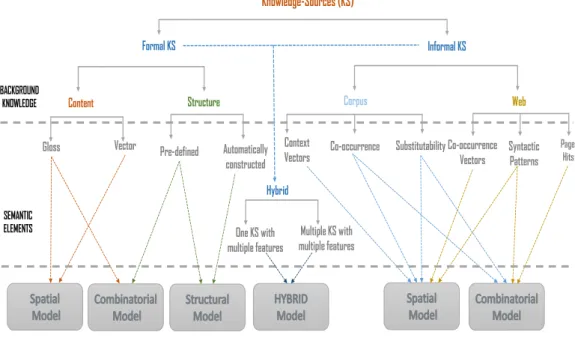
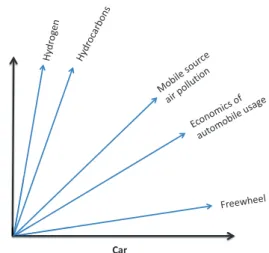
Existing approaches have attempted to solve the problem of comput-ing the semantic association strength by takcomput-ing into account various as-pects (such as distributional similarity, lexical relations, textual content and rhetorical relations) of external sources of world knowledge such as dictionaries, thesauri, lexical databases and encyclopedias. Consequently, this problem is studied using various design models based on these as-pects. The approaches to computing semantic associations can be grouped into three fundamental models based on their underlying framework [19]. The geometric model, also known asspatial model, represents each concept in ann-dimensional space and semantic association is derived from the in-verse of distances between concepts in this space. Thefeature-based model,
also calledcombinatorial model, represents each concept as a set of features and uses the commonalities and differences between the feature sets for computing semantic associations between concepts. Thestructural model, often referred to asnetwork modelorgraph-based model, represents concepts as nodes in huge structures such as semantic networks, taxonomies and graphs. The edges between nodes indicate relationships between con-cepts. Semantic associations are then computed using various techniques such as graph matching, activation spreads and random walks.
While the focus of existing approaches is on improving the overall per-formance of semantic association computation, very little effort has been put to understand, analyze and compare the underlying dynamics of se-mantic association computation. These dynamics include a number of fac-tors such as the choice of background knowledge, utilization of certain aspects of a semantic resource, coping with a multitude of semantic re-lations and the choice of design models of semantic associations. There is a need for better interpretation and analysis of these factors influenc-ing semantic association computation. A detailed analysis of these factors will provide an insight into understanding the underlying mechanism of semantic association computation. This will also help the later semantic association measures to build upon a balanced combination of these fac-tors customized according to the situation and need of an application.
1.3
Research Goals
The goal of the thesis is to demonstrate that using Wikipedia for com-puting word association strength gives better estimates of humans’ asso-ciations than the approaches based on other structured and unstructured knowledge sources. There are two key challenges to achieve this goal: first, to exploit various semantic association models based on different as-pects of Wikipedia in developing new measures of semantic associations; and second, to evaluate these measures compared to human performance
in a range of tasks. The focus of the thesis is on exploring the effective-ness of two aspects of Wikipedia: as an unstructuredtext corpus, and as a well-structuredknowledge source. Following the literature in these two re-search directions, the thesis presents a performance investigation of the underlying design models used for computing semantic word associa-tions. For this purpose, the thesis demonstrates an exploitation of various semantic elements of Wikipedia to augment a semantic association mea-sure with deeper understanding of classical and non-classical relations between concepts. The thesis focuses on understanding the dynamics of computing semantic associations by investigating and analyzing various factors that control and affect the semantic bias of semantic association measures. Based on the findings, the thesis presents an exploitation of Wikipedia semantics for improving the performance of various Natural Language Processing (NLP) applications that critically rely on good esti-mates of semantic associations. In order to fulfill the overall goal and to find answers to related research questions, the thesis establishes a set of research objectives corresponding to the following research questions.
i) How can various aspects of Wikipedia be effectively used for computing se-mantic associations of words?
The research community has analyzed various perspectives of the fac-tors that play a key role in the performance of semantic association measures. Some approaches focused on statistical aspects of informal text corpora while others borrowed structural semantics from well-structured knowledge sources such as lexical dictionaries, knowledge bases and word thesauri. To answer the question above, the thesis explores two aspects of Wikipedia: as a knowledge source and as a corpus. This involves developing different approaches based on the two aspects of Wikipedia and understanding their focus on various lexical and semantic relations of concepts. Existing research shows that Wikipedia is an excellent resource for semantic mining and can be effectively used for various tasks based on natural language
se-mantics interpretation [127]. Semantically rich elements of Wikipedia implicitly as well as explicitly encode different types of both classical and non-classical semantic relations.
Objective 1: To leverage Wikipedia aspects in developing new approaches for computing semantic associations of words.
The fundamental objective of the thesis is to harness semantic capa-bilities of Wikipedia for computing semantic associations of words. This research presents an exploitation of Wikipedia semantics in two directions. In the first research direction, the knowledge source aspect of Wikipedia is used to identify semantic connections of various con-cepts. Wikipedia is a well-structured semantically rich formal knowl-edge source with many structural elements that can be effectively used for computing semantic associations. Two such elements—the hyperlink structure and informative-content of Wikipedia articles— are used to develop new measures of semantic associations. In the second research direction, Wikipedia is viewed as an informaltext cor-pus for scaffolding semantic associations of words with asymmetric word associations. Wikipedia, being a huge repository of dedicated information on all kind of topics, has an enormous coverage that is continuously growing. This feature makes it an excellent resource to be used as an unstructured text corpus for calculating probabilistic word associations. The analysis of Wikipedia as an unstructured text corpus will identify the semantic bias and limitations of this aspect of Wikipedia. This research is an explicit attempt at experimenting and investigating both aspects of Wikipedia on the task of computing semantic associations of words.
ii) What is the impact of using various semantic association measures based on different design models?
The classification of various design models presented in the Section 1.2 is fundamental in nature but is too simplistic to model all the
com-plex relations that might exist between various concepts. This calls for developing new combinations of these models and investigating their impact on computing semantic associations. hence, the second research objective is to develop new semantic association measures based on different design models and their combinations for puting semantic association strengths. It is also important to com-pare and analyze strengths and weaknesses of the underlying design model of semantic association measures.
Objective 2: To develop and compare new semantic association measures based on various design models.
The second research objective is to develop new semantic association measures using combinations of various underlying design models. The thesis investigates the strengths and limitations of each under-lying model in various scenarios using Wikipedia as the background knowledge source. For this purpose, new semantic association mea-sures based on various design models and their combinations will be presented and compared on the task of semantic association compu-tation. Based on the knowledge source aspect of Wikipedia, three new measures relying on combinatorial model, geometric model and hy-brid model will be discussed. Using the corpus aspect of Wikipedia, a new model based on asymmetric probabilistic associations will be developed. An in-depth analysis is conducted to identify limitations of various semantic association measures founded on different design models.
iii) How well does a Wikipedia-based semantic association measure perform in a natural language semantics-based application?
There are two methods for evaluating the performance of a seman-tic association measure. One way is to estimate the correlation of automatically computed scores with manual judgments using pub-licly available benchmark datasets. This method of direct evaluation
is straightforward but suffers from certain limitations: first, the size of the dataset used for this kind of evaluation is usually small and creating larger datasets are expensive and time consuming 5. The other limiting factor is the nature of benchmark datasets which are not general enough to cope with all kinds of classical and non-classical relations. A large proportion of some datasets only contain seman-tically similar word pairs while other datasets focus mainly on the collocation-based word pairs. Hence, a semantic association measure performing extremely well on one dataset might not produce good re-sults on other datasets due to bias in their underlying model towards certain type of semantic relations. In order to avoid these limitations, the performance of a semantic association measure is indirectly eval-uated by employing it in solving a natural language processing task that critically relies on good estimates of semantic associations. Se-mantic association computation is the key component of many NLP tasks such as lexical chaining, information retrieval, text summariza-tion, web page clustering and text mining. Hence, the performance and suitability of a semantic measure should be investigated in an independent application setup.
Objective 3: Task-oriented evaluation of new Wikipedia-based semantic as-sociation measures.
There are two main factors that profoundly influence the performance of a semantic association measure: first, the choice of the underlying knowledge source; and second, the underlying model of computing semantic associations. These two factors play a decisive role in de-termining the semantic bias of a semantic association measure. The thesis presents various approaches for developing new Wikipedia-based semantic measures and exploiting them in two task-oriented applications chosen according to the underlying design model and
5This problem is somewhat overcome only recently by using MTURK workers [167, 71].
the nature of the knowledge source. The first application employs the Wikipedia-based measure for solving word choice problems, which is a well known application for the task-oriented evaluation of seman-tic measures. The second application involves using the Wikipedia-based semantic association measures for detecting causal connections between textual units using COPA evaluation [66]. These applica-tions are useful for evaluating the effectiveness of semantic associa-tion measures on different semantic levels.
1.4
Thesis Outline
The thesis presents a comprehensive study aimed at exploiting various semantically rich elements of Wikipedia for computing semantic associa-tions of words. Thesis layout and coherence of the main chapters is shown in figure 3.
Knowledge Source Aspect Corpus Aspect
Structure-based Measure (CHAPTER 3)
Machine Learning based Measure (CHAPTER 5) Proximity-based Measure (CHAPTER 6) Wikipedia Mining Informative-Content-based Measure (CHAPTER 3) Hybrid Measure (CHAPTER 4)
Word Choice Task
(CHAPTER 7) Semantic Measures
Evaluation
Association Computation task
(CHAPTER 3-6)
Causality Detection Task
(CHAPTER 8)
Figure 1.2: Thesis layout and connectivity of main chapters.
esti-mating semantic associations. It details the evaluation metrics commonly used for measuring and comparing the performance of semantic associa-tion measures. It also details the pervasiveness of semantic associaassocia-tions in various applications belonging to a multitude of fields and identifies the limitations and contributing factors of semantic approaches in various research streams. It then categorizes the existing research on computing semantic associations of words and surveys various techniques for com-puting word associations in each category.
Chapter 3 utilizes two elements of Wikipedia—the hyperlink structure and informative-content of Wikipedia articles—in computing three new semantic association measures. The strengths and limitations of each mea-sure are identified by performing both domain specific and domain inde-pendent evaluations.
Chapter 4 presents a new method of semantic association computa-tion that exploits both structural and informative-content based aspects of Wikipedia. Inspired by humans’ asymmetric associations, the new method is founded on the idea of directional contexts borrowed from asymmetric free word associations. The chapter identifies the fundamental properties of free word associations using a discrete association task and develops a new hybrid measure that uses these properties as the basic assumption of its underlying design model. The measure is evaluated on both symmetric and asymmetric association computation task. This follows a discussion on the difference between the focus of humans’ semantic associations and knowledge source based automatic semantic associations.
The empirical analysis and discussion in the first four chapters leads to the argument that association computation is a complex multi-dimensional problem that can be effectively handled by considering the complemen-tary features based on various semantic aspects of one or more knowledge sources. To support this assertion, Chapter 5 presents a hybrid model that combines various design models of semantic computation using Wikipedia. It involves developing both supervised and unsupervised versions of the
hybrid model and demonstrates that the hybrid models based on multiple features outperform the ones based on individual features.
Chapter 6 extends the idea of free word associations from document level to corpus level by developing a new probabilistic associations based measure of semantic associations. The chapter identifies the limitations of previously presented semantic association measures and overcomes them by computing the associative probabilities of words at corpus level based on the proximity assumption. It also provides a detailed comparison of semantic association measures based on probabilistic asymmetric associa-tions with other symmetric measures.
Chapter 7 presents a task-oriented evaluation of a Wikipedia-based measure of semantic associations—Asymmetry-based Probabilistic Relat-edness Measure (APRM). The measure is employed in two subtasks of the word choice problem task: relatedness-based word choice problems and synonymy-based word choice problems. This involves a detailed discus-sion of the strengths and limitations of APRM measure in each scenario.
Chapter 8 presents another task-oriented evaluation of the APRM mea-sure. For this purpose, the choice of plausible alternatives task is used. Un-der the same experimental setup, the performance of APRM is compared with other Wikipedia-based association measures. This follows an inves-tigation of various factors affecting the performance of causality detection systems.
Chapter 9 summarizes the key contributions and concludes the thesis by suggesting some generalization of the findings. This is followed by a discussion on the future research directions founded on the contributions of the thesis.
This follows a list of appendices consisting of a list of publications based on the research work presented in the thesis, a glossary of the terms used through out the thesis and process flow diagrams.
Background
The work described in this chapter introduces the fundamentals of using knowledge sources for computing semantic associations and presents a detailed survey of existing semantic association measures, categorized ac-cording to their underlying sources of background knowledge. The first part of the chapter introduces the fundamental of semantic associations, different terms used for referring to semantic associations and different kinds of background knowledge sources. Later sections of the chapter present a classification of the existing approaches to semantic computation into two broad categories and their grouping into different classes accord-ing to the underlyaccord-ing design model of semantic associations. The strengths and limitations of various approaches belonging to each research stream are discussed for comparative analysis and various performance indica-tors of semantic similarity are also identified.
2.1
Fundamentals of Semantic Associations
A semantic connection between any two concepts indicates the presence of a semantic relation between them. Consider for instance, the word pairs (car,automobile) and (bird,kiwi). The words in these two pairs are connected through classical taxonomic relations such as
onymy (car and automobile are synonyms) and hyponymy (kiwi is a bird). Such relations are called classical relations. However, many words share more complex relations which can not be easily defined and mapped through lexical relations, for instance (Freud,Psychology),
(lemon,sour) and (car,carbon emission). The relations of such
word pairs cannot be easily detected with a shallow semantic or lexical analysis and are callednon-classicalrelations [144]. It is difficult to tell the exact number of semantic relations as the human language continues to evolve. However, Cassidy [28] identified 400 types of semantic relations in the semantic network, FACTOTUM, which was based on the 1911 edi-tion of Roget’s thesaurus [96].
Classical relations exist in linguistic and lexical resources such as mono-lingual and bi-mono-lingual machine readable dictionaries and thesauri. Morris and Hearst [144] pointed out that linguistic resources such as WordNet cover only the classicalrelations such as hypernymy (vehicle,car), hy-ponymy (bird,kiwi), troponymy (move,run), antonymy (rise,fall), meronymy (car,steering) and synonymy (tool,implement)1. Such word pairs are characterized by an overlap of some defining features and fall in the same syntactic class. For instance, the words car and truck
share a set of features related to their structure (wheels,steering,brakes
,engine) as well as function (driving) and both words belong to the
same class (vehicle). They used the term classical relations to refer to those relations which share properties of classical categories.
2.1.1
Terms and Definitions
There are three terms widely used in the literature of natural language semantics to refer to semantic associations: semantic similarity, semantic relatedness and semantic distance.
Semantic similarity consists of semantic connections between two
cepts that have similar nature, composition or attributes. Examples of semantic similarity are synonymy, hypernymy and hyponymy relations. Sanchez [183] defined semantic similarity as a taxonomic proximity of two words. For instance,carandtruckare semantically similar because both
are vehiclesand share a set of similar features. According to
Budanit-sky [23], semantic similarity is a special aspect of semantic relatedness. Semantic similarity covers most of the previously discussedclassical rela-tions.
Semantic relatedness is closely connected with semantic similarity but is a more general term involving a multitude of classical and non-classical relations [171]. It not only covers semantic similarity but also relates those concepts which apparently do not have similar nature, composition or at-tributes but are strongly associated. For instancevaccineandimmunity
are not semantically similar by their very nature but have a strongCause
-Effect relationship. Semantic relatedness covers various types of
lexi-cal relations such as antonyms(day,night), meronyms
(wheel,auto-mobile)holonymy(tree,bark)and so on. It also maps functional
as-sociations, relating those words which apparently do not have lexical re-lation such as(manager,bank)as well as collocational semantics–those
words which make a new concept when they occur together such ascredit card. The higher the semantic similarity or relatedness the stronger the
semantic association between the concepts. Resnik [171] elaborated the difference between semantic similarity and semantic relatedness by giving an example of two word pairs. In case of word pair (car,gasoline), though both words by their intrinsic nature and composition are not sim-ilar, still they are closely related. According to him, the words in another word pair (car,bicycle) are considered more similar to each other
rather than related due to their categorical nature.
Semantic distance is used in a similar but opposite context. It is the in-verse of both semantic similarity and relatedness. It indicates how distant two words are, in terms of their meanings. The more related or similar
the two words, the smaller the semantic distance between them i.e. the increase in semantic distance correlates with the decrease in semantic sim-ilarity or relatedness. In applications where the measure of simsim-ilarity or relatedness is important, the semantic distance is usually converted into a similarity score using a transformation function such as those introduced by Gracia and Mena [68] and Harispeet al. [73].
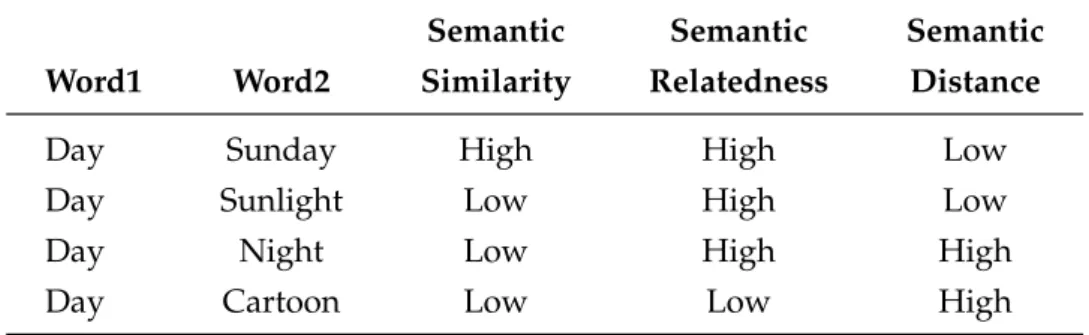
Semantic distance is the most ambiguous of all three terms that are used for referring to semantic associations. It is generally used while talk-ing about similarity as well as relatedness but this usage is not always cor-rect particularly in the case of antonyms, where two words are quite dis-tant in terms of similarity but still are strongly connected semantically. Ex-amples of the three terms of semantic associations are shown in Table 2.1.
Table 2.1: Correlation of the association strength of three terms of semantic associations.
Semantic Semantic Semantic
Word1 Word2 Similarity Relatedness Distance
Day Sunday High High Low
Day Sunlight Low High Low
Day Night Low High High
Day Cartoon Low Low High
2.2
Applications of Semantic Measures
Semantic measures are used as core components in a growing number of applications that critically rely on good estimates of semantic associations. The scope of semantic measures is multidisciplinary, ranging from compu-tational linguistics to artificial intelligence and from cognitive psychology to information retrieval. A multitude of artificial intelligence applications
are essentially founded on semantic association measures. The following list highlights some of these applications and how they use semantic asso-ciation measures:
Automatic keyphrase extractionis the task of systematically extracting the topic-representative keywords and phrases from a text document with minimal or no human intervention [205]. Keyphrase extraction approaches fundamentally rely on the concept of contextual related-ness as candidate words can be potential keywords if they are related to the main topic of the document.
Word sense disambiguationtask requires the automatic identification of the correct sense of a word in a given context [147]. Word sense dis-ambiguation applications largely rely on the understanding of the context in which an ambiguous word occurs in a piece of natural language text. Semantic measures play a critical role in such applica-tions in finding out the relation of each sense of a target ambiguous word with its surrounding context words to pick the correct sense. Paraphrasinginvolves identification, generation and extraction of phrases,
sentences and longer textual units that represent almost the same in-formation [6]. For instance, two text fragments“X made Y” and “Y is the product of X”are paraphrases of each other. These paraphrases are identified by their property of being semantically close to a given piece of text and having the same context around them. The input to aparaphrasing recognition applicationis a pair of text fragments and output is a judgment score indicating whether the members of the in-put pair are paraphrases or not. The aim of paraphrase recognition application is to achieve maximum agreement to the human scores on the task. Among various techniques for paraphrase recognition, co-occurrence based vector space models of association and lexical similarity across a dictionary or thesaurus are commonly used ap-proaches [51].
Automatic text summarizationis the task of producing an informative sum-mary from a single document or multiple documents [79, 11]. The summary is a collection of coherent sentences that are either extracted from the document or generated using machine learning techniques. A query based summarization task first identifies the text segments in a document that are semantically relevant to the query and then generates a summary based on the most relevant text segments. A critical factor in query-based summarization is to choose those sen-tences of the text that are semantically closest to the user generated query. A variant of text summarization is query based summariza-tion–that produces a summery consisting of most salient points that suit a user’s information need (expressed in the form of a query) [201]. Graph-based semantic approaches and probabilistic models are generally used for solving this task [79, 11, 63, 60].
Machine translationis the task of automatically translating a piece of text from one natural language to another language. A machine trans-lation system takes as input a text fragment from a source language and translates it into a text fragment in the target language with min-imal or no loss of generality [103]. For this purpose, various design models are used for substituting words or phrases from source lan-guage to the target lanlan-guage. This substitution requires interpreta-tion of complex linguistics and semantic context of words in two dif-ferent languages [118].
Contextual Spelling error detection and correction is the task of identifying the words in the documents that are spelled incorrectly, determining the candidates for misspelled words and replacing them with the candidate words that are semantically relevant to the context of the text [83]. Generally, spell checkers cannot flag such contextually in-correct words because they consider words in isolation. For instance, the sentence using a word barinstead of the word caris logically
incorrect but the spell checker can not pick this type of errors. To de-tect such errors, surrounding context is of critical importance. Find-ing semantic relatedness of a word to its neighborFind-ing words leads to spell error identifications. To fix such errors, both semantic and probabilistic information are used in literature [92].
Automatic query expansion is the process of reformulating a query to im-prove the performance of information retrieval process [27]. Per-formance of information retrieval systems is largely affected by the poorly- formulated queries representing a user’s needs. To cope with this issue, user generated query is automatically augmented with more semantically relevant words in the same context. The pro-cess of query expansion involves identifying and evaluating query words, finding out other semantically relevant words in the query area and adding those words to the existing query to retrieve more relevant documents. A special case of query expansion isinteractive query refinement, in which the user is given the choice to select the appropriate words for reformulation of queries.
Opinion mining, also known as sentiment analysis, is the task of automat-ically determining the attitude (opinion, appraisal, emotions) of the people regarding entities and their attributes [116]. With the massive growth of social media, such as web blogs, reviews, forum discus-sion and social networking on the web, opinion mining has become a critical area. A fundamental aim of opinion mining approaches is to determine the polarity of a text fragment. Words and sentences are assigned negative, positive or neutral polarity according to the writer’s mood. Advance levels of sentiment analysis involves au-tomatically estimating star ratings. A specialized task is the aspect-based sentiment analysis that involves analyzing opinions regarding certain attributes of an entity. Semantic measures play an important role in identifying the important concepts in an unstructured piece
of text and detecting their relations to the aspect of an entity.
Web search results clusteringis the process of organizing search results by topics into a small number of coherent groups or clusters [26]. In re-sponse to a user query, a ranked result set is returned by a search en-gine. This list consists of web pages on different subtopics or mean-ings of the query. The user keeps visiting the links one by one until the required information is found. To speed up this process of in-formation access and to satisfy the user’s needs in a better way, an automatic clustering approach provides a clustered view of the re-sults. It takes as input a set of web documents retrieved by a search engine and outputs a set of labeled clusters of these documents. Per-formance of clustering approaches critically rely on the precise es-timation of the semantic similarity or semantic distance between a pair of web results [195].
Thus, semantic measures play a major role in the good performance of many applications. Most of these applications do not require to determine the nature or exact type of semantic relation between two concepts but only the strength of their semantic association.
2.3
Can Humans Estimate Semantic Associations?
Humans are good at distinguishing between related and unrelated con-cepts. For example, it is easy for humans to tell that the wordtomatois more related to the word Saucethan to the word Bottle. But, can hu-mans correctly estimate the strength of association of two words on a par-ticular scale (for instance similar words get a score of 1, dissimilar words get a score of 0 and associated words get a score somewhere between 0 and 1)? How strongly do they agree or disagree to each other on estimates of word associations? Will agreement of the same group of people vary over different sets of words? Various attempts have been made to explore the
answers to such questions by creating datasets and measuring the agree-ment of human raters on the datasets.
One of the earliest works that tried to find answers to these questions was a quantitative experiment conducted by Rubenstein and Goodenough [178] in 1965. In their experiment, 51 human judges were given 65 noun word pairs, each pair written on a separate card and were asked to arrange them in the decreasing order of similarity. Then, an averaged continuous similarity value on the scale of [0-4] was assigned to each card based on all judgments. The same experiment was repeated after two weeks with the same human subjects and the new human judgments had a Pearson’s correlationγ of 0.85 with the old judgments. This dataset, known as R&G dataset [178], is a collection of 65 English noun words pairs. In this dataset, the word pairs that were given high scores consisted of semantically simi-lar words. However, the dataset had no word pairs that were semantically related but dissimilar.
In a similar study, Miller and Charles [136] conducted an experiment on general English based dataset consisting of 30 noun term pairs taken from the R&G dataset. In this experiment, 38 human judges were asked to rate the word pairs in this dataset according to similarity and the judg-ments of all participants for each term pair were averaged to get a simi-larity score on a scale of [0-4], where 0 means unrelated and 4 means syn-onyms. These ratings were found to have a high correlation (γ= 0.97) with the mean ratings of R&G dataset. This dataset is generally referred to as M&C dataset. Resnik [172] replicated the same experiment on this dataset and reported an inter-annotator agreement of 0.90.
In order to analyze human estimates on verb similarity, Resnik and Diab [173] conducted a similar experiment in which they split 10 human subjects into context and no-context groups. The subjects in the context group were given 48 verb pairs with example sentences illustrating the intended sense of each verb in the given pair and were explicitly asked to rate them according to semantic similarity rather than relatedness on a
scale of [0-5]. The same experiment with same verb pairs without exam-ple sentences was repeated for the no-contextgroup. They found that the inter-rater agreement2ofcontextgroup was 0.79 whereas that ofno-context group was 0.76. Yang and Powers [223] conducted an experiment in which they collected the human ratings on a larger verb similarity dataset con-sisting of 130 verb pairs. Both these datasets are particularly useful for as-sessing the ability of a semantic relatedness measure to estimate the verb relatedness. This dataset is known as YP-130 dataset.
Finkelsteinet al.[53], created a larger dataset of 353 word pairs (includ-ing the 30 noun pairs from M&C dataset with 0.95 inter-rater agreement with Resnik) scored by 13 to 16 human judges on a scale of [0-10]. This dataset, referred to as WordSimilarity-353 (WS-353), consists of word pairs that are quite diverse in nature ranging from semantically similar word pairs such as(King,Queen)to semantically dissimilar but related word pairs such as (Maradona,Football). It also includes proper nouns
(Michael Jackson), associative term pairs (Wednesday News) and
abbreviations (FBI) and (OPEC), making it a challenging dataset for evaluating the performance of semantic measures.
The annotation guidelines of WS-353 dataset did not distinguish be-tween semantic similarity and relatedness, but most existing semantic mea-sures are semantically biased towards either similarity computation or re-latedness computation. Hence, to analyze the impact of similarity and relatedness on the system performance, Agirre et al. [1] experimented with two subsets of WS-353 dataset focused on similarity and relatedness. To create those subsets, two human judges grouped all pairs in WS-353 dataset into three subsets (similarity pairs, relatedness pairs and unrelated pairs) and then created two new datasets: WS-similarity (the union of sim-ilarity pairs and unrelated pairs) and WS-relatedness (the union of related pairs and unrelated pairs). The inter-rater agreement for their experiment
was 0.80 with a Kappa score3of 0.77.
Another effort to provide additional data for evaluating term relat-edness was done by Randinsky et al. [167], who created a new dataset, MTURK-287, consisting of 287 word pairs. Each word pair was rated by 23 MTURK workers on a scale of [0-5].
In an attempt to create a larger relatedness-based dataset (MTURK-771), 20 MTURK workers assigned relatedness score to 771 English word pairs on a scale of [0-5] [71]. The inter-rater agreement was found to be 0.89 with extremely small variance. This is by far the largest available dataset of word relatedness. Similar efforts were made in languages other than English such as German datasets [69, 229].
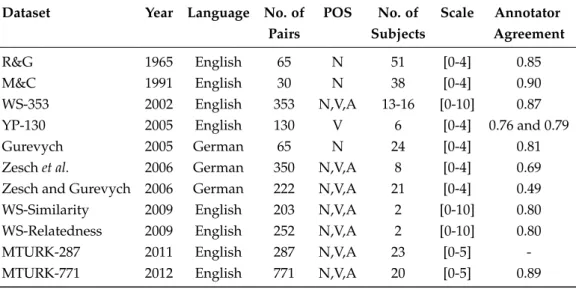
Details of benchmark datasets used for evaluation of semantic similar-ity and relatedness computation approaches are summarized in Table 2.2. The inter-annotator agreement indicates that the humans are good at es-timating the noun-noun relatedness but find it harder to agree when they are presented with a combination of part of speech word pairs. This ta-ble also suggests that predicting semantic similarity is easier than predict-ing semantic relatedness. It is also worth mentionpredict-ing that the annotators were presented with words having multiple senses (ambiguous or poly-semous words), hence the participants had to estimate the similarity or relatedness of the most closely related senses. For example, in the word
pair (crane,implement), both words have multiple senses, however
humans assigned an overall high relatedness score to this pair based on the closeness of their senses crane machine and tool. Overall, these experiments achieved the goal of proving that humans can actually esti-mate semantic associations of words. Moreover, the datasets used in these experiments became the benchmarks for evaluating the performance of semantic measures by comparing the automatically computed scores with manual human judgments. This method will be used for evaluating the
3A measure for assessing the degree to which two or more raters agree on assigning data to different categories
performance of various new measures in the later chapters of the thesis. Table 2.2: Statistics of Benchmark datasets used for evaluation of semantic association measures.
Dataset Year Language No. of POS No. of Scale Annotator
Pairs Subjects Agreement
R&G 1965 English 65 N 51 [0-4] 0.85 M&C 1991 English 30 N 38 [0-4] 0.90 WS-353 2002 English 353 N,V,A 13-16 [0-10] 0.87 YP-130 2005 English 130 V 6 [0-4] 0.76 and 0.79 Gurevych 2005 German 65 N 24 [0-4] 0.81 Zeschet al. 2006 German 350 N,V,A 8 [0-4] 0.69 Zesch and Gurevych 2006 German 222 N,V,A 21 [0-4] 0.49 WS-Similarity 2009 English 203 N,V,A 2 [0-10] 0.80 WS-Relatedness 2009 English 252 N,V,A 2 [0-10] 0.80 MTURK-287 2011 English 287 N,V,A 23 [0-5] -MTURK-771 2012 English 771 N,V,A 20 [0-5] 0.89
2.4
Evaluating Semantic Measures
According to Budanitsky and Hirst [23, 227], there are three methods for evaluating the performance of semantic measures: comparison with human judgments, where manual human judgments are used as gold standard4for evaluation; task-oriented evaluation, where the measure is applied in a real world application and tested indirectly; andMathematical analysis, where formal properties of relatedness measure are assessed. The first two meth-ods are most widely used evaluation method. The mathematical analysis is seldom used.
2.4.1
Correlation with Manual Judgments
To compare automatically computed scores with human judgments, a cor-relation value between the automatic and manual scores is computed. A correlation value indicates two things: the strength of association between two variables; and the direction of the relation (increasing / decreasing or negative / positive). The strength of the correlation is the magnitude of the association between two variables. Depending on the discipline, this magnitude|c|is interpreted or assessed by the the following general guidelines [37]:
• 0.1<|c|<0.3....weak correlation
• 0.3<|c|<0.5....moderate correlation
• 0.5<|c|...strong correlation
The direction of the association between two variables is interpreted by sign of the correlation coefficient: -1 means perfectly negative relationship; 0 indicates no relationship at all; and +1 shows perfect positive relation between the variables. Two types of correlation metrics are commonly used in the literature. Details of both metrics are as follows:
• Pearson Product-momentum correlation coefficient, also known as Pearson correlation (denoted byr), is a measure of strength of linear association between two variables. Pearson’s correlation indicates the deviation of data points from the best fit line (a line that fits all the data points of two variables). The Pearson correlation assumes a value between -1 to +1, depending on whether the association of two variables is negative and positive. The stronger the association of two variables, the higher the correlation value. A value of r = 0
means that there is no association of two variables. A value ofr > 0
indicates that the association of two variables is positive (the value of one variable increases if the value of another variable is increased).
A valuer <0means a negative association (increasing one variable decreases the other variable). Pearson’s correlation is computed as follows: r= Pn i=1(Xi−X¯)(Yi−Y¯) pPn i=1(Xi−X¯)2 Pn i=1(Yi−Y¯)2 (2.1) where nis the sample size and Xi, Yi are the scores of the two
vari-ables being compared.
• Spearman’s rank order correlation coefficient , also called Spear-man’s rho(denoted by ρorrs), is a non-parametric measure of
asso-ciation strength of two variables. It measures how well the associa-tion strength of two variables can be described by using a monotonic function. It is used when the distribution of data makes Pearson cor-
![Figure 1.1: The growth statistics of English Wikipedia [214].](https://thumb-us.123doks.com/thumbv2/123dok_us/404581.2545766/27.892.213.717.536.728/figure-growth-statistics-english-wikipedia.webp)