The Expected Real Return to Equity
Missaka Warusawitharana
∗Board of Governors of the Federal Reserve System
Abstract
The expected return to equity - typically measured as a historical average - is a key variable in the decision making of investors. A recent literature based on analysts forecasts and investor surveys finds estimates of expected returns that are sometimes much lower than historical averages. This study presents a novel method that estimates the expected return to equity using observable data. The method builds on a present value relationship that links dividends, earnings, and investment to market values via expected returns. Given a model that captures this relationship, one can infer the expected return. Using this method, the estimated expected real return to equity ranges from 4.9 to 5.6 percent. Furthermore, the analysis indicates that expected returns have declined by about 3 percentage points over the past forty years. These results indicate that future returns to equity may be lower than past realized returns.
February 23, 2012
∗I thank Eric Engstrom, Jo˜ao Gomes, Deborah Lucas, Michael Palumbo, Jay Ritter, Bo Sun, Hao Zhou, and seminar participants at the George Washington University, the Congressional Budget Office, the Federal Reserve Board, the 2010 Midwest Macro Meetings, the 2010 CRSP Forum, and the 2011 Mid-Atlantic Research Conference for comments. The views expressed in this paper are mine and do not reflect the views of the Board of Governors of the Federal Reserve System or its staff. Contact: Division of Research and Statistics, Board of Governors of the Federal Reserve System, Mail Stop 97, 20th and C Street NW, Washington, DC 20551. [email protected], (202)452-3461.
1
Introduction
The expected return to the aggregate stock market is a key variable in the decisions of both indi-vidual investors and corporations, as emphasized by Merton (1980). A sample average of realized returns provides the simplest, and most widely used, estimate of expected returns. However, future returns may differ from past values. A recent literature examines this possibility by construct-ing forward-lookconstruct-ing measures of expected returns based primarily on analysts forecasts or investor surveys.1
Analysts forecasts and investor surveys have their own limitations. Easton and Sommers (2007) argue that analysts forecasts have an upward bias that can significantly affect estimates of expected returns based on their forecasts. Findings from surveys capture the views of only one segment of the market and, in addition, survey-based methods can suffer from many statistical biases (see Foreman (1991)). As such, this study presents a novel model-based estimation of the expected return to equity that relies only on observed data on aggregate dividends, earnings, investment, and valuations.
The approach builds on Fama and French (2002), who calculate growth rates of dividends and earnings and use them to infer the equity premium using a static Gordon growth model for dividends (see Gordon (1959)). In comparison, this study employs a fully dynamic model with endogenous investment and dividends and exogenous productivity shocks. Given such a model, one could use data on the dividends, earnings, investment and valuations of the US stock market to estimate the model parameters and thereby infer the expected return to equity. This idea differs from the standard approach in the literature, which fits models to data on fundamentals and asset returns to draw inference on the models. Instead, the approach in this study fits a model to data on fundamentals only, and uses the estimates to draw inference on asset returns.
The model underlying the estimation is a variant of the standard production-based asset pricing model employed by Cochrane (1991), Cochrane (1996), Jermann (1998), Gomes, Kogan, and Zhang (2003), Kogan (2004), Zhang (2005), Gomes, Yaron, and Zhang (2006), Liu, Whited, and Zhang (2009), Jermann (2011) and others. The model prices an aggregate equity claim, compared to the per-share claim typically priced in the literature.2 One deviation from the standard model is to
1See Blanchard (1993), Jagannathan, McGrattan, and Scherbina (2001), Claus and Thomas (2001), Graham and
Harvey (2005), Pastor, Sinha, and Swaminathan (2008), and Fernandesz and Baonza (2010).
2Bansal and Yaron (2007) emphasize this distinction and compare the implications of pricing an aggregate equity
claim versus a per-share claim. Larrain and Yogo (2008) examine the present value relationship between asset prices and payouts using data on the aggregate stock market.
incorporate decreasing returns to scale in the profit function, reflecting firm markups. This leads firms to vary its optimal scale following persistent shocks to productivity and helps provide an additional source of value compared to models that take dividends as exogenous.
There are many benefits to taking a model-based approach to estimating expected returns. Such an approach avoids potential biases associated with analysts forecasts (see Easton and Som-mers (2007)). The estimation uses data for the aggregate market, thus taking into account the expectations of all market participants as opposed to only analysts or survey participants. The model captures the dynamics of earnings and the endogeneity of dividends, which are treated as exogenous in methods based on the Gordon growth model (see Fama and French (2002)). The model also incorporates a time-varying pricing kernel that places a greater valuation on dividend payouts in recessions, a feature absent from the forecast-based approaches. On the other hand, a model-based approach is necessarily predicated on a particular model of equity values. As such, I investigate the robustness of the findings to some changes to the underlying model.
I estimate the parameters of the model using data on a U.S. representative firm constructed by aggregating firm level data from the CRSP/Compustat merged data set.3 I perform the analysis on two samples: the first uses annual data from 1966 to 2009; the second uses quarterly data from 1984:Q1 to 2009:Q4. Data availability on stockholders’ equity and dividends constrain the start dates of the two samples, respectively. Both samples exclude financial firms and regulated utilities. The parameter estimates from the annual data imply a mean expected annual real return to equity of about 4.9% to 5.6% over the period from 1966 to 2009. These estimates are within the range of values for expected returns obtained by Fama and French (2002), and Graham and Harvey (2005).4 The findings also support the decision in the limited participation literature to use a lower return to equity than would be indicated by historical returns (see Gomes and Michaelides (2005) and Polkovnichenko (2007)).
Separating the sample into two, I find that average expected returns to equity decline sharply from about 6.6% in the period from 1966 to 1987 to about 3.7% in the period from 1988 to 2009. This decline reflects the fact that while earnings and dividends are lower in the latter periods, valuations are higher. The model reconciles this apparent discrepancy with a lower expected return, which raises valuations by lowering the discount rate applied to future dividends. Repeating the estimation using the quarterly data from 1984:Q1 to 2009:Q4 generates an average real return to
3McGrattan and Prescott (2005) use the representative firm constructed in the Flow of Funds accounts for their
analysis.
4The estimated expected returns are higher than the estimates of Claus and Thomas (2001), Blanchard (1993)
equity of 3.6%, similar to that obtained using the annual data from 1988 to 2009. The results suggest that mean expected returns to the aggregate stock market over the past twenty-five years have been lower than historical returns, as argued by Lettau, Ludvigson, and Wachter (2008) and Cogley and Sargent (2008).
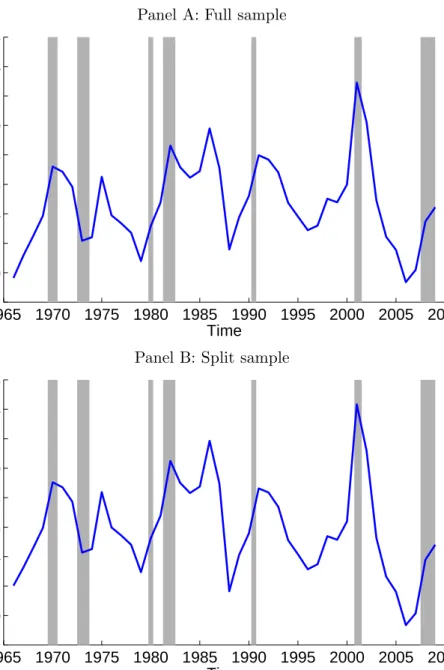
The model performs fairly well on a range of diagnostic tests. Comparing moments not used in the estimation with the corresponding data reveals that the model generates similar properties of the value-to-dividend ratio as the data. The standard deviation of returns implied by the estimates ranges from 7.0% to 11.6%, compared to about 18.3% in the data. Further, the model generates plausible time-variation in expected returns, with conditional expected real returns around 8 percent or higher during most recessions. Conversely, expected returns decline to about zero during periods of strong earnings.
One limitation of the model is that it also generates a relatively high risk-free rate. As I argue later, this reflects the fact that standard production-based models cannot generate risk-free rates much below the economic growth rate. Thus, the approach used in the study cannot be used to provide an estimate of the equity premium. However, this does not invalidate using the model to estimate the expected real return to equity.
The findings have sharp implications for the investment decisions of both individual and in-stitutional investors. Current asset allocation advice is mostly based on properties of historical returns. A lower expected return to equity implies that individuals need to save more to fund re-tirement expenses. They may also need to reduce their allocation to equities in their portfolios. A lower expected return also impacts the actuarial calculation of pension funds and insurance firms, who base their decisions on annual expected nominal returns of 6% to 10%. In particular, a lower expected return would further exacerbate the under-funding problems of state pension funds, as discussed by Novy-Marx and Rauh (2009).
This study is organized as follows. Section 2 presents the model relating earnings, dividends, and valuations. Section 3 discusses the data used in the estimation and the identification of the model parameters. Section 4 presents the results. Section 5 examines other implications of the model and Section 6 concludes.
2
Model
Consider an economy with a representative agent that provides a fixed supply of labor,L, at a wage rate, wt, determined by market clearing conditions in the labor market. The economy consists of
otherwise identical firms that produce differentiated goods yj,t, where j indexes each good. The
differentiated goods are combined to form an aggregate good,Yt, using the Dixit-Stiglitz aggregator
(see Dixit and Stiglitz (1977)) with inverse elasticity of substitution,ν.
Yt= Z y(1−ν) j,t dj 11 −ν .
Letpj,t denote the price of the jth good. The aggregate price index is given by
Pt= Z y 1 1−ν j,t dj (1−ν) .
Given this specification, one can derive the following demand function for each good:
pj,t =YtνPt−νyj,t−ν. (1)
2.1 Firm profits, dividends, and value
Each firm uses assets,kj,t, and labor,lj,t, to produce output. Let Xt denote the aggregate level of
labor augmenting technology andψtdenote trend deviations of aggregate productivity. The output
of each firm is given by:
yj,t=ψtkj,tα(Xtlj,t)1−α, (2)
whereαdenotes the elasticity of output with respect to assets. The profits of each firm is given by maximizing with respect to the labor input,
πj,t= max
lj,t pj,tyj,t−wtlj,t. (3)
Using the equations for the price and output of each firm given in (1) and (2), Appendix A solves for the optimal labor choice and derives the following expression for the profits of each firm as a
function of its assets and aggregate conditions. πj,t=aψ 1−ν 1−(1−α)(1−ν) t X ν 1−(1−α)(1−ν) t k α(1−ν) 1−(1−α)(1−ν) j,t , (4)
where a is a constant term. The wage wt will be set such that the labor market clears, i.e.,
R
lj,tdj=L, where the labor demand is given in (A.4).
Each firm is financed through debt and equity. Denote the level of debt by bj,t. Following much
of the literature, the book leverage is assumed to be a constant, φ, implying that the level of debt
bj,t = φkj,t. This debt is assumed to be riskless with an interest rate r. In unreported results, I
examine the effect of allowing the interest rate to vary with aggregate conditions, and find that this has very little effect on the estimates.
Each firm funds physical investment,ij,t, from its cash flow. The asset accumulation equation
is given by
kj,t+1=kj,t(1−δ) +ij,t,
whereδequals the depreciation rate. Each firm also faces a quadratic adjustment cost of investment given byλ i
2 j,t
2kj,t as in Hayashi (1982). Firms do not face any additional costs of disinvestment as in
Abel and Eberly (1996).
Each firm uses its cash flow to fund investment, pay interest to creditors, pay taxes to the government, and pay dividends to shareholders. The taxes are paid on profits net of depreciation and interest expenses, as in the tax code. I consider a linear tax code with a tax rate, τ. Firms also face a fixed cost of operations ft =Xtf each period. The scaling with aggregate technology
ensures that the fixed costs do not vanish over time. Given these assumptions, the dividend payout of the firm,dj,t, is given by
dj,t= (πj,t−f Xt)(1−τ)−bj,t(1 +r(1−τ)) +bj,t+1+δkj,tτ −ij,t−
λi2j,t
2kj,t
. (5)
Let Mt,t+1 denote the pricing kernel of the economy, which we will parametrize subsequently. The value of each firm, v(kj,t, Xt, ψt), can be expressed as the solution to the following Bellman
equation: v(kj,t, Xt, ψt) = max kj,t+1,ij,t dj,t+E[Mt,t+1v(kj,t+1, Xt+1, zt+1)], (6) kj,t+1 = kj,t(1−δ) +ij,t, Xt+1 = Xt(1 +γ),
whereγ denotes the growth rate of aggregate technology and the expression for dividends is given above in (5).
In effect, each firm chooses the optimal dividend and investment policies to maximize firm value. The value of the firm depends on the endogenous dividend process, which itself is influenced by the pricing kernel, Mt,t+1. For instance, an increase in expected returns will lower the average pricing kernel, leading to both an increase in dividends and a decrease in firm value.
2.2 Aggregate firm value
As all the firms are otherwise identical and face only aggregate shocks, they will use the same inputs for ki,t and li,t. Further, they will have the same investment and dividend policies. As such, one
can rewrite the model in terms of aggregate variables. Let Kt, Πt,Bt,It, Dt, Vt denote aggregate
assets, profits, debt, investment, dividends and firm value, respectively. Then, aggregate profits can be written as Πt=Aψ 1−ν 1−(1−α)(1−ν) t X ν 1−(1−α)(1−ν) t K α(1−ν) 1−(1−α)(1−ν) t ,
where A is another constant that incorporates integration constants. We can simplify the above expression by noting that the exponents of Kt and Xt sum to one. Let θ = 1−(1α−(1α−)(1ν)−ν) be the
exponent on Kt. Then, some algebra yields that the exponent on Xt equals 1−θ. In addition, simplify further by renormalizing the trend deviation of productivity term, ψ, such that zt =
ψ
1−ν 1−(1−α)(1−ν)
t . Thus, one can write aggregate profits as
Πt=AztXt1−θKtθ. (7)
One important point to note here is that the exponent θ on Kt is not equal to α. Instead, θ is a
Using a similar aggregation argument, aggregate dividends are given by the following
Dt= Πt(1−τ)−f Xt(1−τ)−Bt(1 +r(1−τ)) +Bt+1+δKtτ−It− λI 2
t
2Kt. (8)
The value function for the aggregate firm is then given by
V(Kt, Xt, zt) = max Kt+1,It
Dt+E[Mt,t+1V(Kt+1, Xt+1, zt+1)], (9)
Kt+1 = Kt(1−δ) +It,
Xt+1 = Xt(1 +γ),
where dividends are given in (8).
The assumption of differentiated products with a Dixit-Stiglity aggregator implies that the value function for the aggregate firm exhibits decreasing returns to scale inKt. This departs from
standard models that assume constant returns to scale inKt.5 In addition to the empirical evidence
in favor of downward sloping demand curves for firms’ profits, this departure is helpful in the context of this study. It implies that firms will change their optimal scale following productivity shocks. This optimal response acts as an added source of firm value that would be absent otherwise. In addition, a constant returns to scale specification implies that valuation ratios are mainly driven by investment adjustment costs, an unappealing restriction for understanding variation in valuations. A decreasing returns to scale specification also gives the model additional flexibility in matching the averages of earnings and valuations, which can be challening for constant returns to scale models. As I estimate θ, the degree of decreasing returns to scale required to best fit the data becomes a question to be resolved by the estimation.
2.3 Parametrization of the pricing kernel
The productivity term, zt, measures deviations from trend growth levels and is assumed to follow
an auto-regressive process with
log(zt+1) = ρlog(zt) +ǫt, (10)
ǫt ∼ N(0, σ),
5Note that a C.R.S. specification may be more suited for understanding variation in labor and output, whereas
whereǫt denotes shocks to aggregate productivity.
I parameterize the log pricing kernel as a log-linear function of current and future aggregate productivity:
log(Mt,t+1) =−(1 +b0) log(1 +γ)−b1(log(zt)−log(zt+1))−b2log(zt). (11)
The above parametrization is similar to the ones employed by Berk, Green, and Naik (1999) and Zhang (2005). This specification enables one to capture relevant features of pricing kernels in a parsemonious manner. Theb1 term captures the impact of changes in aggregate conditions on the pricing kernel. For instance, a negative value forb1 implies that the agent places lower valuations on assets that have higher payoffs when the aggregate conditions improve. Related, a positive value for b2 implies that as aggregate conditions improve, the agent places a lower value on remaining in the current condition. Both of these are economically meaningful features of the pricing kernel that reflect risk aversion. These features also arise in consumption-based models. The above specification also nests a constant discount rate when b1 = b2 = 0. Note that as the long-run growth rate of the economy, γ, will be fixed in the estimation, the presence of the log(1 +γ) term in the constant term merely functions to rescale b0.6 Eliminating the log(1 +γ) term would have no effect on the results other than to change the estimate ofb0.
2.4 Mapping the model to a stationary economy
The value function given in equation (9) incorporatesXt, the trend productivity term. In order to
simulate and estimate the model, the value function needs to be detrended into a stationary form. Denote the detrended variables using˜s. Thus,
˜ Kt= Kt Xt , I˜t= It Xt , Π˜t= Πt Xt , B˜t= Bt Xt , D˜t= Dt Xt and ˜ V( ˜Kt, zt) = V(Kt, Xt, zt) Xt .
6This particular specification helps the estimation by ensuring that the model converges for all values ofb 0.
It is fairly straightforward to derive that the detrended value of the firm is given by the following Bellman equation: ˜ V( ˜Kt, zt) = max ˜ Kt+1,It˜ ˜ Dt+E h Mt,t+1(1 +γ) ˜V( ˜Kt+1, zt+1) i (12) ˜ Dt = Π(1˜ −τ)−f(1−τ)−B˜t(1 +r(1−τ)) + ˜Bt+1(1 +γ) +δK˜tτ −I˜t− λ ˜ I2 t 2 ˜Kt . (1 +γ) ˜Kt+1 = K˜t(1−δ) + ˜It.
Observe that the terms involving t+ 1 are now multiplied by (1 +γ). This arises due to the fact that when detrendingt+ 1 variables byXt, one needs to include a XtXt+1 = 1 +γ term.7
More importantly, this implies that the transformation of the economy into a stationary form involves an adjustment in the pricing kernel to take into account economic growth. In the absence of this adjustment, one would derive incorrect valuation ratios for a given set of parameter values. The intuition for this result is that observed data on valuations incorporate a component for economic growth. As such, when attempting to understand the relationship between earnings, dividends, and valuations using a stationary model, one needs to incorporate the adjustment for growth. This adjustment for economic growth also implies that the model cannot generate low risk-free rates below the economic growth rate as it would violate the contraction mapping necessary for convergence.
3
Data and estimation
I employ the above model given in (12) to provide an estimate of the expected real return to equity. Fundamentally, data on income accruing to shareholders, dividends, investment and firm value can be used to estimate the structural parameters of the model. The expected return to equity can then be derived from the estimated parameters for the pricing kernel. Appendices B and C detail the simulated method of moments estimator used to obtain the parameter estimates.8 The intuition behind the estimation is that the expected return maps earnings data onto valuation data. Therefore, given data on earnings and valuations, one can infer the expected return.
7Algebraically, Kt+1 Xt = Kt+1 Xt+1 Xt+1 Xt = ˜Kt+1(1 +γ).
8Other studies that use this estimation method include Hennessy and Whited (2005), Cooper and Haltiwanger
(2006), Hennessy and Whited (2007), Eberly, Rebelo, and Vincent (2008), Kogan, Livdan, and Yaron (2009), and Bloom (2009).
The estimation is carried out using a one-step GMM estimator, with the optimal weighting matrix derived from the data moments. For robustness, I examine the effect of using a two-step GMM estimator, where the weighting matrix for the second step is derived using the first step estimate. The two-step estimation leads to similar results as the one-step estimation.9
This analysis provides an alternate perspective on the expected real return to equity that may differ from results based on historical data. Related, Fama and French (2002) argues that dividend growth models suggest that the expected real return to equities may be lower than realized historical values. Claus and Thomas (2001) use analysts forecasts to argue that the equity premium is much lower than historical values. While the hypothesis that future returns should simply reflect past returns is a compelling null hypothesis, there are robust arguments to the contrary. Cogley and Sargent (2008) argue that the Great Depression lead to an increase in the market price of risk that has slowly dissipated over time. Lettau, Ludvigson, and Wachter (2008) argue that declining macroeconomic risk has lead to a decline in the expected equity premium. These arguments motivate using the above model to provide a forward looking estimate of the expected return to equity.
That said, the recent recession may have lead to a reexamination of the riskiness of equities with an associated change in expected returns. Unfortunately, the approach in this study cannot examine this question without data on a sufficient number of periods following the recession. However, much of the recent market turmoil was driven mainly by financial firms, and it is not necessarily given that this turmoil would have affected expected returns to nonfinancial firms, the focus of this study. As I subsequently show, these firms exhibit a quick rebound in earnings from 2009:Q2 onwards.
3.1 Data
The data for the estimation is obtained from the CRSP/Compustat merged data set. I estimate the model on both an annual data set and a quarterly data set. The sample periods for the annual and quarterly data sets extend from 1966 to 2009 and 1984:Q1 to 2009:Q4, respectively. The start dates are constrained by the lack of data on shareholders equity and dividends prior to the start dates for the annual and quarterly data sets, respectively. The sample excludes financial firms and regulated utilities as the model would not be appropriate to use for such firms. The data sets
9Comparing the one-step and two-step estimators reveals that the first stage of the two-step estimator, which uses
an identity weight matrix, matches each individual moment more closely than either the second stage of the two-step estimator or the one-step estimator, both of which use non-diagonal weighting matrices. In these cases, divergences between data and model moments are sometimes offset by off-diagonal terms in the weighting matrix.
for the representative firm are constructed by aggregating firm level data on total assets, capital expenditures, common dividends, income accruing to shareholders, total liabilities, corporate taxes and the book and market values of equity from the respective samples. Any firm with missing values for the market value of equity is excluded from the aggregation.
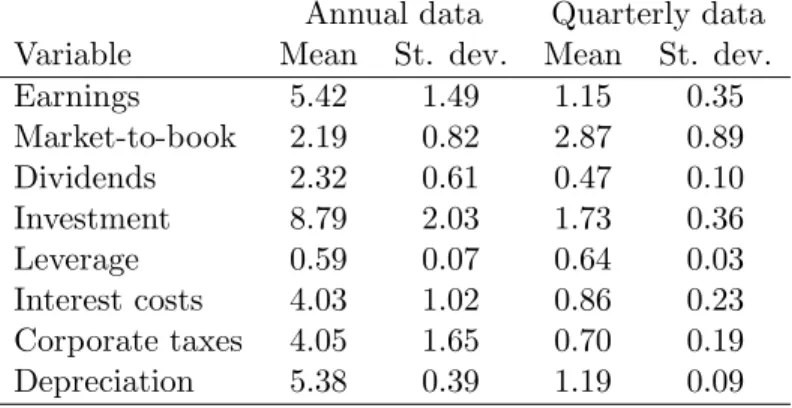
Table 1 reports the summary statistics of interest for the aggregate firm: Panels A and B, respectively, report values at the annual and quarterly frequencies. All variables except the market-to-book ratio, leverage, and interest expenses are constructed after scaling by lagged total assets. The market-to-book ratio equals the market value of common equity divided by book equity.10 The mean value of earnings, measured as income accruing to shareholders, indicates that the aggregate earnings of firms are noticeably higher over the annual data period than over the quarterly data period. Aggregate dividends exhibit a similar pattern. In contrast, the aggregate valuation of firms is lower over the annual data period than over the quarterly data period.
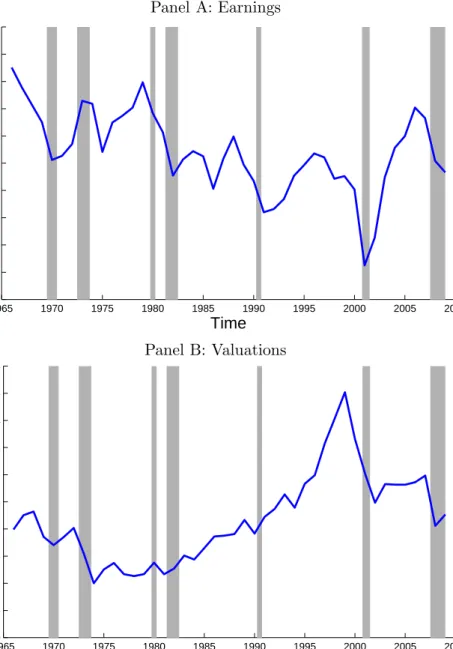
Figure 1 plots the time series of earnings and valuations of the aggregate firm. This confirms the observation that, over time, the aggregate earnings of the selected firms have declined while their aggregate valuation has increased. Further, this effect does not arise from any particular outliers. A way in which one could reconcile higher valuations with lower earnings and dividends would be to have a lower expected return, which, ceteris paribus, increases firm value by lowering the discount rate applied to future cash flows. The subsequent estimation examines this possibility more formally.
3.2 Calibrated parameters
The above model includes many auxiliary parameters, such as the corporate tax rate. One approach would be to include relevant information and estimate all of these parameters. Another approach would be to calibrate some of the model parameters to match the data, and estimate the rest. I take the second approach, which has the benefit of focusing the estimation on the parameters of interest, thereby improving the identification.
In the calibration, the depreciation rate, δ, is set equal to the mean ratio of aggregate depreci-ation to total assets over time. This ensures that the deprecidepreci-ation rate in the simuldepreci-ations matches that in the data. In a similar vein, the interest rate,r, equals the mean ratio of interest payable to total liabilities observed in the data. The linear tax rate equals mean aggregate taxes to taxable
10This scaling transforms all the data into real terms under the assumption that the same deflator applies to all
income. The calibrated tax rate, τ, equals 40.2%, close to the federal tax rate of 35% plus the average state tax rate of 4%. The leverage level, φ, is set to match the ratio of total liabilities to total assets. Finally, the fixed cost of operations, f, is set to match the observed ratio of selling, general, and administration expenses to total assets.
The economic growth rate used in the estimation, γ, equals 1.99%, the per capita consumption growth rate over the sample period. The quarterly estimates assume a quarterly growth rate of 0.5%.
3.3 Identification of model parameters
The simulated method of moments estimation involves matching moments from the data to those obtained by simulating the model given in equation (12). The matched moments include selected means, variances, autocorrelations, and regression coefficients. Given the black box nature of the estimation, it is helpful to provide some intuition as to which moment helps identify which parameter.
The average earnings level helps pin down the curvature of the profit function, θ. This reflects the link between θ and the markup charged by the firm. The autocorrelation of dividends and earnings helps pin down the autocorrelation parameter, ρ. Similarly, the variances of earnings and earnings differences inform the volatility of the productivity shock process,σ. Due to the curvature of the value function, the volatility of the productivity measure also influences the mean market-to-book ratio. The mean dividend level helps pin down the adjustment cost parameter, λ. The resource constraint for the firm implies that dividends equals earnings minus the cost of investment. Given levels of earnings and investment, an increase in adjustment costs lower the dividend payout. Once the model has pinned down the above parameters, the average market-to-book ratio helps pin down the mean pricing kernel. Effectively, given earnings and dividends, a lower market-to-book ratio requires a lower mean pricing kernel. Finally, the expected return to equity equals the average realized return obtained from simulating the model given the estimated parameter values. The expected return is reported after transforming back into the economy with trend growth, so as to be comparable with actual data.
Although the above discussion focuses on selected mappings between the moments and the parameters, the estimation employs data on all the moments to pin down all the parameters. In the model simulations, a parameter change will directly or indirectly affect all the moments. For example, an increase in ρ leads to a higher average market-to-book ratio, in addition to its direct
effect on the autocorrelation moments.
4
Results
This section presents the results from the estimation. The first subsection estimates the model using annual data from 1966 to 2009. The next two subsections, respectively, estimate the model on the annual data split into two subperiods and on quarterly data from 1984 onwards. This analysis helps examine whether average expected returns have changed over time. The last subsection examines an extension of the model that incorporates long-run changes in economic growth, motivated by the long-run risks literature (see Bansal and Yaron (2004)).
4.1 Annual data
Panel A of Table 2 presents the parameter estimates from estimating the model on annual data from 1966 to 2009. The expected mean return to equity from the estimation equals 4.9%, lower than the long-run historical average real return of 6.5% used in the literature. The estimates indicate that the expected return to equity is lower than historical values, consistent with the findings of Fama and French (2002), Siegel (1999), Claus and Thomas (2001) and Jagannathan, McGrattan, and Scherbina (2001). This suggests that historical realized returns may be higher than expected returns in the future. This could be due to either decreasing macroeconomic risk (see Lettau, Ludvigson, and Wachter (2008)), decreased market price of risk (see Cogley and Sargent (2008)) or changes in taxes (see McGrattan and Prescott (2005)).
The intuition for the estimate is that it equals the expected return at which data on earnings, dividends, and associated growth options are best reconciled with data on valuations. A higher expected return would lower the discounted present value of future dividend streams, resulting in a smaller aggregate market-to-book ratio. The precision of the estimate arises from the sensitivity of the model to changes in the expected return. Thus, the method employed in the study helps filter some of the noise in observed returns.
The point estimate for θindicates significant curvature of the profit function.11 The estimates for ρ and σ are mainly determined by the data on the earnings process, while the estimate for λ
enables the model to match the data on dividends. Note that the investment adjustment cost is
11The estimate forθis very close to the value of 0.57 obtained by settingα= 1/3 andν= 1/5 into the definition
the only friction in the model, and the estimate reflects the gap between earnings, dividends, and investment observed in the data.
Panel B of Table 2 presents the moments used in the estimation. The model moments are constructed using the parameter values reported in Panel A. The model successfully matches the first moments of earnings, dividends, and the market-to-book ratio in the data. However, the model fails to match the average earnings to value ratio in the data, indicating that data exhibit a somewhat weaker relationship between firm value and earnings than in the model.
The model matches the volatility of earnings differences, but not earnings themselves. This reflects the fact that, given a single shock process, the model has difficulty matching multiple variances.12 The model matches the persistence of earnings and dividends, with dividends being smoother than earnings, as in the data. Further, the model generates a similar relationship between dividends and earnings as in the data, but fails to generate the relationship between investment and earnings in the data. The model finds investment to be sensitive to current earnings, while investment responds more to lagged earnings in the data, perhaps reflecting lead times associated with planning investment projects.
4.2 Annual data - split sample
Estimating the model after separating the sample into two periods enables one to further examine whether the expected real return to equity has declined over time. Table 3 presents the results from estimating the model after splitting the annual sample at its midpoint, 1987. Panel A reports the parameter estimates from the two samples, and Panel B reports the matched moments.
The split sample results provide clear evidence of a decline in the expected real return to equity, which declines from 6.6% in the twenty two years from 1966-87 to 3.7% from 1988-2009. This decline is both economically and statistically significant. This indicates that the decline in average earnings and the increase in valuations documented in Table 1 and Figure 1 translate to a noticeable decline in the expected return to equity.
One criticism that the reader may pose is whether the lower estimated expected returns reflect an inability of the model to generate high returns to equity. However, note that the estimated expected return for the period from 1966-87 is similar to the long-run historical average. This indicates that the model can generate high real returns to equity, and the lower estimates for the
12For instance, the model also fails to match the observed volatility of the market-to-book ratio in the data.
However, adding the volatility of the market-to-book ratio as a matched moment has little effect on the parameter estimates, as the covariance matrix used to weight the moments gives it little weight.
overall sample (and the latter sample period) are not an artifact of the model, but instead an estimate that reflects the data over these periods.
The gap between the estimated expected return to equity and realized returns may reflect a structural break in the economy or a slow moving change in expected returns.13 Lettau, Lud-vigson, and Wachter (2008) argue that the decline in equity premium arose from a reduction in macroeconomic volatility. Cogley and Sargent (2008) attribute the decline in the equity premium to slow moving changes in the market price of risk following the Great Depression. Bansal and Yaron (2004) argue that slow moving changes in consumption growth drives asset prices. Garleanu, Panageas, and Yu (2011) present a model in which technological change drives slow moving changes in expected returns over long horizons. Increased participation in the stock market may also lower the expected returns to equity. In contrast, Pastor and Veronesi (2009) provide an alternate view that the increase in equity values was a temporary phenomenon associated with the introduction and adoption of the Internet. In a related study, Pastor and Veronesi (2006) argue that the high observed valuations for the NASDAQ could be rationalized given uncertainty about future prof-itability. Ritter and Warr (2002) argue that the bull market in the 1990s may have been partly due to a decrease in inflation. While the results in this study cannot distinguish between these explanations, it suggests that investors should not simply rely on historical returns to equity when forming portfolio and savings choices.
The parameter estimates from the split samples are comparable to those obtained with the full sample. The model manages to fit the chosen moments quite well over the first period.14 It’s less successful at matching all the moments over the second period, indicating that the model has more difficulty generating the relationship between earnings, dividends, and valuations observed over this period.
4.3 Quarterly data
The previous analysis suggests that expected returns to equity have declined noticeably over the past forty years. Another way to verify this result would be to examine whether the model estimated using quarterly data, which are available only from 1984:Q1, generates similar results to that
13See Pastor and Stambaugh (2001) and Kim, Morley, and Nelson (2005) for a Bayesian approach to structural
breaks in equity returns. Lettau and Nieuwerburgh (2008) provides evidence of a structural break in the price-dividend ratio at about the same time.
14The one exception being the regression coefficients of investment on earnings and lagged earnings, where the data
obtained with annual data over the later sample period.
Panels A and B of Table 4 present the estimated parameter values and the matched moments, respectively, from the estimation of the model using quarterly data from 1984:Q1 to 2009:Q4. The estimated expected real return to equity equals 3.6%, similar to the estimate obtained using the annual data for the period from 1988 onwards. The finding provides further evidence in favor of a decline in average expected returns to equity.
The estimates for the other parameters are driven by the matched moments and are, for the most part, comparable to the annual estimates. The estimate for the adjustment cost parameter,
λ, jumps, mainly as a result of the quadratic specification. That is, λ has to be much higher in order to generate the same resource cost of investment with much lower average investment rates, since investment is now measured quarterly, not annually. As before, the mean expected return is fairly precisely estimated, while the model has difficulty pinning down some of the other pricing kernel parameters.
4.4 Long-run changes in economic growth
Bansal and Yaron (2004) emphasize long-run changes in consumption growth as a possible expla-nation for the equity premium. One could examine the effect of such long-run economic changes within the context of this study by incorporating an additional long-run growth term into the value function.
Let xt denote a long-run growth term that takes values of either exp(−lt) or exp(lt), where lt denotes the deviation from trend growth. Let pl and ph denote the transition probabilities of the
economy remaining in the low and high long-run growth states, respectively. The long-run growth term also impacts the pricing kernel. Denote the pricing kernel of the augmented model as
log(Mt,t+1) = −(1 +b0) log(1 +γ)−b1(log(zt)−log(zt+1))−b2log(zt)
−b3(log(xt)−log(xt+1))−b4(log(xt)−µx), (13)
whereb3, b4 denote the parameters associated with the long-run growth terms.
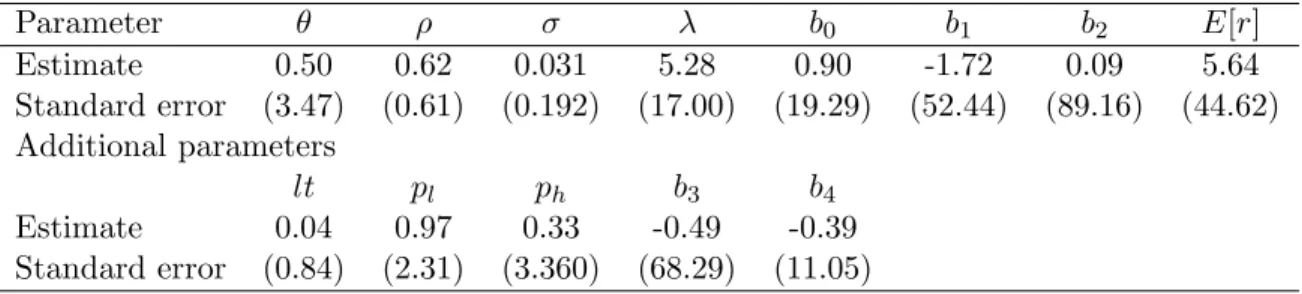
Table 5 presents the results obtained from estimating the augmented model. Panel A presents the parameters of interest, while Panel B presents the matched moments. Consistent with the long-run risks literature, this model generates a higher expected return than the baseline model. However, the estimation fails to identify any of the augmented model parameters, leading to a large
standard error for the expected return.
5
Model implications
This section evaluates the model along some dimensions not used in the estimation, presents the conditional expected returns implied by the model, and examines the implications of the findings for investors’ portfolio choice decisions.
5.1 Model evaluation
The model presented in this study is primarily aimed towards estimating the expected return to equity. The reader may be interested in understanding how the model fares with regards to features of the data that were not employed in the estimation.15 Such a comparison serves as an out-of-sample evaluation of the estimates.
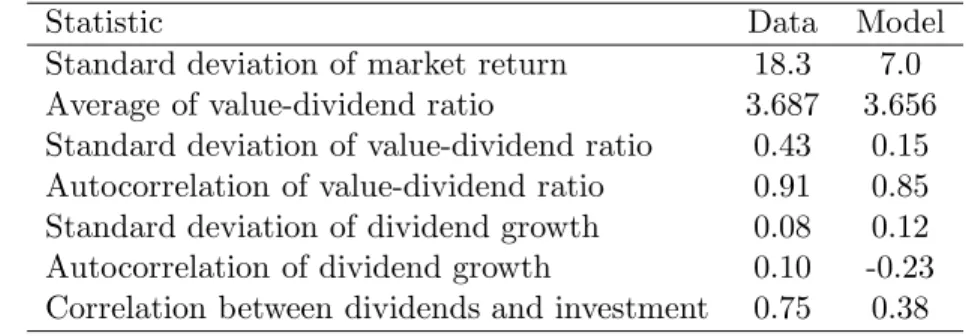
Table 6 presents some statistics of interest obtained from the data and the model simulations. Panel A presents the results using the estimates obtained with the annual data reported in Table 2. Panel B presents the corresponding statistics using the results reported in Table 3. The data statistics are obtained from the corresponding data sets used in the estimations. The reported statistics relate to the key variables employed in the estimation: aggregate dividends, investment, and market value.
The models generate an annualized equity return volatility of 7.0% to 11.6%, about half the value observed in the data. This indicates that although the model has a flexible pricing kernel, it has some difficulty generating the high equity return volatility observed in the data.
The log market value to dividend ratio from the model matches the data well with the annual estimates, but less so for the split sample periods. On the other hand, the model comes close to capturing the autocorrelation of the log market value to dividend ratio over all periods. As Bansal and Yaron (2007) find, the log value to dividend ratio exhibits less persistence than the per share price-dividend ratio.
The model matches the volatility of dividend growth over the longer period, but overshoots the data values for the two sub-periods. Reflecting the mean-reverting nature of the productivity function, the model generates a small negative autocorrelation for dividend growth. However, this autocorrelation takes a small positive value in the data. Finally, the model generates a somewhat
smaller correlation between dividends and investment than in the data, which is perhaps surprising given the fact that the model has a stronger relationship between investment and contemporaneous earnings than in the data.
One dimension along which the model fails to match the data is the risk-free rate. The implied risk-free rates are always above the assumed economic growth rates. As discussed in Section 2.4, production-based models with time-separable utility functions have substantial difficulty generating low risk-free rates once one accounts for economic growth.
5.2 Time variation in expected returns
The previous discussion focused on the mean expected return to equity. However, the model also implies that expected returns vary with the aggregate earnings of firms.16 An examination of the model-implied conditional expected return provides another criterion for evaluating the estimates. Figure 2 plots the model-implied conditional expected return to equity. Panel A plots the series constructed using the estimates from the annual data reported in Table 2; Panel B plots the series constructed using the estimates from the split sample data reported in Table 3. I construct the expected return to equity for each of the earnings grid values used in the estimation. Interpolating the observed earnings data onto the conditional expected returns to equity at these grid points generates the model-implied expected return at each data point. In order to offset the decline in earnings observed in Figure 1, the expected returns using the full sample estimates are calculated after removing the difference in earnings over the two subperiods.17 For the split sample series using annual data, I splice together the implied expected return from the sample from 1966 to 1987 with that from the sample from 1988 to 2009.
The figure demonstrates that the model generates noticeable variation in expected returns.18 Consistent with economic reasoning, the model-implied conditional expected returns reach their peak values during the recessions. Conditional expected returns reach their highest value during the recession of 2001, reflecting the sharp decline in earnings during that period. However, condi-tional expected returns do not rise as sharply during the recession of 2009, reflecting the relatively
16Chen, Novy-Marx, and Zhang (2010) present a three-factor cross-sectional asset pricing model that employs ROA
as one factor.
17Eliminating this difference makes the conditional expected returns reported in Panels A and B comparable.
Constructing this figure using the unadjusted data generates similar cyclical variation. However, since this esti-mate assumes that expected return are, on average, unchanged over the entire period, it shows an upward trend in conditional expected returns as a result of the decline in earnings over this period.
robust performance of the nonfinancial business sector during this period. The range of values for conditional expected real returns are generally plausible, and in particular, takes mostly positive values as emphasized by Campbell and Thompson (2008). These results indicate that the estimates successfully capture time variation in expected returns.
5.3 Implications for portfolio choice
This section examines the portfolio choice implications of differences in the real return to equity. Holding all else constant, it compares the optimal equity weight obtained using the estimated expected returns to equity with the optimal equity weight obtained using a historical average for equity returns. This comparison is carried out for a CRRA investor who lives outside the model.19 Although this analysis is carried out outside the context of the model, it provides a helpful economic perspective on the portfolio implications of the estimated differences in expected returns.
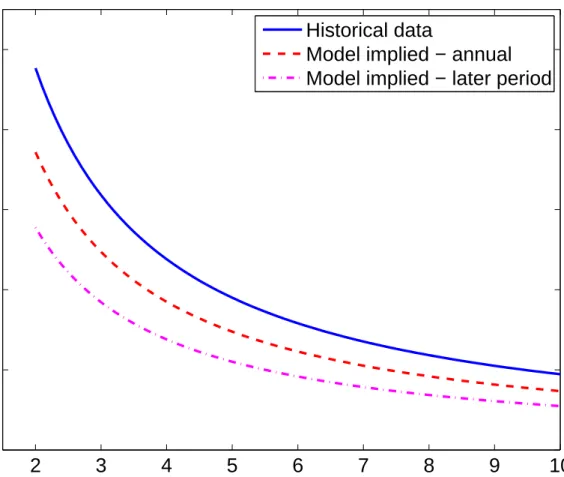
Figure 3 plots the optimal allocation to equity for the investor as a function of his risk aversion coefficient. The investor has a one year holding period. The portfolio weight using historical data was constructed assuming an annual real return to equity of 6.35% and a risk-free return of 0.5%. The excess return of 5.85% reflected the post-war excess return to equity. The expected volatility of the stock return was set equal to its sample average of 18.3%. The red dashed line represents the optimal equity holding for an investor who forms his decisions based on the estimated real return to equity of 4.94% reported in Table 2. The pink dashed-dot line assumes an expected return to equity of 3.69%, as reported in Table 3. In both cases, the investor uses the same values for the risk-free rate and the volatility of equity returns as the data-based investor.
As expected, portfolio allocations based on the estimated expected return result in a lower exposure to the stock market. The gap between the two portfolios is particularly pronounced with low levels of risk-aversion. An investor with a relative risk aversion coefficient of 4 would hold 40% of his wealth in equities given an expected return of 4.94%, compared to about 50% of his wealth in equities with an expected return of 6.35%. This gap becomes even larger when one assumes the lower expected return obtained using the more recent data. Increased risk aversion reduces the gap as investors become less willing to hold equities. This analysis demonstrates that the finding of a lower expected real return to equity has sharp implications for the portfolio choice decisions of an investor.
19This analysis is not applicable within the context of the model, as investors within the model own the entire
6
Conclusion
This study estimates the expected real return to equity using a novel production-based asset pricing approach. The intuition underlying the approach is that the expected return provides a mapping from data on earnings, dividends, and investment onto the valuation of firms. Given data on these variables and a dynamic model for their evolution over time, one can estimate the expected return to equity that generates the best fit for the model.
Using this approach, I obtain estimates for the expected real return to equity of about 4.9%. These results are lower than mean historical returns to equity, indicating that investors expect future returns to equity to be lower than past returns. In addition, the results indicate a clear drop in average expected returns over time. The findings are consistent with other studies in the literature that have argued that expected returns declined over time.
One interesting question that this study cannot answer is whether the decline in expected returns reflects a permanent change or a temporary regime shift. It is quite possible that, in light of the recent financial crisis, expected returns to equity have increased again as investors revise upward their views on the riskiness of equities. That said, some commentators have suggested that stock returns may remain low for a long period following the financial crisis. The method in this study cannot evaluate this question without data on a sufficient sample period following the crisis.
Appendix
A Labor demand and firm profits
Substitute the demand function for the firm’s products (1) into its profit function (3) to obtain
πj,t= max lj,t y
1−ν
j,t YtνPt−ν −wtlj,t. (A.1)
The first order conditions with respect to lj,t imply that
wt= (1−ν)yj,t−νYtνPt−ν
∂yj,t
∂lj,t
.
From (2), the derivative of output with respect to labor equals
∂yj,t
∂lj,t
= (1−α)Yj,t
lj,t
.
Substituting the above two expression, one can rewrite the first order condition for labor and the implied profits of the firm, respectively, as:
wtlj,t = (1−α)(1−ν)yj,t1−νYtνPt−ν, (A.2)
and
πj,t=
(1−(1−ν)(1−α))
(1−ν)(1−α) wtlj,t. (A.3) Substituting the expression for output (2) into (A.2) and rearranging terms, one can write the optimal labor choice as
lj,t= (1−α)(1−ν) wt Yt Pt ν ψt(1−ν)kj,tα(1−ν)Xt(1−α)(1−ν) 1 1 −(1−α)(1−ν) (A.4)
Substituting the above expression into (A.3) one can write the profits of the firm as
πj,t = (1−(1−ν)(1−α))((1−ν)(1−α)) (1−ν)(1−α) 1−(1−ν)(1−α) " Yt Pt ν ψ(1t −ν)kαj,t(1−ν) Xt wt (1−ν)(1−α)#1 1 −(1−ν)(1−α) .
Note that along a balanced growth path, the ratio of aggregate techonology to wages is a constant and the real output grows at the growth rate of techonologyγ. Thus, one can gather the constants into a single term a, and rewrite the above profit function as
πj,t=aψ 1−ν 1−(1−α)(1−ν) t X ν 1−(1−ν)(1−α) t k α(1−ν) 1−(1−ν)(1−α) j,t . (A.5)
B Simulated method of moments
The simulated method of moments estimator of Lee and Ingram (1991) and Duffie and Singleton (1993) obtains parameter estimates by matching a set of selected moments from the data to those obtained by simulation. Denote the true values of the structural parameters by Ψ∗. The matched
moments can be written as a solution to a minimization problem Q(Y, M), where Y denotes the data andM the moments to be matched. The data moments are given by
ˆ
M = arg min
M Q(YN, M), (A.6)
whereYN denotes a data matrix withNobservations. The corresponding moments for the simulated
data set with parameter vector Ψ and n=N ×S observations are given by
ˆ
m(Ψ) = arg min
M Q(Yn, M). (A.7)
This study picksS = 100, above the recommended minimum of 6.
The structural parameters are obtained by minimizing a quadratic form of the distance between the data and simulated moments.
ˆ Ψ = arg min Ψ N h ˆ M −mˆ(Ψ)i′Wˆ hMˆ −mˆ(Ψ)i, (A.8)
where ˆW denotes a positive definite weighting matrix. The value of the above function at the minimum, denoted by ˆΦ, provides a goodness-of-fit measure. The optimal weighting matrix is given by
ˆ
W =hNvar( ˆM)i−1. (A.9) The above covariance matrix is calculated with the actual data set using the influence function
method of Erickson and Whited (2000). Following Lee and Ingram (1991), the estimator is asymp-totically normal for fixedS with covariance matrix given by
√ N( ˆΨ−Ψ∗) ∼ N(0,Σ) (A.10) Σ = (1 + 1 S) ∂M′ ∂Ψ ( ˆW) −1∂M ∂Ψ −1 .
where numerical methods are used to obtain ∂M∂Ψ.
C Numerical solution
The simulations require a numerical solution of the value function for the aggregate firm. The capital grid has 150 points and the productivity grid has 10 points. The capital grid is centered around an approximation of the median size of the firm given the parameters. The approximate value of the steady state capital stock (ˆk) for the case of a constant pricing kernel is given by the following: ˆ k = θ∗µz∗(1−τ) usr 1/(1−θ) , µz = exp 0.5∗σ2/(1−ρ2), usr = 1/β−1 +δ−τ ∗δ+λ∗(δ+γ)∗(1/β −1 +δ−.5∗(δ+γ)),
whereµz and usr denote the mean productivity level and the steady state Jorgensonian user cost of
capital, respectively.20 A check reveals that the steady state firm size obtained from the simulations lies very close to this approximation. The profit grid is formed using the quadrature method of Tauchen and Hussey (1991).
The simulated sample is generated using the value and policy functions for the aggregate firm. The law of motion for productivity is generated directly using the transition equations (10). The simulation is run for 20,000 years, with the initial 10,000 discarded as a burn-in sample. The value of the quadratic form of the distance between the data moments and the simulated moments is computed for each simulation. The program searches for the parameters that minimize this distance using the simulated annealing algorithm. Each estimation involved evaluating more than 100,000 candidate parameter sets and took a day or two of computing time.
References
Abel, Andrew, and Janice C. Eberly, 1996, Optimal investment with costly reversibility, Review of Economic Studies 63, 581–593.
Bansal, Ravi, and Amir Yaron, 2004, Risks for the long-run: A potential resolution of asset pricing puzzles, Journal of Finance 59, 1481–1509.
Bansal, Ravi, and Amir Yaron, 2007, The asset pricing-macro nexus and return-cash flow pre-dictability, Working paper, Duke University.
Berk, Jonathan B., Richard C. Green, and Vasant Naik, 1999, Optimal investment, growth options, and security returns,Journal of Finance 54, 1553–1607.
Blanchard, Olivier J., 1993, Movements in the equity premium, Brookings Papers on Economic Activity 2, 75–138.
Bloom, Nick, 2009, The impact of uncertainty shocks,Econometrica 77, 623–685.
Campbell, John Y., and Samuel Thompson, 2008, Predicting excess stock returns out of sample: Can anything beat the historical average?, Review of Financial Studies 21, 1509–1531.
Chen, Long, Robert Novy-Marx, and Lu Zhang, 2010, An alternative three-factor model, Working paper, Washington University in St. Louis.
Claus, James, and Jacob Thomas, 2001, Equity premia as low as three percent? Evidence from analysts’ earnings forecasts for domestic and international stock markets, Journal of Finance 56, 1629–1666.
Cochrane, John H., 1991, Production-based asset pricing and the link between stock returns and economic fluctuations, Journal of Finance 46, 209–237.
Cochrane, John H., 1996, A cross-sectional test of an investment-based asset pricing model,Journal of Political Economy 104, 572–621.
Cogley, Timothy, and Thomas J. Sargent, 2008, The market price of risk and the equity premium: A legacy of the Great Depression?, Journal of Monetary Economics 55, 454–476.
Cooper, Russell W., and John Haltiwanger, 2006, On the nature of capital adjustment costs,Review of Economic Studies 73, 611–633.
Dixit, Avinash K., and Joseph E. Stiglitz, 1977, Monopolistic competition and optimum product diversity, Americal Economic Review 67, 297–308.
Duffie, Darrell, and Kenneth J. Singleton, 1993, Simulated moments estimation of Markov models of asset prices, Econometrica 61, 929–952.
Easton, Peter D., and Gregory A. Sommers, 2007, Effect of analysts’ optimism on estimates of the expected return implied by earnings forecasts, Journal of Accounting Research 45, 983–1016. Eberly, Janice, Sergio Rebelo, and Nicolas Vincent, 2008, Investment and value: A neoclassical
benchmark, NBER working paper #13866.
Erickson, Timothy, and Toni M. Whited, 2000, Measurement error and the relationship between investment and q,Journal of Political Economy 108, 1027–1057.
Fama, Eugene F., and Kenneth R. French, 2002, The equity premium, Journal of Finance 57, 637–659.
Fernandesz, Pablo, and Javier Del Campo Baonza, 2010, Market risk premium used in 2010 by analysts and companies: A survey with 2400 answers, Working paper.
Foreman, E. K., 1991, Survey Sampling Principles. (Marcel Dekker New York, NY).
Garleanu, Nicolae, Stavros Panageas, and Jianfeng Yu, 2011, Technological growth and asset pric-ing, Forthcompric-ing, Journal of Finance.
Gomes, Francisco, and Alexander Michaelides, 2005, Optimal life-cycle asset allocation: Under-standing the empirical evidence, Journal of Finance 60, 869–904.
Gomes, Joao, Leonid Kogan, and Lu Zhang, 2003, Equilibrium cross section of returns, Journal of Political Economy 111, 693–732.
Gomes, Joao, Amir Yaron, and Lu Zhang, 2006, Asset pricing implications of firms’ financing constraints, Review of Financial Studies 19, 1321–1356.
Gordon, Myron J., 1959, Dividends, earnings and stock prices,Review of Economics and Statistics 41, 99–105.
Graham, John R., and Campbell Harvey, 2005, The long-run equity premium, Finance Research Letters 2, 185–194.
Hayashi, Fumio, 1982, Tobin’s marginalq and average q: A neoclassical interpretation, Economet-rica 50, 213–224.
Hennessy, Christopher A., and Toni M. Whited, 2005, Debt dynamics, Journal of Finance 60, 1129–1165.
Hennessy, Christopher A., and Toni M. Whited, 2007, How costly is external financing? Evidence from a structural estimation, Journal of Finance 62, 1705–1745.
Jagannathan, Ravi, Ellen R. McGrattan, and Anna Scherbina, 2001, The declining U.S. equity premium, Federal Reserve Bank of Minneapolis Quarterly Review 24, 3–19.
Jermann, Urban, 1998, Asset pricing in production economies,Journal of Monetary Economics 41, 257–275.
Jermann, Urban, 2011, A production-based model for the term structure, Working paper, University of Pennsylvania.
Kim, Chang-Jin, James C. Morley, and Charles R. Nelson, 2005, The structural break in the equity premium, Journal of Business and Economic Statistics 23, 181–191.
Kogan, Leonid, 2004, Asset prices and real investment, Journal of Financial Economics 73, 411– 431.
Kogan, Leonid, Dmitry Livdan, and Amir Yaron, 2009, Oil price futures in a production economy with investment constraints, Journal of Finance 64, 1345–1375.
Larrain, Borja, and Motohiro Yogo, 2008, Does firm value move too much to be justified by subse-quent changes in cash flow?, Journal of Financial Economics 87, 200–226.
Lee, Bong-Soo, and Beth F. Ingram, 1991, Simulation estimation of time-series models, Journal of Econometrics 47, 197–205.
Lettau, Martin, Sydney C. Ludvigson, and Jessica A. Wachter, 2008, The declining equity premium: What role does macroeconomic risk play?, Review of Financial Studies 21, 1653–1687.
Lettau, Martin, and Stijn Van Nieuwerburgh, 2008, Reconciling the return predictability evidence, Review of Financial Studies 21, 1607–1652.
Liu, Laura Xiaolei, Toni Whited, and Lu Zhang, 2009, Investment-based expected stock returns, Journal of Political Economy 117, 1105–1139.
McGrattan, Ellen R., and Edward Prescott, 2005, Taxes, regulations, and the value of U.S. and U.K. corporations, Review of Economic Studies 72, 767–796.
Merton, Robert C., 1980, On estimating the expected return on the market: An exploratory investigation, Journal of Financial Economics 8, 323–361.
Novy-Marx, Robert, and Joshua D. Rauh, 2009, The liabilities and risks of state-sponsored pension plans, Journal of Economic Perspectives 23, 191–210.
Pastor, Lubos, Meenakshi Sinha, and Bhaskaran Swaminathan, 2008, Estimating the intertemporal risk-return tradeoff using the implied cost of capital, Journal of Finance 63, 2859–2897.
Pastor, Lubos, and Robert F. Stambaugh, 2001, The equity premium and structural breaks,Journal of Finance 56, 1207–1239.
Pastor, Lubos, and Pietro Veronesi, 2006, Was there a NASDAQ bubble in the late 1990s?,Journal of Financial Economics 81, 61–100.
Pastor, Lubos, and Pietro Veronesi, 2009, Technological revolutions and stock prices, American Economic Review 99, 1451–83.
Polkovnichenko, Valery, 2007, Life-cycle portfolio choice with additive habit formation preferences and uninsurable labor income risk,Review of Financial Studies 20, 83–124.
Ritter, Jay R., and Richard S. Warr, 2002, The decline of inflation and the bull market of 1982-1999, Journal of Financial and Quantitative Analysis 37, 29–61.
Siegel, Jeremy J., 1999, The shrinking equity premium,Journal of Portfolio Management26, 10–17. Tauchen, George, and Robert Hussey, 1991, Quadrature-based methods for obtaining approximate
solutions to nonlinear asset pricing models, Econometrica 59, 371–396.
Wachter, Jessica A., and Missaka Warusawitharana, 2011, What is the chance that the equity premium varies over time? Evidence from predictive regressions, NBER Working paper #17334. Zhang, Lu, 2005, The value premium,Journal of Finance 60, 67–103.
Table 1: Summary statistics
The table reports the summary statistics for the aggregate firm constructed by aggregat-ing firm level data from the CRSP/Compustat merged data set at annual and quarterly frequencies. The sample periods for the annual and quarterly date are from 1966 to 2009 and 1984:Q1 to 2009:Q4, respectively. ‘St. dev.’ denotes standard deviation. The earnings variable measures income accruing to common shareholders scaled by lagged total assets. Market-to-book equals the aggregate market value of equity scaled by the book value of equity. Leverage equals total liabilities divided by total book assets. In-terest costs are scaled by total liabilities. Earnings, dividends, investment, corporate taxes, and depreciation are all scaled by lagged total assets and reported as percentages.
Annual data Quarterly data Variable Mean St. dev. Mean St. dev. Earnings 5.42 1.49 1.15 0.35 Market-to-book 2.19 0.82 2.87 0.89 Dividends 2.32 0.61 0.47 0.10 Investment 8.79 2.03 1.73 0.36 Leverage 0.59 0.07 0.64 0.03 Interest costs 4.03 1.02 0.86 0.23 Corporate taxes 4.05 1.65 0.70 0.19 Depreciation 5.38 0.39 1.19 0.09
Table 2: Annual data
Panel A reports the parameters values obtained from estimating the model on the aggregate firm using annual data. Panel B reports the corresponding moment values from the data and the model. The data moments are obtained using data on the aggregate firm constructed by summing the variables across all firms in a given year. Earnings, dividends, and investment are all reported as percentages. The sample period is from 1966 to 2009. The annual economic growth rate,γ, is assumed to be 1.99%. The expected real return to equity, E[r], equals the average equity return in the simulated data set constructed using the estimated parameter values. The standard error for the expected real return to equity is computed using the delta method.
Panel A: Parameters
Parameter θ ρ σ λ b0 b1 b2 E[r]
Estimate 0.59 0.60 0.044 5.40 1.34 -1.65 0.25 4.94 Standard error (0.02) (0.03) (0.005) (0.38) (0.10) (0.71) (0.37) (0.20)
Panel B: Moments
Moment Data Model
Average of Earnings 5.42 5.29 Market-to-book 2.19 2.32 Dividends 2.32 2.38 Earnings to value 7.03 5.54 Variance of Earnings 2.17 1.01 Earnings difference 0.97 0.80 Autocorrelation of Earnings 0.75 0.60 Dividends 0.85 0.81 Earnings difference 0.16 -0.19 Regression coefficient of Investment on earnings 0.24 0.83 Investment on lagged earnings 0.81 -0.16 Dividends on earnings 0.15 0.26 Dividends on lagged earnings 0.19 0.14
Table 3: Annual data - split sample
Panel A reports the parameters values obtained from estimating the model on the aggregate firm for two annual sub-samples. Panel B reports the corresponding moment values from the data and the model. The data moments are obtained using data on the aggregate firm constructed by summing the variables across all firms in a given year. Earnings, dividends, and investment are all reported as percentages. The sub-sample periods are from 1966 to 1987 and 1988 to 2009, respectively. The annual economic growth rate,γ, is assumed to be 1.99%. The expected real return to equity,
E[r], equals the average equity return in the simulated data set constructed using the estimated parameter values. The standard error for the expected real return to equity is computed using the delta method.
Panel A: Parameters Sample Parameter θ ρ σ λ b0 b1 b2 E[r] 1966 - 1987 Estimate 0.68 0.71 0.050 9.10 1.95 -1.97 0.16 6.62 Standard error (0.02) (0.04) (0.003) (0.62) (0.08) (0.68) (0.26) (0.23) 1988 - 2009 Estimate 0.55 0.66 0.042 10.22 0.73 -1.68 0.17 3.69 Standard error (0.01) (0.02) (0.009) (0.66) (0.14) (2.48) (0.94) (0.16) Panel B: Moments 1966 - 1987 1988 - 2009
Moment Data Model Data Model
Average of Earnings 6.22 6.26 4.61 5.15 Market-to-book 1.58 1.62 2.79 3.78 Dividends 2.71 2.80 1.92 1.82 Earnings to value 9.12 8.22 4.94 3.84 Variance of Earnings 1.34 2.08 1.72 0.91 Earnings difference 0.83 1.12 1.11 0.62 Autocorrelation of Earnings 0.66 0.73 0.68 0.66 Dividends 0.81 0.85 0.76 0.82 Earnings difference -0.03 -0.14 0.25 -0.16 Regression coefficient of Investment on earnings 0.27 0.54 -0.11 0.68 Investment on lagged earnings 0.71 -0.22 0.38 -0.11 Dividends on earnings 0.15 0.39 0.10 0.27 Dividends on lagged earnings 0.20 0.25 0.11 0.12
Table 4: Quarterly data
Panel A reports the parameters values obtained from estimating the model on the aggregate firm. Panel B reports the corresponding moment values from the data and the model. The data moments are obtained using data on the aggregate firm constructed by summing the variables across all firms in a given quarter. Earnings, dividends, and investment are all reported as percentages. The sample period is from 1984:Q1 to 2009:Q4. The quarterly economic growth rate, γ, is assumed to be 0.50%. The annualized expected real return to equity,E[r], equals the average equity return in the simulated data set constructed using the estimated parameter values. The standard error for the expected real return to equity is computed using the delta method.
Panel A: Parameters
Parameter θ ρ σ λ b0 b1 b2 E[r]
Estimate 0.47 0.85 0.026 23.50 0.67 -0.73 -0.09 3.56 Standard error (0.01) (0.06) (0.004) (0.83) (0.06) (1.23) (0.13) (0.23)
Panel B: Moments
Moment Data Model
Average of Earnings 1.15 1.00 Market-to-book 2.87 4.20 Dividends 0.47 0.47 Earnings to value 0.50 0.66 Variance of Earnings 0.12 0.04 Earnings difference 0.05 0.01 Autocorrelation of Earnings 0.80 0.84 Dividends 0.64 0.89 Earnings difference -0.08 -0.08 Regression coefficient of Investment on earnings -0.25 0.55 Investment on lagged earnings 0.42 -0.20 Dividends on earnings 0.11 0.58 Dividends on lagged earnings 0.00 0.15
Table 5: Long-run changes in growth
Panel A reports the parameters values obtained from estimating the model with long-run changes in growth on the aggregate firm. Panel B reports the corresponding moment values from the data and the model. The data moments are obtained using data on the aggregate firm constructed by summing the variables across all firms in a given year. Earnings, dividends, and investment are all reported as percentages. The sample period is from 1966 to 2009. The mean annual economic growth rate, γ, is assumed to be 1.99%. The expected real return to equity, E[r], equals the average equity return in the simulated data set constructed using the estimated parameter values. The standard error for the expected real return to equity is computed using the delta method.
Panel A: Parameters Parameter θ ρ σ λ b0 b1 b2 E[r] Estimate 0.50 0.62 0.031 5.28 0.90 -1.72 0.09 5.64 Standard error (3.47) (0.61) (0.192) (17.00) (19.29) (52.44) (89.16) (44.62) Additional parameters lt pl ph b3 b4 Estimate 0.04 0.97 0.33 -0.49 -0.39 Standard error (0.84) (2.31) (3.360) (68.29) (11.05) Panel B: Moments
Moment Data Model
Average of Earnings 5.42 5.61 Market-to-book 2.19 2.03 Dividends 2.32 2.50 Earnings to value 7.03 6.73 Variance of Earnings 2.17 0.95 Earnings difference 0.97 0.78 Autocorrelation of Earnings 0.75 0.59 Dividends 0.85 0.68 Earnings difference 0.16 -0.21 Regression coefficient of Investment on earnings 0.24 0.92 Investment on lagged earnings 0.81 -0.18 Dividends on earnings 0.15 -0.31 Dividends on lagged earnings 0.19 0.24
Table 6: Model evaluation
The table reports statistics of interest from the data and the model simulations. Panel A reports values from the estimation using annual data from 1966 to 2009 reported in Table 2. Panel B reports values from the estimation using the split sample results reported in Table 3. The data values represent the corresponding statistics from the actual data sets, while the model values are obtained from the simulated data sets given the estimated parameter values. The value-dividend ratio equals the log of the aggregate market value divided by aggregate dividends.
Panel A: Full sample results
Statistic Data Model
Standard deviation of market return 18.3 7.0 Average of value-dividend ratio 3.687 3.656 Standard deviation of value-dividend ratio 0.43 0.15 Autocorrelation of value-dividend ratio 0.91 0.85 Standard deviation of dividend growth 0.08 0.12 Autocorrelation of dividend growth 0.10 -0.23 Correlation between dividends and investment 0.75 0.38
Panel B: Split sample results
1966-1987 1988-2009
Statistic Data Model Data Model
Standard deviation of market return 17.7 11.6 19.1 7.80 Average of value-dividend ratio 3.379 3.292 3.994 4.29 Standard deviation of value-dividend ratio 0.195 0.27 0.37 0.44 Autocorrelation of value-dividend ratio 0.65 0.86 0.79 0.80 Standard deviation of dividend growth 0.05 0.18 0.10 0.31 Autocorrelation of dividend growth 0.19 -0.13 0.18 -0.26 Correlation between dividends and investment 0.52 0.10 0.43 0.38
Figure 1: Aggregate earnings and valuations Panel A: Earnings 19650 1970 1975 1980 1985 1990 1995 2000 2005 2010 1 2 3 4 5 6 7 8 9 10 Time Earnings to assets Panel B: Valuations 19650 1970 1975 1980 1985 1990 1995 2000 2005 2010 0.5 1 1.5 2 2.5 3 3.5 4 4.5 5 Time Market−to−book ratio
Panel A plots the aggregate earnings of nonfinancial corporations as constructed from the CRSP/Compustat merged data set. Earnings are measured as aggregate income accruing to share-holders divided by aggregate lagged total assets. Panel B plots the aggregate valuation of nonfinan-cial corporations, where the aggregate valuation is measured as the aggregate market-to-book ratio. The sample period is from 1966 to 2009 and the data are annual. The shaded areas correspond to NBER recession periods.
Figure 2: Time variation in expected returns
Panel A: Full sample
1965 1970 1975 1980 1985 1990 1995 2000 2005 2010 −2 0 2 4 6 8 10 12 14 16 Time Expected return
Panel B: Split sample
1965 1970 1975 1980 1985 1990 1995 2000 2005 2010 −2 0 2 4 6 8 10 12 14 16 Time Expected return
The figure plots the model-implied annualized conditional expected return to equity. Panel A plots the expected return from the estimates obtained using annual data reported in Table 2. Panel B plots the corresponding series from the split sample results reported in Table 3. The expected return to equity varies with the current value for income accruing to shareholders scaled by lagged total assets. The conditional expected returns in Panel A are calculated after adjusting for changes in average earnings over the two periods. The shaded areas correspond to NBER recession periods.