SMART Rwanda Master Plan
2015 ~ 2020
Abbreviations and Acronyms
AISI African Information Society Initiative
AMIS Agriculture Management Information System APP Application
B2B Business to Business
BAI Board of Audit and Inspection of Korea BNR Banque National du Rwanda
BP Best Practice
BPO Business Processing Outsourcing BRM Business Reference Model
BSC Broadband Systems Corporation CAGR Compound Annual Growth Rate CAPEX Capital Expenditure
CAS Conditional Access System
CBHI Community Based Health Insurance CCTV Closed-Circuit Television
CD Community Development
CERT Computer Emergency Response Team CMS Content Management System
CNS-ATM Communication Navigation Surveillance /Air Management COGS Cost Of Goods Sold
COMESA Common Market for Eastern and Southern Africa CPAS Citizen Petition Analysis System
CPP Citizen Participation Portal CS Cyber Security
CTC Coordination Technical Committee
DB Data Base
DCRS Develop a Digital Court Recording System DDoS Distribute Denial of Service
DR Disaster Recovery
DTT Digital Terrestrial Television
DVB-T2 Digital Video Broadcasting-Second Generation Terrestrial EA Enterprise Architecture
EAC East African Community EAPP East African Power Pool
EASSy Eastern Africa Submarine Cable System
EDPRS Economic Development & Poverty Reduction Strategy e-GOV e-Government
EHR Electronic Health Records EIU Economist Intelligence Unit
EMIS Education Management Information System EMR Electronic Medical Records
EQMS Electronic Queue Management System ERMS Electronic Records Management System ERS Emergency Response System
ESS Energy Saver System
ETCS Electronic Toll Collection System
EWSA Energy, Water, and Sanitation Authority FDI Foreign Direct Investment
FMS Financial Management Systems
FSDP Financial Sector Development Program FTE Full-Time Employee
FWG Focus area Working Group FY Fiscal Year
G2B Government-to-Business G2C Government-to-Citizen G2G Government-to-Government
GAAP Generally Accepted Accounting Principles GBI Government Business Intelligence
GCIO Government Chief Information Officer GDP Gross Domestic Product
GIDW Government Integrated Data Warehouse GIS Geographic Information System
GNI Gross National Income GNP Gross National Product GoR Government of Rwanda GPS Global Positioning System GSI Government Secure Intranet HIV Human Immunodeficiency Virus HLSC High Level Steering Committee
HRMS Human Resource Management System HTS Home Tax Service System
IaaS Infrastructure as a Service
ICT Information Communication Technologies ICT4D ICT for Development
ID Identification
IDC Internet Data Center IDI ICT Development Index IDS Intrusion Detection Systems
INSEAD European Institute for Business Administration(Institute Européen d'Administration des Affaires) INVIL Information Network Village
IPAR Institute of Policy Analysis and Research IPPS Integrated Personnel and Payroll System IPS Intrusion Prevention Systems
ISP Internet Service Provider
ISPA Internet Service Provider in Africa ISS Inspection Support System ITA Integrated Technical Architecture ITU Information Technology
IXP Internet Exchange Point
JICA Japan International Cooperation Agency JIMS Judicial Information Management System JRLOS Justice, Reconciliation, Law & Order Sector JWG Joint-sector Working Group
KIST Kigali Institute of Science and Technology KMN Kigali Metropolitan Network
KN Knowledge Network
KPI Key Performance Indicator
LMIS Labor Management Information System LTE Long-Term Evolution
LUMIS Land Use Management Information System MAJ Maison d’ acess a la Justice
MDA Ministry, Department, Agency MDG Millennium Development Goal
MEST Ministry of Education and Science Technology of Korea MINAGRI Ministry of Agriculture and Animal Resources
MINALOC Ministry of Local Government
MINECOFIN The Ministry of Finance and Economic Planning MINEDUC Ministry of Education
MINICT Ministry in charge of Information Communications Technology MIT Massachusetts Institute of Technology
MITIR Monitoring Information Technology Impact in Rwanda MOFA Ministry of Foreign Affairs of Korea
MOH Ministry of Health
MOJ Ministry of Justice of Korea
MOPAS Ministry of Public Administration and Security of Korea MOSF Ministry of Strategy and Finance of Korea
MSIP Ministry of Science, ICT and Future Planning of Korea MTN Mobile and Telecommunications Network
MW Ministry of Health and Welfare of Korea MYICT Ministry of Youth and ICT
NAFIS National Finance Information System NAS National Assembly of Korea
NBB National Fiber Backbone
NCAB National Cyber Security Advisory Board NCSRC National Cyber Security Research Centre NEIS National Education Information System NEPAD New Partnership for Africa's Development NHS National Health Service
NIA National Information Society Agency of Korea
NICI National Information and Communications Infrastructure Plan NICI I NICI Plan Phase I (2000-2005)
NICI III NICI Plan Phase III (2011-2015)
NICI III+ NICI Plan Phase III+(2013-2018), also referred to as ICT Sector Strategic Plan (SSP) NICI IV NICI Plan Phase IV (2016-2020)
NID National ID
NIPA National IT Industry Promotion Agency of Korea NISC National ICT Steering Committee
NPD New Project Development Division NRI Networked Readiness Index NTS National Tax Service of Korea NUR National University of Rwanda
OECD Organization for Economic Cooperation and Development OpenMRS Open Medical Records System
OPEX Operational Expenditure OS Operating System PaaS Platform as a Service PDA Personal Digital Assistant PEST
Analysis Political, Economic, Social and Technological analysis PKI Public Key Infrastructure
PPP Public Private Partnership
PPS Public Procurement Service of Korea PPSS Personal Policy Support System PSD Private Sector Development PSF Private Sector Federation PSN Public Sector Network R&D Research and Development R&R Roles and Responsibilities
RBS Rwanda Bureau of Standard RDB Rwanda Development Board
RDB/HCID Rwanda Development Board – Human and Institution Capacity Development Division RDB/ICT Rwanda Development Board – ICT Department
RICTA Rwanda ICT Association
RIPPS Rwanda Integrated Payment Processing System
RITA Rwanda Information Technology Agency (predecessor of RDB-ICT) RNP Rwanda National Police
ROI Return on Investment
RTN Rwanda Telecentres Network
RTTA Rwanda Tour and Travel Association RURA Rwanda Utilities Regulatory Authority RwEdNet Rwanda Education Network
S&T Science and Technology SaaS Software as a Service SCM Supply Chain Management SD Skills Development
SME Small and Medium Enterprises SMS Short Message Service
SMTE Small and Medium Tourism Enterprises SNS Social Networking Services
SOC Secure Operation Centre SRMP SMART Rwanda Master Plan SSA Sub-Saharan Africa
STB Set Top Box
TCS Toll Collection System TFT Task Force Team
TRACnet Treatment & Research AIDS Centre network TVET Technical, Vocational Education and Training UC Unified Communication
UNDP United Nations Development Programme
UNESCO United Nations Educational, Scientific, and Cultural Organization UNIDO United Nations Industrial Development Organization
VAT Value Added Tax VfR Vision for Rwanda VLP Virtual Landing Point VoIP Voice over Internet Protocol
VUP Vision 2020 Umurenge Programme WAN Wide Area Network
WBF World Broadband Forum WBN Wireless Broadband Network WDI World Development Indicator WEF World Economic Forum WHO World Health Organization
WIBRO Wireless Broadband (version of WiMAX service) YBE 12-Year Basic Education
Glossary
Application A program, or group of programs, designed for the end user Backbone Network A enabling network that interconnects and provides a path for the exchange of information between various networks Best Practice A set of guidelines, ethics or ideas that represent the most efficient or prudent course of action Big Data
Big data refers to exponential growth and availability of data, both structured and structured. The increasing analytics on larger data will lead to accurate analysis Budgeting Planned future income and expenditures often serve as a guideline for spending and saving Business Investment Set of investment in resources, generally in terms of fiscal and human capital, to enable specific business Chasm Period where effective investment is hindered, further reducing overall productivity/return of the investment
Cloud Computing
Providing the means through which everything from computing power to computing infrastructure, application, business processes to personal collaboration can be deliver to a user as a service wherever and whenever
Coefficient A consistent number by which a variable is multiplied Communication Evolution
Model
Established and utilized by Korean government, measures the efficiency and development of communication between different governmental agencies and departments
Community Based Health Insurance
An emerging concept for providing financial protection and support against the cost of illness and improving access to the quality health services for low-income population in rural who are excluded from formal insurance
Computerized Registry A term referring to the digitalized medical information of patients; information stored electronically Consolidation A process of bringing together separate parts into a single or unified whole from hardware perspective Correlationship Cause and effect relationship between factors
Cost Benefit Analysis Analyzing benefits of the input cost with quantitative measures
Cost Estimation Approximated probable cost/expense of a product, program, or project Cost of Goods Sold (COGS) A figure which reflects the cost of raw materials used to produce a product to sell to customers. COGS is the direct
costs of producing a product for sale
Cyber Crime Term referring to any illegal activity that utilizes a computer and electronic devices as its primary means of commission Cyber Threat Potential cyber events that may cause unwanted outcomes, resulting in harm to a system or organization Data Facts translated into a form that is more convenient to move or process Data Aggregation A process in which information is gathered and expressed in a summary form (For example, for statistical analysis) Data Base An organized collection of data
Data Center
Facility used to house computer systems and associated components, including telecommunications and storage systems with redundant or back up power supplies,
redundant data communication connections, environmental controls, and various security devices
Depreciation Decreased asset value for a given time - allocation of the cost of an assets over useful life
Economic Value
The worth of a good or service as determined by people's preferences and the tradeoffs they choose to make given their scare resources, or the value the market places on an item
Electronic Health Record A systematic collection of electronic health information about an individual patient or population Enterprise Architecture A conceptual blueprint that defines the structure and operation of an organization e-Storage An online space in which information can be saved, accessed and shared
Extranet A computer network that allows controlled access from the outside, for specific business or educational purposes Foreign Affairs Management A term referring to the management of relationships between a public policy administrative organization of a
state, and other countries
Foreign Direct Investment Term referring to investment directly put into production or business by another country GCIO
GCIO refers to assistance in formulating policies and strategies and overseeing implementation of programs and initiatives to drive the further development of ICT
Generally Accepted
Accounting Principles A term referring to the standard framework of guidelines for financial accounting established in each individual country Green IT The Green IT aims to reduce the carbon footprint generated by the Information System business while allowing reducing
the cost
Human Capital Economic value of human competence and capability Implementation Roadmap Set of schedules for implementing projects based on the urgency, strategic importance, and input resources Industry Inducement Effect By implementing specific initiatives, the impact of inducing or increasing overall effectiveness of industry either through
productivity or job creation
Information A term referring to accurate and specific data organized for a purpose Information Platform An online portal that aims to promote, share and exchange information Informatization
Nation-wide reformation to increase the knowledge basis through ICT
Integration
A process of bringing together the component subsystems into one functioning system from software perspective
Intellectual Property
A term referring to the creation of the mind such as art, music, software, literary work, and etc. for which exclusive rights are recognized; legal concept
Intranet
A term for a collection of private computer network technologies as a tool to facilitate communication, information sharing, operational systems, or computing services within an organization
Joint Venture
Business agreement in which the parties agree to develop, for a defined time, a new entity and new assets by
Key Public Infrastructure
A system that enables users of an unsecure public network such as the Internet to securely and privately exchange data and money through the use of a public and a private
cryptographic key pair, the digital certificate, that is obtained and shared through a trusted authority National Budgeting Estimated and planned government revenue and expenditure for the current and following year
NICI Plan
A National Information and Communication Infrastructure Plan consisting of policies, strategies and implementable programs; It’s a guiding framework for integrating ICTs into national development programs, and a monitoring and evaluation tool of the role of ICTs in national development National Maturity
For a given country, the measure of how far specific sector (ICT, Finance, etc.) have progressed in terms of utilizing technology, adopting new methods, and accepting new policies and procedures
Open DB
An initiative to build very large database like information systems, then make them publicly and freely available as open-source tools
PEST Analysis
Framework of macro-environmental factors used in the environmental analysis component of strategic management including political, economic, social, and technological factors
Portal (Web)
A term referring to service that offers and brings broad and diverse information and resources together in a uniform way allowing access to end users
Process Automation
A technology term that is used to describe any process being automated through the use of computers and computer software requiring less human intervention and less human time to deliver
Process Optimization A discipline of adjusting a process to optimize some specified set of systems by reducing some constraints; Maximizing efficiency
Public Private Partnership
A cooperative venture between the public and private sectors, built on the expertise of each partner, that best meet clearly defined public needs through the appropriate allocation of resources, risks, and rewards
Server System responding to requests across a computer network Share Infrastructure Physical elements of an organization that is shared with other parts of the same organization Shared Services Operation or service that are used or shared by multiple parts of the same organization SNS Online service or platform to build social relations with other entities that share interests or activities Social Infrastructure Basic infrastructure to enable and set-up basis for enhancement
Social Security Action programs that government promotes for the welfare and good of the population Strategic Importance The applied project or business effect to the industry or nation is significant Supply and Demand
Management
An effort to make an equilibrium between price and quantity; management towards creating a free market economy in which as supply increases the price decreases and as demand increases the price increases
value and achieve a sustainable competitive advantage Tax incentive Country's tax code designed to incentivize, or encourage a particular economic activity Telecenters A term referring to a public or shared place where people can have access to ICT through devices including
computers, the internet, and other digital technologies Unified Communication A term used to describe all forms of call, multimedia/cross-media, and instant messaging functions
Urgency
The nature of specific business or project is precedence to related development and that specific business and project act as an enabler for other projects or business to be developed
Vision for Rwanda
A plan to transform Rwanda’s economy into a middle
income and knowledge-based society with an annual growth rate of at least 11.5% with high levels of savings and private investment, thereby reducing the country dependence on external aid.
Foreword
The Government of Rwanda seeks to provide better, faster and more secure services to all Rwandans. This requires a strong move towards online services, better protection of private information, more collaboration between government departments, and a change in public service culture. The future of government ICT is not just about technology. It is also about how the government uses information and technology to deliver better services, create jobs and transform the Rwandan society and economy in a constantly changing environment. This is the focus of this strategy.
Achieving these objectives requires a transformation in our approach to ICT. Within five years, we want all new government services to be offered online. This will ultimately be faster and more convenient than paper forms and travelling to physical offices. In saying this, we will continue to recognize the importance of face-to-face services for those without Internet access.
The SMART Rwanda Master Plan, 2015-2020 describes how the priorities, as well as other environmental factors, will shape our ICT services and define our major ICT priorities over the next five years. The plan also links to the key actions and detailed plans that underpin those priorities.
The SMART Rwanda Master Plan provides a foundation for the current government transformation agenda. As we look to continue to transform our society through more efficient processes, systems and infrastructure, we all need to lift our game to enable change. This SMART Rwanda Master Plan points the direction we need to take.
Preamble
he Government of Rwanda (GoR) recognized in the late 1990s that ICTs could play an important role in accelerating the socio-economic development of the country and creation of an information and knowledge economy. Indeed, as the excerpt from H. E. President Kagame’s speech at the official opening of the Regional ICT Investment Summit in Kigali, 4-6 May 2006, he remarked, “ We have said it time and again: the role of ICTs in national, regional, and continental development and, specifically, in wealth creation, employment generation, and poverty reduction, cannot be over-emphasized. Disease, illiteracy, poverty and other ills are real social challenges that must be addressed if we are to attain a good quality of life. Fortunately, ICTs present themselves as key potent tools that can be used to address a number of these challenges.”1
It is in this context that the SMART Rwanda Master Plan reviews and analyses the current national socio-economic development policies, strategy and provisions as well as ICT development, deployment and use in the country through a baseline study. The SRMP also identifies the progress made and the developmental challenges of the country and makes the case for accelerating the march towards a knowledge economy and society as a way of addressing these challenges.
NICI Process
Rwanda’s NICI process commenced in 1998 with the first phase concentrated on a comprehensive ICT-led Integrated Socio-Economic Development Framework for Rwanda. This was followed by the development of an Integrated ICT-led Integrated Socio-economic Policy for Rwanda in 2000 aimed at facilitating the transformation of Rwanda into an information- rich, knowledge-based society and economy within twenty years.
1Speech by His Excellency Mr. Paul Kagame, President of the Republic of Rwanda, at the official opening of the
T
The NICI I Plan (2001-2005), the first of four to be developed within the framework of the Vision for Rwanda (VfR), served as the cornerstone of the Government’s socio-economic development plan over the period. The NICI I Plan was designed to provide details of how these policy commitments of the Government could be translated into concrete programs and initiatives for implementation.
The timeframes of the other NICI Plans were: ! The NICI II Plan (2006 to 2010); ! The NICI III Plan (2011 to 2015); and ! The NICI IV Plan (2016 to 2020).
During implementation of the projects identified under NICI III, the Plan’s objectives were reassessed and re-aligned to the second Economic Development & Poverty Reduction Strategy (EDPRS II, 2013 ~ 2018) and a new strategy the ICT Sector Strategic Plan (SSP) 2013 -2018 was the outcome. This is currently under implementation with all projects under the NICI III incorporated into the ICT SSP.
The SMART Rwanda Master Plan 2015-2020 objectives build on the past NICI Plans including the ICT SSP achievements to further strengthen Rwanda’s economic base and improve its economic environment for accelerated growth towards achieving a predominantly information and knowledge-based economy.
Lessons Learned
The Rwanda NICI process, being among the first in Africa and judged as one of the most successful, does have a number of key lessons which continue to remain relevant towards the success of the SMART Rwanda Master Plan:
• The continued need for high-level political championship of the process if it is to succeed.
! Resource mobilization to implement the policy and the plan is crucial if a high
proportion of the initiatives and projects identified are to succeed.
! Stakeholder participation in the policy and plan development process is crucial
for ensuring buy-in and acceptance of the need to pursue an ICT4D development agenda; and
! A clear vision, mission, and strategy and a well-scheduled execution plan with a step-by-step approach including specific milestones and expected outputs are crucial.
Executive Summary
In 2000, the government of Rwanda (GoR) established Vision 2020 as an economic blueprint to achieve a knowledge-based economy and become a middle-income country by 2020. Along with Vision 2020, the first of the Economic Development and Poverty Reduction Strategy 2007 - 2012 (EDPRS I) and later EDPRS II 2013 -2018, further acknowledged ICT as a key driver for this economic growth. The national information and communication technology plans, NICI Plans I~III 2000 – 2015 were later initiated to guide the ICT4D programs and initiatives linked to the objectives and goals outlined in V2020 and EDPRS I & II.
Despite the achievement of the NICI Plans, especially in building basic infrastructure and launching a highly successful healthcare system and increasing access to financial services, challenges still remain. An assessment of Rwanda’s ICT maturity level (National ICT Competitiveness) ranks it globally at 88th out of 144, confirming the need of a significantly different national ICT strategy and matching investments to accelerate the delivery of the necessary information systems, processes, and skills to support the achievement of the economic objectives.
The current national ICT strategy, ICT Sector Strategic Plan 2013 ~ 2018 requires a review and re-orientation aligned to the new initiatives of SMART ICT as defined in the SMART Rwanda Conference held in June 2012. This was confirmed several months later by the SMART Africa Manifesto signed in Kigali by the African Union Heads of State and Government at the end of the Transform Africa Summit in October 2013. These efforts have as yielded a new national ICT strategy, the SMART Rwanda Master Plan (SRMP) replacing the ICT SSP. It is this SMART Rwanda Master Plan that underpins the current government transformation agenda.
The SRMP derived key initiatives through analysis and assessment from four perspectives: aligning vision and strategies, reflecting the achievements of NICI I~III and ICT SSP, assessment of Rwanda’s internal and external environment challenges, and the execution and management performance. Based on the analysis, three
enablers, ICT Capability, ICT Governance, ICT Shared Infrastructure were identified. Seven pillars were also defined: SMART Agriculture, Finance, Business & Industry, Social Security, Education, Government, and National Information Security,
The process of developing SMART Rwanda also defined a vision statement: “A prosperous and knowledgeable society through SMART ICT”. This vision is underpinned by approximately 90 projects in 20 focus areas based on ten core objectives covering all he seven pillars . The strategy development process also established a prioritization and implementation roadmap for each of the projects having considered their strategic impact, urgency, and resources. Further, these projects were filtered on the SPREAD principles to further narrow down projects that are realizable and actionable with high efficiency.
The expected investment cost of the projects under SRMP is about US$500M, with an accumulated economic benefit of US$1,722M with a 142.3% ROI and 21% contribution to GDP, and more than 50,000 jobs created. Other expected benefits include increased innovation, capacity for ICT exports, boost economic productivity, further poverty reduction and overall achievement of national economic objectives. In order to achieve stated benefits above and address challenges of co-ordination, silo-approach, and poor project completion rate, a governance and management structure centered on GCIO is proposed. This structural change is accompanied by greater emphasis on performance management. The SRMP will continuously monitor 6 main ICT indexes related to performance of the ICT investment. In addition, to efficiently manage and increase the success of the projects requires close collaboration with the private sector through PPP and other innovative models to encourage greater private sector participation, allowing for even more increased productivity and return on investment.
The key strategic differences in the SRMP and previous NICI Plans include:
(i) Execution Model - restructured the leadership and governance structure
to make it more accountable, streamlined and responsive. This will involve strengthening the mandate of the National ICT Steering Committee, creation of an office of the GCIO and installation of a GCIO Council. The GCIO will be accountable for the execution and success of the SRMP and
also implement a strategy to drive common capabilities, infrastructure and standards across the public sector. This is an intensive action plan to significantly drive down the current operating, administrative and recurrent costs, and leverage on existing investments to increase efficiency and productivity.
(ii) Performance management - monitor and aggressively track the ROI and
progress of the strategy execution using 6 ICT indicators: ICT Development Index, Global Competitiveness Index, Global Cyber Security Index, Networked Readiness Index, e-Government Development Index, and Government Broad Band Index.
(iii) Program and project selection process and management – embed best
practices; allocate adequate resources and rigorous program management through effective engagement of stakeholders and project team integration to significantly improve the success rate of projects. A clear linkage between the project and the key strategic priorities and include agreed measures of success will be greed prior to project implementation.
(iv) Monitoring and evaluation – regular reviews and continuous monitoring
and evaluation of the achievement of the stated objectives and outcomes. Furthermore, a mechanism will be developed for evaluating the impact of the SRMP execution on jobs creation, ICT literacy, and infrastructure growth, alongside the other relevant ICT indicators.
(v) Private sector participation – implement a partnership program between
government, private investors and development partners through models like PPP to share the investment burden of the national ICT investment costs.
The vision of “knowledge-based economy” requires that the economy be directly based on the production, distribution and use of knowledge and information. This should be reflected by growth in technology investments, high-technology industries, more highly skilled labor and associated productivity gains. In this view, investments in research and development, education and training and new managerial work structures is key, and SMART Rwanda Master Plan shows how.
I. Introduction
1.
Background
Despite a global economic recession resulting in an average global growth rate of 2.6%, Rwanda has managed to show the highest annual economic growth rate of 8.2% in the last 3 years. This continuous growth has been enabled in part by the government’s aggressive investments in Information Communication Technology (ICT) and the rapid expansion of mobile telecommunication sector. Furthermore, being landlocked has made it imperative for Rwanda’s continued development and investment in ICT.
Having recognized the importance of the ICT investments in achieving the socio-economic growth, the GoR (Government of Rwanda) adopted the National Information and Communications Infrastructure Plan (NICI) in 2000. The first NICI Plan, NICI I (2000-2005) focused on establishing an enabling environment to promote the development and growth of Rwanda’s ICT sector. The second plan, NICI II (2006-2010) focused on providing world-class communications infrastructure to serve as the backbone for current and future communication related requirements. The third plan, NICI III (2011-2015 Plan), focused on the development of services by leveraging ICTs to improve the delivery. NICI III’s overarching goals focused on accelerating service developments through ICTs, thereby facilitating sustainable economic competitiveness and increasing ICTs’ contributions to GDP.
Consequently, the adoption of aggressive ICT developments provides a basis for Rwanda to make a quantum leap forward to become a middle-income nation. In order for the ICT to be efficiently and proactively operated and managed, the strategy and plans require alteration and oriented in correlation to the current ICT and socio-economic status. This therefore calls for a new blueprint for ICT under the tag of SMART ICT.
Rwanda is currently at a critical point with 6 years to realizing the goals of Vision 2020, and this called for a reassessment of the current ICT strategy, the ICT Sector Strategy Plan, and affirms the strategic direction and progress. This assessment revealed a need to make significant changes to the strategy. The changes required can be summarized
Rwanda is currently in the phase where previous growth enabled by ICT will bring ‘Quantum Leap’ into the targeted goals or stay a standard level of growth.
2. ICT as a Driver to Enhance Nation’s Competitiveness
What is the role of ICT and appropriate direction of ICT investment?
ICT has changed the course of global community over the last 30 years. The new wave of innovation has equally created opportunities and challenges. The rapid development of information and communication is bringing various outcomes: new markets are created, and related policies are being impacted. Although developed nations are more advanced in the technical skills and knowledge for now, innovative technologies are presenting and providing the developing nations with room for new market opportunities to change the current market situations. Just as electricity played a key factor in an economic development during the industrialization period, ICT will serve as a core element in the knowledge-based economic development.
For developing countries, ICT investment is an essential driver that brings forth economic development. There is a positive correlation between ICT competitiveness and national competitiveness: a higher ICT competitiveness leads to a stronger national competitiveness according to The World Economic Forum (2011).
Rwanda recognized very early on that ICT investment plays an important role in the national growth and economic development. Although there is a consensus on the importance of the ICT investment, the limited ICT investment sources and resources are
hindering the development. Hence, strategies with distinct methods to utilize the limited resources and maximize the return are required.
For an effective ICT investment, a comprehensive and thorough analysis was conducted to identify focal areas of investments considering strategic impact, outcomes and required resources as well as identified critical success factors for the investment. According to the WEF’s “The Global Competitiveness Report - 2012,” Rwanda’s currently in the initial economic growth stage of development. With five stages of economic development, countries in the initial stage are focused on providing basic infrastructure to guarantee the basic life quality through providing basic ICT infrastructure to support healthcare, and education. Maximizing the return of investment in ICT must consider the application and utilization of this investment through higher education and training to develop skills and improve capabilities for innovation and higher productivity.
Figure 2: ICT Investment driving National Competitiveness
Networks and broadband are basic foundation of ICT and economic development, therefore solid infrastructures and backbone networks establishments are essential The capacity of broadband utility and efficiency are the key drivers of an economic development in the developing countries. WBF (World Broadband Forum) has additionally accounted that doubling the speed of broadband will result in 0.3% of GDP increase for the developing nations (2011), following the previous announcement that 10% increase in the broadband distribution will bring 1% of GDP increase. These
The Global Competitiveness Index framework
※The Global Competitiveness Report 2013-2014 ※Global Competitiveness Index : WEF (World Economy forum 2013)
State 1~2 State 2 State 2~3 State 3 State 1
Accelerating national growth by ‘National ICT Innovation’ Quantum Leap Quantum Leap Economic Growth Stage Efficiency Driven Economic Growth Stage Innovation Driven Economic Growth Stage Rwanda’s
As-Is • Infrastructure• Health • Education & Training • Financial Market
Development • Labor Market Efficiency
• Institution • Technological Readiness • Market Size • Innovation •…
Jump-up in National Growth Stages by Effective Adoption of ICT
Globa l Comp etitiv enes s Index* So… So… Basic requirements sub index Efficiency enhancers sub index Innovation & sophistication factors sub index
• Pillar1. Institutions • Pillar2: Infrastructure • Pillar3.
Macroeconomic environment • Pillar4. Health and
primary education • Pillar5. Higher education and training • Pillar6: Goods market efficiency • Pillar7. Labor market
efficiency • Pillar8. Financial market development • Pillar9. Technological readiness • Pillar10. Market size
• Pillar11. Business sophistication • Pillar12: Innovation Key for factor-driven economies Key for Efficiency-driven economies Key for innovation-driven economies
observations strongly support that broadband infrastructure development is closely linked with the economic development for the developing countries. In addition, ICT Broadband Infrastructure Program is being actively promoted throughout Africa to link and share information with the global community. ICT will not just provide and expand accesses to information, but it will help African becoming competitive in the global landscape. To achieve this, collaborative development between African countries to establish regional broadband network is very important.
Rwanda has invested significant amount of effort and resources in establishing an ICT infrastructure itself a significant step towards becoming the “regional ICT Hub” . With the completion of “Rwanda’s National Backbone Network Project” in December 2010,the project established a fiber optic backbone network covering over 3,000 km across the country.
Furthermore, Rwanda Utilities Regulatory Authority (RURA) is driving the broadband development by establishing a policy that promotes the responsibility of guaranteeing high Internet service quality from the telecommunication and Internet service providers.
Figure 3: Co-‐Relation between BroadBand Development & Economic Impact
Backbone networks for key main networks related to administration, education, finance, and national information security are currently being developed or have been
“ GDP increase & job creation by establishing basic infra.”
Broad-band
Digital Opportunity Index
G lob a l C ompe ti ti v en es s Ind ex
Digital Opportunity Index
G lob a l C ompe ti ti v en es s Ind ex
“ICT competitiveness & national competitiveness are correlated…
• When BB subscription
rate increases by 10% • GDP increases 1.4% (Middle-income country) • Labor productivity
increases: 1.5%
• Households’ yearly income increases: 500~800 USD • When BB’s speed
increases by two folds (2x)
• GDP increases: 0.3%p • Job increases: 80 job
positions
• When 6 African countries use Mobile BB
• When SSA adopts mobile BB within short term
• Creates 15 million jobs • GDP increases: 2.1x
($33.6B)
Mobile Broad-band
established. However, limited access to the backbone network, has constrained the Internet penetration to 7% and this need to be addressed by installing last mile networks.
Role of Private Sector
The role of private sector is crucial in development of a National ICT strategy in terms of both infrastructure investment and driving innovation. The government has facilitated this with creation of a business environment that is conducive to investment. The private sector participation will stimulate and build sustainable value chains which are the basis for shared growth, and reduce the government’s burden to finance and provide the resources for the ICT development. The private sector involvement also brings industry expertise and experience necessary to increase the success of the project implementation. The governments is actively trying to attract multinational corporations through investment-friendly policies to develop a Technopole, and also partner with the private sector on specific projects. The presence of multinationals should facilitate knowledge transfer, local skills development, and faster innovation. Governments can also partner with the private sector on specific projects.
ICT Revolution
Compared to other countries, Rwanda has limited access to resource and capital. Hence, customization of strategic ICT development reflecting other countries’ key takeaways will be critical to success of the SRMP deployment.
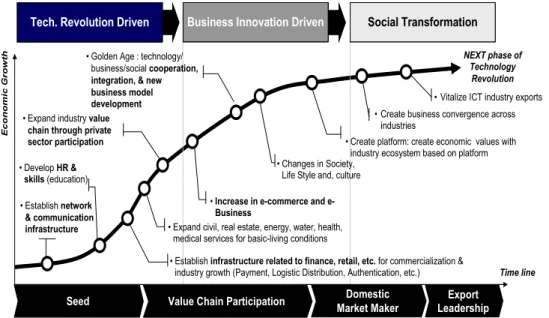
Figure 4: National ICT Evolution
The figure above illustrates the ICT evolution that Rwanda has to travel to reach the desired goal of export leadership in information and communication technologies.
E co no mi c G ro w th Time line
Seed Value Chain Participation Market MakerDomestic LeadershipExport
NEXT phase of Technology
Revolution
Tech. Revolution Driven Business Innovation Driven Social Transformation
Tech. Revolution Driven Business Innovation Driven Social Transformation
Tech. Revolution Driven Business Innovation Driven Social Transformation
• Establish infrastructure related to finance, retail, etc.for commercialization & industry growth (Payment, Logistic Distribution, Authentication, etc.) • Establishnetwork
& communication infrastructure • DevelopHR & skills(education) • Expand industry value
chain through private sector participation
•Increase in commerce and e-Business
• Golden Age : technology/ business/social cooperation, integration, & new business model development
• Create platform: create economic values with industry ecosystem based on platform
• Create business convergence across industries
• Changes in Society, Life Style and, culture
• Vitalize ICT industry exports
• Expand civil, real estate, energy, water, health, medical services for basic-living conditions
3. SMART Rwanda Vision Establishment
SMART Rwanda Master Plan articulated the alignment of key initiatives and implications with the overall national economic goals. It is from this alignment that the guiding vision is derived.
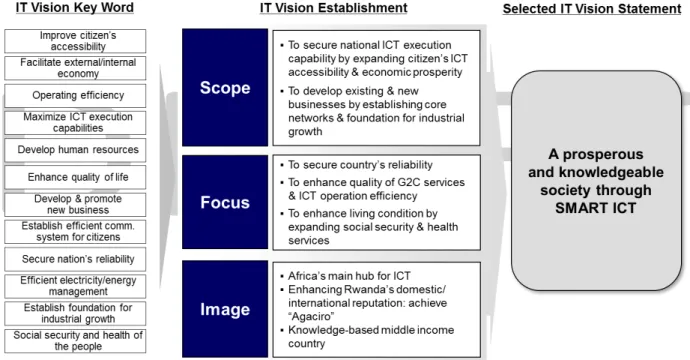
The SMART Rwanda Vision Statement is thus “a prosperous and knowledgeable
society through SMART ICT”
Figure 5: SMART Rwanda Vision Definition
! Scope: To secure national ICT execution capability, expanding ICT accessibility, and establishing core networks (government, education, finance, business, social security, health and national information security) enhancing economic growth.
! Focus: To secure country’s reliance on ICT by upgrading protection and security,
agreeing on rights and responsibilities for data use on the basis of context, and driving accountability and enforcement.
! Image: To become a regional ICT Hub, enhancing Rwanda’s international reputation as a knowledge-based middle-income nation.
SRMP’s vision statement is clear about the future of Rwanda continues to depend on the effective and efficient utilization of Information and Communication Technologies. With the implementation of the SMART Rwanda Master Plan, Rwanda can improve citizens’ quality of life while at the same time developing capability of the private sector key industries to achieve a sustainable socio-economic growth.
Figure 6: SMART Rwanda Vision Statement
• Prosperity: Sustained economic growth, poverty reduction and a reduction
in income inequality
• Knowledge-able society: To secure and accumulate knowledge competency, as
the driver of productivity and economic growth
• SMART ICT: To develop the infrastructure, appropriate skills and competencies,
necessary to develop innovative products that help increase the social, economic, and environmental sustainability and support increase in productivity and competitiveness.
II. Analysis & Assessment
1. Major Consideration Factors of SMART Rwanda Master
Plan
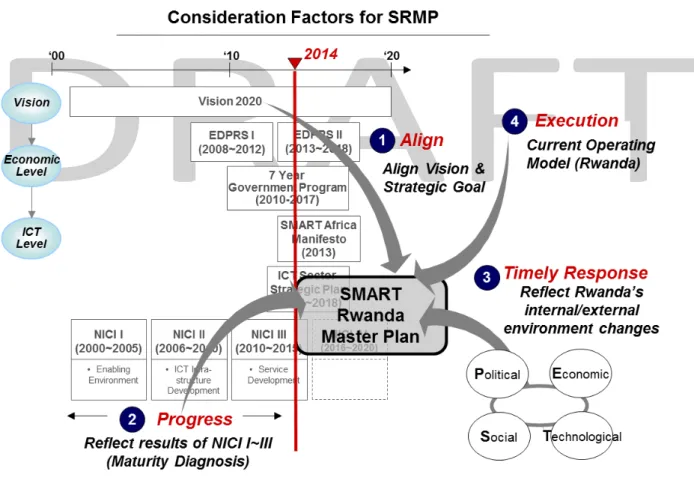
SMART Rwanda Master Plan has been developed by aligning the strategy to the national economic vision, goals and objectives. The development process has taken into account the progress of the NICI Plans along with a quick diagnosis of the national ICT maturity, analysis of the internal and external environmental and the challenges of the current operating model for executing the ICT SSP. Since SRMP would influence various sectors of the country, it was necessary to review and finalize components of the SRMP to further enable sustainable growth.
① Align (Aligning vision and strategic goal):
In order to effectively derive SRMP without any redundancies, SRMP reflected on the key initiatives including Vision 2020, EDPRS, 7 Year Government Program NICI Plans, SMART Africa Manifesto, and the current ICT Sector Strategic Plan. ② Progress (Reflecting results of NICI I~III along with maturity diagnosis):
Reflected on the on-going projects under the ICT SSP to reduce duplication of efforts, optimizing investment and implementation.
③ Timely Response (Reflecting Rwanda’s internal/external environment changes):
Reflected on Rwanda’s internal and external environment challenges through a PEST (Political, Economic, Social, and Technological) analysis to effectively capture on-going changes in Rwanda.
④ Execution (Current Operating Model):
Current operating model for executing and implementing ICT related projects’ was reviewed, challenges identified and recommended changes to address the challenges required to effectively carry out SRMP.
2. Rwanda’s Current ICT Status and Analysis Framework
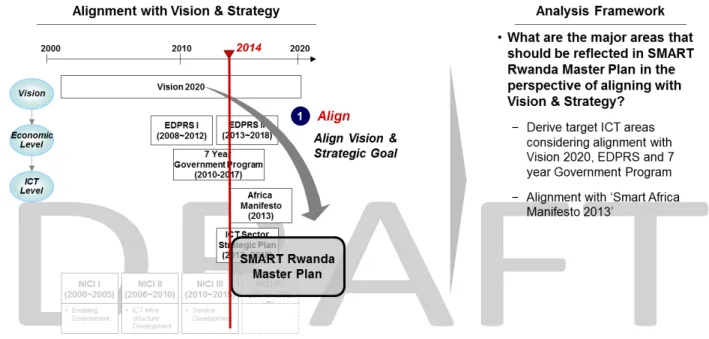
2.1 Aligning Vision & Strategic Goal – Framework for Analysis
The framework for the analysis considered and carefully reviewed the economic development goals consequently aligned to SRMP to effectively capture previous strategies and core areas of improvement.
Figure 8: Alignment with Vision 2020 & EDPRS II
2.1.1 Vision 2020 Analysis
The Vision 2020 seeks to fundamentally transform Rwanda and become a middle-income country by year 2020. This will require achieving an annual per capita middle-income of US$ 1,240 (US$ 290 in year 2000), a poverty rate of less than 30% (60% in year 2000) and an average life expectance of 55 years (49 years in year 2000). Vision 2020 appropriately identified ICTs to help the country achieve the stated economic targets. Major objectives of the Vision 2020 are as follows:
! Short-term objective – Promotion of macroeconomic stability and reduce aid dependency:
There’s high reliance on foreign aid as it accounts for 40% of national budget. In order to reduce aid dependency, the goal is to stabilize the economy at a macro level to transform and stimulate the development of public sector leading to enhancing and securing domestic resources and export. The emphasis on reducing foreign aid reliance and advancement to knowledge-based economy from agrarian economy resulting in increased national competitiveness remains a critical objective.
! Medium-term objective – Transformation from an agrarian economy to a
knowledge-based economy:
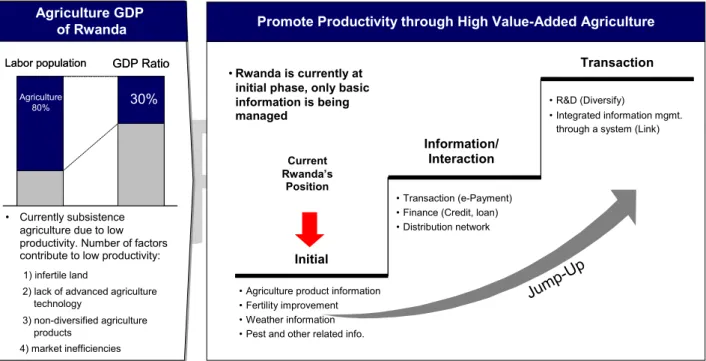
Agriculture is the highest employer and it is important to fundamentally enhance agricultural productivity and quality to support economic development. ! Long-term objective – Jobs creation and fostering entrepreneurship:
In order to create employment, fostering both innovation and entrepreneurship is fundamental to the long-term.
Figure 9: Vision 2020 Key Themes
• Accountability/Transparency • Efficient resource allocation • Rule of law
• Human rights • Democracy
• Education
• - Teacher training, technology, engineering, management training • Health & population planning • - Birth/population growth rate,
infant/maternal mortality, and etc.
• Comprehensive privatization policy • Improve finance sector
• Promote regional business through developing export zones
• Unofficial support for economy • Vitalize labor market by job
creation
• Real estate & land use management • Urban development • Transportation, Communication, ICT • Energy • Water resource • Waste management
• Reforms for land ownership • Develop market in land assets • Extensive research and extension
services
• Investment in rural infrastructures • High yielding varieties and intensive
input use(especially fertilizers) • Promote agro-based manufacturing • Environmental control measures to
halt the decline in soil fertility • Rural financing schemes and
markets
• Promote free trade • Promote foreign investment • Enhance regional market
accessibility as communication hub • Preoccupy strategic comparative
advantage as a trade hub in the region
Good governance and a capable
state HR development & a knowledge based economy A private sector-led economy
Infrastructure development Productive and Market Oriented Agriculture Regional and International Economic integration
Gender equality Protection of environment & sustainable natural resource mgmt. Science and technology,including ICT Cross
2.1.2 EDPRS II (Economic Development and Poverty Reduction Strategy)
There are several key main objectives of EDPRS II: new job creation through sustainable growth, competitiveness enhancement through growth of exports, build capacity of the private sector through innovation and investment, improve productivity of agriculture, and increase access to ICT.
Four thematic areas of EDPRSII are as follows:
! Economic Transformation:
Transform Rwanda from a rural economy to an urban economy and sustain economic development with a high economic growth. The plan is to bring about 11.5% of economic development growth until year 2020 by establishing social infrastructure, higher export, integrated supply line, higher energy supply, green environment, and greater roles of public sector.
! Rural Development:
The main idea of this development is to increase the economic benefits of rural population and their quality of lives through efficient utilization of land, support of agricultural production and social infrastructure. This development decreased the rural poverty level down to 45%. (Improved by 14.9% compared to 2011) ! Productivity & Youth Employment:
In order to advance into a mid-income country, 200,000 needs to be created annually, promote labor market to fulfill the demands, provide vocational education, utilized ICT technology to increase productivity, and encourage higher youth employment.
! Accountable Governance:
In the light of promoting transparency and accountability, more public involvement in policy-making and execution is encouraged. Higher public involvement and public services will strengthen the accountability of governance. In SRMP, the following keywords from EDPRS II were reflected in deriving key themes and strategies:
! Expand Internal/External Economic Interconnection
! Private Sector Innovation
! Green Economy
! Land Management & Regional Development
! Agricultural Productivity Enhancement
! Poverty Reduction
! Skills Development
! Enhance Public Services through ICT
! Enhance Citizen Participation through ICT
2.1.3 7 Year Government Program 2010~2017
The Seven Year Government Program is the vision set forth by H.E. Paul Kagame on 6th September 2010 during his inaugural speech at his swearing-in ceremony to lead Rwanda for the next seven years.
The program objectives are to develop four main pillars, Good Governance, Justice, Economy, and Social Wellbeing, to achieve the overall goal of shifting Rwanda to a middle-income country.
The four pillars of the Seven Year Government Program are briefly explained below: ! Good Governance: “To keep promoting good governance consecrating national
unity, identity and harmony, catalyzing capabilities to increase rapid production and development”
! Justice: “To continue building a country where prevail the rule of law, human rights, and efficient justice that promote development”
! Economy: “To speed up sustainable economic development through increased
production and economic indicators with Rwanda shifting from poor countries to countries not relying on foreign aid”
! Social Well-being: “A skilled, knowledgeable, healthy and wealthy citizen” The SRMP’s key areas for development closely reflect these four pillars.
2.1.4 ICT Sector Strategic Plan 2013
In the course of the developing EDPRS II, it became necessary align the NICI III Plan with the thematic areas of EDPRS II, and this resulted in an updated national ICT strategy, the ICT SSP.
! ICT Skills Development: Developing a high quality skills and leveraging information and communication technologies based on knowledge through PPP (Public-Private Partnership) and knowledge transfer,
! Private Sector Development: Developing a competitive and innovative ICT and private sector enabled by ICT,
! Community Development: Empowering and transforming communities through
enhanced access to information and services utilizing ICT,
! E-Government: Improving government operational efficiency and public services delivery through ICT,
! Cyber Security: Improving security of Rwanda’s cyber environment (Infrastructure
and Information assets).
2.1.5
SMART Africa Manifesto 2013
SMART Africa is a bold and innovative commitment to accelerate sustainable socio- economic development on the continent and usher Africa into the knowledge economy through affordable access to Broadband and usage of Information and Communications Technologies (ICT).
The SMART Africa Manifesto lists five core principles to effectively implement ICT:
! To put ICT at the center of the national socio-economic development agenda
! To improve access to ICT, especially for broadband
! To improve accountability, efficiency and openness through ICT
! To put the private sector first
! To leverage ICT to promote sustainable development
In development of the SMART Rwanda Master Plan, the following keywords from the Manifesto were taken into consideration:
! ICT Skills Development
! ICT Accessibility Enhancement in Africa
! E-Government Establishment
! Open Data Initiative
! Private Sector Development through ICT
! Expansion of Local Innovation Hub
! Access to Market, and Business Information Improvement
! Social Environ. Enhancement by ICT (e-Waste, disaster, risk, etc.) ! Cyber Security, Cloud, Mobility, Shared-Infrastructure/Service
2.2
NICI Progress Review
The national ICT strategy and plan, NICI, was adopted by Rwanda in 2000 under the auspices of the United Nations Economic Commission for Africa, as a holistic approach to using ICTs for development. Each of phases characterizes this strategy and is aligned with the country’s overall development goals and vision.
Figure 11: Alignment of SRMP with the NICI Plans
NICI I: The Creation of an Enabling Environment
NICI I effectively focused on creating an environment conducive to using ICTs as tools for development in Rwanda by setting up an effective implementation and coordination mechanisms. These included, but were not limited to, the appropriate institutional, legal, and regulatory frameworks that would support rapid development of Rwanda’s ICT sector, vitalize the telecommunications industry, and reduce entry barriers to the telecommunications market.
NICI II: The Development of ICT infrastructure
NICI II concentrated on establishing essential national ICT infrastructure. Significant investments have been made in developing efficient ICT infrastructure.
Figure 12: Major Areas of NICI Plans
Some of the key achievements are highlighted below:
! A high-speed fiber-optic backbone network now interconnects all districts and border points of the country. This network interconnects all government institutions and other private enterprises located in Kigali as part of the Kigali Metropolitan Network. In addition, Rwanda established submarine fiber-optic cables, international capacity equivalent to 2.5 gigabytes (GB), connecting to two international routes.
! Mobile phone/data coverage for Rwanda’s population reached 96% in 2011 both through the efforts of aggressive public investment and the introduction of transparent competition among private-sector telecommunications operators.
! Established a tier-3 data center, the first of its kind in the region, offering 99.98% of reliability and cloud services.
! The Karisimbi ICT infrastructure project; a communications, navigation surveillance, and automated traffic management system to ease the flow of air traffic and reduce the risk of flight delays and cancellations in the busy
airspace of the Common Market for Eastern and Southern Africa/ East African Community region.
! The establishment of a digital terrestrial television (DTT) transmission system to boost television, radio, and telecommunication coverage and the deployment of digital television transmitters to improve nationwide television coverage. The goal is to cover 95% of the nation (physical territory) to increase access to information.
! Multi-purpose community telecenters, public information kiosks, and ICT buses have been deployed across the country to increase access to ICTs, provide ICT literacy training, and raise ICT awareness, among other services. The establishment of an innovation center provides an ecosystem in which startups combine innovation and entrepreneurship to produce homegrown solutions for local challenges along with globally scalable knowledge.
NICI III: The Service Development through ICT
The third phase of the NICI plan, which covers the time period of 2011 – 2015, builds on the two previous phases to accelerate Rwanda to the final phase of the NICI process. In this phase, emphasis has been placed on service development across five focus areas - e-Government, Community Development, Private Sector Development, Cyber Security, and Skills Development.
NICI I~III accomplished establishment of basic infrastructure through ICT adoption for educational institutions, technical education system, and framework for law/regulation/system, however the capacity of the private sector development is still insufficient. Integration of public service delivery between the central and local government is weak and additional development is needed in this key area. Overall, attaining a higher ICT maturity level is hindered by low accessibility - inadequate distribution of key backbone networks, cloud, and other access channels. Further, acceleration of growth is constrained by lack of an effective ICT implementation organization.
Major Area NICI Status Scale I II III Development for education/ICT capability & human resources ● ● ●
• ICT professional education and qualification program has been continuously promoted • Connection between educational institutions of
Rwanda and global research/education
network (RwEdNet): still in the planning phase
•Digital Library: not well executed, ambiguous definition and direction
Major Area NICI Status Scale
I II III
Frame/basic standards
establishment for law, regulation & standard
● ● ●
• Lack of regulations on electronic government • Law and regulations for ICT Business
Financing Mechanism are being made
• The Communications Act, the law related to Intellectual property right, electronic message, e-Signature, e-Transaction, info. protection, cyber security, and government ICT application procedure were established
• Facilitating ICT environment through promoting new communication service provider and internet provider to liberalize telecommunication market
ICT
Infrastructure usage
● ●
• Establishment and integration of national backbone network (financial network,
administrative network, educational network) are required
• Established national Fiber Optic Backbone network, WIBRO, broadcasting infra, and aviation mgmt. system
• Need to secure efficiency by applying Cloud Computing technology to the National Data Center and systems for government agencies
Private sector
development ● ● ●
• ICT is applied in the areas of agriculture, medical treatment, tourism, and etc. • e-Soko 2.0: in planning phase, nation-wide
migration and integration is required • SMART Electricity Grid & Energy Market:
detailed plans are incomplete
• Tourism Portal: at the level of providing simple information
•Open MRS: used by 50% of organization, but focused on HIV related services
Public sector
development ● ● ●
• Implementing system for national ICT is insufficient
• Computerization of each administration branch & connection between central-local government, common usage between
departments and information integration are incomplete
• e-Procurement: not sufficient
• National ID & Smart Card: integration with other institutions is necessary for realization of value but it is not sufficient and policies need to be established
• JROS (Justice, Reconciliation, Law & Order Sector) Information System: interagency integration of 12 institutions is necessary, mobile access should be considered
• Services for government administrative tasks were developed such as Cabinet,
e-Parliament, Document tracking, and workflow management system
Major Area NICI Status Scale
I II III
Community
development ● ● ●
• Internet use in rural areas has been
continuously promoted through distribution of telecenter
• Lack of network system to connect capital with local communities, access channel, and
information sharing system
• Constructing ICT infra. of local government & enhancing availability: currently being
established, focusing on video conference facilities, and unified Communication is necessary for future cost efficiency
Cyber security ●
• Anticipation of cyber terror, analysis, and defense system at a national level are insufficient
• National cyber security center is not established
○
Cross-cutting ●
• Little application of Green ICT and energy efficiency in response to increasing energy
2.3 Maturity Level Assessment (Quick Diagnosis)
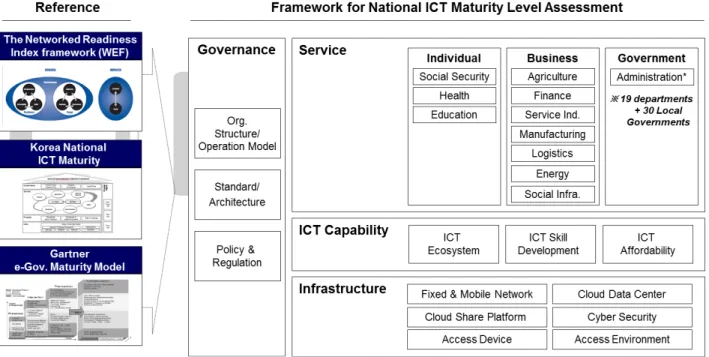
In order to better address the current national maturity level, a quick-diagnosis of the national ICT maturity level in the areas of infrastructure, ICT capability, governance, and service was conducted utilizing a composite framework of three different frameworks: the Network Readiness Index Framework from WEF, Korea’s National ICT Maturity Model, and e-Gov. Maturity Model from Gartner. Each framework was selected for a specific area and the results reflected into the SRMP’s quick diagnosis framework. For instance, drivers and impacts of maturity level were derived from WEF’s framework and selection of which areas to analyze was mainly derived from the Korea’s National ICT maturity model.
Figure 13: Framework for Rwanda ICT Maturity Level Assessment
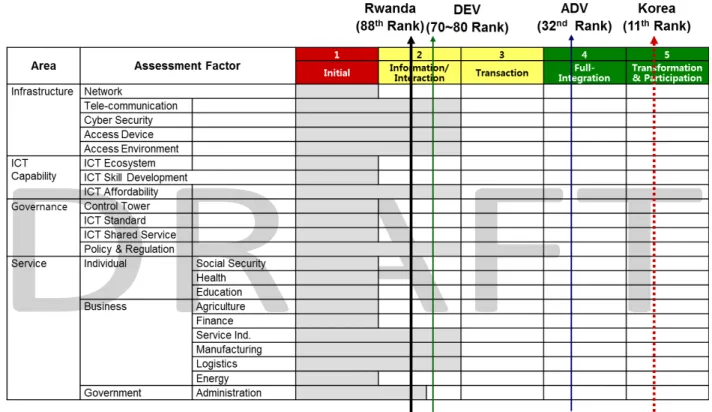
The overall diagnosis indicates that Rwanda is currently at a maturity level between 1 ~ 2, that is, the Initiation/Integration stage. The lowest maturity level was found in areas
inter alia: Cloud data center and shared platforms, Cyber security, ICT ecosystem, ICT
Figure 14: Overview of Maturity Level Assessment
Most of ICT Capability diagnosis areas are still at an initial phase where ICT ecosystem is currently existing but still needing support and ICT skills. ICT affordability is at level two, indicating further government support is required to provide access to ICT.
In terms of Governance, except for policy & regulation, all areas are at initial level. ICT standards have been developed for national ICT skills, and partially defined some standards for ICT related development and skills. ICT shared service’s standardization and development framework related to common functions are defined for national ICT but limited applications to some areas only.
All individual services were are at the Initial phase, though some Social Security systems have been established, there are some improvements needed in terms of digitizing the national registration information for age group under 16. In health, significant progress has been made in digitized medical data, medical history management, and basic disease information. In terms of education, some basic ICT infrastructure has been established through digitized information for students, teachers, and schools.
According to the WEF and European Institution of Business Administration (INSEAD), which considers several factors, including market and regulatory framework in advancing ICT for inclusive development indicates that Rwanda is currently ranked 6th
Assessment Results of Rwanda’s National ICT Maturity Level
Assessment Results of Rwanda’s National ICT Maturity Level Maturity Level 1Maturity Level 2~3 Maturity Level 4~5 Foundation of national ICT development Capacity for sustainable maintenance Execution ability
+
+
ICT Capability InfrastructureFixed & Mobile Network Cloud Data Center
ICT Ecosystem
Cloud Shared Platform Cyber Security Access Device Access Environment
ICT Skill
Development AffordabilityICT
Governance Org. Structure/ Operation Model Standard/ Architecture Policy & Regulation Service
Individual Business Government
Soc. Security Health Education Agriculture Finance Services Ind. Manufacturing Logistics Social Infra. Administration Readiness: Enablers for
National ICT
Usage: Sectorial Service Development for National ICT
in Africa and 88th globally with a score of 3.68 in aspect of capacity and developing economies to leverage ICT for growth and well-being. Most of developing countries (Middle East countries, and others) are currently at maturity level two and advanced countries (Japan, USA, and others) are at maturity level four, full-Integration phase. Korea, ranked 11th is currently at transformation and participation level where innovative technologies are continuously being applied to improve the quality of ICT throughout the sectors.
2.4 PEST Analysis
In order to effectively identify and capture on-going trends and external factors that may impact SRMP, a PEST (Political, Economic, Social, and Technological) analysis focusing on the implications to the SMART Rwanda Master Plan was carried out.
2.4.1 Political Environment Analysis
International relationship between neighboring countries impact Rwanda in many different ways: politically, economically, and socially. Geographically there are four neighboring countries around Rwanda: Democratic Republic of