Increasing the Scalability of a Software Transactional
Memory System
Faustino Dabraio da Silva
Dissertation submitted to obtain the Master Degree in
Information Systems and Computer Engineering
Jury
Chairman: Prof. Nuno Jo˜ao Neves Mamede
Supervisor: Prof. Jo˜ao Carlos Serrenho Dias Pereira Co-Supervisor: Prof. Jo˜ao Manuel Pinheiro Cachopo Members: Prof. Jo˜ao Pedro Faria Mendonc¸a Barreto
Acknowledgements
First and foremost, I am grateful for the support and orientation of my tutor, Prof. Jo˜ao Pereira, who for more than a year was always available every week to guide me through the whole process, always giving me helpful ideas and steering me in the right direction.Also, this thesis would not have been possible without the help of Prof. Jo˜ao Cachopo and Prof. S´ergio Fernandes, who took the time to give me invaluable insight on how the JVSTM works, as well as suggestions on how it could be improved.
Finally, a word of gratitude to my family and friends, who supported me the whole time and provided me with much needed motivation to reach my goals.
Lisbon, May 14, 2012 Faustino Dabraio da Silva
Resumo
A Mem ´oria Transaccional em Software (STM) introduz na programac¸˜ao o modelo transaccional conhecido dos sistemas de bases de dados, com o objectivo de fornecer uma alternativa mais simples e flex´ıvel aos tradicionais trincos usados em programac¸˜ao concorrente. Apesar de as propostas de STM existentes cumprirem as promessas de simplicidade e flexibilidade, ainda h´a margem para melhorias em termos de performance.Neste trabalho comecei por analisar algumas STMs existentes para perceber o seu fun-cionamento e compreender as diferentes opc¸ ˜oes de desenho que existem. Depois de analisar em detalhe o funcionamento da Java Versioned Software Transactional Memory (JVSTM), iden-tifiquei poss´ıveis melhorias para os seus algoritmos e estruturas de dados, implementei-as e avaliei se (e porquˆe) tiveram o impacto esperado na performance da JVSTM.
Abstract
Software Transactional Memory (STM) introduces the transactional model of database systems to software programming, with the aim of being a simpler and more modular alternative to locks in concurrent programming. While most existing STM engine proposals are successful in delivering the promises of increased simplicity and modularity, there is room for improvement in terms of performance.In this work I started by analyzing existing STMs to understand how they work and what different design alternatives exist. Then, after analyzing how the Java Versioned Software Transactional Memory (JVSTM) works, I identified potential improvements to its key data structures and algorithms, implemented them and evaluated whether or not (and why) they had the intended impact on JVSTM’s performance.
Palavras-Chave
Keywords
Palavras-Chave
Mem ´oria Transaccional em Software Escalabilidade
Programac¸˜ao Concorrente com Objectos
Keywords
Software Transactional Memory Scalability
Contents
1 Introduction 1 1.1 Motivation . . . 1 1.2 Context . . . 2 1.3 Goals . . . 2 1.4 Outline . . . 32 Software Transactional Memory 5 2.1 Basic Concepts of STMs . . . 5
2.1.1 Transactions . . . 5
2.1.2 Transactional Memory . . . 6
2.1.3 Transaction Nesting . . . 6
2.1.4 Read and Write Sets . . . 7
2.1.5 In-place/Out-of-place Updates . . . 7
2.1.6 Contention Management . . . 7
2.1.7 Long-running Transactions . . . 7
2.2 Design Alternatives . . . 7
2.2.1 Synchronization Technique . . . 8
2.2.2 Transactional Data Granularity . . . 9
2.2.3 Concurrency Control . . . 9
2.2.4 Lock Acquisition and Recovery Strategy . . . 10
2.2.5 Lock Placement . . . 10 2.2.6 Transaction Validation . . . 10 3 Related Work 13 3.1 DSTM . . . 13 3.2 McRT-STM . . . 15 3.3 TL2 . . . 16 i
3.5 Summary and Conclusions . . . 20
4 JVSTM 23 4.1 The Versioned Memory Model . . . 24
4.2 Transaction Lifecycle . . . 24
4.2.1 Begin . . . 25
4.2.2 Execution . . . 25
4.2.3 Validation and Commit . . . 25
4.2.4 Abort . . . 26
4.2.5 Nested Transactions . . . 27
4.3 Important Data Structures . . . 27
4.3.1 VBox . . . 27 4.3.2 Read Set . . . 28 4.3.3 Write Set . . . 29 4.3.3.1 During Execution . . . 29 4.3.3.2 After Execution . . . 30 4.3.4 ActiveTransactionsRecord . . . 32 4.4 Performance Evaluation . . . 33
4.4.1 Statistical Data Collection . . . 33
4.4.2 Test Environment . . . 34
4.4.2.1 Hardware . . . 34
4.4.2.2 Benchmark . . . 34
4.4.3 Early Conclusions . . . 35
5 Proposed Optimizations 37 5.1 Implement the Read Set Using an Identity Hash Set . . . 38
5.1.1 Description . . . 38
5.1.2 Initial Results . . . 39
5.1.3 Variation with a Hybrid Structure for the Read Set . . . 44
5.1.4 Results in other Scenarios . . . 46
5.1.4.1 1%Write Ratio . . . 46 ii
5.1.4.2 50%Write Ratio . . . 48
5.1.4.3 100%Write Ratio. . . 49
5.2 Adaptive Validation . . . 50
5.2.1 Motivation. . . 50
5.2.2 Initial Results . . . 51
5.2.3 Variation with a Different Read Set Implementation . . . 53
5.2.4 Results with AdaptiveIdentityHashSet . . . 53
5.3 Collaborative Validation . . . 57 5.3.1 Motivation. . . 57 5.3.2 Implementation . . . 58 5.3.3 Results . . . 59 5.4 Limit Helpers . . . 59 5.4.1 Motivation. . . 59
5.4.2 Per-transaction Helper Limit . . . 60
5.4.2.1 Results . . . 60
5.4.3 Simultaneous Write-back . . . 61
5.4.3.1 Results . . . 63
5.4.4 System-wide Helper Limit. . . 65
5.4.4.1 Results . . . 65
5.5 Tweak the Write-back Help Algorithm . . . 65
5.5.1 Motivation. . . 65
5.5.2 UseAtomicIntegerFlags Instead ofAtomicBoolean . . . 66
5.5.3 UseAtomicIntegerFlags and a GlobalAtomicBooleanFlag . . . 67
5.5.4 Results . . . 68
5.6 Upgrade Transactions . . . 69
5.6.1 Motivation. . . 69
5.6.2 Results . . . 70
5.7 Combination of Multiple Optimizations . . . 71
5.7.1 Hybrid Read Set and Transaction Upgrade with Persistence to Disk. . . . 71
6 Conclusions and Future Work 73 6.1 Conclusions . . . 73
6.2 Future Work . . . 74 iii
List of Figures
3.1 A transactional object in DSTM . . . 13
4.1 Example of a versioned box . . . 28
4.2 Example of a transaction’s read set . . . 28
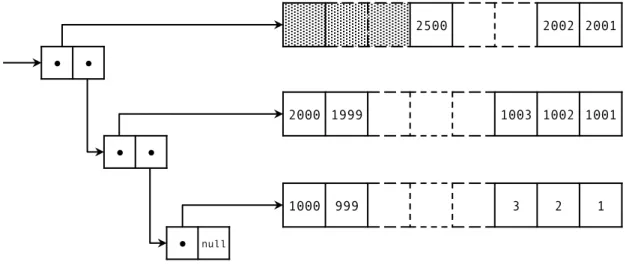
4.3 Example of a write set during execution . . . 31
4.4 Example of a write set after execution . . . 31
4.5 Example of aWriteSetdivided in blocks . . . 32
4.6 Example of the ATR in the original version of the JVSTM . . . 33
4.7 Example of the ATR in the lock-free version of the JVSTM. . . 33
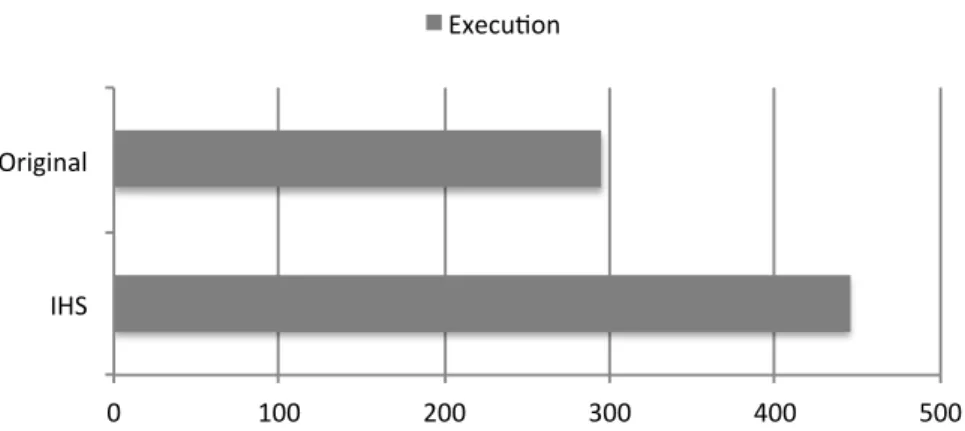
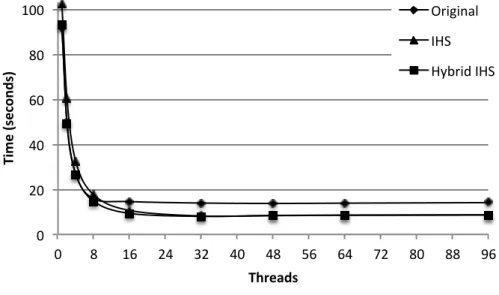
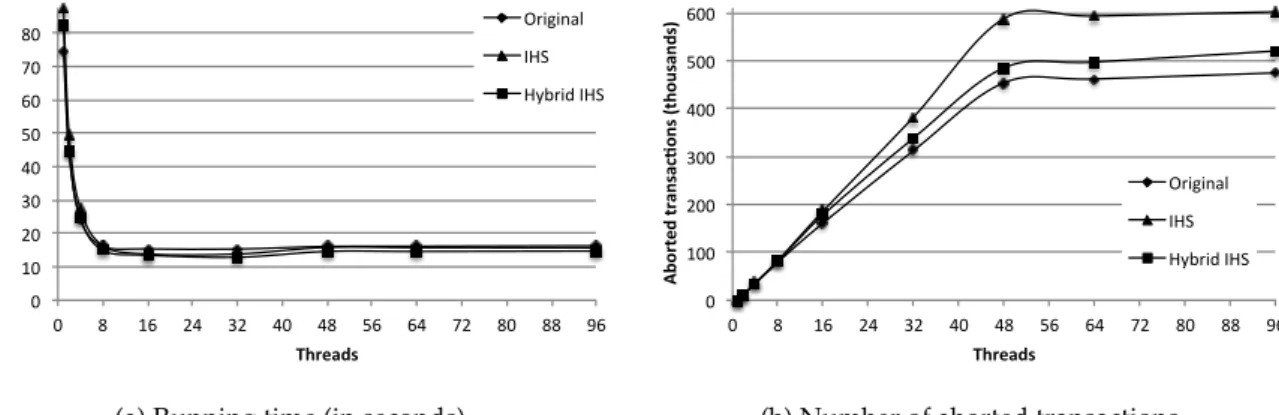
5.1 Running time . . . 40
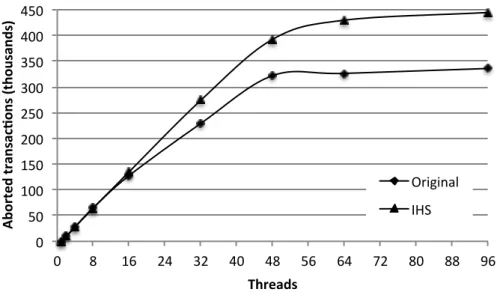
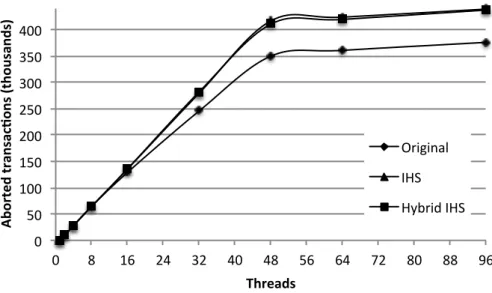
5.2 Number of aborted transactions . . . 40
5.3 Average execution time of a committed transaction (in microseconds;96threads, 250.000transactions,1.000operations/transaction,10%write ratio) . . . 42
5.4 Running time in the original version, IdentityHashSet and hybrid read set (in seconds;250.000transactions,1.000operations/transaction,10%write ratio). 44 5.5 Number of aborted transactions in the original version,IdentityHashSetand hybrid read set (250.000transactions, 1.000operations/transaction, 10% write ratio) . . . 45
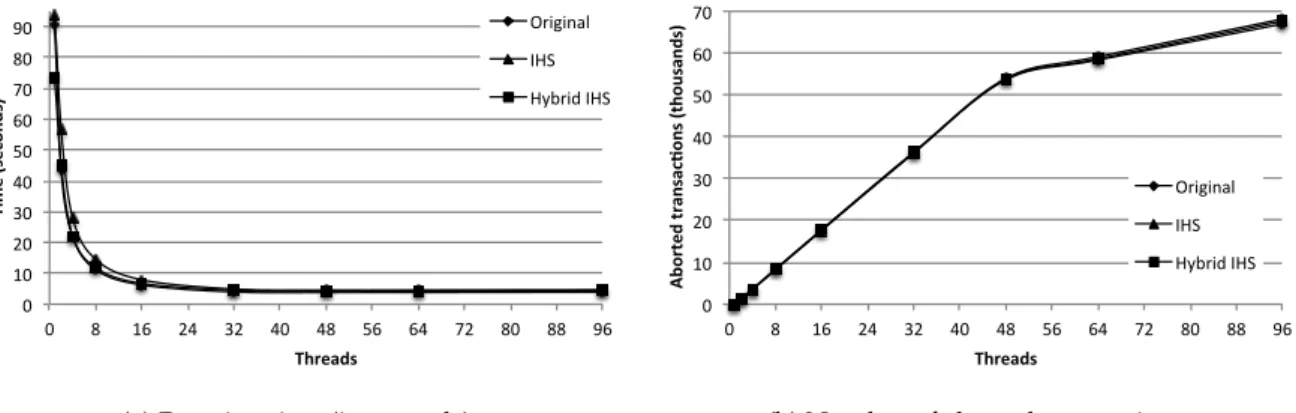
5.6 Performance of the original version, IdentityHashSet and hybrid read set (250.000transactions,1.000operations/transaction,1%write ratio) . . . 46
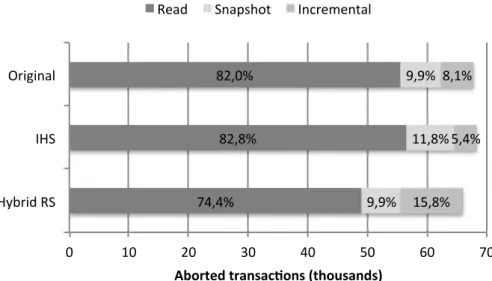
5.7 Abort distribution between original version, IdentityHashSet and hybrid read set (250.000transactions, 1.000operations/transaction, 1%write ratio, 96 threads) . . . 47
5.8 Average performance of a transaction (in microseconds; 250.000 transactions, 1.000operations/transaction,1%write ratio,96threads) . . . 47
5.9 Performance comparison between original version,IdentityHashSetand hy-brid read set (250.000transactions,1.000operations/transaction,50%write ratio) 48 5.10 Abort distribution between original version, IdentityHashSet and hybrid read set (250.000transactions,1.000operations/transaction,50%write ratio,96 threads) . . . 49
5.12 Representation of the Active Transactions Record just beforeXvalidates . . . 50
5.13 Running time . . . 52
5.14 Number of aborted transactions. . . 52
5.15 Running time . . . 54
5.16 Number of aborted transactions. . . 54
5.17 Performance of the adaptive IHS with adaptive validation with1%write ratio. . 56
5.18 Performance of the adaptive IHS with adaptive validation with50%write ratio . 56 5.19 Example of an ATR under collaborative validation . . . 58
5.20 Read set of transactionT6divided into blocks . . . 59
5.21 Example commit queue . . . 61
5.22 Example commit queue . . . 62
List of Tables
3.1 Comparison between STMs . . . 21
5.1 Total running time (in milliseconds), number of aborted transactions and
num-ber of transactions committed/aborted per millisecond in the original version
of the JVSTM and in the version with IdentityHashSet (250.000 txs, 1.000
ops/tx,10%write ratio) . . . 39
5.2 Number of aborted transactions in each stage in the original version of the
JVSTM and in the version withIdentityHashSet(250.000transactions,1.000
operations/transaction,10%write ratio) . . . 41
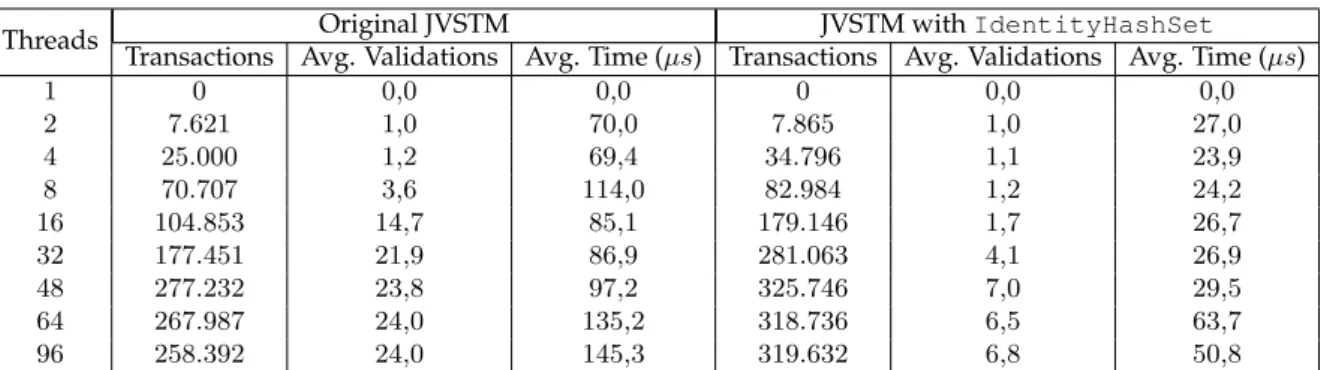
5.3 Number of transactions that perform incremental validation, average number
of incremental validation steps performed by each transaction and average time
per single validation (250.000 transactions, 1.000 operations/transaction, 10%
write ratio) . . . 43
5.4 Running time and number of aborted transactions in the original version,
IdentityHashSetand hybrid read set. . . 45
5.5 Total running time of adaptive IHS and adaptive IHS with adaptive validation
(in milliseconds,10%write ratio) . . . 55
5.6 Comparison of different helper limit strategies . . . 61
5.7 Comparison of write-back to disk without help and with simultaneous write-back 63
5.8 Comparison of the two different commit orders using simultaneous write-back . 65
5.9 Comparison of different tweaks to the write-back help algorithm . . . 69
5.10 Comparison of the original JVSTM with and without upgrade (48threads) . . . . 70
5.11 Comparison of the original JVSTM with and without upgrade (96threads) . . . . 70
5.12 Comparison of optimized JVSTM with and without upgrade (48 threads, with
disk persistence). . . 71
5.13 Comparison of optimized JVSTM with and without upgrade (96 threads, with
disk persistence). . . 71
List of Code Listings
5.1 Code for adaptive validation . . . 51
5.2 Original write-back help algorithm . . . 66
5.3 Write-back help algorithm withAtomicIntegerstatus flags . . . 67
5.4 Write-back help algorithm with AtomicInteger status flags and global
AtomicBooleanflag . . . 68
1
Introduction
1.1
Motivation
Although the availability of multiprocessor computers is nothing new in the server domain, it is only in recent years that multicore processors became commonplace across most comput-ing devices. However, this hardware potential does not translate into real performance gains unless applications are specifically designed to take advantage of parallel computing. Tradi-tionally, programmers have turned to locks as the favorite tool to introduce parallelism into their applications. However, fine-grained locks become extremely error-prone and complex to design in large applications (Herlihy, Luchangco, Moir, and III 2003). On the other hand, coarse-grained locks, while less complex and error-prone, have limited parallelism and thus poor performance (Dice, Shalev, and Shavit 2006;Herlihy, Luchangco, Moir, and III 2003).
While the lock-based approach was somehow tolerable when concurrent programming was somehow a niche feature, the increased popularity of multicore processors demands a more intuitive and higher-level method for programmers to write concurrent applications.
To this end, Software Transactional Memory (STM) brings the transactional model, already proved and tested for several decades in the database community, to concurrent programming (Shavit and Touitou 1997). In simple terms, when using an STM system, the programmer only needs to identify operations that run concurrently and that share the same memory space, and divide them into transactions. With this information on hand, the STM system monitors which shared memory locations are accessed by which transactions and determines the presence of conflicts. A conflict arises when two transactions try to access the same memory location in conflicting modes (read/write or write/write). Upon detecting a conflict, the STM handles it automatically by aborting one of the conflicting transactions, rolling back its effects (if any) and, depending on the STM, restarting it. By doing all this automatically and dynamically, STM systems simplify the task of handling conflicts in concurrent applications, giving programmers more time to focus on the application itself.
However, the convenience of STMs compared to traditional approaches does not come without trade-offs. Keeping track of different transactions, and the memory locations they access, introduces space and time overheads over lock-based approaches. As a result, an ap-plication using well-designed fine-grained locks will perform better than it would using STM (Herlihy and Koskinen 2008). To be a viable substitute for locks, STMs have to reduce the overhead they introduce as much as possible while maintaining the ease of use.
1.2
Context
JVSTM started off as a lock-based system (Cachopo and Rito-Silva 2006; Cachopo 2007), but over time it eventually was developed to become lock-free (Fernandes and Cachopo 2011), but throughout all versions it was based on the concept of versioned boxes, which is its most dis-tinctive feature. Essentially, a versioned box is a container for the history of a transactional object — a memory location that is shared by several transactions and can be accessed con-currently. By keeping a history of values instead of only the most recent one, JVSTM allows concurrent transactions that started at different points in time not to enter into conflict with each other under certain circumstances, which will be detailed later on.
Essentially, in the JVSTM transactions keep logs of their read and write operations during execution. The read log is used to guarantee that the transaction observed a consistent view of the system, while the write log is used to store written values locally instead of writing them immediately to the shared memory space, which means that other transactions will not observe temporary values that may never become definite.
If a transaction finishes without conflicting with another, it is validated using the read log to guarantee that the values it observed during execution remain consistent, and if so the trans-action is put in a commit queue, which defines the order in which transtrans-actions are written to memory.
If the transaction is deemed invalid, its logs are discarded and the user is informed so that he can decide how to proceed, which typically means that the transaction will be restarted. To keep each box’s history ordered, transactions have to be committed one-at-a-time in the or-der defined by the commit queue. Because only one transaction can be committed at a time, but several transactions can be waiting in queue to be committed, those that cannot be committed yet help the first one in the queue, thus speeding up the commit process.
1.3
Goals
The aim of this work is to analyze current STM systems and propose improvements to the scal-ability of one such system, the Java Versioned Software Transactional Memory (JVSTM). This system was chosen as the basis for this work due to the support of its authors and contributors. The performance of an STM can be improved in two ways. The first one involves analyzing the different time and space costs associated to the execution of a transaction, and then chang-ing the algorithms and data structures used by the STM engine in a way that reduces as much as possible the overhead imposed by the STM.
Another improvement path consists in using data structures that allow increased transac-tion concurrency, thus reducing the probability of a transactransac-tion aborting, which results in less aborted transactions and ultimately less time used to execute the same amount of work. An example of this approach is Transactional Boosting (Herlihy and Koskinen 2008), which works by leveraging semantical properties of objects that STMs traditionally abstract them-selves from. When employing this technique, programmers must specify inverse operations for each method that changes the state of an object.
This work follows the former approach, because it is more transparent to the programmer using the JVSTM in the sense that it requires no more intervention than the current implemen-tation, whereas the latter approach requires that the programmer produces extra code to allow
1.4. OUTLINE 3
increased concurrency, which may even not be possible in some application domains.
1.4
Outline
Chapter2starts by introducing a few basic concepts and key design alternatives of STMs. Then, Chapter3describes a few existent systems with different approaches and outlines their design choices in an attempt to understand why those choices were made and in what way they are expected to impact the system.
Then, Chapter4describes the JVSTM, the system whose scalability this work aims to in-crease, in detail to identify possible areas of improvement.
Chapter5presents several ideas on how JVSTM’s structures and algorithms could be changed to address potential problems, and also describes the results of those proposals.
Finally, Chapter6briefly sums up the key conclusions of this work and identifies areas that could be further developed in the future.
2
Software Transactional
Memory
2.1
Basic Concepts of STMs
2.1.1 Transactions
The notion of transaction when applied to software translates into a set of operations, specified by the programmer, that is to be executed atomically.
In databases, transactions have to respect the following properties (Gray and Reuter 1993): • Atomicity:either all actions of a transaction take effect or none of them does.
• Consistency: transactions shall take the system from a consistent state to another consis-tent state.
• Isolation: two transactions may share data between them, but they have to appear to run in isolation to an outside observer.
• Durability: after a transaction becomes effective, its results cannot be reverted and all transactions starting thereafter have to observe its results.
In software transactions, usually only the first three properties are considered (Moss 2006). Durability implies that the results of a successfully committed transaction should be stored persistently, which is not crucial to all application domains, and as such several STMs ignore this property.
After a transaction starts, it performs a sequence of write and/or read operations on shared memory objects and may terminate in two ways. If it executes successfully without entering into conflicts with other transactions, we say the transactioncommits, i.e. its operations become effective and its results become accessible to new transactions. However, if during the execu-tion or at commit-time conflicts are detected, the transacexecu-tionaborts and is rolled back, which means it does not produce any changes to the system and must be restarted.
From atomicity and isolation followslinearizability, which states that transactions must ap-pear to execute at one point in time between their start and their end, and that the order in which non-concurrent transactions appear to execute must be the same in which they started (Herlihy and Wing 1990).
Opacity(Guerraoui and Kapalka 2008) is another property of transactional memory sys-tems that has the following requirements:
1. All operations of all committed transactions must appear to execute at one point in the respective transaction’s lifetime.
2. Operations executed by an aborted transaction cannot be observed by other transactions. 3. All transactions must observe a consistent view of the system.
Opacity ensures linearizability, but goes one step further by also requiring the consistency of transactions in all intermediate states, i.e. transactions must observe a consistent view of the system even while they are running.
Transactions are classified asread-onlywhen they only read memory locations throughout their entire lifecycle, whereas aread transactionis one that reads at least one memory location at some point, independently of whether it performs write operations or not. The same logic applies forwrite-onlyandwrite transactions.
2.1.2 Transactional Memory
Also referred to asshared memory, this term refers to the part of the address space of an applica-tion that is accessed concurrently by transacapplica-tions. These are the accesses that the STM engine has to monitor and synchronize in a way that minimizes conflicts as much as possible.
2.1.3 Transaction Nesting
The modular nature of most applications, where methods call other methods in cascade, means that applications using STM will have transactions invoking other transactions (subtransac-tions) at any point in their execution. Transaction nesting can have flat, closed or open seman-tics (Moss 2006):
• Inflat nesting, subtransactions are subjugated to the invoking transaction. Each transac-tion can only have one subtransactransac-tion at a time and the parent does not run simultane-ously when a subtransaction is active. Subtransactions operate directly on their parent’s read and write sets, and thus their effects only become globally visible when the main transaction successfully commits. In the event that a subtransaction aborts, the whole main transaction also aborts.
• Closed nestinghas the same visibility property as flat nesting with regard to global mem-ory locations, but in this case the effects of a subtransaction are visible to the main transac-tion when the former commits. Aborting a subtransactransac-tion only rolls back its changes and allows the main transaction to continue running, either by restarting the child transaction or by following a different course. Sibling transactions (child transactions that have the same parent) can run concurrently, but the parent transaction does not run while any of its children are active.
• Finally, inopen nestingsemantics a subtransaction’s results are not considered part of its parent, i.e. its read and write sets are not added to its parent’s sets. Instead, when a subtransaction commits its effects become globally visible.
The termsparent transactionandchild transactionare used to denote a dependency between two transactions where the latter is invoked by the former. Atop-level transactionis one that was not invoked by any other transaction, i.e. it does not have a parent.
2.2. DESIGN ALTERNATIVES 7
2.1.4 Read and Write Sets
These sets are usually associated to each transaction and help the STM engine keep track of the transactional data read and written by each transaction, which is useful to detect conflicts between transactions. Read sets keep track of each read memory location — either the value itself or a version number —, while write sets, also called redo/undo logsas described below, provide a way for transactions to defer the update of transactional objects to commit-time.
2.1.5 In-place/Out-of-place Updates
A transaction that wishes to write some value in shared memory may do so in two different ways depending on how the STM engine synchronizes accesses to transactional memory:
1. We refer toin-place updateswhen a transaction writes tentative values to the shared mem-ory location immediately during its execution, which implies that a lock must be acquired immediately and kept until the transaction commits.
2. Out-of-place updates, on the other hand, are not done in shared memory while the transac-tion is executing. Instead, the transactransac-tion stores tentative values in its local write set and only writes them to shared memory on commit.
2.1.6 Contention Management
Depending on the progress guarantees given by the chosen synchronization technique (as ex-plained later in Section2.2), the STM engine may need an external mechanism to solve conflicts between transactions and guarantee system progress in the event of livelocks or deadlocks. Such mechanisms usually carry the name ofcontention managers. They are contacted by trans-actions that detect a conflict and solve it by using a set of rules to decide how the conflicting transactions shall proceed to overcome the conflict. Such decisions may include aborting and retrying one of the conflicting transactions or making it wait (Herlihy, Luchangco, Moir, and III 2003).
2.1.7 Long-running Transactions
A transaction is said to belong-runningwhen it executes a large number (typically millions) of actions, thus taking longer to finish and requiring access to more shared objects than smaller transactions (Cachopo and Rito-Silva 2006). Because of this, long-running transactions are more prone to enter into conflicts with other transactions. Also, because they can access a very large pool of transactional objects during their lifetime, their read and write sets will be larger. Depending on the algorithms and structures used, operations done on these sets, such as lookups, will potentially take longer and thus contribute negatively to the STM’s performance.
2.2
Design Alternatives
STM has been researched as an alternative to locks for more than a decade (Shavit and Touitou 1997), and as such several different proposals exist (Herlihy, Luchangco, Moir, and III 2003;
Saha, Adl-Tabatabai, Hudson, Minh, and Hertzberg 2006; Dice, Shalev, and Shavit 2006; Ca-chopo 2007; Damien Imbs and Michel Raynal 2008). This section describes the most relevant features and design alternatives that differentiate STM systems from one another, presenting their corresponding strong points and drawbacks.
2.2.1 Synchronization Technique
The ultimate goal of STM systems is to allow several transactions to run simultaneously and access shared data concurrently. Because two transactions cannot access the same shared mem-ory location simultaneously when that constitutes a conflict, the STM system has to somehow synchronize those accesses. This synchronization can be either blocking or non-blocking (Saha, Adl-Tabatabai, Hudson, Minh, and Hertzberg 2006).
Theblocking synchronizationtechnique associates locks to shared data and presupposes that those locks are acquired by the transaction prior to data being effectively changed and released after the transaction commits or aborts. Also, these locks can be acquired either at encounter or at commit-time.Encounter-timelock acquisition means locks are acquired as soon as a trans-action tries to access the data, while thecommit-timestrategy defers lock acquisition until the transaction tries to commit. Note that all these lock-related operations are always done auto-matically by the STM and not by the programmer. Problems derived from the usage of locks such as deadlock and starvation are usually avoided by contention managers.
STMs that rely onnon-blocking synchronization do not operate directly on the shared data, but on copies of it instead. Each of these copies is local to a single transaction and thus can be manipulated through the whole lifecycle of the transaction without synchronization concerns. On commit, the shared data is atomically overwritten with the new values. Non-blocking synchronization can have progress guarantees with different strengths (Herlihy, Luchangco, and Moir 2003):
• Obstruction-free techniques “guarantee progress for any thread that eventually executes in isolation”, i.e. in the absence of conflicts with other threads attempting to access the same transactional objects. This is the weakest progress guarantee possible and requires a contention manager to guarantee system progress when two transactions conflict with each other.
• Lock-freesynchronization is stronger than the precedent by guaranteeing that at least one thread always makes progress.
• The strongest progress guarantee possible in a synchronization technique iswait-freedom, as in this case progress is guaranteed for all threads, independently of contention. Wait-freedom offers the ideal behavior, but techniques with weaker guarantees are often enough to make progress and allow for simpler implementations (Herlihy, Luchangco, and Moir 2003).
The concepts of in-place and out-of-place memory updates introduced in the previous sec-tion are closely related to the choice of synchronizasec-tion technique. If an STM wants to update memory locations in-place, it must necessarily use locks to gain immediate exclusive access to the memory location it wants to update. Otherwise, a transaction could update some memory
2.2. DESIGN ALTERNATIVES 9
location in-place even while another transaction was accessing the same memory location. In the case of out-of-place updates, transactions operate on copies of the data and not the shared data itself, and thus the use of locks for synchronization is not required.
2.2.2 Transactional Data Granularity
Because conflicts between transactions arise from concurrent access to data, its granularity has an impact on the number of conflicts.
Word-basedSTM engines detect conflicts based on data accesses the size of a memory word or cache line. Because of this fine granularity, conflicts between transactions are minimized, since two transactions would have to be accessing the exact same field in order to conflict with each other. On the downside, such granularity generates increased time overhead because the STM has to intervene each time the application wants to access a word, which is likely to happen very often. It also requires more space to be used because the read set will also contain more entries. This becomes particularly obvious when applied to object-oriented applications. Considering a simple class with five integer attributes, a word-based STM would require five separate STM API calls if the application tried to access all five fields of an object of that class, whereas anobject-basedSTM would require a single call.
However, the overhead advantage of object-based STMs comes at the expense of unnec-essary conflicts that arise from two transactions trying to access different fields of the same transactional object. Considering the same class from the previous example, a word-based STM would allow up to five concurrent transactions to access the same object (provided each was accessing a different attribute), whereas an object-based STM would only allow one transaction at a time, independently of the attributes being accessed.
2.2.3 Concurrency Control
As previously mentioned, blocking STMs synchronize shared data accesses by means of locks. These can be of two types:read/write locksorversioned write locks.
Theread/write lockingmethod allows transactions to acquire different locks for reading and for writing, depending on what operations they will perform on the shared data. This locking mechanism allows several transactions to read the same object concurrently, but write opera-tions are incompatible with any other data access. This mechanism has the advantage of being a very common concurrency control choice, and thus there are several implementations of it available for different programming languages and platforms. However, its performance is poor because (1) it requires locks to be acquired for read operations and (2) acquiring read or write locks that are already taken makes transactions wait until the locks are available.
Versioned write locks do away with locks for read-only operations by keeping track of a version number for each shared object, which allows read operations to be invisible to other transactions. Every time a transaction reads a shared object, its version is kept in the transac-tion’s read set. At commit-time, the transaction verifies if the values it read are up to date by comparing the version numbers in its local read set with the most current version numbers.
Like in read/write locking, write operations are synchronized by a lock, but read opera-tions only need to check if the lock is free and do not need to actually acquire it, which yields better performance (Saha, Adl-Tabatabai, Hudson, Minh, and Hertzberg 2006).
2.2.4 Lock Acquisition and Recovery Strategy
As a transaction may either commit or abort, the STM engine must keep track of the changes made to the shared data until the atomicity of the transaction can be guaranteed.
Theundo logstrategy works by allowing transactions to do in-place updates of the shared data and keeping a log of the old values. When the transaction successfully commits, the STM engine only needs to discard the undo log. In the event of an abortion, the STM replaces the shared data values with the previous versions stored in the undo log. This requires immediate (encounter-time) locking of the shared data in order for the in-place update to be possible and to prevent other transactions from reading the still tentative value.
In the redo logstrategy transactions do out-of-place updates of the memory locations by storing them it a write set. When the transaction commits, the shared data is overwritten with the new values stored in the transaction write set. However, if the transaction fails, the abort operation consists only in ignoring the redo log because no shared data was actually changed. This strategy allows the STM engine to defer lock acquisition to commit-time.
When a transaction wants to read a memory location in the redo log strategy, it must first search for it in its write set before searching in the shared data pool, because it might have written in that same memory location before. This additional search represents an overhead over the undo log strategy, which may impact the performance of read operations. However, the undo log method has the disadvantage of holding on to locks for a long period of time, while redo log only holds them during the commit phase, which is of special importance in long-running transactions.
2.2.5 Lock Placement
Blocking STM engines have two options regarding where to store the locks associated to each transactional object, namely next to the object itself (inline) or in a separate table.
Storing locksadjacent to the datahas the great advantage that both the object and the lock will probably be present in the cache at the same time (Saha, Adl-Tabatabai, Hudson, Minh, and Hertzberg 2006), yielding less cache misses and thus having greater performance. However, the developer cannot use previously defined data structures without changing their definition and how they are handled, or otherwise they would not be lock-aware.
On the other hand, if locks are keptin a separate tabledevelopers need not change existing libraries. Locks are stored in the table by associating a memory location to a table position by means of a hash function, which is prone to collisions and thus may impair performance.
2.2.6 Transaction Validation
Before the results of a transaction become definite, i.e. before it can be successfully committed, the STM engine must first validate it. Essentially, validating a transaction consists in checking whether committing it would go against any of the properties an STM system is expected to preserve, i.e. if it conflicts with any other transaction (Herlihy, Luchangco, Moir, and III 2003). This is done by observing which shared data locations a given transaction has accessed for reading and/or writing and it can be done at two different times:
2.2. DESIGN ALTERNATIVES 11
• PessimisticSTMs assume that a transaction can enter a conflict at any time and thus check for conflicts each time the transaction tries to access the shared memory space. Each validity check results in the abortion of the corresponding transaction in the event of a conflict or allows it to continue otherwise, thus preventing transactions from running any further unnecessarily.
• Optimistic STMs assume all transactions will be successful and thus allow them to run speculatively and defer all validity checks to commit-time. Such validity checks are re-quired to guarantee a transaction’s linearizability, which is done by checking if all values read by the transaction, i.e. its read set, are still up to date and have not been overwritten by any other transaction.
Following this validation approach may waste CPU time by allowing transactions to con-tinue running even when there is already enough information to know they should be aborted, but on the other hand continuous (and potentially costly) validity checks are avoided.
3
Related Work
This chapter describes some existing STM systems, detailing their protocol, what features they implement, what design options they make and, where applicable, new approaches they apply to increase scalability that differentiate them from the rest. Some systems were chosen because they are common references in related literature, and others because they offer a different com-bination of design choices.3.1
DSTM
Dynamic Software Transactional Memory(DSTM) (Herlihy, Luchangco, Moir, and III 2003) relies on non-blocking synchronization and has a pessimistic approach to validation. It introduces modular contention managers as the way to guarantee obstruction-free thread progress.
Transactional data consists in special container objects (see Figure 3.1) that encapsulate normal objects. When the programmer wants to create a transactional object, he does so by first instantiating an object in the normal way and then by assigning it to a new container object. From this moment on, the programmer must be careful to only access this transactional object using DSTM’s transactional API, or else DSTM will not be able to monitor object accesses properly, and thus will behave erratically. This mechanism presupposes that each encapsulated class offers a cloning method, which is used by DSTM to create a different working copy of the object for each transaction that tries to access it. Each copy is assigned a version number based on the accessing transaction’s identification. It is because of this that the engine does not need locks, but on the other hand requires classes to implement a special interface and makes reusing existing code less practical.
Container! Locator! Transaction! New Object! Status! Data! Data! Old Object!
Figure 3.1: A transactional object in DSTM
Each container object points to a Locator object, which has a reference to the last transaction that opened the object for writing, as well as references to new and old versions of the object. The status of a transaction can be active, committed or aborted. When a transaction wishes to read or write into a transactional object, DSTM checks the status of the transaction referenced by the Locator associated to the object:
• If the transaction is marked asactive, theOld Objectfield in the Locator is referencing the most up to date committed version andNew Objectis a tentative, uncommitted version. Thus,Old Objectis returned to the transaction opening the shared object.
• If the transaction referenced by the Locator is marked ascommitted, New Objectis the most recently committed version.
• If the status is aborted, New Object contains a discarded version and Old Object is the value to be used.
If the object is being accessed for reading, the appropriate value is stored in the transaction’s read-only table, a kind of read set. If the access is for writing, DSTM creates a new Locator object with the following values:
1. Transactionreferences the transaction that is now writing into the object.
2. New Objectreferences the new working copy of the object created using the clone method. 3. Old Object references the old committed version as determined by the rules described above. If the transaction that last wrote into the memory location is still active, a conflict arises and the contention manager has to be called to decide how both transactions will proceed.
Finally, the system changes the container’s reference to the newly created Locator object, the old one is discarded and the transaction that asked to access the memory location writes into the New Objectfield. Changing the Locator reference is done atomically using a CAS instruction, which guarantees that only one transaction overwrites the Locator object.
DSTM takes a pessimistic approach to transaction validation to detect concurrent accesses to shared data and abort conflicting transactions. To validate a transaction, DSTM checks whether any memory location it accessed has been opened afterwards in a conflicting mode by another transaction. This is done to detect inconsistencies that could arise if during the execution of a transactionT1 another transactionT2 changes some shared locations thatT1
ac-cessed before and others that it will access thereafter. Without this validation,T1would observe
an inconsistent snapshot of the application’s shared memory, only observing a portion ofT2’s
effects.
Commit and Abort protocols Committing or aborting a transaction is as simple as vali-dating its read-only table and, depending on this validation’s result, atomically changing the
Status field to the appropriate value. From that point on, any transaction that tries to access an object updated by this transaction will be pointed by the engine to the most recent version determined by this transaction’s status.
Due to the use of a CAS instruction to swap Locator objects during transaction execution, DSTM’s memory location update policy can be considered to be in-place. However, in the event that a transaction T aborts, DSTM does not need a separate undo log to reinstate old values, as these are kept in each Locator’sOldObjectfield, which other transactions will read ifT is marked as aborted.
Of particular interest is the concept ofearly releasethat DSTM’s authors introduce. Funda-mentally, it allows the programmer to release during execution an object that was previously
3.2. MCRT-STM 15
opened for reading in a transaction. By doing so, this object will not conflict with any other transactions that might need it, but it is up to the programmer to determine when it is safe to release objects in this way, otherwise it may lead to inconsistent states. If done successfully, performance gains will arise from reduced conflicts, even in long-running transactions, but the burden on the programmer is arguably similar to that of designing fine grained locks (Saha, Adl-Tabatabai, Hudson, Minh, and Hertzberg 2006).
3.2
McRT-STM
Unlike most STMs, which are standalone, McRT-STM (Saha, Adl-Tabatabai, Hudson, Minh, and Hertzberg 2006) is a system developed in the context of an experimental multi-core runtime (McRT) that also includes a thread scheduler, a synchronization framework and a memory manager, components which the STM leverages to increase performance.
McRT-STM’s authors argue that other STM implementations guarantee non-blocking prop-erties at the expense of simplicity and performance. Therefore, McRT-STM is a blocking STM where non-blocking properties are enforced externally by the runtime’s thread scheduler through preemption control, with minimal intervention from the STM system.
McRT-STM associates a versioned write lock with each transactional memory location, with both object and word-based conflict detection methods being available to the programmer. The choice of implementing both methods is sustained by inconclusive performance results in the comparison between them using different data structures. When a transaction wishes to update a shared memory location and does not own the associated lock already, it acquires said lock if it is free or invokes the contention manager, which determines if the transaction should wait until the lock is released or abort. Once the lock is successfully acquired, it is added to the transaction’s write set and the data is then updated in-place. On the other hand, read operations only need to check if the lock associated to the data is not held by another transaction and do not actually acquire it. Depending on which transaction owns the lock, the read operation proceeds as follows:
• If the lock is free, the transaction reads the value and stores the corresponding version number in the read set.
• If the lock is held by the same transaction that wants to read the location, access is granted immediately.
• If the lock isheld by another transaction, the memory location cannot be read and the contention manager is called to determine if the transaction should wait and retry or abort.
The versioned write lock approach eliminates writing to the lock word in read operations and upgrading locks from read to write access, which the authors point out as performance degrad-ing factors. This STM has a semi-pessimistic approach to transaction validation by insertdegrad-ing validation checks at backward edges to avoid error conditions such as infinite loops.
Commit ProtocolThe commit operation does not need to install any values because up-dates were already done in-place. However, it must validate the transaction because read op-erations did not require locks to be acquired, which means values might have been updated by
other transactions that committed during the execution of this transaction. The transaction’s read set is validated by comparing the version numbers it contains with the most current ver-sions of the data. After this is done successfully, the locks can be released and the transaction marked as committed.
Abort ProtocolBecause of the in-place data updates, aborting a transaction requires the old values to be restored from the undo log to memory, after which all locks held by the transaction can be released and the contention manager invoked to restart the transaction.
3.3
TL2
Transactional Locking II(TL2) (Dice, Shalev, and Shavit 2006) is a lock-based approach that uses a global version-clock to timestamp transactions. One of the objectives of this work is to improve on previous lock-based systems that rely on specialized managed runtime environments, such as that of McRT-STM.
Like McRT-STM, TL2 associates a versioned write lock with each memory location, but in this case the lock’s version number is not local to each object and is taken from the global version-clock instead. TL2 also supports both word and object-based approaches as well as adjacent or separate lock placement. Transactions are executed speculatively, which means that memory locations are updated out-of-place and locks acquired at commit-time.
Write transactions start by storing a sample of the global version-clock locally, which will be used to detect changes in data. While the transaction is running, read and write sets are kept for future validation and installment of new values, respectively. The read set only stores the addresses of memory locations read by the transaction, while the write set also stores the speculative value that the transaction wishes to write. Read operations are augmented with a validation check that verifies if the lock associated with the data to be read is free (but does not acquire it) and asserts that its version number is at most equal to the value of the global version-clock previously sampled by the current transaction. Also, the lock’s version number must be the same immediately before and after the read operation. This is done to guarantee that locations read by the transaction have not been changed since its start by other transactions.
With performance in mind, read transactions have a simpler protocol than writing ones where no write set is kept. Therefore, their execution consists only in validating each read operation the same way as write transactions do. TL2 supports two methods of differentiating between read and write transactions:
1. Developers can mark transactions as read-only at compile time.
2. The STM engine assumes at first that all transactions are read-only. If a transaction at-tempts a write operation, it is aborted and marked as a write transaction, so that future transactions that execute the same code already begin in write mode.
Commit protocolLocks for each location in the write set are acquired at commit-time in such an order that avoids deadlock. The commit operation then proceeds by incrementing the global version-clock and revalidating the read set, which is done again by comparing each lo-cation’s current version to the transaction’s global version-clock sample. Despite the read set
3.3. TL2 17
having been validated during execution, revalidation of memory locations read by the trans-action is necessary because other transtrans-actions could have updated them since they were read. After the read set is revalidated, the values stored in the transaction’s write set are installed (redo log strategy), each lock’s version is updated to the new global version-clock’s value and all locks are released, after which the transaction is successfully committed.
Abort protocolThe abort protocol consists in dropping the transaction’s write set, if appli-cable, and releasing any locks it may hold. Transactions can abort at three different times:
1. When the read set cannot be validated, either during execution of a transaction or at commit-time.
2. During acquisition of locks for the write set at commit-time, if any of them is taken. 3. When a transaction was assumed to be read-only but attempts to make a write operation.
A few of TL2’s approaches to increase performance include acquiring locks only at commit-time, tweaking the version-clock implementation for low contention and adopting Bloom fil-ters (Bloom 1970) to determine while transactions are running whether a memory location is present in their write set.
As a way to reduce contention generated by the global version-clock when transactions attempt to increment it, the authors propose augmenting the clock variable, which includes a version number, with the id of the thread that last updated it. By doing this, “a thread will not need to change the version number if it is different than the version number it used when it last wrote”, which reduces the number of times the version-clock variable is updated and thus it generates less contention.
When a writing transaction wants to perform a read operation, it must first search for the value in its write set. This is necessary because the same transaction may have previously written a new value in the memory location that is now being read, in which case the read operation should return the most up to date tentative value from the write set instead of the value stored in memory. TL2 resorts to the aforementioned Bloom filters to perform this search more efficiently. Bloom filters are an ideal data structure for this because their strength is iden-tifying a given message1as not being a member of a given set, and they do it with higher time and space efficiency than traditional hash-coding methods. By ruling out candidate memory locations using Bloom filters, the number of costly and unnecessary searches in the write set is greatly reduced. However, Bloom filters allow false positives, which means that a small fraction of unnecessary searches in the write set will still be performed.
3.3.1 CS-STM
Despite not being a completely new STM, I chose to includeConsistent State Software Transac-tional Memory(CS-STM) (da Cunha 2007) in this analysis because it is a work similar to the one this thesis proposes to do, in the sense that it takes a state-of-the-art STM (TL2) and changes its implementation with the goal of observing the impact of such changes. CS-STM introduces the following new features:
• User-called aborts that allow the programmer to explicitly abort a transaction on de-mand. This is useful because programmers can take advantage of the associated recov-ery mechanisms in specific conditions that depend on the application’s semantics and not only on the STM’s transactional logic.
• TL2 only guarantees that transactions commit successfullyat most once, whereas CS-STM providesautomatic transaction retriesthat guarantee that each transaction is committed successfullyexactly once.
• Transaction nestingwas also added to TL2 with an implementation partially inspired in closed nesting semantics. The behavior in the event of an abort is different depending on whether the transaction is aborted explicitly by the programmer or by the STM due to a conflict.
Other changes were made to TL2 with performance in mind. The first of such changes is the introduction of an undo log mode with in-place updates and encounter-time lock acquisition, unlike TL2’s redo log strategy with out-of-place updates and commit-time lock acquisition. Like in TL2, read operations are augmented with consistency validations, but CS-STM has three alternative levels of validation (described below) that provide different guarantees and performance.
Commit/Abort protocolWrite operations in CS-STM consist in acquiring the lock and in-stalling the new value immediately instead of storing it in a redo log. Old values are stored in an undo log to be used if the transaction aborts. This approach reduces the time needed to commit a transaction because the new values are already in memory. Using an undo log comes at the cost of increased time in abort operations, which have to reload old values from the log back into memory, but it should not be a problem as aborts ought to be far less frequent than successful commits.
Another improvement proposed by CS-STM is to change the block size when working in word-based mode. With increased block size, the STM needs to have less locks and thus generates less overhead. However, the greater the block size, the more unnecessary contention will be generated.
The author describes three consistent state validation modes with different requirements and guarantees that can be used alongside object-sized data granularity:
• Full state validationrequires the lock’s version to be verified every time a memory location is read, thus guaranteeing the transaction’s consistency at all times but generating more overhead. This can be done automatically by the STM engine.
• Partial state validationplaces validation checks only in some locations. These locations are chosen by the compiler or by a specialized optimization tool based on sequential accesses to the same memory location. If a given memory location is accessed by several sequential instructions within a transaction, its consistency will only be verified once after the last instruction and not every time after each instruction. Inconsistencies are allowed but will only last while the same memory location is being accessed repeatedly.
• No state validation is an optimistic approach that does not verify consistency while the transaction is running.
3.4. A LOCK-BASED PROTOCOL FOR STM (LBP-STM) 19
Performance-wise, CS-STM’s tests show small advantages of the undo log strategy and ad-jacent lock placement over their respective alternatives. Results also show a more pronounced advantage of object-based locking over the word-based approach, but the difference becomes small when the number of conflicts rises. As expected, partial state validation clearly shows better results than the full state mode and no state validation overtakes both approaches in most tests, even if not by a great margin.
3.4
A Lock-based Protocol for STM (LBP-STM)
As implied by its name,A Lock-based Protocol for STM (LBP-STM) (Damien Imbs and Michel Raynal 2008) describes a blocking protocol that uses reader/writer locks to synchronize con-current accesses to transactional memory locations. These locks are acquired at commit-time and memory locations are updated out-of-place.
Apart from the lock that all other STM systems described in this section associate with transactional memory locations, LBP-STM also associates the following two sets to each shared objectO:
1. A read setRSthat keeps track of which transactions read the object, unlike conventional STMs that only keep a read set associated to each transaction.
2. A forbidden setF BDthat keeps track of transactions that have read another object that has since been updated by another transaction that has already committed. A transaction belonging to this set should not readOagain from shared memory, since it conflicts with a transaction that has already committed. This allows the conflicting transaction to be aborted as soon as the conflict arises.
This system also keeps a global setOW of all transactions that have read values that were later updated by other transactions, which is used to detect conflicts between transactions.
Additionally, each transaction also keeps read and write sets, which are queried using Bloom filters for efficiency. Unlike traditional write sets, these only store the ids of the memory locations written and not the actual values.
When a transactionT wishes to update a shared memory locationO, it starts by allocating space for a local copy ofOif it does not already exist. Tthen proceeds to write the new value in the local version of the memory location and adds its id toT’s write set. All of these operations work exclusively inT’s local memory and thus never cause it to abort.
When a local working copy of the memory location to be read (O) is already available because it was previously accessed by the same transaction, the read operation consists only in returning the value stored locally. However, if there is no local working copy ofOin transaction
T, the protocol for read operations is the following: 1. Space for a local working copy ofOis allocated. 2. Ois added toT’s read set.
4. The current value ofOis copied from shared into local memory. 5. T is added toO’s read set (RSas previously explained).
6. The lock is released.
7. IfT is present inO’s forbidden setF BD,T is aborted. 8. The value is returned from local memory.
Step 7 is necessary because another transaction could overwriteO’s value between the lock be-ing released and the value bebe-ing returned to the transaction, thus invalidatbe-ingT’s local working copy ofO.
Commit protocolRead-only transactions are committed immediately because all read op-erations already triggered validation checks. Write transactions follow a more complex proto-col:
1. Locks for all objects in the transaction’s read and write set are acquired.
2. If the committing transaction belongs to the global set OW described above, it aborts. Otherwise, it is guaranteed to commit successfully.
3. The new values for the memory locations in the write set are copied from the transaction’s local memory into shared memory.
4. The global setOW is updated to include all transactions that read the memory locations updated byT.
5. The setsF BDassociated to all objects updated by the committing transactionT are also updated to include the transactions that read overwritten values.
6. The locks for all accessed memory locations are released.
Abort protocol As described above, a transaction can only abort either while reading a value or during commit, not while writing into a memory location. Also, aborts triggered dur-ing the commit operation are always associated to invalid read operations. From this follows that write-only transactions are never aborted.
3.5
Summary and Conclusions
Table3.1presents a comparison between all STM systems described in this section using some of the most relevant design alternatives presented in Section 2.2. Note that CS-STM, being based on TL2, also has a redo log mode with commit-time lock acquisition and out-of-place memory updates that is not represented in the table. Also, LBP-STM’s lock placement policy is missing because the authors did not specify it.
As expected, blocking STMs that update memory in-place require encounter-time lock ac-quisition, whereas out-of-place updates only need locks to be acquired at commit-time.
Also of note is that no system makes a clear choice between placing locks adjacent to the data or in a separate table. While CS-STM shows an advantage of adjacent locks in most tests, it is too small for it to emerge as a clear winner in terms of performance.
3.5. SUMMARY AND CONCLUSIONS 21 DSTM McRT TL2 CS LBP Synchroniz. technique Non-blocking Blocking
Data granularity
Object-based Word or object-based Object-based
Concurrency control — Versioned write locks R/W locks
Lock acquisition — Encounter-time
Commit-time Encounter-time Commit-time
Memory update In-place In-place Out-of-place In-place Out-of-place
Lock placement — Adjacent or separate Not specified
Validation Pessimistic Pess. or Optim. Pessimistic
4
JVSTM
In this chapter I will describe the JVSTM more thoroughly, with a special focus on the features and data structures that are more relevant for the optimizations I will propose in Chapter5.JVSTM started off as a lock-based system (Cachopo and Rito-Silva 2006; Cachopo 2007), but over time it was subjected to several revisions, and eventually a lock-free version ( Fernan-des and Cachopo 2011) was developed, but the concept of versioned boxes is common to all versions. Unless specifically stated, the features and behaviors described henceforth refer to the lock-free version, as this is the version this work will try to improve upon. Moreover, there are other iterations of the lock-free JVSTM that use different data structures, but those will not be described here to avoid confusion.
Section 4.1 introduces the versioned memory model, which is JVSTM’s most distinctive feature. Then, Section4.2 describes the phases of a transaction’s lifecycle and Section 4.3 fo-cuses on the most important data structures used by JVSTM in general and in each transaction. Finally, Section 4.4 describes the benchmark used to assess JVSTM’s performance in several scenarios, as well as some conclusions that enabled the identification of possible optimizations.
4.1
The Versioned Memory Model
As one would expect from any STM, in JVSTM a transaction is a set of operations, marked by the user, that should execute atomically. Transactions can run at one of two different levels — anested(or child) transaction is one that is started by another transaction (its parent), whereas atop-leveltransaction does not have a parent.
Each top-level transaction is executed by a thread and its child transactions (if it has any) are also executed by that same thread. From this it follows that a nested transaction and its parent never run simultaneously, and the same applies to two child transactions that share the same parent. This behavior is known as linear nesting (Cachopo 2007;Moss and Hosking 2005). When a top-level transaction starts, it is assigned a temporary number that is the same as the one from the most recently committed transaction, which means that several concurrent transactions may have the same number. However, once a transaction is successfully validated and enters the commit queue, it is assigned a unique number in such a way that all transactions in the commit queue are numbered sequentially. A nested transaction is assigned the same number as its parent and upon commit it is not assigned a new number because its changes are committed to the parent transaction and it does not enter the commit queue.
The most distinctive feature of JVSTM is its multi-version memory model. Under this model, each shared memory location is represented by aversioned box, implemented by the
VBox class described in Section 4.3.1. Each box encapsulates multiple versions of a shared memory location, i.e. it contains that location’s history. Each value is associated with a version number that corresponds to the final number of the transaction that committed that version. Like other STMs’ memory locations, versioned boxes support two operations — read and write. While reads happen during a transaction’s execution, writes to a box only happen at commit-time; tentative values are written in the transaction’s write set.
Having multiple versions of the same memory location allows JVSTM to guarantee that all read-only transactions always complete successfully, because even if another transaction commits a newer value to that box, the read-only transaction can still access the version it needs. This guarantee also eliminates the need for validation in this kind of transactions. Be-cause read-only transactions always observe a consistent state that is defined by the number they were assigned at start, it follows that such transactions are linearizable at the time they started (Cachopo 2007).
On the other hand, write transactions can only be linearized at the time they commit, be-cause that is when their changes become visible to the rest of the system. However, they ran with a consistent view of the system at the time they started, which means these transactions’ read sets have to be validated at commit time, as explained in Section4.2, to ensure their va-lidity at that point. Because write-only transactions have an empty read set, their validation is always successful and they can always be linearized at commit-time, which means that, like read-only transactions, they never abort.
4.2
Transaction Lifecycle
In JVSTM, a typical top-level transaction’s lifecycle can be divided into three main stages: be-gin, execution and commit/abort.
4.2. TRANSACTION LIFECYCLE 25
4.2.1 Begin
The begin phase is the shortest of all three and essentially consists in initializing fields and data structures that will be used in the subsequent phases. For example, it is in this phase that a transaction is assigned a temporary version number, the same as the most recently committed transaction’s number, that will define the context under which the transaction will run, i.e. which version of the transaction memory it will “see”.
4.2.2 Execution
The execution phase is when the transaction’s actual work is done by reading and/or writing boxes. In the case of write transactions (both write-only and read/write), read and write op-erations are logged in the transaction’s read and write sets, respectively. On the other hand, read-only transactions do not require a read set because they do not need to be validated, as explained in Section4.1. The absence of a read set means read-only transactions have a lower overhead than write transactions, which was one of JVSTM’s original goals (Cachopo 2007). Write-only transactions are also guaranteed to commit successfully, but their write operations must be logged so that other (read/write) transactions can validate themselves against the write-only ones.
During the execution phase, transactions can abort under the following circumstances: • When a read-only transaction attempts to perform a write operation on a box. This gives
the user the possibility of assuming a transaction is read-only when it starts, thus tak-ing advantage of the lower overhead of this kind of transaction, and only restart it as a read/write transaction (with higher overhead) if indeed that need arises.
• When a read/write transactions tries to read from a box that has been updated after the transaction started (i.e. the box’s most recent version is greater than the transaction’s, in which case we know the transaction cannot be committed).
4.2.3 Validation and Commit
This stage only applies to write transactions because read-only transactions do not need to be validated and cannot abort. For write transactions that finished the execution phase without conflicts, this third stage can be divided into three parts — write-back (first), validation and write-back (second), whereas those that encountered a conflict during execution skip this stage and abort.
Writing back a transaction consists in making its results permanent and visible to other transactions by inserting them in their corresponding boxes.
The first write-back step ensures that the write sets of all transactions that are already validated and in queue to be committed are written-back. When the transaction cannot observe any more pending transactions in the queue, it performs a two-phase validation process. The commit queue, also called Active Transactions Record and explained in more detail in Section4.3.4, is essentially a linked list that represents the order in which valid transactions are committed. To guarantee that the queue only contains transactions that can effectively be committed without