CHAPTER 4
CLOUD SERVICES FOR POWER SYSTEM
TRANSIENT STABILITY ANALYSIS
4.1 INTRODUCTION
The virtualization and grid computing technologies are the key concepts for evaluation of cloud computing. Mohsin Ali et al (2007) proposed a method for transient stability analysis using grid computing technology. Grid computing enables sharing, selection, and aggregation of a wide variety of geographically and organizationally distributed resources like supercomputers, storage systems, data sources for solving resource-intensive problems. It uses standard, open, general-purpose protocols, and delivers the desired Quality of Service (QoS) via virtual computing systems. There are no global standard architectures for cloud computing comparable to the globus toolkit for grid computing, and cloud computing does not necessarily need a standard, open, general-purpose protocol. Furthermore, it supports interfaces that are syntactically simple, semantically restricted and high-level. These features of interfaces are underlying factors for a rapid adoption of cloud computing services in the power sectors.
Armstrong et al (2005) stated that the virtualization technology is not only associated with the software layer but also with the hardware too. The resource virtualization is the abstraction of a server, storage, network, and operating system by creating a virtual version of them. The primary use of virtualization technologies is to support multiple operating
systems and platforms. Essentially, it uses a virtual machine monitor or host called a “hypervisor” to enable multiple operating system instances to run on a single physical server, and based on that, it can enable hardware consolidation in an enterprise. At the software platform level, the heterogeneity exists, which usually offers different implementations, semantic behaviors and APIs. For these heterogeneous systems, virtualization is the pivotal technology to realize interoperability. Virtualization can take place at both the platform and application level, making it easier for researchers to develop and use new applications while hiding the complexity of the low level infrastructure and reducing manageability overheads. Aman Kansal et al (2010) proposed virtualization concepts for metering and provisioning of power to the end user and realize significant cost savings for implementing virtualized data centers in power sectors. Perhaps, the performance of virtual machine is not suitable for computing high end applications, especially for those applications involving closely coupled communications. Compared to virtualization, cloud computing is more like a kind of “technology cluster”, which contains more than one distinguishable, but interrelated elements of technology.
The primary functionality of a power system is based upon processing or manipulating and exchanging its data between the power system applications. The power system data for analyzing the transient stability of power systems include general, line, bus and synchronous machine data. In existing systems, these data are normally stored in databases, often using a Microsoft Access or Relational Database Management System (RDBMS). The Structured Query Language (SQL) is used for accessing the database. It becomes very difficult to perform remote operations on the data when they have been stored in a centralized data base. A cloud environment is providing separate layer, ‘Storage as a Service’ layer which allows the data to be accessed efficiently from anywhere at any time.
A deregulated electricity environment comprises of Generation, Transmission and Distribution sectors. Each sector has as an independent grid operator, known as Independent System Operator (ISO). They are responsible for the day-to-day operation of the power systems. The data sharing and integration are becoming major issues between these sectors while performing power system operations. As an analogy, in open access electricity market the demand has to be served by generation from anywhere in the interconnected systems. Cloud environment provides anytime anywhere solutions for data sharing and integration issues.
The scalability is the other issue in the current power system network. The power system operations are used by many concurrent users at a time. The systems have to be designed to handle operations by the clients and providers without any hurdle to exchange data due to heterogeneous nature. The conventional data center does not provide the dynamic scalability. The cloud environment provides the inherent dynamic scalability for the operations of power systems. The tight coupling between various applications is another issue in power system operations. Tight coupling is possible at different levels of the system, ranging from hardware resources to dependencies on external systems. It reduces the scalability of the system. Applications, which are designed to be loosely coupled should be able to move easily into a cloud environment in contrast to tightly coupled applications. To resolve tight coupling, some systems may need to be partially redesigned to handle dynamic resources and avoid network dependencies. Inter-operations between the deregulators are common in large scale power systems. It leads to additional challenges, such as how these operations can be performed in a secure and reliable manner in a cloud computing environment.
The power system engineers have to manage the parameters such as real power, reactive power, voltage and frequency for the stable operation of power systems. To store and maintain these parameters in a cloud, efforts must be taken to ensure the information is kept safe, in transport, processing and storage. The Service Level Agreements (SLA) may be executed between the provider and clients to keep the information in a safe and secure manner in the cloud environment. The cloud environment has to provide more reliable services to the clients as the number cloud service providers have become increased. The power sectors still rely on the applications written in languages such as FORTRAN and COBOL that are running on outdated operating systems like UNIX or Windows NT. Moving these applications to a cloud environment would likely be expensive due to the large number of required changes. Furthermore, the fact that these systems still run on legacy software and technologies might indicate that the organizations prefer reliable and stable operation of power systems at the cost of dynamic scalability.
In power system analysis, the computation between conventional and Web enabled applications has become cross-discipline in nature. Using the current Information Technology (IT) concepts, the applications can be invoked from anywhere by the users. The scope of power system services computing covers whole lifecycle of power system services innovation research that includes Power System componentization, service modelling, service creation, service realization, service annotation, service deployment, service discovery, service composition, service delivery, service-to-service collaboration, services monitoring, services optimization and as well as service management. The goal of power systems services computing is to adopt recent IT services and computing technologies to perform the services more efficiently and effectively. A Web service based model for doing power system analysis is reported in the previous chapter. The work mainly concentrates on the representation of power system data and its operations in
Power System Client Registry Cloud Services Publish Find Bind Invoke Virtual Service Provider Virtual Service Provider Virtual Service Provider Services Services Services
a distributed heterogeneous environment. The computation of stability services in SOA has also been investigated. The Web service architecture provides the capability for self-contained functions to operate over the Internet. The SOA facilitates interoperable services between distributed systems to communicate and exchange data with one another, thus providing a uniform means for clients and service providers to discover and offer services respectively.
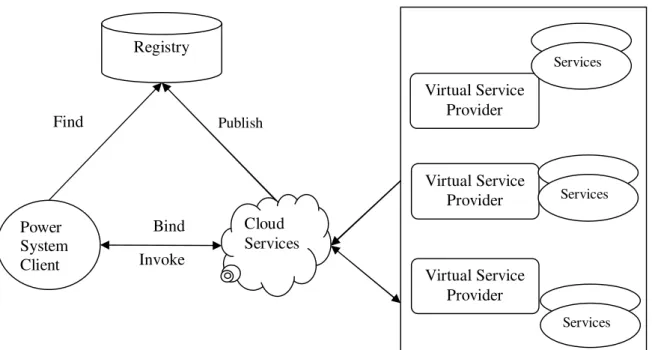
The extension of SOA to cloud computing architecture is shown in Figure 4.1. The computation of services in cloud model is based on distributed IT concepts that are inherent, which provides the easy way of interaction between power system applications in a heterogeneous environment. The application providers can deploy their applications without any limitation in a cloud environment and users can access complex, data rich deployed applications from anywhere on demand basis. The deployment of applications in a cloud environment reducing the cost for service providers when compared to other distributed environments.
Cloud computing is the Internet based system development paradigm in which large scalable computing resources are provided “as services” over the Internet to users. Web-based companies, such as Google and Amazon have built Web infrastructure to deal with computation of applications in the cloud environment. According to a survey by Gartner (2009), nearly 90% of organizations expect to maintain or grow their usage of applications in cloud computing environment. In this research, Google App Engine, a cloud computing environment provided by Google is utilized for stability services and for exchanging power system data.
In this proposed model, power system clients are able to invoke the power system services anytime from anywhere and utilize large scale storage and computing resources. On the other hand, the cloud computing service providers themselves may focus on how to distribute and scheduled the computer resources. The storage and computing on massive data are the key technologies for a cloud computing infrastructure. Nowadays, the service providers and clients interested in implementing clouds face the challenge of integrating complex software and hardware components from multiple vendors. Cloud computing platforms are attractive because they quickly access private and public resources on demand without any complexities. The core benefit of cloud computing is instant deployment of power system applications, which is offering immediate easy access to power system client from any location worldwide. Combined with this, other important benefits are self services. The cloud based applications are instantly scalable. For both clients and service providers, the successful creation and deployment of cloud services will become the foundation for their operations.
Today, the latest paradigm to emerge is that of cloud computing which promises reliable services delivered through next-generation data centers that are built on virtualized compute and storage technologies. The
clients will be able to access applications and data from a ‘cloud’ anywhere on demand basis. The power system clients are assured that the cloud infrastructure is very robust and will always be available at any time. Computing services need to be highly reliable, scalable, and autonomic to support ubiquitous access, dynamic discovery and composability. The recently emerged cloud computing paradigm appears to be the most promising one to leverage and build on the developments from other paradigms.
4.2 NEED FOR CLOUD SERVICES IN POWER SECTORS
The proposed cloud computing model is capable of providing the following technical benefits for the power system industries.
The ability to create the illusion of infinite capacity performance is the same if scaled for any number of power system clients with consistent service-level characteristics.
Abstraction of the infrastructure enables the power system applications not locked into devices or locations.
The power system clients only pay for what they use, with no or minimal up-front investment costs for using the deployed power system services in the cloud environment.
Power system services are available on demand and able to scale up and down with near instant availability. Typically, no forward planning forecast is required.
Access to power system applications and information can be obtained from any access point.
The cloud services for power system transient stability analysis can guarantee Quality of Service (Qos) for power system clients.
The computation of power system services in a cloud computing environment is an autonomous entity and it is managed transparently to a power system client.
The hardware, software and data required for analyzing power systems represented in cloud can be automatically reconfigured, orchestrated and consolidated to present a single platform and finally rendered to power system clients.
The above key features enable the power sectors for representing their operations and analysis in a cloud computing environment.
4.3 LAYERS OF CLOUD COMPUTING ARCHITECTURE
The main layers of cloud computing architecture are shown in Figure 4.2. The different layered services are ‘Infrastructure as a Service’ (IaaS) layer, ‘Platform as a Service’ (PaaS) layer and Software or Application as a Service (SaaS) layer. Each segment serves a different purpose and offers different solutions to businesses and individuals. Cloud computing is a model for enabling convenient, on-demand network access to a shared pool of configurable computing resources that can be rapidly provisioned and released with minimal management effort or service provider interaction. In simpler terms, cloud computing is nothing but accessing all the computational needs of the consumer from a single point. This offers reliable services delivered through data centers that are built on computer and storage virtualization technologies.
Figure 4.2 Layers of Cloud Computing Architecture
Clients are the devices (mobiles, thick and thin clients) that the end users interact with, to manage their information on the cloud. The data center is the collection of servers where the subscribed application is housed. Distributed Servers are placed at geographically disparate locations. But to the cloud subscriber, these servers act as if they were right next to each other in the cloud environment. The different layers of cloud computing architecture are explained in the following sections.
4.3.1 Infrastructure as a Service (IaaS)
The cloud infrastructure layer provides the fundamental resources needed to provide upper level platforms and services. The physical resources along with core middleware capabilities form the basis for delivering Infrastructure as a Service (IaaS). The services provided in this layer can be split into three categories namely computational resources, data storage and communication. The properties and design features are shared between the above three categories are availability, interoperability and security. Generally, the communication is based on SOAP or Representational State Transfer (REST) over standard HTTP. The works reported in this thesis mainly concentrated on the SOAP based communication as it makes power system applications are more interoperable. The service providers are free to
Software as a Service (SaaS) Platform as a Service (PaaS) Infrastructure as a Service (IaaS)
Service Provider Client
design their systems directly on top of this layer, skipping the platform layer. This results in increased freedom and flexibility, since providers can opt to use an existing platform that matches the individual system, or even implement their own platform for specific cases. This approach can also be used to transfer power system applications to a cloud in order to reduce infrastructure investments.
4.3.2 Platform as a Service (PaaS)
The PaaS provides the environment for service providers to implement their services. It also provides a source code level environment with a set of APIs to aid the interaction between cloud components and applications, scalability, and ease deployment and management. The Google App Engine (GAE) provides Java runtime environment and APIs for interacting with the cloud runtime environment. The major benefit for providers implementing their services in this layer is that the environment provides useful features easing development and reducing development time, including automatic scaling and load balancing, as well as integration with other services. The service providers are able to dedicate more of their focus on implementing specific logic, while outsourcing base functionality to platform services.
4.3.3 Software as a Service (SaaS)
The cloud application or software layer is the topmost layer in the cloud architecture, and the layer most visible to end users. The services in this layer are typically accessed through Web portals. The proposed cloud computing model has proven popular with end users because it alleviates the need to provide support for hardware to run applications and services, as well as eliminate the need for local installation and configuration. The clients can compute their required services from their terminals to the data centers in
which the cloud is located. The stability services provided with this model are normally referred to as SaaS, and has the advantage of ensuring recurring revenue for the service provides, as well as reducing the need for initial investments for clients. The advantages of providing applications and services in this manner by power system service providers lie in the fact that it also eases work related to upgrading, patching and protecting the intellectual property since clients are unable to access the source code. The service providers are able to roll out new features and updates without disturbing the clients, as long as the system is backward compatible with existing data.
4.4 STABILITY ANALYSIS IN CLOUD COMPUTING
ENVIRONMENT
The modern power systems consist of many interconnected synchronous generators, large transmission network and distribution system. The size of the power system grows exponentially due to increase in power demand. The data required for various power system applications have been stored in different formats in a heterogeneous environment. The power system applications themselves have been developed and deployed in different platforms and language paradigms. Interoperability between power system applications becomes a major issue because of the heterogeneous nature.
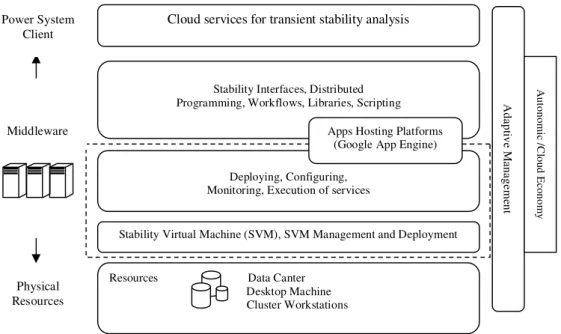
The main aim is to develop a cloud computing model that provides power system transient stability analysis as a service on demand over the Internet. The power system applications developed in cloud computing environment minimize the risk of physical infrastructure, reduce the run time and response time, reduce the initial cost and increase the pace of innovation. The proposed cloud computing model for transient stability analysis is shown in Figure 4.3.
Cloud services for transient stability analysis
Stability Interfaces, Distributed Programming, Workflows, Libraries, Scripting
Deploying, Configuring, Monitoring, Execution of services
Stability Virtual Machine (SVM), SVM Management and Deployment
Resources Data Canter
Desktop Machine Cluster Workstations
Apps Hosting Platforms (Google App Engine)
Adapt ive M anageme nt A utonom ic /Cl ou d Ec o nom y Power System Client Middleware Physical Resources
Figure 4.3 Cloud Computing Model for Transient Stability Analysis
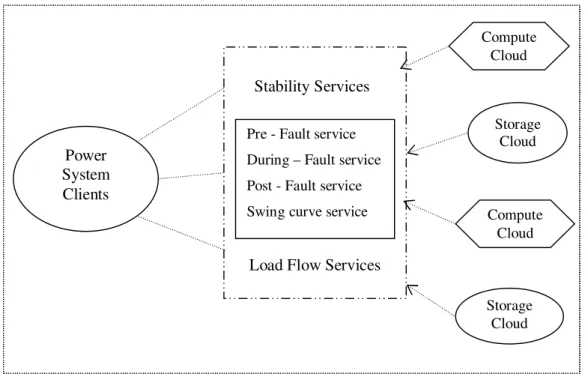
In the proposed model, the stability services are stored in the centralized location. The server in the cloud environment has the control and can manage the services stored in the “Storage as a Service” layer. The advantage with this model is that, even if thousands of requests are placed to the server at a time, the server will be able to offer the services simultaneously to all the clients. The “Stability as a Service” layer is provided on top of an effective “Infrastructure as a Service” layer that manages virtualization of resources and multi-tenancy. In this layer, the stability services such as Pre-Fault, During-Fault, Post-Fault and Swing curve are available to access any time over a network to the power system client on demand basis. The power system clients can able to access the services at anytime from anywhere on demand which makes the model robust in nature. The computation of stability services in cloud computing are highly reliable, scalable, and autonomic to support ubiquitous access and dynamic discovery.
4.4.1 Physical Resources for Stability Services
The physical infrastructure provides fundamental resources to power system stability services. In cloud systems, computational resources are normally provided in the form of virtual machines, since it gives the users significant flexibility because they have super-user access to their infrastructure, while protecting the data center by ensuring isolation between different systems. It has been made economically feasible due to the adoption of virtualization techniques. The lack of strict performance isolation between VMs sharing physical nodes result in difficulty for vendors to provide strong performance guarantees, which in turn result in providers offering weaker Service Level Agreements (SLAs) to ensure cost-effective services. Data storage is the second infrastructure resource, providing cloud systems ability to store power system data at remote sites, with access from several locations. This storage service is essential to facilitate scaling applications beyond individual servers. Cloud storage services must meet several requirements, such as high availability, adequate performance, replication and consistency. In general, cloud storage services are designed to be highly scalable, and focus primarily on availability and performance at the cost of consistency, often using the notion of eventual consistency.
4.4.2 Cloud Interfaces for Transient stability Analysis
The cloud interfaces do not force the power system clients to change their working habits and environments, e.g., programming language, compiler and operating system. This feature makes the cloud computing to differ from Grid computing. The power system clients in Grid computing have to learn new Grid commands and APIs to access Grid resources and services. The cloud client software which is required to be installed locally is lightweight. The cloud interfaces are location independent and can be accessed by well established interfaces like Web services framework and Internet browser.
4.4.3 Creating, Uploading and Registering the Stability Services
The Google App Engine (GAE) is used for registering, uploading and accessing the stability services in the proposed cloud computing model for transient stability analysis. The GAE allows dynamic allocation of system resources for a power system application based on the actual demand. The App Engine Software Development Kit (SDK) for Java is used to create the stability services by the service providers. The cloud applications need a configuration file to deploy and run the application. It includes the registered ID of stability application and the version number of application and lists of files that ought to be treated as static files and resource files (such as stability.jsp and other application data).
The power system applications developed using App Engine are easy to build, easy to maintain, and easy to scale as traffic and data storage needs grow. There is no need to maintain the servers. The applications have been uploaded for ready to serve to power system clients. App Engine is a complete development stack that uses familiar technologies to build and host Web applications.
With App Engine, the power system service providers can write their application code, test it on their local machine and then upload it on cloud environment. Once the applications are uploaded to Google, it will automatically host and scale the power system applications for the users. The service providers no longer need to worry about system administration, bringing up new instances of their application, sharing their database or buying machines. In GAE, the applications are built on the scalable technologies like Google File System (GFS) and BigTable. The above technology provides automatic scaling for building applications using App Engine. The GFS is a scalable distributed file system for large distributed data intensive applications. It provides fault tolerance while running on
inexpensive commodity hardware, and it delivers high aggregate performance to a large number of clients. With the above advent, the App Engine can scale to meet the power system engineers need.
BigTable is a distributed, column-oriented, multi-dimensional sorted map that can run on thousands of physical machines and allow for extremely high consistency. The power system data is replicated on multiple machines and hence a hard disk failure on a given machine has no effect on bringing the whole system down, which potentially allows full consistency even any of the Google’s servers were to fail at once. MapReduce is a software framework introduced by Google to support distributed computing on large data sets on clusters of computers. The power system clients specify a map function that processes a key / value pair to generate a set of intermediate key / value pairs, and a reduce function that merges all intermediate values associated with the same intermediate key. Google's index of the WWW is regenerated using MapReduce and it allows for many parallel processing tasks in distributed applications.
4.4.4 Configuring the Stability Services in Cloud
The configuration provides the information about the name of the service and its XML schema and name of the remote interface and its implementation. The configuration of power system stability services is represented as follows: <?xml version="1.0" encoding="UTF-8"?> <appengine-web-app xmlns="http://appengine.google.com/ns/1.0" xmlns:xsi="http://www.w3.org/2001/XMLSchema-instance" xsi:schemaLocation="http://kenai.com/projects/nbappengine/ downloads/schema/appengine-web.xsd appengine-web.xsd"> <application>powersystemtsa</application> </appengine-web-app>
The <application> element contains the application's ID (powersystemtsa). This is the application ID which has been created and registered in the Google App Engine. At the time of uploading the application, AppCfg gets the application ID from this file.
4.4.5 Deployment of Stability Services
In the traditional Web application deployment model, the power systems services can be deployed using software and purchasing servers from hardware vendors for storing the services. Since the applications can also be provided for external use, the power sectors must also buy data center equipments such as firewalls, switches, routers, load balancers, VPNs etc., to improve performance quality and data security. The power sectors also have to purchase bandwidth and hosting services from the third party. In the server side, the power sectors need to purchase and install an operating system, and subsequently application server stacks, such as Tomcat for Java, LAMP for PHP or Perl and database software like MS Access and Oracle. The resulting system can end up being expensive to build and hard to operate, which motivates the power sector to move in to cloud computing environment for their operations. The stability service provider has to provide a deployment descriptor file in XML as given below, which is to be used by the cloud to initiate the service invocation in the ‘appspot.com’ domain.
<?xml version="1.0" encoding="UTF-8"?>
<web-app version="2.5" xmlns="http://java.sun.com/xml/ns/javaee" xmlns:xsi="http://www.w3.org/2001/XMLSchema-instance" xsi:schemaLocation="http://java.sun.com/xml/ns/javaee http://java.sun.com/xml/ns/javaee/web-app_2_5.xsd"> <session-config> <session-timeout>30</session-timeout> </session-config> <welcome-file-list> <welcome-file>stability.jsp</welcome-file> </welcome-file-list> </web-app>
App Engine supports automatic compilation and URL mapping for Java Server Pages (JSPs). Google App Engine supports secure connections via HTTPS for URLs using the *.appspot.com domain. When a power system client requests an access to a URL using HTTPS, both the request and the response are encrypted, transmitted, and decrypted for enabling secure operations in a cloud computing environment.
4.4.6 Accessing the Services by Client
In this proposed model, the power system client applications are written in Java to access the stability services in a cloud computing environment. The Web based Administration Console in GAE provides an environment for the power system engineers to easily manage the power system applications which are running. The client communicates with the power system services in a cloud environment as shown in Figure 4.4.
Figure 4.4 Communications with Power System Service Provider -Cloud Environment
Power System Clients
Stability Services
Pre - Fault service During – Fault service Post - Fault service Swing curve service
Compute Cloud Compute Cloud Storage Cloud Storage Cloud
In cloud computing environment, the power system clients can access their required services by paying for what they use with minimal investment costs. The power sector can adopt this environment for running their power system applications in order to improve the efficiency of their operations demands. The on demand cloud services for power system transient stability analysis ensures Quality of Service (Qos) to the power system clients.
The Cloud services for transient stability analysis can be viewed
any where using a URL http://powersystemtsa.appspot.com by the power
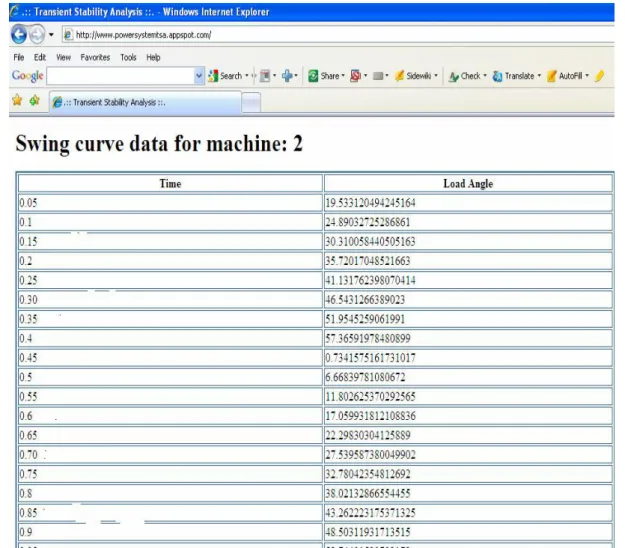
system clients. The response of the invocation of computeSwing() service from the cloud environment is shown in Figure 4.5.
The proposed cloud computing model is a paradigm shift which provides an environment for power system data centers and service providers with an architecture that delivers highly reliable and scalable services to their clients. It is significantly more agile and cost effective than other enhanced distributed models.
4.5 PERFORMANCE ANALYSIS OF THE PROPOSED
MODELS
The power system transient stability analysis is being carried out for 6, 14, 39 and real time TNEB large interconnected systems. The major factor that influences the performance of the proposed models is the Round Trip Time (RTT). The RTT is the time that elapses from the initiation of a method invocation by the power system client until the required results are returned. The power systems are highly interactive systems, in which clients are constantly providing input and waiting for their required results. In this situation, keeping response times low is essential to enable power system engineers to work efficiently.
When the service invocation is carried out within the LANs, RTT is less than 10 milliseconds is normal. In case of WAN, the RTTs will increase compare to LAN. When multiple requests and responses are required by the clients RTT will be further increased and it leads to a slower response of the system. The geographical distance of the resources required for design and development of cloud services is also one of the important factors results in the increase or decrease of RTT. In distributed models, the RTT is lower due to geographical closeness of the resources. Compared to distributed environment, packets will need to travel farther to reach the cloud environment and back, with latency depending on the geographical distance to the cloud provider. So, the increased in RTT is unavoidable latency when moving to a cloud environment. The RTT is even more important if one cloud
based system is required the services from other clouds. In cloud computing environment, the system is able to scale dynamically based on demand. Since, the factor of Internet latency must be taken into account when considering running systems in the cloud.
There are several important differences between Web services and RMI. RMI is a distributed object model and enables the development of distributed Java applications in which the methods of remote objects can be invoked from other Java virtual machines, possibly on remote hosts. The communication in RMI is based on the notion of distributed objects and follows the object paradigm. A distributed object exposes a remote interface through which the clients can invoke methods. RMI supports synchronous request/response method invocation. Distributed objects in RMI can be stateful and maintain their identities. The RMI communication is usually blocked by firewalls. Therefore, it is appropriate, mainly for communication within LANs. The RMI uses TCP/IP as the underlying protocol for binary communication, which is not secured by default. RMI works only between applications developed in Java using its own framework.
In Web services, RTT is higher when compared to RMI. The reasons for slower performance of Web services compared to RMI are due to message sizes transferred over the network, processing overhead of the messages, and implementation related overheads. The differences between binary JRMP and XML-based SOAP message communications are also influencing the performance of the proposed models. The major portion of the overhead is related to the introduction of the message level security and to the textual encoding of the message content (pay load).
The RTT is estimated for performing the transient stability analysis using enhanced distributed models such as JAX-RPC, SOA and Cloud computing. The performance analysis of the different distributed models has
been carried out with respect to round trip time by considering various numbers of clients invoking the services.
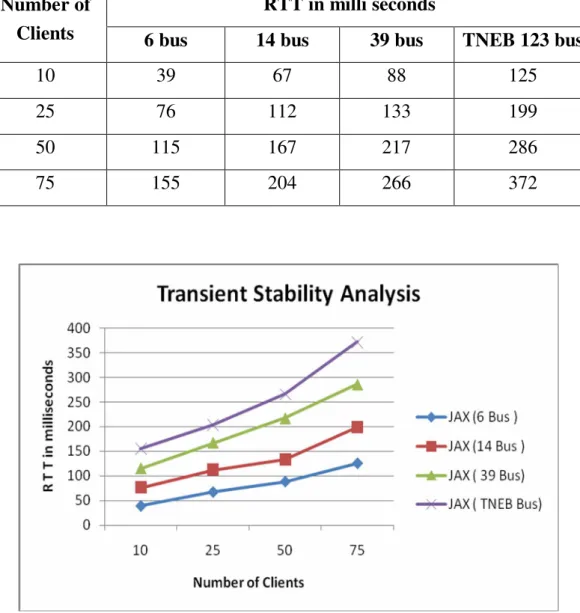
The RTT estimated using JAX-RPC model is depicted in Figure 4.6 with the corresponding data given in Table 4.1.
Table 4.1 RTT measures using JAX-RPC Model
JAX-RPC Model
RTT in milli seconds Number of
Clients 6 bus 14 bus 39 bus TNEB 123 bus
10 39 67 88 125
25 76 112 133 199
50 115 167 217 286
75 155 204 266 372
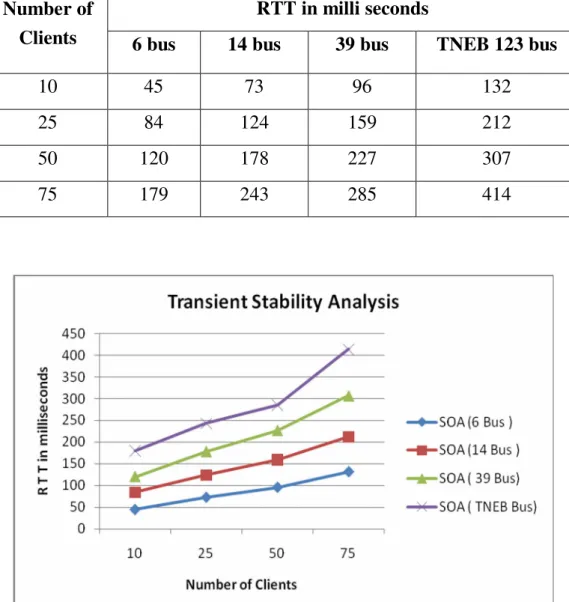
The RTT estimated using SOA model is depicted in Figure 4.7 with the corresponding data given in Table 4.2.
Table 4.2 RTT measures using SOA Model
SOA Model
RTT in milli seconds Number of
Clients 6 bus 14 bus 39 bus TNEB 123 bus
10 45 73 96 132
25 84 124 159 212
50 120 178 227 307
75 179 243 285 414
Figure 4.7 RTT Vs Number of Clients in SOA
JAX-RPC uses the XML-based SOAP communication between remote services. SOAP builds on top of existing Internet protocols, such as HTTP, FTP or SMTP. Therefore SOAP can transverse firewalls seamlessly,
because firewalls will treat SOAP messages similarly as other HTTP (or FTP, SMTP) messages. The RTT is increased 8-12 % in SOA when compared to JAX-RPC model. Because, the SOA model provides the communication over the XML-based SOAP protocol and thus enables overhead with other Web services, which do not have to be developed in Java.
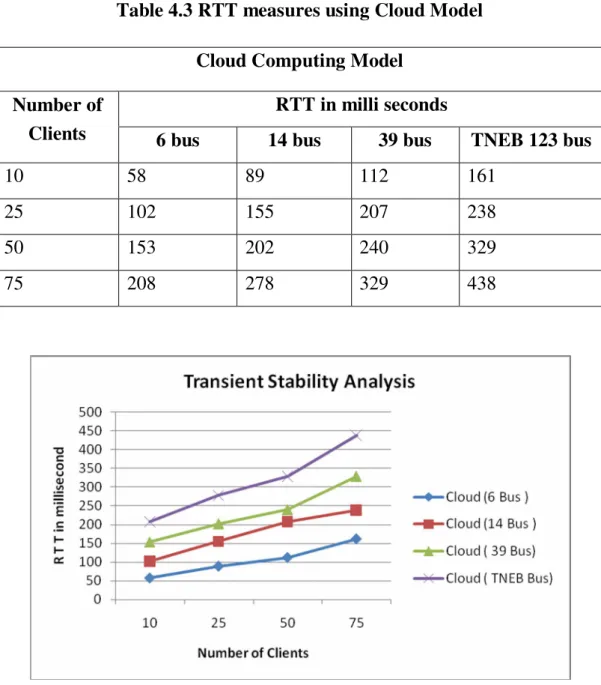
The RTT estimated using Cloud model is depicted in Figure 4.8 with the corresponding data given in Table 4.3.
Table 4.3 RTT measures using Cloud Model
Cloud Computing Model
RTT in milli seconds Number of
Clients 6 bus 14 bus 39 bus TNEB 123 bus
10 58 89 112 161
25 102 155 207 238
50 153 202 240 329
75 208 278 329 438
In cloud computing environment, the overhead will be inevitable due to enhancement in the interoperability between power system applications in heterogeneous environment. It minimizes the physical infrastructure, lowering the cost and increasing the pace of innovation even though the RTT is higher when compared to other models.
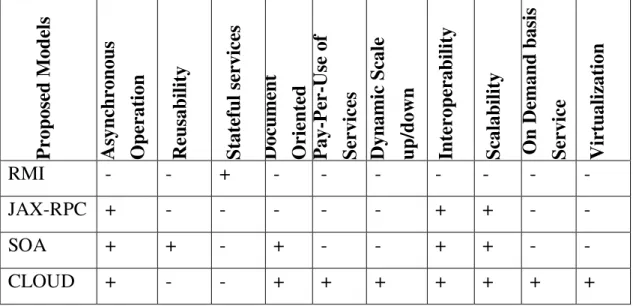
Table 4.4 shows the functional comparison of proposed architectural models for representing the transient stability analysis in power systems. In the table, ‘+’ sign means the proposed model contains desirable properties and a ‘-’ sign means the proposed model does not contain desirable properties.
Table 4.4 Functional Comparison of Proposed Models
Proposed Models Asynchronous Operation Reusability Stateful services Document Oriented Pay
-Per
-Use of
Services Dynamic Scale up/down Interoperability Scalability On Demand basis Service Virtualization
RMI - - + - - -
-JAX-RPC + - - - + + -
-SOA + + - + - - + + -
-CLOUD + - - + + + + + + +
Some of the properties and issues are typically applicable in one model cannot be available in other models. For example, the pay per use service, on demand service, dynamic scale up / down and virtualization are exclusively cloud computing related issues, marshalling SOAP message between client and server is exclusively a Web service related issue, while reusability of services is exclusively a SOA related issue. Other issues, such
as security is common for all the proposed models. But, cloud computing expands scalability than SOA by adding virtualization and grid computing concepts. The proposed cloud computing infrastructure using Google App Engine is composed of many virtual machines that instantiated at runtime to scale the system dynamically.
4.6 CONCLUSION
A cloud service model for power system transient stability analysis has been developed. The power systems and their operations are more analogous to cloud architecture and its services. The cloud services can be viewed and accessed on demand basis at anytime and anywhere that makes rapid adoption of cloud computing in the power sectors. The performance analysis of the proposed distributed models using JAX-RPC, SOA and Cloud Computing for representing and solving transient stability problems is carried out for the sample and real-time systems. The RTT has been considered as the performance measure and it has been estimated with respect to different distributed models by considering the number of clients invoking the services.