Protein
Interaction
Analysis
Analyzing protein interactions with the
ProteOn
™XPR36 protein interaction array system
Virtually every cellular structure and process depends on protein interactions.
DNA replication and transcription, RNA splicing and translation, protein modification
and secretion, cell cycle control and apoptosis, cell growth and intermediary
metabolism, signal transduction, and gene expression — all exploit intricate protein interactions
for the execution and maintenance of complex cellular life processes, making the analysis of
protein interactions an especially valuable area of research.
Surface plasmon resonance (SPR) optical biosensing is an analytical technique that
requires neither radiochemical nor fluorescent labels to provide real-time data on the affinity,
specificity, and interaction kinetics of protein interactions. SPR biosensors generate the interaction
data required to establish the functional roles of proteins, understand cellular function, and
develop new drugs to treat disease (Rich and Myszka 2005).
This article features the ProteOn XPR36 interaction array system, an SPR imaging
optical biosensor that allows simultaneous analysis of up to 36 biomolecular
interactions on a single sensor chip. The ProteOn XPR36 system
increases the throughput, flexibility, and versatility of experimental
design for a wide range of biomolecular studies.
Evaluating Protein Interactions
Protein interactions are identified using a wide assortment of library-, affinity-, and array-based methods, such as yeast two-hybrid screening, protein arrays, proteolytic cleavage, and cross-linking. Identifying potential interacting partners, however, is only the first step towards understanding the impact of a protein interaction in the cell; also required is an understanding of the extent to which the interaction actually occurs. For this, the binding kinetics of the interaction as well as the environment of the interactants within a cell must be evaluated.
The Importance of Interaction Kinetics
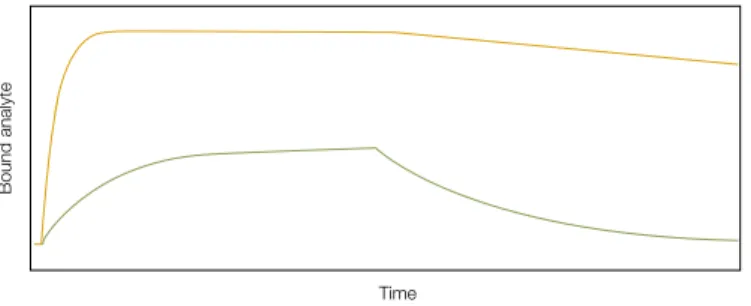
To evaluate the strength of an interaction and the extent to which that interaction might occur in the cell requires an understanding of its kinetics. The strength of a two-molecule interaction is characterized by the equilibrium dissociation (binding) constant KD = [P][L]/[PL], where [P] is the concentration of free protein, [L] the concentration of ligand, and [PL] the concentration of the complex. At equilibrium, KD is related to the rate of complex formation (described by the association rate constant, ka) and the rate of breakdown (described by the dissociation rate constant, kd), such that KD = kd/ka. A high-affinity interaction is characterized by a low KD, rapid recognition and binding of the interactants (rapid “on rate”, or high ka), and stability of complex formation (slow “off rate”, or low kd) (Figure 1). Many commonly used techniques (for example, equilibrium dialysis and immunoprecipitation) provide measurements of KD. However, most do not offer the real-time measurements required for determining association and dissociation kinetics.
The measurement of relative association and dissociation kinetic rate constants is extremely valuable when investigating mutations of amino acid residues to study a protein interface or when modifying small-molecule lead compounds to optimize binding to drug targets. Changes made to interacting molecules may not affect overall binding affinity yet may alter the association and dissociation rates significantly. Since KD = kd/ka, if both rate constants become slower or faster in concert after a molecular modification, then the contributions of particular residues or modifications may be overlooked if the binding constant alone is measured. When both the association and dissociation rates of an interaction are measured, insights can also be gained into the biological function of an interaction, the relevance of specific residues in binding hot spots can be determined, and compounds can be selected that bind to targets with clinically favorable properties.
Affinity data also provide an important clue as to whether two molecules actually interact in the intracellular milieu. For a protein and ligand to interact in a cell a significant fraction of the time, their intracellular concentrations must be in the same range as the KD. The lower the value of KD, the lower the concentration required for two intracellular proteins to interact; the higher the value of KD, the higher must be their concentrations. Thus, affinity data combined with knowledge of intracellular concentrations provide an excellent diagnostic clue as to the biological relevance of intracellular protein interactions.
From protein interfaces to multiunit
complexes and cascades, the ProteOn
XPR36 system provides the high-quality
data needed to decipher the fundamental
interactions underlying protein function.
Considerations Related to Higher Levels of Cellular OrganizationEven if a protein and its ligand exhibit strong binding affinity for each other and are expressed at sufficient levels in a particular tissue to interact functionally, other factors influence the nature of their interaction. Certain molecules, such as ions or cofactors, may be critical for binding, while others, such as competitors, can inhibit it. Molecular modifications, conformational changes, cellular compartmentalization, membrane dynamics, molecular crowding, or changes in pH of the cellular environment can also either promote or inhibit the interaction. There is, therefore, a well-established need to study protein interactions under biologically relevant, controlled conditions.
In addition, proteins are often part of functional networks made up of closely interacting clusters of proteins that in turn interact more loosely with other clusters (Spirin and Mirny 2003). The clusters correspond to protein complexes (proteins that form a functional unit) and dynamic cascades (proteins that execute a cellular process). SPR biosensors can provide useful data at this higher level of cellular organization by providing firm experimental data on the formation and stabilization of protein clusters. From such data, an understanding of the higher-level dynamics of functional networks becomes attainable.
SPR Optical Biosensors — Real-Time, Label-Free Kinetic Data
SPR optical biosensors respond with high sensitivity and in real time to the recognition, binding, and separation of two interacting molecules, which provides critical data regarding the rates of association and dissociation.
The principle behind SPR is detailed in the sidebar opposite. SPR biosensors analyze interactions free of radiochemical and fluorescent labels, bypassing the need for costly, time-consuming labeling reactions and eliminating the potential for unintentional modification of interacting chemical groups. SPR biosensors can detect subfemtomolar levels of proteins and other molecules as small as a few hundred Daltons, and Fig. 1. Kinetics of analyte binding. Upper trace, a high-affinity interaction
characterized by a high ka (fast association) and a low kd (slow dissociation); lower trace, a low-affinity interaction characterized by both a low ka and a high kd.
Bound analyte
Time COVER STORY
are compatible with a wide range of biologically relevant chemical environments and temperatures. SPR biosensing is fast, requires very little material, and can be applied to studies of most biomolecules, including DNA, RNA, lipids, and carbohydrates as well as proteins. Using SPR biosensors, then, the native state of a protein can be simulated and modified as necessary to decipher the mechanisms of its interaction with other biomolecules.
SPR biosensors complement a number of techniques to effectively link interaction mechanisms with biological function. SPR biosensors are used for effective antibody characterization and development, and for the study of drug-target interactions. Used alongside other screening techniques, like yeast two-hybrid or phage display methods, SPR biosensors provide the kinetic data required to determine the extent to which an interaction takes place. Paired with site-directed mutagenesis and X-ray crystallography, SPR can help identify and validate key residues or motifs involved in binding; SPR data can distinguish the components of the binding interface that affect recognition and formation from those that maintain stability (Reichmann et al. 2005). Finally, with techniques used to identify
and characterize protein complexes and cascades, SPR optical biosensors can provide data on the formation and stabilization of protein complexes consisting of multiple interaction partners (Spirin and Mirny 2003). Analyzing protein interactions under multiple conditions and among multiple interaction partners, however, requires an SPR optical biosensor capable of processing multiple samples in parallel while still yielding high-quality data.
The ProteOn XPR36 Protein Interaction Array System The ProteOn XPR36 system is an SPR optical biosensor capable of simultaneous measurement of 36 individual molecular interactions. It integrates a high-efficiency microfluidics system with a high-sensitivity optical system to generate data over a unique 6 x 6 interaction array for the analysis of up to six ligands with up to six analytes.
A 6 x 6 Interaction Array Coupled With Efficient Fluidics
The 6 x 6 interaction array is generated by the centerpiece of the fluidics system, the multichannel module (MCM). The MCM forms six channels on the ProteOn sensor chip surface, and up to six different ligand samples can be immobilized in each of
Surface plasmon resonance (SPR) is a phenomenon that occurs when light interacts with a metal film (such as gold) placed at the interface between two media with different refractive indices (such as a glass prism and water). When light passing through glass crosses into water, it speeds up because the water has a lower refractive index. If the light is traveling at an angle when it crosses the interface, it will bend toward the glass (refract). At a single well-defined angle (the critical angle), the light cannot pass into the water and instead propagates along the interface. This light wave is called the evanescent wave. Because light has wavelike properties, however, a portion of the wave evanesces, or extends a fraction of a wavelength into the water before disappearing.
If a thin layer of gold is inserted between the glass and water, light incident at any angle onto the gold surface is reflected back into the glass. But the evanescent wave produced by the incident light is partly absorbed by the gold. Gold, like all metals, has the property that its electrons are not confined to a single nucleus but act as a charged “sea” that can respond in unison. Disturbance of the negatively charged electrons by the absorption of light causes a local charge imbalance, which causes waves of electrons to move with the waves of light. This effect is called surface plasmon resonance. Careful observation reveals a thin shadow in the reflected image at a specific angle corresponding to the absorption of the incident light by the gold surface. This shadow is called the SPR dip, and the angle at which the dip occurs (the SPR angle) can be measured by an optical detector.
SPR optical biosensors respond in real time to changes in the refractive index near the surface (in the range of the evanescent wave) resulting from the binding and subsequent separation of two proteins. One protein is chemically bound to the gold layer on the sensor surface, and a second protein flows in solution over the immobilized protein. As the protein in solution binds to the immobilized protein, the refractive index near the sensor surface increases, leading to a shift in the SPR angle. When the protein solution is replaced with a solution without protein, the protein complex on the sensor surface dissociates, the refractive index decreases, and the SPR angle shifts back. SPR optical biosensors record the shift in the SPR angle as a function of time in the form of a sensorgram (see figure below). The angular shift is measured in response units (RU). (1 RU = 10–6 change in refractive index.)
The sensorgram displays the time course of binding of analyte to ligand on the chip surface. During the association phase, analyte solution flows over the ligand surface, and analyte binds to the ligand. If the association phase is sufficiently long, the reaction will reach a plateau (equilibrium) characterized by equal rates of association and dissociation. When analyte flow is stopped, the dissociation phase starts and the sensorgram declines as analyte leaves the ligand surface.
The shift in SPR angle can be measured so precisely that the binding kinetics of protein-protein interactions can be measured without labels at a resolution of detection on the order of picograms of protein per square millimeter of sensor surface.
Schematic illustration of the conversion of shift in SPR angle to sensorgrams. A, as analyte binds to ligand molecules on the sensor chip surface, the intensity minimum (shadow) produced by the SPR effect shifts. B, this intensity shift is measured in real time for 36 interaction spots and 42 interspot references (shown for one spot). C, each of the resulting sensorgrams is fitted to an appropriate mathematical model to quantitatively characterize the interaction (shown for one set of 6).
Angle Re sp on se Time In te ns ity B C
Analyte flow Bound ligand
Sensor chip
Incident light
the channels. A second set of channels is formed orthogonal to the first, creating a crisscross pattern of two sets of orthogonal flow channels (Figure 2). Up to six analyte samples can then be injected in parallel into this second set of channels. The response at each interaction spot is then detected, generating 36 sensorgrams corresponding to six analytes interacting with each of the six ligands. The associated fluidics ensure a smooth, constant flow of sample and buffer fluids for accurate measurement of binding kinetics.
Innovative Optics
The ProteOn XPR36 system also features an optics system capable of producing a high-quality response over the entire 36-element array. A synchronized sequential scanning illumination and imaging system detects the SPR response as the illumination passes through the critical angle (see sidebar on the previous page). The optical system has the additional advantage of scanning electronically with no moving parts. The complete SPR curve of intensity versus angle of illumination is measured at each point on the sensor chip, and the shift of the SPR angle is determined accurately and independently for each point in the chip surface image.
Fig. 3. One-shot kinetics for the IL-2 cytokine/IL-2 antibody interaction. Each set of six sensorgrams displays the responses from the six IL-2 cytokine concentrations interacting with one immobilization level of IL-2 antibody. Sensorgrams are shown for the five levels of IL-2 antibody immobilization (ligand density) and the reference channel. Black lines represent the global fit of the sensorgrams to a 1:1 kinetic interaction model.
Fig. 2. Generation of the 6 x 6 ligand-analyte interaction array.A, six ligands are immobilized in six parallel ligand channels; B, six analyte samples are injected into six analyte channels orthogonal to the six ligand channels; C, detail of a single ligand-analyte interaction spot (green) showing the positions of the two interspot references (yellow).
160 140 120 100 80 60 40 20 0 2,823 RU ligand density Response, RU 0 2 4 6 8 10 12 1,702 RU ligand density Response, RU 160 140 120 100 80 60 40 20 0 0 2 4 6 8 10 12 100 50 0 1,368 RU ligand density Response, RU 0 2 4 6 8 10 12 2,053 RU ligand density 160 140 120 100 80 60 40 20 0 0 2 4 6 8 10 12 Response, RU 1,468 RU ligand density 160 140 120 100 80 60 40 20 0 0 2 4 6 8 10 12 Response, RU 8 6 4 2 0 –2 –4 –6 –8 Reference channel
Run time, min
0 2 4 6 8 10 12 Response, RU A B C COVER STORY
Interspot References — Maximizing Throughput and Flexibility
The 6 x 6 array and microfluidics of the ProteOn XPR36 system provide efficient parallel processing of multiple samples, which is further enhanced by another innovation: the ability to measure the SPR response of 42 interspot references. Interspot references are regions on the sensor chip situated between the flow channels and adjacent to both sides of every interaction spot in the direction of analyte flow (Figure 2). During ligand immobilization, these interspot references are not exposed to activation or ligand solutions; during analyte binding, however, the interspot references are exposed to analyte flow. Because interspot references do not have bound ligand, they can be used in place of a reference channel. This feature permits all 6 x 6 microchannels to be used for interaction analysis, maximizing throughput and flexibility in experimental design (Bronner et al. 2006).
One-shot Kinetics™ Technique
The parallel processing capability of the ProteOn XPR36 system is ideally suited for the quick and efficient analysis of multiple protein interactions. An innovative technique termed “One-shot Kinetics” achieves a robust kinetic analysis of an analyte concentration series without need for regeneration between samples (Figure 3; Bronner et al. 2006). Because multiple conditions can be tested in parallel, the process of optimizing the protocols for immobilization and binding reactions can be handled quickly and efficiently, and the high sample throughput of the ProteOn XPR36 system can then be applied to screening and comparative analysis of multiple samples, such as those
encountered in hybridoma screening and immunogenicity testing (see the sidebar above and bulletins 5360 and 5368 for other examples of applications).
Conclusions
To fully understand the role of a protein, it is important to move beyond analysis of its expression patterns and identify the potential interactions of that protein with other biomolecules, determine the extent to which these interactions take place, and analyze their consequences on cellular function. Deciphering the character and extent of protein interactions unlocks the dynamics of virtually every cellular process. From protein interfaces to multiunit complexes and cascades, the ProteOn XPR36 system provides the high-quality data needed to decipher the fundamental interactions underlying protein function. The integrated 6 x 6 design of the system makes it a versatile tool that augments other protein analysis techniques for a wide variety of applications. References
Bronner V et al. (2006). Rapid and efficient determination of kinetic rate constants using the ProteOn XPR36 protein interaction array system. Bio-Rad bulletin 3172.
Reichmann D et al. (2005). The modular architecture of protein-protein binding interfaces. Proc Natl Acad Sci USA 102, 57–62.
Rich RL and Myszka DG (2005). Survey of the year 2004 commercial optical biosensor literature. J Mol Recognit 18, 431–478.
Spirin V and Mirny L (2003). Protein complexes and functional modules in molecular networks. Proc Natl Acad Sci USA 100, 12123–12128.
1 2 3 4 5 6 1 2 3 4 5 6
The innovative crisscross microfluidic design of the ProteOn XPR36 system easily and rapidly performs a multitude of experiments.
One-shot Kinetics™ Technique
This technique permits acquisition of a complete kinetic profile of six analytes with six ligands. The automated injection of six analyte concentrations over a single ligand concentration, or six analyte concentrations over six ligand concentrations, permits expanded statistical inference and acceleration of experimental results (see example below).
Analysis of Multiple Protein Interactions
Numerous life science applications require coordinated investigation of multiple interaction events between groups of closely related proteins and variants of a single protein.
• Efficiently immobilize up to 6 different ligands in one immobilization step, then sequentially analyze various analytes in successive binding steps • Rapidly investigate complex interactions between several groups of closely
related proteins
• Screen focused libraries against a panel of structurally similar targets, identifying the basis of binding specificity
• Map pharmacologically crucial details of the protein interfaces and binding sites of multiple mutant proteins, oligonucleotides, and peptide sequence variations Testing of Multiple Conditions
A great advantage of the ProteOn XPR36 system is that multiple results are simultaneously obtained and instantly seen in the context of other conditions. • Rapidly and accurately acquire kinetic, thermodynamic, specificity, and
affinity data in one experiment of 36 separate interactions — all with the sensitivity of SPR technology
• Determine pH and salt effects on binding interaction and complex formation • Perform competitive binding assays with concentration series of multiple
analytes and competitors in parallel Antibody Characterization
• Analyze, compare, and cross-reference up to 30 samples per hour in hybridoma screening and immunogenicity testing
• Obtain a complete epitope mapping and interaction matrix among a panel of 6 antibodies and 6 antigens — in a single experiment
Experimental Design Using the ProteOn XPR36 Protein Interaction Array System
Step 2. Analyze binding of cytokine IL-2.
(Cytokine concentration varied in each channel.) 80 nM IL-2 40 nM IL-2 20 nM IL-2 10 nM IL-2 5 nM IL-2 2.5 nM IL-2 Reference channel (PBS/Tween only)
EDAC/sulfo-NHS (1x), IL-2 antibody, ethanolamine HCl EDAC/sulfo-NHS (0.5x), IL-2 antibody, ethanolamine HCl EDAC/sulfo-NHS (0.25x), IL-2 antibody, ethanolamine HCl EDAC/sulfo-NHS (0.125x), IL-2 antibody, ethanolamine HCl EDAC/sulfo-NHS (0.063x),IL-2 antibody, ethanolamine HCl
Life Science Group
13-0606 0413 Sig 1212 Bulletin 5538 Rev D US/EG
Bio-Rad
Laboratories, Inc.
Web site www.bio-rad.com USA 800 424 6723 Australia 61 2 9914 2800 Austria 01 877 89 01 Belgium 09 385 55 11 Brazil 55 11 5044 5699 Canada 905 364 3435 China 86 21 6169 8500 Czech Republic 420 241 430 532 Denmark 44 52 10 00 Finland 09 804 22 00
France 01 47 95 69 65 Germany 089 31 884 0 Greece 30 210 9532 220 Hong Kong 852 2789 3300 Hungary 36 1 459 6100 India 91 124 4029300 Israel 03 963 6050 Italy 39 02 216091 Japan 03 6361 7000 Korea 82 2 3473 4460 Mexico 52 555 488 7670 The Netherlands 0318 540666 New Zealand 64 9 415 2280 Norway 23 38 41 30 Poland 48 22 331 99 99 Portugal 351 21 472 7700 Russia 7 495 721 14 04
Singapore 65 6415 3188 South Africa 27 861 246 723 Spain 34 91 590 5200 Sweden 08 555 12700 Switzerland 026 674 55 05 Taiwan 886 2 2578 7189 Thailand 800 88 22 88 United Kingdom 020 8328 2000
Tween is a trademark of ICI Americas Inc.
Information in this article was current as of the date of writing (2006) and not necessarily the date this version (rev D, 2013) was published.
For more information, visit us on the Web at www.bio-rad.com/proteininteraction. Call toll free at 1-800-4BIORAD (1-800-424-6723); outside the US, contact your local sales office.
The ProteOn XPR36 protein interaction array system is covered by Bio-Rad patents, including United States patent numbers 8,111,400, 8,105,845, 7,999,942, and 7,443,507.
This product or portions thereof is manufactured and sold under license from GE Healthcare under United States patent numbers 5,492,840, 5,554,541, 5,965,456, 7,736,587, and 8,021,626, and any international patents and patent applications claiming priority.