EVALUATION OF LINK QUALITY FOR ROUTING IN DSR
1N.PRASATH, 2 P.SENGOTTUVELAN
1
KPR Institute Of Engineering and Technology, Department of Computer Science and Engineering, Coimbatore, INDIA
2Bannari Amman Institute of Technology, Department of Information Technology, Sathyamangalam,
INDIA
E-mail: 1 [email protected]
ABSTRACT
MANETs are networks comprising of nodes communicating with each other without network infrastructure and whose advantage is that they can operate alone or in coordination with wired infrastructure. This is usually done through gateway nodes participating for traffic relay in both networks. Application areas are battlefield deployment, rescue work and civilian applications like outdoor meetings or Ad-hoc classrooms. This paper shows a process to evaluate link quality to improve routing by using Dynamic source routing protocol. Considering wireless links quality, a routing algorithm chooses better paths. In this paper, the performance of the effect of link-quality metrics is evaluated. The metrics using a DSR-based routing protocol is studied.
Keywords: MANET (Mobile ad hoc network), DSR (Dynamic source routing protocol), Link quality
1. INTRODUCTION
With cheaper, smaller, and powerful mobile devices increasing, MANETs are now the cynosure of research. This self-organizing network, combines wireless communication with high node mobility and hence is attractive for applications like rescue
and tactical operations. Their dynamic
infrastructure provides a lot of flexibility. Without fixed infrastructure, like wired networks (base stations, centralized management points etc) node unions form arbitrary topology [1]. Flexibility makes them suitable for applications like military deployment where network topology changes rapidly reflecting a force’s operational movements. It is also used in disaster recovery operations where existing/fixed infrastructure can become non-operational. The ad hoc self-organization is suitable
in virtual conferences, where setting up
conventional network infrastructure is time
consuming [2].
MANET, a new kind of wireless net is independent of fixed basic structure and their success is ensured by their cooperating nodes. MANET uses non-central distributed controlling, is self-forming, anti-ruining and composes easily.
Many MANET applications involve
communication modes of many-to-many and one-to-many processes ensuring improved group communication. Provision of hot communication has always been a hot MANET topic. Safe group
communication is required globally, and progress has been made in this [3].
MANETs are autonomous mobile node systems connected by multi-hop wireless links without central infrastructure. A challenge in such networks is dynamic routing protocol development that
efficiently locates routes between two
communicating nodes and can keep up with high node mobility that usually alters network topology drastically and unpredictably. Routing protocols are classified as on-demand routing protocols (reactive) and table-driven routing protocols (proactive). Popular on demand routing algorithms are Ad hoc On-Demand Distance Vector routing and Dynamic Source Routing [4].
Current ad hoc routing protocols choose paths that lower hop count [5, 6]. Minimal hop count paths perform poorly in ad hoc wireless networks as they include wireless links between distant nodes which can be slow or lossy, resulting in poor throughput [7]. Again the network’s dynamic nature leads to route link breaks. A routing algorithm chooses better paths by considering wireless links quality. This study investigates link quality effect on network performance.
2. LITERATURE REVIEW
Sharvani et al [8] suggested a solution to locate intra node paths in MANETs. Termite is an
communication networks which is adaptive, distributed, mobile-agents-based and inspired by recent work on ant colony metaphor. In this algorithm, a mobile agents (or artificial termites) group builds paths between node pair by exploring a network and exchanging information to update routing tables. Packet delays and throughput were the parameters used to evaluate its performance. This algorithm reveals better throughput compared to current algorithms. Hence, Termite algorithm is a good alternative for data routing in commercial networks.
KaurandRai [9] used routing techniques which are challenging due to ad hoc networks dynamic topology. Different strategies are proposed for
efficient routing which claimed improved
performance. There are many routing protocols for MANETs making it hard to determine which suits varying network conditions proposed by their Quality of service offerings. The paper gives an overview of various routing protocols in literature and compares them.
Johnson et al [10] described a DSR protocol design providing a summary of some current simulation and test bed implementation results. DSR design assumptions are also discussed. The author presented DSR protocol design and described its important properties. The author specifically described Route Discovery and Route Maintenance, two mechanisms which ensure DSR operation supporting heterogeneous networks and interconnecting with the Internet. It also described current support present in DSR ad hoc networks multi packet routing. The author summarized some DSR simulation results describing a physical outdoor ad hoc network testbed built in Pittsburgh for DSR related experiments.
Rawat et al [11] proposed DSR enhancements ensuring secured route discovery and improved QoS. This paper evaluated integrating Secured Routing Protocol (SRP) and Secured Message Transmission (SMT) with DSR resulting in Secured Dynamic Source Routing (S-DSR), capable of secure route discovery. The paper’s proposed extension incorporates multiple cached routes, concurrent usage to improve throughput, exploring route cache enrichment management possibilities leading to improved efficiency. It also proposed a new idea of proactive route discovery for high, sustained bandwidth dependent applications like video conference, voice over IP. The paper ended with remarks on a possible comprehensive SDSR
protocol, incorporating better route cache
maintenance, proactive route discovery and
integrating SRP/SMT features to ensure secure route discovery and data transmission.
Sharma et al [12] modeled MANET behavior for DSR protocol considering significant routing metrics (packet delivery fraction, normalized routing load, average end-to-end delay etc.) generated by Network Simulator NS 2.34 tools. Node movement was generated using Bonmotion 1.4. MANET DSR protocol behavior was hypothesized to depend on variables like node density, pause time, packet number transferred, and connections number. MANET behavior was also discussed using supervised learning algorithm i.e. Levenberg-Marquardt, a network training algorithm which updates weights/bias values for DSR (Dynamic Source Routing) protocol. The algorithm was implemented on MATLAB 7.7 and was found satisfactory with minimum error rate.
Gaertner et al [13] stated that popular link quality prediction algorithm 802.11 for MANET performs poorly when applied to urban environments than in simulations. Author’s measurements revealed that best performing prediction algorithm failed to predict between 18 and 54 percent of total observed packet loss in real urban environments. Also, this algorithm lost between 12 and 43 percent of transmitted packets due to the erroneous link failure prediction which was in contrast to the near-perfect accuracy in corresponding simulations. An in-depth examination of factors was performed to account for this discrepancy which influenced link quality. The conclusion reached was that shadowing was a significant and underestimated factor in MANET’s link quality prediction.
Farkaset et al [14] proposed a XCoPred approach to predict link quality variations dependent on pattern matching exploited for mobility prediction. XCoPred needs no external hardware or reference point. MANET nodes monitor Signal to Noise Ratio (SNR) of links to get a SNR time series measurements. The node detects patterns similar to the current situation in SNR history values when prediction was required through the application of normalized cross-correlation function. Matches found are used as prediction base. Simulations revealed fairly accurate predictions and around 2 dB absolute average prediction errors are possible with XCoPred in appropriate parameter settings and scenarios with clear node mobility patterns.
3. METHODOLOGY
3.1 Dynamic Source Routing (DSR):
In dynamic source routing [15], a route request is flooded to all nodes by the source node within wireless transmission range. Source routing protocol consists of 2 mechanisms allowing ad hoc networks’ discovery and maintenance of source routes mechanism, Wireless nodes flood a route request to nodes in wireless transmission range to commence route discovery. Route discovery initiator (source) and target (destination) are identified by route request packets. Source nodes provide unique request identification number in route request packet. Target nodes scan own route cache, to respond to route request for routes before sending route reply to initiator node. When no suitable route is located, target executes own route discovery mechanism to reach the initiator. A DSR routing entry has intermediate route nodes instead of the next hop information.
DSR aims for low overhead to react quickly to changes. MANET protocols are divided into 2 categories: proactive and reactive. DSR is a reactive protocol, ensuring successful data delivery during network changes. Two mechanisms form DSR core: Route Discovery and Route Maintenance. Route Discovery is used by a sending node S attempting to send a packet to destination node D when a source route is unknown. Route Maintenance can be used by any path node, when using a source route to D, to see if network topology has changed, and source route is invalid. When an invalid route is detected by Route Maintenance, other routes are tried automatically, or source tries to locate a new destination route. Route Maintenance similar to Route Discovery is only used when packets are forwarded and operate on an on-demand basis. There is no periodic link status to sense packets or ads as with common
routing protocols. When network topology
stabilizes, control information decreases
dramatically; while in a static network, there will be
literally no DSR Route Maintenance/Route
Discovery traffic [16].
3.2 Route Discovery
Route discovery allows any ad hoc network host to dynamically discover a route to other ad hoc network hosts, whether directly in wireless transmission range or to be reached through one/more intermediate network hops via other hosts. Route request packet identifies host, called route discovery target, for which a route is requested. When route discovery is successful, initiating host gets a route reply packet with a
network hops sequence through which it can reach target.
When a host receives a route request packet, it is processed based on the following:
1. If this route request pair is found in the host’s list of recently seen requests, then discard route request packet totally.
2. Or else, if the host’s address is listed in request’s route record, then discard route request packet.
3. If request target matches host’s own address, then packet route record contains route by which request reached the host from route request initiator. Return a route copy to the initiator in a route reply packet.
4. Otherwise, append host’s address to route request packet’s route record and re-broadcast request [17].
3.3 Route Maintenance
DSR protocol implements route maintenance when communicating packets from source to destination. But when communication between source and destination breaks or a network
topology change is noticed, it leads to
communication failure between the source node and destination node. Here, DSR protocols use route mechanism, to detect any other route to destination for data transmission. If route maintenance is unable to locate an alternative route to establish communication then it invokes route discovery to find a new route to destination [17].
Figure 1. Route Discovery example from node A to node E
3.4 Link Quality Metrics
number over a path so that paths with fewer connections (traffic) are chosen as to save intermediate nodes’ resources on this path by distributing network traffic over other nodes. This in turn, increases system life and end-to-end delay.
Link quality evaluation
Equation (1) gives the reception power Pr for a signal transmitted with power Pt at a distance d:
(
)
2 2
* * *
4 * * r t r t
P P G G
d λ π
=
Where
Pr = received power,
Pt = transmitted power,
Gt= antenna gain of the transmitter,
Gr = antenna gain of the receiver,
λ = wavelength,
d = distance.
From this equation, link quality evaluation according to received signal strength is descriptive for network factors like:
• Battery power: This is important as a node
with less battery energy has limited transmission range affecting neighborhood link quality.
• Distance: Reception power is relative to intra node distance as when distance increases, link quality decreases.
• Mobility: Two nodes link is directly
affected by nodes’ mobility when link quality decreases when neighbors move away from each other, increasing when they come closer[18].
Three other wireless link quality metrics - each of which represent a different notion of what constitutes good link quality – are discussed.
Hop Count metric ensures minimum hop-count routing. This metric’s Link quality is a binary concept; either link exists or it doesn’t. Its advantage is its simplicity. Once topology is known, it computes and minimizes hop count between source and destination. Also, computing hop count needs no additional measurements, in contrast to other metrics described here. This metric’s main disadvantage is that it does not consider packet loss/bandwidth. It was shown [19] that a route which lowers hop count need not
maximize flow throughput For example, a two-hop
path over reliable/fast links shows better
performance than a one-hop path over lossy/slow link. HOP metric, will prefer a one-hop path.
Per-hop Round Trip Time (RTT) metric is centered on computing the round trip delay seen between neighboring nodes by unicast probes. Calculation of RTT is done by a node sending a probe packet having a timestamp every 500 milliseconds to all of its neighbors. All the neighbors respond, echoing the timestamp, to the probe with a probe response. This helps the sending node to find the RTT of each of its neighbor.
Per-hop Packet Pair Delay (PktPair) metric is based on measuring the holdup between a neighboring node and a pair of back-to-back probes. It is designed to right the problem, due to
queuing delays, the distortion of RTT
measurement. To calculate this metric, every 2 seconds, a node sends 2 probe packets to each neighbor back-to-back. The initial probe packet is little, and the subsequent one is big. The delay between them is calculated by the neighbor. The delay report is sent to the sending node. An exponential weighted moving average of all these delays for each of its neighbors is maintained by the sender. The objective of the routing algorithm is to minimize the sum of these delays.
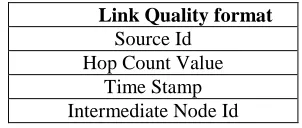
Link Quality format Source Id
[image:4.612.341.492.450.514.2]Hop Count Value Time Stamp Intermediate Node Id
Figure 2: Link Quality Format
4. RESULTS AND DISCUSSION
Figure 3: Number of Hops to Destination
[image:5.612.323.521.168.345.2]It is observed from the Figure 3 that the hop count for link quality DSR is higher than the DSR, as routes with better links are selected for the route to destination.
Figure 4: Number of retransmissions
[image:5.612.101.287.314.457.2]
Figure 4 shows the number of retransmissions done by DSR and link quality based DSR. It is observed that the link quality based DSR requires less transmission. This is due to the goodness of the routes selected based on link quality, the success of transmission on data is high, leading to less number of retransmissions.
Figure 5: Average Time Delay
Though the number of hop count increases in link quality based DSR, the average time delay is considerably reduced as seen in Figure 5. The quality of routing is improved due to better routes with good links leading to reduced delay in transmission.
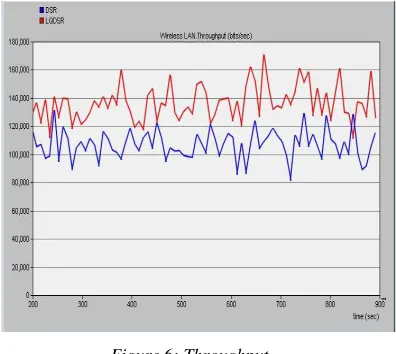
Figure 6: Throughput
As observed in Figure 6, the throughput of the link quality based DSR is significantly higher than that of the DSR. The successful transmission of packets and reduced time delay results in higher throughput in the network.
5. CONCLUSION
Most current ad hoc routing protocols design is based on minimum hop count for path selection. A routing algorithm chooses better paths by considering wireless links quality. This paper implements a dynamic source routing method to evaluate link quality metric’s performance. Link quality based on received power, hop count, Per-hop Round Trip Time (RTT) and Per-Per-hop Packet Pair Delay (PktPair) are considered. Simulations evaluate hop number to destination, retransmissions number, average time delay and throughput. Results demonstrate that the link quality based DSR performs better than the DSR.
REFRENCES
[1] Goyal, P., Parmar, V., & Rishi, R. (2011).
[image:5.612.101.299.572.706.2][2] Şen, S., Clark, J. A., &Tapiador, J. E. (2010). Power-aware intrusion detection in mobile ad hoc networks. In Ad hoc networks (pp. 224-239). Springer Berlin Heidelberg
[3] Du, X., & Zhao, Z. (2010). A Group Key Agree
Management Scheme for
MANET. International Journal of Nonlinear Science, 10(1), 77-81.
[4] Agrawal, A., Paulus, R., Jaiswal, A. K., &
Singh, A. Performance Comparison of Routing Protocols Based on Different Models in Mobile Adhoc Network.
[5] V. D. Park and M. S. Corson. A highly adaptive
distributed routing algorithm for mobile wireless networks. In INFOCOM, Apr 1997.
[6] C. E. Perkins and P. Bhagwat. Highly dynamic
destination-sequenced distance vector routing (dsdv) for mobile computeres. In SIGCOMM, Sep. 1994.
[7] D. De Couto, D. Aguayo, J. Bicket, and R.
Morris. High-throughput path metric for multi-hop wireless routing. In MOBICOM, Sep 2003
[8] Sharvani, G. S., & Cauvery, N. K. (2009).
ADAPTIVE ROUTING ALGORITHM FOR MANET: TERMITE 1.
[9] Kaur, R., &Rai, M. K. (2012). A Novel Review
on Routing Protocols in
MANETs. Undergraduate Academic Research Journal (UARJ), ISSN, 2278-1129.
[10]Johnson, D. B., Maltz, D. A., &Broch, J.
(2001). DSR: The dynamic source routing protocol for multi-hop wireless ad hoc networks. Ad hoc networking, 5, 139-172.
[11]Rawat, A., Vyavahare, P. D., &Ramani, A. K.
(2007). Enhanced DSR for MANET with
improved secured route discovery and
QoS. Department of Electronics and
Telecommunication Engineering, Shri GS
Institute of Technology and Science, India School of Computer Science, DAVV, Khandwa Road Campus, India.
[12] Sharma, P., Kohli, S., &Sinha, A. K. Decision Support System (DSS) For DSR in MANET Using Fuzzyfied ANN. Simulation, 150(160), 170.
[13] Gaertner, G., ONuallain, E., Butterly, A.,
Singh, K., & Cahill, V. (2004, January). 802.11 link quality and its prediction–an experimental
study. InPersonal Wireless
Communications (pp. 147-163). Springer Berlin Heidelberg.
[14] Farkas, K., Hossmann, T., Ruf, L., &Plattner, B. (2006, October). Pattern matching based link
quality prediction in wireless mobile ad hoc networks. InProceedings of the 9th ACM international symposium on Modeling analysis and simulation of wireless and mobile systems (pp. 239-246). ACM.
[15] Hsu, J., Bhatia, S., Takai, M., Bagrodia, R., & Acriche, M. J. (2003, October). Performance of mobile ad hoc networking routing protocols in realistic scenarios. In Military Communications Conference, 2003. MILCOM'03. 2003 IEEE (Vol. 2, pp. 1268-1273). IEEE.
[16] Savola, P. DSR: dynamic source
routing. CSC/FUNET, Helsinki University of Technology.
[17] Johnson, D. B., &Maltz, D. A. (1996).
Dynamic source routing in ad hoc wireless
networks. Kluwer International Series in
Engineering and Computer Science, 153-179.
[18] Biswal, S., Mohanty, S., & Seth, D. (2011).
Study of DSR Routing protocol in Mobile Adhoc network. In International Conference on Information and Network Technology, IACSIT Press, Singapore, IPCSIT (Vol. 4).
[19] A. Adya, P. Bahl, J. Padhye, A. Wolman, and