ISSN: 1992-8645 www.jatit.org E-ISSN: 1817-3195
353
A NON-BLIND ROBUST WATERMARKING APPROACH
FOR 3D MESH MODELS
1OLA M. EL ZEIN, 2LAMIAA M. EL BAKRAWY, 3NEVEEN I. GHALI
1, 2, 3
Al-Azhar University, Faculty of Science, Cairo, Egypt
E-mail: 1dr [email protected], [email protected], [email protected]
ABSTRACT
This paper presents non-blind and robust watermarking approach for three-dimensional (3D) mesh models using K-means clustering technique. K-means clustering technique is used to cluster 3D mesh vertices into suitable or non-suitable watermark carrier based on feature vector. Then the watermark is inserted in the selected vertices for being carrier watermark that come out from K-means clustering technique and the other vertices are ignored. The watermark insertion is done by modifying the vertex position without causing perceptible distortion to 3D mesh models. Experimental results show that our watermarking approach is imperceptible and robust against different geometric attacks such as noise addition, cropping and mesh smoothing.
Keywords:Digital Watermarking, K-Means Clustering Technique, 3D Mesh, Feature Vector, 1-Ring Neighborhood
1. INTRODUCTION
Due to the rapid growth of internet that allows us to copy, modify, store and distribute digital data without any effort such as electronic documents, images, sounds, videos and 3D meshes or models, there is a strong need for presenting techniques for copyright protection of various multimedia contents and prevent unauthorized use or illegal distribution of data.
Recently, 3D meshes are greatly used in many applications such as industrial, medical and entertainment [1]. Therefore, copyright protection for 3D meshes is an important issue.
Digital watermarking is considered an efficient solution to solve the arising problem, which can be used to embed some hidden messages or information into the digital media. This information can be used to prove ownership, identify a thief person [1-3].
According to the application purposes, watermarking techniques can be divided into robust and fragile watermarks. Robust watermarks are used for the copyright protection and prepared to withstand any tries to clear or damage the watermark. In contrast, fragile watermarks are used for integrity content, localization of modification and prepared to detect the slightest modify to the document [4-6].
There are two types of 3D mesh watermarking algorithms, spatial domain method and frequency or transform domain method [7, 8, 9]. The spatial
domain method embeds the watermark by directly changing or modifying the mesh geometry or connectivity, while the frequency domain method embeds the watermark by modifying the frequency domain coefficients after mesh transformation [10]. In the first type, the embedding process is often easier and faster than in the second type, but the embedded watermark is less imperceptible and robust for the operations of 3D meshes. However, the watermarking process in the second type is more complex and slower than the first type because of the need to transform and inverse transform [8].
Relying on the extraction method, watermarking algorithms are separated into blind and non-blind. A blind watermark needs only the secret key in the extraction stage and not needs the original model, but non-blind watermark needs the secret key and original model in the extraction stage. However, the non-blind watermark generally is more robust than blind watermark [1, 2, 11].
ISSN: 1992-8645 www.jatit.org E-ISSN: 1817-3195
354
transforms, simplification and subdivision
operations. Blind hierarchical watermarking
framework for semi-regular meshes is reported by Wang et al in [13]. A robust watermark and a high-capacity watermark are embedded in different resolution levels of the wavelet decomposition of a mesh by changing the norms of wavelet coefficients. Both watermarks are blind and withstand to similarity transformations. Cai et al in [14] proposed a robust blind watermarking scheme for 3D mesh models using Octree partition. RGB watermark image is inserted into the lowest level space of Octree structure. This method is robust against geometric transformation (such as translation, rotation, uniform scaling) and vertex reordering attacks. Soliman et al in [15] introduced a blind and robust 3D mesh watermarking approach by converting the original mesh into a multi-resolution format, composing of a coarse base mesh and a sequence of refinement. The watermark bits are embedded through progressive mesh level of details and extracted at refinement stage without any need for the original model. The watermark is inserted in the marked vertices that come out from Self Organization Maps (SOM) clustering neural network by modifying the vertex value with respect to the mean and standard deviation of its immediate neighbors in the original 3D mesh. This algorithm is robust against attacks such as mesh smoothing, noise addition and mesh cropping.
In contrast, Benedens et al in [16, 17] presented a non-blind watermarking approaches. They used modification of normal distribution to invisibly store information in the geometry of the model. A watermark is inserted in the frequency domain, coarse mesh, mesh spectral domain, spherical domain or vertex normals. A Non-blind spatial domain method for watermarking of 3D models is presented by Motwani and Harris in [18]. The mesh vertices are labeled into (low, moderate and high) regions based on local smooth variation of a model. The watermark is inserted in the moderate vertices by modifying the location of vertices with minimal distortion. Wang et al in [19] proposed a non-blind robust watermarking algorithm for 3D Models. The Cartesian coordinates of 3D model vertices are converted into spherical coordinates. All vertices are divided and sorted by angles, and then vertex sets for watermark inserting are built. The watermark is inserted by modifying the vertex norms. The watermarking algorithm is robust against various attacks such as translation, rotation, uniform scaling, vertex reordering, noise, simplification, cropping, quantization, smoothing, subdivision and their combined attacks.
This paper introduces non-blind and robust 3D mesh watermarking approach using k-means clustering technique.
In this work, we use k-means to cluster vertices into appropriate or inappropriate choices for carrier watermarks based on the feature vector. Then the watermark is inserted in the appropriate vertices.
The remainder of this paper is organized as follows: Brief introduction of k-means clustering technique, 3D mesh and feature vector are respectively introduced in Section 2.
The proposed approach including insertion and extraction of watermark is presented in Section 3. Results of the experiments and comparison are shown and discussed in Section 4. Finally, Section 5 concludes the paper.
2. AN OVERVIEW
2.1 K-Means Clustering Technique
Clustering is the process of gathering a set of data objects into classes or clusters so that objects inside the cluster are similar to each other but different from the objects in other clusters [20]. One of the clustering processes that reduce the clustering error is the k-means algorithm.
K-means is one of the simplest unsupervised learning algorithms that is used to divide the input dataset into k clusters. Each cluster is represented by changing centroid (also called cluster centre), starting from some initial values named seed-points. K-Means determines the distances between the inputs (data objects) and centroids, and assigns values to the closest centroid [21].
2.2 3D Mesh
A mesh is a group of polygonal facets, aimed to set up a suitable approximation of a real 3D object. It has three various elements: vertices, edges and faces. The vertices represent the models location and orientation in space, whereas edges connect the vertices to form faces, which in turn approximate the surface. Mathematically, 3D mesh including N vertices and M edges.
Each vertex element Vi is numbered by an index i
and is described by its three-dimensional Cartesian coordinates (Xi; Yi; Zi) [1].
The set of all vertices that connected or neighbors to a vertex
Vi is called 1-ring of the vertex. The set of all
ISSN: 1992-8645 www.jatit.org E-ISSN: 1817-3195
355 along with the set of their 1-ring neighbors is called 2-ring of the vertex. The number of vertices that
connect to vertex Vi in its 1-ring neighborhood is the
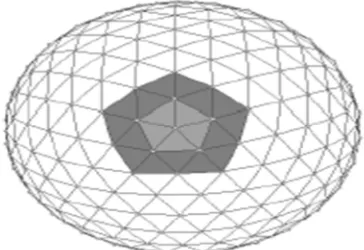
valence or degree of the vertex Vi. Fig.1 shows a
[image:3.612.112.294.179.304.2]vertex of valence 5 in (1-ring) and vertices of valence 5 and 6 in (the 2-ring) [22].
Figure 1: Vertex of Valence 5 In (1-Ring) Described By Light Gray and Vertices of Valence 5 and 6 In (The
2-Ring) Described By Light and Dark Gray
2.3 Feature Vector
In our work, we used the angle variation between surface normals and the average normal corresponding to a vertex to obtain the local smoothness measure for the model. Feature vector is a group of angles deduced by calculating the orientation of the surface normal to the average normal of the triangular faces that shape a 1-ring neighborhood for a vertex as shown in Fig.2. This feature vector represents the curvature of the 1-ring vertex neighborhood and the length of the feature vector is equal to the valence of the vertex [23]. In this work we deal with vertices of valence 6 since most of
3D meshes have valence 6.
Figure 2: Surface Normals (In Red) And Average Normal (In Blue) For a 1-Ring Vertex Neighborhood of Valance 6.
The steps for finding the feature vector for vertices of valence 6 are:
Step 1: Compute normals ni to each face which is
formed by V and its neighboring vertices.
n= ∑ (1)
Step 2: Find the average n of all the above normals passing through the vertex V.
Where, m is the number of its neighbor faces to a
vertex V.
Step 3: Compute the angles between the surface
normal ni and average normal n, Feature vector F =
(α1; α2; α3; α4; α5; α6).
αi=cos | || |. ) (2)
3. THE PROPOSED APPROACH
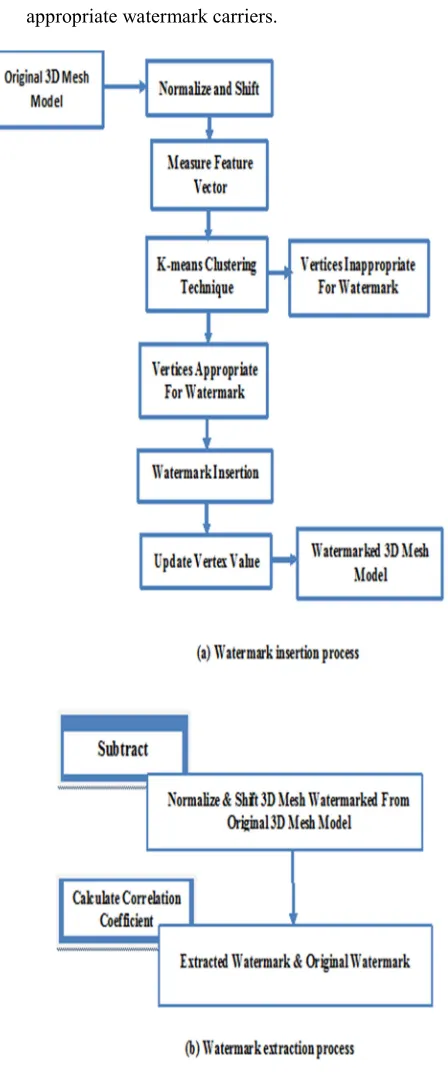
In this section, we explain the proposed approach of 3DWatermarking. It contains three steps as shown in Fig.3. The first step, clustering vertices into appropriate and inappropriate chooses for
carrier watermark using k-means clustering
technique based on the feature vector. The second step, the insertion process of watermark that inserts a random watermark bits in the selected locations. The third step, the extraction process that passes the same steps of insertion on the receive side.
3.1 Clustering Vertices Using K-Means Technique
We use k-means to cluster the 3D mesh vertices into appropriate and inappropriate carrier watermark based on the feature vector. As shown from previous, we used angle variation between
surface normals and the average normal
ISSN: 1992-8645 www.jatit.org E-ISSN: 1817-3195
[image:4.612.77.301.103.641.2]356 and low cluster and take the medium cluster to be appropriate watermark carriers.
Figure 3: The Proposed 3D Mesh Watermarking Approach
3.2 Insertion of Watermark
We insert a random real numbers sequence W (the watermark data) in the appropriate vertices which have medium value that output from the
clustering technique according to the following equation.
V '(x, y, z) = V(x, y, z) + S *W (3)
Where, V' is the watermarked vertex, V is the original vertex,
S is the scaling factor and W is the watermark bits.
3.3 Extraction of Watermark
To extract the watermark bits from the attacked 3D model, we need the original 3D model and the location of the marked vertices. Therefore, our proposed approach is considered as non-blind watermark. The vertex difference between the watermarked model and the original model will give the watermarked inserted, extracting watermark bits according to the following equation:
W = V '( x, y, z) - V(x, y, z)/S (4)
The correlation coefficient is used to measure the similarity between the original and the extracted watermark [15]. The value of the correlation
coefficient r is a number between -1
and +1 and is
evaluated by the following equation.
r = ∑ ∗ ∗
∑ ∗ ∗ ∑ (5)
Where ∗ and denote respectively the averages of
the extracted watermark bit sequence ∗ and the
inserted watermark bit sequence .
4. EXPERIMENTAL RESULTS AND COMPARISON
The proposed method is implemented in MATLAB R2014a, and has been tested on several 3D mesh models. Fig.4 illustrates five of them:
Bunny, Hand, Dragon, Venus and Rabbit
respectively. The five 3D mesh models with their number of vertices, faces and the number of vertices marked by K-means that appropriate to be watermark carriers are shown in Table 1.
ISSN: 1992-8645 www.jatit.org E-ISSN: 1817-3195
357
Figure 4: Original 3D Mesh Models
Table 1: The Description of 3D Mesh Models
Models No. of
vertices
No. of faces
No. of appropriate WM carriers
vertices
Bunny 34,835 69,666 6,926
Hand 36,619 72,958 6,087
Dragon 50,000 100,000 4,346
Venus 100,759 201,514 11,627
Rabbit 70,658 141,312 20,347
4.1 Evaluation of Imperceptibility
The first desirable advantage of a watermarking method is the imperceptibility of the watermark [25]. Therefore, after inserting the watermark bits in the original models, we need to measure the perceptibility of the watermark to achieve the imperceptibility of the watermarking method. The quality of the watermarked models is measured by Vertex Signal-to-Noise Ratio (VSNR) which determines the visual difference between the original and the watermarked models. VSNR can be calculated as follows [26]:
SNR = ∑" # ∑"∗ ∗! ! !∗ $
(6)
Where N is the number of vertices in the 1-ring neighborhood of the centre vertex including the centre vertex, (%,& , () and (%∗, &∗, (∗ are the
Cartesian coordinates of the vertex Vi before and
after the watermark inserting, respectively.
V SNR = 20log + ,-.) (7)
As shown in Table 2, our proposed method gives the highest value of VSNR compared to the method proposed by [24] after inserting 64, 128 binary bits
watermark respectively. It means that the
watermarked images of our proposed method have better image
Table 2: The VSNR Values for Each Model
Mesh Models
Proposed method Soliman’s method
64 bit WM
128 bit WM
64 bit WM
128 bit WM
Bunny 141.86 135.93 106.73 104.56
Hand 144.02 138.08 120.08 114.49
Dragon 146.96 141.03 118.37 112.37
Venus 157.37 151.43 135.53 129.69
Rabbit 147.44 141.50 135.69 127.24
4.2 Evaluation of Robustness
A watermarking method must be able to resistant the malicious or non-malicious attacks. To prove the robustness of the proposed watermarking method, we apply a set of different attacks on the watermarked models such as:
1) Similarity Transformations: Includes translation, rotation and uniform scaling. Our algorithm is invariant to similarity transformations attacks since the model is normalized before insertion the watermark.
2) Noise attack: we add a random noise to the watermarked model with different noise level (sigma) varies from (S=0.1%, 0.3%, 0.5% to 0.9%).
3) Cropping attack: we remove some of vertices from the watermarked model with different level of cropping (C=10%, 50%, 70%).
4) Smoothing attack: we apply the laplacian smoothing on the watermarked model with (relaxation ʎ = 0.1 and iteration Itt=5).
ISSN: 1992-8645 www.jatit.org E-ISSN: 1817-3195
358
Table 3: Evaluation of Robustness against Additive Noise Attacks
Models S Proposed
method
Soliman's method
Bunny 0.1%
0.3% 0.5% 0.9% 0.945 0.803 0.721 0.527 0.774 0.770 0.653 0.506
Hand 0.1%
0.3% 0.5% 0.9% 0.969 0.848 0.703 0.505 0.864 0.859 0.688 0.432 Dragon 0.1%
0.3% 0.5% 0.9% 0.968 0.842 0.771 0.537 0.949 0.927 0.726 0.449
Venus 0.1%
0.3% 0.5% 0.9% 0.978 0.867 0.737 0.633 0.964 0.941 0.715 0.441
Rabbit 0.1%
0.3% 0.5% 0.9% 0.978 0.871 0.747 0.586 0.927 0.893 0.646 0.380
The results simulated in Table 4 demonstrate that the proposed method is robust against different degrees of cropping attacks and outperformed the compared method.
Table 4: Evaluation of Robustness against Cropping Attacks
Models C% Proposed
method
Soliman's method
Bunny 10%
50% 70% 0.994 0.790 0.789 0.851 0.660 0.527
Hand 10%
50% 70% 0.995 0.966 0.139 0.969 0.969 0.385
Dragon 10%
50% 70% 0.891 0.806 0.739 0.700 0.353 0.173
Venus 10%
50% 70% 0.975 0.959 0.613 0.686 0.016 0.016
Rabbit 10%
50% 70% 0.994 0.993 0.371 0.659 0.472 0.243
In Table 5, the proposed methods achieve high results in resisting smoothing attacks at iteration 5 compared with the proposed method.
Table 5: Evaluation of Robustness against Smoothing Attacks
Models Itt Proposed
method
Soliman's method
Bunny 5 0.940 0.968
Hand 5 0.951 0.939
Dragon 5 0.929 0.910
Venus 5 0.947 0.910
Rabbit 5 0.991 0.728
5. CONCLUSION
In this paper, a robust non-blind 3D mesh watermarking algorithm is proposed. It depends on selection of suitable vertices from the 3D mesh model by using K-means clustering technique without causing perceptible distortion. The 3D mesh model is watermarked by modifying the vertices which are used as
candidates for watermark carriers. Our watermarking algorithm is robust against different geometric attacks like noise addition, cropping and mesh smoothing. It also maintains high results of imperceptibility.
REFERENCES:
[1] K. Wanga, G. Lavouea, F. Denisb and A. Baskurta, "A Comprehensive Survey On Three
Dimensional Mesh Watermarkin", IEEE
Transactions on Multimedia, Vol. 10,
December 2008, pp. 1513-1527.
[2] K. Wanga, G. Lavouea, F. Denisb and A.
Baskurta, "Robust and blind mesh
watermarking based on volume moments", Computers and Graphics, vol. 35, No. 1, 2011, pp. 1-19.
[3] Peng F, Guo RS, Li CT and Long M."A
Semi-Fragile Watermarking Algorithm For
Authenticating 2D CAD Engineering Graphics
Based On Log-Polar Transformation",
Computer-Aided Design, Vol. 42, No. 12, 2010, pp. 1207-1216.
[4] C.M. Chou and D.C. Tseng, " Technologies for 3D Model Watermarking: A Survey", IJCSNS International Journal of Computer Science and Network Security, Vol. 7, No. 2, February 2007, pp. 1-7.
ISSN: 1992-8645 www.jatit.org E-ISSN: 1817-3195
359 [6] M. Motwani, R. Motwani and F. Harris, Jr, "
Fragile Watermarking of 3D Models Using Genetic Algorithms", Journal Of Electronic Science And Technology, Vol. 8, No. 3, Sep 2010, pp. 244-250.
[7] M. Hachani, A. Ouled zaid and W. Puech, "Robust Mesh Data Hiding Based On Irregular
wavelet Transform", European Signal
Processing Conference, Vol. 12, No. 1, July 2013, pp. l-5.
[8] T. Harte and A. G. Bors, "Watermarking 3D Models", Processing of IEEE International Conference on Image Processing, Vol. 3, June 2002, pp. 661-664.
[9] L. Li, D. Zhang, Z. Pan, J. Shi, K. Zhou, and K. Ye, "Watermarking 3D mesh by spherical parameterization", Computers and Graphics, Vol. 28, No. 6, December 2004, pp. 981-989. [10] C. T. KUO, S. C. CHENG, D. C. WU and C. C.
CHANG, "A Blind Robust Watermarking Scheme for 3D Triangular Mesh Models Using 3D Edge Vertex Detection", Asian Journal of Health and Information Sciences, Vol. 4, No. 1, 2009, pp. 36-63.
[11] X. Feng and Y. Liu. "A Robust, Blind and Imperceptible Watermarking of 3D Mesh Models Base on Redundancy Information", International Journal Of Digital Content Technology and Its Applications (JDCTA), Vol. 6, No. 2, February 2012, pp. 172-179. [12] J. Cho, R. Prost and H. Jung,"An Oblivious
Watermarking for 3-D Polygonal Meshes Using Distribution of Vertex Norms", IEEE Transactions On Signal Processing, Vol. 55, No. 1, January 2007, pp. 142-155.
[13] K. Wang, G. Lavoue, F. Denis and A. Baskurt, "Hierarchical Blind Watermarking of 3D Triangular Meshes", Multimedia and Expo, 2007 IEEE International Conference on, July 2007, pp. 1235-1238
[14] S. Cai and X. Shen, "OTP-W: Octree Partition-based 3D Mesh Watermarking", IEEE, Education Technology and Computer Science (ETCS), 2010 Second International Workshop on, Vol. 3, March 2010, pp. 19-22.
[15] M.M. Soliman, A,E. Hassanien and H.M. Onsi, "A Blind robust Watermarking Scheme based on Progressive Mesh and Self Organization Maps", SecNet 2013, CCIS 381, 2013, pp. 131-142.
[16] O. Benedens, "Geometry-based watermarking of 3d models", IEEE Comput. Graph. Appl, Vol. 19, No. 1, 1999, pp.46-55.
[17] O. Benedens and C. Busch., "Toward blind detection of robust watermarking in polygonal
models", Comput. Graph, Vol. 19, No. 3, 2000, pp. 199- 208.
[18] R. Motwani and F. Harris, "Robust 3D
watermarking using vertex smoothness
measure", in International Conference on Image Processing, Computer Vision and Pattern Recognition, July 2009, pp. 287-293. [19] X. Wang, Y. zhan and S. Du., "A Non-blind
Robust Watermarking Scheme for 3D Models
in Spatial Domain", Springer Berlin
Heidelberg, Vol. 98, 2011, pp. 621-628. [20] H.-S. Park, C.-H. Jun,"A simple and fast
algorithm for K medoids clustering", .Expert Systems with Applications, Vol. 36, 2009, pp .3336-3341.
[21] N. K. Kaur, U.Kaur and Dr.D. Singh, "K-Medoid Clustering Algorithm A Review", International Journal of Computer Application and Technology (IJCAT), Vol. 1 Issue 1, ISSN: 2349-1841, April 2014, pp. 42-45. [22] M.C. Motwani, "Third Generation 3D
Watermarking: Applied Computational
Intelligence Techniques", A dissertation
submitted in partial fulfillment of the requirements for the degree of Doctor of
Philosophy in Computer Science and
Engineering, July 2011.
[23] R.C. Motwani, M.C. Motwani, F.C. Harris and
B.D. Bryant, "Watermark Embedded
Optimization for 3D Mesh Objects using Classification Based Approach", International
Conference on Signal Acquisition and
Processing, DOI 10.1109/ICSAP.2010.83,
2010, pp. 128-129.
[24] M.M. Soliman, A,E. Hassanien and H.M. Onsi, "A blind 3D watermarking approach for 3D Mesh using Clustering Based Methods", International Journal of Computer Vision and Image Processing, Vol. 3, No. 2, April-June 2013, pp. 43- 53.
[25] Y. Yang and I. Ivrissimtzis, "Polygonal mesh watermarking using Laplacian coordinates",
Eurographics Symposium on Geometry
Processing 2010 Olga Sorkine and Bruno Lvy (Guest Editors), Vol. 29, No. 5, 2010, pp. 1-9. [26] M.M. Soliman, A,E. Hassanien and H.M. Onsi.