R E S E A R C H
Open Access
Surgeons
’
and methodologists
’
perceptions
of utilising an expertise-based randomised
controlled trial design: a qualitative study
Jonathan A. Cook
1,2*, Marion K. Campbell
3, Katie Gillies
3and Zoë Skea
3Abstract
Background:Randomised controlled trials (RCTs) are widely recognised to be the most rigorous way to test new and emerging clinical interventions. When the interventions under study are two different surgical procedures, however, surgeons are required to be trained and sufficiently proficient in the different surgical approaches to take part in such a trial. It is often the case that even where surgeons can perform both trial surgical procedures, they have a preference and/or have more expertise in one of the procedures. The expertise-based trial design, where participating surgeons only provide the procedure in which they have appropriate expertise, has been proposed to overcome this problem. When expertise-based designs should be best used remains unclear; such approaches may be more suited to addressing specific questions. The aim of this qualitative study was to improve understanding about the range of views that surgeons and methodologists have regarding the use of the expertise-based RCT design.
Methods:Twelve individual interviews with surgeons and methodologists with experience of surgical trials were conducted. Interviews were semi-structured and conducted face-to-face or by telephone. Interviews were audio-recorded, transcribed and analysed systematically using an interpretive approach.
Results:Both surgeons and methodologists saw potential advantages in the expertise-based design particularly in terms of surgeons’participation and in trials where the procedures being evaluated were significantly different. The main disadvantages identified were methodological (e.g. the potential for surgeons carrying out one of the trial procedure being systematically different) and operational (e.g. the need to‘transfer’patients between surgeons with potential consequences for the surgeon/patient relationship).
Conclusion:This study suggests that the expertise-based trial design has significant potential to increase surgeon participation in trials in some settings. In other settings the standard design was generally seen as the preferable design. Particularly suitable conditions for an expertise-based design include those where the surgical procedures under evaluation are substantially different, where they are routinely delivered by different health professionals/surgeons with clear proficiencies in each; and contexts in which a multiple-surgeon model is in use and trust between the patient and surgeons can be suitably protected. The standard design was seen by most participants as the default design. Several logistical and methodological concerns remain to be addressed before the expertise-based design is likely to be more widely adopted.
* Correspondence:[email protected]
1Centre for Statistics in Medicine, Nuffield Department of Orthopaedics,
Rheumatology and Musculoskeletal Sciences, University of Oxford, Windmill Rd, Oxford OX3 7LD, UK
2
Surgical Intervention Trials Unit, Nuffield Department of Orthopaedics, Rheumatology and Musculoskeletal Sciences, University of Oxford, Botnar Research Centre, Windmill Rd, Oxford OX3 7LD, UK
Full list of author information is available at the end of the article
Background
Randomised controlled trials (RCTs) are widely recog-nised to be the most rigorous way to test new and emer-ging clinical interventions. While many surgeons accept the need in principle for RCTs, some surgeons may be reluctant to participate in a standard RCT if they have to perform a surgical procedure in which they have less experience/believe is less effective than the alternative treatment in their hands. As surgery is a craft specialty, where training and skill is honed through practice, it is often the case that even where surgeons can perform both trial surgical procedures, they have a preference for, and/or have more expertise in, one procedure than the other. When the surgical procedures under evaluation differ substantially, surgeons may only routinely conduct one of the trial procedures. This creates a number of po-tential issues for surgeons participating in a RCT evalu-ating two surgical procedures; some surgeons may be less willing to participate if they will have to deliver an operation they are less comfortable with, they may be less willing to facilitate patient recruitment as they may be uncertain about the manner in which the procedure will be delivered, and where they do deliver the proced-ure they are less confidence in, they may be less likely to fully comply (i.e. there may be more conversions to the preferred procedure). Furthermore, the newer and less familiar procedure might be argued to not be assessed in its optimal form as they are learning the procedure dur-ing the runndur-ing of the trial.
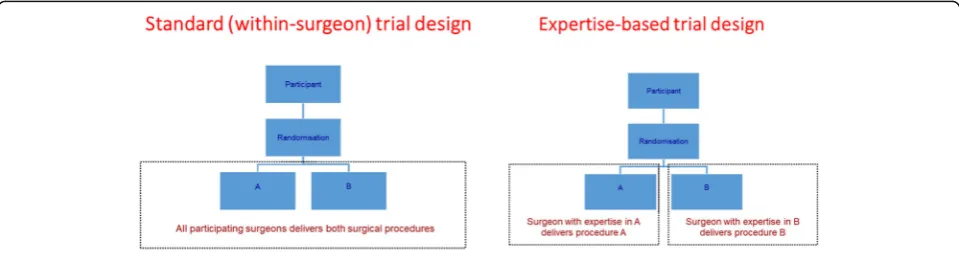
An expertise-based approach to trial design, where participating surgeons only provide the procedure in which they have greatest expertise has been proposed to overcome these problems [1]. This differs from a stand-ard two-arm RCT in which patients are randomly allo-cated to receive either intervention A or intervention B (see Fig.1). When the intervention under study is a new drug (and is being compared against a comparator drug or placebo) physicians generally require the same skill set to provide both interventions. However, when the in-terventions under study are two different surgical proce-dures, surgeons are required to be trained and to be
sufficiently proficient in the different surgical approaches to take part in such a trial–delivery of the interventions can be said to be within-surgeon. This is classed as the standard surgical RCT design. Under an expertise-based trial design, a patient is randomly allocated to receive a specific trial surgical procedure; the allocated procedure is then delivered by an expert in the specific surgical procedure. Participating surgeons are not required to de-liver both surgical procedures.
Purported benefits of the expertise-based design include increased surgeon participation and compliance with allo-cated intervention, addressing the learning curve effect along with desirability from a patient perspective in terms of the procedure being conducted by an ‘expert’ and ac-cording to the surgeon’s usual care and preference [1]. While such a design is not new [2], the profile of the design is increasing and its use appears to be becoming more common [3,4]. For some comparisons, such as surgery ver-sus non-operative management (e.g. surgical repair verver-sus physiotherapy for the management of a rotator cuff tear), where each intervention is carried out by a different health professional) an expertise-based trial design is often the de-fault design, although not typically termed as such. Expertise-based designs have, however, been criticised on a number of grounds and many methodological consider-ations have been highlighted (e.g. the impact upon sample size) [4]. In particular how‘expertise’should be defined can be variable but is clearly of critical importance. It is also un-clear under which circumstances the expertise-based design should be the design of choice [3,5–8].
The aim of this study, therefore, was to explore when the expertise-based approach would be considered an accept-able and feasible design. It examined the range of views that surgeons and methodologists have regarding the use of the expertise-based RCT design. Specific objectives were to ex-plore surgeons’and methodologists’ views on the accept-ability and use of expertise-based trial designs; and to explore the circumstances in which such a design could or should be used. To our knowledge this is the first study to explore in-depth views on the use of an expertise-based de-sign to compare surgical procedures.
[image:2.595.58.538.588.718.2]Methods
Study design
The choice of research method was informed by the aim and objectives. As this study aimed to explore in-depth surgeons’ and methodologists’ perspectives regarding an expertise-based trial design, the use of semi-structured in-terviews was considered the most appropriate method for capturing subjective meanings and experiences [9–11]. Qualitative methods aim to provide an in-depth under-standing by exploring and capturing phenomena from the perspective of those being studied, using methods that are sensitive to the study context. Qualitative methods are con-sidered especially suitable for exploring new topics and for obtaining insightful data on complex issues and have been successfully used previously in the context of surgical trials [12]. The COnsolidated criteria for REporting Qualitative research (COREQ) Checklist has been used to ensure com-pleteness of reporting items.
Recruitment, sampling and consent
Purposive (with respect to professional background, surgi-cal areas of familiarity and prior trial experience), and snowballing techniques [13, 14] were employed to derive the sample. Our final sample size was guided by the con-cept of data saturation. Initially, it was anticipated that be-tween 10 and 15 participants would be sufficient to identify a range of experiences and views. It was not intended for this project to be exhaustive in terms of all views on the topic. At least five methodologists and five surgeons, re-spectively, were sought. Methodologists could come from any academic background but had to be involved in trial design in some way (e.g. statistician). No restriction was made on the surgical specialty. An initial list of potential participants was drawn up driven by knowledge of the sur-gical trial literature, personal involvement in sursur-gical trials and related research projects and networks. Initial contact was either by email or face to face followed by an email with invitation letter. Recruitment was focused on UK-based participants to an extent driven by convenience and a preference for face-to-face interviewing and primary interest in the UK clinical setting. Participants were asked to suggest suitable names of further individuals who might be willing to participate. All participants gave written con-sent before participating in interviews. Some of the partici-pants were personally known to the lead researcher prior to study conduct.
Data collection
Interviews with surgeons and methodologists were con-ducted by one researcher (JAC) who had undergone formal training in qualitative methods (interviewing and analysis) and who had also received mentoring from experienced qualitative researchers. The inter-viewer has a background in trials methodology, was a
senior trial statistician, and had been involved in de-signing and conducting surgical trials for 10 years post PhD. Interviews explored individual views about expertise-based designs and what role (if any) they saw for the design versus the standard within-surgeon ap-proach. A topic guide was developed prior to the first interview and it was used to facilitate the interview conversations. It included specific questions tailored to methodologists, trial principal investigators and sur-geons, respectively (Additional file 1). Opinions were sought on issues such as the ethics, practicality of the design, including whether they varied according to clin-ical area and research questions. Views regarding ac-ceptability in the surgical community and influence of setting (e.g. NHS) were addressed. For surgeons, will-ingness to participate in a study with an expertise-based design was explored and correspondingly for methodol-ogists, their willingness to use such a design.
Data analysis
Interviews were audio-recorded and transcribed verbatim (transcripts were checked only by the interviewer). The analytical approach was both systematic and interpretive and the analysis was guided by a framework approach [15]. The framework approach is not aligned with a par-ticular theoretical approach, but rather it is a flexible tool that can be adapted for use in qualitative studies that aim to generate themes inductively from data. A constant comparison approach was used to identify convergences and divergences across the data. Three authors (JAC, KG and ZS) familiarised themselves with the dataset and fol-lowing initial familiarisation and group discussions, devel-oped a coding framework based on a priori questions and emergent themes. Initial codes from this framework were systematically applied to the data. Data management and initial analytic coding was facilitated by the use of NVivo 10 software. The primary focus during the analysis was guided by the study aims set out in the protocol. During analysis, particular attention was paid to: the types of judgement and beliefs participants expressed in relation to expertise-based trial designs; personal willingness to use/ participate in such a study, perceived advantages and dis-advantages, practicalities and views of surgical community and patients. The analysis was finalised without any fur-ther input from the interviewees.
Results
Sample characteristics
Eight were face to face (all in a research building setting) and four were by telephone with only the interviewer and the interviewee present. Of the 12 interviewees, eight were surgeons (S1–S8), four were methodologists (M1–3,5) (and one of the surgeons, S2, was also engaged in methodo-logical research, indicated by M4). The surgeons were all (except for one registrar) consultants in the UK NHS; al-most all of the surgeons worked at a teaching hospital. All 12 had experience of being involved in multicentre surgical trials and five had been the lead researcher (i.e. chief/princi-pal investigator) of a randomised trial and were UK-based though some had worked in other countries. Three of the 12 participants were women, ages ranged from approxi-mately 30 to 60 years old, and a number of participants were known by the interviewer prior to the interview through various professional connections. Most of the sur-geons and methodologists had personally been involved in an expertise-based trial. Levels of clinical and research ex-perience amongst the surgeons varied though most were of a senior professional level (consultant with substantial man-agerial responsibilities at clinical and/or academically and had been involved in multiple surgical RCTs) and reflected a range of surgical specialties. Methodologists were mostly very experienced in terms of professional track record (number of projects and publications).
General views of an expertise-based trial design
Both the surgeons and the methodologists (with the ex-ception of one surgeon who was noticeably more scep-tical) expressed generally positive views regarding the potential of an expertise-based trial design. All the sur-geons stated a willingness to be involved in principle with a trial with both expertise-based and standard designs. Methodologists were perhaps more agnostic in terms of its value but open to its use in particular situations:
‘You could imagine that there are different levels of expertise related to the two procedures, and what would provide a, you know, a fair comparison is I guess what we’re talking about.’M1
Some methodologists expressed an explicit preference for running with a standard design if there was not a compel-ling argument to change:
‘I would go with the standard design because I think it – why make life more difficult than you have to?’ M3
‘But in some ways I still think you would start with (a standard design), could anybody be expert in both procedures at the same time, because it just takes out an extra potential factor that might bias your results, the surgeon being different.’M1
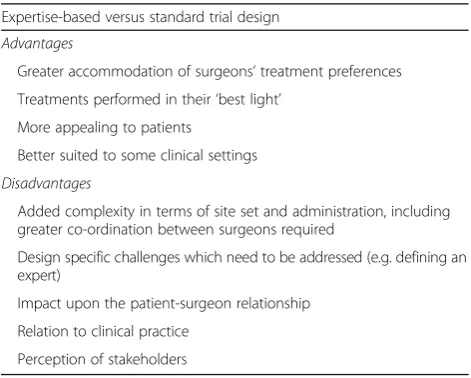
While acknowledging potential advantages, the potential downsides to the use of an expertise-based design were also raised by both surgeons and methodologists: which included a view that the standard within-surgeon design should be the default; that the expertise-based approach has additional potential for biased findings; and that deliv-ering only one procedure does not address all of the as-pects of the trial that may be problematic for a surgeon. The potential advantages and disadvantages of using an expertise-based trial design over a standard trial design mentioned by participants are summarised in Table1.
Potential advantages to an expertise-based design in practice
From the data it was apparent that interviewees identi-fied four main reasons why expertise-based trial designs might be perceived as being advantageous over more standard approaches. These related to perceptions that (a) surgeons tend to hold particular preferences for (and/or have particular skills in) certain procedures; (b) treatments should be performed in their ‘best light’ within trials; (c) the design could be appealing to pa-tients and (d) it could fit the clinical setting more appro-priately. These are discussed in turn below.
a) Surgeons’treatment preferences
[image:4.595.304.540.544.733.2]Firstly, several of those interviewed made the point that in principle expertise-based trial designs might prove more pragmatic and realistic compared with more standard approaches in the sense that surgeons very often have particular preferences for (and/or skills in) performing certain procedures – preferences and skills that expertise-based trials can usefully accommodate:
Table 1Participants’perceived potential advantages and disadvantages of an expertise-based versus a standard trial design
Expertise-based versus standard trial design
Advantages
Greater accommodation of surgeons’treatment preferences
Treatments performed in their‘best light’
More appealing to patients
Better suited to some clinical settings
Disadvantages
Added complexity in terms of site set and administration, including greater co-ordination between surgeons required
Design specific challenges which need to be addressed (e.g. defining an expert)
Impact upon the patient-surgeon relationship
Relation to clinical practice
(There can be)‘loads of different ways to do the same thing…we all have preferences and beliefs’. S6
‘Any RCT goes completely against the grain of being a surgeon. You’re a surgeon because you believe in something, you have an intervention to offer, you’re going to do your best to offer it, the best way you can.’S8
‘I just don’t want to be doing that arm of it (the arm in which the surgeon has less experience). I think, you know, you can encompass a broader group of people into it (an expertise-based design) and that has some clear advantages. And…the primary drive for the sur-geon is trying to do the best for the patient.’S6
The expertise-based design could be more attractive to surgeons with a strong preference for a particular oper-ation. It was stated that an expertise-based design could potentially help with‘buy in’(S7) from those with strong preferences, as long as the wider clinical team was will-ing to have ‘collective equipoise’– individually surgeons still get to do deliver what they wish to.
b) Treatments would be performed in their‘best light’
Secondly, interviewees suggested that any treatments being investigated within a clinical trial setting should in theory be tested in their‘best light’(M2) in order to reflect best practice–something that again expertise-based trials are designed to accommodate:
‘…you get the best person doing the operation for the patient... So you’re not forcing a randomisation to where there’s expertise imbalance, and you’re also getting the surgeon who is really comfortable doing that particular intervention’and, therefore, this design might be ‘more likely to show up a difference.’ M2
This idea was regarded by some as being particularly important for ensuring that crucial differences between procedures were not masked:
‘You probably are more likely to show differences between the two in that particular design (the expertise-based design), I suspect.’ M2
Surgeons who could only do one procedure could be involved in the study and, therefore, the results might also be more generalisable. This has a potential further advantage in terms of improving fidelity to al-location and avoiding ‘contamination’ (S5) between arms:
‘It is absolutely inevitable that the surgeons as they learn the new technique will change the way that they do their operations (specialising in one procedure).’S5
c) May be more appealing to patients
It was also suggested that it was plausible that there could be a positive impact upon patient accrual as get-ting treated by someone who is considered an ‘expert’ could be appealing to some patients:
‘That’s an area that I’m not sure. Whether their perception…treated by an expert would increase accrual or not, (and) make it easier for the study from the patient perspective.’M1
d) May be better suited to the clinical setting
In some settings doing only one operation might be practically and professionally more appealing as it can be scheduled on the same surgical list and operated on by the same surgeon.
‘I’m very happy doing X but very happy doing Y…. around the country in some units there are surgeons who don’t do Y, who just do X and they have colleagues in the same unit who do Y knees. And so to make it available to everyone, to buddy-up as a team is quite a good option.’S6
Disadvantages to an expertise-based design
Stated disadvantages of an expertise-based design were (a) the additional complexity in terms of set-up and re-cruitment; (b) the potential impact upon the patient-surgeon relationship; (c) how the model relates to clinical practice; and (d) potential negative percep-tions of key external stakeholders.
a) Added complexity
The complexity of the set up and administration be-yond a standard design was seen as the main drawback by surgeons and methodologists:
‘I just think because you’ve added complexities in terms of the recruiting of the patients.’(expertise-based more complicated over standard trial design) M5
point of view, and potentially getting people involved it sounds really good, but when you come to do it it’s not so straightforward.’M2
This included reorganising the lists in some settings and also the impact of surgical waiting times:
‘….waiting lists for surgeons are often very different, and then their timing and if you’re getting randomised to you know, an X, but the X (operation) surgeon’s waiting list and slots are different to the Y or the Z (operations), then you could have you know, you’re in less control because the surgeons are independent in many ways working, and so there, methodologically there are issues there.’M1
It was also noted that not having a team set up at sites could be problematic and also that certain set-tings, e.g. emergency procedure where there would only be one surgeon makes an expertise-based design more challenging:
‘I could certainly see in institutions where you don’t necessarily have (a team), it depends on the end relationship between colleagues and the
communications and the politics of the environment as to whether or not this sort of thing (setting up an expertise-based trial) was straightforward.’S4
In some settings, patients are not directed to a surgeon who could do the operation sooner even though that would be more efficient:
‘You will have a crazy situation where tomorrow the surgeon operating tomorrow hasn’t got cases, but the one who is not operating has got 20 patients waiting.’ S1
An expertise-based trial design was also noted to cre-ate another layer of complexity if the surgeon is involved in the recruitment and treatment pathway:
‘Whereas as soon as you start making it difficult and complicated for busy surgeons to take part in the trials, they just lose heart, and given the choice between doing a very well-paid commercial trial, or doing a more interesting but hard-work and financially unrewarding investigator-led academic trial, they’ll do the commercial activity.’S7
While a surgeon might be more willing to take part if they only deliver one operation they still have to consider how they would recruit someone to a study where they might get the other:
‘There is then the question about how they can recruit into that study if they think one of the arms is ridiculous. So they have to work out where they sit on that ethically.’S6
However, there was a perception that site set-up that is sensitive to the local situation, carried out with the expertise-based trial design in mind, and where there is a local willingness to modify processes for the trial can mitigate these added difficulties:
‘So when I go approach a unit I don’t approach an individual to come into a trial, I ask units to come into a trial.’S5
‘How they (the complexities of expertise-based designs) are successfully addressed depends on the will of the individuals involved, so if you’ve got very informed surgeons who are keen on the trial and want to do it, it’s relatively easy.’ M2
b) Impact upon the patient- surgeon relationship
A key challenge was perceived by most but not all surgeons to be the relationship between the patient and the surgeon which for elective operations begins when the patient initially discusses having surgery. The perception of one surgeon was that maintaining this link was clinically preferably but also important to patients:
‘And all of that bit about the decision making as to whether they would have the operation–any operation. And if that patient then goes on to see another surgeon to have the operation is there some loss of confidence in the fact that they’ve now got another person to deal with. So it slightly challenges the gold standard clinical care pathway…’S4
‘So if I were going to have a XXXX (operation), I would want to meet the surgeon beforehand. I’d want to have the operation, that guy helps in my shared decision. He does the operation, he follows me up and he looks after me if it goes wrong or if it does well.’ S4
Another interviewee noted that this had led to one of the surgeons dropping out of a previous expertise-based trial when they came to realise the implications regarding treat-ing a patient assessed for surgery by another surgeon.
this would need to be raised if undertaking a trial with an expertise-based design:
‘Not all patients may understand that not all surgeons can do all of the operations. And that in itself is an interesting concept that you have to be able to deal with and how patients would react to that.’S4
c) Relation to clinical practice
While acknowledging the potential advantages of adopt-ing expertise-based trial designs in principle, several inter-viewees made the point that in clinical practice, surgeons might be regularly providing different procedures, some of which they will be better or worse at performing than others. Therefore, one could argue that to be really prag-matic these types of trial designs might not be the best ap-proach and that more standard apap-proaches are likely to better reflect normal practice at least in some settings:
‘All surgeons can do both and I’m perfectly happy with that because that follows clinical practice.’S3
‘So I’m doing both operations and I’m fairly happy from all the discussions we’ve had when the trial was being initiated and started...’S6
d) Perception of stakeholders
It was noted by one surgeon that methodologists and funding panels were a barrier to conducting expertise-based trials as they were perceived to prefer the standard design:
‘So, and persuading methodologists and panels that actually those biases they are worried about are trivial compared to the real life of biases in treatment and persuading the funding committees that they need to ignore such concerns is, I think is a challenge.’ S5
A more general concern raised by surgeons and methodologists was that they wanted to be involved in studies that would change practice and influence key bodies:
‘The question is, what is going to be the evidence that expertise-led trials are going to produce, which are going to allow NICE, for example, to make recommendations?’ S8
‘And the other issue about it is I would want a trial where the results can be used in the real world, and it
worries me that if you have an expertise design that might limit its subsequent uptake of the
interventions.’S2/M4
When to use an expertise-based trial design
In discussing when, and in what circumstances, they would consider expertise-based designs to be appro-priate, interviewees stated that (1) study designs should be driven by the research question, (2) the ex-tent to which the treatment comparators are per-ceived as being different and (3) the willingness/ ability of surgeons to deliver both:
a) Study designs should be driven by the research question
Several interviewees made the observation that study designs should be driven by the nature of the research questions and that if it is considered to be the best de-sign from a methodological point of view then it should be used (regardless of whether it might not be as easy to implement as a standard RCT):
‘The main driver is that the question that was needing to be answered by the community was X (operation) versus Y (operation). But nobody, or almost no surgeon was prepared to do both procedures.’M1
b) The extent to which the treatment comparators are perceived as being different
Interviewees also argued that the appropriateness or otherwise of expertise-based designs is likely dependent on the nature of the comparison interventions. For ex-ample, if it is a specialist/risky procedure then an expertise-based design might be more appropriate, whereas some comparisons might not be so suitable – as would be the case where there were only minor differ-ences between procedures:
‘...(where the new procedure involves) little tweaks and way to do procedures, and in those cases I don’t think there is a role for an expertise-based trial in those settings.’M1
c) The willingness/ability of surgeons to deliver both
‘You know there are…surgeons who can do one procedure but they can’t do the other.’S3
‘...(if you have a surgeon that says)“Well I can only do one of these. I’ve always done it. I believe in it.”Then that’s your perfect expertise candidate.’S4
However, it was noted that if all surgeons were equally competent, then a standard trial design would be more appropriate:
‘So in the study they do both procedures, so they’re competent at both.’S7
‘All surgeons can do both and I’m perfectly happy with that because that follows clinical practice.’S3
Methodological challenges to delivering expertise-based trials
A number of methodological issues were raised which would need to be addressed when a expertise-based trial design is used which were (a) the task of defining expert-ise; and (b) the possibility of bias resulting from different surgeons and related statistical clustering of outcome. These could also be viewed as disadvantages in that they are additional challenges over using a standard design.
a) Defining who is an expert
Exactly how to define expertise was raised as a challen-ging methodological issue by most interviewed and by both methodologists and surgeons. For example, should it be judged by the grade of a physician or by the numbers of procedures performed? Some argued that this could prove problematic particularly as it was suggested that some surgeons have a tendency to inflate numbers of pro-cedures performed and/or deflate complications:
‘People inflate the numbers (of operations performed) and deflate their complications.’S2/M4
The point was also made that regularly performing procedures does not necessarily equate with someone being more skilled:
‘And some people get very good after 10, and other people it takes 40…’S2/M4
Finally, the potential pejorative connotation of the im-plied term ‘expert’ implied by the name expertise-based trial was noted by two surgeons, i.e. being only in one arm they were not‘expert’in the other arm.
b) Potential differences in surgical skill between surgeons in the randomised groups
Also raised was the potential for bias in the differences between surgeons that might lead to systematic differ-ences between the groups which are not purely due to the treatment:
‘But in some ways I still think you would start with, could anybody be expert in both procedures at the same time, because it just takes out an extra potential factor that might bias your results, the surgeon being different.’M1
If the surgeons carrying out one arm were systematic-ally different from the other arm this could lead to a difference being observed due to the surgeons and not the procedure.
An implication noted by multiple interviewees (sur-geons and methodologists) delivering the treatments was the potential impact of statistical clustering of outcome around surgeon (this is that the outcome of operations conducted by the same surgeon are more similar than those conducted by different surgeons). This can occur in an expertise-based trial and is akin to a cluster rando-mised trial:
‘Okay, we need to allow for the inter cluster
correlation of the operations within surgeon, that sort of thing, so there clearly has got to be some allowance for that in our calculations, from your trialists’ statistical point of view if you like. We had to address that particular aspect of it…’M3
Discussion
Summary of work
To our knowledge, this is the first in-depth qualitative study of surgeons’and methodologists’ attitudes to the use and conduct of expertise-based trials. It has helped to clarity the circumstances under which an expertise-based design could be identified as the design of choice and also revealed key insights into the perceived advan-tages and disadvanadvan-tages of the design.
When to use an expertise-based design
it reasonable to expect one individual to do both opera-tions–if not then an expertise-based trial might be pref-erable), and also who delivers each in practice (a team-based service delivery model lent itself more natur-ally to an expertise-based model). The participating sur-geons reflected a broader range (and generally more positive) set of views on the desirability of using an expertise-based design than the methodologists. The latter appeared to be more concerned about the potential disad-vantages of the design (e.g. differences in surgeons deliver-ing the respective trial surgical procedures) which they felt required to be offset. Benefit for the surgeon or their col-leagues (via greater continuity with their usual practice and preference) was perhaps more obvious to the former.
The expertise-based design was also seen as particu-larly useful in aiding situations where there might not be individual surgeon equipoise but rather where‘collective’ or professional equipoise was present. The importance of physicians and surgeons being able to continue to take part in randomised trials when community rather than individual equipoise is dominant has been dis-cussed widely in the literature [17] and the expertise-based design was viewed as particularly useful in this regard. This is consistent with the work of Devereux, Scholtes and colleagues [1, 18] who noted the particular strength of the expertise-based trial design in this regard. Such a benefit would not remove the generally challen-ging nature of recruiting to trials for clinicians with treatment preferences [19–21] as highlighted by a quali-tative study which considered surgical trials with both expertise-based and standard designs [22].
Advantages versus disadvantages of expertise-based versus other trial designs
A number of advantages were perceived with regards to the use of an expertise-based trial design. The potential attraction to surgeons of participating in a clinical trial while continuing to deliver surgery according to their preference was seen as particularly beneficial, and con-ducting the operation a surgeon was most comfortable with, experience in, and preferred was attractive. A num-ber of these issues have been raised in previous opinion pieces [1, 18] and surveys of orthopaedic, urogynaecolo-gical and vascular surgeons [6,7, 16] indicating that ex-pertise can vary between operations and that in some settings an expertise-based trial design might be more appealing to, and better supported by, surgeons.
Our findings also suggested that the expertise-based design may also have other perceived benefits for tients. It was suggested that it could be attractive to pa-tients enrolling within a trial that their surgeon would be an ‘expert’ in whatever procedure they were rando-mised to and would be delivering the procedure they were most comfortable with. However, others raised
concerns about whether this design might result in a po-tential breach of the interpersonal relationship between recruiting surgeon and patient if, as a consequence of enrolling a patient in the trial, they would then hand over their care to a different surgeon. The importance of trust between the participant and health professional has high saliency in the literature around decisions to par-ticipate in trials [23–26] and it is, therefore, important that any impact of an expertise-based design on this do-main is fully understood.
Further disadvantages noted by interview participants were the additional complexity of the site set-up requir-ing pairs or at least two sets, of surgeons to be available for the purposes of the trial. Previous expertise-based trials have been successfully conducted in a number of settings [3], though this has not always [27] been the case. However, it was suggested that is much easier in some settings or at least in these contexts this practical obstacle can be overcome [3]. The view that the likeli-hood of successful conduct is setting dependent was expressed by most of the interviewees in this study.
A number of methodological issues were raised includ-ing how to define expertise, the impact of the surgeon no longer being controlled for in the comparison, and the potential impact of clustering of outcome upon the required sample size. Administrative issues, such as the impact of the surgical waiting lists (that is substantial de-lays for receipt of surgery once its clinical need has been confirmed), or interacting with the health care system administration to schedule trial surgical procedures, was seen to be the most intractable problem where it was ap-plicable, as it required multiple stakeholders to engage in a timely manner. Other issues (communication be-tween surgeon’s delivering respective procedures) ap-peared to be thought of as solveable though potentially requiring more resources compared to an equivalent trial with a standard design. It is clear that these meth-odological issues require further investigation before the expertise-based design can be more widely adopted [28, 29]. More experience of conducting expertise-based tri-als in surgery is needed, along with in-depth evaluation of the impact upon set-up and delivery. Furthermore, critical evaluation of the practical implication of the dif-ferent designs for addressing surgical procedure research questions across a range of surgical specialties is needed. Additionally, further work exploring the patient perspec-tive on expertise-trial design would be beneficial.
Strengths and limitations
date regarding the potential use of some of the less com-mon trial designs and particularly their use in the surgi-cal context. This study also involved both surgeons and methodologists perspectives and included individuals from across a broad spectrum of practice which adds to the richness of the findings. The participants were also purposively chosen to have had experience of participat-ing in, or leadparticipat-ing, surgical trials. As such, our findparticipat-ings have been generated from an informed and experienced collective adding weight to the findings. This may, how-ever, consequently suggest that the views may be less typical of the wider surgical community though possible more so of the research active sub-community.
A potential limitation of the study was that the partici-pants were from the UK, which may limit the inter-national insights generated by our findings (and may unduly reflect the practical constraints observed within the UK NHS particular within specific specialities). However, given that the primary focus of the study was on trial design features (rather than on direct implemen-tation), many of the methodological issues raised will apply in all settings, e.g. the expertise-based design will need pairs, or two sets of surgeons to be available wher-ever that trial is conducted. A further limitation was the lead researcher’s relative lack of experience in using qualitative methods which may have limited the richness of the data collection. Furthermore, their understanding of both surgical trials and quantitative methodological concerns, while advantageous in terms of facilitating dis-cussion of some more technical issues, could have inad-vertently led to personal views being unconsciously transferred despite efforts taken to avoid this. The sam-ple was also relatively small; however, as it is depth ra-ther than breadth that is sought in qualitative studies, this sample size is not unusually so. Indeed, in terms of data saturation, we were satisfied that our sample size was appropriate and adequate for enabling us to suffi-ciently answer our research aims [13]. However, the study did not address patients’ perspectives which is a shortcoming, further studies to address this would be valuable.
Conclusion
This study has shown that the expertise-based trial de-sign is viewed as having de-significant potential to address known challenges with the design and conduct of surgi-cal trials and has the potential to increased surgeon par-ticipation in trials under certain circumstances. In other settings the standard design was generally seen as the preferable design. Particularly suitable conditions for an expertise-based design include those where the surgical procedures under evaluation are substantially different, where they are routinely delivered by different health professional/surgeons with clear proficiencies in each;
and contexts in which a multiple-surgeon model is oper-ating and the trust between the patient and surgeons can be suitably protected. The standard trial design was, however, seen by most participants as the default design. Several logistical and methodological concerns remain to be addressed before the expertise-based design is likely to be more widely adopted.
Additional file
Additional file 1:Topic guide–methodologists and surgeons. (DOCX 12 kb) Abbreviations
COREQ:COnsolidated criteria for REporting Qualitative research; NHS: National Health Service; RCT: Randomised Controlled Trial
Acknowledgements
The authors would like to acknowledge the interviewees for giving up the time to take part in the interviews and Sharon McCann for her guidance when setting up the study.
Funding
Jonathan Cook held a Medical Research Council (MRC) UK methodology (G1002292) fellowship which supported this study. Katie Gilles holds a MRC UK methodology fellowship (MR/L01193X/1). The Health Services Research Unit, Institute of Applied Health Sciences (University of Aberdeen), is core-funded by the Chief Scientist Office of the Scottish Government Health and Social Care Directorates. The funders had no involvement in study design, collection, analysis and interpretation of data, reporting or the decision to publish.
Availability of data and materials
The data files produced and analyses as part of this study are available upon reasonable request from the corresponding author.
Authors’contributions
JAC conceived of the idea along with MKC. JAC undertook all interviewees prepared the initial thematic analysis and drafted the initial version of the manuscript. ZS and KG undertook analysis of the interview data and contributed to the finalised thematic summary. All authors read and approved the final version of the manuscript.
Ethics approval and consent to participate
This study was approved by University of Aberdeen’s College of Life Sciences Ethics Review Board (CERB/2013/1/846). Informed consent was obtained from all participants.
Consent for publication
Consent for publishing the findings of the study was received.
Competing interests
The authors declare that they have no competing interests.
Publisher’s Note
Springer Nature remains neutral with regard to jurisdictional claims in published maps and institutional affiliations.
Author details
1Centre for Statistics in Medicine, Nuffield Department of Orthopaedics,
Rheumatology and Musculoskeletal Sciences, University of Oxford, Windmill Rd, Oxford OX3 7LD, UK.2Surgical Intervention Trials Unit, Nuffield
Department of Orthopaedics, Rheumatology and Musculoskeletal Sciences, University of Oxford, Botnar Research Centre, Windmill Rd, Oxford OX3 7LD, UK.3Health Services Research Unit, University of Aberdeen, Health Sciences
Received: 11 January 2018 Accepted: 1 August 2018
References
1. Devereaux PJ, et al. Need for expertise based randomised controlled trials. BMJ. 2005;330(7482):88.
2. van der Linden W. Pitfalls in randomized surgical trials. Surgery. 1980;87(3): 258–62.
3. Cook JA, et al. A systematic review of the use of an expertise-based randomised controlled trial design. Trials. 2015;16:241.
4. Biau DJ, Porcher R. Letter to the editor re: Orthopaedic surgeons prefer to participate in expertise-based randomized trials: Bednarska E, Bryant D, Devereaux, PJ. Orthopaedic surgeons prefer to participate in expertise-based randomized trials. Clin Orthop Relat Res. 2008;466:1734-1744. Clin Orthop Relat Res. 2009;467(1):298–300. author reply 301-2
5. Ergina PL, et al. Challenges in evaluating surgical innovation. Lancet. 2009; 374(9695):1097–104.
6. Bednarska E, et al. Orthopaedic surgeons prefer to participate in expertise-based randomized trials. Clin Orthop Relat Res. 2008;466(7):1734–44. 7. Mastracci TM, et al. Open versus endovascular repair of abdominal aortic
aneurysm: a survey of Canadian vascular surgeons. Can J Surg. 2008;51(2): 142–8. quiz 149
8. Walter SD, et al. Statistical issues in the design and analysis of expertise-based randomized clinical trials. Stat Med. 2008;27(30):6583–96.
9. Britten N. Qualitative interviews in medical research. BMJ. 1995;311(6999):251–3. 10. Pope C, Mays N. Qualitative research in health care. 3rd ed. Ebook central.
2006, Malden: Blackwell Pub.
11. Bowling A. Research methods in health : investigating health and health services. 4th ed. Maidenhead: Open University Press; 2014.
12. Ziebland S, et al. Does it matter if clinicians recruiting for a trial don’t understand what the trial is really about? Qualitative study of surgeons’ experiences of participation in a pragmatic multi-centre RCT. Trials. 2007;8:4.
13. Marshall MN. Sampling for qualitative research. Fam Pract. 1996;13(6):522–5. 14. Braun V, Clarke V. Successful qualitative research: a practical guide for
beginners. Los Angeles: SAGE; 2013.
15. Bryman A, Burgess RG. Analyzing qualitative data, Ebook central. London: Routledge; 1994.
16. Bakali E, et al. Clinicians’views on the feasibility of surgical randomized trials in urogynecology: results of a questionnaire survey. Neurourol Urodyn. 2011;30(1):69–74.
17. Freedman B. Equipoise and the ethics of clinical research. N Engl J Med. 1987;317(3):141–5.
18. Scholtes VA, et al. Emerging designs in orthopaedics: expertise-based randomized controlled trials. J Bone Joint Surg Am. 2012;94(Suppl 1):24–8. 19. Elliott D, et al. Understanding and improving recruitment to randomised
controlled trials: qualitative research approaches. Eur Urol. 2017;72(5):789–98. 20. Donovan JL, et al. Clear obstacles and hidden challenges: understanding
recruiter perspectives in six pragmatic randomised controlled trials. Trials. 2014;15:5.
21. Strong S, et al. The trial is owned by the team, not by an individual’: a qualitative study exploring the role of teamwork in recruitment to randomised controlled trials in surgical oncology. Trials. 2016;17(1):212. 22. Rooshenas L, et al. Conveying equipoise during recruitment for clinical trials:
qualitative synthesis of clinicians’practices across six randomised controlled trials. PLoS Med. 2016;13(10):e1002147.
23. McComas KA, et al. Individuals’willingness to talk to their doctors about clinical trial enrollment. J Health Commun. 2010;15(2):189–204. 24. Mangset M, et al. Two per cent isn’t a lot, but when it comes to death it
seems quite a lot anyway’: patients’perception of risk and willingness to accept risks associated with thrombolytic drug treatment for acute stroke. J Med Ethics. 2009;35(1):42–6.
25. Tooher RL, Middleton PA, Crowther CA. A thematic analysis of factors influencing recruitment to maternal and perinatal trials. BMC Pregnancy Childbirth. 2008;8:36.
26. Abraham NS, Young JM, Solomon MJ. A systematic review of reasons for nonentry of eligible patients into surgical randomized controlled trials. Surgery. 2006;139(4):469–83.
27. Rogers CA, et al. Coronary artery bypass grafting in high-RISk patients randomised to off- or on-pump surgery: a randomised controlled trial (the CRISP trial). Health Technol Assess. 2014;18(44):v-xx, 1–157.
28. Cook JA, et al. Clustering in surgical trials—database of intracluster correlations. Trials. 2012;13(2).https://doi.org/10.1186/1745-6215-13-2. 29. Vierron E, Giraudeau B. Design effect in multicenter studies: gain or loss of
power? BMC Med Res Methodol. 2009;9:39.