Munich Personal RePEc Archive
A nonparametric estimation of the local
Zipf exponent for all US Cities
González-Val, Rafael
Universitat de Barcelona Institut d’Economia de Barcelona (IEB)
13 July 2011
Online at
https://mpra.ub.uni-muenchen.de/32222/
A Nonparametric Estimation of the Local Zipf Exponent for all US Cities
Rafael González-Val
Universitat de Barcelona & Institut d’Economia de Barcelona (IEB)
Abstract: In this paper we apply the methodology proposed by Ioannides and
Overman (2003) to estimate a local Zipf exponent using data for the entire
twentieth century of the complete distribution of cities (incorporated places)
without any size restrictions in the US. First, we run kernel regressions using the
Nadaraya–Watson estimator, excluding some atypical observations (5.66% of
the sample). The results reject Zipf’s Law from a long-term perspective, but the
evidence supports Gibrat’s Law. In the short term, decade by decade, the
evidence in favour of Zipf’s Law is stronger. Second, to consider the whole
sample we apply the LOcally WEighted Scatter plot Smoothing (LOWESS)
algorithm. From a long-term perspective the evidence supporting Zipf’s Law
increases, but the evidence supporting Gibrat Law’s is weaker, as small cities
exhibit higher variance than the rest of the cities. Finally, the estimated values by
decade are again closer to Zipf’s Law.
Keywords: Zipf’s Law; Gibrat’s Law; urban growth.
JEL: R00; C14.
Address: Rafael González-Val,
Departamento de Economía Política y Hacienda Pública, Universitat de
Barcelona. Facultat d’Economia i Empresa, Av. Diagonal 690, 08034 Barcelona
1. Introduction
City size distribution has been the subject of numerous empirical investigations
by urban economists, statistical physicists and urban geographers. One of the stylised
facts in urban economics is that the city size distribution in many countries can be
approximated by a Pareto distribution whose exponent is equal to one. If this is the case,
it can be concluded that there is evidence for Zipf’s Law1 (Zipf, 1949) and this means
that, ordered from largest to smallest, the size of the second city is half that of the first,
the size of the third is a third of the first and so on. Another well-known stylised fact is
Gibrat’s Law or the Law of Proportionate Growth (Gibrat, 1931), which establishes that
the growth rate of a variable is independent of its initial size. Both are considered to be
two sides of the same coin. While Gibrat’s Law has to do with the population growth
process, Zipf’s Law refers to its resulting population distribution. They are closely
linked; if the city sizes exhibit random growth rates (Gibrat’s Law) then the city size
distribution will satisfy Zipf’s Law (Gabaix, 1999).
These are extensively studied empirical regularities in many countries,
especially in the United States (US); see Black and Henderson (2003), Ioannides and
Overman (2003), Eeckhout (2004) and González-Val (2010). Ioannides and Overman
(2003) propose a nonparametric procedure to estimate Gibrat’s Law for city growth
processes as a time-varying geometric Brownian motion and to calculate local Zipf
exponents from the mean and variance of city growth rates. They use data from
metropolitan areas from 1900 to 1990 (112 to 334 metropolitan areas) and arrive at the
conclusion that Gibrat’s Law holds in the urban growth processes and that Zipf’s Law is
also fulfilled approximately for a wide range of city sizes. Nevertheless, Black and
Henderson (2003) arrive at different conclusions for the same period (probably because
1
they use different metropolitan areas; their data increase from 194 metropolitan areas in
1900 to 282 in 1990). Zipf’s Law holds only for cities in the upper third of the
distribution, while Gibrat’s law would be rejected for any sample size. These results
highlight the extreme sensitivity of conclusions to the geographical unit chosen and to
the sample size.
Finally, Eeckhout (2004) demonstrates the statistical importance of considering
the whole sample, not only the larger cities.2 The estimated Pareto parameter depends
on the truncation point, so when all the cities are considered for the period 1990 to
2000, the empirical city size distribution follows a log-normal rather than a Pareto
distribution, and the value of Zipf’s parameter is not 1, as earlier works concluded, but
is slightly above 12; Gibrat’s Law holds for the entire sample. In a recent work,
González-Val (2010) generalises this analysis for all of the twentieth century, extracting
long-term conclusions: Gibrat’s Law holds (weakly; growth is proportionate on average
but not in variance, as the smallest cities present a clearly higher variance) and Zipf’s
Law holds only if the sample is sufficiently restricted to the top, not for a larger sample,
because city size distribution follows a log-normal distribution when we consider all
cities with no size restriction.
The nonparametric procedure put forward by Ioannides and Overman (2003) is
especially relevant because it is based on the statistical explanation of Zipf’s Law for
cities offered by Gabaix (1999). Gabaix presents a model based on local random
amenity shocks, independent and identically distributed, which through migrations
between cities generate Zipf’s Law. The main contribution of the work is to justify the
2
fulfilment of Zipf’s Law in that cities in the upper tail of the distribution follow similar
growth processes, so that the fulfilment of Gibrat’s Law involves Zipf’s Law.
In this paper, the methodology proposed by Ioannides and Overman (2003) to
estimate a local Zipf exponent is applied to a new data set covering the complete
distribution of cities in the US (understood as incorporated places) without any size
restrictions, for the entire twentieth century. Section 2 presents the data set and
summarises the nonparametric procedure and its statistical foundations. Section 3 offers
the results and Section 4 concludes.
2. Data and Methodology
Following Eeckhout (2004; 2009), Levy (2009), Giesen et al. (2010) and
González-Val (2010), we identify cities as what the US Census Bureau calls places.
This generic denomination, since the 2000 census, includes all incorporated and
unincorporated places. We use the same data set as González-Val (2010). Table 1
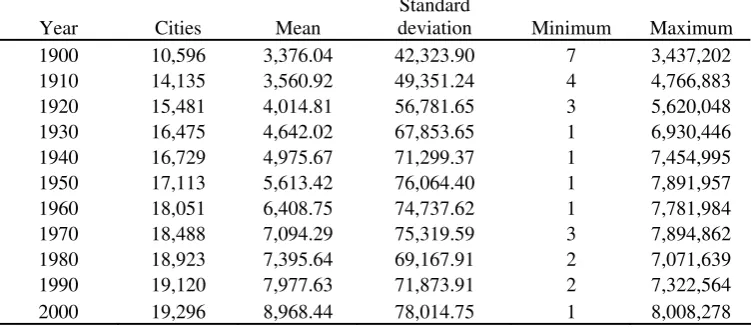
presents the number of cities for each decade and the descriptive statistics. Our base,
created from the original documents of the annual census published by the US Census
Bureau, consists of the available data of all incorporated places without any size
restriction, for each decade of the twentieth century (decennial data from 1900 to 2000).
The US Census Bureau uses the generic term incorporated place to refer to the
governmental unit incorporated under state law as a city, town (except in the states of
New England, New York and Wisconsin), borough (except in Alaska and New York) or
village, and which has legally established limits, powers and functions.
Two details should be noted.3 First, Alaska, Hawaii and Puerto Rico have not
been considered due to data limitations. Second, for the same reason, we also exclude
all the unincorporated places (concentrations of population that do not form part of any
3
incorporated place, but that are locally identified with a name), which began to be taken
into account after 1950. However, these settlements did exist earlier, so their inclusion
would again present a problem of inconsistency in the sample. Also, their elimination is
not quantitatively important; in fact there were 1,430 unincorporated places in 1950,
representing 2.36% of the total population of the US, which by 2000 would be 5,366
places and 11.27%.
The empirical strategy commonly used to test Zipf’s Law consists in the
estimation of log linear regressions of city size (population, P) against rank
R :
P A PR log log
log , (1)
where A and are parameters. Zipf’s Law is an empirical regularity, which appears
when the Pareto exponent is equal to unity, 1 (see the surveys of Cheshire, 1999,
and Gabaix and Ioannides, 2004, for further explanation). The results are usually
presented in double logarithmic graphs of rank compared to population, named Zipf
plots, which are used extensively in the specialised literature.
However, this approach has pitfalls, highlighted in the recent literature, and
different estimators have been proposed. Gabaix and Ioannides (2004) show that the
Hill (maximum likelihood) estimator is more efficient if the underlying stochastic
process is really a Pareto distribution, but when the size distribution of cities does not
follow a Pareto distribution the Hill estimator may be biased (Soo, 2005). At the same
time, the OLS estimate has some problems; see Goldstein et al. (2004) and Nishiyama
et al. (2008). Finally, Gabaix and Ibragimov (2007) propose subtracting 2 1
from the
In this paper we apply the nonparametric procedure put forward by Ioannides
and Overman (2003). This is a completely different empirical strategy, relying on the
statistical foundation of Zipf’s Law offered by Gabaix (1999). The exposition follows
Ioannides and Overman (2003) closely; see also Gabaix (1999) and Gabaix and
Ioannides (2004) for more details.4
Let Si denote the normalised size of city i, that is, the population of city i
divided by the total urban population. Following Gabaix (1999), city sizes are said to
satisfy Zipf’s Law if the countercumulative distribution function, G
S , of normalisedcity sizes, S, tends to
S a S
G , (2)
where a is a positive constant and 1. If Gibrat’s Law holds for city growth
processes, cities grow randomly, with the same expected growth rate and the same
standard deviation; then the limit distribution will converge to G
S , given by Eq. (2).5Gabaix also considers the case where cities grow randomly with expected
growth rates and standard deviations that depend on their sizes (a weak Gibrat’s Law).
That is, the size of city i at time t varies according to:
t
t t tt S dt S dB
S
dS
, (3)
where
S and 2
S denote, respectively, the instantaneous mean and variance ofthe growth rate of a size S city, and Bt is a geometric Brownian motion. In this case,
the limit distribution of city sizes will converge to a law with a local Zipf exponent,
4
Eqs. (3) and (4) replicate, respectively, Eq. (11), p. 756, and Eq. (13), p. 757, in Gabaix (1999).
5
dS S dp S p S S ,
where p
S denotes the invariant distribution of S. Starting from the forwardKolmogorov equation associated with Eq. (3), the local Zipf exponent, associated with
the limit distribution, can be derived and is given by
S S S S S S S 1 2 2 2 2
, (4)
where
S is relative to the overall mean for all city sizes.6 Eq. (4) identifies twopossible causes of deviations from Zipf’s Law: the means and the standard deviations. If
1
then the distribution has neither finite mean nor finite variance, and if 1 2 it
has finite mean but not finite variance.
3. Results
3.1 Kernel regressions
First, we use kernel regression techniques that establish a functional form-free
relationship between the mean and the variance of city growth rates and city size for the
entire distribution. This allows us to test whether Gibrat’s Law holds. Second, we use
Eq. (4) to estimate the local Zipf exponents directly.
6
Recently Eq. (4) has been strongly criticized by Malevergne et al. (2010) and Malevergne et al. (2011). They claim that some of Gabaix’s (1999) assumptions are crucial. First, “Gabaix (1999) considers that firms cannot decline below a minimum size and remain in business at this size until they start growing up again”, and second, “all firms (or cities) are supposed to enter at the same time, which is technically equivalent to consider that there is only one firm in the economy”. They argue that without these assumptions the distribution arising from Eq. (3) is the log-normal distribution. However, one can still consider for the log-normal distribution some form of “effective” power exponent:
2 ln 2
2 1
e x
x (Eq. (5) in Malevergne et al., 2011), where and 2 are, respectively, the
In order to analyse the entire twentieth century, all the growth rates are taken
between consecutive periods. There are 162,698 population–growth rate pairs in that
pool. City size is defined as the normalised size of the city
S , that is, the population ofthe city divided by the total urban population,7 and the growth rate
S is defined asthe difference between each city’s growth rate and the contemporary average growth
rate, as in Ioannides and Overman (2003). Table 2 shows the number of growth rates
and descriptive statistics by decade. To calculate the conditional mean and variance on
city size, we apply the Nadaraya–Watson method,8 exactly as it appears in Härdle
(1990, Chapter 3). The estimator is very sensitive, both in mean and in variance, to
atypical values. Thus, we decided to eliminate the 5% of the smallest distribution
observations for each decade because, as Table 2 shows, they are characterised by very
high dispersion in mean and in variance, and they distort the results. Therefore, the
sample size is reduced to 154,563 observations. Finally, we also eliminate 1,079
observations with a growth rate
S greater than 2. The reason is that we cannotcontrol for changes in city boundaries; there are more than twenty thousand different
cities in the sample, and information on boundaries is only available for the largest
cities in some decades. Then, we decide to eliminate the cities with the greatest growth
rates to control for the most extreme cases, relying on the huge sample size to make the
spurious growth produced by changes in boundaries irrelevant. The final sample size is
153,484 observations (94.34% of the total sample).9
Figure 1 shows the nonparametric estimates for the entire twentieth century of
the mean growth rate and variance of growth rate conditional on city size, and the local
Zipf exponent calculated applying Eq. (4). Figures 1c to 1e also display bootstrapped
7
The US urban population data from 1900 to 1990 come from Table 1 in Overman and Ioannides (2001). The data for the year 2000 is taken from the US Census Bureau (http://www.census.gov).
8
We use an Epanechnikov kernel and Silverman’s kernel bandwidth.
9
95% confidence bands, calculated using 500 random samples with replacement. The
results are shown until city sizes of 0.01, the reason is that there is one technical
problem with this procedure: the sparsity of data at the upper tail of the distribution,
which produces extreme values of the estimations. This means that, as Ioannides and
Overman (2003), we must exclude the 77 observations corresponding to the largest
cities with shares greater than 0.01 (0.05% of the total sample; see Table 2).
Figures 1a and 1b show the estimates of growth and variance with the
experimental points. The estimates seem to be straight lines both for growth and for
variance, indicating that growth and variance are independent of the initial city size and
supporting Gibrat’s Law. Although some of the smallest cities deviate and exhibit
higher growth rates and variances, the bulk of the 153,484 observations are close to the
estimates. Part of this high variation at the lower tail could be explained by the
appearance of new cities that enter with small sizes.10 To be able to observe some kind
of increasing or decreasing pattern in the estimates it is necessary to reduce the x-axis
scale; this is shown in Figures 1c and 1d. The results show a very slight increasing
behaviour of city growth (observe the very small scale of the growth graph), as well as a
slight negative relationship between variance and city size. Thus, small cities exhibit
lower growth rates and higher variances than larger cities. However, these differences
are not significant for most of the city sizes in growth rates, and for any city size in the
case of variance. Therefore, the evidence against Gibrat’s Law is weak. Regarding
Zipf’s Law, one would expect a lower Zipf exponent at the upper-tail distribution for
two reasons. First, in Eq. (4) the subtracting term depends on the quotient between the
growth rate and the variance (
S S2
); Figures 1c and 1d show that both
S and
10
S2
are positive, ensuring that
02 2 S S
, and as larger cities exhibit higher
estimated growth rates and lower variances the expected Zipf exponent must be lower at
the upper-tail distribution. Second, the term
S S
S S
2 2
in Eq. (4) will also be
negative (as long as the variance is decreasing with size
02 2 S S
; see Figure 1d)
and decreasing with city size. Thus, all points to a lower Zipf exponent at the upper-tail
distribution. Figure 1e shows that this is the case, as the local estimate of the Zipf
exponent is decreasing with city size. The results reject Zipf’s Law from this long-term
perspective, as the estimated values are close to zero.
Some papers propose theoretical models that give an economic explanation for
deviations from Zipf’s Law. Rossi-Hansberg and Wright (2007) identify the standard
deviation of industrial productivity shocks as the key parameter determining the
dispersion in the city size distribution, Eeckhout (2004) presents a model that also
relates the migration of individuals between cities with productive shocks, obtaining as
a result a log-normal and non-Pareto distribution of cities, and Duranton (2007) offers a
model of urban economics with detailed microeconomic foundations for technology
shocks, which are the fundamental drivers of the distribution of city sizes in the steady
state.
The variation in the estimates is very small, maybe as a consequence of the
huge sample size of the pool. Moreover, most of the observations are concentrated at the
lower end of the distribution. So, we repeat the exercise for each decade, with lower
sample sizes. One advantage is that the influence of new entrant cities is lower from one
decade to another than in the whole twentieth century. Also, short-term estimations
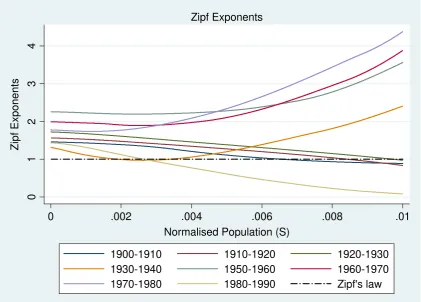
Figure 2 shows the estimates11 of the Zipf exponent for almost all the decades,
only excluding the decades 1940–1950 and 1990–2000. The reason is that in these
decades the estimated values of the Zipf exponent are negative (in 1940–1950 for all the
city sizes and in 1990–2000 for only the largest cities), and therefore we cannot
interpret those coefficients. The explanation is that, in 1940–1950, both
S and
S2
are positive and growth is much greater than variance; thus, the sign of
Sbecomes negative (see Eq. (4)).
We can observe in Figure 2 that, except for 1980–1990 when the estimated
values are similar to those of the pool for the whole century, decade by decade the
estimates of the Zipf exponent are greater than when considering all the twentieth
century. We find evidence in favour of Zipf’s Law as the estimates by decade are close
to one. In fact, value one falls within the confidence bands (not shown for clarity
purposes) for most of the distribution in most of the decades. The exception in most of
the decades is the upper-tail distribution. We can also see how periods in which the Zipf
exponent grows with city size (the decades from 1930 to 1980) are interspersed with
others in which the relationship between the exponent and the city shares is negative
(the decades from 1900 to 1930 and from 1980 to 2000). As the growth rates and
variance show similar patterns for almost all the decades,12 the differentiated behaviours
of local exponents must be a consequence of interactions between the terms
S S 2 2
and
S S
S S
2 2
in Eq. (4). The growth estimates are always negative (except in
1940–1950), which implies that, by decade,
S S 2 2 is positive (and increasing with
11
Again, we exclude the observations with shares greater than 0.01; the maximum number of these observations is 12 in 1920. See Table 2.
12
size, given the patterns of growth and variance). This helps to explain why
decade-by-decade estimates are, in general, higher than when considering the entire twentieth
century; the estimated growth for the pool of the whole century is positive, and thus, as
noted above, 2 2
0S S
in that case. Regarding Gibrat’s Law, in general growth
rates by decade show an increasing behaviour with city size in all the decades except
1930–1940 and 1970–1980, while the only exception to the decreasing pattern of
variance with city size is 1940–1950. However, the differences in growth rates and
variance are not significant, finding evidence supporting Gibrat’s Law even in the short
term.
However, 2
S 2 S is negative as variance is decreasing with size in all thedecades (except in 1940–1950 again), so
02 2 S S S S
and decreasing with city
size. Therefore, the resulting Zipf exponent by decade is the difference between
0 21 2 S S
and
02 2 S S S S
(see Eq. (4)), and both terms vary with city
size. An increasing Zipf exponent means that in that decade the term
S S 2 2 1 is
dominant, while a decreasing coefficient implies that
S S
S S
2 2
is the relevant
term.
3.2 A resistant smoothing approach
Kernel estimation of regression functions has been receiving much attention in
the recent literature examining Gibrat’s Law (Ioannides and Overman, 2003; Eeckhout,
2004; González-Val, 2010; González-Val and Sanso-Navarro, 2010; Giesen and
Therefore, the results in the previous section can be compared with those of other
studies. However, the Nadaraya–Watson estimator is known to be highly sensitive to
the presence of outliers in the data, and that is the reason why we exclude some
observations. Nevertheless, Eeckhout (2004) demonstrates the importance of
considering the whole sample.
In this section we try to reduce this sensitivity by using a resistant smoothing
technique, the LOcally WEighted Scatter plot Smoothing (LOWESS) algorithm. This
method was proposed by Cleveland (1979), and is based on local polynomial fits; see
Härdle (1990, Chapter 6). The advantages of LOWESS are that it is a free-functional
form method13 and that it is robust to atypical values. Therefore, it allows us to obtain
robust nonparametric estimates of growth, variance and Zipf exponent, using all the
sample including the 5% of the smallest distribution observations and the observations
with a growth rate greater than 2, which we exclude in the previous section. However,
their inclusion produces an increase in the estimates of both growth and variance,
especially at the lower tail of the distribution; this increment is much greater in the case
of variance, as the dispersion of these observations is very high (see Table 2). Both
growth and variance estimated by LOWESS are decreasing with city size.14 Although
the differences in growth rates by city size are not significant, the variance of the growth
rates is clearly greater at the lower tail. Thus, small cities exhibit higher variance than
the rest of the cities, indicating that Gibrat’s Law does not hold exactly. This possibility
has already been considered theoretically; Gabaix (1999) examines the case in which
cities grow randomly with expected growth rates and standard deviations that depend on
13
It does not require the specification of a function to fit a model to all of the data in the sample, LOWESS simply carries out a locally weighted regression of the y variable on the x variable, obtaining a new smoothed variable. We use the lowess command in STATA with the default options: a smoothing parameter equal to 0.8 and a tricube weighting function.
14
their sizes, and Córdoba (2008) introduces a parsimonious generalisation of Gibrat’s
Law that allows size to affect the variance of the growth process but not its mean.
We will focus on the analysis of the estimates of the Zipf exponent. Figure 3
shows the estimates of the Zipf exponent using LOWESS and considering all the
observations. Again, the results are shown until city sizes of 0.01; the problem of the
sparsity of data at the upper tail of the distribution still remains, so again we must
exclude the observations corresponding to the largest cities (77 observations). Figure 3a
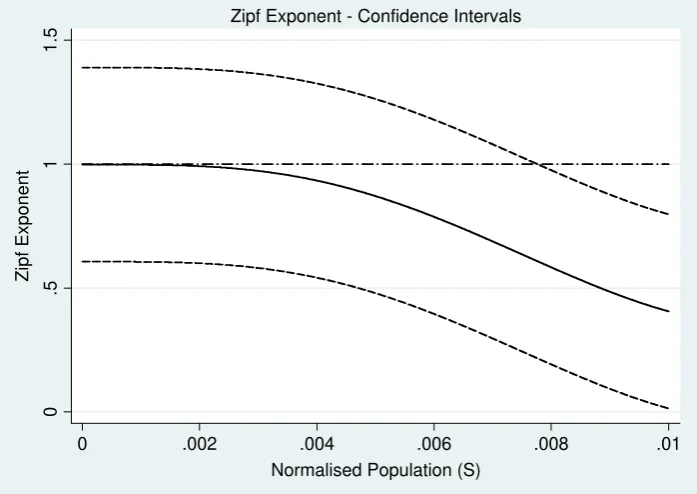
displays the results for a pool of 162,698 observations over the whole century. The
dotted lines are bootstrapped 95% confidence bands, calculated using 500 random
samples with replacement. The exponent is decreasing with city size, as in the previous
section (Figure 1e). The difference is that here the estimates are much closer to the
value one, finding evidence supporting Zipf’s Law except in the upper-tail distribution.
The explanation is the high variance; both
S and 2
S are positive, and thus
02 2
S S
(Eq. (4)), but the estimated variance is so high that this term becomes
very small, especially at the lower tail of the distribution where the variance is higher.
Therefore, the decreasing pattern with city size of the estimated Zipf exponent is robust
to the inclusion of all the cities, but the values are closer to Zipf’s Law when all the
cities are considered.
Figure 3b shows the estimates of the Zipf exponent by decade. All the decades
are shown, as all the estimates are positive. The difference from Figure 2 is that now
there is only one kind of behaviour: all the estimated values are increasing with city
size. Moreover, the estimates are close to Zipf’s Law (value one) in most of the decades
(the values range from 0.8 to 1.1), with the exception of 1900–1910 and 1980–1990.
4. Conclusions
In this paper, the methodology proposed by Ioannides and Overman (2003) to
estimate a local Zipf exponent is applied to a new data set covering the complete
distribution of cities in the US (understood as incorporated places) without any size
restrictions for all the twentieth century.
First, we run kernel regressions using the Nadaraya–Watson estimator. As the
estimator is very sensitive, both in mean and in variance, to atypical values we must
exclude some observations, so the final sample size is 153,484 observations (94.34% of
the total sample). The results reject Zipf’s Law from a long-term perspective, as the
estimated values are close to zero. However, the evidence supports Gibrat’s Law. In the
short term, decade by decade, we find evidence in favour of Zipf’s Law for most of the
distribution in most of the decades. We also observe differentiated behaviours: periods
in which the Zipf exponent grows with the city size are interspersed with others in
which the relationship between the exponent and the city shares is negative.
Second, to consider the whole sample (162,698 observations) we apply the
LOcally WEighted Scatter plot Smoothing (LOWESS) algorithm. The evidence
supporting Zipf’s Law increases, as the estimated values are closer to one, but the
evidence supporting Gibrat Law’s is weaker, as small cities exhibit higher variance than
the rest of cities. Finally, the estimated values by decade are also closer to Zipf’s Law.
Acknowledgements
The author acknowledges financial support from the Spanish Ministerio de
Educación y Ciencia (ECO2009-09332 and ECO2010-16934 projects), the DGA
referees have undoubtedly improved the version originally submitted. All remaining
errors are mine.
References
Black D, Henderson V, 2003, “Urban evolution in the USA” Journal of Economic
Geography3(4) 343 – 372
Cheshire P, 1999, “Trends in sizes and structure of urban areas”, in Handbook of
Regional and Urban Economics, Vol. 3, Eds P Cheshire and E S Mills (Elsevier,
Amsterdam) Chap. 35, pp 1339 – 1373
Cleveland W S, 1979, “Robust locally weighted regression and smoothing scatterplots”
Journal of the American Statistical Association74 829 – 836
Córdoba J C, 2008, “A generalized Gibrat’s law” International Economic Review49(4)
1463 – 1468
Duranton G, 2007, “Urban evolutions: the fast, the slow, and the still” American
Economic Review97(1) 197 – 221
Eeckhout J, 2004, “Gibrat’s law for (all) cities” American Economic Review94(5) 1429
– 1451
Eeckhout J, 2009, “Gibrat’s law for (all) cities: reply” American Economic Review
99(4) 1676 – 1683
Gabaix X, 1999, “Zipf’s Law for cities: an explanation” Quarterly Journal of
Economics114(3) 739 – 767
Gabaix X, Ibragimov R, 2007, “Rank-1/2: a simple way to improve OLS estimation of
Gabaix X, Ioannides Y M, 2004, “The evolution of city size distributions” in Handbook
of Urban and Regional Economics, Vol. 4, Eds J V Henderson, J F Thisse (Elsevier,
Amsterdam) pp 2341 – 2378
Gibrat R, 1931 Les Inégalités Économiques (Librairie du Recueil Sirey, Paris)
Giesen K, Südekum J, 2011, “Zipf’s Law for cities in the regions and the country”
Journal of Economic Geography11(4) 667 – 686
Giesen K, Zimmermann A, Suedekum J, 2010, “The size distribution across all cities –
double Pareto lognormal strikes” Journal of Urban Economics68 129 – 137
Goldstein M L, Morris S A, Yen G G, 2004, “Problems with fitting to the power-law
distribution” The European Physical Journal B – Condensed Matter41(2) 255 – 258
González-Val R, 2010, “The evolution of the US city size distribution from a long-run
perspective (1900–2000)” Journal of Regional Science50(5) 952 – 972
González-Val R, Sanso-Navarro M, 2010, “Gibrat’s law for countries” Journal of
Population Economics23(4) 1371 – 1389
Härdle W, 1990 Applied Nonparametric Regression (Cambridge Univ. Press,
Cambridge)
Ioannides Y M, Overman H G, 2003, “Zipf’s Law for cities: an empirical examination”
Regional Science and Urban Economics33 127 – 137
Levy M, 2009, “Gibrat’s Law for (all) cities: a comment” American Economic Review
99(4) 1672 – 1675
Malevergne Y, Pisarenko V, Sornette D, 2011, “Gibrat’s Law for cities: uniformly most
powerful unbiased test of the Pareto against the lognormal” In press in Physical Review
Malevergne Y, Saichev A, Sornette D, 2010, “Zipf’s Law and maximum sustainable
growth” arXiv:1012.0199v1 [physics.soc-ph]
Nishiyama Y, Osada S, Sato Y, 2008, “OLS estimation and the t test revisited in
rank-size rule regression” Journal of Regional Science48(4) 691 – 715
Overman H G, Ioannides Y M, 2001, “Cross-sectional evolution of the U.S. city size
distribution” Journal of Urban Economics49 543 – 566
Rossi-Hansberg E, Wright M L J, 2007, “Urban structure and growth” Review of
Economic Studies74 597 – 624
Soo K T, 2005, “Zipf’s Law for cities: a cross-country investigation” Regional Science
and Urban Economics35: 239 – 263
Zipf G, 1949 Human Behaviour and the Principle of Least Effort (Addison-Wesley,
Table 1. Number of cities and descriptive statistics
Year Cities Mean
Standard
Table 2. Growth rates
S : descriptive statisticsAll cities
Initial Year Growth rates Mean
Standard
deviation Minimum Maximum
1900 10,502 4.30E-11 0.51 -0.94 9.54
1910 13,543 -1.29E-11 0.52 -0.90 31.82
1920 15,085 9.56E-12 0.58 -0.89 22.34
1930 16,199 3.90E-11 0.44 -1.01 31.67
1940 16,416 1.40E-11 1.85 -0.95 231.04
1950 16,943 2.30E-10 1.03 -0.89 92.38
1960 17,831 1.90E-09 36.93 -1.23 4926.66 1970 18,321 -4.93E-11 0.83 -0.90 52.07
1980 18,810 3.70E-11 0.39 -0.84 13.14
1990 19,048 1.42E-10 0.48 -0.96 30.11
Total 162,698 2.51E-10 12.25 -1.23 4926.66
5% smallest cities
Initial Year Growth rates Mean
Standard
deviation Minimum Maximum
1900 525 0.21 0.85 -0.69 4.98
1910 677 0.16 1.45 -0.81 31.82
1920 754 0.11 1.43 -0.87 22.34
1930 810 0.19 1.56 -0.96 31.67
1940 821 0.27 8.11 -0.88 231.04
1950 847 0.02 1.94 -0.86 34.61
1960 892 5.54 165.08 -1.17 4926.66
1970 916 0.18 1.96 -0.89 26.93
1980 941 0.00 1.01 -0.84 12.41
1990 952 0.12 0.93 -0.94 16.67
Total 8,135 0.68 54.74 -1.17 4926.66
Cities greater than 0.01
Initial Year Growth rates Mean
Standard
deviation Minimum Maximum
1900 11 -0.05 0.08 -0.15 0.12
1910 11 0.08 0.23 -0.07 0.75
1920 12 0.09 0.25 -0.08 0.78
1930 10 -0.06 0.07 -0.12 0.10
1940 9 -0.05 0.07 -0.10 0.12
1950 8 -0.17 0.09 -0.25 0.04
1960 5 -0.43 0.07 -0.50 -0.32
1970 5 -0.24 0.08 -0.33 -0.11
1980 3 0.02 0.11 -0.09 0.13
1990 3 -0.05 0.02 -0.07 -0.03
Figure 1. Nonparametric estimates for all the twentieth century (a pool of 153,484 observations, Nadaraya–Watson estimator)
-1 0 1 2 M ean Growt h Rat e
0 .002 .004 .006 .008 .01
Normalised Population (S) Mean Growth Rate
0 1 2 3 4 5 V ariance of Growt h Rat e
0 .002 .004 .006 .008 .01
Normalised Population (S) Variance of Growth Rate
(a) Mean (b) Variance
.067 .0672 .0674 .0676 M ean Growt h Rat e
0 .002 .004 .006 .008 .01
Normalised Population (S) Mean Growth Rate
.16235 .1624 .16245 .1625 .16255 V ariance of Growt h Rat e
0 .002 .004 .006 .008 .01
Normalised Population (S) Variance of Growth Rate
(c) Mean (reduced scale) (d) Variance (reduced scale)
-. 1 -. 05 0 .0 5 .1 .1 5 .2 .2 5 Zipf E x ponent
0 .002 .004 .006 .008 .01
Normalised Population (S) Zipf Exponent - Confidence Intervals
Figure 2. Nonparametric estimates of the Zipf Exponent by decade (Nadaraya–Watson estimator)
0
1
2
3
4
Zipf Exponents
0 .002 .004 .006 .008 .01
Normalised Population (S)
1900-1910 1910-1920 1920-1930
1930-1940 1950-1960 1960-1970
1970-1980 1980-1990 Zipf's law
Zipf Exponents
Figure 3. Nonparametric estimates for all the twentieth century (a pool of 162,698 observations) using the LOcally WEighted Scatter plot Smoothing (LOWESS) algorithm
0
.5
1
1.5
Zi
pf Exponent
0 .002 .004 .006 .008 .01
Normalised Population (S) Zipf Exponent - Confidence Intervals
(a) Twentieth century
.4
.6
.8
1
1.2
1.4
Zi
pf Exponents
0 .002 .004 .006 .008 .01
Normalised Population (S)
1900-1910 1910-1920 1920-1930
1930-1940 1940-1950 1950-1960
1960-1970 1970-1980 1980-1990
1990-2000 Zipf's law
Zipf Exponents
(b) By decade