Venue-based Mobility Models: Evaluation of MANET
Routing Protocols
Sehrish Abrejo
Dept. of Computer Science Isra University, Hyde , PakistanHameedullah Kazi
Dept. of Computer Science Isra University, Hyd , PakistanShams-ul-Arfeen
Faculty of ES&T Hamdard University, Karachi,Pakistan
ABSTRACT
MANET is infrastructure less network consisting of wireless nodes acting either as a host or a routing node. A number of simulation studies have been carried out to evaluate the performance of MANET routing protocols. In typical simulations, nodes move at speeds between the broad range of 1 – 30 m/s, whereas in a real life setting, the movement speed of nodes at a particular venue may be confined to a narrower range depending on the nature of the venue. This paper analyzes the performance of routing protocols, on the basis of four venue based mobility models. These models are Fast Car Model (FCM), Slow Car Model (SCM), Human Run Model (HRM) and Human Walk Model (HWM). Four routing protocols namely AODV, DSDV, DSR and TORA are compared in this paper. The simulation results show that DSDV has low end-to-end delay, whereas TORA has high overhead as speed is increased.
Keywords
Mobile Ad Hoc Networks, Routing Protocols, Venue-Based Mobility Models
1. INTRODUCTION
The key features in the growth of wireless communication are Ad hoc networks [1]. For any mobile devices, MANETs have become a promising solution to set up a network [2]. A Mobile Ad hoc network is infrastructure-less network which contains portable devices as network participant. As compared to traditional network, MANETs don’t use base stations. Due to which, each mobile node has the responsibility to find suitable path and to send messages to the target node. Each of the nodes communicates with each other over wireless interface containing radio or infrared. MANET nodes communicate with each other in two ways, if they are within each other’s range they communicate directly (Single -hope), but if they are not in each other’s range, the intermediate nodes are used to forward messages from source to destination(Multihop) [3]. In the second case, the intermediate or midway nodes act as nodes as well as routers to forward data from the source node to the destination node.
Ad hoc networks have gained importance due to growing number devices and well known applications [4]. These networks can be used anywhere, with less or no communication infrastructure or there where fixed infrastructure networks are expensive to use. MANET allows the portable/mobile devices to uphold connections to the network with the advantage of scalability, which means, new devices can join and existing devices can leave network at any time. The exceptional features of MANET like multipath
routing, distributed operation, independent terminal, dynamic network, light-weight nodes and changeable link capacity not only express the nature of Ad hoc networks but also describe some boundary conditions [4, 5].
In order to make communication possible between network nodes, many routing protocols have been proposed. These protocols have been tested under different situations in terms of different network loads and speeds. In most of the simulations of routing protocols, all of the mobile nodes move at changeable speeds (between 1 to 30 m/s) and don’t consider roaming velocities and pause-time intervals observer in real-world situation [6, 7]. In real real-world scenario, the actual nodes of Ad hoc networks can be a human carrying mobile device or any vehicular with wireless connection. There are restrictions and limitations on the speeds of the real world mobile nodes (i.e. a human node can’t move at the speed of 30 m/s). Thus for venues such as a university campus or shopping centre, mobile nodes are mostly be comprised of human members moving at a slow speed. While venues such as highway or town center, may also include car participants moving at much higher speeds. For that reason, four Venue-based mobility models are used that mimic the actions of the nodes in the real world situations. Four MANET routing protocols namely DSDV, TORA, DSR and AODV are compared with these mobility models.
The rest of the paper is ordered as follows: section 2 gives review to related work in this area; section 3 reviews the four MANET routing protocols briefly, section 4 covers the explanation of our designed venue-based mobility models; section 5 describes the simulation results; section 6 presents discussion and paper ends with conclusion in section 7.
2. RELATED WORK
Several researchers have performed their analysis of MANET routing protocols using different performance metrics and different simulators. Boukerchi [7] has compared AODV, PAODV (preemptive AODV), CBRP, DSR and DSDV using different workloads and scenarios. There workloads and scenarios are characterized by mobility, load and size of the ad hoc network. These evaluation was based on Throughput, Average end-to-end delay and Normalized routing overhead using NS-2 simulator. Their results indicate that CBRP has a higher overhead than DSR because of its periodic hello messages while AODV’s end-to-end packet delay is the shortest when compared to DSR and CBRP. PAODV.
Fraction, end-to-end delay and Routing overhead. They used OPNET simulator. Their results show that TORA performs better compared other routing protocols.
Al-Maashri et al [17] evaluated the performance of three MANET routing protocols namely DSR, AODV and OLSR in the presence of bursty self similar traffic. The results were compared on the basis of Delivery ratio, Routing overhead, Throughput and end-to-end delay. NS-2 simulator was used. Their simulation results show that DSR performs better with bursty traffic.
Bo et al [18] have compared DSDS, DSR and AODV under security attack where misbehavior of nodes was investigated. Network performance was evaluated in terms of Normalized throughput, Routing overhead, Normalized routing load and Average packet delay. NS-2 simulator was used to carry out the simulations. According to their results, performance of all routing protocols degrades, but DSDV is the most robust routing protocol under security attacks.
Shrirany et al [19] in their paper have evaluated the performance of DSDV, AODV and DSR using different mobility model scenarios. Evaluation was based on Packet delivery ratio, Routing overhead and Path optimality (packet delay) using NS-2 simulator. Their results show that DSDV performs well then other routing protocols.
Khan et al [20] evaluated the performance of AODV, DSR and DSDV using NCTUns simulator. The key performance matrics in this study were Packet delivery ratio, Number of packets dropped, end-to-end delay and Average routing overhead. The results indicate that performance of DSR and AODV is superior to DSDV.
3. AD HOC ROUTING PROTOCOLS
A convention or standard through which nodes come to agree the way to route packets between computing devices in a network is called Routing Protocol. There are two basic functions of a routing protocol, to select appropriate route for various pairs of source-destination nodes, and to deliver message to the correct destination from correct source. Ad hoc routing protocols can be divided into Proactive routing (also known as Table-driven protocols), Reactive routing (also known as On-demand routing or Source-initiated routing) and Hybrid routing, which is combination of proactive and reactive protocols.In proactive/Table-driven routing protocols, the path information from source to all the other nodes in the network is always maintained in the format of routing tables at every node. Examples of proactive routing protocols are Destination-Sequence Distance Vector (DSDV) [21], Wireless Routing Protocol (WAP) [22], Clustered Gateway Switched Routing (CGSR) [23], Fisheye State Routing (FSR) [24] and Optimized Link-State Routing (OLSR) [25] protocols. whereas, source-initiated on-demand Reactive routing protocols create routes only when desired by the source node. Examples of reactive routing protocols are Ad hoc On-Demand Distance Vector (AODV) [6], Dynamic Source Routing (DSR) [26], Temporally Ordered Routing Algorithm (TORA) [27], Associatively-Based Routing (ABR) [28], Signal Stability Routing (SSR) [29], Location Aided Routing (LAR) [30], Lightweight Mobile Routing (LMR) [31], and Route-Lifetime Assessment Based Routing (RABR) protocol [32].
In this work, four MANET routing protocols namely, AODV, DSR, TORA and DSDV are compared in terms of
venue-based mobility models. The following section describes the basic working of these routing protocols.
3.1
AODV Routing Protocol.
The AODV is an on-demand or reactive MANET routing protocol [8]. The number of routing messages in the network is reduced due to its reactive approach which makes it use the bandwidth more efficiently. But in highly mobile and heavily loaded networks, protocol overhead may increase. Furthermore, due to reactive approach it is more immune to the topological changes witnessed in the MANET environment. As a result, the AODV offers quick adaptation to dynamic link conditions, low CPU processing and memory overhead, low network utilization, and determines unicast routes to destinations within the MANET. It also allows mobile nodes to obtain routes quickly for new destinations, and does not require nodes to maintain routes to destinations that are not in active communication. One distinguishing feature of AODV is its use of a destination sequence-number (DSN) for each route entry. The DSN is created by the destination to be included along with any route information it sends to requesting nodes. Use of DSN in routing protocols ensures loop freedom. Hence, the operation of AODV is loop-free, and by avoiding the Bellman-Ford "counting to infinity" problem offers quick convergence when the MANET witnesses topological changes.
AODV has a few constraints and limitations. Firstly, it does not support multiple routes. There is only one route at a time from source to destination and in the case of link failure; a new path needs to be found. Secondly, it uses hello messages at the IP-level to maintain connectivity between the neighbors. The hello messaging adds a significant overhead to the protocol and consumes more bandwidth. Lastly, the protocol does not support unidirectional links.
When a source node desires to send a message to some destination node and does not already have a valid route to that destination, it initiates a route discovery process to locate the other node. It places the destination IP address and last known sequence number for that destination, as well as its own IP address and current sequence number (Broadcast-ID) into a Route Request (RREQ) message. The broadcast-ID and the nodes own IP address, uniquely identifies the RREQ which helps to suppress duplicate RREQ’s to flow in the MANET when the same RREQ is received by a mobile node again. After that it broadcasts the route request (RREQ) message to its neighbors, which then forward the request to their neighbors, and so on, until either (a) the destination or (b) an intermediate node with a “fresh enough” route to the destination is found. If neither of these conditions is met, the node rebroadcasts the RREQ.
An active route is defined as a route which has recently been used to transmit data packets. Link breaks in non-active links do not trigger any protocol action. However, when a link break in an active route occurs, then link failure notification is propagated to the node upstream of the break determines whether any of its neighbors use that link to reach the destination. If so, it creates a Route Error (RERR) packet. The RERR contains the IP address of each destination which is now unreachable, due to the link break. The RERR also contains the sequence number of each such destination, incremented by one. The node then broadcasts the packet and invalidates those routes in its route table.
When a neighboring node receives the RERR, it in turn invalidates each of the routes listed in the packet, if that route used the source of the RERR as a next hop. If one or more routes are deleted, it then goes through the same process, whereby it checks whether any of its neighbors route through it to reach the destinations. If so, it creates and broadcasts its own RERR message. Once a source node receives the RERR, it invalidates the listed routes as described. If it determines it still needs any of the expired routes, it then reinitiates route discovery for that route.
3.2. DSR Routing Protocol.
Dynamic Source Routing (DSR) [5, 11, 12] is a source-initiated reactive routing protocol in which route is created only when requested by source node. Source routing means that each packet in its header carries the complete ordered list of nodes through which the packet must pass. The protocol performs its operation in two phases: Route Discovery and Route Maintenance.
3.2.1. Route Discovery
Route discovery is a mechanism where source wishes to send message to destination and obtains the route to the destination. Each node in the network contains a route cache, in which all the routes to different destinations are stored. When a node wishes to send data, it checks its route cache to find out if it has route entry to the destination. If it finds one, it uses that route and sends data to the destination. If no entry found, then it initiates a route discovery method. In route discovery, a source node floods a query packet into the network. This query packet contains unique ID and initial empty list. When receiving a query packet, if a node has already seen this ID (i.e. duplicate query packet) or it finds its own address already recorded in the list, it discards the copy and stops flooding; otherwise, it appends its own name in the list and broadcasts the query packet to its neighbors. This process continues until the destination is located or any other intermediate node finds a route entry to the specified destination into its route cache. The reply is sent back to the source node either by the destination or by the intermediate node without propagating the query packet further.
3.2.2. Route Maintenance
Route maintenance is a mechanism by which a packet sender detects if the network topology has changed so that it can no longer use its route to the destination. This might happen because a host listed in a source route, move out of wireless transmission range or is turned off making the route unusable. When route maintenance detects a problem with a route in use, route error packet is sent back to the source node. When this error packet is received, the hop in error is removed from this hosts route cache and all routes that contain this hop are truncated at this point.
This protocol has the advantage of learning routes by
from N1 to N5 through N2 means that N1 learns the route to N5, but also that it will learn the route to N2. The source route will also mean that N2 learns route to N1 and N5 and that N5 learns the route to N1 and N2. This form of active learning is very good and reduces overhead in the network. However, each packet carries a slight overhead containing the source route of packet. This overhead grows when the packet has to go through more hops to reach the destination. So the packet sent will be slightly bigger, because of overhead [11].
3.3. TORA Routing Protocol.
Temporally Ordered Routing Algorithm (TORA) [11, 27] is a loop-free, source-initiated, distributed routing algorithm based on concept of link reversal. It provides multiple routes for any source/destination pair and uses Internet MANET encapsulation Protocol (IMEP) for other underplaying functions. The key concept in its design is that the control messages are localized only to small set of nodes. TORA performs its operation in three basic functions: Route Creation, Route Maintenance and Route Erasure.
In route creation phase, TORA builds a directed acyclic graph (DAG) rooted at the destination and assigns directions to link in an undirected network. TORA associates each node with height and data flows downstream, from node with higher height to the node with lower height. For example, in Fig. II -7, the destination node has lowest height from all other nodes in the network. Each route is created with Query (QRY) and Update (UPD) packets. When a node with no downstream links needs a route to the destination, it floods the QRY packet throughout the network. This packet is propagated through the network until it reaches the node that has a route or destination itself. Then such a node will broadcast a UPD packet, which contains the height of that node. Upon receiving the UPD packet, each node will set its height higher then the height specified in the UPD packet. Then the node will broadcast its own UPD packet, which results in a number of directed links from the QRY packet originator to the destination.
In route maintenance phase, each route to the destination is re-established when any network topological change occurs. TORA’s route erase phase essentially involves flooding a broadcast clear packet (CLR) throughout the network to erase invalid routes.
3.4. DSDV Routing Protocol
In DSDV [9, 10], each node maintains a routing table, which has an entry for each destination in the network. The attributes for each destination are the next hop, metric (hop counts), and a sequence number originated by the destination node. To maintain the consistency of the routing tables, DSDV uses both periodic and triggered routing updates; triggered routing updates are used in addition to the periodic updates in order to propagate the routing information as quickly as possible when there is any topological change. The update packets include the destinations accessible from each node and the number of hops required to reach each destination along with the sequence number associated with each route.
one more hop to reach the destination. A newly recorded route is immediately advertised to its neighbors.
When a link to the next hop is broken, any route through that next hop is immediately assigned infinity metric and assigned an updated sequence number. This is the only case when sequence numbers are not assigned by the destination. When a node receives infinity metric and it has an equal or later sequence number with a finite metric, a route update broadcast is triggered. Therefore, routes with infinity metrics will be quickly replaced by real routes propagated from the newly located destination.
One of the major advantages of DSDV is that it provides loop-free routes at all instants. It has a number of drawbacks however. Optimal values for the parameters, such as maximum settling time, for a particular destination are difficult to determine. This might lead to route fluctuations and spurious advertisements resulting in waste of bandwidth. DSDV also uses both periodic and triggered routing updates, which could cause excessive communication overhead. In addition, in DSDV, a node has to wait until it receives the next route update originated by the destination before it can update its routing table entry for that destination. Furthermore, DSDV does not support multipath routing.
4. VENUE-BASED MOBILITY MODELS
Human mobility is crucial in simulations of MANET routing protocols [14], as mostly hum carry different wireless devices in real world scenarios. Therefore, it is important to simulate a MANET protocol more realistically by designing Venue-based mobility models to accurately represents the speed patterns of various MANET participants observed in real-world. Such models should attempt to mimic the actual movements of human and other MANET participants. It is important to create different models based on the limits of various MANET participants in which different nodes can move at maximum speed, which will be helpful in classifying protocols suitable in different conditions. Therefore, in this study, these models are entitled Venue-Based Mobility Models which are designed to compare the performance of DSDV, AODV, DSR and TORA protocols.4.1. Fast Car Model (FCM)
In this model, vehicles (cars, ambulances) are considered to be the MANET participants and can move up to the speeds of 30 m/s or 108 km/h. It is important to note that vehicles don’t move all the time without any pause, these vehicular nodes might need to stop at some place for some period of time. For this reason, pause time intervals are also considered in this model.
4.1. Slow Car Model (SCM)
In this model, it is assumed that vehicles are in busy streets and can’t move at higher speeds. Therefore, in this model, speed is reduced to 15 m/s or 45 km/h [15].
4.3. Human Running Model (HRM)
In most of the cases, MANET participants are human and it is important to carefully consider their real world speeds. For example, a human solder can run or walk in battle field, they also can stop at some place. This model considers the situation where human nodes are running like in rescue operation. On average, the running speed of a human is 8 m/s or 28.8 km/h [15] is considered for this model with various pause times.
4.4. Human Walking Model (HWM)
This model is similar to HRM but the speeds of mobile nodes are considered to be slow. For example, people usually walk in a shopping mall, campus or at a festival. Human walking speed on the average is 2 m/s or 7.2 km/h [15].
5. ANALYSIS
[image:4.595.324.534.251.491.2]To analyze the effect of venue-based mobility models, 10 mobility scenario files were generated with 100, 300s and 500s pause times for each model. The maximum speeds of mobile nodes are 2, 8, 15 and 30m/s for HWM, HRM, CSM and CFM respectively. The number of sources is limited to 10 at a time, generating 4 packets per second. Total number of nodes is limited to 25. The simulations were conducted using NS-2 for 900s. These parameters are listed in Table 1.
Table 1. Simulation Parameters
VARIABLES VALUE
Transmission range 250 m
Simulation time 900 s
Topology size 1000 m x 1000 m
Total nodes 25
Mobility model Random Waypoint
Traffic type Constant bit rate
Packet rate 4 packets/sec
Packet size 512 bytes
Maximum Speed 2, 8, 15, 30 m/s
Number of sources 10
Pause time 100s, 300s, 500s
NS-2 Version NS-2.34
5.1. Simulation Results
There are three performance metrics that are measured in these simulations, namely, packet delivery fraction, average end-to-end delay and normalized routing overhead. The selection of these parameters is based on the conformance with the work done by other researchers as mentioned in section 2.
5.1.2. Packet Delivery Fraction (PDF)
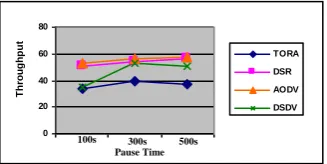
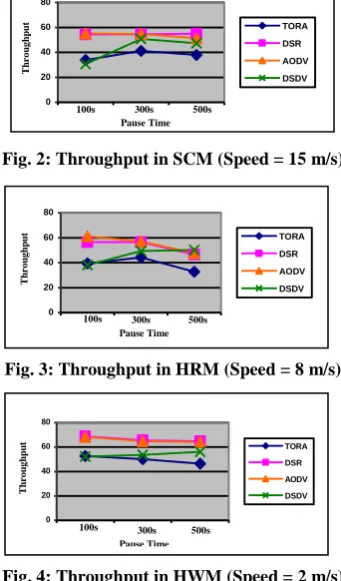
The PDF is defined as the number of data packets received divided by the number of data packets sent. PDF shows the efficiency of MANET routing protocol. The throughput and performance of any routing protocol are considered to be better than other protocols if that protocol has higher PDF. For this research, four routing protocols namely DSDV, AODV, DSR and TORA are analyzed under FCM, SCM, HWM and HRM mobility models.
0 20 40 60 80
[image:4.595.345.509.667.749.2]TORA DSR AODV DSDV
Fig. 1: Throughput in FCM (Speed = 30 m/s)
100s 300s 500s Pause Time
T
h
ro
u
g
h
p
u
0 20 40 60 80 TORA DSR AODV DSDV
Fig. 2: Throughput in SCM (Speed = 15 m/s)
0 20 40 60 80 TORA DSR AODV DSDV
Fig. 3: Throughput in HRM (Speed = 8 m/s)
0 20 40 60 80 TORA DSR AODV DSDV
Fig. 4: Throughput in HWM (Speed = 2 m/s)
It can be seen in Fig. 1 and Fig. 2, that under very high speeds of 30 m/s and 15 m/s with 100s, 300s and 500s pause time intervals, throughput of DSR and AODV is above 50%, whereas the throughput of TORA and DSDV are identical with pause time 100. Furthermore, the throughput of DSDV rises up to 50% and throughput of TORA approximately rises up to 40% as their pause time increases
In Fig.3 with the speed of 8 m/s, the throughput of DSR and AODV is close to 60% and the throughput of DSDV and TORA is equal to the 40%. However, as pause time intervals of each of the MANET protocol increases, the throughput of DSR, AODV and TORA decreases to 50%, 50% and 30% respectively. Furthermore, the throughput of DSDV increases from 40% to 50% as the pause time increases.
In Fig. 4, with speed of 2 m/s, each protocol show the improvement in their throughput with pause time 100s, where, the throughput of DSR and ASDV is equal to 70% and throughput of DSDV and TORA is above 50%. But as the pause time of DSR, AODV and TORA increases, the throughput is slightly decreased. Furthermore, the throughput of DSDV remains above 50% for all pause times.
5.1.1. Normalized Routing Overhead
The packet overhead is the number of routing packets transmitted per data packet delivered at the destination. As it can be seen in Fig. 5, with high speed of 30 m/s and pause time of 100, TORA generates 20 routing packets in order to send only one data packet, which is more bandwidth consumer but DSR, AODV and DSDV generate 10, 6 and 5 routing packets respectively. However, as pause time increases, TORA decreases its overhead up to 10 routing packets for sending one data packet and DSR decreases to 6 routing packets. Furthermore, the routing overhead of AODV and DSDV remains same for all pause times which proves that these both protocols are more bandwidth saver in FCM.
In Fig. 6, TORA with pause time 100s still generates 18 packets in order to send single data packet to its destination, whereas, DSR generates 8 routing packets versus one data packet. It can also be analyzed that as the pause time increases, the routing overhead of TORA and DSR is reduced and becomes less than 10 routing packets per data packet. Furthermore, the routing overhead of AODV and DSDV remains same for all pause times.
[image:5.595.326.529.153.574.2]0 5 10 15 20 25 TORA DSR AODV DSDV
Fig. 5: Protocol Overhead in FCM (Speed = 30 m/s)
0 5 10 15 20 25 TORA DSR AODV DSDV
Fig. 6: Protocol Overhead in SCM (Speed = 15 m/s)
0 5 10 15 20 25 TORA DSR AODV DSDV
Fig. 7: Protocol Overhead in HRM (Speed = 8 m/s)
0 5 10 15 20 25 TORA DSR AODV DSDV
Fig. 8: Protocol Overhead in HWM (Speed = 2 m/s)
It can be analyzed in Fig. 7 that TORA still generates 14 routing packets to deliver one data packet, whereas, routing overhead of DSR is decreased to 6 routing packets. The overhead of both protocols is further decreased to 8 and 6 routing packets as their pause time increases from 100s to 300s. But as the pause time further increases to 500s, the overhead of both TORA and DSR protocols is also increased to 11 and 7 routing packets respectively. Furthermore, the overhead of AODV and DSDV remains steady at all pause times.
In the end, in HWM with the speed of 2 m/s, the overhead of each protocol is low. The routing overhead of TORA is again higher at 500s pause time and it generates around 11 routing packets versus one data packet. The routing overhead of DSR, AODV and DSDV is identical at all pause time intervals. These overheads are shown in Fig. 8.
100s 300s 500s
100s 300s 500s
100s 300s 500s Pause Time Pause Time Pause Time Th r ou gh p u t Th r ou gh p u t Th r ou gh p u t
100s 300s 500s Pause Time R ou ti n g O ve r h e ad (n o: of P a c k e ts )
100s 300s 500s
R ou ti n g O ve r h e ad (n o: of P a c k e ts )
100s 300s 500s
R ou ti n g O ve r h e ad (n o: of P a c k e ts )
100s 300s 500s
5.1.3. Average End-to-End Delay
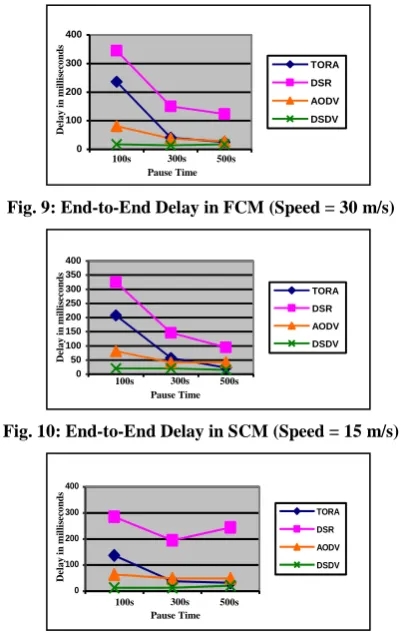
The end-to-end delay is defined as the time a data packet takes to travel from source to the destination. Average end-to-end delay is perceived by all the packets including, route acquisition delay. Once again, it can be seen in Fig, 9 and Fig, 10, which show the identical results; that at pause time 100s, DSR has delay around 350 milliseconds and TORA has above 250 milliseconds. But as the pause time increases, the delay for both protocols is reduced to less than 150 and 50 respectively. Furthermore, the delay of AODV and DSDV protocols at 100s pause time is 60 and 20 which is further reduced according to the increment in the pause times. In Fig. 11, DSR has higher delay than other protocols at all pause time intervals. The delay is around 300 with pause time of 100s and decreases to 200 at pause time interval of 300s. When the pause time is further increased, the delay again increases to 250 milliseconds. The delay of TORA is higher at 100 pause time up to 150 which is reduced to less than 50 as the pause time increases. Furthermore, the delay of AODV and DSDV remains same for all pause times.
With HWM all protocols including TORA, AODV and DSDV have steady delay at all pause time intervals which is less than 50 milliseconds. However, the delay in DSR increases from 100 to 150 milliseconds as the pause time increases from 100s to 500s. The delay in HWM is shown in Fig. 12.
0 100 200 300 400
[image:6.595.339.519.74.170.2]TORA DSR AODV DSDV
Fig. 9: End-to-End Delay in FCM (Speed = 30 m/s)
0 50 100 150 200 250 300 350 400
TORA DSR AODV DSDV
Fig. 10: End-to-End Delay in SCM (Speed = 15 m/s)
0 100 200 300 400
TORA DSR AODV DSDV
Fig. 11: End-to-End Delay in HRM (Speed = 8 m/s)
0 50 100 150 200 250 300 350 400
TORA DSR AODV DSDV
Fig. 12: End-to-End Delay in HWM (Speed = 2 m/s)
6.
DISCUSSION
According to the simulation results, DSR and AODV have higher throughput than TORA and DSDV. This is because of the route cache used by DSR and route tables used by AODV. As in many cases, route reply is immediately received by intermediate nodes by searching their route tables or route cache. Therefore small number of route packets travel over the network and more data packets are sent frequently from source to destination.
As described before, TORA has highest protocol overhead compared to all other routing protocols. In Fig. 5, 6 and 7, it can be noted that when pause time is small, the overhead is 20 packets but as the pause time is increased, the mobility of nodes is decreased and the overhead of TORA is also decreased to 10 packets. This means that under high mobility, the overhead of TORA is increased. This is because of the use of IMEP by TORA. It adds another extra layer to the protocol stack. IMAP generates a lot of overhead mainly because of IMAP neighbor’s discovery mechanism that generates at least one hello message per second. The amount of generating hello messages is increased when neighbors are changed due to high mobility, causing the node to discover new neighbors, hence increasing the overall overhead of protocol; the overhead is also increased because of the reliable in-order delivery of the packets that IMEP provides. DSR also performs poor as compared to AODV and DSDV, because the route cache is useless when nodes are moving at higher speeds and links are lost more frequently. Consequently, intermediate mobile nodes need to keep on engaging path discovery, which causes the increase in routing overhead. On the other hand, DSDV outperforms other routing protocols uniformly in all mobility models. This is because of the use of the routing tables. Routes to destination are already in the table at the time of data delivery, which reduces the overall overhead of protocol.
In all cases, DSDV has the lowest end-to-end delay compared to all other on-demand protocols, because route information may not be available at the time a route request is received. The delay to determine a route can be significant for all on-demand routing protocols. On the other hand, DSR has high end-to-end delay as compared to the other on-demand routing protocols. The reason behind this is that DSR uses length of the route as the main criteria for choosing a route from several routes.
D
e
lay
i
n
mi
ll
is
e
con
d
s
D
e
lay
i
n
mi
ll
is
e
con
d
s
D
e
lay
i
n
mi
ll
is
e
con
d
s
D
e
lay
i
n
mi
ll
is
e
con
d
s
100s 300s 500s Pause Time
100s 300s 500s Pause Time
100s 300s 500s Pause Time
[image:6.595.66.267.352.669.2]7.
CONCLUSION
This paper is based on the comparison of four well known MANET routing protocols namely DSDV, AODV, DSR and TORA. Most of the research conducted in evaluating these protocols has been based on a mobility model of random speeds of nodes within a broad range (1 to 30 m/s). This paper considers mobility models that represent the real life dynamics of particular venues such as shopping centre, university campus and town centre. Therefore, instead of taking different speeds at random, the speed, participants and movement patterns of different MANET participants were analyzed. Based on this information, four Venue-Based mobility models were designed namely FCM, SCM, HRM and HWM with the speeds of 30, 15, 8 and 2 m/s respectively. Using these mobility models, simulations were carried out on NS-2 simulator. To comprehensively analyze the results of these routing protocols, various parameters are considered such as Average End-to-End Delay, Normalized Routing Overhead, and Packet Delivery Fraction.
According to the simulation results, DSDV is the first choice for all of the mobility models, though its throughput is lower than TORA, DSR and AODV. AODV is considered to be the second choice for HWM because as speed of nodes is increased, its throughput is decreased and end-to-end is slightly increased. As far as DSR is concert, its performance varies under different speed and performance parameters. In the end, TORA was found to be worst routing protocol especially in FCM and SCM. All of these protocols were simulated with a network of 25 nodes. For more research on the analysis of routing protocols, these models can also be tested under different network simulators, because each simulator has its own implementations of routing protocols and might produce different analysis results. Furthermore, a high number of mobile nodes can also be considered for better simulations. Finally, our results can be helpful when a MANET operates at a particular venue such as a university campus, shopping mall, or disaster area or other similar locations.
8.
REFERENCES
[1] J. Wu, I. Stojmenovic, 2004, Guest Editors’ Introduction: Ad Hoc Networks. IEEE Computer Society. pp. 29-31.
[2] Hernandex-Cons, N. Kasahara, S. and Takahashi, Y. 2010. Dynamic Hello/Timeout timer adjustment in routing protococls for reducing overhead in MANETs. In Journal of Computer Communication, Vol. 33. Pp. 1864-1878.
[3] Mor, A, 2013, A study of improved AODV routing protocol in VANET. In international journal of Computer Applications & Information Technology. Vol II.
[4] J.Z. Sun, 2001, “Mobile Ad hoc Networking: An Essential Technology for Pervasive Computing”. Proceedings of ICII International Conference, Beijing, pp. 316-321.
[5] K. Rafique, 2002, A Survey on Mobile Ad Hoc Networks. ELEN 6951.
[6] Ashwini K. Pandey, 2005, Study of MANET routing protocols by GloMoSim simulator, International Journal of Network Management, pp. 393-410.
[7] A. Boukerches, 2004, Performance Evaluation of Routing Protocols for Ad Hoc Wireless Networks, Mobile Networks and Applications, vol. 9, pp. 333–342,
[8] Charles E. Parkins, Elizabeth M. Royer, Samir R. Das, and Mahesh K. Marina, 2001, Performance comparison of two on-demand routing protocols for ad hoc networks, IEEE Personal Communications, vol. 8, no. 1, pp. 16-28.
[9] V.D. Park and M.S. Corson. 1997, A Highly Adaptive Distributed Routing Algorithm for Mobile Wireless Networks. In Proceedings of the IEEE Conference on Computer Communications (INFOCOM), Kobe, Japan, pp. 1405-1413.
[10]S.J. Lee, M. Gerla and C.K. Toh, 1999, A Simulation Study of Table-Driven and On-Demand Routing Protocols for Mobile Ad Hoc Networks. IEEE Network, vol. 13, no. 4, pp. 48-54.
[11]T. Larsson and N. Hedman, 1998, Routing Protocols in Wireless Ad-Hoc Networks - A Simulation Study. Master’s thesis, Lurea University of Technology.
[12]P. Unnikrishnan, 2004, Introduction and Analysis Of DSR Protocol. In HUT T-110.551 Seminar on Internetworking, Sjökulla.
[13]E.M. Royer, and S.B.C. Toh, 1999, A Review of Current Routing Protocols for Ad Hoc Mobile Wireless Networks. IEEE Personal Communications.
[14]Nils Aschenbruck, 2004, Human Mobility in MANET Disaster Area Simulation - A Realistic Approach, 29th Annual IEEE International Conference on Local Computer Networks, pp. 668-675, November .
[15] Wikipedia encyclopedia, Orders of magnitude (speed), Available:
http://en.wikipedia.org/wiki/Orders_of_magnitude_%28s peed%29
[16] K.S. Lee, S.J. Lee, Y.K. Chung, 2005, A performance comparison of on-demand routing protocols for application data in mobile ad hoc networks Proceedings of the third ACIS International Conference on Software Engineering Research, Management and Applications, pp.331-337.
[17] A. Al-Maashri, M. Ould-Khaoua, 2006, Performance Analysis of MANET Routing Protocols in the presence of Self-Similar Traffic. Proceedings of 31st IEEE conference on Local Computer Networks, pp. 801-807.
[18] S.M. Bo, H. Xiao, A. Adereti, J.A. Malcolm, B. Christianson, 2007, A performance Comparison of Wireless Ad Hoc Network Routing Protocols under Security Attack. Proceedings of the Third International Symposium on Information Assurance and Security, pp. 50-55.
[19] S.A. Kulkarni, G.R. Rao, 2008, Mobility Model Perspectives for Scalability and Routing Protocol Performance in Wireless Ad-Hoc Networks. Proceedings of First International Conference on Emerging Trends in Engineering and Technology, pp. 176-181.
[20] K.R. Khan, R. Zaman, A.V Reddy, 2008, Performance Comparison of On-Demand and Table Driven Ad Hoc Routing Protocols using NCTUns Proceedings of Tenth International Conference on Computer Modeling and Simulation, pp. 336-341.
SIGCOMM Conferebce on Communication Architecture, Protocols and Applications, London, UK, pp. 234-244.
[22] S. Murthy, J.J.G-L. Aceves, 1996, An Efficient Routing Protocol for Wireless Networks. ACM Mobile Networks and Applications, special issue on Routing in Mobile Communications Networks, vol. 1, no.2, pp. 183-197.
[23] C.C. Chaing, 1997, Routing in Clustered Multihop, Mobile Wireless Networks with Fading Channel. Proceedings of the IEEE Singapore International Conference on Networks. pp. 197–211.
[24] G. Pei, M. Gerla, T.W. Chen, 2000, Fisheye State Routing: A Routing Scheme for Ad Hoc Wireless Networks. Proceedings of the IEEE International Conference on Communications (ICC), New Orleans, LA, pp. 774.
[25] T. Clausen, P. Jacquet, 2003, Optimized Link State Routing Protocol. Internet-Draft, draft-ietf-manet-olsr-11.txt.
[26] D.B. Johnson, D.A. Maltz, 1996, Dynamic Source Routing in Ad Hoc Wireless Networks. Mobile Computing, Chapter 5, Kluwer Academic Publishers, pp. 153-181.
[27] V.D. Park, M.S. Corson,1997, A Highly Adaptive Distributed Routing Algorithm for Mobile Wireless Networks. Proceedings of the IEEE Conference on Computer Communications (INFOCOM), Kobe, Japan, pp. 1405-1413.
[28] C.K. Toh, 1997, Associatively based routing for ad hoc mobile networks. In Wireless Personal Communications Journal, pp. 103-139.
[29] R. Dube, C. Rais, K. Wang, S. Tripathi, 1997, Signal stability based adaptive routing (SSA) for ad hoc mobile networks. IEEE Personal Communication Magazine, vol. 4, no. 1, pp. 36-45.
[30] Y.B. KO, N.H. Vaidya,1998, Location-Aided Routing (LAR) in Mobile Ad Hoc Networks. Proceedings of the ACM/IEEE International Conference on Mobile Computing and Networking (MOBICOM), Dallas, TX, pp. 66-75.
[31] M.S. Corson, A. Ephremides, 1995, A Distributed Routing Algorithm for Mobile Wireless Networks. ACM Wireless Networks, vol. 1, no. 1, pp. 61-81.