Screening of L-Asparaginase Producing Bacteria
from Central MP
Deepali Shukla1, Vivek Kumar Shrivastav2, Dr. Archana Shrivastav3
1, 2
Department of microbiology, college of Life sciences Cancer hospital and research institute,Gwalior MP
3
Prof. And HeadDepartment of microbiology, college of Life sciences Cancer hospital and research
Abstract: L-Asparaginase is devlop a remarkable achievement in the field of medicine as an effective antitumor agent Asparaginase has proved to be promising for the treatment of acute lymphocytic leukemia. L-Asparaginase is the most important agent used in multi-drug chemotherapy regimens in the treatment of malignancies which are derived from the lymphoid system (Acute Lymphoblastic leukemia and Non-Hodgkin lymphoma).Fact behind this property of enzyme is that, the malignant cell deficient in aspartate-ammonia ligase activity, which restricts their ability to synthesize normally non-essential amino acid, L-asparagine, which requires for growth and therefore, they are forced to extract it from body fluids. The action of Asparaginase does not affect the functioning of normal cells, which are able to synthesize enough for their own requirements, but reduce the free exogenous concentration, and so induce a state of fatal starvation in the susceptible tumor cells. The present deals new search of potential L-Asparaginase from bacteria for screening of L-asparaginase producer bacteria from soil of Madhya Pradesh.
Keywords: L-Asparaginase, ALL, Non-Hodgkin lymphoma
I. INTRODUCTION
L- Asparagianse is an antileukamic enzyme, having promising properties for the treatment of acute lymphocytic leukaemia[1], it is proved by the research. Fact behind this property of enzyme is that, the malignant cell deficient in aspartate-ammonia ligase activity, which restricts their ability to synthesize normally non-essential amino acid, L-asparagine, which requires for growth and therefore, they are forced to extract it from body fluids. The action of Asparaginase does not affect the functioning of normal cells, which are able to synthesize enough for their own requirements, but reduce the free exogenous concentration, and so induce a state of fatal starvation in the susceptible tumor cells. Emergence of L-asparaginase as a potential health care agent for the treatment of acute lymphocytic leukemia [2],[3],[4]and[5] and increasing demand of L-asparaginase in food industries have rise great attention to scientific communities and research industries. With the development of its new functions, a great demand for L-asparaginase is expected in coming years, L-asparaginase production using microbial systems has attracted considerable attention. Bacteria are promising source of a wide range of important enzymes with respect to their medicinal use, some of which produced in industrial scale. The present work initiates to address new search of potential L-Asparaginase from bacteria for fulfilling this aim. Present study deals screening of L-asparaginase producer soil bacteria of Madhya Pradesh. Madhya Pradesh represents central India. Soil of MP has diverse of temperature, pressure, pH, salinity and water activity at which environment with greater microbial diversity might claim the production of enzyme with some properties that can stabiles at different temperature tolerance. A systematic study to explore the soil sources for bacteria producing L-asparaginase, was carried out. The study included identification of the isolate; optimization of process parameters; purification and characterization of the enzyme.
II. METHODS AND MATERIAL
A. Sample Collection
The study was conducted from June2010 to August 2012.Sediment samples were collected from different soil in the sterilized poly bags from the depth of 30cm of different farms in the various area of Madhya Pradesh in summer .
B. Isolation of Bacteria
plated in 9 cm diameter sterile petri-dishes and incubated at 37ºC for 24 hrs. Fluconazole-75 μg/ml was incorporated to prevent the fungal contamination.
C. Screening
1) Rapid plate Semi Quantitative Assay: Isolates were initially screened by rapid plate assay method, using modified M-9 medium
[7]. Isolated colonies from nutrient agar were inoculated on specific medium for primary screening. After inoculation, plates were then incubated at 37°C for 24-48 hrs. A set of plates was also run as a control without L-Asparagine. The strains having potential for L-Asparaginase production were selected on the basis of pink colour zone formation around the colonies on M9 medium and were used for further screening.
D. Secondary Screening
1) Inoculum Preparation: Quantitative estimations of enzyme activities were carried out using liquid M-9 medium [7] Each isolated bacterial colony from the primary screening were inoculated in liquid M-9 medium at pH 7.0 and incubated at 37ºC at 120 rpm for 24 to 72 h, in a controlled environment shaker-incubator. Un-inoculated medium served as a control. After incubation, the culture broths were centrifuged at 10,000 ×g for 10 min, and the supernatant were collected for enzyme assay.
E. Analytical Study
1) Determination of L-Asparaginase activity :Determination and analysis of L-Asparaginase activity was done according to the standard protocol of Imadaet al., 1971[8].
F. Protein Estimation.
Extracellular protein was estimated by Lowry et al., 1951[9].
III. RESULTS
A. Isolation&Primary screening of L-Asparaginase producing bacteria
The present investigation was targeted to screen the potentiality of L-Asparaginase production by soil bacteria, 70 different soil samples were collected from various locations of Madhya Pradesh. Out of 70 samples 20, 10,10,10,10 were collected from Gwalior, Banmore, Bhind, Dabra, and Morena region respectively. A total 312 bacteria were isolated from 70 samples. Out of them 229 were found positive for L-Asparaginse activity based on primary screening. Table 1 reveals that from total isolates of 312, 75 bacteria were isolated from Gwalior, 55 from Banmore, 56 from Bhind, 67 from Dabra, and 59 bacteria were from Morena region.
[image:3.612.69.537.574.731.2]Out of 75 isolates from Gwalior region 63 (84%) isolates were found to be L-Asparaginase producers, 23 (41.8%) isolates out of 55 isolates from Banmore region were positive for L-Asparaginase activity similarly, out of 56, 47(83.9%) isolates were having positive L-Asparaginase activity in Bhind and from Morena region 41 (74.5%) out of 59 isolates shows L-Asparaginase activity. Data from table I reveals that on primary screening overall 229(73.39%) out of 312 of bacteria were found to have potential for L-Asparaginse production isolated from soil of Madhya Pradesh. Primary screening for L-Asparaginase production shown in. Figure 2.
Table 1: Primary screening of L-Asparaginase producing isolates from various region of Madhya Pradesh Region Soil Sample Total Isolates L-Asparaginase producing Isolates
Number Percentage
Gwalior 20 75 63 84%
Banmore 10 55 23 41.8%
Bhind 10 56 47 83.9%
Dabra 10 67 55 83.3%
Morena 10 59 41 74.5%
Fig1: L-Asparaginase producing isolates from various region of Madhya Pradesh
Figure 2: Evaluation of L-Asparaginase production capability by bacteria on primary screening
B. Secondary Screening
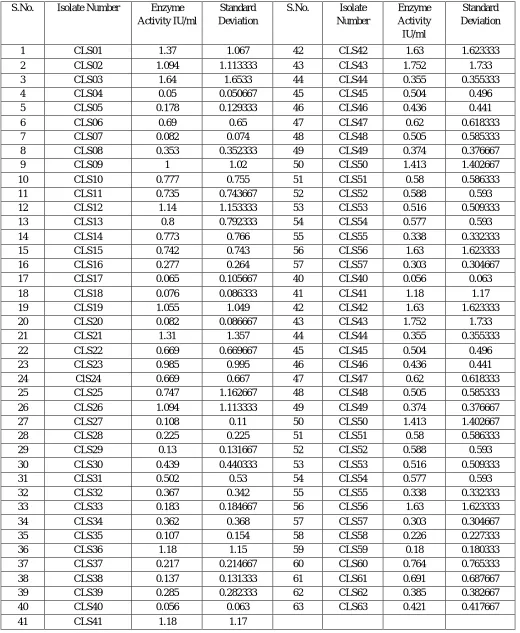
After primary screening, L-Asparaginase produced by isolates was quantitatively estimated with the help of secondary screening by the method of Nesselerisation. after secondary screening, all 229 isolate were selected as primary screening ranked into four categories for enzyme activity, poor L-Asparaginase producers, moderate L-Asparaginase producers, good L-Asparaginase producers and excellent, L-Asparaginase producer. (*Catagories=Less than 0.1 IU/ml =Poor L-Asparaginase producers,0.1 IU/ml-0.5 IU/ml= Morderate L-Asparaginase producers,IU/ml-0.5 IU/ml-1 IU/ml= Good L-Asparaginase producers, Greater than 1 IU/ml = Excellent L-Asparaginase producers)Region wise study indicates, that from Gwalior region, 63(84%) isolates were found to be positive for L-Asparaginase activity after primary screening, secondary screening reveals that maximum 29 (46%) isolates were found to be poor L-Asparaginase producer, 18 (28.5%) shows moderate L-Asparaginase activity, 10(15.8%) were found to be good, and 6 (9.5%) isolates were found to have excellent L-Asparaginase activity, Table 2 present the data of L-Asparaginase activity of bacteria isolated from Gwalior.
84%
41.80%
83.90% 83.30%
74.50%
Asparaginase producing isolates
Gwalior
Banmore
Bhind
Dabra
Table 2: L-Asparaginase activity of isolates from Gwalior region S.No. Isolate Number Enzyme
Activity IU/ml
Standard Deviation
S.No. Isolate Number
Enzyme Activity IU/ml
Standard Deviation
1 CLS01 1.37 1.067 42 CLS42 1.63 1.623333
2 CLS02 1.094 1.113333 43 CLS43 1.752 1.733
3 CLS03 1.64 1.6533 44 CLS44 0.355 0.355333
4 CLS04 0.05 0.050667 45 CLS45 0.504 0.496
5 CLS05 0.178 0.129333 46 CLS46 0.436 0.441
6 CLS06 0.69 0.65 47 CLS47 0.62 0.618333
7 CLS07 0.082 0.074 48 CLS48 0.505 0.585333
8 CLS08 0.353 0.352333 49 CLS49 0.374 0.376667
9 CLS09 1 1.02 50 CLS50 1.413 1.402667
10 CLS10 0.777 0.755 51 CLS51 0.58 0.586333
11 CLS11 0.735 0.743667 52 CLS52 0.588 0.593
12 CLS12 1.14 1.153333 53 CLS53 0.516 0.509333
13 CLS13 0.8 0.792333 54 CLS54 0.577 0.593
14 CLS14 0.773 0.766 55 CLS55 0.338 0.332333
15 CLS15 0.742 0.743 56 CLS56 1.63 1.623333
16 CLS16 0.277 0.264 57 CLS57 0.303 0.304667
17 CLS17 0.065 0.105667 40 CLS40 0.056 0.063
18 CLS18 0.076 0.086333 41 CLS41 1.18 1.17
19 CLS19 1.055 1.049 42 CLS42 1.63 1.623333
20 CLS20 0.082 0.086667 43 CLS43 1.752 1.733
21 CLS21 1.31 1.357 44 CLS44 0.355 0.355333
22 CLS22 0.669 0.669667 45 CLS45 0.504 0.496
23 CLS23 0.985 0.995 46 CLS46 0.436 0.441
24 ClS24 0.669 0.667 47 CLS47 0.62 0.618333
25 CLS25 0.747 1.162667 48 CLS48 0.505 0.585333
26 CLS26 1.094 1.113333 49 CLS49 0.374 0.376667
27 CLS27 0.108 0.11 50 CLS50 1.413 1.402667
28 CLS28 0.225 0.225 51 CLS51 0.58 0.586333
29 CLS29 0.13 0.131667 52 CLS52 0.588 0.593
30 CLS30 0.439 0.440333 53 CLS53 0.516 0.509333
31 CLS31 0.502 0.53 54 CLS54 0.577 0.593
32 CLS32 0.367 0.342 55 CLS55 0.338 0.332333
33 CLS33 0.183 0.184667 56 CLS56 1.63 1.623333
34 CLS34 0.362 0.368 57 CLS57 0.303 0.304667
35 CLS35 0.107 0.154 58 CLS58 0.226 0.227333
36 CLS36 1.18 1.15 59 CLS59 0.18 0.180333
37 CLS37 0.217 0.214667 60 CLS60 0.764 0.765333
38 CLS38 0.137 0.131333 61 CLS61 0.691 0.687667
39 CLS39 0.285 0.282333 62 CLS62 0.385 0.382667
40 CLS40 0.056 0.063 63 CLS63 0.421 0.417667
In Banmore region, a total of 23 isolates were found L-Asparaginase producers. Quantitative estimation indicates that from Banmore region 7 (30.43%) isolates were found poor Asparaginase producer, maximum isolates 9(39.1%) shows moderate L-Asparaginase activity, 3(13%) were found good, and 4(17.3%) isolates were found to have excellent L-L-Asparaginase activity, Table 3 shows results of enzyme activity.
Table 3: L-Asparaginase activity of isolates from Banmore region S.No. Isolate
Number
Enzyme Activity IU/ml
Standard Deviation
S.No. Isolate Number Enzyme Activity IU/ml Standard Deviation
1 CLS164 0.035 0.057333 12 CLS175 1.31 1.357
2 CLS165 0.09 0.091 13 CLS176 0.669 0.669667
3 CLS166 0.126 0.13 14 CLS177 1.29 1.266667
4 CLS167 0.061 0.060333 15 CLS178 0.747 1.162667 5 CLS168 0.101 0.112333 16 CLS179 1.094 1.113333 6 CLS169 0.094 0.092333 17 CLS180 1.29 1.273333 7 CLS170 0.054 0.054667 18 CLS181 0.05 0.050667 8 CLS171 0.065 0.105667 19 CLS180 0.178 0.129333 9 CLS172 0.076 0.086333 20 CLS181 0.072 0.073333
10 CLS173 1.055 1.049 21 CLS182 1.29 1.343667
11 CLS174 0.082 0.086667 22 CLS183 0.074 0.072 23 CLS184 0.184 0.172333
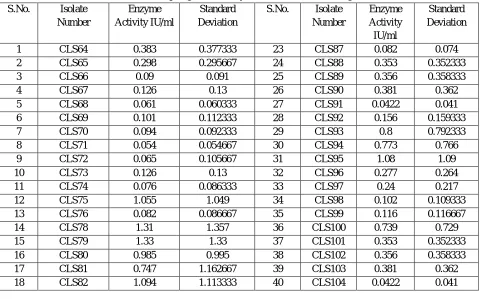
47 isolates was found to be positive L-Asparaginase producers after primary screening, from Bhind region 19 (40.4%) isolates were found to be poor L-Asparaginase producer, 15 (31.9%) show moderate L-Asparaginase Activity, 10 (21.2%) were found good, and 3(6.3%) isolates were found to have excellent L-Asparaginase activity Table 4 represents the enzyme activity result of bacteria isolated from Bhind region.
Table 4: L-Asparaginase activity of isolates from Bhind region S.No. Isolate
Number
Enzyme Activity IU/ml
Standard Deviation
S.No. Isolate Number Enzyme Activity IU/ml Standard Deviation
1 CLS64 0.383 0.377333 23 CLS87 0.082 0.074
2 CLS65 0.298 0.295667 24 CLS88 0.353 0.352333
3 CLS66 0.09 0.091 25 CLS89 0.356 0.358333
4 CLS67 0.126 0.13 26 CLS90 0.381 0.362
5 CLS68 0.061 0.060333 27 CLS91 0.0422 0.041
6 CLS69 0.101 0.112333 28 CLS92 0.156 0.159333
7 CLS70 0.094 0.092333 29 CLS93 0.8 0.792333
8 CLS71 0.054 0.054667 30 CLS94 0.773 0.766
9 CLS72 0.065 0.105667 31 CLS95 1.08 1.09
10 CLS73 0.126 0.13 32 CLS96 0.277 0.264
11 CLS74 0.076 0.086333 33 CLS97 0.24 0.217
12 CLS75 1.055 1.049 34 CLS98 0.102 0.109333
13 CLS76 0.082 0.086667 35 CLS99 0.116 0.116667
14 CLS78 1.31 1.357 36 CLS100 0.739 0.729
15 CLS79 1.33 1.33 37 CLS101 0.353 0.352333
16 CLS80 0.985 0.995 38 CLS102 0.356 0.358333
17 CLS81 0.747 1.162667 39 CLS103 0.381 0.362
[image:6.612.67.547.444.743.2]19 CLS83 0.759 0.740333 41 CLS105 0.156 0.159333 20 CLS84 0.05 0.050667 42 CLS106 0.293 0.284667 21 CLS85 0.178 0.129333 43 CLS107 0.0413 0.044667 22 CLS86 0.072 0.073333 44 CLS108 0.05 0.044967
Asparaginase activity has been noted in 55 (83.3%) isolates from Dabra on primary screening, maximum isolates having poor L-Asparaginas activity that is 22 (40%), while 18 (32.7%),10 (18%),5(9%) isolates were moderate, good and excellent L-L-Asparaginase producers respectively (Table 5).
Table5: L-Asparaginase activity of isolates from Dabra region S.No. Isolate Number Enzyme
Activity IU/ml
Standard Deviation
S.No. Isolate Number
Enzyme Activity IU/ml
Standard Deviation
1 CLS112 0.77 0.778333 27 CLS138 0.285 0.282333
2 CLS113 0.8 0.792333 28 CLS139 0.056 0.063
3 CLS114 0.773 0.766 29 CLS140 0.553 0.531667
4 CLS115 0.742 0.743 30 CLS141 0.639 0.636333
5 CLS116 0.277 0.264 31 CLS142 1.752 1.733
6 CLS117 0.24 0.217 32 CLS143 0.355 0.355333
7 CLS118 0.102 0.109333 33 CLS144 0.504 0.496
8 CLS119 0.116 0.116667 34 CLS145 0.436 0.441
9 CLS120 0.739 0.729 35 CLS146 0.62 0.618333
10 CLS121 0.571 0.575667 36 CLS147 0.505 0.585333
11 CLS122 0.086 0.084 37 CLS148 0.374 0.376667
12 CLS123 0.66 0.683333 38 CLS149 1.413 1.402667
13 CLS124 0.476 0.475 39 CLS150 0.58 0.586333
14 CLS125 0.439 0.440333 40 CLS151 0.588 0.593
15 CLS126 0.108 0.11 41 CLS152 0.516 0.509333
16 CLS127 0.225 0.225 42 CLS153 0.577 0.593
17 CLS128 0.13 0.131667 43 CLS154 0.338 0.332333
18 CLS129 0.439 0.440333 44 CLS155 0.276 0.280333
19 CLS130 0.502 0.53 45 CLS156 0.303 0.304667
20 CLS131 0.367 0.342 46 CLS157 0.226 0.227333
21 CLS132 0.183 0.184667 47 CLS158 0.18 0.180333
22 CLS133 0.362 0.368 48 CLS159 0.764 0.765333
23 CLS134 0.107 0.154 49 CLS160 0.691 0.687667
24 CLS135 0.502 0.53 50 CLS161 0.385 0.382667
25 CLS136 0.217 0.214667 51 CLS162 0.421 0.417667
26 CLS137 0.137 0.131333 52 CLS163 0.383 0.377333
Table 7: L-Asparaginase activity of isolates from Morena region S.No. Isolate
Number
Enzyme Activity IU/ml
Standard Deviation
S.No. Isolate Number
Enzyme Activity IU/ml
Standard Deviation
1 CLS185 0.164 0.157 23 CLS208 0.088333 0.118778
2 CLS186 0.102 0.108333 24 CLS209 0.011333 0.084889 3 CLS187 0.11 0.109667 25 CLS210 0.038667 0.126444 4 CLS188 0.124 0.128667 26 CLS211 0.026667 0.090667
5 CLS189 0.045 0.045333 27 CLS212 0.1132 0.121511
6 CLS190 0.057 0.048667 28 CLS213 0.059 0.056444
7 CLS191 0.05 0.048333 29 CLS214 0.012333 0.046667
8 CLS192 0.156 0.126 30 CLS215 0.132 0.135333
9 CLS193 0.047 0.092333 31 CLS216 0.011 0.049
10 CLS194 0.069 0.071667 32 CLS217 0.051 0.053556
11 CLS195 0.079 0.079 33 CLS218 0.04 0.053333
12 CLS197 0.05 0.053333 34 CLS219 0.11 0.113333
13 CLS198 0.058 0.052333 35 CLS220 0.046 0.048667
14 CLS199 0.013 0.057889 36 CLS221 0.046 0.048667
15 CLS200 0.035 0.057333 37 CLS222 0.12 0.133333
16 CLS201 0.0598 0.060756 38 CLS223 0.089 0.087333
17 CLS202 0.010333 0.041889 39 CLS224 0.061 0.058667
18 CLS203 0.012667 0.050333 40 CLS225 0.08 0.1
19 CLS204 0.014667 0.057444 41 CLS226 0.091 0.093667 20 CLS205 0.040333 0.056333 42 CLS227 0.0922 0.093844
21 CLS206 0.031 0.123667 43 CLS228 0.099 0.094333
22 CLS207 0.0235 0.072722 44 CLS229 0.12 0.106667
C. Quantitative status of L-Asparaginase producing isolates
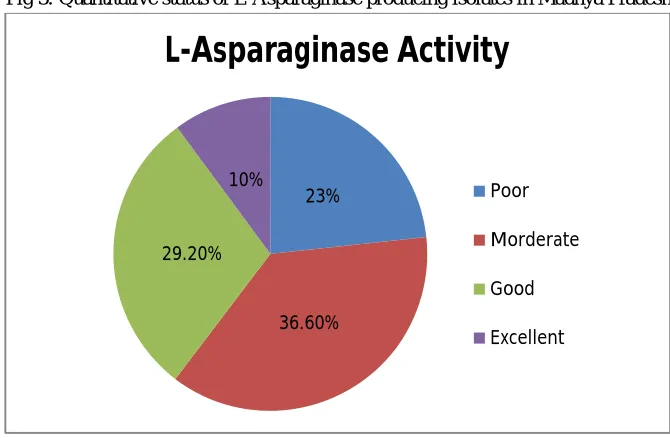
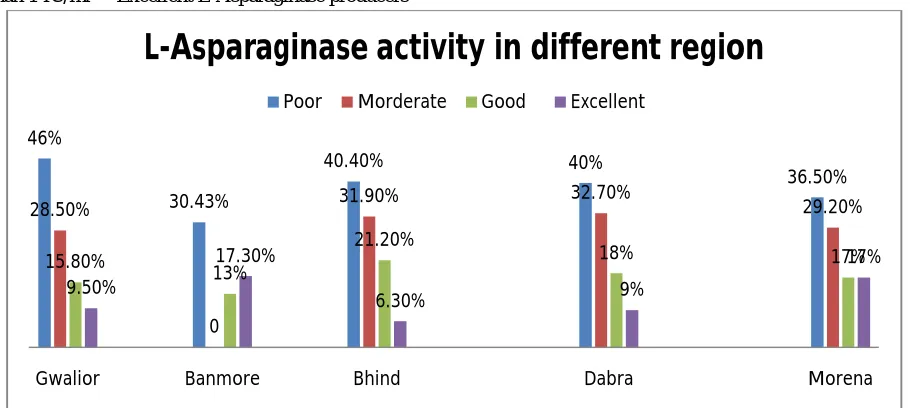
As data reveals that out of total 229 L-Asparaginase producing isolates 53 (23%) isolates were found poor L-Asparaginase producers, followed by 84 (36.6%) as moderate producers, 67(29.2%) as good producers and 25 (10%) were as excellent producers of L-Asparaginase (Fig 3,4 and Table 8).
Fig 3: Quantitative status of L-Asparaginase producing isolates in Madhya Pradesh
23%
36.60% 29.20%
10%
L-Asparaginase Activity
Poor
Morderate
Good
[image:8.612.137.472.517.736.2]Table8: Quantitative status of L-Asparaginase producing isolates
Region
Number of Isolates
Catagories of L-Asparaginase Producing Isolates
Poor L-Asparaginase producers
Morderate L-Asparaginase
producers
Good L-Asparaginase producers Excellent L-Asparaginase producers Number of Isolates Percentage of Isolates Number of Isolates Percentage of Isolates Number of Isolates Percentage of Isolates Number of Isolates Percentage of Isolates Gwalior
63 29 46% 18 28.5% 10 15.8% 6 9.5%
Banmore 23 7 30.43% 9 .39.1% 3 13% 4 17.3%
Bhind 47 19 40.4% 15 31.9% 10 21.2% 3 6.3%
Dabra 55 22 40% 18 32.7% 10 18% 5 9%
Morena 41 15 36.5% 12 29.2% 7 17% 7 17%
Total 229 53 23% 84 36.6% 67 29.2% 25 10 %
[image:9.612.79.534.395.599.2]*Catagories=Less than 0.1 IU/ml =Poor L-Asparaginase producers 0.1 IU/ml-0.5 IU/ml= Morderate L-Asparaginase producers 0.5 IU/ml-1 IU/ml= Good L-Asparaginase producers Greater than 1 IU/ml = Excellent L-Asparaginase producers
Fig 4 : Quantitative status of L-Asparaginase producing isolates in different region of Madhya Pradesh
IV. DISCUSSION
The findings of the present work revealed that the bacteria isolated from Madhya Pradesh, India have a potentiality for extracellular L-Asparaginasee production that shows futuristic approach for the purification studies and evaluation of its antitumor activity. Present study was targeted for the search of new bacterial species with having demandable enzyme characteristic objective of present work was to isolate and screen the L- Asparaginase producing bacteria from the soil of Madhya Pradesh. For that soil samples of different region of Madhya Pradesh, like Gwalior, Bhind, Morena, Dabra and Datia were collected. From them 312 soil bacteria were isolated and all isolates were subjected to primary screening based on plate assay protocol. Isolates producing L-asparaginase were identified by a pink coloured colony on modified M9 agar medium with phenol red as an indicator for detection
46% 30.43% 40.40% 40% 36.50% 28.50% 0
31.90% 32.70% 29.20%
15.80% 13% 21.20% 18% 17% 9.50% 17.30% 6.30% 9% 17%
Gwalior Banmore Bhind Dabra Morena
L-Asparaginase activity in different region
of L-Asparaginase producing colonies [10]. The isolates with the pink coloured colony were selected for further studies, however the organism did not produce any pink zone in both control groups - M-9 media incorporated with L-Asparagine but without phenol red and M-9 media incorporated without L-asparagine. This indicates that the formation of pink zone is due only to L-asparaginase production. For the production of enzyme, it is necessary to know the quantity of enzyme L-Asparaginase produced by soil isolates. The second objective of the study was the quantification of Asparaginase produced by all 229 isolates, which shown positive L-Asparaginase production after primary screening. Enzyme activity was estimated by the Nesslerization method. The enzyme activity was expressed in international units per mililiter (IU/ml). The liberation of ammonia can be determined by reaction of Nessler’s reagent and the production of yellow color was evaluated. The ammonia content was estimated by a standard curve prepared from various dilutions of ammonium chloride solution. After quantitative estimation, 229 isolates were categorize in to four groups which shown that 23% isolates with less than 0.1 IU/ml enzyme activity, considered as poor producers, 36 % isolates shown 0.1-0.5 IU/ml activity, as moderate producers, 29% isolates good enzyme producers have enzyme activity in range of 0.5-1 IU/ml and among them maximum activity was shown by 10% isolates above than 1 IU/ml which were considered as excellent enzyme producers.
V. CONCLUSION
L- Asparaginase is a very important enzyme for commercial purpose used as an anti-neoplastic agent. With the development of its new functions, a great demand for L-asparaginase is expected in coming years Bacteria are promising source of a wide range of important enzymes with respect to their medicinal use, some of which produced in industrial scale. It is necessary for the isolates which gives maximum activity of enzyme should be able survive in different physiological conditions because enzyme produce by this type of isolates may have ability for stable enzyme activity to tolerate different physiologic condition for its industrial applications. There is a immense need of L-Asparaginase which bind substrate efficiently that can be calculate by considerable KM
value of the enzyme, and it can also more efficient in physiological pH. Thus, it is desirable to search for new bacterial isolates producing L-asparaginase with novel properties from as many different sources as possible.
VI. ACKNOWLEGMENTS
Author thankful to a Dr. B.R. Shrivastav, head department of surjury, cancer hospital Gwalior for support during research.
REFERENCES
[1] Pieters, R., Hunger, S.P., Boos, J., Rizzari, C., Silverman, L., Baruchel, A., Goekbuget, N., Schrappe, M. and Pui, C.H., 2011. L‐asparaginase treatment in acute lymphoblastic leukemia. Cancer, 117(2), pp.238-249.
[2] El-Bessoumy A A, Sarhan M and Mansour J (2004 ), “Production, Isolation, and Purification of L-Asparaginase from Pseudomonas Aeruginosa 50071 Using Solid-state Fermentation”, J. Biochm. and Mol. Biol., Vol. 37, No. 4, pp. 387-393
[3] Sahu, M.K., Sivakumar, K., Poorani, E., Thangaradjou, T. and Kannan, L., 2007. Studies on L-asparaginase enzyme of actinomycetes isolated from estuarine fishes. Journal of Environmental Biology, 28(2), p.465
[4] Gupta, N., Dash, S.J. and Basak, U.C., 2009. L-asparaginases from fungi of Bhitarkanika mangrove ecosystem. AsPac J. Mol. Biol. Biotech, 17(1), pp.27-30 [5] Nottage, K.A., Ness, K.K., Li, C., Srivastava, D., Robison, L.L. and Hudson, M.M., 2014. Metabolic syndrome and cardiovascular risk among long‐term
survivors of acute lymphoblastic leukaemia‐From the St. Jude Lifetime Cohort. British journal of haematology, 165(3), pp.364-374 [6] MacDonald, R.M., 1986. Extraction of microorganisms from soil. Biological Agriculture and Horticulture, 3(4), pp.361-365
[7] Gulati, R., Saxena, R.K. and Gupta, R., 1997. A rapid plate assay for screening l‐asparaginase producing micro‐organisms. Letters in applied microbiology, 24(1), pp.23-26
[8] Imada, A., Igarasi, S., Nakahama, K. and Isono, M., 1973. Asparaginase and glutaminase activities of micro-organisms. Microbiology, 76(1), pp.85-99 [9] Lowry, O.H., Rosebrough, N.J., Farr, A.L. and Randall, R.J., 1951. Protein measurement with the Folin phenol reagent. Journal of biological chemistry, 193(1),
pp.265-275