
R E S E A R C H A R T I C L E
Open Access
Evaluation of the effects of a standardized
aqueous extract of
Phyllanthus emblica
fruits on endothelial dysfunction, oxidative
stress, systemic inflammation and lipid
profile in subjects with metabolic
syndrome: a randomised, double blind,
placebo controlled clinical study
Pingali Usharani
*, Padma Latha Merugu and Chandrasekhar Nutalapati
Abstract
Background:Endothelial dysfunction (ED) has been observed in individuals with metabolic syndrome (MetS) and contributes to the initiation and progression of atherosclerosis. The primary management of MetS involves lifestyle modifications and treatment of its individual components with drugs all of which have side effects. Thus, it would be of advantageous if natural products would be used as adjuncts or substitutes for conventional drugs. The aim of the present study was to evaluate the effect of standardized aqueous extract of fruits ofPhyllanthus emblica
(P. emblica)250 mg and 500 mg twice daily on ED, oxidative stress, systemic inflammation and lipid profile in subjects with MetS.
Methods: In this randomised, double-blind, placebo-controlled clinical study endothelial function was measured by calculating reflection index (RI) using digital plethysmograph. Oxidative stress biomarkers used were nitric oxide (NO), glutathione (GSH) and malondialdehyde (MDA). Systemic inflammation was measured by determining high sensitivity C-reactive protein (hsCRP) and dyslipidemia by lipid profile. ANOVA, paired and unpaired t-test were used.P-value < 0.05 was considered statistically significant.
Results:Out of 65 screened subjects all 59 enrolled completed the study.P. emblicaaqueous extract (PEE), 250 mg and 500 mg twice daily dosing, showed significant reduction in mean RI, measure of endothelial function, at 8 and 12 weeks (p< 0.001) compared to baseline and placebo. Significant mean % change was seen in oxidative stress biomarkers, NO (+ 41.89%, + 50.7%), GSH (+ 24.31%, + 53.22%) and MDA (−21.02%, −31.44%), and systemic inflammation biomarker, hsCRP (−39.68%, −53.77%) (p< 0.001) at 12 weeks with 250 mg and 500 mg twice daily dosage respectively. Significant mean % change was also seen at 12 weeks with TC (−7.71%, −11.11%), HDL-C (+ 7.33% + 22.16%, p< 0.05), LDL-C (−11.39%, −21.8%) and TG (−9.81%, −19.22%) respectively with 250 mg and 500 mg twice daily (p< 0.001). PEE 500 mg twice daily was significantly more efficacious than the 250 mg twice daily and placebo. No participant discontinued the study because of adverse events.
(Continued on next page)
© The Author(s). 2019Open AccessThis article is distributed under the terms of the Creative Commons Attribution 4.0 International License (http://creativecommons.org/licenses/by/4.0/), which permits unrestricted use, distribution, and reproduction in any medium, provided you give appropriate credit to the original author(s) and the source, provide a link to the Creative Commons license, and indicate if changes were made. The Creative Commons Public Domain Dedication waiver (http://creativecommons.org/publicdomain/zero/1.0/) applies to the data made available in this article, unless otherwise stated.
* Correspondence:[email protected]
(Continued from previous page)
Conclusions: P.emblica aqueous extract significantly improved endothelial function, oxidative stress, systemic inflammation and lipid profile at both dosages tested, but especially at 500 mg twice daily. Thus, this product may be used as an adjunct to conventional therapy (lifestyle modification and pharmacological intervention) in the management of metabolic syndrome.
Trial registration: This study was registered with Clinical Trials Registry –India (CTRI) with the registration number of CTRI/2017/09/009606. The study was registered retrospectively on 4th September 2017.
Keywords: Phyllanthus emblica, Emblica officinalis, Amla, Reflection index, Dyslipidemia, Oxidative stress, Systemic inflammation, Endothelial dysfunction
Background
Metabolic syndrome (MetS) is characterized by the coexistence of multiple interrelated cardiovascular (CV) risk factors in a single individual [1]. The Na-tional Cholesterol Education Program’s Adult Treat-ment Panel III (ATP III) identified six components of the MetS: abdominal obesity, insulin resistance with or without glucose intolerance, atherogenic dys-lipidaemia, raised blood pressure, prothrombotic state, and proinflammatory state [2]. MetS affects 25% of the world population, and its incidence is gradually increasing [3].
Endothelial dysfunction (ED) is abnormal functioning of the endothelial cells, caused by a decrease in bioavail-ability of vasodilator substances, particularly nitric oxide (NO), and increase of vasoconstrictor substances. Nu-merous metabolic abnormalities found in MetS result in endothelial cell dysfunction by affecting NO synthesis or degradation. The frequent metabolic abnormalities that may contribute to ED in patients with MetS are hyperin-sulinemia, hyperglycaemia, increase in the levels of fatty acids, C- reactive protein, oxidative stress, triglycerides and low-density lipoprotein cholesterol (LDL-C), and a decrease in high-density lipoprotein cholesterol (HDL-C) [4].
Both obesity and MetS have been independently asso-ciated with increased oxidative and inflammatory stress [5]. Oxidative stress is due to the production of reactive oxygen species (ROS), increased lipid peroxidation and impairment of antioxidant enzymatic defences, such as superoxide dismutase (SOD) or glutathione peroxidase (GPx) or combination of these factors [6]. Lipid peroxi-dation leads to the formation of malondialdehyde (MDA), and increased levels of MDA are found in obes-ity and insulin resistance. MDA can induce the increased expression of pro-inflammatory cytokines, resulting in systemic stress [7]. C-reactive protein (CRP) is a marker of systemic inflammation and a predictor of future atherosclerotic events [5]. Specifically, high sensitivity C -reactive protein (hsCRP) is an independent predictor of coronary heart disease [8].
Endothelial dysfunction (ED) is the earliest detectable functional disturbance in the natural history of the dis-ease and a powerful predictor of future CV events [9]. Therapeutic interventions aimed at reducing CV risk factors may improve the endothelial function [10]. The primary management of MetS involves lifestyle modifica-tions and treatment of its individual components, which includes lipid-lowering drugs, angiotensin-converting enzyme inhibitors, antidiabetic drugs, antiplatelet and antioxidant agents. However, the currently available pharmacologic interventions sometimes may not suffi-ciently improve endothelial function or may have side ef-fects [11]. So, alternative treatments are needed to prevent the development of cardiovascular diseases (CVD) in subjects with MetS.
Phllanthus emblica (Emblica officinalis, Amla) fruits are an important dietary source of polyphenolic com-pounds, which are low molecular weight hydrolysable tannins. This fruit extract has been reported to exhibit hypolipidemic, antidiabetic, inflammatory, and anti-oxidant properties [12]. It has been reported that the tannoid principles of aqueous extract of Amla are a po-tent inhibitor of lipid peroxide generation and a scaven-ger of hydroxyl and superoxide radicals in vitro and in vivo [13].
Clinical studies provide evidence that P.emblica ex-tract has significantly improved endothelial function and reduced biomarkers of oxidative stress and systemic in-flammation in patients with type 2 diabetes mellitus (T2DM) [14,15]. As there is a paucity of data on the ef-fect ofP.emblica on ED in MetS, the present study was undertaken to evaluate the effect of a standardized aque-ous extract of P.emblica, at 250 mg (PEE250) and 500 mg (PEE500) versus placebo twice daily on ED, oxidative stress, systemic inflammation and lipid profile in MetS.
Methods
India, after written approval from the Institutional Ethics Committee. Written informed consent was taken from all the subjects prior to participation in the study.
Subjects included in the study were of either gender, aged 30–68 years, having ED defined as ≤6% change in reflection index (RI) on post salbutamol challenge test and having MetS according to “The International Dia-betes Federation” guidelines, dated 2006 [3]. Exclusion criteria consisted of subjects with severe uncontrolled hypertension, uncontrolled hyperglycemia, impaired hepatic or renal function, cardiac arrhythmia, chronic obstructive pulmonary disease (COPD), bronchial asthma, history of smoking, chronic alcoholism, malig-nancy or stroke and any other serious disease requiring active treatment and treatment with any other herbal supplements. A total of 65 subjects were screened and 59 eligible subjects were randomised by computer gener-ated block randomisation.
Study medications: The test products, PEE250 (CAPROS® 250) and PEE500 (CAPROS® 500) and matching placebo capsules used in the present study were supplied by Natreon Inc., USA. Each capsule of the PEE250 and PEE500 comprised of aqueous extract of the edible fruits of P. emblica, standardized by high performance liquid chro-matography (HPLC) to contain not less than 60% of low molecular weight hydrolysable tannins ((LMwHTs), com-prising of Emblicanin–A, Emblicanin-B, Pedunculagin and Punigluconin as bioactives. Placebo capsules contained microcrystalline cellulose, lactose and magnesium stearate as excipients. The HPLC chromatogram of CAPROS® is shown in Fig. 1. The HPLC method used was the com-pany’s In-house Monograph method. Briefly, 50 mg of P.emblicaextract was dissolved in 50 ml of distilled water, and filtered through 0.22μm syringe filter. The filtered
solution (20μL) was injected into Waters HPLC system (equipped with e2695 separation module, Photodiode Array detector (2998), and Empower3 pro Software). Compounds were separated on a NovaPak RP C18 150 × 3.9 mm, 4μ
(Waters corporation, WAT086344), column using 0.1 M sodium acetate–acetic acid buffer (pH 3.9) as the mobile phase at the flow rate of 0.6 ml/min and detection wave-length 280 nm. The percentage content of the LMwHTs was calculated using area of the LMwHTs peaks and the linear regression equation of the external standard.
Eligible subjects were enrolled and randomised by the investigator. The containers containing drugs were se-quentially numbered and were dispensed by the pharma-cist to the subjects according to the randomly allocated sequence so as to receive one capsule of PEE250, PEE500 or placebo twice daily for 12 weeks. Subjects returned for follow up visits at 4, 8 and 12 weeks of therapy, when sub-jects were evaluated for efficacy and safety. Pharmacody-namic evaluation of endothelial function (RI) was conducted at every visit. A 10 ml blood sample was col-lected in plain blood collection tubes after an overnight fast of 12 h for evaluation of NO, MDA, glutathione (GSH), hsCRP and lipid profile at baseline and at the end of 12 weeks of treatment. A complete physical examin-ation and safety lab investigexamin-ations for hematological, hep-atic and renal biochemical parameters were conducted at baseline and at the end of the study, and as required dur-ing the study. Subjects were enquired for the presence of adverse drug reaction (ADR) at every visit, and any re-ported ADRs were recorded in the case report form. Compliance with therapy was assessed by pill count method.
Endothelial function was evaluated by salbutamol chal-lenge test using the digital volume plethysmography
[image:3.595.58.542.504.713.2](DPG) as reported by Chowienczyk et al. and Naidu et al. [16, 17]. Subjects were examined in supine position after 5 min of rest. A digital volume pulse (DVP) was ob-tained using photo plethysmograph (Pulse Trace PCA2, PT200, Micro Medical, Kent, UK) transmitting infra-red light at 940 nm, placed on the index finger of right hand. The signal from the plethysmograph was digitized using a 12 bit analogue to digital converter with a sampling frequency of 100 Hz. DVP waveforms were recorded over 20 s period and the height of the late systolic / early diastolic portion of the DVP was expressed as a percent-age of the amplitude of the DVP to yield the RI, as per the procedure described in detail by Millasseau et al. [18]. After DVP recordings had been taken, three mea-surements of RI were calculated and the mean value was determined. Subjects were then administered 400μg of salbutamol by inhalation. After 15 min, three measure-ments of RI were obtained again and the difference in mean RI before and after administration of salbutamol was used for assessing endothelial function. A change of ≤6% in RI post salbutamol was considered as endothelial dysfunction.
A spectrophotometer was used to estimate serum MDA (Thiobarbituric acid reactive substance test), NO (Colorimetric detection with Griess reagents) and GSH (Ellman’s method) levels [19–21].
Peripheral venous blood was collected in plain blood collection tubes after an overnight fast of 12 h after the last dose of medication for the estimation of haemoglo-bin, blood urea, serum creatinine, liver function test, lipid profile using standard techniques.
Primary and secondary efficacy parameters
The primary efficacy criterion was more than 6% change in RI (a measure of ED), assessed at 4,8 and 12 weeks. Secondary efficacy parameters included improve-ments in oxidative stress markers - NO, GSH and MDA, systemic inflammation marker hsCRP and the lipid pro-file at 12 weeks. Safety and tolerability assessment of the test medications were also conducted at 12 weeks.
Statistical analysis
Sample size calculation
Sample size calculation was done based on a previous study by Nishat Fatima et.al [14]. A sample size of 65 was estimated to recruit 59 patients considering a differ-ence of 0.91% change in mean reflection index between PEE250 versus PEE500, with anticipated standard devi-ation of 0.92 at 5% level of significance and 80% power of study with screen failure rate of 10% and dropout rate of 15%.
Data were expressed as mean ± SD. The Kolmogorov-Smirnov test was used to assess the normality of the data. Unpaired t-test was performed to determine the
statistical significance between groups and paired t-test was used to analyse within the group. One-way ANOVA was done for between groups analysis for absolute and mean percentage change. Posthoc analysis was done by Tukey’s test. A p-value of less than 0.05 was considered to be statistically significant. All statistical analysis was performed using the GraphPad Prism version 4.
Results
Out of the 65 screened subjects, 59 eligible subjects were randomised and all completed the study. Of the 59 subjects, 18 subjects received placebo, 20 subjects received PEE250 and 21 subjects received PEE500 twice daily. The subjects’ baseline characteristics are shown in Table 1, which indicate the study population was homogenous. Lipid abnormalities were present in all subjects.
The RI was used to assess endothelial function. It can be seen from Table2, that baseline RI was nonsignificant between the three treatments. Treatment with PEE250 and PEE500 twice daily showed a significant reduction in mean RI at 8 and 12 weeks, indicating an improve-ment in endothelial function (p< 0.001). On further analysis, it was found that change in mean RI with PEE500 was significantly better compared to PEE250 (p < 0.05). Compared to placebo absolute change of RI was statistically significant with the two active treatments after 8 and 12 weeks of treatment.
The mean percent change in biomarker values was analysed for each of the study treatments at 12 weeks. Significant mean % change was seen in oxidative stress biomarkers, NO (+ 41.89%, + 50.7%), GSH (+ 24.31%, + 53.22%) and MDA (−21.02%, −31.44%), and the sys-temic inflammation biomarker, hsCRP (−39.68%, − 53.77%) (p< 0.001) at 12 weeks with the 250 mg and 500 mg twice daily dosage respectively (Table 3), evi-dence of improved endothelial function and decreased systemic inflammation. PEE500 was significantly (p < 0.01 top< 0.001) more efficacious than PEE250.
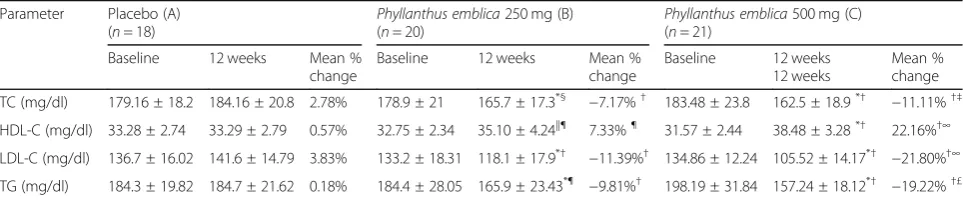
Significant mean % changes were also seen at 12 weeks with TC (−7.71%,−11.11%), HDL-C (+ 7.33%,p< 0.05, + 22.16%), LDL-C (−11.39%, −21.8%) and TG (−9.81%,− 19.22%) respectively with PEE250 and PEE500 twice daily dosing (p < 0.001) (Table 4). Compared to PEE250 twice daily, treatment with PEE500 twice daily was more effica-cious in improving TC (p< 0.05), LDL-C (p< 0.001), HDL-C (p< 0.001) and TG (p< 0.01) levels (Table4).
resolved with symptomatic treatment. None of the pa-tients discontinued the study prematurely because of these adverse events.
Discussion
In our study on 59 subjects the aqueous extract of P.emblica has shown statistically significant improve-ment in endothelial function, biomarkers of oxidative stress (NO, GSH, MDA), inflammatory marker (hsCRP) and lipid profile.
Studies by Hyun Young Kim et al. [22] and Manoj Gupta et al. [23] showed beneficial effects ofP.emblicaon parame-ters of MetS like oxidative stress biomarkers, lipid profile, and inflammatory markers. However, these studies did not evaluate endothelial function. In our study, RI was mea-sured to assess endothelial function, using salbutamol chal-lenge test employing DPG. Salbutamol chalchal-lenge test used to assess endothelial function (RI) is a simple, non-invasive, reproducible and a reliable method [17]. This test does not require trained personnel unlike flow-mediated vasodilation (FMD) which requires sophisticated instrument, a skilled
[image:5.595.57.538.99.296.2]operator and has a chance for large inter-individual vari-ability in the assessment of ED [17,24]. In our earlier study using salbutamol challenge test, we have reported a signifi-cant reduction in mean RI withP.emblica250 mg (from− 2.25 ± 1.37 to−9.13 ± 2.56) and 500 mg (from−2.11 ± 0.98 to −10.04 ± 0.92) after 12 weeks of treatment in patients with T2DM [14]. In another study, we demonstrated a sig-nificant reduction in the mean RI compared to baseline and placebo withTerminalia chebula250 mg [from−2.25 ± 0.70 to−3.72 ± 1.35 mg] and 500 mg [from−2.35 ± 0.85 to−6.14 ± 1.01] in MetS subjects [25]. Keisuke Fujitakaa et al. in their study reported that administration of modified resveratrol (Longevinex) for 3 months improves endothelial function (measured using flow-mediated dilatation) in adults with MetS receiving standard treatment for T2DM, dyslipidaemia, or hypertension [26]. Results of the earlier mentioned study [14] are in accordance with our study where we found that treatment with a standardized aque-ous extract of the edible fruits ofP. emblicashowed a sig-nificant reduction in mean RI compared to baseline and placebo using DPG method.
Table 1Baseline characteristics of subjects receiving Placebo,Phyllanthus emblica250 mg andPhyllanthus emblica500 mg
Parameter Placebo (A) (n= 18) Phyllanthus emblica250 mg (B) (n= 20) Phyllanthus emblica500 mg (C) (n= 21) Age in Yrs. 56.89 ± 7.39 57.45 ± 7.44 57.24 ± 8.94
Gender (M/F) 14/4 14/6 15/6 Bodyweight (Kg) 78.17 ± 5.94 78.9 ± 6.61 78.9 ± 4.87 Height (cm) 161.17 ± 2.77 162.20 ± 3.53 162.14 ± 2.83 BMI (Kg/m2) 30.11 ± 1.72 30.02 ± 1.66 30.05 ± 1.70 BMI (kg/m2) < 30 5 (28%) 7 (35%) 6 (29%)
> 30 13 (72%) 13 (65%) 15 (71%) SBP (mmHg) < 130 5 (28%) 7 (35%) 9 (43%)
> 130 13 (72%) 13 (65%) 12(57%) DBP (mmHg) < 85 10(56%) 12(60%) 8(38%)
> 85 8 (44%) 8 (40%) 13 (62%) FPG (mg /dL) < 100 13 (72%) 11 (55%) 8(38%)
> 100 5 (28%) 9 (45%) 13 (62%)
Values expressed as mean ± SD
SDstandard deviation,BMIBody Mass Index,SBPSystolic blood pressure,DBPDiastolic blood pressure,FPGFasting plasma glucose
Table 2Effect of Placebo,Phyllanthus emblica250 mg and Phyllanthus emblica500 mg on reflection index % (marker of endothelial function)
Parameter Placebo (A) (n= 18)
Phyllanthus emblica250 mg (B) (n= 20)
Phyllanthus emblica500 mg (C) (n = 21)
RI (%) Baseline After treatment Baseline After treatment Baseline After treatment
4 weeks 8 weeks 12 weeks 4 weeks 8 weeks 12 weeks 4 weeks 8 weeks 12 weeks Mean ±
SD − 2.27 ± 1.22 −
1.88 ± 1.24 −
1.46 ± 1.61 −
0.97 ± 2.45 −
2.20 ± 0.97 −
2.39 ± 1.16 −
4.18 ± 0.87*† −
8.82 ± 1.54*† −
2.52 ± 1.13 −
2.76 ± 0.99 −
4.86 ± 0.88*†‡ −
10.03 ± 1.58*†‡ p NS NS NS NS < 0.001 < 0.001 NS < 0.001 < 0.001
Values expressed as mean ± SD
SDstandard deviation,RIReflection index
[image:5.595.58.538.620.707.2]Increased oxidative stress plays a pivotal role in the pathogenesis of ED. Tung-Sheng Chen et al., have re-ported that oral administration of a 1:1 mixture of epi-gallocatechin gallate (EGCG) and Emblica officinalis extract 300 mg/day for 3 months significantly reduced the MDA (p< 0.001) levels in diabetic uremic patients [27]. Hyun Young Kim et al. demonstrated that oral ad-ministration of an ethyl acetate (EtOAc) extract of amla, to high-fructose diet fed rats at the dose of 20 mg/kg re-duced the serum and hepatic mitochondrial MDA levels (p < 0.001) [22]. Our study had shown results similar to Tung- Sheng Chen et al. We found that 12 week therapy with PEE250 and PEE500 significantly decreased MDA levels compared to baseline and placebo. Additionally, we also evaluated NO and GSH and reported a statisti-cally significant increase in their levels. In an earlier study done by us withP. emblicaon T2DM patients, we reported similar results on biomarkers of oxidative stress [14]. No significant changes were observed in the pla-cebo group in any of these evaluated parameters.
Akhtar et al. reported that treatment withEmblica offi-cinalis fruit powder, either 2 or 3 g per day for 21 days, significantly increased HDL-C (p< 0.05) and lowered TC (p < 0.05) and TG (p < 0.05), LDL-C (p < 0.05) levels in normal and diabetic human subjects [28]. Savita Khanna et al. demonstrated that 3 months oral supplementation
[image:6.595.58.544.99.209.2]of standardized extract of P. emblica fruit 500 mg twice daily, showed a significant decrease in LDL-C (p= 0.023) and total cholesterol/HDL ratio (p= 0.006) in over-weight/Class-1 obese adults [8]. A pilot study done by Biswas et al. in human volunteers with a long smoking history, demonstrated a marginal decrease in cholesterol (−6.1%), triglyceride (−3.2%) and LDL (−9.4%) but a significant increase in serum HDL level (25.6%) with Emblica officinalisextract [29], the same extract used in the present study. Our results were in accordance with the reported study [29] and we also found that 12 weeks of treatment with PEE250 and PEE500 twice daily showed a significant change in TC (−7.71% and− 11.11%), LDL-C (−11.39% and−21.8%), and TG (− 9.81% and−19.22%) and HDL-C (+ 7.33% and + 22.16%) compared to baseline for PEE250 and PEE500 respect-ively. PEE500 was significantly more efficacious than PEE250, while the placebo group had no significant ef-fect on any of the parameters. The improvement in lipid parameters which were found in our study may be attributed to the fact that hypercholesterolemia in-duces a number of changes in vascular homeostasis and it appears that cholesterol-induced ED is linked to the degree of LDL oxidation and not LDL concen-tration itself [30]. Antioxidants may be protective against oxidative stress and preserve NO by Table 3Effect of Placebo,Phyllanthus emblica250 mg andPhyllanthus emblica500 mg on biomarkers
Parameter Placebo (A)
(n = 18) Phyllanthus emblica
250 mg (B)
(n = 20) Phyllanthus emblica
500 mg (C) (n= 21)
Baseline 12 weeks Mean % change
Baseline 12 weeks Mean % change
Baseline 12 weeks Mean% change NO (μM/L) 32.97 ± 4.02 32.58 ± 3.88 −0.94% 34.53 ± 5.81 47.88 ± 5.62*† 41.89%† 32.62 ± 3.91 48.80 ± 5.97*† 50.70%†∞ GSH (μM/L) 421.24 ± 61.1 429.3 ± 62.4 2.15% 424.91 ± 103.16 524.05 ± 121.5*§ 24.31%† 395.07 ± 58.03 599.33 ± 62.69*† 53.22%†∞ MDA (nM/ml) 3.79 ± 0.67 3.90 ± 0.60 3.53% 3.86 ± 0.75 2.94 ± 0.57*† −21.02%† 3.85 ± 0.79 2.48 ± 0.38*† −31.44%†Ns hsCRP (mg/L) 3.61 ± 0.74 3.66 ± 0.61 2.48% 3.39 ± 0.74 2.06 ± 0.93*† −39.68%† 3.51 ± 0.91 1.56 ± 0.63*† −53.77%†‡
Values expressed as mean ± SD
SDStandard deviation,NONitric oxide,GSHGlutathione,MDAMalondialdehyde,hsCRPhigh sensitivity C - reactive protein
*
p< 0.001 compared to baseline value.†p< 0.001 and§
p< 0.01 compared to placebo (A vs B, A vs C).∞p< 0.001 B vs C,‡p< 0.05: B vs C
Table 4Effect of Placebo, Phyllanthus emblica250 mg andPhyllanthus emblica500 mg on lipid profile
Parameter Placebo (A) (n= 18)
Phyllanthus emblica250 mg (B) (n= 20)
Phyllanthus emblica500 mg (C) (n= 21)
Baseline 12 weeks Mean % change
Baseline 12 weeks Mean % change
Baseline 12 weeks 12 weeks
Mean % change TC (mg/dl) 179.16 ± 18.2 184.16 ± 20.8 2.78% 178.9 ± 21 165.7 ± 17.3*§
−7.17%† 183.48 ± 23.8 162.5 ± 18.9*† −11.11%†‡
HDL-C (mg/dl) 33.28 ± 2.74 33.29 ± 2.79 0.57% 32.75 ± 2.34 35.10 ± 4.24||¶ 7.33%¶ 31.57 ± 2.44 38.48 ± 3.28*† 22.16%†∞
LDL-C (mg/dl) 136.7 ± 16.02 141.6 ± 14.79 3.83% 133.2 ± 18.31 118.1 ± 17.9*† −11.39%† 134.86 ± 12.24 105.52 ± 14.17*† −21.80%†∞
TG (mg/dl) 184.3 ± 19.82 184.7 ± 21.62 0.18% 184.4 ± 28.05 165.9 ± 23.43*¶
−9.81%† 198.19 ± 31.84 157.24 ± 18.12*† −19.22%†£
Values expressed as mean ± SD
SDStandard deviation,TCTotal cholesterol,HDL-CHigh-density lipoprotein Cholesterol,LDL-Clow-density lipoprotein cholesterol,TGTriglycerides
*
p< 0.001,||
p< 0.05 compared to baseline value.†p< 0.001,§
p< 0.01,¶
p< 0.05 compared to placebo (A vs B, A vs C).∞p< 0.001 B vs C,£
[image:6.595.57.539.597.697.2]scavenging ROS and inhibiting oxidized LDL (OxLDL) formation [31].
Systemic inflammation biomarkers, hsCRP, is a pre-dictor of CV events in healthy individuals as well as in persons with the MetS [32]. Antony et al. observed that treatment with Amlamax®, at doses of 500 mg/day and 1000 mg/day, brought about a significant fall in blood CRP levels [33]. Savita Khanna et al. demonstrated that treatment with standardizedP.emblicafruit extract, 500 mg twice daily for 3 months, revealed a significant de-crease in hsCRP (p< 0.001) in overweight /Class-1 obese adults [8]. In another study, it was observed that there was a significant change (−14.3%) in the level of hsCRP levels withEmblica officinalis extract treated group and a 7.4% increase with the placebo group [29]. We re-ported a similar reduction in hsCRP in our earlier study withP. emblicain T2DM patients [14]. Similar findings were reported in the present study in which 12 week treatment with PEE250 and PEE500 showed significant reduction in hsCRP compared to baseline and placebo.
Improvement in endothelial function and dyslipidae-mia achieved by amla extract seems to be brought about by a number of factors, like preventing the initiation of early ED by its antioxidant action, preventing LDL oxi-dation, decreasing LDL cholesterol, besides inhibiting 3-hydroxy-3-methylglutaryl- Coenzyme A (HMG Co-A) reductase activity and elevating HDL-C level [34]. The antioxidant property and cholesterol-lowering activity of polyphenolic compounds present in amla seem to play a role here.
Conclusion
In the present study, standardized aqueous extract of Phyllanthus emblica significantly improved endothelial function, as evidenced by a significant decrease in reflec-tion index, accompanied by a significant increase in NO, GSH and a significant decrease in MDA in subjects with MetS. In addition, the systemic inflammation biomarker, hsCRP, also decreased and the lipid profile improved sig-nificantly. Both 250 mg twice daily and 500 mg twice daily doses had significantly better effect than the pla-cebo; however, the 500 mg twice daily dose was signifi-cantly more efficacious than the 250 mg twice daily dose. All the treatments were well tolerated. Hence we suggest that Phyllanthus emblicabe used as an adjunct to con-ventional treatment (lifestyle modification and pharma-cological intervention) in the management of MetS. Further studies in a larger population are warranted to address whether administration of Phyllanthus emblica may lead to a novel therapeutic alternative in improving the components of metabolic syndrome.
Abbreviations
ADR:Adverse drug reaction; ATP III: Adult Treatment Panel III; CRP: C-reactive protein; CV: Cardiovascular; CVD: Cardiovascular disease (CVD); DM: Diabetes
mellitus; DPG: Digital volume plethysmography; DVP: Digital volume pulse; ED: Endothelial dysfunction; PEE:Phyllanthus emblicaextract; FMD: Flow-mediated vasodilation; GSH: Glutathione; HDL–C: High-density lipoprotein cholesterol; hsCRP: High sensitivity C - reactive protein; LDL–C: Low-density lipoprotein cholesterol; LMwHTs: low molecular weight hydrolysable tannins; MDA: Malondialdehyde; MetS: Metabolic syndrome; NO: Nitric oxide;P.
emblica:Phyllanthus emblica; RI: Reflection index; ROS: Reactive oxygen species; TG: Triglycerides
Acknowledgments
We are grateful to Dr.Y.S.N. Raju, Professor of General Medicine, NIMS, for his clinical support. The authors also acknowledge Natreon, Inc., USA, for providing study medications (Phyllanthus emblicacapsules and Placebo capsules) and kits for biomarkers, Dr. I. Sravanthi, an Ayurvedic physician for her expert advice and study coordinator Mr. Muralidhar.
Funding
We acknowledge Natreon, Inc., USA, for providing study medications and kits for biomarkers. The design of the study, collection, analysis, and interpretation of data and writing the manuscript was done by the investigators.
Availability of data and materials
The datasets used and/or analyzed during the current study are available from the corresponding author on reasonable request.
Authors’contributions
UP Protocol and study design, subject recruitment, follow-up of the subjects, interpretation of the data, drafting of the manuscript, approved the final version of the manuscript. PLM Subject recruitment, follow-up of the subjects, acquisition of the data, drafting of the manuscript, approved the final version of the manuscript. CN Subject recruitment, follow-up of the subjects, acquisition of the data, drafting of the manuscript, approved the final version of the manuscript.
Ethics approval and consent to participate
The present study was approved by Nizam’s Institute of Medical Sciences -Institutional Ethics Committee (NIEC), IRB/NIMS/011(a) 2012.Written informed consent was taken from all the subjects prior to participation in the study.
Consent for publication Not Applicable.
Competing interests
Authors declare no competing interests. We acknowledge Natreon, Inc., USA, for providing study medications and kits for biomarkers.
Publisher’s Note
Springer Nature remains neutral with regard to jurisdictional claims in published maps and institutional affiliations.
Received: 11 December 2018 Accepted: 17 April 2019
References
1. Alberti KGMM, Eckel RH, Grundy SM, Zimmet PZ, Cleeman JI, Donato KA, et al. Harmonizing the metabolic syndrome: a joint interim statement of the international diabetes federation task force on epidemiology and prevention; National Heart, Lung, and Blood Institute; American Heart Association; world heart federation; international atherosclerosis society; and international association for the study of obesity. Circulation. 2009;120:1640–5. 2. Third report of the National Cholesterol Education Program (NCEP) expert
panel on detection, evaluation, and treatment of high blood cholesterol in adults (adult treatment panel III). Final Report Circulation 2002; 106: 3143–3421. 3. The IDF consensus worldwide definition of the metabolic syndrome.
International Diabetes Fedaration 2006. Avaliable fromhttps://www.idf.org/ e-library/consensus-statements%20/60-idf%20consensus-worldwide-definitionof-the-metabolic-syndrome. [Accessed 17 May 2017]. 4. Cozma A, Orasan O, Sampelean D, Fodor A, Vlad C, Negrean V, et al.
5. Van Guilder GP, Hoetzer GL, Greiner JJ, Stauffer BL, DeSouza CA. Influence of metabolic syndrome on biomarkers of oxidative stress and inflammation in obese adults. Obesity. 2006;14:2127–31.
6. Yubero-Serrano EM, Delgado-Lista J, Peña-Orihuela P, Perez-Martinez P, Fuentes F, Marin C, et al. Oxidative stress is associated with the number of components of metabolic syndrome: LIPGENE study. Exp Mol Med. 2013;45:e28.
7. Srikanthan K, Feyh A, Visweshwar H, Shapiro JI, Sodhi K. Systematic review of metabolic syndrome biomarkers: a panel for early detection, management, and risk stratification in the west Virginian population. Int J Med Sci. 2016;13:25–38.
8. Khanna S, Das A, Spieldenner J, Rink C, Roy S. Supplementation of a standardized extract fromPhyllanthus emblicaimproves cardiovascular risk factors and platelet aggregation in overweight/class-1 obese adults. J Med Food. 2015;18:415–20.
9. Halcox JPJ, Ozkor MA, Mekonnen G, Quyyumi AA. Coronary endothelial dysfunction, obesity and metabolic syndrome. J Diabetes Metab. 2014;5:362. 10. Chhabra N. Endothelial dysfunction–a predictor of atherosclerosis. Int J
Med Update. 2009;4:33–41.
11. Versari D, Daghini E, Virdis A, Ghiadoni L, Taddei S. Endothelial dysfunction as a target for prevention of cardiovascular disease. Diabetes Care. 2009; 32(Suppl 2):S314–S21.
12. Bhandari PR, Kamdod MA.Emblica officinalis(Amla): a review of potential therapeutic applications. Int J Green Pharmacy. 2012;6:257–69.
13. Khan KH. Roles ofEmblica officinalisin medicine. Bot Res Intl. 2009;2:218–28. 14. Usha Rani P, Fatima N, Muralidhar N. Effects ofPhyllanthus Emblicaextract
on endothelial dysfunction and biomarkers of oxidative stress in patients with type 2 diabetes mellitus: a randomised, double-blind, controlled study. Diabetes Metab Syndr Obes. 2013;6:275–84.
15. Usharani P, Kishan PV, Fatima N, Kumar CU. A comparative study to evaluate the effect of highly standardised aqueous extracts ofPhyllanthus emblica,
Withania somniferaand their combination on endothelial dysfunction and biomarkers in patients with type 2 diabetes mellitus. Int J Pharm Sci Res. 2014;5:2687–97.
16. Chowienezyk PJ, Kelly RP, MacCallum H, Millasseau SC, Andersson TL, Gosling RG, et al. Photoplethysmographic assessment of pulse wave reflection:blunted response to endothelium-dependent beta 2-adrenergic vasodilation in type II diabetes mellitus. J Am Coll Cardiol. 1999;34:2007–14.
17. Naidu MUR, Sridhar Y, Usha Rani P, Mateen AA. Comparison of twoβ2 adrenoceptor agonists by different routes of administration to assess human endothelial function. Indian J Pharmacol. 2007;39:168–9. 18. Millaesseau SC, Kelly RP, Ritter JM, Chowienczyk PJ. Determination of age
related increases in large artery stiffness by digital pulse contour analysis. Clin Sci. 2002;103:371–7.
19. Vidyasagar J, Karunaka N, Reddy MS, Rajnarayan K, Surender T, Krishna DR. Oxidative stress and antioxidant status in acute organophosphorus insecticide poisoning. Indian J Pharmacol. 2004;36:76–9.
20. Katrina MM, Michael GE, David AW. A rapid, simple spectrophotometrically method for simultaneous detection of nitrate and nitrite. Biol Chem. 2001;5: 62–71.
21. Elman GL. Tissue sulfhydryl groups. Arch Biochem Biophys. 1959;82:70–7. 22. Kim HY, Okubo T, Juneja LR, Yokozawa T. The protective role of amla
(Emblica officinalis Gaertn.) against fructose-induced metabolic syndrome in a rat model. Br J Nutr. 2010;103:502–12.
23. Gupta M, Mathur KC, Yadav K, Sharma P, Tilwani K, Narnolia PK, et al. Effect of Amla (Emblica officinalis) on various physiological and biochemical parameters of metabolic syndrome. Scholars J Appl Med Sci. 2016;4:469–75. 24. Rambaran C, Jiang B, Ritter JM, Shah A, Kalra Chowienczyk PJ. Assessment
of endothelial function: comparison of the pulse wave response toβ2
-adrenoceptor stimulation with flow mediated dilatation. Br J Clin Pharmacol. 2008;65:238–43.
25. Kishore KK, Kishan PV, Ramakanth GSH, Chandrasekhar N, Usharani P. A study ofTerminalia chebulaextract on endothelial dysfunction and biomarkers of oxidative stress in patients with metabolic syndrome. Eur J Biomed Pharm Sci. 2016;3:181–8.
26. Fujitaka K, Otani H, Jo F, Jo H, Nomura E, Iwasaki M, et al. Modified resveratrol Longevinex improves endothelial function in adults with metabolic syndrome receiving standard treatment. Nutr Res. 2011;31:842–7. 27. Chen TS, Liou SY, Wu HC, Tsai FJ, Tsai CH, Huang CY, et al. Efficacy of
epigallocatechin-3-gallate andAmla (Emblica officinalis)extract for the treatment of diabetic-uremic patients. J Med Food. 2011;14:718–23.
28. Akhtar MS, Ramzan A, Ali A, Ahmad M. Effect of Amla fruit (Emblica
officinalis Gaertn.) on blood glucose and lipid profile of normal subjects and type 2 diabetic patients. Int J Food Sci Nutr. 2011;62:609–16.
29. Biswas TK, Chakrabarti S, Pandit S, Jana U, Dey SK. Pilot study evaluating the use ofEmblica officinalisstandardized fruit extract in cardio-respiratory improvement and antioxidant status of volunteers with smoking history. J Herbal Med. 2014;4:188–94.
30. Anderson TJ. Assessment and treatment of endothelial dysfunction in humans. J Am Coll Cardiol. 1999;34:631–8.
31. Engler MM, Engler MB, Malloy MJ, Chiu EY, Schloetter MC, Paul SM, et al. Antioxidant vitamins C and E improve endothelial function in children with hyperlipidaemia. Endothelial assessment of risk from lipids in youth (EARLY) trial. Circulation. 2003;108:1059–63.
32. Kamath DY, Xavier D, Sigamani A, Pais P. High sensitivity C-reactive protein (hsCRP) & cardiovascular disease: an Indian perspective. Indian J Med Res. 2015;142:261–8.
33. Antony B, Benny M, Kaimal TNB. A pilot clinical study to evaluate the effect ofEmblica officinalisextract (amlamaxtm) on markers of systemic


![2 Hydroxy 2′ oxo 1,2,3,3a,8,8a,1′,2′,3′,4′ decahydrospiro[cyclopenta[a]indene 3,1′ naphthalen] 8 yl acetate](data:image/gif;base64,R0lGODlhAQABAIAAAP///wAAACH5BAEAAAAALAAAAAABAAEAAAICRAEAOw==)