Learning Styles and Use of Clinical Knowledge
Sources among Junior Doctors
Christian Gerdesköld
1,2,*, Eva Toth-Pal
1,3, Inger Wårdh
4, Lars-Erik Strender
1, Gunnar H. Nilsson
11Division of Family Medicine, Department of Neurobiology, Care Sciences and Society, Karolinska Institute, Sweden 2Center for Clinical Research, Uppsala University, Central Hospital, Sweden
3Academic Primary Health Care Centre, Stockholm County Council, Sweden
4Department of Dental Medicine, Academic Centre of Geriatric Dentistry, Karolinska Institute, Sweden
Copyright©2017 by authors, all rights reserved. Authors agree that this article remains permanently open access under the terms of the Creative Commons Attribution License 4.0 International License
Abstract
Objective: The primary aim of this study was to explore the use of clinical knowledge sources among junior doctors in relation to their learning styles. The secondary aim was to describe how junior doctors value different qualities of knowledge sources in clinical situations. Methods: A cross-sectional study among 63 junior doctors in a Swedish hospital. A questionnaire was used to collect information about the use of knowledge sources, to identify learning styles according to Kolb and to record the value of qualities of knowledge sources in clinical situations. The 1-Sample Sign Test and the Mann-Whitney test were used to analyse the non-parametric data. Results: The most frequently used knowledge sources were personal contacts with colleagues (n=14, p=0.0002) followed by internet-based guidelines (n=14, p=0.0034) and printed reference literature (n=14, p=0.0225). Learning styles aggregated into two main clusters, converging (54%) and assimilating (30%). Access was the most valued quality of knowledge sources. Conclusions: Although personal contacts were most frequently used, internet-based sources reached almost the same level. Learning styles among junior doctors were in accordance with the findings in previous studies. Convergers seemed to use computer-based knowledge sources less than the assimilators. This needs further investigation. Access should be addressed in the design of knowledge tools since this was overall the most valued quality in clinical situations.Keywords
Knowledge Source, Learning, Medical Education, Internship, Junior Doctor1. Introduction
The purpose of a knowledge source is to present knowledge that can be meaningful data or personalised understanding, i.e. “know-how”, such as tacit knowledge.(1-3) A distinction should be made between data,
information and knowledge with a sequential order.(4-6) These concepts can be defined in the terms of each other.(5) Data by itself is of no value if it is not put into context and must be organised to become interpretable.(5-7) When data is structured and put into context it becomes information that can be relevant and valuable.(8) When skills, experience, beliefs and expertise are added to information, it creates usable knowledge that is a base for medical decision making.(5, 6) Hence a knowledge source is a collection of knowledge which can exist in different forms (e.g. textbooks, personal contacts or websites on the internet). Studies of knowledge sources have found that physicians make use of consultations with colleagues, print sources and electronic aids to answer questions on clinical practice as well as to keep up to date.(9-11) readily available knowledge sources that are accessible, integrated with the workflow and applicable with a minimal amount of work are the most valuable.(10, 12, 13)
There is currently limited understanding of how learning styles and the use of clinical knowledge sources affect each other.(19, 22, 23)
The primary aim of this study was to explore the use of clinical knowledge sources among junior doctors in relation to their learning styles. The secondary aim was to describe how junior doctors value qualities of knowledge sources in clinical situations.
2. Methods
2.1. Study DesignWe conducted a cross-sectional study of junior doctors who were undergoing a 21-month medical internship at a regional hospital in Sweden. This was a descriptive study without any intervention and participation was advertised at lectures and by e-mailed invitations. Junior doctors participated in the study during a two hour lecture hall session. A questionnaire to collect information about the use of knowledge sources, learning styles and values of different knowledge sources in clinical situations was distributed individually. The questionnaire was completed anonymously by the participants and the collected data did not contain any personal information.
2.2. Data Collection
Since we could not find a suitable questionnaire in the
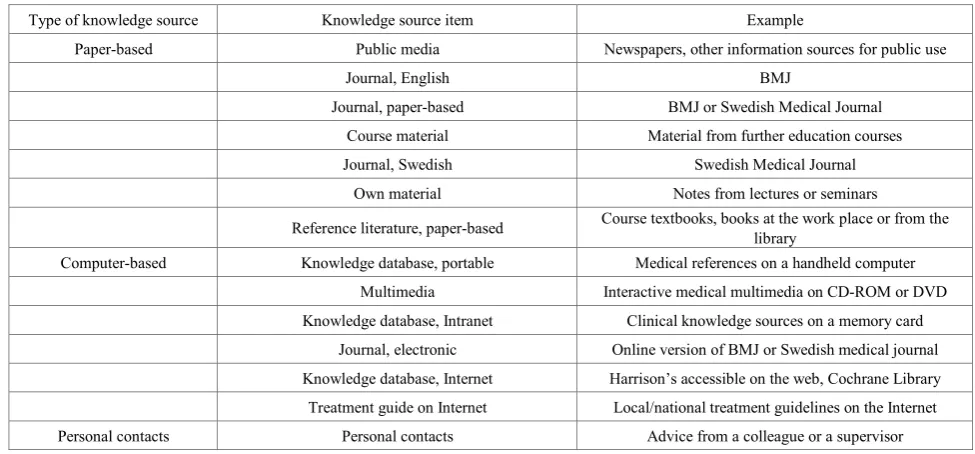
[image:2.595.59.547.447.674.2]published literature we modified a validated questionnaire by Slotnick.(24) The questionnaire collected factors such as age, gender and length of completed internship. It also contained questions on the frequency of use of knowledge sources in daily clinical work. Fourteen different knowledge sources were selected (Table 1). The participants were asked to mark their use of each knowledge source on a Visual Analogue Scale (VAS) consisting of a horizontal line, 100 mm in length, where the far left represented ‘Never’ and the far right ‘Very often’. We measured the distance in millimeters from the left end of the line to the point that the respondent had marked. Median and range values were calculated. The questionnaire also contained 12 questions in which the respondents were asked to indicate the importance of four predefined qualities of any knowledge source: access to the knowledge source, layout of the interface, searchability (search options within the knowledge source) and whether the source contained Swedish clinical guidelines (Table 2). The importance of each of those qualities was to be indicated in each of the following three clinical situations: when junior doctors needed general information about a disease, information about diagnosing a disease and when treating a disease. The responses were marked on the VAS with the descriptors ‘Not important at all’ to the far left and ‘Of crucial importance’ to the far right. Finally, the questionnaire contained The Kolb Learning Style Inventory to identify junior doctors’ preferred learning styles.(25)
Table 1. Knowledge source items in the questionnaire
Type of knowledge source Knowledge source item Example
Paper-based Public media Newspapers, other information sources for public use
Journal, English BMJ
Journal, paper-based BMJ or Swedish Medical Journal
Course material Material from further education courses
Journal, Swedish Swedish Medical Journal
Own material Notes from lectures or seminars
Reference literature, paper-based Course textbooks, books at the work place or from the library
Computer-based Knowledge database, portable Medical references on a handheld computer
Multimedia Interactive medical multimedia on CD-ROM or DVD
Knowledge database, Intranet Clinical knowledge sources on a memory card Journal, electronic Online version of BMJ or Swedish medical journal Knowledge database, Internet Harrison’s accessible on the web, Cochrane Library Treatment guide on Internet Local/national treatment guidelines on the Internet
Table 2. The importance of quality of knowledge sources in different clinical situations (n=63) Quality of knowledge
sources Access Layout Searchability Contains Swedish guidelines
Clinical situations when doctors needed
information about: All Female Male All Female Male All Female Male All Female Male
A disease in general 86 89 78 53 52 58 82 83 73 69 74 62
Diagnosing a disease 89 90 85 56 51 61 82 87 72 85 88 84
Treating a disease 91 92 85 58 58 58 81 85 79 90 89 90
KEY: F=Female; M=Male
[image:3.595.135.478.216.663.2]Note: All figures are given in median values in mm on the Visual Analogue Scale (VAS).
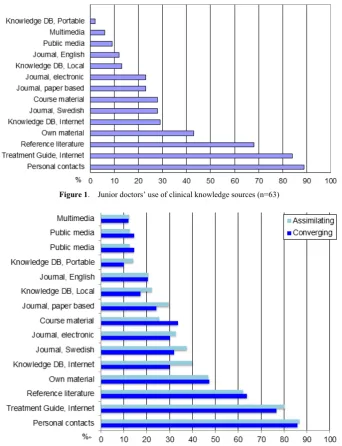
Figure 1. Junior doctors’ use of clinical knowledge sources (n=63)
Figure 2. Junior doctors’ use of clinical knowledge sources in the two dominating learning styles (n=53)
2.3. Participants
Junior doctors (n=67) were invited and 63 participated in the study. Two declined for personal reasons and two were about to finish their internship. The median age was 30 years (range 25-46) and 41 (65%) of the participants were women.
2.4. Statistical Analysis
Statistical analyses were done using the 1-Sample Sign Test and the Mann-Whitney U test. The choice of parametric versus non-parametric methods in the context of VAS is controversial. We used non-parametric tests because the analysis was less sensitive to extreme values from the normality. The statistical software SPSS for Windows version 10.1 was used for all calculations.
3. Results
3.1. Use of Clinical Knowledge Sources
The use of the clinical knowledge sources varied considerably (Figure 1). The junior doctors mainly used personal contacts with colleagues (n=14, p=0.0002) but they marked the use of treatment guidelines on the internet almost as high (n=14, p=0.0034) In third place was the use of paper-based reference literature (n=14, p=0.0225). Portable knowledge databases and multimedia were used significantly less compared to any of the other knowledge sources (n=14, p=0.0034 and p=0.0225).
3.2. Learning Styles and Use of Clinical Knowledge Sources
The most frequent learning styles were converging, with 34 doctors (54%), and assimilating, with 19 doctors (30%). The accommodating and diverging styles were less frequent and in total consisted of 10 doctors (16%). No further analysis was done concerning this third group due to the small sample size. Males and females were equally divided in all four learning style clusters. The use of knowledge sources among the most frequent learning styles showed minor differences (Figure 2).
3.3. Value of Qualities of Knowledge Sources in Clinical Situations
Access was ranked as the most valued quality in all three clinical situations (86-91 mm on VAS, n=63, Table 2). When the purpose was to find general information about a disease, access was more important in comparison to the other three qualities: layout, searchability and Swedish guidelines (86 vs. 53-82 mm on VAS, n=63). Layout was ranked as least important in all three clinical situations (53-58 mm on VAS, n=63).
The importance of Swedish clinical guidelines and searchability were ranked in between the other two qualities in all three clinical situations. In general, when searching for information about a disease, searchability was more important than Swedish clinical guidelines (82 vs. 69 mm on VAS, n=63), whereas in searching information about treatment of a disease the Swedish guidelines were more important than searchability (90 vs. 81 mm on VAS, n=63).
4. Discussion
4.1. Knowledge Sources
We found that internet-based knowledge sources were more often used by junior doctors than paper-based sources and that the use of internet-based sources was close to reaching the same level as that of personal contacts. Access to clinical knowledge sources was shown to be a key determinant of actual use. Our study showed that junior doctors seemed to mainly consult other doctors for advice. However, the use of internet-based treatment guidelines is no longer far behind. It has previously been shown in a convincing way that doctors seek answers to clinical questions from other doctors. The rationale for this is that it is quick and easy to rephrase complex questions if necessary and that it also provides an opportunity to transfer tacit knowledge. Contact with other humans provides the personal support, guidance, affirmation and feedback that is not available from other sources is of importance.(12, 26) Our study found that the use of internet-based treatment guidelines was almost as frequent as the use of personal contacts. This is not surprising in view of the general interest in and easy access to the internet.
This underlines the importance of knowledge sources being computer-based and easily accessible. This has previously been found to be among the factors of critical importance to the success of clinical information systems.(10) According to a review by Gruppen, junior doctors were found to consult other doctors and review literature most often and they were more apt to use computerised sources rather than consult older physicians.(27) In a more recent study by Westbrook, exploring the usage frequency of an online evidence retrieval system, it was found that more junior than senior doctors had used the system and junior doctors found it easier to use.(11)
The third most prevalently used clinical knowledge source in our study was paper-based reference literature. Medical books have been at the heart of clinical practice since time immemorial. Written text is a typical example of explicit knowledge and its strength lies in transferability which makes it easy to communicate or diffuse. A review of literature on the information-seeking behaviour of doctors between 1996 and 2006 showed that four out of six studies identifying knowledge sources used by doctors ranked text sources first, although the newest studies showed an increasing use of computer-based sources.(28)
The least frequently used clinical knowledge sources in our study were multimedia sources and portable knowledge databases. This is not surprising as they are not so widespread, often need specific technical installations and are generally less easily accessible.
4.2. Learning Styles
an assimilating learning style (30%). Some earlier studies also found that the majority of general and internal medicine residency programs aggregated into the converging and the assimilating learning styles.(29, 30) Other researchers have found learning style preferences that differ from our findings, the majority of anaesthesia residents and paediatric residents aggregating into the accommodating and diverging learning styles.(15, 31)
It seems that learning styles may vary within academic sub-specialties. This finding could indicate a need for individualisation of features of information resource design to fit different sub-specialties.
4.3. Connection between Preferred Use of Knowledge Sources and Learning Styles
We found no significant difference for the converging learning style, representing more than half of the participants in our study, to use computerised knowledge sources differently compared to the next largest group assimilators. However, this may indicate a need for further investigation of the underlying reasons and a need for efforts to find methods for adjusting the design of computerised sources so they become more relevant for the majority of user groups.
4.4. Value of Qualities of Clinical Knowledge Sources We found that access to information is the most important factor when seeking information about a disease in general, as well as when seeking information about the investigation and treatment of a disease. This is in line with previous research.(31, 32) Layout ranked lowest of all. This was in accordance with findings in a study of family physicians which showed that changes in decision making did not depend on the format of information but rather on its validity.(33) Our study showed that it was important for doctors that knowledge sources contained national guidelines, especially when diagnosing and treating a disease, as this was the second most valued quality in those clinical situations. An explanation for this could be that diagnostic and treatment traditions often differ between countries. This finding indicates that it is necessary to consider local diagnostic and treatment guidelines when designing clinical knowledge sources aimed for use by a geographically defined user group. In our study, access to knowledge sources and Swedish guidelines were more important for women than for men in several of the clinical situations. The significance of this finding is not clear and needs further investigation.
4.5. Limitations
Our study suffered from the methodological limitations of single cross-sectional studies. One hospital was surveyed in this study and this may have limited the ability to generalise our findings to doctors outside the study format. However,
we considered this cross-sectional of junior doctors to be a representative sample of Swedish junior doctors during their medical internship. Another limitation was the use of knowledge sources that were self-reported and thereby subject to retrospective recall bias. The fact that the sample size was small also makes the results more uncertain. Furthermore, it turned out that the marks on the VAS showed a large variation and a wide range which limited our possibility to statistically support any difference in the use of clinical knowledge sources in the different learning styles. We would have needed a larger sample size to show statistically significant differences. To our knowledge, the objectives of this study have not previously been explored. One strength of the study is that our findings could be of significance in the further development of clinical knowledge sources to better fit the needs of many user groups. Strength of the study is its small drop-out rate and that all the questions in the distributed questionnaires were answered.
5. Conclusions
The findings in this study may be used to improve medical education. Personal consultation is still used most frequently but internet-based knowledge sources are catching up. There may be a difference in different learning styles’ in the use of knowledge sources. This needs further investigation in larger studies as it can have important implications for future design of medical educational tools to fit a variety of users. Access should be addressed since overall this was found to be the most valued quality of knowledge sources in all clinical situations and this could help to improve medical education.
Conflict of Interest
The authors declare that they have no conflict of interest.
REFERENCES
[1] Hansen MT, Nohria N, Tierney T. What’s your strategy for managing knowledge? The Knowledge Management Yearbook 2000–2001. 1999.
[2] Wickramasinghe N, Bali RK, Lehaney B, Schaffer J, Gibbons MC. Healthcare knowledge management primer: Routledge; 2009.
[3] Wyatt JC. Management of explicit and tacit knowledge. J R Soc Med. 2001;94(1):6.
[5] Rowley JE. The wisdom hierarchy: representations of the DIKW hierarchy. Journal of information science. 2007. [6] Zins C. Conceptual approaches for defining data, information,
and knowledge. Journal of the American society for information science and technology. 2007;58(4):479-93. [7] Liew A. Understanding data, information, knowledge and their
inter-relationships. Journal of Knowledge Management Practice. 2007;8(2):1-16.
[8] Curley SP, Connelly DP, Rich EC. Physicians' Use of Medical Knowledge Resources Preliminary Theoretical framework and Findings. Med Decis Making. 1990;10(4):231-41.
[9] Axelson C, Wårdh I, Strender L-E, Nilsson G. Using medical knowledge sources on handheld computers–A qualitative study among junior doctors. Med Teach. 2007;29(6):611-8. [10]Kawamoto K, Houlihan CA, Balas EA, Lobach DF. Improving
clinical practice using clinical decision support systems: a systematic review of trials to identify features critical to success. BMJ. 2005;330(7494):765.
[11]Westbrook J, Gosling A, Westbrook M. Use of point‐of‐
care online clinical evidence by junior and senior doctors in New South Wales public hospitals. Intern Med J. 2005;35(7):399-404.
[12]Ely JW, Osheroff JA, Chambliss ML, Ebell MH, Rosenbaum ME. Answering physicians' clinical questions: obstacles and potential solutions. J Am Med Inform Assoc. 2005;12(2):217-24.
[13]McAlearney AS, Chisolm DJ, Schweikhart S, Medow MA, Kelleher K. The story behind the story: physician skepticism about relying on clinical information technologies to reduce medical errors. Int J Med Inform. 2007;76(11):836-42. [14]Romanelli F, Bird E, Ryan M. Learning styles: a review of
theory, application, and best practices. Am J Pharm Educ. 2009;73(1):1.
[15]Baker J, Cooke J, Conroy J, Bromley H, Hollon M, Alpert C. Beyond career choice: the role of learning style analysis in residency training. Med Educ. 1988; 22(6):527-32.
[16]Chapman DM, Calhoun JG. Validation of learning style measures: implications for medical education practice. Med Educ. 2006;40(6):576-83.
[17]Coker CA, Pedersen SJ. Context and test-retest reliability of Kolb's Learning Style Inventory 1. Psychol Rep. 2004;95(1):180-2.
[18]DiBartola LM, Miller MK, Turley CL. Do learning style and learning environment affect learning outcome? J Allied Health. 2001;30(2):112-5.
[19]Richard RD, Deegan BF, Klena JC. The learning styles of orthopedic residents, faculty, and applicants at an academic program. J Surg Educ. 2014;71(1):110-8.
[20]Slotnick H. Physicians’ learning strategies. CHEST Journal. 2000;118(2_suppl):18S-23S.
[21]James WB, Gardner DL. Learning styles: Implications for distance learning. New directions for adult and continuing education. 1995;1995(67):19-31.
[22]Engels PT, Gara C. Learning styles of medical students, general surgery residents, and general surgeons: implications for surgical education. BMC Med Educ. 2010;10(1):1. [23]Samarakoon L, Fernando T, Rodrigo C. Learning styles and
approaches to learning among medical undergraduates and postgraduates. BMC Med Educ. 2013;13(1):1.
[24]Slotnick H, Harris TR, Antonenko DR. Changes in learning-resource use across physicians' learning episodes. Bull Med Libr Assoc. 2001;89(2):194.
[25]Kolb DA, Hay T. Learning style inventory: Version 3: Hay/McBer Training Resources Group Boston, MA; 1999. [26]Smith R. What clinical information do doctors need? BMJ.
1996;313(7064):1062-8.
[27]Gruppen LD. Physician information seeking: improving relevance through research. Bull Med Libr Assoc. 1990;78(2):165.
[28]Davies K. The information‐seeking behaviour of doctors: a review of the evidence. Health Information & Libraries Journal. 2007;24(2):78-94.
[29]Adesunloye BA, Oluranti Aladesanmi MD M, Henriques-Forsythe M, Ivonye C. The preferred learning style among residents and faculty members of an internal medicine residency program. J Natl Med Assoc. 2008;100(2):172. [30]Mammen JM, Fischer DR, Anderson A, James LE, Nussbaum
MS, Bower RH, et al. Learning styles vary among general surgery residents: analysis of 12 years of data. J Surg Educ. 2007;64(6):386-9.
[31]Kosower E, Berman N. Comparison of pediatric resident and faculty learning styles: implications for medical education. The American journal of the medical sciences. 1996;312(5):214-8.
[32]Casebeer L, Bennett N, Kristofco R, Carillo A, Centor R. Physician internet medical information seeking and on‐line
continuing education use patterns. J Contin Educ Health Prof. 2002; 22(1):33-42.