1
Interviewing Walls: Towards a Method of Reading Hybrid Surface Inscriptions
Sabina Andron
Most of us encounter graffiti and street art as part of our everyday experiences of the city, as they
occupy spots on urban surfaces and coexist alongside a wide array of urban signage. Graffiti and
street art have been researched as aesthetic categories, urban cultures, legal contentions, cultural
commodities and place-making tactics – but they are also, perhaps fundamentally, localized
inscriptions. They take place in precise locations within the built environment, adapting to existing
visual and material contexts and contributing to their appearance and development.
This chapter attempts to theorize a unifying visual-material approach to urban inscriptions,
using frameworks like multimodality (Kress and van Leeuwen 2001), geosemiotics (Scollon and
Wong Scollon 2003) and semiotic landscapes (Kress and van Leeuwen 2006; Jaworski and
Thurlow 2010). Starting from site-specific visual data of annotated photographs I took in London
between 2012 and 2015, the chapter aims to generate a responsive, integrative discourse of
sanctioned and unsanctioned surface inscriptions. These often form qualitatively different parts of
the semiotic landscape but their boundaries seem to be increasingly permeable, as graffiti, street
art, advertising and street signage recurrently make less distinct categories. Different types of signs
form clusters of hybrid communication, using a variety of media and placement strategies within
the same territories. I propose the concept of “hybrid surface inscriptions” to bring all these signs
together and accommodate the extraordinarily diverse and elusive nature of the markings it refers
to.
A fundamental question I explore in this chapter is what happens when one looks at graffiti
and street art as localized inscriptive artifacts, rather than focusing on their production, reception
2 studies of graffiti and street art, and into the realm of visual, textual and semiotic approaches. I
propose to bracket the distinct cultures of “graffiti” and “street art” with their own codes and
histories, and tackle them through the lens of semiotic theories instead, as part of a wider material
and communicative context.
This chapter puts forward “wall interviews” as a methodological exercise and illustrates
the process through a selection of annotated visual material. These images can be studied alongside
or separately from the main body of the text, as they unpack surface semiosis by referencing a
diverse range of material and graphic elements. The wall interviews are supported by input from
visual, linguistic and semiotic landscape theories and explore the results of reading graffiti and
street art less as separate categories, and more as localized components of the urban semiotic
landscape.
Urban Inscriptions as Textual and Visual Signs
The first section of this chapter deals with the textual and visual dimensions of city surface signage,
and seeks to integrate both components into a discussion of signs by using linguistic and visual
methodologies. The general rhetoric that accompanies urban signs is often a linguistic one, in
which cities are legible, public signs are meant to be read, people who practice graffiti are writers
and the city primarily creates a textual landscape around us. This is known as a “linguistic
landscape”, a subfield of sociolinguistics that was first introduced by linguist Rodrigue Landry
and social psychologist Richard Bourhis in 1997. Landry and Bourhis define linguistic landscapes
3 languages and offers an insight into the geographic territories occupied by minority language
communities. Linguistic landscape studies are usually limited to verbal signs, often in multilingual
areas, and focus mostly on quantitative research (like counting minority language signs), analysing
inscriptions according to language used, multilingualism and language policies. As Landry and
Bourhis suggest (1997: 25):
The language of public road signs, advertising billboards, street names, place names,
commercial shop signs, and public signs on government buildings combines to form the
linguistic landscape of a given territory, region or urban agglomeration.
This is not meant to be an exhaustive list, and it calls for the inclusion of unsanctioned practices
which contribute to the linguistic landscape just as prominently, like tags, stickers, graffiti
throw-ups and pieces, slogans or any kind of random textual scribbling. These have been considered by
a number of scholars working in the field of linguistic landscapes who have looked at graffiti in
their studies: graffiti is discussed as indicative of a community’s vernacular literary practices
(Jaworski and Thurlow 2010); mentioned as part of the bottom-up configured linguistic landscape
(Waksman and Shohamy 2010) and as part of the language of minority or excluded social groups
(Marten 2010); is recognized as a literary genre (Blume 1985), and is considered as a linguistic
genre which has contributed significantly to the localized study of language, through its
connections to the built environment, transgression and the right to urban semiosis (Scollon and
Wong Scollon 2010; Ben-Rafael, Shohamy and Barni 2010; Pennycook 2009; Pennycook 2010).
However, as the focus of linguistic landscape studies is on language rather than image, they are
4 Writing seems to be the concept of choice for studying many inscriptive practices, turning
reading into the required action for engagement and for making sense of our urban environments.
In his study of public writing and literacy in 19th century New York, historian David Henkin
observes that “we have come to expect cityscapes to be legible, much as we expect consumer
goods to come with labels” (1998: 3). This is a telling comparison because product labels, as much
as urban signs, are rarely made from bare lines of text. Text on labels is often accompanied by
images and is always placed and designed in a certain way, and so are the messages on our city
surfaces.
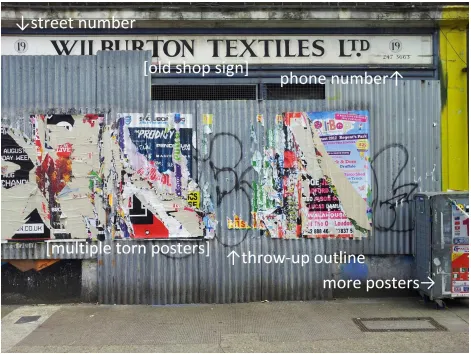
Figure 1 shows different types of public writing as they sit in relation to each other and
display contrasting visual forms. Written text is always styled, as is apparent through the more
prominent and legible messages in this frame (like the old shop sign), or the faded and
unintelligible ones (like most of the text on the layered posters). Placement and design offer clues
about the propriety of language on city surfaces. Here, the street number and shop sign are written
in a legible typeface and therefore project a legitimate presence, while the throw-ups and posters
5 Figure 1. Written texts are image signs, not just language signs. London, Spitalfields, November
2012. Photo: Sabina Andron
As this first example makes apparent, a semiotic model that privileges language signs and assigns
a subservient role to the image limits the potential scope of these analyses. What is needed is an
approach which accounts for visual signs as much as verbal ones, as proposed by semioticians
Gunther Kress and Theo van Leeuwen (2006). They stress the importance of visual literacy in
today’s urban environments, complementing Henkin’s emphasis on reading and textual
apprehension. With surface communication becoming denser and more competitive, and the battle
6 prominent components of urban environments. City surfaces are used as platforms for the gain of
visibility, where images selectively attract public attention from privileged or outsider positions,
some with authorisation and others in spite of the lack thereof.
Cultural and visual theorist Ella Chmielewska (2005) talks about the immersive visual
environment of urban inscriptions, stressing the image qualities of surface signage in addition to
their textual ones. The importance of urban images gets reflected in practices such as design and
advertising, with branding industries creating logos which are recognizable beyond language or
culture. Even when they are words, logos function as images, communicating in a visually, rather
than textually, mediated manner. The proliferation of images also gets reflected in their use by
disciplines like communication, media studies or discourse analysis, and is perhaps primarily
analyzed by the discipline of visual culture.
Visual culture can bring a few relevant contributions to the study of city surface
inscriptions, their actual and perceived legitimacy, and their placement. Graffiti and street art have
often been discussed as art historical phenomena, but their inclusion within the remit of visual
culture seems much more accurate, as it accounts not only for their aesthetic and stylistic
components, but also for their cultural, affective and relational dimensions. What types of popular
culture are being appropriated and produced by city surface inscriptions, how do these inscriptions
alter their environments through their presence, and how do they engage with their material and
communicational contexts? These are all questions which visual culture is equipped to address by
exploring the powerful attributes of contextualized images.
Urban surfaces are home to a constant battle for visibility taking place between the most
unequal of forces: authorities intervene with regulatory discourses like traffic signs and public
7 developers promise luxurious lifestyles from the hoardings of construction sites; and commercial
discourses flash posters, billboards and shop signs through our spectre of visibility. At the same
time, a number of transgressive voices make their presence felt through independent inscriptive
practices, strategically occupying urban surfaces in their own right. This battle is fought by
prominently placing one’s own inscription, but also by rendering other inscriptions visible or
invisible (e.g. parasitic placement, removal of unauthorised markings or building on existing ones).
Shaping and managing visibility is a practical and political issue with social and spatial
implications which can be observed not only on the respective surfaces, but also way beyond them.
For example, vehicular and pedestrian flows in the city depend on the correct placement of traffic
signs, sentences for graffiti writers depend on how many of their tags the police identified and
recorded, and the commercial viability of a brand depends on the number of people who see and
identify its logo or product (Brighenti 2007a, 2009).
The scale of visibility battles is not always prominent, and it is often on less conspicuous
surfaces that they can be best observed. The wall in Figure 2 displays a number of interactions
between sanctioned and unsanctioned texts and images, as well as between different media (from
the metallic sheet of the council sign to the small paper stickers and the texts written in marker pen
and aerosol, and those scratched into the supporting concrete wall). The council’s directive (“No
ball games”) has been transformed through a series of interventions into the more relatable notice
“Ball games are great!”, while some stickers have occupied the smooth surface of the plaque. From
entitled prescriptive messages like the council sign, to opportunistically placed stickers or strategic
textual subversions – they are manifestations of multimodal discourse that can be encountered on
8 Figure 2. Individual signs signify through individual modes, which makes collective surface
discourse multi-modal. London, Spitalfields, December 2012. Photo: Sabina Andron
It already becomes apparent from the number of different examples of linguistic and visual
landscapes that these two cannot be fully separated, and the opposition between text and image
collapses and asks for a new reading of the complex semiological urban landscapes. This has been
acknowledged from within the visual culture discipline by W.J.T. Mitchell through his argument
that all media are mixed media (Mitchell, 2002), while Kress and van Leeuwen have called for a
multimodal reading of semiotic discourse which must be interdisciplinary and take into account
different modes of communication at the same time, “a theory of semiotics appropriate to
[image:8.612.71.541.70.424.2]9 Similarly, James Elkins proposes that we snap out our “word-image trance” by using the
Greek concepts gramma (picture, written letter, and piece of writing) and graphein (to write, draw
or scratch) instead (1999: 83).
Together, gramma and graphein preserve a memory of a time when the divisions we are so
used to did not exist, and they help us remember, when we need to, that picturing and
writing are both kinds of ‘scratching’ – that is, marking on and in surfaces.
Drawing, scratching and surface marking are all common attributes of graffiti definitions, and in
fact graffiti shares a common etymological background with the Greek graphein and the Indo-European *gerebh-, which is a general term for writing, drawing and scratching.1 Elkins includes
graffiti in the category of allographs, which he defines as forms of typography and calligraphy,
namely the visual changes made to letters without affecting their alphabetic identities, or their
textual communicative potential (1999: 95). Graffiti is therefore text and image at the same time,
and so are many of the signs encountered on the surfaces of our cities.
1 The etymological root of graffiti can be traced through the singular graffito, “a scribbling”, which is the diminutive
form of graffio, “a scratch or scribble”. It was first used in this form in the mid-19th Century to refer to wall
10
City Surfaces as Material and Territorial Landmarks
The second section of this chapter looks at another essential component of surface signage
semiosis, namely placement and location. The places of inscriptions are just as important as their
visual and textual components, and can produce powerful contentions over permission and
entitlement. Surface sites generate availability and meaning, while providing a highly influential
context of reception. Signs are part of material and communicative surface networks, and undergo
a process of material charting and adaptation as they occupy their spots on city surfaces. These
spots are the primary connection that signs establish with the urban environment and they require
as much analytical attention as the statements signs make or the messages they represent. In fact,
it is often the case that physical presence itself is the message, and simply being visible on a certain
surface is the most powerful content one can send across. As Chmielewska argues (2010: 277):
Every urban sign, each billboard or display screen is a semiotic object whose material
presence indexes and informs both the visual context and the specific physical location.
Whether the content of its message is generic or place-specific, its location creates a
discrete condition of semiosis.
Physical proximity leads to friction and intermingling of cultures through their signage, so signs
can offer reliable understandings of social geographies. They can reveal the language minorities
in a particular area, they speak of the daily habits and customs of city dwellers, point to the degree
of privatisation of urban environments, offer insights into cultural trends and they show which
displays are allowed or not under particular circumstances, often through the traces of their
11 about its artistic inclinations and political grievances, its social policies and cost of life, and its
inhabitants’ problems, passions and preoccupations. This complex semiotic system includes
“private interests, mutually indifferent pursuits, antagonistic ideologies and discrete messages”
(Henkin, 1998: 3), all drawing and redrawing on fluid and interactive surface territories.
The semiotic category of graffiti has received more scholarly attention than other forms of
public visual discourse because it is perceived as being “out of place”, as argued by geographer
Tim Cresswell (1996). Place and territory studies are important to the study of graffiti, as graffiti
is very rarely perceived as pertaining to an environment, and has not undergone a process of
backgrounding like other urban semiotic marks (Jaworski and Thurlow 2010: 21). Graffiti has
been recognised as being a highly spatially sensitive practice, more so than its sanctioned
counterparts. Ethnographic studies have pointed to the careful selection of writing spots by graffiti
writers, showing how graffiti is highly controlled by its supportive environment (Ferrell and Weide
2010), and street artists have been declared adept masters of spatial semiotics on account of their
engagement with the city (Irvine, 2012). Cresswell (1996) talked about a hierarchy of visual rights
to places and characterized graffiti as out-of-place, as it often defies expectations of legality and
propriety, while geographer Luke Dickens proposed to include graffiti into the “wealth of other
cultures of inscription” (2008: 472), as a means of researching the city. Chmielewska has also
repeatedly emphasized the importance of researching graffiti as a localized practice (2007: 163):
“A graffito is a topo-sensitive language sign that points to itself while designating the local surface
and referencing the discourse that surrounds it”.
Looking at sites in relation to graffiti has mostly been interesting because of underlying
territorial contentions, which rarely appear in the case of sanctioned signage. Studies of graffiti
12 generate territorial controversy. However, I would like to argue that sites are as important for
understanding sanctioned surface marks as they are for understanding tagging or fly-posting, as
they all form part of the same semiotic aggregates and signify through juxtaposition and
accumulation.
Not only is any surface more than a blank canvas, but it bears upon it layers and layers of
material and visual codes and it stands as part of a larger physical and inscriptive system. Surfaces
are shifting, exposed territories, which are constantly subject to dispute, claiming and reclaiming.
Sociologist Andrea Mubi Brighenti (2010a, b) studied territories as semiotically expressed social
relations, which can have different degrees of material presence. Territories can exist without
physical markers (publicly accessible private property is not always marked as such, but we are
still aware it belongs to someone) and they are never fixed in space and time. Vulnerable,
contested, and always open to dispute and change, surface territories are shifting, superimposed
functions which express the dynamics of urban life in their acceptance or rejection of signage, and
offer a variety of information through their shifting configuration.
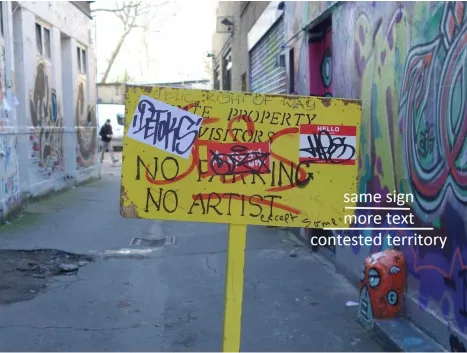
Territories never exist in a fixed state, and the example in Figure 3a&b illustrates how
territorial challenges can occur. These two photographs (Figure 3a,b) were taken one month apart
in a prime painting spot off London’s Brick Lane and show how the initial sign “Private Property,
No Visitors, No Parking, No Artist [sic]” got reconfigured by the addition of “Public Right of
Way” and of successive tags and stickers. The territorial challenge goes beyond the sign itself and
into the parking lot behind it, based on the public accessibility of the privately owned lot. In this
particular case of territorial contestation, ownership is but one of the aspects that drives
14 Figure 3a,b. Privately owned, but publicly accessible and visible: the aspect of city surfaces should
remain disputed. London, Brick Lane, December 2014 and January 2015. Photo: Sabina Andron
The nature of supportive surfaces will make some signs more vulnerable than others. Ownership,
materials, accessibility and exposure all get to decide the duration of signs’ public lives. It is
usually a regulatory or territorial claim that can make the difference between ephemeral, transient
signage and sturdy, durable ones, but the physicality of both the sign and its supportive surface are
also decisive factors.2 For example, paper-based inscriptions are likely to weather away more
easily than metallic plaques, irrespective of their (un)authorized nature; while anything painted on
2 See also my photographic project “100 Days of Leake Street”, which follows the daily changes on walls in an
15 a smooth surface such as glass or metal is easier to remove and prone to a shorter life span.
However, all public signs are vulnerable and are subject to responses, appropriation, collaboration,
defacement, interpretation, weathering, attack and obliteration. Henkin explains this vulnerability
(1998: 60):
Once words have been physically and dramatically exposed to public view, they are no
longer under the control of their originators. Writing assumes a life of its own in public
space and becomes subject to close, literal and socially unstable reading.
When thought of as territories, urban surfaces become deeply imbued with meaning. Linguist Roy
Harris uses integrational semiology to account for the importance of locational content (1995:
113): “From an integrational point of view, the surface is not semiologically inert or valueless. It
makes its contribution to the significance of what is written, and it may do so in various ways”.
Harris speaks of a semiological relationship of surface to text, which is determined by the affinities
or tensions that exist between the two. In the urban environment, inscriptions and surfaces relate
through at least three different types of territories: ownership, materiality and communication.
Territorial ownership generates the most contentions in relation to uninvited inscriptions,
as each publicly visible surface has a property status and belongs to someone, whether it is marked
as such or not. According to Western social models, the availability of certain surfaces is strictly
connected to their ownership, as they are carriers of implicit and explicit rules and codes of
conduct, permission systems and legal frameworks. The first claim at territories is always
associated with ownership and is often exclusionary, as the rights to public visibility and display
16 control or precedence over any possible object that will happen to lie within it”, but this claim can
always be contested, as new territories are asserted through visible graphic interventions which
then become part of the territorial cycle (Brighenti 2010b: 67). City surfaces offer some of the best
examples to illustrate the links between property and exclusion, but they are also the best places
to look for the numerous contestations of this social postulate.
A second territorial degree is defined by the materiality of surfaces, their appearance and
accessibility, or their designated purpose. The physical accessibility of a surface can be a constraint
and an opportunity (e.g., placing an inscription within reach is easier as it doesn’t require special
equipment, but it also makes the inscription more vulnerable to future interventions), while its
material features can have a major impact on the media used for its inscription (e.g., surface
elevations, materials, textures, dimensions, framings and graphic saturation levels all play a role
in placement).
Any added inscription will then form third and subsequent mini-territories, which are
generated in accordance to or in spite of initial territorial layers, staking their own claims and
becoming potential backdrops for even more additions. This is a fundamental mobility for hybrid
surface inscriptions, which shift their message, placement and readings according to their
communicative context. They take advantage of the latency of some territories (e.g., walls where
owners don’t clean tags, spots where councils don’t respond to fly posting, or billboard displays
which aren’t checked for legality), or engage in dialogue and direct reference to existing spatial
and inscriptive elements (e.g., placing a sticker directly onto a traffic sign, or the practice of
subvertising).
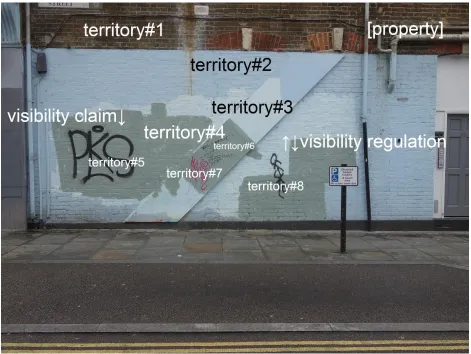
As can be seen in Figure 4, the simple presence of a new inscription on a surface is enough
17 in its moment of emplacement. In this particular instance, ownership territories which are often
abstract become actualized through the persistent repainting (buffing) of this wall. Visibility gets
policed through direct obstruction, with ownership as the underlying justification. This creates new
[image:17.612.71.542.194.548.2]surface geometries in the process, which then form fresh visual and material territories.
Figure 4. The buff appears more authoritative when it purposefully stands out and demarcates a
territory. London, Bethnal Green, July 2015, Photo: Sabina Andron
18 The third section of this chapter brings together previously discussed dimensions into a single
inclusive method which is equipped to deal with textual, visual and territorial aspects across a wide
range of city surface inscriptions, be they sanctioned or unsanctioned. Hybrid inscriptions are a
sum of their media, message, linguistic and visual codes, as well as of the territories they belong
to and the visual context that surrounds them. There are connections to be deciphered and layers
to be read on any such type of marked urban surface, and its immediate legibility or visual appeal
should not be part of our decision to do so. It is often the big, crisp and sharp signs which create a
more powerful impact, as opposed to the smaller, undecipherable, and less striking ones, but they
both form meaningful parts of urban cultures. In fact, the number of unsanctioned signs on city
surfaces very likely exceeds their sanctioned counterparts, illustrating an urban culture which
rarely behaves in a permissioned and orderly fashion. Each sign proves that a particular place is
alive and inhabited, transforming surfaces into vigorous social spaces in contemporary cities.
The methodological apparatus that is needed to deal with this system must therefore be
capable of handling its complexity from an interdisciplinary, inclusive perspective. Linguistic
landscapes and integrational linguistics accounted for the places of language; and visual culture
argued for the necessary blurring of text and image. What brings these all together in accounting
for the communicational and locational diversity of urban signage is a semiotic discourse which
has been proposed alternatively as “geosemiotics” (Scollon and Wong Scollon 2003) and
“semiotic landscapes” (Kress and van Leeuwen, 2006; Jaworski and Thurlow 2010). Both these
theories are anchored in the multifaceted, localized nature of the semiotic sign and have the
capacity to address it in all its complexity.
Geosemiotics, as introduced by Scollon and Wong Scollon (2003), foregrounds the places
19 semiotic markings within the material world, and is built on the principle that every sign is actively
and intrinsically connected to its location, generating discourse and information through its simple
presence. Geosemiotics can therefore be read as a theory of indexicality or localization, its purpose
being to interpret the meaning systems by which textual and visual discourses are located in the
material world. Lying at the intersection of visual and place semiotics, it uses tools from linguistics,
cultural geography, communication, discourse analysis and sociology to generate a multimodal
discourse about urban signs and their locations.
Similarly, the concept of semiotic landscape proposed by Kress and van Leeuven (1996)
and further developed by Jaworski and Thurlow (2010) aims to incorporate not just textual
utterances in the urban environment, but also visual and non-verbal discourses, cultural values, as
well as architecture and the built environment. As Kress and van Leeuwen argue (1996: 33):
.
The place of visual communication in a given society can only be understood in the context
of, on the one hand, the range of forms or modes of public communication available in that
society, and, on the other hand, their uses and valuations. We refer to this as the ‘semiotic
landscape’. […] so particular modes of communication should be seen in their environment, in the environment of all the other modes of communication that surround
them, and of their functions.
There is a strong sense of emplacement here as well, which is not limited to looking at the places
of discourse, but also includes the inherent semiotic function of those places (e.g., their assigned
and disputed territorial functions). Jaworski and Thurlow go on to define semiotic landscapes as
20 meaning making” (2010: 2) – a definition which prioritises places over inscriptions and suggests
that inscriptions can generate as much knowledge about their supportive places, as places can about
their supported inscriptions.
Both these systems of categorization function less based on the messages they carry, and
more based on how these messages are carried (as does indeed any semiotic theory). In the case of
hybrid surface inscriptions, the main material signifiers are placement and authorisation, i.e. where
these messages appear and whether they are allowed to be there or not. State signage, commercial
billboards, tags, notice boards, CGIs of real estate developments, discarded leaflets and artistic
murals share territories all the time, and co-existence is intrinsic to their urban occupations. They
each bring with them specific types of production and notions of entitlement, forming “very
complex systems of interaction of multiple semiotic systems” or, “semiotic aggregates”, as Scollon
and Wong Scollon term them (2003: xii). The annotated photographs that accompany this chapter
are instances of such semiotic aggregates, each with specific properties: direct linguistic reference
and appropriation, visual translations of territorial claims, or material affinities between official
and uninvited signage. Whatever the case, it is the complexity of these aggregates that makes them
interesting for this type of reading, rather than the isolated examination of their individual
elements.
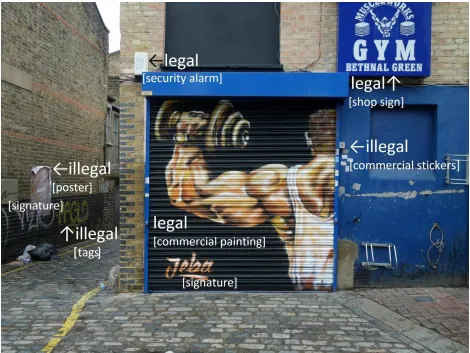
For example, Figure 5 shows an array of inscriptions whose semiotic analysis, as an
aggregate, points to a number of things. We are looking at a number of graffiti tags (or signatures),
a poster, a few commercial stickers, a text-based shop sign and a painted shutter with the image of
a muscular weightlifting man. Here are some observations that can be made based on this
21 - Aerosol paintings are sought-after options for on-site commercial signage. This is a
response to the wider visual context of the Brick Lane – Bethnal Green – Cambridge Heath
area in London, which is very dense in aerosol inscriptions.
- Visual forms are rarely celebrated or frowned upon in themselves: it is their placement that
turns the compass when it comes to acceptability. Here, tags appear both on the side wall
and on the shutter, and the latter enjoys a higher degree of tolerance because it is part of an
invited painting project.
- Commercial inscriptions are not to be presumed legal. Advertising is often installed
without authorisation, and the small commercial stickers in this image are just one instance
of how this happens. In the UK, flyposting and graffiti fall under the incidence of the same
legislation.3
- Graffiti need not have prominence in a geosemiotic study of urban surfaces. The wider the
lens applied to surface inscriptions, the more diverse the information that can be obtained
from their semiotic reading.
3 Specifically, Part 6 of the 2003 Anti-Social Behaviour Act and Part 4 of the 2005 Clean Neighbourhoods and
22 Figure 5. All graphic elements in a semiotic aggregate are significant, not just prominent ones.
London, Bethnal Green, July 2015. Photo: Sabina Andron
Closing the Interview: Graffiti and Beyond, or Beyond Graffiti?
Human interaction in public space reveals itself through the semiosis of hybrid surface
inscriptions. Each sign bears within it not just its physical presence, but has the capacity of
invoking the presence of its producer and projecting intentionality in their action. For example, we
23 Moreover, we know advertising is exactly that because of the way it is placed and the visual codes
it employs, this being a skill we constantly perfect as city dwellers, whether we want to or not.
Sign producers have learned to play with our sign reading proficiency and are using visual
or spatial codes specific to certain signs to transmit unexpected messages. This is the case when
authorities produce messages which have an independent, grassroots aesthetic; or street artists
employ advertising resources to put up their art; and corporations use street art murals to promote
their products. In fact, the lines between these have become so blurred, that our sign reading
proficiency is often yet to keep up with the incredibly complex range of hybrid urban signage.
With an increasing number of street art or graffiti works being created with permission, it often
gets tricky to distinguish between sanctioned and unsanctioned signs, or legal and illegal
productions.
Figures 6a,b,c show examples of how spaces, styles and visual codes get appropriated for
purposes outside their conventional remit, eroding those conventions in the process. Graffiti
visuals are employed to change the territorial and aesthetic praxis of commercial messages, as is
the case with the spray-painted hoarding announcing the launch of a range of luxury apartments in
Figure 6a. This looks like graffiti, but it is advertising, and might be illegal nonetheless. Notice
how “Eagle Black 15.05.14” was sprayed over another promotional message on the same hoarding,
indicating a change of marketing strategy from the more conventional to what was likely perceived
as an edgier approach. Similarly, the “Original Banksy” stencil in Figure 6b was placed in one of
London’s most prolific street art areas by the Truman Brewery, capitalising on the presence of
street work to raise interest. Follow the arrow, one might assume, and it will lead you to one of
24 artworks by the share (hence the £120 price per share of an artwork by Banksy).4 One last example
in Figure 6c is of the sponsored mural by prolific artist Dan Kitchener, painted with permission
using fluorescent paint under the administration of Global Street Art.5 This was paid for by
corporate money and displays a logo and hashtag to mark that, but the scale of the painting makes
it easy to overlook its raison d’être. The brand proposes itself as a supporter of creative outdoor
expression, while pushing a commercial message from behind a street art aesthetic.
4 The gallery is called My Art Invest and is no longer at the aforementioned location at the time of writing
(December 2015).
5 Global Street Art is one of the most prominent street art and advertising agencies in London. They organize
27 Figure 6a,b,c. Graffiti and street art still seem to have a worthwhile marketing capital. 6a: London
Old Street, May 2014. 6b: London Brick Lane, May 2014. 6c: London Clerkenwell, July 2015. All
photos: Sabina Andron
With these and previous examples, my proposal for a place-based semiotic reading shifted away
from graffiti, in order to accommodate a wider range of city surface signs and utterances. Based
on theories of geosemiotics and semiotic landscapes, this chapter introduced some samples of what
a “wall interview” might look like as a reading method, and the type of visual evidence it can
produce. I like to think of the images in this chapter as snippets of “interviewing walls”, or
28 What I would suggest by way of a conclusion is that a better semiotic understanding of
graffiti and street art can only take place by incorporating other urban semiotic aggregates into the
interpretative process, and generating a localized interpretation of their relations and territories.
This can be achieved by taking up hybrid surface inscriptions and further exploring them as
localized utterances of visual, textual and material composition that make up the “surfacescapes”
of our cities. Geosemiotic readings of these surface landscapes are able to reveal a great deal of
information about claims, entitlements and the daily battles for visibility, which can be used to
inform graffiti scholarship.
Surface signs reflect on urban cultures and rhythms and produce new cultures of their own,
impacting profoundly on how cities are perceived, regulated and navigated. Hybrid surface
inscriptions are not only a lens through which graffiti and street art can be read, but they are means
through which urban social life constructs itself spatially and visually. I attempted to capture some
of these complex urban palimpsests through the use of images as analytical tools, while providing
some theoretical underpinnings for this form of city reading. Urban cultures research has a lot to
gain from performing a more comprehensive reading of signs in public spaces, and graffiti can
provide a generous starting point for such an endeavour.
References
Avramidis, Konstantinos. 2014. ‘Public [Ypo]graphy: Notes on Materiality and Placement’. In
29 Ben-Rafael, Eliezer, Shohamy, Elana Goldberg and Barni, Monica. 2010. ‘Introduction’. In
Shohamy, Elana Goldberg, Ben-Rafael, Eliezer and Barni, Monica (eds.), Linguistic Landscape in
the City. Bristol: Multilingual Matters.
Blume, Regina. 1985. ‘Graffiti’. In van Dijk, Teun Adrianus (ed.), Discourse and Literature. Amsterdam: Benjamins.
Brighenti, Andrea Mubi. 2007a. ‘Visibility: A Category for the Social Sciences’. Current Sociology. 55(3): 323-342.
Brighenti, Andrea Mubi. 2007b. ‘On Territory as Relationship and Law as Territory’. Canadian
Journal of Law and Society. 21(2): 65-86.
Brighenti, Andrea Mubi. 2009. ‘Walled Urbs to Urban Walls – and Return? On the Social Life of
Walls’. In The Wall and the City. Trento: Professional Dreamers.
Brighenti, Andrea Mubi. 2010a. ‘At the Wall: Graffiti Writers, Urban Territoriality, and the Public
Domain’. Space and Culture. 13(3): 315-332.
Brighenti, Andrea Mubi. 2010b. ‘On Territorology: Towards a General Science of Territory’.
Theory, Culture & Society. 27(1): 52-72.
Chmielewska, Ella. 2005. ‘Logos or the Resonance of Branding: A Close Reading of the
Iconosphere of Warsaw’. Space and Culture. 8(4): 349-380.
Chmielewska, Ella. 2007. ‘Framing [Con]text: Graffiti and Place’. Space and Culture. 10(2):
145-69.
Chmielewska, Ella. 2010. ‘Semiosis Takes Place or the Radical Uses of Quaint Theories’. in
30 Cresswell, Tim. 1996. In Place / Out of Place: Geography, Ideology, and Transgression. Minneapolis: University of Minnesota Press.
Dickens, Luke. 2008. ‘Placing Post-Graffiti: The Journey of the Peckham Rock’. Cultural Geographies. 15(4): 471-96.
Elkins, James. 1999. The Domain of Images. Ithaca: Cornell University Press.
Ferrell, Jeff and Weide, Robert. 2010. ‘Spot Theory’. City. 14(1-2): 48-62.
Harris, Roy. 1995. Signs of Writing. London: Routledge.
Henderson, Sally and Landau, Robert. 1981. Billboard Art. London: Angus & Robertson.
Henkin, David. 1998. City Reading: Written Words and Public Spaces in Antebellum New York.
New York: Columbia University Press.
Irvine, Martin. 2012. ‘The Work on the Street. Street Art and Visual Culture’. In Heywood, Ian
and Sandywell, Barry (eds.), The Handbook of Visual Culture. London: Berg.
Jaworski, Adam and Thurlow, Crispin. 2010. ‘Introducing Semiotic Landscapes’. In Jaworski,
Adam and Thurlow, Crispin (eds.), Semiotic Landscapes: Language, Image, Space. London: Continuum.
Kress, Gunther and van Leeuwen, Theo. 2001. Multimodal Discourse: The Modes and Media of
Contemporary Communication. London: Arnold.
Kress, Gunther and van Leeuwen, Theo. 2006. Reading Images: The Grammar of Visual Design.
2nd ed. London: Routledge.
Landry, Rodrigue and Bourhis, Richard. 1997. ‘Linguistic Landscape and Ethnolinguistic Vitality:
An Empirical Study’. Journal of Language and Social Psychology. 16(1): 23-49.
31 Pennycook, Alastair. 2009. ‘Linguistic Landscapes and the Transgressive Semiotics of Graffiti’.
In Shohamy, Elana and Gorter, Durk (eds.), Linguistic Landscape: Expanding the Scenery. London: Routledge.
Pennycook, Alastair. 2010. ‘Spatial Narrations: Graffscapes and City Souls’. In Jaworski, Adam
and Thurlow, Crispin (eds.), Semiotic Landscapes: Language, Image, Space. London: Continuum.
Scollon, Ron and Wong-Scollon, Suzie. 2003. Discourses in Place: Language in the Material World. London: Routledge.
United Kingdom, Ministry of Justice. 2003. Anti-social Behaviour Act. Available at: http://www.legislation.gov.uk/ukpga/2003/38. Accessed: 29 December 2015.
United Kingdom, Ministry of Justice. 2005. Clean Neighbourhoods and Environment Act. Available at: http://www.legislation.gov.uk/ukpga/2005/16/contents. Accessed: 29 December
2015.
University of Texas Linguistic Research Centre. “Indo-European Lexicon”, Available at:
http://www.utexas.edu/cola/centers/lrc/ielex/X/P0579.html. Accessed: 29 December 2015.
Waksman, Shoshi and Shohamy, Elana Goldberg. 2010. ‘Decorating the City of Tel Aviv-Jaffa
for its Centennial: Complementary Narratives via Linguistic Landscape’. In Shohamy, Elana
Goldberg, Ben-Rafael, Eliezer and Barni, Monica (eds.), Linguistic Landscape in the City. Bristol: