2016 International Conference on Electronic Information Technology and Intellectualization (ICEITI 2016) ISBN: 978-1-60595-364-9
The Construction Investigation of the Software
Process Domain Onto Logy
Pengcheng Liu and Xiaojie Wang
ABSTRACT
This text applies the framework method to construct the software process model. Firstly, this text determines the purpose and the scope of the ontology application. Secondly, it analysis the software process ontology and defines all the meanings of the ontology terms and the relations among them. The software process ontology should include all the concepts in this domain but it is hard to achieve that and what is needed is to continuously perfect them so it is strongly flexible. The content of this text sets the basis for the construction of the software process ontology and the knowledge searching system of the software process.
The Construction Standard of The Domain Ontology Model
Domain ontology is a description to the concepts of the subject including the ontology in the domain and its actions, properties and the vocabulary, the definition, the axiom and the theorem describing relations between the ontologies. Domain ontology describes the certain concept collections in this domain and the relations between these concept collections, giving the actions and activities in the domain and also the main theories and the basic principles.
The Constitution of The Domain Ontology
The domain ontology is made up of the following aspects:
1. Concepts: Be made up of the service function, the resource and the role.
__________________________
(1)Service function. It describes the work or the task in the domain that needs to be accomplished. The service function could form a gradation constitution by disintegrating itself from the top to the bottom including the atomic service function that cannot be further disintegrated and the complex service function that can be disintegrated.
(2)Resource: It refers to the ontologies that needs to be used, produced or consumed when the service function is being carried out including the information, the personnel, the instruments etc.
(3)Role: The carrier of the service function such as the programming personnel. 2. Relations include the encompassments among the service functions, that is, the encompassments between the goal and the process, between the process and the action; the relation of using and being used between the service function and the recourses, the carrier and being carried out between the role and the service function. 3. The examples are the concrete factors, for example, the feasibility analysis report is an actual example of the file catalogue.
The Construction Standard of The Domain Ontology
When an ontology needs to be designed and constructed to refer to something, firstly a certain subjective standard and principle is needed so as to conduct and judge the process and the outcome. Among them, the most influential is the five designing ontology basic principles raised by T.R Gruber:
1. Clarity: the ontology must effectively illustrate the meaning of the defined term.
2. Coherence: the ontology should support the inference that is in accordance with its definition and should commonly follow the defined structure of the model ontology.
3. Feasibility: the ontology should offer the concept basis to the predictable model.
4. Minimal encoding bias: due to improbable different knowledge expressions of the actual system, the descriptions of the concepts should be expressed by different signs.
5. Minimal ontological commitment: the ontology commitment could meet the demand of the certain knowledge sharing.
The Model of The Software Process Ontology
The Description of The Relations Between The Parts in The Software Process
The relations between the constitutive parts of the software process include: the inherence relation, the encompassment relation and the usage relation, among them the inheritance relation provides the superclass and the subclass relations between the constitutive parts. The encompassment relation shows the relation between the entirety and the sections of the constitutive parts, the usage relation between the constitutive parts gives the relation between a series of simple constitutive parts and the parts that are made up by those simple ones. The relation between the constitutive parts of the software process can give reference information for the software process.
The Software Process Ontology Model Description
This text applies the framework method to the construction of the software process ontology. Firstly, the purpose and the scope of the ontology application should be considered and determined. A software process needs to consider the inputting and outputting factors, actions that need to be accomplished, resources that are needed, dealing methods( methods, technologies, models, etc.) and the life circle model that should be followed.
A certain project needs a certain software process. We regard the organization structure, the policy, the program, the technology, the resource and the activity as the parts of the software process.
Software process ontology model is composed of every sub-ontology and the relations among them. The carrying out of the software process depends on the organization structure according to the policies in the organization. The carrying out of the software process is ultimately shown by the activity that needs objects input and objects output. The software process activity needs to use certain resources. All kinds of activities also need to take the certain procedures and technologies.
The software process activity is the functioning part that needs to be finished by the roles including the management activities, the construction activities and the quality insurance activities. See the figure 1.
A c t i v i t y
[image:3.612.121.502.548.665.2]M a n a g e m e n t A c t i v i t y C o n s t r u c t i o n A c t i v i t y Q u a l i t y I n s u r a n c e A c t i v i t y
Software process construction activity mainly includes the question raising, the instruction of the software demanding, the software designing, the software achieving, the software confirmation and the software evolution and other basic activities.
Software process objects are the files, models and software that are produced or used during the software development process. See the figure 2.
O b j e c t
[image:4.612.121.502.195.263.2]F i l e M o d e l S o f t w a r e
Figure 2. The ontology model of the objects.
In the activities, objects are produced while being used. Take the files in the object as an example, the main files in the software project are the feasibility analysis report, the project development plan, the software demanding instruction( the software standard instruction), the abstract design instruction, the detailed design instruction, the development process monthly newspaper, the testing plan, the testing and analysis report, the user's operation booklet, the project development summery report, the software maintaining booklet, the software problem reporting and the software correcting report, etc. These files are the premise of some activities or they could be produced by some activities.
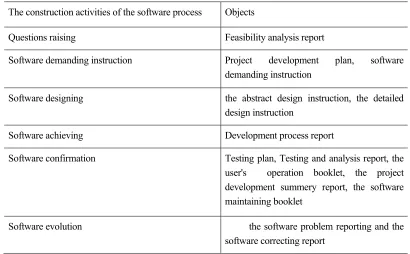
During different stages of the software process, different objects may be produced such as the demanding standard instruction, the designing instruction, the original program and its parts, the testing example, the personnel booklet and all kinds of development management files, etc. Table 1 gives the objects of the software process construction activity.
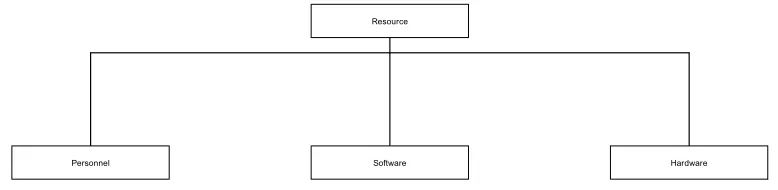
The software process resource mainly includes the personnel, the software resources and the hardware resources. See figure 3:
R e s o u r c e
S o f t w a r e
P e r s o n n e l H a r d w a r e
[image:4.612.102.491.552.647.2]TABLE 1. THE OBJECETS IN THE CONSTRUCTON ACTIVITIES OF THE SOFTWARE PROCESS.
The construction activities of the software process Objects
Questions raising Feasibility analysis report
Software demanding instruction Project development plan, software demanding instruction
Software designing the abstract design instruction, the detailed design instruction
Software achieving Development process report
Software confirmation Testing plan, Testing and analysis report, the user's operation booklet, the project development summery report, the software maintaining booklet
Software evolution the software problem reporting and the software correcting report
CONCLUSION
This text applies framework method to construct the software process model. Firstly, this text determines the purpose and scope of the ontology application. Secondly, it analysis the software process ontology and defines all the meanings of the ontology terms and the relations among them. Software process ontology should include all the concepts in this domain but it is hard to achieve this and what is needed is to continuously perfect them so it is strongly flexible. The content of this text set the basis for the software process ontology construction and software process knowledge search system.
REFERENCES
1. Gruber T.R. A Translation Approach to Portable Ontology Specifications [J]. Knowledge Acquisition, 1993, 5: 199~220.
2. J. McCarthy. Circumscription -A form of non-monotonic reasoning [J]. Artificial Intelligence, 1980, 5 (13): 27~39.