5
X
October 2017
Reconstructive Subspace Based Multimodal
Biometric For Accurate Person Authentication
Suchetha N V1, Dr. M Sharmila Kumari2
1
Department of Computer Science & Engg, SDMIT, Ujire, India 2
Department of Computer Science & Engg, P.A College of Engineering Mangaluru, India
Abstract: In this paper, we explored principal component analysis based experimental study on multimodal biometric considering face and fingerprint. Multimodal biometric is found to be the most reliable method used for authentication of persons. We discuss the existing unimodal biometric and present their suitability to a small gallery. Although they are good for a simple application, for a large mass of population, having single modality is not sufficient and hence researchers aim in developing multimodal biometric. Several combinations of biometric have been developed, but face and fingerprint combination is one of the most explored combinations. In this context, we make an attempt to present the experimental study on these two biometric traits with a briefrevieon biometric method; unimodal and multimodal, their advantages and disadvantages, and different fusion methods. Finally, experimental results are presented by considering standard datasets such as ORL face dataset and FVC fingerprint dataset.
Keywords: Principal Component Analysis, Unimodal Biometric, Multimodal Biometric, Person Authentication.
I. INTRODUCTION
Traditionally passwords, ID cards and smart cards have been used the control access to assets but these methods can easily be breached and are changeable. Because of this problem in traditional approach to secure the resources there is a demand for providing suitable, reliable security. In biometric based authentication system human’s physiological and behavioral characteristics such as facial features, fingerprint, hand geometry, voice print, signature, keystrokes etc. are considered [1].The benefit of biometric system is that it cannot be copied, stolen, or forgotten, and forging one is practically impossible.
Biometric technology is an automated method of recognizing the identity of persons based on their physiological and behavioral characteristics. Face, fingerprint, retina, iris, hand geometry, voice, DNA etc. physiological characteristics. Gait, signature and keystroke etc. are behavioral characteristics. Depending on the application biometric system operates in two modes: verification mode and identification mode [6]. To reduce the dimension and to acquire relevant information from the input image dimension reduction techniques such as principal component analysis (PCA)[2][3], discrete cosine transform (DCT)[4], linear discriminative analysis (LDA)[5] are used.
There are two types of biometric system based on number of traits used i.e. unimodal biometric system and multimodal biometric system. Single biometric traits are used for person identification in unimodal biometric system. Multiple biometric traits are used for person identification in multimodal biometric system. Traditional unimodal biometric system suffers from the issues of non-universality, intra-class variation and noisy data. This weakness can be overcome by using multimodal biometric system. It is not easy for an intruder to spoof all the biometric traits of an authorized enrolled person.
A. The multimodal biometric system integrates the information at various levels. Fusion in multimodal biometric system can be done in two ways [7]:
1) Fusion prior matching
2) Fusion after matching
3) Fusion prior matching: Fusion prior matching is done at two levels:
4) Sensor level fusion: In sensor level fusion to collect different samples multiple sources of single biometric traits are used
5) Feature level fusion: In feature level fusion different features collected from multiple biometric traits are combined.
6) Fusion after matching: Fusion after matching level is done at three different levels:
7) Match score level fusion: This is one of the widely used methods for fusion. It provides richer set of information.
9) Decision level fusion: Decisions from different matchers are evaluated with the help of rules like ‘AND’, ‘OR’ and majority voting etc.
B. Let us have a look at some of the multi biometric systems:
Table1. Multi Modal Biometric Systems
Modalities fused Level of fusion Fusion methodology Authors
Face fingerprint and voice
Match score Likelihood ratio Jain et al..199b
Face and voice Match score Geometric weighted
average
Bruneli and Falavigan, 1995
Face and fingerprint Match score Product rule Hong and Jain 1998
Face and iris Match score fisher’s linear
discrimination,Sum rule, weighted sum rule, neural network
Wand et al., 2003
Face, fingerprint and hand geometry
Match score Sum rule, decision trees,
discriminant function
Ross and Jain, 2003
Face and ear Sensor Concatenation of raw
images
Chang et al., 2003
Fingerprint, hand geometry and voice
Match score Weighted sum rule Toh et al., 2004
Fingerprint and voice Match score Functional link network Toh and Yau,2005
Voice and signature Match score Weighted sum rule Krawczyak
And jain, 2005
Fingerprint and signature Match score SVM in which quality
measures are incorporated
Fierrez-aguilar et. al.,2005c
Face and fingerprint Decision level Logical AND operator
dynamic score selection
Celik et al., J BiomBiostat 2015
Face and fingerprint Feature level RVM Long B. Tran,2015
Face and fingerprint score level product rule and nearest
neighbor classifier
Ashraf A Darwish, 2010
Face and fingerprint matching score level weighted sum rule Norhene GARGOURI
BEN AYE, 2011
Face and fingerprint feature level Gabor wavelet filters AmitDeshmukh, 2013
Due to easy data acquisition and low cost in commercial applications widely face and fingerprint traits are used. In our experiments we have considered the multimodal biometric authentication using face and fingerprint with feature level fusion.
II. METHODOLOGY
Here we will study multimodal biometric recognition using face and fingerprint with feature level fusion. Face and Fingerprint recognition is done using PCA. PCA is one of the most used algorithms for face recognition, and used to reduce the dimension of the image. PCA algorithm extracts only the relevant information about the image. This algorithm decreases the large dimension data into smaller set of independent components.Orthogonal components are derived using Eigen vectors of the covariance matrix of input data space. Eigen faces retains only most significant Eigen vectors and projects input data on Eigen space. Steps involved in
A. PCA:
1) Arrange the dataset as a set of n data vectors.
2) Compute mean
4) Calculate covariance matrix
5) Calculate eigenvalues and eigenvectors of the covariance matrix
6) Arrange eigenvalues and eigenvectors
7) Select subset of the eigenvectors
8) Map mean-subtracted images into eigen space.
In this system we have used PCA to extract features of both face and fingerprint. Feature level fusion is done by concatenating the feature vectors of both face and fingerprint extracted using PCA.
B. The process contains the following steps:
1) Load face image test images
2) Load fingerprint test images
3) Extract face features using PCA
4) Extract fingerprint features using PCA
5) Fuse extracted features of face and fingerprint test images
6) Compare fused extracted features of face and fingerprint test images with train images using Euclidian distance.
7) If match is accrued then user is accepted, otherwise user is rejected.
III. EXPERIMENTAL RESULT
We have conducted experiments on face and fingerprint dataset. We have considered ORL dataset for face and FVC for fingerprint dataset. ORL dataset consists of 200 face images of 40 persons with 10 samples of each, out of which we considered 80 images of 10 persons with 8samples of each. FVC dataset consists of 4 databases i.e. db1, db2, db3, db4. All four data base consists of 80 fingerprint images of 10 persons with 8 samples of each, out of which we have considered 80 images of 10 persons with 8 samples of each. Images are resized to 90X90. Each sample has variation in pose and illumination.
While conducting experiments we have considered the following experimental setups: i) 1,2,3,4. ii) 5,6,7,8. iii) 1,2,7,8. iv) 3,4,5,6. v) 1,3,5,7. vi) 2,4,6,8 for testing and reaming samples for training.
In fusion we have concatenating the feature vectors of face and fingerprint with 39 elements each to form fused feature vector of 78 elements. In all the experiments, we have recorded recognition accuracy of face, fingerprint and fusion of face and fingerprint. The recognition accuracy is shown below:
Table2. Face recognition using PCA for ORL dataset
Test images ( No. of test images)
% of recognition rate
1,2,3,4 (40) 95
5,6,7,8 (40) 85
1,2,7,8 (40) 97
3,4,5,6 (40) 92
1,3,5,7 (40) 95
2,4,6,8 (40) 90
Table3. Fingerprint recognition using PCA for FVC dataset
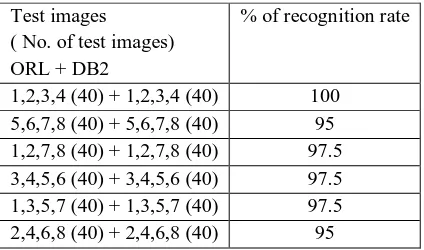
Table 2 shows the face recognition accuracy for ORL dataset using PCA algorithm. Recognition accuracy for different combination of test and training images are shown. Table 3 shows the fingerprint recognition accuracy for FVC dataset using PCA is shown. Table 4 shows recognition accuracy for fusion of face ORL dataset and fingerprint FVC DB1dataset. Recognition is done using PCA algorithm and fusion is done by concatenating feature vectors of face and fingerprint images. Table 5 shows recognition
Test images
( No. of test images)
% of recognition rate DB1 DB2 DB3 DB4
1,2,3,4 (40) 90 95 82.5 95
5,6,7,8 (40) 82.5 87.5 92.5 92.5
1,2,7,8 (40) 87.5 95 87.5 85
3,4,5,6 (40) 95 90 92.5 95
1,3,5,7 (40) 92.5 92.5 92.5 87.5
accuracy for fusion of face ORL dataset and fingerprint FVC DB2 dataset. Table 6 shows recognition accuracy for fusion of ORL dataset and fingerprint FVC DB3 dataset. Table 7 shows recognition accuracy for fusion of ORL dataset and fingerprint FVC DB4 dataset.
Table4. Fusion of Face and Fingerprint recognition (ORL+ DB1)
[image:5.612.202.413.134.258.2]Table5. Fusion of Face and Fingerprint recognition (ORL+ DB2)
Table 6. Fusion of Face and Fingerprint recognition (ORL+ DB3)
Table 7. Fusion of Face and Fingerprint recognition (ORL+ DB4) Test images
( No. of test images) ORL + DB1
% of recognition rate
1,2,3,4 (40) + 1,2,3,4 (40) 100
5,6,7,8 (40) + 5,6,7,8 (40) 97.5
1,2,7,8 (40) + 1,2,7,8 (40) 97.5
3,4,5,6 (40) + 3,4,5,6 (40) 97.5
1,3,5,7 (40) + 1,3,5,7 (40) 100
2,4,6,8 (40) + 2,4,6,8 (40) 100
Test images ( No. of test images) ORL + DB2
% of recognition rate
1,2,3,4 (40) + 1,2,3,4 (40) 100
5,6,7,8 (40) + 5,6,7,8 (40) 95
1,2,7,8 (40) + 1,2,7,8 (40) 97.5
3,4,5,6 (40) + 3,4,5,6 (40) 97.5
1,3,5,7 (40) + 1,3,5,7 (40) 97.5
2,4,6,8 (40) + 2,4,6,8 (40) 95
Test images ( No. of test images) ORL + DB3
% of recognition rate
1,2,3,4 (40) + 1,2,3,4 (40) 95
5,6,7,8 (40) + 5,6,7,8 (40) 100
1,2,7,8 (40) + 1,2,7,8 (40) 97.5
3,4,5,6 (40) + 3,4,5,6 (40) 95
1,3,5,7 (40) + 1,3,5,7 (40) 97.5
2,4,6,8 (40) + 2,4,6,8 (40) 100
Test images ( No. of test images) ORL + DB4
% of recognition rate
1,2,3,4 (40) + 1,2,3,4 (40) 97.5
5,6,7,8 (40) + 5,6,7,8 (40) 92.5
1,2,7,8 (40) + 1,2,7,8 (40) 100
3,4,5,6 (40) + 3,4,5,6 (40) 97.5
1,3,5,7 (40) + 1,3,5,7 (40) 97.5
[image:5.612.201.413.291.416.2]IV. CONCLUSION
In this paper, we have explored the suitability of principal component analysis for multimodal biometric. We presented a brief overview of biometric methods including both unimodal and multimodal and their advantages and disadvantages; different fusion methods and PCA based face and fingerprint recognition with feature level fusion. From the experimental results, we concluded that fusion of face and fingerprint i.e. multimodal biometric approach gives better accuracy than unimodal face and fingerprint recognition. Further research work will be carried in this direction by considering various problems associated with datasets itself.
REFERENCES
[1] Long B. Tran andThai H. Le, “Person Authentication using Relevance Vector Machine (RVM) for Face andFingerprint”,I.J. Modern Education and Computer Science, vol. 5,2015.
[2] M. Kirby and L. Sirovich,“Application of the Karhunen-Lokve procedure for the characterization of humanfaces”, IEEETtransactions onpattern analysis and machine intelligence. vol. 12. no. 1 . January 1990.
[3] M. A. Turk and A. P. Pentland, “Eigenfaces for recognition,” J. Cogn.Neurosci., vol. 3, pp. 71–86, 1991.
[4] Prof. AnandNajan, Prof. Mrs.C. Phadke, “DCT Based Face Recognition”, International Journal ofEngineering Innovation & Research, Volume 1, Issue 5, ISSN : 2277-5668
[5] C. Zhou, et al., “Face recognition based on PCA image reconstruction and LDA”, Optik - Int. J. Light ElectronOpt.,http://dx.doi.org/10.1016/j.ijleo.2013.04.108 (2013).
[6] Ramadan Gad, “Multi-Biometric Systems: A State of the Art Survey and Research Directions”, InternationalJournal of Advanced ComputerScience and Applications,Vol. 6, No. 6, 2015.
[7] Divyakant T. Meva, Dr C. K. Kumbharana, “Design and evaluation of multimodal biometric system withfingerprint and face recognition”, international Journal of Scientific and Research Publications, Volume 5, Issue4, ISSN 2250-3153, April 2015.
[8] M.H. Yang, “Kernel Eigenfaces vs. Kernel Fisherfaces: Face Recognition Using Kernel Methods,” Proc. Fifth IEEE Int’l Conf. Automatic Face and Gesture Recognition (RGR’02), pp. 215-220, May 2002.
[9] M.S. Bartlett, J.R. Movellan, and T.J. Sejnowski, “Face Recognition by Independent Component Analysis,”IEEE Trans. Neural Networksvol. 13, no. 6, pp. 1450-1464, 2002.
[10] Aman R. Chadha, Pallavi P. Vaidya, M. Mani Roja, “Face Recognition Using Discrete Cosine Transform for local and Local Features”, Proceedings of the 2011 International Conference on Recent Advancements in lectrical, Electronics and Control Engineering(IConRAEeCE) IEEE Xplore: CFP1153R-ART; ISBN: 978-1-577-2149-6.
[11] Daoqiang Zhang, Zhi-Hua Zhou,“ (2D2 PCA): Two-directional two-dimensional PCA for efficient facerepresentation and recognition”, Neurocomputing69, 224–231,(2005).