Mobile Cloud Computing: A Review on Smartphone Augmentation
Approaches
∗SAEID ABOLFAZLI1, ZOHREH SANAEI2, ABDULLAH GANI3
Mobile Cloud Computing Research Lab, Faculty of Computer science and Information Technology University of Malaya
MALAYSIA
abolfazli1,[email protected], [email protected]
Abstract: Smartphones have recently gained significant popularity in heavy mobile processing while users are increasing their expectations toward rich computing experience. However, resource limitations and current mo-bile computing advancements hinder this vision. Therefore, resource-intensive application execution remains a challenging task in mobile computing that necessitates device augmentation. In this article, smartphone augmen-tation approaches are reviewed and classified in two main groups, namely hardware and software. Generating high-end hardware is a subset of hardware augmentation approaches, whereas conserving local resource and re-ducing resource requirements approaches are grouped under software augmentation methods. Our study advocates that consreving smartphones’ native resources, which is mainly done via task offloading, is more appropriate for already-developed applications than new ones because of costly re-development process. Moreover, cloud com-puting is one of the major cornerstone technologies in augmenting comcom-puting capabilities of smartphones. Sample execution model for intensive mobile applications is presented and taxonomy of augmentation approaches is de-vised. For better comprehension, the results of this study are summarized in a table.
Key–Words: Mobile Cloud Computing, Smartphone Augmentations, Next Generation Mobile Applications.
1
Introduction
Smartphones popularity is drastically increasing and statistics show their surpassing trend toward station-ary computing devices [1]. Mobile users are vision-ing to perform heavy computvision-ing tasks as convenient as stationary devices while on the go [2]. However, de-vice handiness and compactness, mobility, and current technologies restrain smartphones to limited comput-ing capabilities due to limitations of underlycomput-ing re-sources like CPU, battery, and local storage.
Manufacturers are enhancing computing capabili-ties of smartphones by generating high-end hardware, but manufacturing costs and sharp rise in device price on one hand and limitations on size, weight, and bat-tery on the other hand hinder their attempts.
Considering the fact that energy, as the essential resource, is the only unrestorable resource in smart-phones, several proposals [3, 4] are aimed to not only conserve local energy, but also enable resource-intensive application execution.
Reducing resource requirements of mobile appli-cations is the recent approach to empower mobile de-vices. The main notion in this approach is to not
∗Published in the 1st International Conference on Computing,
Information Systems, and Communication, May 2012, Singapore
perform heavy local transactions. Instead, intensive components’ execution will be performed in collab-orative environment, where powerful computing de-vices perform code execution on behalf of the weak smartphone. By rapid proliferation of cloud comput-ing technology [5], cloud resources are highly uti-lized in recent approaches [6,25,36,37]. Cloud com-puting is envisioned to deliver elastic comcom-puting ca-pability to end-user based on “pay as you use” prin-cipal and Service-Level Agreement (SLA). SLA is a negotiable part of the service contract, between cloud provider and consumer, to define and enforce service level against an agreed cost. Successful exploitation of cloud resources in stationary machines, motivates elastic resources for mobile devices specially smart-phones in wireless ecosystem that breed new com-puting field, called Mobile Cloud Comcom-puting (MCC). MCC deemed to reduce the ownership and mainte-nance cost of mobile devices and conserve local re-sources by leveraging cloud distributed rere-sources.
Figure 1: Taxonomy of Smartphone Augmentation Approaches
In this paper, we review augmentation approaches and present taxonomy of augmentation approaches in Section 2. The taxonomy contributes toward ad-vancement of research and development in augment-ing computaugment-ing abilities of smartphones to deliver a rich experience to mobile users. Based on the current augmentation approaches, a sample execution flow of intensive mobile applications is suggested and the pa-per is concluded in Section 3.
2
Taxonomy
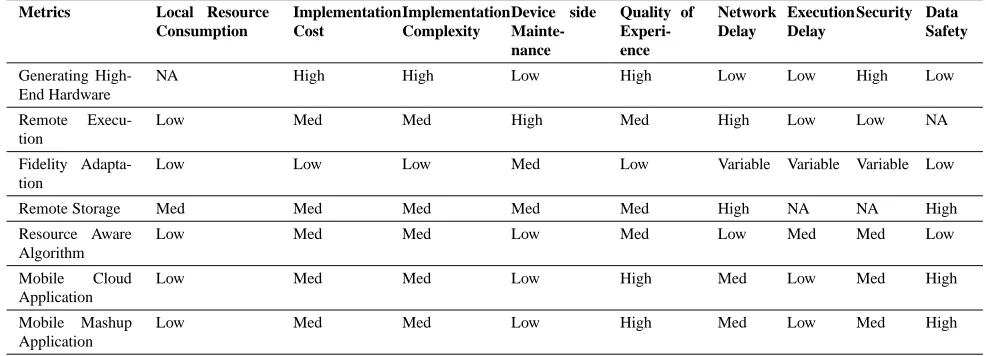
Based on available augmentation efforts in literature, this section presents our proposed taxonomy. We have classified augmentation approaches into two main cat-egories, namely hardware and software. In first ap-proach, augmentation is achieved by manufacturing high-end resources and hardware. In second ap-proach, smartphones are augmented either by con-serving their local resources, or reducing resource re-quirements of mobile application. Figure 2 depicts the devised taxonomy and various approaches with rela-tive efforts are described as follows. For better com-prehension, the results of this comparison are summa-rized in Table 1.
2.1 Hardware Augmentation
Hardware augmentation is achieved by manufacturing long lasting and high-end hardware.
Generating High-End Resources: The initial step in
enhancing computing capabilities of smartphones is to increase device’s local resources by manufacturing high-end hardware like multicore processor and long lasting battery [7, 8]. However, it is very slow and costly advancement considering current technologies. Energy is the only unrestorable resource in mo-bile devices which cannot be renewed without
exter-nal resource [9]. Current technologies are able to only increase battery capacity 5% per annum [10] while heat dispensation is yet an issue [11]. Many energy harvesting efforts are in progress since 90’s to replen-ish energy from resources like human movement [12], solar energy [13], and wireless radiation [14] which could not noticeably enhance energy deficiency and are still under investigation. However, mobile man-ufacturers such as Samsung [8] are endeavouring to produce energy-efficient hardware resources with en-hance performance.
Similarly, generating large storage and screen de-creases smartphone handiness due to additional size and weight. Data storage and retrieval is proven to be energy-hungry[15, 16]. Hence, memory en-largement contributes toward faster battery drainage. In efforts to extend data-presentation area, Kyocera leverages two 4.3” screens to stretch smartphone screen size to 4.7”, but it sharply drains the battery (http://www.echobykyocera.com/). Nirvana project [17], GeoTV [18], and remote display solution [19] are some of the efforts to extend smartphones’ screen size.
However, manufacturing sophisticated hardware noticeably increases the price of smartphones com-pare to stationary machines. Moreover, unlike PCs, smartphone’s hardware is not upgradable, hence, a new device should be possessed in case of technol-ogy advancement. Therefore, alternative techniques are essential to augment smartphones without owner-ship price hike.
2.2 Software Augmentation
2.2.1 Conserving Local Resources
The early mobile augmentation attempt refers back to late 90’ when mobile resources were aimed to be conserved through execution workload reduction. In this domain, noticeable R&D efforts have been taken place which are briefed below.
Remote Execution: Rudenko et al, [3] in 1998
in-troduce the idea of remote execution to conserve mo-bile device’s energy. Later in 2001, Satyanarayana [4] reintroduces the concept of remote execution in perva-sive environment and coined the term Cyber Foraging (CF) to not only conserve local resource like battery, memory, and storage of mobile devices, but also en-able execution of intense processing applications in smartphone [6, 22]. Thenceforth, a noticeable num-ber of research and development appeared in literature [20-22]
CF is an augmentation method to migrate the resource-hungry components of mobile applications to nearby resource-rich computing machines, called surrogates. Surrogates are connected to uninterrupt-able power source and the Internet to provide unpaid computing resources. However, in one hand process-ing overhead due to pre and post offloadprocess-ing tasks (like surrogate discovery, resource estimation, code parti-tioning, and networking) and in the other hand lack of supervising authority hinder usability of CF meth-ods. In some cases the offloading overhead exceeds conserved resources [23]. Moreover, developing CF-enabled mobile applications creates further program-ming complexity and cost. Although CF consumes local resources, it seems to be the common approach for enabling execution of the already-developed mo-bile applications since the re-development process is costly and time consuming.
Moreover, guarantying security of surrogate ma-chines to end-user from one side and convincing sur-rogate machine’s owner that user will not violate terms of service from the other side create hindrances to remote execution. Hence, evolutionary develop-ments of CF methods deemed to mitigate offloading overhead and communication latency in trustworthy environment.
In latest efforts [22, 24, 25] cloud computing is deployed as a resourceful environment to address current problems since security, quality of service, reliability, and expenses are concerned.
Fidelity Adaptation (FA): Another potentially useful
approach to conserve mobile’s resources is fidelity adaptation (FA). This is an alternative solution to augment smartphones in absence of surrogates via exchangeing execution quality for energy conserva-tion [26]. Energy is conserved and applicaconserva-tion can be
executed by altering application-level quality metrics to exchange quality of service for local resources [27]. For example, in multiple-power-state memory [28] quality of service is exchanged with energy consumption [28]. Several approaches [12, 29] lever-age composition of CF and FA for better performance.
Remote Storage: In capacity-aware data storage
ap-proaches, leveraging de-duplication (omitting redun-dant data) methods and hierarchical remote storages can conserve local storage of smartphone if non-crucial and least frequently used data can be stored remotely. Depending on data type and user require-ments (e.g. security, reliability, safety) tiering process ensures desired information availability in the right place at the proper time, assuming availability of reli-able connectivity [30]. Example of remote storage is Cloud Storage [31] where not only smartphone stor-age is virtually expanded, but also data safety is en-hanced [32]. However, data transmission, compres-sion, and encryption consume local resources of mo-bile device.
2.2.2 Reducing Resource Requirements
Parallel to manufacturing sumptuous high-end hard-ware, reducing local resource requirement plays a vital role in augmenting smartphones’ processing capabilities. This approach demands consideration in design phase of development with focus on develop-ing resource-efficient applications.
Resource-aware Algorithm: Mobile domain is a
heterogeneous environment with a plethora of tech-nologies. In wireless communication, there are var-ious non-uniform technologies with different qual-ity promises and energy consumption levels. Con-sidering limited resources of mobile devices, creat-ing resource-aware mobile application promotes con-siderable resources reduction. For instance, energy-aware applications are required to exploit 2G technol-ogy for telephony and 3G for FTP service because of difference between energy requirement of these tech-nologies [15].
Table 1: Comparison of Mobile Augmentation Approaches
Metrics Local Resource Consumption
Implementation Cost
Implementation Complexity
Device side Mainte-nance
Quality of Experi-ence
Network Delay
Execution Delay
Security Data Safety
Generating High-End Hardware
NA High High Low High Low Low High Low
Remote Execu-tion
Low Med Med High Med High Low Low NA
Fidelity Adapta-tion
Low Low Low Med Low Variable Variable Variable Low
Remote Storage Med Med Med Med Med High NA NA High
Resource Aware Algorithm
Low Med Med Low Med Low Med Med Low
Mobile Cloud Application
Low Med Med Low High Med Low Med High
Mobile Mashup Application
Low Med Med Low High Med Low Med High
stimulate energy efficient data storage. In ’off’ mode, cell energy consumption is 0mW, whereas ’on’ state consumes 74mW, which is more energy efficient approach compare to Mobile-RAM [28].
Cloud-mobile Applications: Cloud-mobile
applica-tions are envisioned to minimize smartphones’ source consumption by leveraging rich cloud re-sources with no quality degradation. Cloud compo-nents implicitly save smartphone resources. More-over, large, heterogeneous cloud resources expedite code execution and reduce overall execution time without using native smartphones’ resources. There-fore, smartphons monitoring time and communication overhead are shrunk leading to explicit resource sav-ing.
March et al. [36] develop a mobile applica-tion framework leveraging cloud resources. In this component-based developing approach, three types of component, namely mobile, cloud, and hybrid (cloud-mobile) are presented to facilitate design and devel-opment of mobile applications with least component-level communication and dependency that promises high functionality and resource efficiency. The cloud and mobile components are running on the cloud and mobile device respectively, while hybrid components are free to run either locally or remotely(depends on computing capability of underlying smartphone). In order to reduce resource consumption, resource-intensive instructions are developed as cloud compo-nents. During runtime, the execution request is sent to the cloud and results will be sent back to mobile device.
In similar effort, Lu et al. [37] leverage cloud, advanced compression methods, and networking technologies to develop a conceptual architecture to perform screen rendering tasks inside the cloud
where the online data and remote code execution take place. Certainly, resource-hungry and non-interactive components of screen will be executed inside the Cloud so that the local CPU, GPU, and battery consumption are reduced.
Mobile Mashup Application: Mobile Mashup is
an-other approach that can be leveraged to reduce re-source requirement of mobile applications. Mobile Mashup (MM) is a technique to create mobile appli-cation by aggregating available services and contents offered in ubiquitous environment leveraging Mobile Service Oriented Architecture (Mobile SOA) [38] as the backbone. However, from resource efficiency point of view, content mashup is less suitable than functionality, since I/O transactions and content han-dling are battery-hungry tasks [15].
Considering mobility and dynamism of environ-ment, loose service composition is an essential trait of mashup applications which can be achieved by coarse-grained mashup locally (client side) and fine-grained mashup remotely (server side) [39].
However, mashup by using SOA is a complex ap-proach. Several efforts have been done to justify and fit it into mobile ecosystem and benefit from loosely coupling and remote execution of services toward conserving local resources. Among them, minimizing data transfer between mobile and service provider by coarse grain mashup and shrinking XML file size [40], compressing SOAP message [41] or using REST-ful message [30], asynchronous communicating with server [42, 43], and leveraging lightweight workflow [31] are to name few approaches that are aimed to re-duce the resource consumption of mobile applications and enable smartphones to delivering rich user expe-rience.
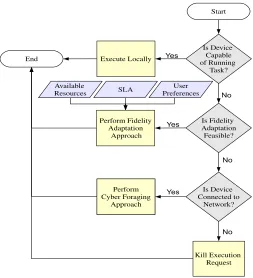
mo-bile application execution flow is derived and depicted in Figure 3. Mobile Application execution is highly context-dependent in which several metrics like avail-ability of local resource, user QoS requirement, SLA, and network availability impact at runtime.
3
Conclusion
In this paper, we reviewed and synthesized smart-phone augmentation approaches from application exe-cution point of view. Generating high-end hardware is expensive, energy-hungry, and time-consuming effort that requires imminent technologies. Smartphones are not intrinsically safe data storage. Data safety and privacy is vulnerable due to risk of device malfunc-tion, robbery, and loss. However, cloud computing is stretched to the mobile domain with aim to reduce necessity of high-end hardware, minimize ownership and maintenance cost in amortized manner, and en-hance data safety and privacy.
Conserving local resources through cyber forag-ing and fidelity adaptation are feasible and widely ac-ceptable approaches to alleviate execution of heavy already-developed applications and adaptive pro-grams on mobile devices. However, several problems challenge the development including security of both user and service providers, adequate estimation of re-source consumption, availability of remote rere-sources, maintenance cost, and network delay.
Reducing resource requirements is mainly achieved through novel programming architecture leveraging cloud computing and mashup technolo-gies. Cloud-mobile and mashup applications are flexible distributed applications that request remote execution of resource-intensive parts of applications.
As explained in section 2, mobile cloud comput-ing as the technology of future, provides trustwor-thy resource-rich environment for mobile users spe-cially smartphone users. Therefore, future generation of mobile applications deemed to be highly dependent to the Cloud services.
Acknowledgements: This work is fully funded
by Malaysian Ministry of Higher Education under the University of Malaya High Impact Research Grant UM.C/HIR/MOHE/FCSIT/03.
References:
[1] Gartner Lowers PC Forecast as Consumers Diversify Computing Needs Across Devices,
http://www.gartner.com/it/page. jsp?id=1570714, 2011.
[image:5.612.317.570.38.316.2][2] Smartphone/Tablet User Survey, Nov 2011, Prosper Mobile Insight,http:
Figure 2: A Sample Mobile Application Execution Flow
//www.prospermobileinsights. com/Default.aspx?pg=19.
[3] A. Rudenko, et al.,Saving portable computer battery power through remote process execution, ACM SIGMOBILE Mobile Computing and Com-munications Review, Vol.2, No.1, 1998, pp. 19-26.
[4] M. Satyanarayanan,Pervasive computing: vi-sion and challenges, Personal Communications, IEEE, Vol.8, No.4, 2001, pp. 10-17.
[5] P. Mell and T. Grance, The NIST Def-inition of Cloud Computing, http: //csrc.nist.gov/publications/
nistpubs/800-145/SP800-145.pdf,
2011.
[6] K. Kumar and Y. H. Lu,Cloud Computing for Mobile Users: Can Offloading Computation Save Energy?, Computer, Vol.43, No.4, 2010, pp. 51-56.
[7] The ARM Cortex-A9 Processors, ARM, 2009. [8] Samsung Exynos 4212, http:
//www.samsung.com/global/
business/semiconductor/products/ mobilesoc/Exynos/products4212. html, 2011.
[10] S. Robinson, Cellphone Energy Gap: Desperately Seeking Solutions, Strategy Analytics, http://www. strategyanalytics.com/default. aspx?mod=reportabstractviewer\ &a0=4645, 2009.
[11] Y. Neuvo,Cellular phones as embedded systems, Proc. ISSCC, Vol.47, 2004, pp. 32-37.
[12] J. Flinn and M. Satyanarayanan, Energy-aware adaptation for mobile applications, Proc. SOSP, Vol.33, 1999, pp. 48-63.
[13] T. Starner, et al., The Locust Swarm: An environmentally-powered, networkless location and messaging system, Proc.ISWC Digest of Pa-pers., 1997, pp. 169-170.
[14] S. R.Avro, Wireless Electricity is Real and Can Change the World,Consumer Energy Report, 2009–.
[15] G. P. Perrucci, et al., Survey on Energy Con-sumption Entities on the Smartphone Platform, Proc. VTS, IEEE, 2011, pp. 1-6.
[16] A. Rice and S. Hay, Decomposing power mea-surements for mobile devices, Proc. Percom, IEEE, 2010, pp. 70-78.
[17] The ”Nirvana Phone” Concept Specification and Draft Reference Architecture, Open Kernel Labs and Citrix Systems, Inc., 2010.
[18] C. Yih-Farn, et al., Project GeoTV - A Three-Screen Service: Navigate on SmartPhone, Browse on PC, Watch on HDTV, Proc. CCNC, IEEE, 2009, pp. 1-2.
[19] P. Simoens, et al.,Remote Display Solutions for Mobile Cloud Computing, Computer, Vol.44, No.8, 2011, pp. 46-53.
[20] E. Cuerv, et al., MAUI: Making Smartphones Last Longer with Code Offload, MobiSys, 2010. [21] M. D. Kristensen, Scavenger: Transparent de-velopment of efficient cyber foraging applica-tions, IEEE Percom, IEEE, 2010, pp. 217-226. [22] C. Byung-Gon and M. Petros, Augmented
Smartphone Applications Through Clone Cloud Execution, Proc. HotOS XII, 2009.
[23] M. Sharifi, et al.,A Survey and Taxonomy of Cy-ber Foraging of Mobile Devices, Communica-tions Surveys & Tutorials, IEEE, Vol.PP, No.99, 2011, pp. 1-12.
[24] R. Kemp, et al., The Smartphone and the Cloud: Power to the User, Proc. MobiCloud, 2010. [25] X. W. Zhang, et al.,Towards an Elastic
Ap-plication Model for Augmenting the Comput-ing Capabilities of Mobile Devices with Cloud Computing, Mobile Networks & Applications, Vol.16, No.3, 2011, pp. 270-284.
[26] B. Rajesh Krishna,Powerful change part 2: re-ducing the power demands of mobile devices, Pervasive Computing, IEEE, Vol.3, No.2, 2004, pp. 71-73.
[27] B. D. Noble, et al., Agile Application-Aware Adaptation for Mobility, Proc. SOSP , Vol.31, 1997, pp. 276-287.
[28] R. Duan, et al., Exploring Memory Energy Op-timizations in Smartphones, Proc. IGCC 2011, pp. 1-8.
[29] E. De Lara, et al., Puppeteer: Component-based adaptation for mobile computing, Proc. USITS, 2001, pp. 14-25.
[30] L. Richardson and S. Ruby, RESTful Web Ser-vices, O’Reilly Media, 2007.
[31] G. Hackmann, et al., Sliver: A BPEL work-flow process execution engine for mobile de-vices, Proc.ICSOS, 2006.
[32] T. M. Coughlin, Virtualization of consumer stor-age, Proc. ISCE,IEEE, 2010, pp. 1-4.
[33] M. Lee, et al.,PABC: Power-Aware Buffer Cache Management for Low Power Consump-tion, IEEE Transactions on Computers, Vol.56, No.4, 2007, pp. 488-501.
[34] H. Huang, et al., Design and Implementation of Power-Aware Virtual Memory, Proc. of the an-nual conference on USENIX Anan-nual Technical, 2003.
[35] B.G.Johnson and C.H.Dennison, Patent No.: 6,791,102, 2004.
[36] V. March, et al., Cloud: Towards a New Paradigm of Rich Mobile Applications, Proc. MobiWis, 2011.
[37] Y. Lu, et al.,Virtualized Screen: A Third El-ement for Cloud-Mobile Convergence, IEEE Multimedia, Vol.18, No.2, 2011, pp.4-11. [38] R. Tergujeff, et al., Mobile SOA: Service
Orientation on Lightweight Mobile Devices, Proc.ICWS, IEEE, 2007, pp.1224-1225.
[39] X. Luo, et al., Research on SOA-based platform to enable mobile mashups, Proc.ICCT,IEEE, 2008, pp.607-610.
[40] M. Tian, et al.,Performance considerations for mobile web services, Computer Communica-tions, Vol.27, No.11, 2004, pp.1097-1105. [41] C. Werner and C. Buschmann, Compressing
SOAP messages by using differential encoding, Proc.ICWS,IEEE, 2004, pp.540-547.
[42] Y. Natchetoi, et al., Service-Oriented Archi-tecture for Mobile Applications Proc. of SAM, ACM, 2008.