5
VIII
August 2017
Survey Paper on Generating Correlation among
Different Modalities by Using Parallel Processing
for Cross-Media Retrieval
Rokkam Srikanth Reddy
PG Student, Department of CSE, JNT University, Ananthapur, AP.
Abstract: Hashing methods are useful for performing variety of tasks in recent years. Various hashing approaches have been performing retrieve the cross-media information. The Semantic level similarities between word and documents are rarely considered. The semantic level approach is the main concern to retrieving the relative information from the bag of words. Search can be based on text or other content-based information. It have a problem to process different modalities in a single process. To retrieving cross-media information from large data sets it causes difficulties to process and retrieve the information at run time. In the proposed method retrieve cross-media information using multi core processer and multi-threading.
Keywords: Hashing, Cross-media, Semantic level, parallel processing, Query.
I. INTRODUCTION
The main aim of the proposed system is to increase the efficiency of retrieving cross-media information. Various applications such as information retrieval, near duplicate detection and data mining are performed by hashing methods. Images and videos are associated with tags and captions. Based on that the searching modalities can be performed on World Wide Web, digital information are much easier to access, modify, and duplicate. The Search technique is mainly perform by the use of sample text or query. The information may be a mix of web pages, images, and other type of files. The material data from different mood usually have semantic relation. It will support to rectify information from different modalities. For example, Image can be used to find semantically relevant textual information. As well as the images will be retrieved with the textual query. The existing systems are rarely consider the semantic level similarities between word and documents. Nearest neighbor search methods based on draw consider attention for efficiency. Modern operating systems are utilize the multi-process. The basic scheduling is performed by the threads, basically if a program having one active thread it will process one action at a time, if the program having multi threads it will schedule at a time to process.
II. LITERATURE SURVEY
A. Collective Matrix Factorization Hashing for Multimodal Data
Y.Yang, Z.Huang, Y.Zhuang, and Z.Huang proposed the concept of factorization paradigm for retrieving multimodal data by using hashing models. It is useful for retrieving different data information from heterogonous data sources. For example using a query image to retrieve textual information or image from different data sources. For allow large-scale inter-media retrieval, inter-media hashing (IMH) model is a tail to cross the relation between multi media groups from different data types [1]. Media objects are complementary each other not only in the manner of semantics and also in the view of model [2]. Normal multimedia information retrieval methods are usually content-based or text-based searching models. Generally the main hashing methods is categories into two main class: random projection hashing methods and hashing methods based on machine learning. The main difference between these two types methodologies are generations of hashing methods. In the first method uses random vectors are the functional bases. The key integration for this method is called locality sensitivity, more precisely, from this family need to satisfy the following functional property:
p(h(x)=h(y))=sim(x,y),
Machine learning based hashing method is improve the hashing quality by learning the set of reliable hashing methods. [2]
representation is attention on document representation with or without the knowledge of linguistics. In efficient detection focus on the efficiency of the document consider by the linguistic knowledge. [5]
Skip-gram model is generally efficient model for near duplicate detection. However, instead of anticipate the current word based on the history and future words, it tries to maximize classification precision of words within a certain range before and after the current word based on the current word as input. The approaches mainly point on documents or webpages, Muthmann proposed model is used to identify threads with near-duplicate identification and to combine these threads into the search results. They include text-based characteristics, characteristics text-based on reproduce entities for products, and structure-text-based features to capture the near-duplicate threads. [5]
B. Latent Semantic Sparse Hashing for Cross-Modal Similarity Search
G. Ding, J. Zhou and Y. Guo proposed the concept for retrieve the cross media similarity elements using latent semantic sparse hashing. Similarity search hashing model is used for performing efficient and effective to retrieval the cross-modal information from large-scale multimedia databases with huge images and text have magnetize important attention. Most of the existing methods cross modal hash are implant the heterogeneous data into a connect abstraction space by linear prediction. To discourse these challenges using a novel based Latent Semantic Sparse Hashing (LSSH) to accomplish cross-modal homogenous search by exposes Sparse Coding and Matrix Factorization. Sparse Coding for represent high level salient formation of images, and Matrix Factorization to evolve latent concepts from texts. Basically for retrieving cross media information using linear projection to extract and quantization of correlation information. Most existence hashing methods can only be applied on union modal data. Although, with the fast furtherance of multimedia contented on the Web, like Flickr, Wikipedia, and Twitter, most cross media retrieval problem, return the similar results of all query models for given, have attracted increasing consideration. Compare to efficiency and effectuality give best results for low-level abstraction, It not suitable for high level abstraction and implantations. To rectify those challenges LSSH is used.
This method utilizes Sparse Coding (SC) and Matrix Factorization (MF) to combine multiple latent semantic descriptions to generate distinguish binary codes. An Iterative strategy helps to LSSH traverse the correlation between multi-modals cross media information characterizations effectively and automatically. Generally, LSSH shows outstanding development for retrieve cross-model with long size of codes. Compare to the existing CMH methods and LSSH, illustrated with toy data existing CMH methods learn independent hash codes for each modal of illustration. LSSH, a merge hashing cross-modal method, represents image and text feature by unified hash codes. [6]
Here choose mean Average Precision (mAP) as the evaluation metric for resulting efficacy. A massive mAP specify appropriate performance that similar occurrence have high rank. Given a query and a set of R redeem samples, the Average Precision is defined as
AP = ∑ ( ) ( )
Where P(r) represent the accuracy of top r retrieved samples, L is the number of applicable illustrations in retrieved set. Which is defined as the ratio between the number of retrieved instance r and the number of relevant instance, and δ(r) is an index function which equals to 1 if the rth illustrations is relevant to query or 0 otherwise.
C. Angular Quantization-based Binary Codes for Fast Similarity Search
Y. Gong, S. Kumar, V. Verma, and S. Lazebnik proposed the novel based approach for retrieving the cross media information from massive databases. There is a two challenges to be data are need to store in huge data sets and slow speed of retrieval. Binary codes provide an attractive result for this problems. Binary coding for the cosine equivalence is fully based on the Locality Sensitive Hashing (LSH). But it is not taken advantage for retrieving the non-negative model of histogram data. The reliability of the LSH is restricted for most real world data. Min-wise Hashing is an additional method it is intent for non-negative data. Binary coding methods quantify the equivalence between groups of binary vectors using the hamming interval. The appropriate comparable measure our approach is the cosine of the angle θ between two binary vectors b and b’. [7]
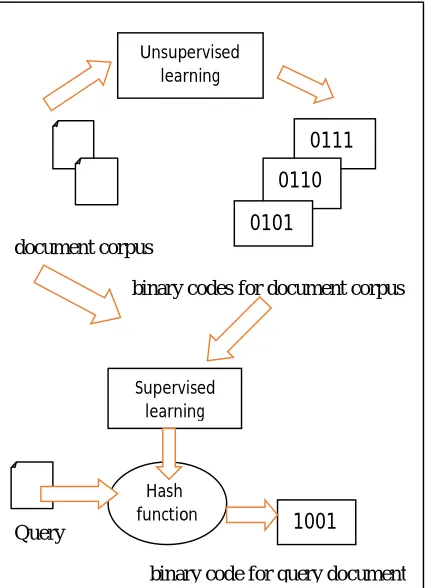
So that semantically equivalent documents are mapped to similar codes. Self-Taught Hashing (STH) is another module for searching related information from different datasets. STH approach to semantic level hashing is a general learning is a framework that consider into two stages. We call the approach “self-taught” the hashing function is learnt from his experience by its previous stage of learning experience.
[image:4.612.221.434.135.429.2]
Fig. 1 STH approach to semantic hashing
In this framework in stage one process unsupervised and supervised data, coming to the second stage taken query as input and process it with hashing function with the help of previous stage of experience. Similarity search based on semantic hashing which draw small-scale binary codes for several documents in large size. A semantic hashing should be homogeneously protect to ensure effectiveness. That is to say, semantically related documents should be mapped to same codes with in a low Hamming distance. The distance between two binary codes leistered as below. To meet the criteria of similarity preserving, we minimize the weight of Hamming distance
∑ ∑ | − |2
This function after some mathematical transformation it will written in matrix form as ( ) . We shall also apply this
approach to text mining functions and content-based multimedia data retrieval. [9]
D. Joint Learning of Words and Meaning Representations for Open-Text Semantic Parsing
X. Glorot, A. Bordes, Y. Bengi, and J. Weston, proposed a model for process wide-range supervised data. The semantic parser is to inspect the composition of sentence meaningfully and, formally, this all are exist of mapping a natural language sentences into a logical meaning representation (MR). This task is mostly carry out into manually, compare to large scale index databases it non effective. To identify the each and every semantic entry expressed in a sentence depending on it either be straight forward. MRs and WordNet relations are flip into common scheme of model. [10]
Natural Language Processing is very difficult domain. It faces difficult challenges to process and represent. Mostly three of the concept challenges to connectionist successfully. They are linguistic representation, constituency representation of the complex structures, in fixed resource systems how the nature of the language be accommodated. For this challenges we accomplished a
document corpus
binary codes for document corpus
Query
binary code for query document Unsupervised
learning
0111
0110
0101
Supervised learning
Hash
sample recurrent network. The model taken here include consider the network as a simple dynamical system in which previous states are made available as an additional input. In this work the network state is depend upon the current state input, and its own internal state of previous recurrent cycle.
[image:5.612.175.392.132.409.2]
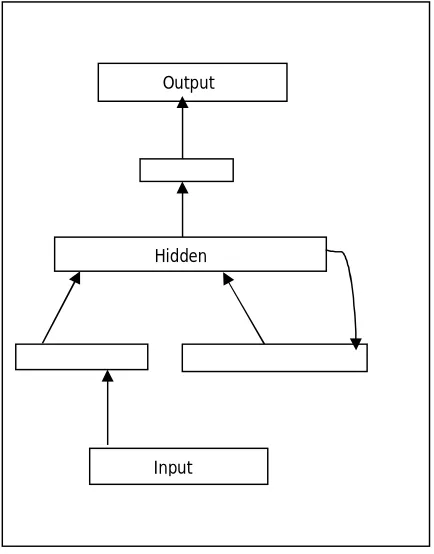
Fig. 2 Network Architecture
This network have a modal connection between input units to hidden units, and from hidden unis to output units. Here we are using additional context units it provides the limited recurrence to the network. The context units are activated with a fixed weight. On the next cycle of process the new input and activated hidden unit are combined by the context. The hidden unit takes the job to combine and prior states to the output. [11]
In Linear Relation Embedding (LRE) is used for representing n-dimensional vectors representations. Linear dynamic systems most promotable to multidimensional matrix models. The each observation a real-valued vectors in hidden state space. The output model for the liner-dynamic system is:
x (t+1)=Rx(t)+€
y (t)=Cx(t)+
In above functions x is hidden state and y is visible state, R is linear dynamics, C is linear model of output, € is noise in dynamics and is noise in output. [12]
E. Recurrent Neural Network Based Language Model
Language model for machine translation or real-world speech recognition systems are enhance on large amount of data elements, in real-time.
Output
Hidden
[image:6.612.196.414.116.406.2]
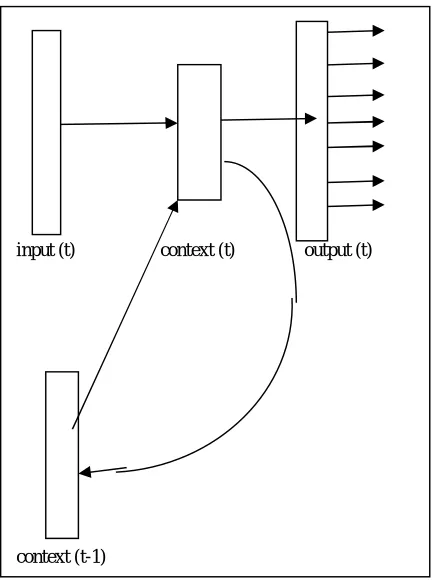
Fig. 3 Simple recurrent neural network
Most of the advanced language modeling methodologies provide only little improvements over simple baselines. The system architecture for the simple recurrent neural network is consists input, output, and hidden layers.
Artificial neural networks in statistical language modeling has been already proposed by Bengio, in that model used feed-forward
fixed size of neural network context. This model abnormally successful and it further investigated by the Goodman. So that this single model perform better than the other mixed range of several other models based on that.
The architecture used for this model is simple called as a Elman network or simple recurrent neural network. This is most probably simply used network model and,very easy to implement and analyze and trainee. The network has input x, hidden layer s and output y and t is the network time, x(t) is the network time of input and y(t) is the output network time. Input, Hidden and output layers are compressed as follows:
x(t)=w(t)+s(t-1) (1)
sj(t)=f(∑ ( ) ) (2)
( ) = (∑ ( ) ) (3)
Where f(z) sigmoid activation function:
f(z)= (4)
and g(z) is:
g( )=∑ (5)
input (t) context (t) output (t)
Yet, simple recurrent neural networks can represent truly long context information, as cache models nevertheless provide compatible information uniform to dynamic model. [13]
F. Parallel Task for parallelizing object-oriented desktop applications
N. Giacaman and O. Sinnen enhanced the parallelism of object oriented applications. Based the three new concepts: Parallel Iterator, Parallel Task and Pyjama. Parallel Task (ParaTask) is help to the programmer to develop a programs with a small change to the familiar development process. ParaTask is basically designed for the desktop applications. It contain source-to-source that process paratask java files into multi-threaded java code, and the task is managed by the supported run time libraries. ParaTask has the unique feature of multi-threading applications, it can used by the programmers for increasing the interoperability and responsiveness of their applications on even the applications run on a single processer, it allows the applications to automatically scale when executed on multi-core processors.
[image:7.612.190.433.231.362.2]
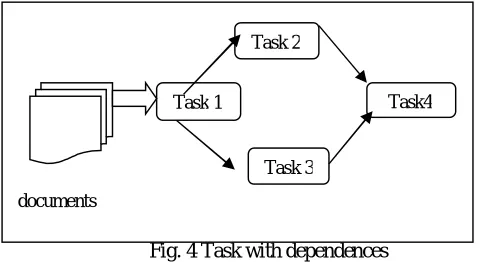
Fig. 4 Task with dependences
It integrates different task concepts into a single task those are: one-off task, multi-task operations and I/O tasks. It supports the non-blocking notification of task completion. [14]
Multi task support the concept of SPMD, where the same task is executed multiple times. Where we invoking a one-off the task into a multiple times. At first, a multi-task provides a better documents the programmer is aware of the intention to execute it multiple times. Second the sub-tasks of a multi-task map to different workers. This can be used for efficient parsing or scheduling the workload.
This approach is overhead and load balancing the various parallelisms.
documents
Task 1
Task 2
Task 3
Task4
Local Deques (LIFO)
Thread A Thread B
Global Queue (FIFO)
Fig. 5 Work sharing threads
This model achieves better performance using work-stealing over work-sharing as the processor count increases. [15]
III. CONCLUSIONS
In this paper we have been studied about the Information Retrieval models for searching and retrieving the cross-media information based on the input query. The input is may be text or image. Also discussed about semantic level searching technique by using binary coding with the help of hamming functions. The hash code is a simplified and improve binary code model for retrieving similar data items for different cross-media information. The neural network models are using semantic level linguistic knowledge for retrieving similar information from the query in natural language processing. From the case study this novel based model parallel processing gives effective performance and reduce the time complexity of retrieve information cross-media datasets significantly gives better result than state-of-art approaches.
REFERENCES
[1] Qi Zhang,Yang Wang, Jin Qian, and Xuanjing Huang ”A Mixed Generative-Discriminative Based Hashing Method” in Ieee Transactions On Knowledge and
DataEngineering,Vol.28, No.4, April 2016.
[2] J. Song, Y. Yang, Y. Yang, Z. Huang, and H. T. Shen, “Inter-media hashing for large-scale retrieval from heterogeneous data sources,” in Proc. Int. Conf. Manage. Data, 2013, pp. 785–796.
[3] Y. Zhuang, Y. Yang, F. Wu, and Y. Pan, “Manifold learning based cross-media retrieval: A solution to media object complementary nature,” J. VLSI Signal
Process. Syst. Signal, Image Video Technol., vol. 46, pp. 153–164, 2007.
[4] Z. Yu, F. Wu, Y. Yang, Q. Tian, J. Luo, and Y. Zhuang, “Discriminative coupled dictionary hashing for fast cross-media retrieval,” in Proc. 37th Int. ACM
SIGIR Conf. Res. Develop. Inf. Retrieval, 2014, pp. 395–404.
[5] Q. Zhang, Y. Zhang, H. Yu, and X. Huang, “Efficient partialduplicate detection based on sequence matching,” in Proc. 31st Annu. Int. ACM SIGIR Conf. Res.
Develop. Inf. Retrieval, 2010, pp. 571–578.
[6] J. Zhou, G. Ding, and Y. Guo, “Latent semantic sparse hashing for cross-modal similarity search,” in Proc. 37th Int. ACM SIGIR Conf. Res. Develop. Inf.
Retrieval, 2014, pp. 415–424.
[7] Y. Gong, S. Kumar, V. Verma, and S. Lazebnik, “Angular quantization-based binary codes for fast similarity search,” in Proc. Adv. Neural Inf. Process. Syst.,
2012, pp. 1196–1204.
[8] K. Grauman and R. Fergus, “Learning binary hash codes for largescale image search,” in Proc. Mach. Learn. Comput. Vis., 2013, pp. 49–87.
[9] D. Zhang, J. Wang, D. Cai, and J. Lu, “Self-taught hashing for fast similarity search,” in Proc. 33rd Int. ACM SIGIR Conf. Res. Develop. Inf. Retrieval, 2010,
pp. 18–25.
[10] A. Bordes, X. Glorot, J. Weston, and Y. Bengio, “Joint learning of words and meaning representations for open-text semantic parsing,” in Proc. Int. Conf. Artif.
Intell. Statist., 2012, pp. 127– 135.
[11] J. L. Elman, “Distributed representations, simple recurrent networks, and grammatical structure,” Mach. Learn., vol. 7, pp. 195– 225, 1991.
[12] G. E. Hinton, “Learning distributed representations of concepts,” in Proc. 8th Annu. Conf. Cognitive Sci. Soc., 1986, pp. 1–12.
[13] T. Mikolov, M. Karafiat, L. Burget, J. Cernockỳ, and S. Khudanpur, “Recurrent neural network based language model,” in Proc. INTERSPEECH, 2010, pp.
1045–1048.
[14] N. Giacaman and O. Sinnen. Parallel Task for parallelizing object-oriented desktop applications. In Proc. of 11th IEEE Int. Workshop on Parallel and
Distributed Scientific and Engineering Computing (PDSEC-10) (in conjunction with IPDPS2010), Atlanta, USA, April 2010. IEEE Press.
[15] N. Giacaman and O. Sinnen. Parallel Task for parallelising object-oriented desktop applications. Technical Report 675, University of Auckland, New Zealand,