3303
A REVIEW OF STUDIES ON ONTOLOGY DEVELOPMENT
FOR ISLAMIC KNOWLEDGE DOMAIN
1
M UHAMM AD AM AN, 2ABAS B IN M D SAID, 3SAID JADID ABDUL KADIR,
4BAHARUM BAHARUDIN
1,2,3,4
Department of Computer and Information Sciences, Universiti Teknologi Petronas, Malaysia
E-mail: [email protected], [email protected], [email protected],
4
ABSTRACT
Ontologies are used to explicitly represent knowledge of a various domain, and thus provide a shared understanding. Therefore, with the explosion of textual information on the Internet they are becoming a key technology for semantic-driven modeling, knowledge interchange and integration. Islam is one of the most popular religions of the world and Quran and Sunnah is the main source of knowledge for Muslims. To utilize this non-trivial knowledge domain for the betterment of humanity, numerous studies have been carried out to exploit ontologies for capturing knowledge from Islamic knowledge sources. This paper presents a review of different ontology oriented approaches for building domain specific ontology for Islamic knowledge domain, with the goal to identify the main problems in ontology development, and shortcomings of these approaches.
Keywords: Ontology development, knowledge representation, ontology learning, Quranic knowledge
domain, concept extraction
1 INTRODUCTION
Ontology can be defined in many ways; one of the definition by Gruber is "an explicit specification of a
conceptualization" [1, 2]. Ontology formally
represents concepts and their relationship, within a specific domain. The components of ontology include: individuals, classes, instances, and attributes, relations between concepts, terms, restrictions, axioms, rules, and events. These components play an important role of intelligent information processing, and represent the knowledge within a specific domain and help avoid ambiguity of terms of that specific
domain.
The key advantage of ontology usage is that it provides a unique global identifier for all identified concepts. It represents knowledge in any specific domain [3, 4]. It enables different users to analyze and reuse the domain knowledge by sharing of, mutual understanding of information structure among the users. Also, it helps to expand existing domain knowledge by merging it.
Although a lot of applications can exploit the potential benefits of using ontologies, it is well known that ontology development is costly [5-7]. In several studies on methodologies for ontology engineering, this problem is identified and is referred to as knowledge acquisition bottleneck [8-12]. In fact, modeling a non-trivial domain of knowledge is time consuming and challenging task. The main reason for this difficulty is that ontology is supposed to foster conciseness of the ontology by defining meaningful and reliable generalizations and to have significant domain coverage, at the same time. Ideally, this problem can be solved by an approach to learn ontologies automatically from data. Indeed, such an approach would help reduce the costs for ontology development dramatically[5, 13].
3304 domain ontology models are also limited in their expressivity and complexity.
In modern information systems ontologies are often viewed, as the solution to the need for interoperable semantics. (Semi-)automatic ontology learning from text is now a very promising research area because of the eruption of textual data on the internet along with the increasing demand for ontologies to support the Semantic Web [13]. Ontologies are considered as a key technology for, the ever-increasing demand of
knowledge integration and interchange, and
semantic-driven modeling because it provides a shared understanding of specific domain. Ontology in combination of semantic annotation of data, become machine processable. Thus, it allows the data exchange between various applications. Ontologies are therefore, often used for the explicit knowledge representation, which is given by different kinds of data implicitly[16].
Knowledge representation and ontology-based models of computational semantics are rapidly gaining importance, and being adopted widely in various application areas for example, Information
Extraction, Information Retrieval, Knowledge
Management, and Semantic Web. Therefore, religious studies researchers have also undertaken initiative to exploit ontologies for improving the knowledge capture from religious knowledge resources such as the Quran and Hadith [17]. Applying ontologies to Islamic knowledge domain would facilitate machine to automatically process information and understand it. Thus providing better knowledge service to users [3, 4].
On the topic of ontology development for Islamic knowledge domain, many research studies have been initiated [1, 3, 18-31]. However, these approaches are very limited and inconsistent [17]. To find potential future direction, a careful examination of existing approaches is needed. In this paper, we present a review on studies of ontology development for Islamic knowledge domain to identify limitations of existing work.
The research, on exploiting ontologies in Islamic knowledge domain, is yet on its initial stages. Therefore, the work in this domain is limited. Previously, a review was presented on the similar topic by S. M. Alrehaili and E. Atwell [17]. However, focus of the study was on comparing the ontologies developed by different approaches. He concluded that most of the ontologies developed for the Quran are aimed at a limited specific domain and are incomplete. Also, no clear consensus is available
on the technology to be used, semantic annotation format, and verification or validation of the results. In contrast, our focus is on identifying the shortcomings of different ontology development approaches.
The rest of the paper is organized as follow: In section 2 the background of the study is provided. Section 3 reviews in detail the existing approaches towards ontology development in Islamic domain. Section 4 concludes the paper with future work recommendation.
2 BACKGROUND
2.1 Knowledge Representation And
Ontologies
The focus of most of the current research in the field of artificial intelligence (AI) is on the
construction of systems, which incorporates
knowledge about a specific domain. Based on this knowledge the systems could reason and solve problems, which it never comes across before. Symbolic and explicit representation of knowledge is common to all the systems, about a specific domain. The advantage of such symbolic and explicit representation is that it can be disconnected from procedural aspects relating to its application, and thus can be reused in principle across systems[5].
In essence, computers are machines that manipulate symbols. In order to use these symbols in an expressive way, they need clear instructions. Therefore, to represent knowledge, some logical method with model-theoretic semantics and a syntactic procedure to verify semantic validity, is used, which can be executed by a computer [5]. Now, the question is this, which symbols should be used to represent knowledge in a way that a computer system can process it. Thus, Ontology as a model is needed. Such model would define which objects are
important and what are their relationships,
considering the domain in question.
2.2 Semantic Technology
3305 The semantic web architecture introduced in 2006 by Tim Berners-Lee is comprising of eight layers, as shown in Figure 1.
Figure 1. The Semantic Web Architecture [1, 33]
The Ontology and Resource Description
Framework (RDF) are considered to be the most important layers of this systematic structure. RDF is a data model for representing resources and relations amongst them. The RDF infrastructure plays a key role, in enabling semantic interoperability and to construct semantic web. It is a web standard which enables to encode exchange and reuse the structured metadata. By using RDF in a large scale on the web, it is predicted that, content and relationship between different resources will be described better, and this will also help search engines to find resources on the Web easily and enable content rating [1, 33]. Ontology is considered as a backbone of the Semantic Web. Ontology became an interesting topic for researches and plays a important role in
developing the Semantic Web, because it provides a sharable domain that facilitates the communities to understand and access the interlinked data [34].
2.3 Manual Ontology Development
Ontologies can be developed either manually or (semi-)automatically. Protégé[35]-an open source ontology editor- and Web Ontology Language (OWL2) [36] is widely used for building ontologies manually. Though a number of applications can exploit potential benefits of ontologies, however, building ontologies manually is costly [5-7]. Normally, this problem is known as knowledge acquisition bottleneck which is also identified in a number of publications on approaches towards ontology engineering [5, 8-13].
To resolve this problem, a best approach would be to learn ontologies automatically from data. Of course, such an ideal solution would lead to a dramatic decrease in the costs involved in construction of ontologies.
2.4 Semi-Automatic Ontology Development
(Ontology Learning)
[image:3.612.116.508.543.705.2]Although there is an increasing demand for building ontologies in different domains, this task is very tedious and complex, and requires a huge amount of effort and domain knowledge from domain experts. To facilitate this task, ontology learning has been widely studied and used to build ontology semi-automatically [14] [13, 37]. The ontology learning process can be structured in a layer cake as shown in Figure 2. The organization of subtasks is according to their increasing complexity within the process of ontology learning, to get them[5].
3306 This layer cake is referred to as ontology learning layer cake. Whereas the layers indicate the different subtasks while learning ontology[5].
1. Relevant terms acquisition,
2. Synonym terms identification / linguistic
variations,
3. Concepts formation,
4. Organizing concepts in a hierarchy (concept
hierarchy),
5. Extracting relations, attributes or properties,
together with the right domain and range,
6. Organizing relations in a hierarchy (relation
hierarchy),
7. Instantiating axiom schemata
8. Defining arbitrary axioms
For illustration, Figure 2 contains some real examples from geography domain to the left of layer cake. Within the acquisition of terminology step the relevant terms are found such as country, river, nation, capital, and city. At the discovery of synonym step, country and nation might be grouped together. This collection of synonyms will provide the lexicon
Refc which is part of the concept country: =<
i(country), ǁcountryǁ,Refc(country) > along with
intension i(country) and the extension ǁcountryǁ. The
intension, for instance, could be stated as 'An area of
land forming a politically independent unit'.
Furthermore, a concept hierarchy could be learnt between the concepts already acquired. For instance, in geographical domain, it could be learnt that “capital ≤c city, city ≤c Inhabited GE (where GE stands for geographical entity)” [5]. In addition, relation could be extracted along with domain and range for example, the river flow-through (relation) some GE. In the next step, we might learn ordering relations hierarchically, for example, the relation capital_of is a specialization of relation located_in. Next, at the acquisition of axiom schema step, it could be derived that mountain and river are disjoint concepts. Finally, at the last level we also might infer more complex relationships, in the form of axioms, between concepts and relations. The rule in Figure 2 for instance, tells us that every country has a unique capital [5].
3 MAIN PROBLEMS OF ONTOLOGY
LEARNING
The goal of Ontology Learning is the extraction of concepts and their relationships together with occasional axioms related with the concepts from documents, to build an ontology [13, 37]. The
concepts normally represent a set of classes of entities or things within a specific domain [35]. According to earlier studies [38, 39], as noun phrases are suitable to represent the key information within text documents, therefore, they can often describe the concepts. A noun phrase means a single noun or a group of words that function together as a noun [36]. However, the main problem in this scheme is that not all the noun phrases can be thought of as domain-specific concepts and beneficial for precisely abstracting domain knowledge. This is because; such concepts may contain noise terms or having terms that are too common and general. Therefore, a key challenge in ontology learning is the automatic extraction of domain-specific key concepts and their relationships that can correctly represent the key knowledge of a corpus of document (s) in a specific domain. Thus, extraction of key concepts and their relationships is a basic and the most important task for ontology learning from text documents [13, 38]. If the key concepts extracted are non-relevant, the ontology may not correctly and fully represent domain knowledge, also such irrelevant concepts can lead to the generation of non-relevant relations between concepts, and axioms [37].
4 ONTOLOGY DEVELOPMENT IN
ISLAMIC KNOWLEDGE DOMAIN
Islamic source of knowledge i.e. Quran and Sunnah have unique characteristics, which highly demands the support of semantic search. These characteristics can be categorized as follows [3].
1. The Quranic content has allegorical nature,
so the meanings, metaphors and intents cannot be understood easily without semantics and underlying meanings.
2. Islamic Concepts are diverse and
interrelated, so the search results must show relationships and dependencies among various concepts. For example, explanation of one verse is implicitly mentioned in another verse.
3. The Quranic terminology includes many
legacy terms which may have many interpretations, so without incorporating semantic search for the synonyms of these legacy terms may not return the intended results.
3307 knowledge domain is at initial stage therefore, not so many references have been found for this study. Mostly, this research focus is on improving efficiency of Information retrieval for Quran by manually developing domain-specific ontology [1, 3, 26-31]. Generally, these studies have facilitated the access to Quranic knowledge. However, there is variation among the approaches in different aspects for instance, Quran coverage, text language, discourse level, Arabic text or translation, focused domain or subject, types and number of concepts covered, methodology of concept extraction, types of relations they extract, technology and techniques used for building ontology, availability for reuse, and evaluation methods [17]. Broadly, this initial research can be classified, based on the ontology development methods, into the following two categories.
4.1 Manual Ontology Development
Most of the manually created ontologies are developed using Protégé, Web Ontology Language (OWL), Manchester OWL and SPARQL. These ontologies are either built around a specific topic or a document.
4.1.1 Topic level ontologies
A topic level ontology is developed by A. Ta'a et al. [29]. They proposed a theme-based approach to classify and represent the knowledge of the Quran using ontology. The ontology was developed using protégé-OWL as developing tool and Malay language text. The ontology was verified by domain experts focusing on only two themes: “Iman”, meaning faith and “Akhlaq”, which means deed are covered in this research paper. Another topic level ontology is developed by Khan et al. [31] they developed sample domain ontology in protégé ontology editor tool, based on living creatures such as birds and animals mentioned in the Holy Quran, SPARQL Queries have been run to illustrate the proper role of ontology . This paper also presents a framework and a model, which includes creation of Quranic WordNet, integration, mapping and merging of domain ontologies under the umbrella of upper ontology. However, results and analysis are missing in the paper. In [3] AlAgha et al. developed a topic level ontology based system OntoADL, that integrate semantic search with a section of Al-Shamelah digital library (ADL). The searching domain consists of sixty sayings of the Prophet Mohammed (SW) obtained from the book of “Al-tib Al-Nabawi”. The methodology adopted includes, manual creation of a limited Ontology around the topic of Prophetic Medicine, manual semantic annotation and linking
the ADL content with the ontology concepts, use of Inference engine to infer new facts from existing ones, and translating Ontology Terms to SPARQL.
4.1.2 Document level ontologies
K. Dukes [28] defined about 300 concepts in the Quran and used Predicate logic, to find the relationships among these concepts and the total number of relations extracted is about 350. The scope of the work is limited to the taxonomic type of relations i.e. Is-a or Part-of relation. Based on readily available Quranic Arabic Corpus ontology by K. Dukes [28], Z. Yahya et al. [27] proposed document level ontology based system for Quran using Cross Language Information Retrieval technique. They developed a bilingual ontology for Holy Quran, comprising of concepts and found 5695 documents, related to main concepts, whereas the number of documents, not assigned to any single concept in the Quran English translation, are 541. In Malay, 5999 documents are assigned to key concepts, whereas 237 documents remained not assigned to any concept. Similarly, In [26] a semantic search system for Quran domain is proposed, using existing Quran ontology developed by researchers from Leeds University[28]. Additionally, more than 650 relationships were defined, depending on the Holy Quran, Hadith, and Islamic websites. A framework is developed comprising of Quran Ontology, Knowledge base, Inference engine and Manchester OWL. In [30] a Framework to discover and extract knowledge from the documents related to Holy Quran related domain is proposed. The framework is implemented with name DataQuest using manually created document level ontology, and maintaining a relational database for annotated documents. Ishkewy et al. [1] presents a prototype for Islamic Ontology based search engine for Holy Quran. The prototype is built based on a portion of Islamic Ontology which is already created and uses Azhary as a lexical ontology for the Arabic language [25]. The modules and processes such as Ontology Building, Ontology Extending, Verses Annotating, Query Preparing, and Searching are included in the System. This paper shows experimental work which explores structure, usage and significance of ontology.
4.2 Semi-Automatic Ontology Development
3308
4.2.1 Concept Extraction
Regarding concept extraction, Saad et al. [18] described the Islamic concepts and presented a methodology which is composed of rules and techniques of extracting concepts from Quran translation, and to build the ontology of Islamic Knowledge. The focus of the work was on concepts related to prayer. The author identified two major components of ontology (a) TBox (terminological) which is composed by taxonomy of concepts. (b)
Abox (assertion) which contains concrete
representations of these concepts i.e. instances. In [20] Saad et al. further proposed rules and a new pattern named QPattern that can be used in extracting knowledge, from English translation text of Quran. The methodology is based on the combination of rule-based approach using NLP and the machine learning techniques [40]. The Author used three layers’ approach, for ontology development, (a) Meta concepts extraction from Quran indexes text. (b) Extraction of concepts related to prayer (c) ontology population to enrich the ontology built in first and second layer. The approach is evaluated empirically by comparing the resulting concepts and relations with the gold standard that has already been identified by the domain experts. Moreover, Saad et al. [21] carried out several experiments, based on linguistics, statistical and hybrid approaches, in order to identify the best techniques and approaches for extracting terms from Quran English translation text. The techniques used for concept extraction include, Documents Preprocessing, POS chunking, Feature extraction, Ranking and Validation and Relevant terms acquisition. The systematic comparison and analysis of different techniques for concept extraction from Quran’s Translation is a plus point of their work, which is helpful in identifying the adequate approach for term extraction. However, they are relying on linguistic patterns, which is hard to hand craft and may not cover all the domain concepts.
4.2.2 Relation Extraction
For relation extraction Al Zamil et al. [23] developed a methodology that extracts ontological relationships and semantic features from Arabic text, and proposed syntactic patterns of relationships among concepts. Finally, they presented a formal model for extraction ontological relations. The methods used in this work includes, preprocessing of plain Arabic text i.e. POS tagging, Features and Hearst Lexical pattern extraction, Pattern expansion using WordNet and Filtering and applying Hearst’s algorithm with some enhancement for extracting
ontological relationships from Arabic corpus. The advantage of the work is the experiments performed to empirically evaluate the proposed method, and study the effect of varied factors on the performance of the proposed technique. Also, the author carried out comparison of his method with similar ones. However, this work is limited to taxonomic relations e.g. Is-A relation based on Hearst Patterns and does not cover nontaxonomic relations. Similarly, In[24], an experiment is performed to learn relations such as taxonomic relations (Is-A, Part-of relations) and non-taxonomic relations (synonym and definition relations) from Quran English translation based on the Ontology Learning approach, and using the existing Natural Language Processing (NLP) Pattern. General Architecture of Text Engineering (GATE) tool is used to prepare the POS tagging (verb, noun, preposition, pronoun, conjunction, adverb, adjective and article). To find patterns, structure of annotated text has been analyzed. Patterns are matched with text to find relations.
In [22], the authors proposed a framework for ontology development from Arabic texts based on the holy Hadith, (Sayings of the Prophet Muhammad). The focus of the work is on Arabic text. The different approaches and current research challenges in ontology development from Arabic texts are also summarized in this paper. The author mentioned different steps, for extracting concepts and semantic relations from Arabic texts, based on NLP, statistical and data mining techniques. Although this paper presents an overview of methodology on ontology development from Holy Hadith, it does not provide the sufficient details of each step. Petiwala et al. [19] proposed a different multiple-agent system to automatically build ontology from English translation of Holy Quran. The readily available digital data composed of vocabulary, indexes, and concordances of the Quran, is used as a data source by the multiple agents. The author used WordNet lexicon to cluster the index terms, and utilized Synonym, Hypernym, Holonym, relationships of WordNet. The author also mentioned the OTCM (Ontology Term Coverage Metric) for evaluating ontology generation of each phase.
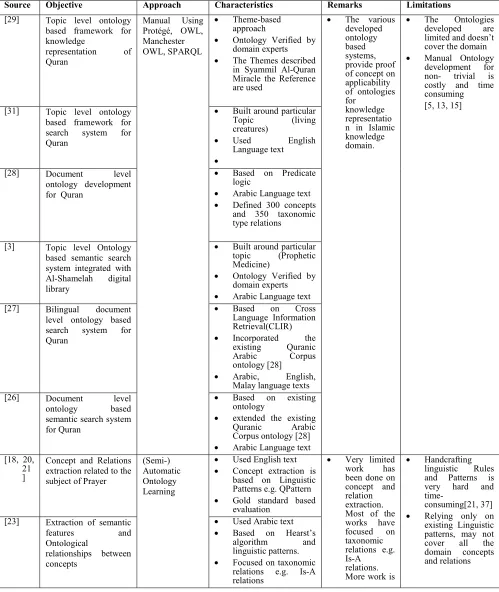
These works are worthy to get of idea of ontology learning methodology for Quran. However, they are limited to the use of existing NLP patterns, which may not extract all kind of relations from Quran Translation. Table 1 shows the summary of different approaches towards ontology development, and their limitations.
3309
Table 1 comparison of different approaches towards ontology development for Islamic knowledge domain
Source Objective Approach Characteristics Remarks Limitations
[29] Topic level ontology based framework for knowledge
representation of Quran
Manual Using Protégé, OWL, Manchester OWL, SPARQL
• Theme-based approach
• Ontology Verified by domain experts
• The Themes described in Syammil Al-Quran Miracle the Reference are used
• The various developed ontology based systems, provide proof of concept on applicability of ontologies for
knowledge representatio n in Islamic knowledge domain.
• The Ontologies
developed are limited and doesn’t cover the domain
• Manual Ontology development for non- trivial is costly and time consuming [5, 13, 15]
[31] Topic level ontology based framework for search system for Quran
• Built around particular
Topic (living
creatures)
• Used English
Language text
•
[28] Document level
ontology development for Quran
• Based on Predicate logic
• Arabic Language text
• Defined 300 concepts and 350 taxonomic type relations
[3] Topic level Ontology based semantic search system integrated with Al-Shamelah digital library
• Built around particular topic (Prophetic Medicine)
• Ontology Verified by domain experts
• Arabic Language text [27] Bilingual document
level ontology based search system for Quran
• Based on Cross
Language Information Retrieval(CLIR)
• Incorporated the
existing Quranic
Arabic Corpus
ontology [28]
• Arabic, English,
Malay language texts
[26] Document level
ontology based
semantic search system for Quran
• Based on existing ontology
• extended the existing
Quranic Arabic
Corpus ontology [28]
• Arabic Language text [18, 20,
21 ]
Concept and Relations extraction related to the subject of Prayer
(Semi-) Automatic Ontology Learning
• Used English text
• Concept extraction is based on Linguistic Patterns e.g. QPattern
• Gold standard based evaluation
• Very limited
work has
been done on concept and relation extraction. Most of the works have focused on taxonomic relations e.g. Is-A
relations. More work is
• Handcrafting linguistic Rules and Patterns is very hard and
time-consuming[21, 37]
• Relying only on existing Linguistic patterns, may not cover all the domain concepts and relations [23] Extraction of semantic
features and
Ontological
relationships between concepts
• Used Arabic text
• Based on Hearst’s
algorithm and
linguistic patterns.
3310
[24] Extraction of
taxonomic relations between concepts
• Used English text
• Focused on taxonomic relations e.g. Is-A relations
• Based on existing NLP patterns
needed on extraction of concepts and
non-taxonomic
kind of
relations. [19] A multi-agent based
methodology for building ontology from Quran
• Proposed multiple agent based system and OTCM (Ontology
Term Coverage
Metric) for evaluation
5 CONCLUSION
In this research, we have mainly focused on review of ontology development approaches for Islamic knowledge domain. The objective was to identify main problems in ontology development and shortcomings of existing approaches in Islamic knowledge domain. By comprehensive literature review it is found that extraction of concepts and their relationships is the main challenging task in Domain Ontology Learning. From the comparison, we have concluded that firstly, most of the approaches towards ontology creation for Islamic knowledge domain are manual, which is costly and time consuming. Secondly, the (semi-) automatic Ontology Learning approaches in Islamic knowledge domain to address the problem of extraction of concepts and their relationships are very limited and are based on existing lexico-syntactic patterns. Using linguistic patterns result in a rather high efficiency, however, their major drawbacks are the amount of supervision and huge effort is required for handcrafting linguistic rules, also defining semantic patterns manually to identify key concepts for target domain is very hard and time consuming. Finally, relying only on existing linguistic patterns, may not cover all the domain concepts and their relationships. In future, more research is needed on concept and relation extraction, to consider the shortcomings and limitations identified. Our intention will be the development of a hybrid method that will exploit the strengths of various statistical, linguistic and machine learning techniques for concept and relation extraction.
REFERENCES:
[1] H. Ishkewy and H. Harb, "ISWSE: Islamic
Semantic Web Search Engine," International
Journal of Computer Applications, vol. 112,
2015.
[2] T. R. Gruber, "A translation approach to
portable ontology specifications," Knowledge
acquisition, vol. 5, pp. 199-220, 1993.
[3] I. M. AlAgha and M. G. Al-Masri, "An
Ontology Based Approach to Enhance
Information Retrieval from Al-Shamelah Digital Library," IUG Journal of Natural Studies, vol. 24, 2016.
[4] Y. Zhao and C. Hu, "An ontology-based framework for knowledge service in digital
library," in 2007 International Conference on
Wireless Communications, Networking and
Mobile Computing, 2007, pp. 5345-5348.
[5] P. Cimiano, Ontology learning from text, 2006. [6] E. Ratsch, J. Schultz, J. Saric, P. C. Lavin, U.
Wittig, U. Reyle, et al., "Developing a protein
interactions ontology," Comparative and
Functional Genomics, vol. 4, pp. 85-89, 2003.
[7] H. S. Pinto and J. P. Martins, "Ontologies: how
can they be built?" Knowledge and information
systems, vol. 6, pp. 441-464, 2004.
[8] M. Uschold, "Building ontologies: Towards a
unified methodology," Technical
report-university of edinburgh artificial intelligence applications institute aiai tr, 1996.
[9] M. Fernández-López, A. Gómez-Pérez, and N. Juristo, "Methontology: from ontological art towards ontological engineering," 1997.
[10] C. W. Holsapple and K. D. Joshi, "A collaborative approach to ontology design,"
Communications of the ACM, vol. 45, pp. 42-47,
2002.
[11] Y. Sure and R. Studer, "Methodology, tools & case studies for ontology based knowledge management," 2003.
[12] H. S. Pinto, S. Staab, and C. Tempich,
"DILIGENT: Towards a fine-grained
methodology for Distributed,
Loosely-controlled and evolvInG," in Proceedings of the
16th European Conference on Artificial
Intelligence (ECAI 2004), 2004, p. 393.
[13] W. Wong, W. Liu, and M. Bennamoun, "Ontology learning from text: A look back and
into the future," ACM Computing Surveys
3311
[14] A. Maedche, Ontology learning for the semantic
web vol. 665: Springer Science & Business
Media, 2012.
[15] S. Staab and R. Studer, Handbook on
ontologies: Springer Science & Business Media,
2013.
[16] P. Cimiano and J. Völker, "text2onto," in International Conference on Application of Natural Language to Information Systems, 2005, pp. 227-238.
[17] S. M. Alrehaili and E. Atwell, "Computational ontologies for semantic tagging of the Quran: A
survey of past approaches," LREC 2014
Proceedings, 2014.
[18] S. Saad, N. Salim, and H. Zainal, "Towards context-sensitive domain of Islamic knowledge ontology extraction," 2010.
[19] A. J. Petiwala and S. S. Sathya, "A multi-agent system to learn literature ontology: An experiment on English Quran corpus," in
Intelligent Agent and Multi-Agent Systems
(IAMA), 2011 2nd International Conference on,
2011, pp. 46-51.
[20] S. Saad, S. Noah, N. Salim, and H. Zainal, "Rules and Natural Language Pattern in Extracting Quranic Knowledge," in Advances in Information Technology for the Holy Quran and Its Sciences (32519), 2013 Taibah University International Conference on, 2013, pp. 381-386. [21] S. Saad, N. Salim, and S. Tiun, "Concept
Extraction on Qur’anic Translation Text," 2014. [22] A. Al Arfaj and A. Al Salman, "Towards
Ontology Construction from Arabic Texts-A
Proposed Framework," in Computer and
Information Technology (CIT), 2014 IEEE
International Conference on, 2014, pp. 737-742.
[23] M. G. Al Zamil and Q. Al-Radaideh, "Automatic extraction of ontological relations
from Arabic text," Journal of King Saud
University-Computer and Information Sciences,
vol. 26, pp. 462-472, 2014.
[24] R. Ismail, Z. A. Bakar, and N. A. Rahman, "Extracting knowledge from english translated
quran using nlp pattern," Jurnal Teknologi, vol.
77, 2015.
[25] H. Ishkewy, H. Harb, and H. Farahat, "Azhary:
An Arabic Lexical Ontology," arXiv preprint
arXiv:1411.1999, 2014.
[26] A. R. Yauri, R. Abdul Kadir, A. Azman, and M. A. Azmi Murad, "Quranic verses extraction base
on concepts using OWL-DL ontology,"
Research Journal of Applied Sciences,
Engineering and Technology, vol. 6, pp.
4492-4498, 2013.
[27] Z. Yahya, M. T. Abdullah, A. Azman, and R. A. Kadir, "Query Translation Using Concepts Similarity Based on Quran Ontology for
Cross-Language Information Retrieval," Journal of
Computer Science, vol. 9, p. 889, 2013.
[28] K. Dukes, "Statistical parsing by machine learning from a classical Arabic treebank,"
arXiv preprint arXiv:1510.07193, 2015.
[29] A. Ta'a, S. Zainal Abidin, M. S. Abdullah, M. Ali, A. Bashah, and M. Ahmad, "Al-Quran themes classification using ontology," 2012. [30] Q. ul Ain and A. Basharat, "Ontology driven
Information Extraction from the Holy Qur’an
related Documents," in 26th IEEEP Students’
Seminar, 2011.
[31] H. U. Khan, S. M. Saqlain, M. Shoaib, and M. Sher, "Ontology based semantic search in Holy
Quran," International Journal of Future
Computer and Communication, vol. 2, p. 570,
2013.
[32] T. Berners-Lee. "Artificial Intelligence & the Semantic Web", World Wide Web Consortium,
2006. . Available: http://www.w3.org.
[33] L. Yu, Introduction to the semantic web and semantic web services: CRC Press, 2007. [34] T. Berners-Lee, J. Hendler, and O. Lassila, "The
semantic web," Scientific american, vol. 284,
pp. 28-37, 2001.
[35] N. F. Noy and D. L. McGuinness, "Ontology development 101: A guide to creating your first ontology," ed. Online: Stanford knowledge systems laboratory technical report KSL-01-05 and Stanford medical informatics technical report SMI-2001-0880, Stanford, CA, 2001. [36] B. Motik, B. C. Grau, I. Horrocks, Z. Wu, A.
Fokoue, and C. Lutz, "Owl 2 web ontology
language: Profiles," W3C recommendation, vol.
27, p. 61, 2009.
[37] Y.-B. Kang, P. D. Haghighi, and F. Burstein, "CFinder: An intelligent key concept finder
from text for ontology development," Expert
Systems with Applications, vol. 41, pp.
4494-4504, 2014.
[38] X. Jiang and A. H. Tan, "CRCTOL: A
semanticbased domain ontology learning
system," Journal of the American Society for
Information Science and Technology, vol. 61,
pp. 150-168, 2010.
[39] Q. Li and Y.-F. B. Wu, "Identifying important
concepts from medical documents," Journal of
biomedical informatics, vol. 39, pp. 668-679,
2006.
[40] A. Kao and S. R. Poteet, Natural language
![Figure 1. The Semantic Web Architecture [1, 33]](https://thumb-us.123doks.com/thumbv2/123dok_us/8906502.957086/3.612.103.301.139.350/figure-semantic-web-architecture.webp)