7654
MEASURING THE SUCCESS OF E-GOVERNMENT
SYSTEMS: APPLYING THE SUCCESS MODEL OF THE
DELONE AND MCLEAN INFORMATION SYSTEM
11ZAINAB AMIN AL-SULAMI, 2HAYDER SALAH HASHIM
1,2Basra University, Basra-Iraq
E-mail: 1 [email protected] , 2 [email protected]
ABSTRACT
The success model of an information system from an Iraqi citizen’s perspective was utilized to examine the e-government system in developing countries, exclusively in Iraq's environment. Partial Least Square path modeling algorithm was applied as a fundamental technique to analyze the collected data using a questionnaire of 160 citizens in Iraq. The proposed model was developed by modifying the updated DeLone and McLean IS success model. The proposed model consisting of the previous six constructs from the updated D&M model was integrated with trust constructs. Results empirically corroborate that ten hypotheses among the seven constructs are supported significantly, whereas the other three are less supported. Model constructs are affirmed to affect the citizen intention and satisfaction positively. The impact gradually decreases from trust as the highest influence constructs, followed by service, system, and information qualities. Trust is confirmed as the main powerful construct that positively influences the Iraqi citizen’s usage intentions. The managerial implications of these research results contend that the Iraqi government agencies, along with the system developers, must pay extra attention to the proposed model constructs that influence the citizen’s intention to use an e-government system, specifically the construct of citizen trust.
Keywords: e-government system, success model of DeLone and McLean, citizen trust, Iraqi citizens,
1. INTRODUCTION
Technology has significantly influenced many essential parts of life through the rapid and easy exchange of communication and information. It allowed the further development of different sectors, such as technological, economic, and social sectors [1].From the government perspective, Information Technology (IT) allowed the emergence of e-governance as an advanced means to enhance the exchange of information between governments and citizens. E-governance is known as the usage of IT to supply any government citizens with the required services, enhance the public agencies' performance, and provide the successful participation of the citizens within the entire process of social and technical development [2].Substantially, e-government reduced service's delivery costs, sped up the service processing time, and enhanced the overall transformation of service
7655 Hence, a few studies intensively examined the role of citizen’s relationship with their governments and how this relation positively or negatively affected the success of e-government. Recent studies focus on the trust dimension that somehow facilitates the use behavior of citizens [6],[7].Hitherto, little consideration exists on how the e-government system considers successful adoption from the citizens' trust perspective [8].This empirical study aims to measure the success within the e-government system from a citizen’s perspective. DeLone and McLean’s updated model [9] has been used for this research. Unlike other models, the success model of DeLone and McLean is used to evaluate the effectiveness of ISs by measuring the six constructs of the model. Nevertheless, the D&M model was criticized for excluding trust construct in its conceptualization. The researchers justified their criticism by the importance of this construct in the measurement and evaluation of ISs [10], [11]. The data were collected from 156 citizens in Iraq using a questionnaire and were analyzed thereafter. The citizens were chosen randomly on the basis of their qualification level. The findings from this research could be deployed to measure the success of e-government application from citizens’ view as the main users of e-government implementations in real-life activities and transactions.
2. RELATED WORK 2.1 E-Government
The term e-government is described as electronic supplier of data throughout the online interface. E-government allows E-governments to deploy new technology and adopt modern mechanisms to promote general public services [12]. However, the main purposes of implementing e-government can be justified by reorganizing the government organization's public services, enhancing service capacity, facilitating corporations within the top management, speeding up the communication and coordination between citizens and government, and simplifying the operations of financial transactions and public services [13]. Many researchers argued that governments that implement e-government technology can promote citizens trust, reduce time, save efforts, and respond to citizens’ demands efficiently[14].Therefore, many governments are currently expediting the successful implementation of e-government[15].
2.2 E-Government Systems
E-government system is identified as an electronic platform that provides online communications among government, citizens, and organizations [16]. E-government systems are classified into three system types, namely, government to the citizen (G2C), government to government (G2G), and government to business (G2B). However, the implementations of e-government systems require the acquisition and development of professional skills and expertise from government employees [17].The most extensive board of studies affirms that the G2C system is the researcher's huge concern [18]. [19] Argued that the recent increase in the investigated G2C can be justified by many reasons as follows: citizens currently receive the most services through online e-government applications. However, the use of e-government services requires citizens to interact within the government system efficiently and confidently. Therefore, expending the investigations on G2C is critical. Further studies must be conducted to investigate the e-government information system from the citizens’ perspective and not merely from the employees’ perspective [20].
Many constructs can influence the success within the e-government system, whether incrementing or decrementing on the basis of the citizen’s perspective. However, the most powerful construct that can affect the citizen’s willingness to participate in e-government application is trust. Trust is a controversial concept. This concept is ambiguous to evaluate and assess [21]. Traditionally, trust demands a high level of certainty in any aspects of life. With reference to e-government success, trust becomes a critical success construct to achieve successful e-government implementations [22]. It provides the capacity to employ the secure and invulnerable system throughout the online electronic environments [23].Thus, many studies emphasize the need for and the value of trust to implement successful e-government implementations [24], [25].
2.3 E-Government System in Iraq
7656 Iraq in all fields. Hitherto, Iraq is suffering from the war's consequences and related drawbacks, such as system chaos [26]. Regarding the IT infrastructure, IT in Iraq is extremely limited. According to the UNESCO survey [26], ICT infrastructure and literacy rates in Iraq are extremely poor; only 12% of the population own personal computers, and 7% of the population have Internet access. Therefore, Internet access is also limited with poor speed. The telecommunication infrastructure is inadequate, along with the power-supply shortage [27]. Owing to the unstable political condition, companies, qualified international experts, and investors fear of coming to Iraq. Realistically, security is the main obstacle preventing Iraq from evolving into a developed country.
In 2004, the Iraqi government started initiating the e-government infrastructure with the support of an Italian company [28].However, owing to poor security and unstable political situations, the project was delayed until 2010. Thereafter, the Iraqi government took the initiative to collaborate with the United Nations Development Program (UNDP) and develop a detailed understanding and strategy work on the successful implementation of this project. Consequently, the Iraqi e-government portal was successfully launched in 2014, with certain services, such as health, e-learning, municipal services, and electronic personal data.
However, hitherto, the services of e-governments are not completely implemented. Only few services are practically operating on the e-government system in Iraq. Therefore, many aspects must change to guarantee the successful implementations of the e-government system. Evidently, the Iraqi government must improve its social environment as well as its policy trends and structures. Moreover, coordination must also happen between governments and citizens [28]. Iraqi citizens have experienced poor participation in the e-government system, which, in turn, contributed to the limited actual activations of the e-government system. The citizen’s poor attitude toward e-government occurs for many reasons, such as trust, training, and accountability [29]. For instance, the Iraqi government must improve the decision maker’s decisions and performance in a way that helps Iraqi citizens increase their participation in e-government systems. Consequently, government decisions that result in untrusted operations and unorganized processes will not obtain citizens’ trust on the e-government system [30].Therefore, huge demands
and needs exist for the Iraqi government to exhibit a positive attitude toward the successful implementation of e-government services to help their citizens. Thus, this research is considered one of the studies that measure the success of an e-government system from an Iraqi citizen’s perspective as primary users of the system and its services.
2.4Delone and Mclean Information System Success Model
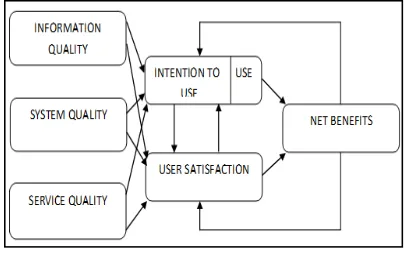
The DeLone and McLean information system (hereafter known as D&M IS success model) was presented in 2003 by the researchers DeLone and McLean. The model is an updated version from the previous D&M model introduced in 1992. The updated D&M model provides the opportunity to demonstrate the autonomous and multidimensional nature of the information system’s success. The taxonomy of the updated D&M model consists of the following six interrelated constructs:
(1) Information Quality (IQ) (2) System Quality (SQ) (3) Service Quality (SV) (4) System Use (U) (5) User Satisfaction (US) (6) Net Benefits (NBs)
[image:3.612.322.524.522.651.2]The modified model is considered one of the most IS success models extensively utilized in various IS fields [20], [31]. The model is used to assess and evaluate the effectiveness of ISs throughout the applying measurements of the model’s six constructs. Figure 1 illustrates the updated D&MIS success model.
Fig 1: Updated D&MIS Success Model (Delone and Mclean, 2003)
e-7657 government information system website to deal with various public services, such as license renewal, voting, and election. Through such daily e-government tasks, citizens are able to notice the improvement of the online service by observing time reduction, service's availability, and response to time duration. Therefore, the e-government system can be investigated and studied by using the D&M IS success model[32].In addition, DeLone and McLean also recommended that further field of studies adapt or update their original model. Thus, the D&M model can be adopted as a success assessment model for the e-government system from a citizen’s perspective. Nevertheless, the D&M model was criticized for excluding trust in its conceptualization [11]. Accordingly, the constructs of the D&M model were used in this study, along with the trust construct. Trust constructs were added to the D&M model owing to its importance in ensuring effective assessment of e-government systems.
2.5 Proposed Conceptual Model and Hypothesis
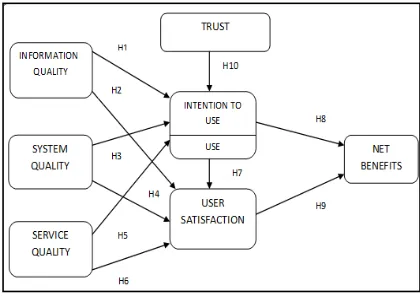
The research uses the model and constructs obtained from related studies. The current research mainly aims to provide a model to measure the success of e-government systems from the perspectives of citizens. Apparently, e-government systems are recognized as one type of IS [33]. Therefore, the success of e-government systems could be measured by the updated D&M IS success model. According to the previous studies, such as [9], [32], the initially proposed conceptual model is formulated as shown in Figure 2. The model constructs are explained briefly below:
1. System Quality (SQ): This construct can measure an e-government system’s technical success. SQ demonstrates the system performance regarding usability and user friendliness [9], [34].
2. Information Quality (IQ): This construct represents e-government system output quality [35].In addition; IQ can be measured within various semantic attributes [9].
3. Service Quality (SV): This construct represents service quality that system users receive from system staff [35]. Similar to SQ and IQ, SV is also used to measure an e-government system’s general quality by measuring the willingness of staff to offer reliable services, trusted connections, and system availability when they are working on an e-government system.
4. Intention to Use (U): This construct represents the attitude and the degree of e-government system capabilities from the users’ perspective. Hence, U measures users’ attitude toward the system dependency, frequency usage of system, and the willingness to use it in the future. 5. User Satisfaction (US): US represent the users’
general method of using an e-government system [34].US can measure whether the tested e-government system is worth using in terms of required expectations and general satisfaction from the users’ views.
6. Trust (T): This construct represents the system’s capacity to be trustworthy and reliable from the users’ perspective. With respect to e-government systems, trust plays an important role in achieving successful e-government implementations [22], [36], [37].
[image:4.612.327.537.346.496.2]7. Net Benefits (NBs): This construct represents the capacity of an e-government system to increase the success of individual users [35].
Fig 2: Proposed Conceptual IS Success Model from a Citizen’s Perspective.
Figure 2 exhibits that the updated D&M model is integrated with trust construct to formulate the proposed conceptual model that will be used to assess the success of e-government systems. The integrated model is multidimensional and consists of mutually dependent constructs. Thus, analyzing the interrelations among its constructs, indicators, and sources is necessary, as presented in Table 1.
Table 1: Constructs and indicators of the proposed conceptual model
Constructs Indicators Sources
System
7658
(SQ) 3. Usability
Information Quality(IQ)
4. Precise
information 5. Up-to-date
information 6. Sufficient
information 7. Reliable
information
8. Useful
information
[20], [39]
Service
Quality(SV) 9. Readiness for service 10. Safe
transactions 11. Availability 12. Individual
attention 13. Specific needs
for users
[20], [32], [40], [41]
Intention to
Use(U) 14.15. Dependency Frequency of system use
16. Tendency to
use
17. Duration of
future use
[20], [31]
User Satisfaction
(US)
18. Satisfaction with system 19. Perceived
utility 20. Expectations
[20], [32], [34].
Trust(T) 21. Trustworthy 22. Has high integrity 23. Keeps my best interests in mind 24. Does the right job 25. Carries out online transactions faithfully 26. Keeps promises and commitments
[37],[42], [43], [44]
Net Benefits
(NBs) 27. Makes job easier 28. Time savings 29. Useful
[9],[20]
The following hypotheses regarding the interrelations within the proposed conceptual model are clarified below:
H1: Information quality has a positive impact on intention to use/use e-government systems from the citizens’ perspective.
H2: Information quality has a positive impact on user satisfaction in e-government systems from the citizens’ perspective.
H3: System quality has a positive impact on intention to use/use e-government systems from the citizens’ perspective.
H4: System quality has a positive impact on user satisfaction in e-government systems from the citizens’ perspective.
H5: Service quality has a positive impact on intention to use/use e-government systems from the citizens’ perspective.
H6: Service quality has a positive impact on user satisfaction in e-government system from the citizens’ perspective.
H7: User satisfaction in e-government systems has a positive impact on net benefits.
H8: Intention to use/use has a positive impact on user satisfaction in e-government systems.
H9: Intention to use/use of e-government systems has a positive impact on net benefits.
H10: Trust has a positive impact on intention to use/use e-government systems from the citizens’ perspective.
3. RESEARCH METHODOLOGY
3.1 Data Collection Phase
The conceptual model is examined by analyzing data collected from ordinary citizens in Iraqi society. The citizens were chosen randomly on the basis of their qualification level (BSc). Approximately 358 Iraqi citizens participated voluntarily in this study. The responses of roughly 160 were collected throughout the duration of 13 weeks. Non-engaged bias analyses were conducted. Four responses were omitted owing to incomplete answers, whereas the remaining 156 were used for data analysis. [45] Asserted that several responses between 30 and 500 are sufficient for any academic research. All constructs were measured by their 29 indicators using a seven-point Likert scale [46].
3.2 Data Analysis Phase
7659 technique as a comprehensive formidable statistical tool.
4. RESULTS
4.1 Demographic Data
This research collected answers from 156volunteer respondents. The percentage of male respondents was approximately 78%. The distribution of age was nearly normal between 20 and 29 (25.6%), between 30 and 39 (25%), between 40 and 49 (17.3%), between 50 and 59 (19.9%), and over 60 (12.2%). The respondents were placed as Center (40.6%), South (29.6%), West (17.4%), and East (12.4%). Table 2 presents the demographic data.
Table 2: Demographic data
(N=156) Characteristics Frequencies Percentages
Gender Male 123 78.2
Female 33 21.8
Age 20–29 40 25.6
30–39 39 25
40–49 27 17.3
50–59 31 19.9
>60 19 12.2
Education Diploma 22 14.1
Bachelor’s 52 33.3
Master’s 70 44.8
PhD 12 7.6
Place of residence
Center 15 40.6
South 29 29.6
West 29 17.4
East 21 12.4
4.2. Measurement model
4.2.1 Convergent validity
The total reflective construct's loadings are over the minimum of 0.7. The total latent constructs have high levels of internal consistency reliability, and the accepted CR must be more than 0.70[49]. In
addition, the reliability test (Cronbach's alpha) must be more than 0.7. Cronbach's alpha is between 0.885 and 0.939, which is an accepted level. The values of variance extracted (AVE) are higher than the minimum level of 0.50. Table 3 shows the values of convergent validity for total constructs.
Table 3: Measurement model values–convergent validity
Construct Items Loading CR AVE Cronbach's alpha
SQ
SQ1 0.921
0.835 0.698 0.933
SQ2 0.933
SQ3 0.899
IQ
IQ1 0.923
0.851 0.718 0.885
IQ2 0.913
IQ3 0.866
IQ4 0.797
IQ5 0.795
SV
SV1 0.865
0.799 0.743 0.931
SV2 0.921
SV3 0.844
SV4 0.871
S
V5 6 0.79
U
U1 0.877
0.899 0.733 0.939
U2 0.788
U3 0.789
U4 0.937
US
US1 0.911
0.876 0.663 0.919
US2 0.822
US3 0.783
T
T1 0.914
0.923 0.793 0.923
T2 0.887
T3 0.864
T4 0.839
T5 0.848
T6 0.899
NBs
NBs1 0.855
0.798 0.765 0.905
NBs2 0.833
7660 4.2.2 Discriminate validity
[image:7.612.84.307.95.245.2]Discriminate validity is defined as the measurement of distinct concepts by examining the correlations among the measurements of constructs that could be overlapped. Two basic steps should be followed as demonstrated in Table 4 to test discriminate validity. On the basis of the Fornell and Larcker criterion, the correlations that exist among the latent constructs are outlined as off-diagonal values. Subsequently, the off-diagonal values are depicted as the square values of AVEs [50].
Table 4: Values of discriminate validity–latent construct Correlations
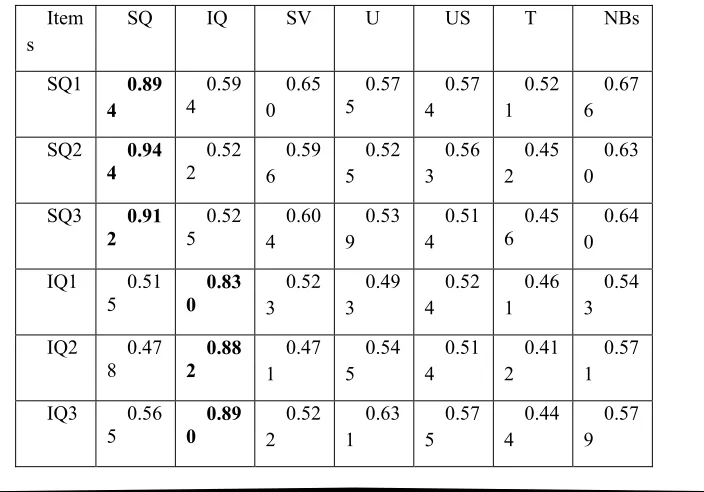
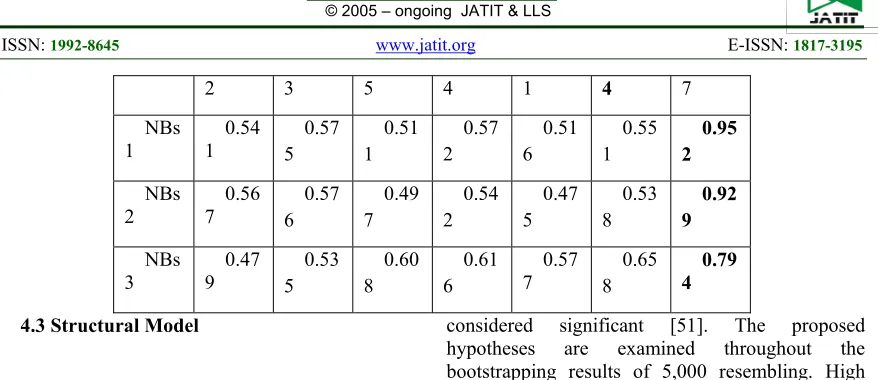
The loadings across are compared with the indicator’s loadings. The indicator’s loading on its personal construct is affirmed to be higher in all cases compared with all of its cross-loadings with
other constructs. Thus, each item value of loadings is more than the required value of 0.5. In addition, the item’s loadings on its personal construct are higher than all of its cross-loadings with other constructs.
Table 5: Values of discriminate validity–cross loadings
Item s
SQ IQ SV U US T NBs
SQ1 0.89
4
0.59
4 0 0.65 5 0.57 4 0.57 1 0.52 6 0.67
SQ2 0.94
4 2 0.52 6 0.59
0.52 5
0.56 3
0.45 2
0.63 0
SQ3 0.91
2
0.52
5 4 0.60 9 0.53 4 0.51 6 0.45 0 0.64
IQ1 0.51
5 0 0.83 3 0.52
0.49 3
0.52 4
0.46 1
0.54 3
IQ2 0.47
8 2 0.88 1 0.47 5 0.54 4 0.51 2 0.41 1 0.57
IQ3 0.56
5 0 0.89
0.52 2
0.63 1
0.57 5
0.44 4
0.57 9
SQ I
Q V S U S U T Bs N
S Q 73 0.8
I
Q 89 0.5 844 0.
S
V 11 0.6 621 0. 899 0.
U 0.4
90 533 0. 495 0. 940 0.
U
S 98 0.3 477 0. 422 0. 633 0. 932 0.
T 0.5
99 498 0. 533 0. 566 0. 547 0. 917 0.
N
[image:7.612.139.491.480.726.2]7661
IQ4 0.50
1 0 0.85
0.45 9
0.64 7
0.49 8
0.40 1
0.55 5
IQ5 0.55
9 4 0.87 9 0.44 3 0.52 0 0.43 9 0.47 6 0.55
SV1 0.56
8
0.52
9 2 0.91
0.54 4
0.50 2
0.56 4
0.53 2
SV2 0.54
8 0 0.56 3 0.92 8 0.59 9 0.45 7 0.60 3 0.52
SV3 0.55
1
0.56 3
0.88 3
0.60 9
0.50 5
0.58 0
0.49 7
SV4 0.61
2 7 0.64 2 0.88 0 0.51
0.49 6
0.59 0
0.70 9
SV5 0.62
8 9 0.63 7 0.91 0 0.64 7 0.52 6 0.62 3 0.69
U1 0.60
2
0.63 4
0.68
3 3 0.83
0.53 8
0.64 1
0.62 4
U2 0.57
8 9 0.63 0 0.67 7 0.73 5 0.50 2 0.53 7 0.63
U3 0.57
8
0.59
7 9 0.67 2 0.92 7 0.52 5 0.72 2 0.60
U4 0.48
5 9 0.57 6 0.68 8 0.92 8 0.49 4 0.69 4 0.52
US1 0.60
7 9 0.75 9 0.57 3 0.52 3 0.94 2 0.61 3 0.59
US2 0.62
7 4 0.68 1 0.58 7 0.54 4 0.90 0 0.52 7 0.61
US3 0.50
9 6 0.48
0.52 8
0.46 8
0.85 6
0.47 2
0.58 4
T1 0.44
5 0 0.53 2 0.54 2 0.58 8 0.56 6 0.90 9 0.63
T2 0.47
2
0.57 9
0.58 1
0.60 1
0.59 1
0.80 3
0.63 5
T3 0.56
8 3 0.52 6 0.60 9 0.75 9 0.57 3 0.94 3 0.52
T4 0.54
3 1 0.56 6 0.68 4 0.63 3 0.60 2 0.78 8 0.53
T5 0.55
1
0.56 2
0.60 6
0.75 9
0.57 9
0.94 3
0.52 3
7662
2 3 5 4 1 4 7
NBs
1 1 0.54 5 0.57 1 0.51 2 0.57 6 0.51 1 0.55 2 0.95
NBs
2 7 0.56 6 0.57
0.49 7
0.54 2
0.47 5
0.53 8
0.92 9
NBs
3 9 0.47 5 0.53 8 0.60 6 0.61 7 0.57 8 0.65 4 0.79
4.3 Structural Model
This study developed ten hypotheses to test the interrelations among the constructs. [51] corroborated that the criterion to make the hypothesis acceptable is Sig (P-value) of the relationship among independent constructs; dependent constructs must be less than 0.05 to be
considered significant [51]. The proposed hypotheses are examined throughout the bootstrapping results of 5,000 resembling. High path coefficients and T-values support all straight hypotheses. In addition, trust is the highest predictor of U, followed by SV, SQ, and IQ. In addition, US is influenced by SV, SQ, U, and IQ, respectively. Finally, the NBs are influenced by US and U.
Table 6: Path coefficients of proposed hypotheses
[image:9.612.90.529.56.246.2]Significant at P** less or equal 0.01, P* less or equal 0.05 Table 7 presents the summary of the endogenous
latent variable of the proposed model. The predictive power of the proposed model is represented by R square values. High level refers to R square values that are more than 0.67, moderate level refers to the R square values that occur between 0.33 to 0.67, weak level refers to the R square values that occur between 0.19 to 0.33,and an unacceptable level for the R square values is less
than 0.19[52]. Table 7 shows that the four variables (IQ, SQ, SV, and T) that are linked to U are capable of explaining the 39.8% of the variation in the U toward the continuance U the services of e-government. Thereafter, IQ, SQ, SV, and US that are linked to US are capable of explaining the 43.9% of the variation of the US to use the services of e-government. The U and US are capable of clarifying the 67.6% of NB variation.
H Path Path coefficients B Std. Error T-value P-value Judgment
H1 IQ…U 0.547 0.239 0.091 2.635 0.009 Supported**
H2 IQ..US 0.468 0.188 0.084 2.250 0.025 Supported*
H3 SQ U 0.582 0.179 0.059 3.009 0.003 Supported**
H4 SQUS 0.601 0.150 0.029 5.106 0.010 Supported*
H5 SV .U 0.659 0.143 0.029 2.918 0.014 Supported*
H6 SVUS 0.634 0.211 0.048 4.383 0.002 Supported**
H7 T…U 0.789 0.891 0.037 24.300 0.000 Supported**
H8 U US 0.584 0.179 0.059 3.009 0.003 Supported**
H9 U NBs 0.362 0.150 0.029 5.106 0.006 Supported**
7663
Table 7: R-square of the endogenous latent variable
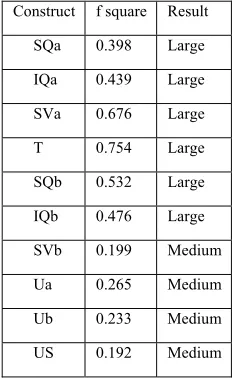
[image:10.612.136.254.348.537.2]Subsequently, the difference in the R square value when a particular exogenous construct is deleted from the model can be used to assess whether the deleted construct has a substantive effect on the endogenous constructs. This measure is utilized to evaluate the R square values of all endogenous constructs, and it is known as f square effect size [52]. [52] suggested that the values of f square are those values less than 0.02, 0.02 to 0.15, 0.15 to 0.35, and above 0.35,corresponding to no, low, intermediate, and high effects of exogenous latent variable[53]. Table 8 shows the results of f square.
Table 8: f square of the exogenous latent variable
Construct f square Result
SQa 0.398 Large
IQa 0.439 Large
SVa 0.676 Large
T 0.754 Large
SQb 0.532 Large
IQb 0.476 Large
SVb 0.199 Medium
Ua 0.265 Medium
Ub 0.233 Medium
US 0.192 Medium
In addition, researchers must test the value of Stone–Geisser's Q square [54], [55] to evaluate the magnitude of the R square values as a criterion of predictive accuracy. PLS used for predicting reasons frequently requires measuring the predictive relevance called the Blindfolding procedure. Regarding the structural model, Q
square values more than zero for a certain reflective endogenous latent variable indicate the path model's predictive relevance for this specific construct.
Table 8 shows the result of f square, construct cross-validated redundancy. Table 9 shows that the redundancies of constructs are acceptable.
Table 9: Q square values
Construct Q square
U 0.247
US 0.291
NBs 0.332
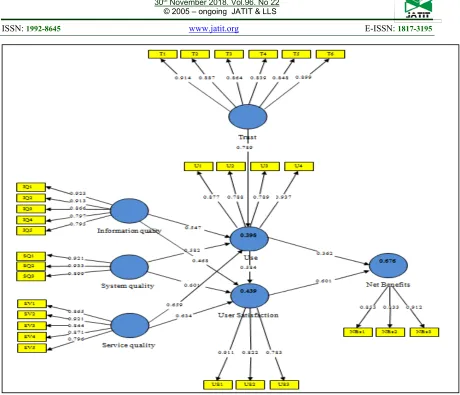
GoF is defined as the global fit measure; it is the geometric mean of average variance (AVE) and the average of R square of the endogenous variable [56]. GoF’s purpose is the accounting of research model for two levels, namely, measurement and structural models, with focus on the model’s overall performance [57]. The criteria of GoF to determine whether GoF values are less than 0.1, 0.1 to 0.25, 0.25 to 0.36, or greater than 0.36, respectively, represent no fit, small, medium, or huge to be considered as a valid PLS model as given by [58].According to this explanation and on the basis of the formula following the value of GoF (0.618), the GoF model of this research can be concluded to be great in as much as necessary to be considered having sufficient global PLS model validity. According to the finding of structural and measurement models for this research, the proposed model of measuring the success of e-government system from an Iraqi citizen’s perspective is illustrated in Figure 3.
Construct R square Result
U 0.398 Moderate
US 0.439 Moderate
7664
Fig3: Proposed model of measuring e-government system success
5. DISCUSSION
[image:11.612.89.549.50.445.2]The research discusses the major contributions derived from examining the proposed model and confirming its hypotheses. The results confirm that all proposed hypotheses are supported, as shown in Table 6. The study has tested ten hypotheses using PLS 3 algorithms. The information quality was confirmed to be an effective construct that influences the intention to use e-government systems. This result affirms that the increase in the quality of information for the citizens will guide to the increase in intention to use e-government systems. These systems are useful and beneficial for all Iraqi citizens. In agreement with the present study, previous empirical studies have determined that the information quality has considerable impact on the intention to use. [20] tested the interrelation
of information quality and intention to use; he found important association between the two. Similarly, [8] proved that the relationship between both variables is important.
7665 centers’ success in information system usefulness were found by [58].
In addition, system quality is stated to have an influence on the intention to use. The citizens in Iraqi government assume that the quality of e-government systems can promote their desire to use these systems frequently. This finding affirms that, the easier the work on the systems, the more likely that the citizens in the Iraqi government will adopt and continue using e-government systems. Similar to the result of the current research, [20] measured the success of e-government systems and tested the impact of system quality on the intention to use. He found an important interconnection between these two constructs. [20] Discovered that the quality of the system is stated as a significant predictor of intention to use. Similar findings were discovered in other earlier research, such as those of [58] and [8].
Furthermore, system quality was confirmed to be an effective construct that impacts user satisfactions in e-government systems. The current result means that the increment in the quality of information to citizens will lead to the increment in the satisfaction of the citizen toward e-government systems. Previous studies have found similar results. [59] Determined the significant influence between system quality and user satisfaction to use an information system. Similar results related to assessing call centers’ success in information system usefulness were found by [58].
Service quality affects positively the intention to use e-government systems. This finding highlights the fact that good-quality services can assure high usage intention toward e-government systems among the Iraqi citizen's society. The finding from this study is similar to the findings from the literature. [20] Concluded that service quality is significant for the adoption of e-government systems. Similar findings were found by [58]
Moreover, service quality is hypothesized as an important driver for the satisfaction of users. In addition, good service quality was predicted to have a positive affect toward user satisfaction of e-government systems. The findings validated that Iraqi citizens care for the quality of services that their government introduces to them. This concern
might slow down or reduce the adoption process of systems. Thus, they will be hesitant to use the system when the service quality is insufficient from their personal perspective. The results of the current research are similar to those of the previous research, such as those of [60], [58], and [20].
Interestingly, trust is confirmed to be the strongest predictor of intention to use. From the result of data analysis, trust state is the key indicator of the intention to use e-government systems. Trust is recognized to be the highest construct that influences the intention of Iraqi citizens toward e-government systems usage. Consequently, trust can be considered an essential construct for any online transactions. Thus, the lack of it is problematic and might lead to abandonment of the systems services. The government must ensure that the systems are managed by trustworthy personnel and cannot be accessed by a third party. For instance, if the government uses high-security level mechanisms and techniques for their e-government services and system, the users’ trust will increase because they know that their data are stored and accessible only by the person allowed by the government. This finding is in agreement with the literature. Previous studies discovered that trust has a major impact to increase citizens’ acceptance and usability of e-government systems [2],[8],[61].
Intention to use was proven to be an effective construct that affects the user satisfaction to use e-government systems by Iraqi citizens. This finding contends that citizens’ increment in the intention to use systems will result to an increment in the satisfaction of user toward e-government systems. The current research results are similar to the results of the previous literature. Those who examine the effect of intention to use on the users' satisfaction found similar results, such as [20], [58], and [60].
7666 Finally, user satisfaction was proven to be an effective construct that has an effect on net benefits by the Iraqi citizens’ usage of e-government systems. This finding could be explained as follows: the increase in the satisfaction of a citizen using the systems will lead to an increase in the net benefits received from such systems in Iraq's technology environment.
5.1. Theoretical Contributions from the Research
This research introduces two major contributions for e-government systems. First, this study developed a conceptual model to address the critical constructs that affected the success of implementing e-government system. This research adopted and utilized the updated model of DeLone and McLean as assessing model for the success of information systems. Consequently, e-government system can be considered a standard information system that could be assessed and evaluated using the DeLone and McLean model. In addition, the significant three constructs in DeLone and McLean model, namely, information quality, system quality, and service quality, are closely related to achieving this research objective that is, measuring the success of an e-government system. This primary theoretical contribution explored its significance exclusively by applying the study model in the Iraqi e- government environment as a case study of developing countries. Theoretically, model contribution showed the model importance and confirmed its validity throughout the critical analysis and subsequently deduced results in the previous sections. Second, the updated model of DeLone and McLean only focused on technical constructs to assess the success of information system, whereas the current study adjusts the updated DeLone and McLean model by including trust as another construct that influences e-government success from a multi-dimensional relationship. This study adds trust as an important construct that has a significant influence on the intention to use e-government system mentally. Consequently, the intention to use the e-government system will affect the success of e-government implementation. To illustrate, the trust constructs can explore into which level the citizen can rely upon the government system and services. If the citizens feel that e-government system is a trustworthy and reliable system, then they will
frequently be encouraged to use the system. Consequently, the e-government system will be considered a successfully implemented and efficiently used system. Third, previous studies were focusing on measuring the success of e-government system from the employees’ perspective. The current research is focusing on the citizen’s perspective toward using or not using the e-government system successfully. Depending on Iraqi citizens’ concerns, considerations, and satisfaction, the intention to use e-government system will determine which degree the system will perceive benefits and be considered beneficial implementation.
5.2. Managerial Implications from the Research
7667 Second, government agencies must pay attention to acquire citizens’ trust in e-government system. The most powerful construct was confirmed to be trust in the e-government system. Hence, the decision makers must put substantial effort in obtaining the Iraqi citizens’ trust and eventually increasing their motivation to use the system. Furthermore, citizens must feel that their e-government systems are reliable and accountable for use. This ideal scenario could be achieved by offering an invulnerable system that can be trustworthy to use for the daily working activities, such as banking, applying a license, and so on. Practically, these managerial implications should advocate the government agencies to take practical actions in improving trust reputation for Iraqi citizens. Didactically, the stakeholders should advertise their e-government system. Citizens must educate and acknowledge on the system usage, polices, and services. Public seminars, online advertisements, and trainings must be conducted by the government agencies to enhance the trust level and increase the overall implantations to use the system. In addition, the feedback of citizens regarding their opinions in e-government websites must be collected and analyzed. The results from the analyzed citizens’ feedback will help government agencies rebuild the websites in such a way that increase the usability to the citizens. Consequently, optimizing the main constructs (information quality, system quality, service quality, and trust) will help optimize the construct of intention to use and the construct of user satisfaction. Eventually, these optimizations will bring major benefits to the net and are thus considered the indicators of successful e-government implantations.
6. CONCLUSION AND FUTURE WORK
This study purposely integrated trust construct within the technical constructs to assess e-government system success from an Iraqi citizen perspective in Iraq, as one of the developing countries. The study aims to modify the updated D&M IS success model by adding trust construct and then integrating it with other technical constructs. The conducted model is dedicated to assess the e-government system in Iraq as a type of IS. The model constructs are affirmed to have a positive impact on the Iraqi citizen’s usage and satisfaction. The impact of these constructs is gradually decreased from trust as a highest
construct, followed by service quality, system quality, and information quality. Basically, citizen trust in an e-government system is the most powerful construct that could positively influence the intention to use e-government system. Thus, trust constructs require extra attention from the government agencies and system developers owing to its significant impact on the citizen’s usage intention. In light of the above view, the government agencies and system developer should consider the influence of the model constructs to promote the citizens’ low-level participation in the e-government system in Iraq. Consequently, this study can be considered a foundation for additional research regarding the constructs’ issues, specifically the trust domain. However, further research should be comprehensively focusing on trust and must study its impact from multi-dimensional views, such as studying the trust influence in technology. This study can be limited to the focus on conceptualized and analyzed trust construct from a general concept, while overlooking on the multidimensional nature of trust as well as its attributes and types.
REFERENCES:
[1] Roztocki N, Weistroffer HR. Information and communication technology in transition economies: an assessment of research trends. Information Technology for Development. 2015 Jul 3;21(3):330-64.
[2] Abu-Shanab E. Electronic Government, a tool for good governance and better service. A book published by author (deposit number: 2013/2/355, call number: 658.4038). 2013. [3] Weerakkody V, Janssen M, Dwivedi YK.
Transformational change and business process reengineering (BPR): Lessons from the British and Dutch public sector. Government Information Quarterly. 2011 Jul 1;28(3):320-8. [4] Bertot JC, Jaeger PT, Grimes JM. Using ICTs to
create a culture of transparency: E-government and social media as openness and anti-corruption tools for societies. Government information quarterly. 2010 Jul 1;27(3):264-71. [5] Banerjee A, Duflo E, Imbert C, Mathew S,
7668 [6] Abu-Shanab EA. E-government familiarity
influence on Jordanians’ perceptions. Telematics and Informatics. 2017 Feb 28;34(1):103-13.
[7] Santhanamery T, Ramayah T. Trust in the System: The Mediating Effect of Perceived Usefulness of the E-Filing System. InUser Centric E-Government 2018 (pp. 89-103). Springer, Cham.
[8] Alzahrani L, Al-Karaghouli W, Weerakkody V. Analysing the critical factors influencing trust in e-government adoption from citizens’ perspective: A systematic review and a conceptual framework. International Business Review. 2017 Feb 1;26(1):164-75.
[9] Delone WH, McLean ER. The DeLone and McLean model of information systems success: a ten-year update. Journal of management information systems. 2003 Apr 1;19(4):9-30 [10]Khayun V, Ractham P. Measuring e-excise tax
success factors: Applying the DeLone & McLean information systems success model. InSystem Sciences (HICSS), 2011 44th Hawaii International Conference on 2011 Jan 4 (pp. 1-10). IEEE.
[11]Hsu MH, Chang CM, Chu KK, Lee YJ. Determinants of repurchase intention in online group-buying: The perspectives of DeLone & McLean IS success model and trust. Computers in Human Behavior. 2014 Jul 1;36:234-45. [12]Huai J. Quality evaluation of e-government
public service. InManagement and Service Science (MASS), 2011 international conference on 2011 Aug 12 (pp. 1-4). IEEE.
[13]Santos P, Melo AI, Dias GP. Administrative modernisation and e-government: The case of Águeda. InInformation Systems and Technologies (CISTI), 2013 8th Iberian Conference on 2013 Jun 19 (pp. 1-6). IEEE. [14]Al Ajeeli, A.T. and Al-Bastaki, Y.A.L., 2011.
Handbook of Research on E-Services in the Public Sector: E-Government Strategies and. [15]Welch EW, Feeney MK. Technology in
government: How organizational culture mediates information and communication technology outcomes. Government Information Quarterly. 2014 Oct 1;31(4):506-12.
[16]West DM. Assessing e-government: The Internet, democracy and service delivery by state and federal governments.
[17]United Nation, E-Government Survey 2014, United Nation, New York, 2014.
[18]Snead JT, Wright E. E-government research in the United States. Government Information Quarterly. 2014 Jan 1;31(1):129-36.
[19]Jaeger PT, Thompson KM. E-government around the world: Lessons, challenges, and future directions. Government information quarterly. 2003 Jan 1;20(4):389-94.
[20]Stefanovic D, Marjanovic U, Delić M, Culibrk D, Lalic B. Assessing the success of e-government systems: An employee perspective. Information & Management. 2016 Sep 1;53(6):717-26.
[21]Wang YD, Emurian HH. An overview of online trust: Concepts, elements, and implications. Computers in human behavior. 2005 Jan 1;21(1):105-25.
[22]Park R. Measuring factors that influence the success of E-government initiatives. Inhicss 2008 Jan 7 (p. 218). IEEE.
[23]Chopra K, Wallace WA. Trust in electronic environments. InSystem Sciences, 2003. Proceedings of the 36th Annual Hawaii International Conference on 2003 Jan 6 (pp. 10-pp). IEEE.
[24]Carter L, Bélanger F. The utilization of e-government services: citizen trust, innovation and acceptance factors. Information systems journal. 2005 Jan;15(1):5-25.
[25]Tan CW, Benbasat I, Cenfetelli RT. Building citizen trust towards e-government services: do high quality websites matter?. InHawaii International Conference on System Sciences, Proceedings of the 41st Annual 2008 Jan 7 (pp. 217-217). IEEE.
[26]Al Azzawy DS. Review on Challenges in Building Knowledge based Societies through E-Governance Framework: Technology and Management Issues from Global Perspective. Indian Journal of Science and Technology. 2017 Jul 4;10(28)
[27]Salih EH, Diwan SA, Fattah AJ. Multi-Agent Based Security Framework for E-Government in Recently technology Developed Countries. Journal of Computer Engineering and Intelligent Systems. 2013;4(11):1-0.
[28]Mohammed MA, Aboobaider BM, Ibrahim H, Abdullah HA, Ali MH, Jaber MM, Shawkat A. E-government and its challenges in developing countries: Case study Iraqi e-government. The Social Sciences. 2016;11(17):4310-9.
7669 Citizens' Participation in E-Government Decision.
[30]Charalabidis Y, Lampathaki F, Misuraca G, Osimo D. ICT for governance and policy modelling: research challenges and future prospects in Europe. InSystem Science (HICSS), 2012 45th Hawaii International Conference on 2012 Jan 4 (pp. 2472-2481). IEEE.
[31]Hassanzadeh A, Kanaani F, Elahi S. A model for measuring e-learning systems success in universities. Expert Systems with Applications. 2012 Sep 15;39(12):10959-66.
[32]Wang YS, Liao YW. Assessing eGovernment systems success: A validation of the DeLone and McLean model of information systems success. Government Information Quarterly. 2008 Oct 1;25(4):717-33.
[33]Almalki O, Duan Y, Frommholz I. An exploratory study on eGovernment systems success in Saudi Arabia. In12th European Conference on e-Government, Barcelona, Spain 2012 Jun 1 (pp. 38-46).
[34]Wang YS, Wang HY, Shee DY. Measuring e-learning systems success in an organizational context: Scale development and validation. Computers in Human Behavior. 2007 Jul 1;23(4):1792-808.
[35]Petter S, DeLone W, McLean ER. Information systems success: The quest for the independent variables. Journal of Management Information Systems. 2013 Apr 1;29(4):7-62.
[36]Stieninger M, Nedbal D. Diffusion and acceptance of cloud computing in SMEs: Towards a valence model of relevant factors. In2014 47th Hawaii International Conference on System Sciences (HICSS) 2014 Jan 1 (pp. 3307-3316). IEEE.
[37]Hashim HS, Hassan ZB. Factors that influence the users’ adoption of cloud computing services at Iraqi Universities: an empirical study. Australian Journal of Basic and Applied Sciences. 2015 Aug;9(27):379-90.
[38]Ozkan S, Koseler R. Multi-dimensional students’ evaluation of e-learning systems in the higher education context: An empirical investigation. Computers & Education. 2009 Dec 1;53(4):1285-96.
[39]Urbach N, Smolnik S, Riempp G. An empirical investigation of employee portal success. The Journal of Strategic Information Systems. 2010 Sep 1;19(3):184-206.
[40]Balaban I, Mu E, Divjak B. Development of an electronic Portfolio system success model: An information systems approach. Computers & Education. 2013 Jan 1;60(1):396-411.
[41]Chiu CM, Chiu CS, Chang HC. Examining the integrated influence of fairness and quality on learners’ satisfaction and Web-based learning continuance intention. Information systems journal. 2007 Jul;17(3):271-87.
[42]Burda D, Teuteberg F. The role of trust and risk perceptions in cloud archiving—Results from an empirical study. The Journal of High Technology Management Research. 2014 Jan 1;25(2):172-87.
[43]Lian JW. Critical factors for cloud based e-invoice service adoption in Taiwan: An empirical study. International Journal of Information Management. 2015 Feb 1;35(1):98-109.
[44]Lallmahomed MZ, Lallmahomed N, Lallmahomed GM. Factors influencing the adoption of e-Government Services in Mauritius. Telematics and Informatics. 2017 Jul 1;34(4):57-72.
[45]Sekaran U, Bougie R. Research methods for business: A skill building approach. John Wiley & Sons; 2016 Jun 27.
[46]Nunnally JC, Bernstein IH. Psychological theory. New York, NY: MacGraw-Hill. 1994. [47]Valaei N, Baroto MB. Modelling continuance
intention of citizens in government Facebook page: A complementary PLS approach. Computers in Human Behavior. 2017 Aug 1;73:224-37.
[48]Ringle CM, Wende S, Becker JM. SmartPLS 3. SmartPLS, Hamburg.
[49]Hair JF, Ringle CM, Sarstedt M. PLS-SEM: Indeed a silver bullet. Journal of Marketing theory and Practice. 2011 Apr 1;19(2):139-52. [50]Fornell C, Larcker DF. Evaluating structural
equation models with unobservable variables and measurement error. Journal of marketing research. 1981 Feb 1:39-50.
[51]Pallant J. SPSS Survival Manual: A Step by Step guide to data analysis using IBM SPSS.. Berkshire, England.
[52]Chin WW. The partial least squares approach to structural equation modeling. Modern methods for business research. 1998 Mar 1;295(2):295-336.
7670 [54]Geisser S. A predictive approach to the random
effect model. Biometrika. 1974 Apr 1;61(1):101-7.
[55]Stone M. Cross-validatory choice and assessment of statistical predictions. Journal of the royal statistical society. Series B (Methodological). 1974 Jan 1:111-47.
[56]Hair Jr JF, Hult GT, Ringle C, Sarstedt M. A primer on partial least squares structural equation modeling (PLS-SEM). Sage Publications; 2016 Feb 29.
[57]Wetzels M, Odekerken-Schröder G, Van Oppen C. Using PLS path modeling for assessing hierarchical construct models: Guidelines and empirical illustration. MIS quarterly. 2009 Mar 1:177-95.
[58]Baraka HA, Baraka HA, El-Gamily IH. Assessing call centers’ success: A validation of the DeLone and McLean model for information system. Egyptian Informatics Journal. 2013 Jul 1;14(2):99-108.
[59]Roky H, Al Meriouh Y. Evaluation by users of an industrial information system (XPPS) based on the DeLone and McLean model for IS success. Procedia Economics and Finance. 2015 Jan 1;26:903-13.
[60]Tam C, Oliveira T. Understanding the impact of m-banking on individual performance: DeLone & McLean and TTF perspective. Computers in Human Behavior. 2016 Aug 1;61:233-44. [61]Bannister F, Connolly R. Trust and