Journal of Chemical and Pharmaceutical Research, 2014, 6(4):265-269
Research Article
ISSN : 0975-7384
CODEN(USA) : JCPRC5
Numerical simulation of one-dimensional flood with WENO scheme
Y. L. Liu, Y. F. Hong, W. L. Wei* and X. F. Yang
State Key Laboratory of Eco-Hydraulic Engineering in Shaanxi, Xi’an University of Technology,
Xi’an, Shaanxi, China
_____________________________________________________________________________________________
ABSTRACT
This paper is concerned with a mathematical model for simulating hydrodynamics of 1D flood flows with the WEN O(Weighted Essentially Non-oscillatory Scheme) scheme. The time discretization uses the Runge-Kutta TVD(Total Variation Diminishing) scheme. By using the model, the flow property of dam-break was calculated, and the flow velocity and water depth were obtained. The calculated results show that the WENO scheme has higher accuracy and better stability, and has the ability to automatically capture shock waves, and may suppress the oscillations of numerical solution. This model can effectively simulate the hydrodynamics of 1D river flow.
Keywor ds: WENO scheme; simulation; flood
_____________________________________________________________________________________________
INTRODUCTION
The flood wave caused by a dam fa ilure can result in the loss of hu man lives and has a severe economic impact. Therefore, significant efforts have been carried out over the years to produce methods for determination of the e xtent and timing of the flood wave. Most of these methods are based on the solution of the Shallow Water equations. There are a number of accurate and efficient methods available to solve the Shallow Water equations [1-4].
It is an important basis for validating the numerical method whether the scheme can capture the dam-break bore waves accurately or not. This g ives rise to an increasing interest in solving such a proble m. Fro m 1980 to 2000 several fin ite-difference schemes that handle discontinuities effectively we re used to compute open -channel flo ws, such as the approximate Rie mann solver [3,4]. Based on the above research results, the goal of the current work is to develop a mathe matica l mode l capable of dea ling with hydraulic discontinuities such as steep fronts, hydraulic ju mp and drop, etc. The water governing equations has been solved by the WENO scheme and the Finite Vo lu me Method on unstructured grid.
MATHEMATICAL MODEL
Flow Governing equations
The one-dimensional equations in conservative form in Cartesian coordinates for unsteady gradually va ried flow in open channels are[5].
)
(
)
(
q
b
x
q
f
t
q
(1)
and q is the conservation physical quantity;
f q
is the flu x vector in x direct ion;b q
is the source term vector; his flow depth; u is depth-averaged velocity in th e x-d ire ct ion ; g is th e g rav it y acceleration; Sox is the channel
bottom slope in the x-direct ion and is defined as
S
ox
Z
0
x
, where Z0 is the bottom elevation; and Sfx is thefriction slope in the x-direction, co mputed using the steady state frict ion formula
S
fx
(
n
2u
u
2
v
2)
h
4/3, inwhich n is the Manning’s roughness coefficient.
Discretization of the flow equation
The integral discretization of Eq. (1) Leads to:
1
1 2 1 2
( )
( )
n n n n
i i i i i
q
q
f q
f q
tb
(2)in which qn and qn+1 a re the conservation variables for n and n+1 time steps;
t
x
;
t
is t ime step;
x
isspace step; superscript
n
indicates the time layer; subscripti
denotes space node;f
in12andf
in12are the nu mericalflux in equation (1).
The key proble m of solution of Eq . (2) is to determine the normal flu x o f
f q
. The values of q orq
may bediscontinuous on the contacting surface of the control volumes, which is a FVM d iscontinuous problem, and brings
difficult ies to the solution off q
, and is written asf q
f q q
L, R
. The computation of the normal fluxf q
has two important aspects: one is the computation of
f q q
L,
R
, the other is the computation ofq
Landq
R( usually is called reconstruction).Solution of normal fluxes using FDS(Flux Difference Splitting)
The computation of transformation normal fluxes on crossing unit boundary uses Roe’s average FDS method [6]:
1 2 1 2 1 2 1 2
1 2
L R R L
i i i i
f q f q f q a q q (3)
where the Roe’s speed is
1 2
1 2
1 2 1 2
R L
i i
R L
i i
f q f q
a
q q
,and 1 2
L i
q
andq
iR1 2 are the values ofq
at the left andright sides of the point
x
i12, respectively; thus the normal flu x of the discretization equation (3) may be obtained.The values of
q
iL1 2andq
iR1 2 are obtained by weighting and arraying the stencils with the WENO scheme.Restructuring of WENO scheme
Now the application of the WENO scheme is explained by the computation of
q
iL1 2 .The idea used in the WENO schemes is: Given the stencil size k , supposing the k candidate
stencils
S
r
i
x
i r,
,
x
i r k 1
,r
0
,
,
k
1
, the k kinds of different restructuring ways may be obtained: 1
1
2 0
k r
rj i r j i
j
q
c q
,r
0,
,
k
1
, (4)Three possible interpolation stencils are:
0 i 2, i 1, i
S q q q , S1
qi1,q qi, i1
and S2
q qi, i1,qi2
i i+1 i+2 i-1
i-2 Stencil 0
Stencil 2
Stencil 1
Fig.1 Ste ncil option of W ENO sche me
The expressions for 1
2
r
i
q
are: 0
1 2 1
2
1 7 11
3 i 6 i 6 i
i
q q q q
, 1
1 1 1
2
1
5
1
6
i6
i3
ii
q
q
q
q
, 2
1 1 2
2
1 5 1
3 i 6 i 6 i
i
q q q q
. (5 a, b, c)
The definitions of coefficients are in literature [7].
These optimized schemes for all the k candidate stencils are then convexly co mbined to obtain the W ENO schemes.
The WENO schemes use all the values of
1 2
r i
q to combine convexly to compute 1 2
L i
q
. 1 1 1 2 2 0 k r L r i i r
q
q
(6)in which
ris the weight.Determination of Weight
rIn order to satisfy the stability and the co mpatib ility, we request
r 0and
1 01
k r r
. Further said that if thefunction
q x
in all stencils is a smooth function, then the constantd
rexists and satisfies:
1
2 1
1 1 1
2 0 2 2
k r
L k
r
i i i
r
q
d q
q x
O
(7)
After the simple algebraic operation, these coefficients in Eq.(8) may be determined and satisfies
1
1 0
r k r kd
.Under the smooth function situation, we have
r
d
r
O
x
k1
,r=0,…,k-1. In order to make the calcu lationmore effectively, we may use the following form the weight
1 0 k s s r
r
1 0 k s s rr
,r
0,
,
k
1
,
2r r
r d
, in wh ich
is a rea l nu mber, genera lly ta kes
10
6, to avoid the denominator beingzero.
k is called “the smooth factor” as a measure of s mooth of the k th possible interpolation reg ion, and itsformula is given in Literature [8](Wei, 2001) .
The third-order mathematical expression for the computation of
q
iL1 2is: 0 1 2
1 0 1 1 1 2 1
2 2 2 2
* * *
L
i i i i
q q q q (8)
1 2
R i
q
is computed by the similar solution method.differencing-Time processing
Time processing may use the Rugge-Kutta method with the nature of TVD, for example, regarding the time for mth
order, 1
0
i
i k k
ik ik
k
q
q t
L q
,i
1,
,
m
. At initial time step 0 nq q , after finishing one
time-step calculation, m n 1
q q .
One-Dimensional Dam-Break Simulation
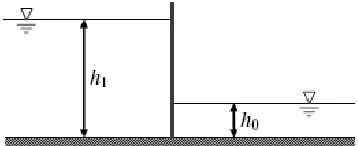
The scenario considered here was the total and instantaneous dam-failure on a flat and frictionless bed. This provides an ideal benchmark test case for shock-capturing schemes since analytica l solution has been known. Figure 2 shows the illustration of the dam-brea k proble m, where the init ial upstream water depth was
h
1=10 m, and the [image:4.596.217.396.292.365.2]downstream water depth was
h
0=1.The length of the computational region is 200m, and the dam was located at x=200 m. The grid spacing was 1 m. The t ime step was 1 s. Figure 3 shows the water surface position, and Figure 4 shows the velocity distribution, 7.0s after da m fa ilure by using the model, where the solid line represents the analytical solution and the circ le points illustrate the predicted results. It can be seen that the shallower the downstream water depth, then the faster the flood wave travels. The ag ree ment between the analytical and nu merical solutions is satisfactory.Fig.2 Illustration of the dam -bre ak proble m
Fig. 3 W ate r surface position
Fig. 4 Ve locity distribution
CONCLUSION
effectively simulate 1D flow acco mpanied with a da m-brea k. The proposed method can a lso be e xpanded to 2D the flows.
Acknowledgments
Partia l financial support of this study from the National Natural Science Foundation of China (Grant No.51178391), Shan xi Province education department funds(2009JK649, 2010JK761)and the special funds for the development of characteristic key d isciplines in the local university supported by the central financia l (Grant No: 00X101, 106-5X1205) and the Shanxi Province key subject construction funds.
REFERENCES
[1]K. Hu, C.G. M ingham, D.M. Causon, Int. J. Numer. Methods in fluids, 1998,28:1241-1261.
DOI:10.1002/(SICI)1097-0363(19981130)28:8<1241:AID-FLD772>3.0.CO;2-2.
[2]K. Anastasiou, C.T. Chan, Int. J . Numer. Methods in fluids, 1997,24:1225-1245. DOI:10.1002/
(SICI)1097-0363(19970615) 24:11<1225:AID-FLD540>3.0.CO;2-D.
[3]C.G. M ingham, D.M . Causon, J. Hydr. Engrg. ASCE, 1998,124:605-614. DOI: 10.1061/
(ASCE)0733-9429(1998)124:6(605).
[4]P. Glaister, Int. J. Numer. Methods in fluids, 1993, 16:629-654. DOI:10.1002/fld.1650160706. [5]Zhao, D.H., J. Water Scientific Advance, 2000, 11:368~373.
[6]P.L. Roe, J. Comp phys, 1981, 43:357-359. DOI:10.1016/0021-9991(81)90128-5.
[7] H.X. Zhang, M.Y. Shen, Computational hydromechanics difference method principle with applications. 2003,Beijing: Defense Industry Publishing House.