Process improvement and automation in
construction: Opposing or complementing
approaches?
Koskela, LJ
Title
Process improvement and automation in construction: Opposing or
complementing approaches?
Authors
Koskela, LJ
Type
Conference or Workshop Item
URL
This version is available at: http://usir.salford.ac.uk/31959/
Published Date
1992
USIR is a digital collection of the research output of the University of Salford. Where copyright
permits, full text material held in the repository is made freely available online and can be read,
downloaded and copied for noncommercial private study or research purposes. Please check the
manuscript for any further copyright restrictions.
The 9th International Symposium on Automation and Robotics in Construction June 3-5
, 1992 Tokyo, JapanPROCESS IMPROVEMENT AND AUTOMATION IN CONSTRUCTION: OPPOSING OR COMPLEMENTING APPROACHES?
Lauri KoskelaI , Visiting Scholar Center for Integrated Facility Engineering
Terman Engineering Center Stanford University Stanford, Ca 94305 - 4020
U.S.A.
ABSTRACT
It is widely recognized that there must be wide-ranging changes in construction before automation can be implemented in practice. On the other hand, the innovation rate of construction is rather low, and thus it is unclear, how the steps necessary for automation could be realized. It is argued, that an insufficient attention to process improvement is a major barrier to automation and other technological progress of construction.
1. INTRODUCTION
1.1 Needs for reconsideration
The goal of this paper is to suggest an extension of the domain of construction robotics and automation to cover, on the one hand, more general frameworks of construction processes, and on the other hand, certain process improvement techniques with immediate relevance for the industry. The need for such a reconsideration is indicated by the status of construction robotics R&D, experiences of other industries and the nature of global development needs for construction technology.
1.2 The status of construction robotics R&D
In spite of successful development of many prototypes and a clear progress in theoretical understanding, there is a widespread feeling that construction robotics research has produced rather few practical results. Even if there are good arguments for basic research, it has been evident that in many countries it is extremely difficult to start or sustain long term oriented efforts like construction robotics. After all, notable construction robotics activities can be found only in a handful of countries. The fact is that in most countries (with the exception of Japan) the construction industry is showing only lukewarm or cool attitude towards construction robotics, especially on site. The alienation of the construction industry in regard of construction robotics is well mirrored in the attitudes of American construction managers, who do not view site robotics as a major technology to be promoted in the this decade [18].
One reason for this situation might be that the construction robotics community has failed to produce a plausible image of future construction, with a transition path for the industry. These difficulties are not unrelated to the question asked by the construction robotics community. Analysis of construction robotics feasibility studies from different countries [4,5,6,9,14] shows that the primary question asked has been: To which construction tasks can robotics be applied? This approach is quite appropriate in the early phases of a new technology. However, in subsequent phases more external interest will be directed to the managerial question: What is the role of robotics in the overall technology strategy of construction? Clearly, the benefits of robotics have to be compared with other competing technological solutions to the problem at hand (as argued by Everett [5]). The major motivations for construction robotics are high accident rate, scarcity of labor and low productivity. However, in many situations, there are more immediate solutions to these problems than construction robotics.
1.3 Experiences from other industries
An analoguous situation may be found in other industries. At the risk of oversimplification, one could say that there have been two approaches to manufacturing in the last decade (for example, [17]). The first, a Western oriented approach has tried to enhance the capability to manage complexity and uncertainty by information technology and automation. The latter approach, originated in Japan, stresses simplifying the problem itself, before possible automation and computerization. In the first approach, the prime mover of development is seen to be the technological progress in information and other technology as well as the resultant potential to replace human work with machines; the latter approach sees the drive to eliminate waste and to reduce complexity and uncertainty as the prime mover.
Empirical results show that the efficiency of the latter approach has been superior. One of the best researched areas is car manufacturing [20]. Productivity increases in car manufacturing have been primarily due to managerial and organizational factors, not to new technology. The resultant new mode of production, called "lean" production, is characterized as using less of everything compared with mass production - half the human effort in the factory, half the manufacturing space, half the investments in tools, half the engineering hours to develop a new product in half the time.
The two approaches have had distinct backgrounds, communities and networks. The first approach has been based on robotics and CIM-related research in companies and universities. It can be characterized as science-based and technology push oriented. The latter approach has evolved in a more pragmatic manner, driven forward by champions in companies and consultants; the academic world has participated rather thinly. Thus, it is engineeri ng- based and demand pull oriented, with a science base still partly lacking.
1.4 Global needs for the development of construction technology
The huge needs for decent housing and other constructed facilities in developing countries is well known. Recently, the needs for reconstruction of the infrastructure and housing in the former planned economies in Eastern Europe have become apparent. In both cases, the problem is characterized by a requirement of rapid development of technological capability and an abundance of labor force.
The efforts to promote construction robotics, in regard of their long term character and pursuit of replacement of human labor, do not seem to serve these needs.
1.5 Conclusions
The construction robotics efforts have been heavily based on technology push, with an analoguous development path to the automation efforts in manufacturing. The basic dilemma of construction robotics is thus a detachment from the more immediate needs of construction industries in developed countries, as well as from the global needs for the development of construction technology. It is proposed that the domain of construction robotics be augmented so that this detachment can be overcome.
For this purpose, the process improvement approach (aimed at reducing complexity and uncertainty) and its application to construction are analyzed. The relation of process improvement to automation is discussed in general terms and from the point of view of construction. Finally, the options to redirect construction robotics research are charted. The discussion in this paper is based on an ongoing study on the application of the new production philosophy in construction.
2. PROCESS IMPROVEMENT
2.1 Origin, development and main ideas
The conception of the new production philosophy has evolved through three stages: It has been viewed as a tool (like kanban or quality circles), as a manufacturing method (like JIT) and as a general management philosophy (referred to, for example, as world class manufacturing). The theoretical and conceptual understanding of the new production philosophy is still incomplete. Among the recent attempts to formalize the new philosophy, the study [8] of the Committee on Foundations on Manufacturing, assembled in 1989 by the National Academy of Engineering (of the United States), is noteworthy. The Committee presents a number of foundations or principles that have to be adopted by organizations that aspire to be world class. Interestingly, the committee voices a strong conviction that a manufacturer can make the best use of technology only after it has embraced and is practicing the foundations described.
In essence, the new production philosophy deals with how production activities are conceived, controlled and improved. For the present purposes, the main ideas can be characterized as follows:
Manufacturing is conceptualized as a value adding process, as a flow of material and information, to which various production activities either add value or do not add value (like transport, handling, storing, inspection, planning, monitoring). One important performance measure is the share of non-value adding time (or cost) from the total flow time (cost). Non-non-value activities are called waste.
Tight process control (good controllability) is viewed as inherently good. It makes possible the elimination of the various wastes of the process, which reduce productivity and hamper productivity improvement. Because internal and external uncertainty in the manufacturing process leads to the requirement of slack (which is waste), the reduction of uncertainty is an important precondition for controllability.
Improvement is considered as a combination of continuous improvement and innovation. Innovation usually refers to the implementation of outside technology for individual operations of the process, whereas continuous improvement is an internal, incremental and continuous activity, which focuses primarily on the whole process. The goal of continuous improvement is to enhance both the controllability (that is, to eliminate problems and constraints of control) and the productivity of the production process. It is argued that there is an order of improvement and innovation: "improvement adheres to a certain order" [15]. Improvement should be directed at the present constraints in the production flow. Only after exhausting incremental improvement potential, major innovation implementations are suggested: "Perfect existing processes to their full potential before designing new ones" [3].
In this paper, the term process improvement is used to characterize this new production philosophy to stress the focus on process (instead of individual operations) and on continuous improvement (instead of innovations aiming at leaps in efficiency).
2.2 Process improvement in construction
In the construction industry, the attention to the new production philosophy has grown slowly. Quality assurance and TQC are being adopted by a growing number of organizations in construction, first in construction material and component manufacturing, later also in design and contracting. The new approach, in its JIT oriented form, has been used in manufacturing oriented parts of the industry: component manufacturing, like windows and prefabricated housing. All in all, the overall diffusion of the new philosophy in construction still seems to be rather limited and the applications partial.
However, all available knowledge indicates that the potential for waste reduction in construction is substantial, as shown by the high share of non-productive activities, waste of materials, deficient quality, disruptions and confusion on sites. On the other hand, it is generally known that the development of construction, as measured by productivity or other relevant measures, has not been as good as in manufacturing. There is plenty of room for continuous improvement in each organization in the construction industry. Why has the adoption of the new production philosophy been so slow in construction?
fabrication and assembly, are often not easy to internalize and generalize from the point of view of other industries.
Peculiarities of construction, like unique, one-of-a-kind products, on-site production, temporary project organizations, and regulatory intervention would at least necessitate a re-interpretation of the general foundations and principles of the new philosophy(which still exist only as fragmentarily formalized).
However, there is a growing body of empirical evidence from pioneering firms which shows that there are no fundamental obstacles to the application of the new production philosophy after these initial barriers have been overcome.
3. PROCESS IMPROVEMENT AND AUTOMATION
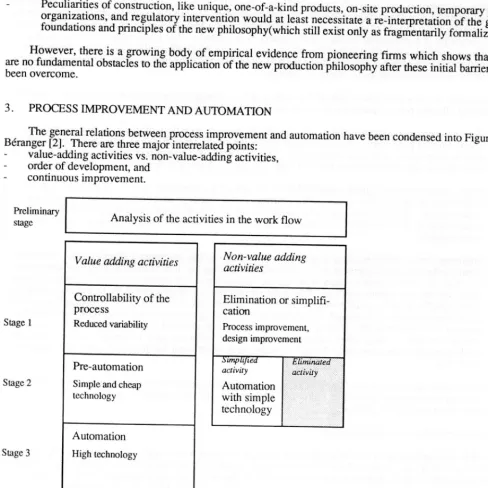
The general relations between process improvement and automation have been condensed into Figure 1 by Beranger [2]. There are three major interrelated points:
- value-adding activities vs. non-value -adding activities, - order of development, and
- continuous improvement.
Preliminary stage
Stage 1
Stage 2
Stage 3
Analysis of the activities in the work flow
Value adding activities
Controllability of the
process
Reduced variability
Pre-automation
Simple and cheap
technology
Automation
High technology
Non-value adding activities
Elimination or
simplifi-cation
Process improvement, design improvement
Simplified Eliminate activity activity
Automation
[image:5.611.50.539.123.612.2]with simple technology
Figure 1. Stagewise development of a production process towards automation (modified from [21).
Distinction of activities on basis of value added
It is usually more effective to eliminate or reduce non-value adding activities than to automate them. If elimination is not possible, these activities should be automated with simple and inexpensive technology. However, it is usually not worthwhile to automate them with high technology, because a competitor might find the means to eliminate those activities. Thus, the automation efforts should be directed to value-adding activities.
Order of development
simplified, streamlined and stable work flow contributes to the reliability of automated systems: automation hardware has in itself already a relatively high frequency of breakdowns;
multiskilled personnel are needed in the stage of automation: the development of such personnel can be started in the process of process improvement;
process improvement decreases the investment needs for automation
and thus increases the profitability
of automation; and
process improvement can be started immediately with little cost
, whereas automation requires a long,
and expensive project.
Thus, on the way towards automation
, the first stage is to enhance the controllability of the process through variability reduction and to suppress non-value adding activities through design and process modifications.
The second stage consists of automating with simple and inexpensive technology. Often the existing machinery is augmented by means of simple mechanical or mechatronic devices, which allow for autonomous operation of the machinery for some period or reduce human activities in the work process.
Only in the third stage, after an accumulation of understanding and process efficiency, will automation with high technology be justified as the next step towards cost reduction.
Continuous improvement
The role of continuous improvement is significant especially in the stage of enhancement of the controllability of the process and in pre-automation. Continuous improvement activities require wide involvement of all employees on day to day basis. But also in all stages of
automation the efficiency and yield
can be increased by continuous improvement. Thus the overall conclusion is, that both the implementation and also the development of robotics have to be embedded by a process of continuous improvement.
4. PROCESS IMPROVEMENT AND AUTOMATION IN CONSTRUCTION
The framework presented in Section 3 is generally valid also from the point of view of construction. Several individual ideas of the framework have been stressed earlier by construction robotics researchers. The need for construction process improvement as a precondition for automation has been stressed by Hasegawa [7], Terai [16] and others. The significance of robotizing simple work operations has been analyzed by Warszawski [19] and Atkin [1].
Experiences from construction robotics development support further the reasoning on relations between process improvement and automation, presented above. The following example is related to the distinction of activities according to the value added:
Example 1. In a study on robotization of interior construction works [10], a semiautomated material handling system was conceptually designed and its feasibility was analyzed
. In initial calculations, the
semiautomated system proved to be considerably more economical than the conventional method. However, in more detailed scrutinity it turned out that the smooth functioning of such a system requires changes in material handling procedures, like
- better material flow planning, - JIT-deliveries, and
- order and cleanliness.
These changes, which generally aim at eliminating non-value adding activities, are of course applicable without automation and profitable in themselves. When compared to the estimated costs of a "perfected" conventional solution, the benefit of the semiautomated system became minor. The major conclusion was that development of better procedures in material handling is the first step towards subsequent automation.
The automation of non-value adding tasks should thus be subjected to the utmost scrutinity. Of course, in some cases, automation of non-value adding activities can well be justified. From this point of view the following applications, for example, require a careful justification:
- automated data capture,
automated storages on site, and
use of machine vision as an auxiliary technology in a robotized construction task.
The material handling example (as well the masonry example below) identifies one construction peculiarity: there are still many physically taxing work operations, where the time required for physiological recovery from the physical effort is many times longer than the actual productive operation. Such extraneous recovery periods do not add value and should be eliminated, in the first instance with simple tools and devices: if this is not possible, with automation.
The principle of "order of development" can further be illustrated with the case of masonry:
Example 2. The efforts to develop masonry can be divided into three levels:
development of simple tools and machines for added productivity and better ergonomy, like motorized brick pushcart or mortar trough, the vertical position of which can be adjusted to the height of the respective brick row;
mechanization of material handling and operator movement, like the system developed by Lohja Ltd [11;
automation of the whole work process [12].
The thrust of the construction robotics research has been on the last approach (automation with high technology). However, the progress seems considerably more promising for the projects in the second approach (pre-automation), embraced primarily by companies. The first level (simple tools) which at least for the short term could have the widest impact, has been left to be handled primarily by mason-inventors and small equipment producing companies. One can ask whether the focus of construction robotics research should be redirected to cover all three levels.
Finally, the principle of continuous improvement is illustrated by an example on tiling robotics:
Example 3. A tiling robot prototype was developed by VTT in an effort to evaluate the feasibility of construction robotics [131. It was concluded that robotized tiling requires adaptation for building design, materials and construction planning and execution. Major adaptation needs are directed to - characteristics of mortar,
- dimensional accuracy of tiles,
- quality of the surfaces to be tiled, and - order and cleanliness on site.
Clearly, these needed adaptations can be realized only through a combination of continuous improvement and more clear-cut development projects by the respective organizations.
Thus, we are now ready to answer the polemic question in the title: are process improvement and automation in construction opposing or complementing approaches?
Due to insufficient attention to process improvement, processes in construction, in general, are not well controlled. As a consequence of this, the share of waste (activities which do not add value to the client) is considerable in construction . In most activity flows of construction, it is more profitable to
initiate process improvement activities than to automate parts of the present activity flow.
On the other hand, a simplification of the respective activity flow, often a result of process improvement, decreases the investment needs for automation and thus increases it's profitability. Process improvement is both economically and technologically a precondition for automation in construction.
Thus, process improvement and automation are complementary, in fact intimately intertwined and interdependent. It would be unfruitful to oppose them or to ignore either of them.
5. CONCLUSIONS
which are related to the development and implementation of construction automation. In the following, three such segments are presented.
Construction robotics research has focused on mechatronic or robotized machines, the associated work flows and adaptation needs of surrounding parts in the process. However, as in manufacturing [8], understanding of separate unit operations of construction is not sufficient. There is a need for an explicit
core set of principles , on the basis of which the construction process, as a totality, could be analyzed, designed, managed and improved. Such a set of principles is currently lacking in
construction.
Indeed, from the managerial viewpoint, the goal is not to robotize, but to reduce costs and to increase value produced. Thus, what is needed is a conceptual and theoretical framework for development of construction, which would give guidance for selecting themes and means - automation among others - of development and a basis for evaluating different construction processes. Only in this way can the position of construction automation vis-a-vis other technologies be determined.
Another need for extension seems to relate to the requirement of the presence of robotized elements in the machines to be developed. Suppose a mechanical device is developed, which favorably competes with an earlier robotized device for the same purpose; should it be reported in a construction robotics symposium? The modern design theory strongly recommends simple solutions over more complex, and in this light the new device can be seen as an advancement worth reporting. Thus, maybe the focus should be redirected to
development of design principles of construction tools and machines and related work flows (for similar arguments, see [4]). Such principles would correspond to the immediate needs of the construction industry in both developed and developing countries.
The third extension need deals with continuous process improvement in preceding phases to automation. It has became apparent that construction robotics and automation cannot emerge from the researchers's
this chambers to the site as deus ex machina, unrelated to the plot and actors present earlier in the play. Earlier, paper argued that automation with high technology should be preceded by increase of the controllability of the respective process, suppression of non-value-adding activities and pre-automation with simple technology, all stages realized in combination of continuous improvement and implementation of outside technology. By
giving a formalized and scientific basis to these preceding phases to automation
, access to the
automation ladder is provided to the majority of companies in the construction industry.
One could raise the objection that through the proposed extensions, the focus of effort in construction automation will become fuzzy or diluted or that too much detailed, idiosyncratic substance will creep in. However, at the level of generic solutions and principles and theories these themes can well be incorporated into the scientific body of construction automation.
Through these extensions, the relevance of construction robotics research will be strengthened and the significance of the research output increased.
REFERENCES
1 Atkin, Brian & al. A new direction in automating construction. Sixth International Symposium on Automation and Robotics in Construction. Proceedings. San Francisco, 6 8 June, 1989. Pp. 119
-126.
2 Beranger, Pierre. Les nouvelles regles de la production. Dunod, Paris, 1987. 212 p.
3 Blaxill, M.F. & Hout, T.M. The Fallacy of the Overhead Quick Fix. Harvard Business Review, July-August 1991, pp. 93 - 101.
4 Demsetz, Laura. Task identification for construction automation. Sixth International Symposium on Automation and Robotics in Construction. Proceedings. San Francisco, 6 8 June, 1989. Pp. 95
-102.
6 Fazio, Paul, Moselhi, Osama & Hason, Stanley. Automation index for evaluation of robotics implementation in construction. Sixth International Symposium on Automation and Robotics in Construction. Proceedings. San Francisco, 6 - 8 June, 1989. San Francisco. Pp. 317 - 324.
7 Hasegawa, Yukio. One decade of robotics in construction. The 8th International Symposium on Automation and Robotics in Construction, 3 - 5 June 1991, Stuttgart. Pp. 21 - 32.
8 Heim, Joseph A. & Compton, W. Dale (ed.). Manufacturing systems: foundations of world-class practice. National Academy Press, Washington, DC, 1992. 273 p.
9 Koskela, Lauri, Lempinen, Heikki, Salo, Esko, Wetlesen, Thorvald. The feasibility of construction robotics in Finland and Norway. Sixth International Symposium on Automation and Robotics in Construction. Proceedings. San Francisco, 6 - 8 June, 1989. Pp. 80 - 86.
10 Koskela, L., Kemppainen, T. Lehtinen, H., Matikainen, M., Sainio, H. & Seren, K. Robotization of interior construction. VTT Research Notes 1327. Espoo 1992. 60 p.+ app. 18 p. (In Finnish).
11 Koskela, L. State of the art of construction robotics in Finland. The 8th International Symposium on Automation and Robotics in Construction, 3 - 5 June 1991, Stuttgart. Pp. 65 - 70.
12 Lehtinen, H., Salo, E., & Aalto, H. Outlines of two masonry robot systems. Sixth International Symposium on Automation and Robotics in Construction. Proceedings. San Francisco, 6 - 8 June,
1989. Pp. 143 - 150.
13 Lehtinen, H., Sainio, H., Matikainen, M., Seren, K-J., Koskela, L. & Kemppainen, T. Development of a mobile cladding robot system. The 8th International Symposium on Automation and Robotics in Construction, 3 - 5 June 1991, Stuttgart.
14 Martineau, Thomas. Future uses of robotics and other forms of automation in on-site construction applications. The 7th International Symposium on Automation and Robotics in Construction, Bristol, 5 -7 June 1990. Proceedings. Pp. 602 - 609.
15 Ohno, Taiichi. Workplace management. Productivity Press, Cambridge, MA, 1988. 153 p.
16 Terai, Tatsuo. Administrative measures to take in advancement of electronics-oriented building construction technology. Proceedings of the 5th ISRC, June 6 - 8, Tokyo. JSCE, AIJ, RSJ & JIRA. Pp. 65 - 70.
17 Tidd, Joseph. Flexible Manufacturing Technologies and International Competitiveness. Pinter, London, 1991. 113 p.
18 Tucker, R. An overview of construction automation in the United States from an industry perspective. Paper presented at the 8th International Symposium on Automation and Robotics in Construction, Stuttgart, Germany, June 3, 1991. 13 p.
19 Warszawski, A. Industrialization and Robotics in Buiding: A Managerial Approach. Harper & Row, New York, 1990. 466 p.