Journal of Chemical and Pharmaceutical Research, 2016, 8(3):800-806
Research Article
ISSN : 0975-7384
CODEN(USA) : JCPRC5
Development and validation of stability-indicating HPTLC method for
determination of fluindione
Mahesh G. Thakare and Mrinalini C. Damle*
AISSMS’s College of Pharmacy, Kennedy Road, Near RTO, Pune-411001
_____________________________________________________________________________________________
ABSTRACT
A simple, accurate, precise and rapid validated stability indicating HPTLC method of Fluindione was successfully developed. This method is based on HPTLC separation followed by UV detection at 285 nm. The separation was carried out on merck TLC aluminium sheets precoated with silica gel 60F254 using chloroform: methanol (9.9: 0.1%
v/v) as a mobile phase. Fluindione gave well defined and sharp peak at Rf 0.47 ± 0.02. Calibration curve was linear
in range 1000-3000 ng/band. Stress degradation study shows that sample degraded with acid and base hydrolysis, under oxidation, thermal and photolytic stress conditions. The peak purity parameter ensured noninterference by product of degradation. This method can be applied to determination of stability of Fluindione. The suitability of this HPTLC method for quantitative determination of Fluindione was proved by validation in accordance with requirements of ICH guidelines.
Keywords: Fluindione, HPTLC, Forced degradation, Validation
_____________________________________________________________________________________________
INTRODUCTION
Fluindione is an oral anticoagulant. It is used in various cardiologic diseases for the prevention of thromboembolism. It inhibits the synthesis of vitamin K-dependent clotting factors. Chemically it is 2-(4-fluorophenyl) indene-1, 3-dione [1].
Fig 1.: Chemical structure of Fluindione
EXPERIMENTAL SECTION
Chemicals and reagents
Analytically pure sample of Fluindione was kindly supplied by Mylan Laborotories Ltd. (Hyderabad) India. Chloroform and Methanol (HPLC grade) were purchased from Merck specialties Pvt. Ltd. (Mumbai, India).
Instrumentation and chromatographic conditions
Precise analytical weighing balance (Shimadzu AY120) was used to maintain weighing accuracy. Chromatographic separation of drug was performed using aluminium plate precoated with silica gel 60 F254 (10 ×10) with 250 µm
thickness (E. MERCK, Darmstadt, Germany) using a CAMAG Linomat 5 sample applicator (Switzerland). Samples
were applied on the plate as a band with 6 mm width using Camag 100 µL sample syringe (Hamilton, Switzerland).
Photo stability was determined in photo stability chamber (Neutronic). Thermal degradation study was carried out in hot air oven (Kumar lab).
Linear ascending development was carried out in 10 x 10 cm twin trough glass chamber (CAMAG, Muttenz, Switzerland) by using Chloroform: Methanol (9.9:0.1 v/v) as mobile phase. The optimized chamber saturation time for mobile phase was 15 min. The length of chromatogram run was 9 cm and development time was approximately 15 min. TLC plates were dried in a current of air. Densitometric scanning was performed on CAMAG thin layer chromatography scanner at 285 nm operated by WINCATS software version 1.4.2. The source of radiation utilized was deuterium lamp emitting a continuous UV spectrum between 200 to 400 nm.
Preparation of Stock Solution
Standard stock solution of Fluindione was prepared by dissolving 10 mg of drug in 10 ml of methanol to get concentration of 1000 µg/ml from which 1 ml was further diluted to 10 ml with methanol to get concentration of solution 100 µg/ml.
Selection of Detection Wavelength
The UV spectrum of Fluindione (10 µg/ml) solution was obtained over the range of 200-400 nm. It was observed
[image:2.595.157.437.449.563.2]that drug showed considerable absorbance at 285 nm. So, wavelength 285 nm was selected as the wavelength for detection.
Fig. 2: UV Spectrum of Fluindione (10µg/ml)
Analysis of Drug in blend mixture
Acid treatment
1 ml working standard solution of Fluindione (1000 µg/ml) was mixed with 1 ml of 0.1 N methanolic hydrochloric acid (HCl) and 8 ml of methanol. Solution was kept at room temperature for 3 days. The 20 µl of resulting solution was applied on TLC plate and developed under optimized chromatographic condition.
Alkali treatment
1 ml working standard solution of Fluindione (1000 µg/ml) was mixed with 1 ml of 0.01 N methanolic sodium hydroxide (NaOH) and 8 ml of methanol. Solution was kept at room temperature for 1 hour. The 20 µl of resulting solution was applied on TLC plate and developed under optimized chromatographic condition.
Neutral Hydrolysis
1 ml working standard solution of Fluindione (1000 µg/ml) was mixed with 1 ml of water and 8 ml of methanol. Solution was kept at room temperature for 1 hour. The 20 µl of resulting solution was applied on TLC plate and developed under optimized chromatographic condition.
Oxidative degradation
1 ml working standard solution of Fluindione (1000 µg/ml) was mixed with 1 ml of 0.3% v/v metabolic Hydrogen peroxide (H2O2) and 8 ml of methanol. Solution was kept at room temperture for 1 hour. The 20 µl of resulting
solution was applied on TLC plate and developed under optimized chromatographic condition. .
Degradation under dry heat
Dry heat study was performed by keeping drug in oven at 60ºC for period of 6 hours. A sample was withdrawn at appropriate times, weighed and dissolved in methanol to get solution of 1000 µg/ml. 20 µl of the resulting solution was applied to HPTLC.
Degradation under Photolytic conditions
Photolytic degradation studies were carried out by exposure of drug to UV light up to 200 watt hours /square meter and subsequently to fluorescence light illumination not less than 1.2 million lux hours. Sample was weighed, dissolved in methanol to get concentration of 100 µg/ml. 20 µl of the resulting solution was applied to HPTLC.
RESULTS AND DISCUSSION
Optimization of chromatographic conditions
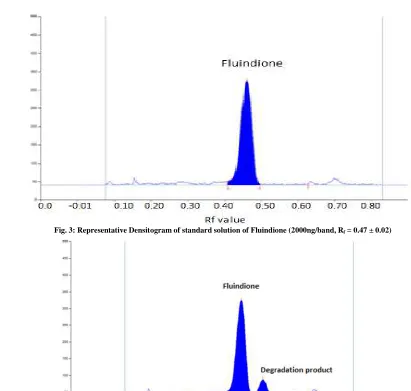
The primary objective in developing this stability indicating HPTLC method is to achieve the resolution of Fluindione and its degradation products. The chromatographic separation was achieved by linear ascending development in 10 cm × 10 cm twin trough glass chamber using Chloroform: Methanol (9.9: 0.1, v/v) as mobile phase and detection was carried out at 285 nm. The retention factor for Fluindione was found to be 0.47 ± 0.02. Representative Densitogram of standard solution of Fluindione is shown in figure: 3
Results of forced degradation studies
Forced degradation study showed that the method is highly specific and there was no interference of degradation products observed at retention factor of drug.
Acid treatment
In Acid hydrolysis condition, 19.27 % degradation of Fluindione was observed with the product of degradation at Rf
Fig. 3: Representative Densitogram of standard solution of Fluindione (2000ng/band, Rf = 0.47 ± 0.02)
Fig. 4: Densitogram obtained from sample subjected to acid degradation with degradation product at Rf 0.51 (Duration 3 days)
Alkali treatment
In alkaline hydrolysis condition, 17.66 % degradation of Fluindione was observed.
Oxidative degradation
Fluindione when treated with 0.3% v/v H2O2 i.e. oxidative degradation, 12.98 % degradation was observed.
Neutral Hydrolysis
In neutral hydrolysis condition, 8.77 % degradation of Fluindione was observed.
Fig. 5: Densitogram obtained from sample subjected to acid degradation with degradation product at Rf 0.51 (Duration 1days)
Fig. 6: Overlay of UV spectra of Fluindione drug and degradation product
Photo degradation Studies
Fluindione exhibited 18.10 % of degradation, when exposed to ultraviolet light (200 Watt hours/Square meter) and 19.41 % of degradation when exposed to fluorescence light (1.2 million lux hours).
The forced degradation studies data are summarized in Table 1.
Table 1: Data of forced degradation studies of Fluindione
Stress conditions/ duration % Assay of
Fluindione
Rf values of degraded Products
Acidic hydrolysis / 0.1 N HCl/ kept at room temperature for 3 days. 80.73 % 0.51 Alkaline hydrolysis /0.01 N NaOH/ kept at room temperature for 1 Hr. 82.34 % - Oxidative /0.3 % v/v H2O2 / kept at room temperature for 1 Hr. 87.02 % -
Neutral hydrolysis /H2O/kept at room temperature for 1Hr. 91.23 % -
Dry heat/ 60ºC/ 6 hours 85.30 % -
Photolysis UV fluorescent light (320 to 400 nm) 81.90 % -
Cool white fluorescent light 80.59 % -
Validation of the method
The method was validated for various parameters in accordance with ICH guidelines. [7]
Specificity
[image:5.595.128.459.318.471.2]Linearity and range
The standard stock solutions of Fluindione (100 µg/ml) were applied by spotting on TLC plate in range of 10, 15, 20, 25 and 30 µl. Straight-line calibration graphs were obtained in the concentration range 1000-3000 ng/band with high correlation coefficient > 0.99.
Accuracy
To check accuracy of the method, recovery studies were carried out by adding standard drug to sample at three different levels 80, 100 and 120 %. Basic concentration of sample was 1000 ng/band from SB. The drug concentrations were calculated from respective linearity equation. The results of the recovery studies indicated that the method is accurate for estimation of drug in tablet dosage form. The results obtained are shown in Table 2.
Table 2: Recovery studies of Fluindione
Drug Amount taken (ng/ band) Amount added (ng/ band) Total Area found (ng/ band) % Recovery % RSD
Fluindione
1000 800 11120.49 99.73% 1.225 1000 1000 12158.6 100.47% 1.701 1000 1200 13089.9 100.07% 1.551
*Average of three determinations
Precision
A set of three different concentrations in three replicates of standard solutions of Fluindione were prepared. All the solutions were analyzed on the same day in order to record any intraday variations in the results. Intra-day variation, as RSD (%), was found to be in the range of 0.64 to 1.77. For Inter day variation study, three different concentrations of the standard solutions in linearity range were analyzed on three consecutive days. Interday variation, as RSD (%) was found to be in the range of 0.61 to 1.51. The lower values of % R.S.D. (< 2) indicated that method was found to be precise.
Limit of detection (LOD) and Limit of quantitation (LOQ)
LOD and LOQ were calculated as 3.3 σ/S and 10 σ/S, respectively; where σ is the standard deviation of the concentration response (y-intercept) and S is the slope of the calibration plot. The LOD and LOQ were found to be 88.67 ng/band and 268.70 ng/band respectively.
Robustness Studies
[image:6.595.131.463.247.298.2]Robustness of the method was determined by carrying out the analysis under conditions during which mobile phase composition, chamber saturation time was altered and the effect on the area of drug was noted. Robustness of the method checked after deliberate alterations of the analytical parameters showed that areas of peaks of interest remained unaffected by small changes of the operational parameters (% R.S.D. < 2). The results are given in Table 3.
Table 3: Robustness Data in Terms of Peak Area (% RSD)
Sr. No. Parameter (% RSD)
1 Mobile phase saturation time 10 min and 20 min 1.34 2 Mobile phase variation chloroform 9.8 and 10 ml 0.885
*Average of three determinations
DISCUSSION
The percent degradation under various stress conditions in our study, match fairly with reported method but this literature report does not mention product of degradation, hence there is a need to investigate acid catalysed hydrolysis in detail.
Acknowledgement
The authors are thankful to principal and management of AISSMS college of Pharmacy, Pune for providing the research facilities. We also thankful to Mylan Laboratories Ltd. (Hyderabad, India) for providing us Fluindione as gift sample.
REFERENCES
[1] https://www.google.co.in/fluindione (accessed on 21/10/2015).
[2]N M Rao; D Gowrisankar, Eurasian Journal of Analytical Chemistry., 2015, 10(2), 127-136. [3] M Thimmaraju; K Hemanth, Der Pharmacia Lettre., 2015, 7(2), 237-242.
[4] International Conference on Harmonization (ICH), Impurities in new drug product Q3B, (2006).
[5] International Conference on Harmonization (ICH), Stability testing of new drug substances and products, Q1A (R2), (2003).
[6] International Conference on Harmonization (ICH), Photo stability testing of new drug substances and products, Q1B.