Journal of Chemical and Pharmaceutical Research, 2014, 6(7):2589-2595
Research Article
CODEN(USA) : JCPRC5
ISSN : 0975-7384
Research on improved SIFT algorithm
Xue Leng*
and Jinhua Yang
School of Photoelectric Engineering, Changchun University of Science and Technology, Changchun, China
_____________________________________________________________________________________________
ABSTRACT
Image matching is a research focus in the field of image processing. The method based on feature matching by researchers alike for Its stable performance. Based on the analysis of the traditional SIFT algorithm, For computationally intensive problems of SIFT feature descriptor links, Proposed a new descriptor generation algorithm. Experimental results show that this method can effectively reduce the amount of calculation, improve processing speed.
Keywords: Feature, Improve, SIFT Algorithm
_____________________________________________________________________________________________
INTRODUCTION
Image matching is between two or more images from different times or different perspectives of the same scene to find the best correspondence transform relationships. There are two main image matching techniques: pixel matching and feature matching. Feature matching method by researchers alike for its performance and stability, matching speed. Usually image in the imaging process will be affected by shooting time, angle, the natural environment and other factors, Not only the image captured by the interference noise, and there are serious distortions and aberrations. The purpose of matching is to overcome the noise and interference, to find corresponding points between two or more images. So researchers are constantly looking for high precision, high accuracy, strong anti-interference and fast matching algorithm. In 2004, David Lowe proposed a new feature extraction algorithm——Scale Invariant Feature Transform. The algorithm have a good effect for solving image
distortion caused by viewpoint change, rotation and scaling and partial occlusion.But computationally intensive and slow match are sift’sdisadvantage. For sift’s disadvantage, this paper presents an improved feature descriptor generation algorithm. Use the convolution calculation of the weighted sum of the feature descriptor generation algorithm to reduce the characteristic data, thereby reducing the amount of calculation and improve the matching speed.
EXPERIMENTAL SECTION
1 Image matching preprocessing
Matching preprocessing is to reduce or eliminate various error factors interfere with the performance of the match. Pretreatment methods used in this paper is the Gaussian filtering and Wallis image enhancement combining.
1.1 Gaussian Filter
Gaussian smoothing filter is a linear method, by using the shape of a Gaussian function select the weighted value. Gaussian filter to remove noise better,for Normal distribution. One-dimensional zero-mean Gaussian function is:
2 2
2
)
(
σx
e
x
g
−
σ
determines the width of the Gaussian filter.For the image, Used two-dimensional discrete Gaussian for smoothing filter. Function expression is:2 2 2
2 ) (
2
2
1
)
,
,
(
σπσ
σ
y x
e
y
x
G
+ −
=
(2)
The principle of Gaussian filter is: Using a template scan each pixel in the image, Use of the template to determine the weighted average gray value of pixels in the neighborhood instead of template center pixels’ gray value. General template size is 3X3 or 5X5, The weighted distribution of values shown in Fig1.
Fig1 Gaussian distribution of weighted value
Gaussian filter image processing results are as follows:
Fig2 Original imag Fig3Add salt and pepper noise image
Fig4 Adding Gaussian noise image Fig5Remove salt and pepper noise image
For Figure 3,4, Gaussian filter processing are shown in Figure 5,6. By results, Gaussian filter has a certain extent to Gaussian noise,salt and pepper noise suppression effect is not very good. But the edge of the image to retain better. In order to reduce the image differences caused by noise, The image smoothing method Blurring the edges of the image, reducing the image contrast, the effect of the impact of the image matching. So filtered imagewill be processing for image enhancement.
1.2 Wallis Image Enhancement
Wallis filter can suppress noise at the same time enhancing the contrast of the original image, the image can be enhanced image texture patterns at different scales. Therefore, It can improve the quantity and accuracy of point features on the image. Improve the matching reliability in image matching results. The basic principle of the Wallis filter is the Gray value and variance of the original image mapped to the scope of given value and the variance. Specific implementation process is as follows:
(1)The original image is divided into a number of non-overlapping rectangular area, Scale of the rectangular area corresponds to the scale to enhance the texture pattern.
(2)Calculate the mean and variance of each rectangular area.
(3)Take the target of gray mean and variance, Calculate the filter coefficients of additive and multiplicative in each rectangular area.
(4)Calculate the new gray value of all pixels.
Use the Wallis filter enhance the image, Results shown in Figure5.
Fig5 Filtering effect of the wallis filter 2 The basic principles of SIFT
SIFT algorithm derived from the scale-space theory, is a local feature extraction algorithm. Looking at the extreme point, extract the location, scale and rotation invariant in the scale space. The principle diagram of the algorithm shown in Figure6.
Fig6 Block diagram of the algorithm SIFT
2.1 Scale spatial structure
SIFT algorithm is to build a Gaussian differential pyramid by DOG operator. Gaussian function
G
(
x
,
y
,
σ
)
having different values ofσ
,Convolution of the imageI
(
x
,
y
)
,Get the Gaussian scale-spaceL
(
x
,
y
,
σ
)
. Gaussian scale-space sampling to obtain Gaussian pyramid, Gaussian scale-space adjacent obtained by subtracting the Difference of Gaussian scale-space.)
,
(
)
,
,
(
)
,
,
(
x
y
G
x
y
I
x
y
L
σ
=
σ
∗
(3))
,
,
(
)
,
,
(
)
,
(
))
,
,
(
)
,
,
(
(
)
,
,
(
σ
σ
σ
σ
σ
y
x
L
k
y
x
L
y
x
I
y
x
G
k
y
x
G
y
x
D
−
=
∗
−
=
Image pyramid of O group, Each group has an S-layer. The next set of images obtained from a set of images on the down-sampling. Specific process shown in Figure 7,Left is to build the pyramid of the first and second groups of Gaussian scale space construction diagram, Pictured on the right is Difference of Gaussian scale space pyramid structure diagram.
Fig7DOG scale space and scale space structure diagram
2.2 Local space extremum point detection
Local extreme point detection, Each group except for the first and last layers of the sample point for all layers and all of its neighboring pixels is compared, Whether the comparison is the value of the pixel values of the image domain and its neighboring point scale domain.
Fig8Scale space local extreme point detection
Due to the need in the same group of Gaussian differential scale space pyramid scale is compared with neighboring, So a group of Gaussian differential image S = 4 was detected in only two local extreme point scale. While other local extreme points in the second layer required for detecting the image of the next group of Gaussian pyramid image of the difference. According to this principle, Final inspection of local extreme points in the image at different scales in different layers of the pyramid. However, the local extreme points are thus detected are not stable keypoints, So we need to pinpoint the location of the key points.
2.3 Determine the position of the extreme points
All extrema detected by fitting a quadratic function, Exact location of extreme points. Get fit function of key point.
x
x
D
x
x
D
D
x
D
TT
2 2
2
1
)
(
∂
∂
+
∂
∂
+
=
(5)
Derivative of the above equation and make the equation equal to zero, You can get extreme points:
x
D
x
D
x
∂
∂
∂
∂
−
=
2 2−1(6)
Corresponding to the extreme points of the equation is:
x
x
D
D
x
D
T
∂
∂
+
=
2
1
)
(
03
.
0
)
(
x
〈
D
as the feature points of the key points of the unstable, Culling. In the process of calculating equation pinpoint the location and the scale of the feature points.
2.4 The direction of the feature points
With the location and scale of the feature points, Also ensure its rotational invariance, Therefore, to determine the main direction. By the formula (8) and (9), Use extreme point gradient direction distribution characteristics of neighboring pixels, Specify the value and direction of the gradient modulus for each critical point. Determining the position of the feature point, the scale and the direction,that can be extracted.
2 2
))
1
,
(
)
1
,
(
(
))
,
1
(
)
,
1
(
(
)
,
(
x
y
=
L
x
+
y
−
L
x
−
y
+
L
x
y
+
−
L
x
y
−
m
(8))))
,
1
(
)
,
1
(
/(
))
1
,
(
)
1
,
(
((
)
,
(
1y
x
L
y
x
L
y
x
L
y
x
L
tg
y
x
=
−+
−
−
+
−
−
θ
(9)L is the dimension of the key points of the detected.
2.5 Generate the feature descriptors
To ensure rotational invariance, The axis of rotation to the main direction of the feature points, Feature points as the center of the window to take a 8X8, Then statistical eight directions gradient direction histogram in each direction 4X4 pieces, And calculate the accumulated value of each gradient direction, Get a seed point. There are eight points each seed direction vector information, So the formation of a 128-dimensional feature descriptors.
Fig9Neighborhood gradient direction Fig10The key point of the feature vector
3 Improved SIFT algorithm
SIFT operator to extract image local characteristics, Luminance changes, scaling and rotation holding scale invariance, And on the subject of noise, the perspective changes to maintain a certain stability. However, due to the complexity of the construction process SIFT operator, And the extracted feature data is large, So it's the real poor. So this paper presents a calculation of the weighted sum of the features described in sub-generation algorithm using convolution. So this paper presents a calculation of the weighted sum of the features described in sub-generation algorithm using convolution. The neighborhood of the feature point is divided into multiple sub- neighborhoods. Then each statistical information for each sub-gradient neighborhoodIn the eight directions, To generate the feature descriptors.
Given an image, First calculate the derivative images for each point on each of the eight directions.
)
0
,
max(
i oo
I
G
i∂
∂
=
(10) iO
represents the direction,
i
=0,……7,Get the image derivative matrix on Eight directions.Statistics feature point to all the sub-neighborhood gradient information in the eight directions.calculated for each weights sub-matrix and gradient matrix convolution.k o j i k
w
w
G
G
ji,
=
,∗
, (11)Where
i
=
1
,...
4
,
j
=
1
,....
4
,
k
=
1
,...
8
.k
wij
G
, is the gradient matrix after the original in the direction of
k
convolution with in the weight matrixw
.G
,(
x
,
y
)
kwij is a
(
x
,
y
)
-centered 4x4 neighborhood, Each point in thepoint
( v
u
,
)
in the16 sub-neighborhood in direction 8, Can be based only on the position of the sub-neighborhoodRead the center of each sub-neighborhood of
(
x
i,
y
i)
values from the kwij
G
, . This avoids double-counting
gradient weighted of feature point. Feature point descriptor vector elements consists of gradient weighted of feature
points In the eight directions of its neighborhood 16 sub.After the calculation of
k wij
G
, ,The gradient weighted of the
feature points in the Sub-neighborhood on Eight directionsCan according to the center sub-neighborhood fast read
out on the corresponding
k wij
G
, ,So you can read feature descriptor vectors obtained directly from the k wij
G
, .
T w
w w
w
x
y
G
x
y
G
x
y
G
x
y
G
v
u
Des
(
,
)
[
1(
1,
1),...
8(
1,
1),...
1(
4,
4),....
8(
4,
4)]
44 44
11 11
=
(12)
Where
(
x
i,
y
i)
is the center of the sub-neighborhood.RESULTS AND DISCUSSION
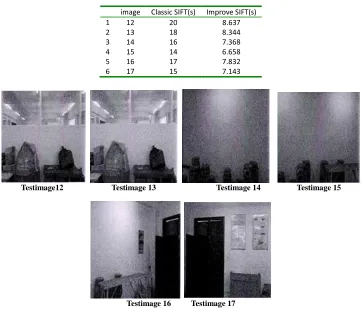
[image:6.595.125.489.357.667.2]In this paper, We use of improved algorithms and classic feature descriptor SIFT algorithm generate the feature descriptors For the following four chart, Running time as shown in Table 1. Experimental results show that the improved algorithm proposed in this paper generate feature descriptors SIFT algorithm faster than the speed of more than 1 times.
Table 1 Running time comparison
image Classic SIFT(s) Improve SIFT(s)
1 12 20 8.637
2 13 18 8.344
3 14 16 7.368
4 15 14 6.658
5 16 17 7.832
6 17 15 7.143
Testimage12 Testimage 13 Testimage 14 Testimage 15
Testimage 16 Testimage 17
Summary
REFERENCES
[1] CHENG dezhi,LI yanjun,YU ruixin:Image Matching Method Based on Improved SIFT Algorithm, Computer Simulation,2011,7(28),285-289.
[2] Liu Jia,Fu Weipin,Wand Wen,Li Na: Image matching based on improved SIFT algorithm, Chinese Journal of
Scientific Instrument,2013,5(34),1107-1112.
[3] FU W P, QIN CH, LIU: Matching and location ofimage object based on SIFT algorithm , Chinese Journal of
Scientific Instrument, 2011,1 (32):163-169.
[4] Ke SH,Wang BL,Huang XY:An improved SIFT algorithm and its application in medical image registration.
Journal of Xia men University:Natural Scienc,2010,3 (49):354-358.
[5]TAl Nengjian,WU Dewei,Ql Junyi:A method toextract high robust kcypoints based on improvedSIFT.Acta
acronautica et astronautica sinica,2013,11(42),1296-1300.
[6] WAN Xue,ZHANG Zuxun, KE Tao:An improvedSIFT operator based on the theory of zero-crossing on feature
extraction,Journal of Wuhan university,geomatic and information science edition, 2013,3(38),270-273.
[7] LIU Hui,Shen Harlong: Image Match Method Based on Improved SIFT Algorithm, Microelectionics and
computer,2014,1(31),38-42.
[8] NIU Junwei,HAO Xiangyang,LIU Songlin: An Improved SIFT Feature Extraction Algorithm, Journal of
Geomatics Science and Technology,2014,2(31),173-176.
[9] SHANU Mingshu: A Fast Image Mosaic Algorithm Based on Improved SIFT Feature Matching,