0095-1137/05/$08.00⫹0 doi:10.1128/JCM.43.10.4977–4983.2005
Serotype-Specific Detection of Dengue Viruses in a Fourplex
Real-Time Reverse Transcriptase PCR Assay
Barbara W. Johnson,* Brandy J. Russell, and Robert S. Lanciotti
Diagnostic and Reference Laboratory, Arbovirus Diseases Branch, Divisionof Vector-Borne Infectious Diseases, Centers for Disease Control and Prevention, Fort Collins, Colorado
Received 15 June 2005/Returned for modification 11 July 2005/Accepted 26 July 2005
The dengue (DEN) viruses are positive-strand RNA viruses in the genusFlavivirus. Dengue fever and dengue
hemorrhagic fever/dengue shock syndrome are important human arboviral diseases caused by infection with one of four closely related but serologically distinct DEN viruses, designated DEN-1, DEN-2, DEN-3, and DEN-4 viruses. All four DEN serotypes are currently cocirculating throughout the subtropics and tropics, and genotypic variation occurs among isolates within a serotype. A real-time quantitative nucleic acid amplification assay has been developed to detect viral RNA of a single DEN virus serotype. Each primer-probe set is DEN serotype specific, yet detects all genotypes in a panel of 7 to 10 representative isolates of a serotype. In single reactions and in fourplex reactions (containing four primer-probe sets in a single reaction mixture), standard dilutions of virus equivalent to 0.002 PFU of DEN-2, DEN-3, and DEN-4 viruses were detected; the limit of detection of DEN-1 virus was 0.5 equivalent PFU. Singleplex and fourplex reactions were evaluated in a panel of 40 viremic serum specimens with 10 specimens per serotype, containing 0.002 to 6,000 equivalent PFU/
reaction (0.4 to 1.2ⴛ106
PFU/ml). Viral RNA was detected in all viremic serum specimens in singleplex and fourplex reactions. Thus, this serotype-specific, fourplex real-time reverse transcriptase PCR nucleic acid detection assay can be used as a method for differential diagnosis of a specific DEN serotype in viremic dengue patients and as a tool for rapid identification and serotyping of DEN virus isolates.
Dengue (DEN) viruses are a group of four closely related
arboviruses in the genusFlavivirus, designated DEN-1, DEN-2,
DEN-3, and DEN-4 viruses (7). Aedes aegypti is the primary
mosquito vector of the DEN viruses, and humans are the
primary host. As a result of the expansion of the range ofA.
aegyptiin urban environments throughout the tropics and sub-tropics, transmission of DEN viruses has also increased, with an estimated 2.5 billion people at risk of infection (4, 7–9). As many as 100 million people per year may become infected, including approximately 400,000 cases of DEN hemorrhagic fever (DHF) and DEN shock syndrome (DSS), which are more serious manifestations often associated with secondary DEN virus infections (34). In areas of dengue hyperendemicity, all four of the DEN virus serotypes may be circulating simulta-neously, and an increase in DHF and DSS has been reported in these areas (4, 7, 9, 10).
The DEN viruses are closely related serologically; however, they are antigenically distinct, and primary infection by one DEN virus serotype does not protect against infection from another DEN virus serotype (8). The antibodies raised against the primary infecting DEN virus serotype may cross-react with the subsequent infecting DEN virus serotype and through op-somization may function to enhance the ability of the sec-ond DEN virus serotype to infect the host, in a process called antibody-dependent enhancement of infection (28). DHF and DSS are characterized by a diminished immunoglobulin
M (IgM) response, an increase in vascular permeability, and hemorrhage, followed by vascular collapse, which may lead to death (8).
There is extensive cross-reactivity among flaviruses in sero-logical assays, particularly between the DEN virus serotypes (12, 24, 25). In addition, upon secondary DEN virus infection, the antibody response may be greater to the primary infecting DEN virus serotype than to the infecting DEN virus serotype, which is reflected in serological assays as well. Alternatively, the IgM antibody response may be low and thus undetectable in serological assays, such as IgM antibody capture enzyme-linked immunosorbent assay. As a result, identification of the infecting virus by serology is not possible in many cases where multiple flaviviruses are circulating.
In DEN virus infections, the patient is viremic for 5 to 8 days after the onset of symptoms and may have a viral load as high
as 103RNA particles/ml in primary DEN virus infections and
⬎106RNA particles/ml in secondary DEN virus infections (22,
34). Virus isolation from acute-phase sera remains the method of clinical diagnosis and identification of DEN virus infections in these areas. However, molecular methods of virus nucleic acid detection are becoming more widely used, as they can provide results more quickly and have been shown to be more sensitive than virus isolation in some cases (15, 16, 21, 30).
We report the development of a fourplex DEN virus sero-type-specific, real-time nucleic acid detection assay. Four sets of primer pairs and fluorogenic probes were designed, each of which is specific for a single DEN virus serotype but which also detects multiple genotypes and strains within the serotype. The assay was evaluated for sensitivity and specificity in a virus dilution series and against a panel of DEN viremic serum specimens that had previously been serotyped. Specificity was
* Corresponding author. Mailing address: Diagnostic and Reference Laboratory, Arbovirus Diseases Branch, Division of Vector-Borne Infectious Diseases, Centers for Disease Control and Prevention, 3150 Rampart Rd., Fort Collins, CO 80521. Phone: (970) 266-3543. Fax: (970) 221-6476. E-mail: [email protected].
4977
on May 15, 2020 by guest
http://jcm.asm.org/
also assessed in a representative collection of DEN virus iso-lates, other closely related flaviviruses, and arboviruses that may share the same geographical range or mosquito vector. The assay was shown to be DEN virus serotype specific, and all genotypes and variant isolates within a serotype that were tested were also detected. In singleplex and in fourplex reac-tions, in which the four serotype-specific primer and probe sets were contained in a single reaction mixture, viral RNA of DEN-2, DEN-3, and DEN-4 viruses could be detected to 0.002 equivalent PFU (0.4 PFU/ml); the limit of detection of DEN-1 virus was 0.5 PFU (100 PFU/ml). Thus, this serotype-specific real-time fourplex reverse transcriptase PCR (RT-PCR) assay will be a useful tool in the differential diagnosis of DEN virus infections.
MATERIALS AND METHODS
Virus strains.The 36 DEN virus strains used in this study were obtained from the World Health Organization Collaboration Center for Reference and Re-search at the Centers for Disease Control and Prevention, Division of Vector-Borne Infectious Diseases (CDC/DVBID) in Fort Collins, Colo. The following viruses were used as prototypes to prepare standard dilutions for each serotype: DEN-1 Hawaii 44, DEN-2 New Guinea C 44, DEN-3 H-87 (Philippines 56), and DEN-4 H-241 (Philippines 56). Other flaviviruses evaluated include the attenu-ated Japanese encephalitis virus (JEV) strain SA-14-14-2, St. Louis encephalitis virus (SLEV) strain TBH-28, West Nile virus (WNV) strain New York 99, and yellow fever virus (YFV) vaccine strain 17D. Also used were Venezuelan equine encephalitis virus (VEEV) vaccine strain TC83, eastern equine encephalitis virus (EEEV) NJ/60 strain, an EEEV isolate from Ecuador, the western equine encephalitis virus (WEEV) Fleming strain, a WEEV isolate from Brazil, and a California group C virus, Caraparu, which was isolated in Brazil. These viruses were also obtained from the CDC/DVBID reference collection.
Clinical samples.Human clinical specimens submitted to the CDC/DVBID, Dengue Branch, for diagnosis or confirmation of DEN infection and from which virus had been isolated and serotyped were used in this study.
[image:2.585.45.542.80.238.2]Virus titer.Tenfold dilutions of prototype virus were made for each DEN virus serotype in 1 ml of BA-1 diluent (1⫻M-199 medium with Hank’s salts, 0.05 M Tris [pH 7.6], 1% bovine serum albumin, 0.35-g/liter sodium bicarbonate, 100-U/ml penicillin, 100-g/ml streptomycin, 1-l/ml amphotericin B [Fungi-zone]). Virus titers of the standard dilutions used in the assays were determined by double-overlay plaque assay of Vero cells as previously described (26).
RNA extraction.Viral RNA for the nested RT-PCR and real-time RT-PCR assays was extracted from 100l of virus isolates and serum specimens by using the QIAamp Viral RNA Mini kit (QIAGEN, Valencia, CA) according to the manufac-turer’s instructions, with the exception of the elution volume, which was 100l.
Nested RT-PCR assay.Nested RT-PCR of DEN virus RNA was carried out with DEN virus consensus and serotype-specific primers, as described previously (20). Modifications to the procedure were as follows. Five microliters of RNA in
a 50-l reaction volume was used with the QIAGEN OneStep RT-PCR kit (QIAGEN). RT-PCR was carried out according to the manufacturer’s instruc-tions with a 55°C annealing temperature. The resultant PCR product was diluted 1:100 in water. Nested PCR was carried out with 5l of the diluted RT-PCR product in a 50-l reaction volume with the TaqPCR Master Mix kit (QIAGEN). Initial denaturation of 3 min at 94°C was followed by 25 cycles, each consisting of 94°C for 0.5 min, 50°C for 1 min, and 72°C for 1 min; this was followed by a final extension step of 72°C for 10 min. Both the RT-PCR and nested PCR products were analyzed by gel electrophoresis on a 2% agarose gel (SeaQem) containing ethidium bromide (0.5g/ml). A band on the agarose gel of the correct size was interpreted as a positive result. A faint band of the correct size was considered an equivocal result.
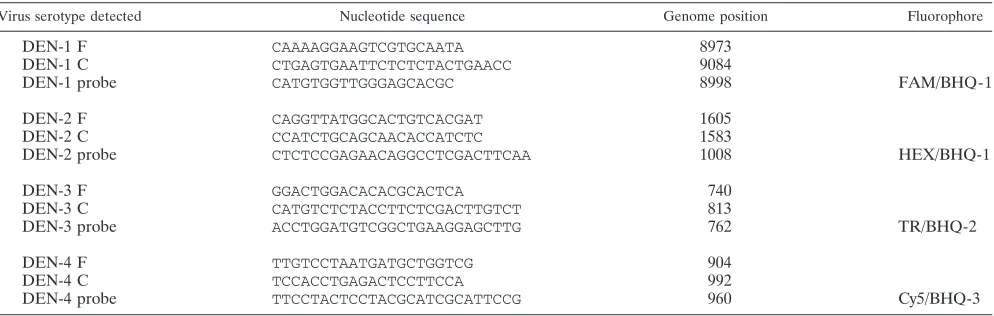
Real-time RT-PCR (TaqMan) assay.Serotype-specific DEN virus primers and fluorogenic probes were designed by using the PrimerExpress, version 2.0.0 (PE Applied Biosystems, Foster City, CA), and Beacon Designer (Premier Biosoft International, Palo Alto, CA) software packages (Table 1). Serotype specificities of primer sequences were evaluated by comparison of available published se-quences of the complete genome of each DEN virus serotype from GenBank, which were aligned with Megalign software (DNAstar, Madison, WI). Compar-isons of specific regions were also done with PrimerSelect software programs and by BLAST searches. Sequences of primers and probes designed to detect DEN-2 virus (strain PUO218) were reported previously (13). The DEN-1 probe was labeled at the 5⬘end with the 6-carboxyfluorescein (FAM) reporter dye and at the 3⬘end with black hole quencher 1 (BHQ-1) fluorophore; the DEN-2 probe was labeled with HEX and BHQ-1; the DEN-3 probe was labeled with Texas red (TR) and BHQ-2; and the DEN-4 probe was labeled with Cy5 and BHQ-3 (Table 1). RNA from other flaviviruses or negative extractions of tissue cul-ture media was included as a negative control in all real-time RT-PCR assays. The specificities of the primer-probe sets were determined as previously de-scribed (21).
In singleplex reaction mixtures, 5l of RNA was combined with 50 pmol of each primer and 9 pmol of the probe in a 50-l total iScript One-Step RT-PCR kit for probes (Bio-Rad, CA). Each reaction mixture contained a single DEN serotype primer pair and probe; therefore, in singleplex assays four separate reactions were carried out for each RNA sample. In fourplex reaction mixtures, 50 pmol (each) of DEN-1- and DEN-3-specific primers, 25 pmol (each) of DEN-2- and DEN-4-specific primers, and 9 pmol of each probe were combined in a 50-l volume total reaction mixture. Reverse transcription of 10 min at 50°C was followed by 45 cycles of amplification in an Icycler iQ Real-Time Detection System (Optical System software, version 3.0a; Bio-Rad, Hercules, CA) accord-ing to iScript One-Step RT-PCR kit instructions for real-time RT-PCR condi-tions and using a 60°C annealing temperature.
The number of infectious viral RNA transcripts detected was calculated by generating a standard curve from 10-fold dilutions of RNA isolated from a known amount of prototype virus, the titer of which was determined by plaque assay, as previously described (13). Briefly, total RNA for the real-time RT-PCR assay was extracted from 100l of the same virus suspension used to inoculate Vero cells for plaque titration. The amount of infectious RNA transcripts per reaction corresponded to the known PFU per reaction and is expressed as equivalent PFU (13, 17, 21). Positive results were determined according to the amplification cycle at which the fluorescence was detected above the threshold
TABLE 1. Oligonucleotide primers and fluorogenic probes used in the serotype-specific DEN virus real-time RT-PCR assay
Virus serotype detected Nucleotide sequence Genome position Fluorophore
DEN-1 F CAAAAGGAAGTCGTGCAATA 8973
DEN-1 C CTGAGTGAATTCTCTCTACTGAACC 9084
DEN-1 probe CATGTGGTTGGGAGCACGC 8998 FAM/BHQ-1
DEN-2 F CAGGTTATGGCACTGTCACGAT 1605
DEN-2 C CCATCTGCAGCAACACCATCTC 1583
DEN-2 probe CTCTCCGAGAACAGGCCTCGACTTCAA 1008 HEX/BHQ-1
DEN-3 F GGACTGGACACACGCACTCA 740
DEN-3 C CATGTCTCTACCTTCTCGACTTGTCT 813
DEN-3 probe ACCTGGATGTCGGCTGAAGGAGCTTG 762 TR/BHQ-2
DEN-4 F TTGTCCTAATGATGCTGGTCG 904
DEN-4 C TCCACCTGAGACTCCTTCCA 992
DEN-4 probe TTCCTACTCCTACGCATCGCATTCCG 960 Cy5/BHQ-3
on May 15, 2020 by guest
http://jcm.asm.org/
cycle (CT) relative fluorescence unit (RFU) in the PCR baseline-subtracted
RFU. Thresholds for the four fluorophores were determined with the Icycler software in a series of reactions using the DEN RNA standard dilutions and then set for subsequent runs as follows: FAM/BHQ DEN-1, 200 RFU; HEX/BHQ-1, 100 RFU; TR/BHQ-2, 250 RFU; and Cy5/BHQ-3, 100 RFU. A sample was determined empirically to be positive if theCTvalue wasⱕ36, based on
back-ground cross-reactivity of the primers and probes in nontemplate control reac-tions.
RESULTS
Sensitivity of DEN serotype-specific primers and probes in
singleplex and fourplex reactions. To optimize the fourplex
assay, a range of reagent concentrations and annealing tem-peratures was evaluated, with sensitivity measured as the
low-est CTvalue. The concentration of magnesium chloride and
deoxynucleoside triphosphates contained in the iScript One-Step RT-PCR master mix (Bio-Rad) was found to be optimal; the addition of magnesium chloride (concentration range tested, 4 to 5 nM) or deoxynucleoside triphosphates (concen-tration range tested, 10 to 18 mM) to the master mixture did
not improve sensitivity. Primer concentrations from 400 to 1,000 nM and probe concentrations ranging from 150 to 300 nM were assessed; final concentrations of 500 to 1,000 nM each primer and 180 nM each probe were found to be the most sensitive in the fourplex assay. Reaction efficiencies were com-pared, with annealing temperatures ranging from 54 to 60°C. Sensitivity was improved by lowering the annealing tempera-ture to 55°C; however, the annealing temperatempera-ture was main-tained at 60°C to increase specificity.
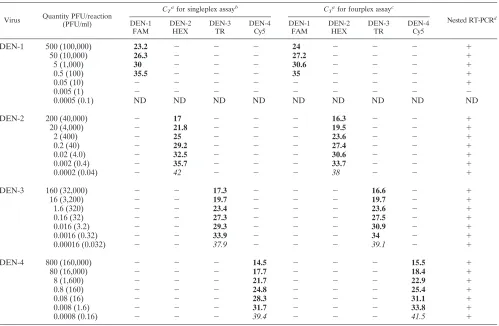
[image:3.585.44.543.88.414.2]The efficiency of the primers and probes was compared in singleplex reactions and fourplex reactions. Singleplex reac-tions contained a single serotype primer-probe set in the mas-ter mixture and thus required four separate reactions for each sample with four different reaction master mixtures. Fourplex reactions contained all four sets of primers and probes within one reaction master mixture. Sensitivities between the two were comparable; the limit of detection of DEN-1 virus RNA was 0.5 equivalent PFU. DEN-2, DEN-3, and DEN-4 virus RNA could be detected to 0.002, 0.0016, and 0.008 equivalent PFU, respectively (Table 2).
TABLE 2. Sensitivities of serotype-specific DEN singlexplex real-time RT-PCR, fourplex real-time RT-PCR, and nested RT-PCR assays and DEN serotype specificity of singleplex and fourplex real-time RT-PCR assays
Virus Quantity PFU/reaction (PFU/ml)
CTafor singleplex assayb CTafor fourplex assayc
Nested RT-PCRd
DEN-1 FAM
DEN-2 HEX
DEN-3 TR
DEN-4 Cy5
DEN-1 FAM
DEN-2 HEX
DEN-3 TR
DEN-4 Cy5
DEN-1 500 (100,000) 23.2 ⫺ ⫺ ⫺ 24 ⫺ ⫺ ⫺ ⫹
50 (10,000) 26.3 ⫺ ⫺ ⫺ 27.2 ⫺ ⫺ ⫺ ⫹
5 (1,000) 30 ⫺ ⫺ ⫺ 30.6 ⫺ ⫺ ⫺ ⫹
0.5 (100) 35.5 ⫺ ⫺ ⫺ 35 ⫺ ⫺ ⫺ ⫹
0.05 (10) ⫺ ⫺ ⫺ ⫺ ⫺ ⫺ ⫺ ⫺ ⫹
0.005 (1) ⫺ ⫺ ⫺ ⫺ ⫺ ⫺ ⫺ ⫺ ⫺
0.0005 (0.1) ND ND ND ND ND ND ND ND ND
DEN-2 200 (40,000) ⫺ 17 ⫺ ⫺ ⫺ 16.3 ⫺ ⫺ ⫹
20 (4,000) ⫺ 21.8 ⫺ ⫺ ⫺ 19.5 ⫺ ⫺ ⫹
2 (400) ⫺ 25 ⫺ ⫺ ⫺ 23.6 ⫺ ⫺ ⫹
0.2 (40) ⫺ 29.2 ⫺ ⫺ ⫺ 27.4 ⫺ ⫺ ⫹
0.02 (4.0) ⫺ 32.5 ⫺ ⫺ ⫺ 30.6 ⫺ ⫺ ⫹
0.002 (0.4) ⫺ 35.7 ⫺ ⫺ ⫺ 33.7 ⫺ ⫺ ⫹
0.0002 (0.04) ⫺ 42 ⫺ ⫺ ⫺ 38 ⫺ ⫺ ⫹
DEN-3 160 (32,000) ⫺ ⫺ 17.3 ⫺ ⫺ ⫺ 16.6 ⫺ ⫹
16 (3,200) ⫺ ⫺ 19.7 ⫺ ⫺ ⫺ 19.7 ⫺ ⫹
1.6 (320) ⫺ ⫺ 23.4 ⫺ ⫺ ⫺ 23.6 ⫺ ⫹
0.16 (32) ⫺ ⫺ 27.3 ⫺ ⫺ ⫺ 27.5 ⫺ ⫹
0.016 (3.2) ⫺ ⫺ 29.3 ⫺ ⫺ ⫺ 30.9 ⫺ ⫹
0.0016 (0.32) ⫺ ⫺ 33.9 ⫺ ⫺ ⫺ 34 ⫺ ⫹
0.00016 (0.032) ⫺ ⫺ 37.9 ⫺ ⫺ ⫺ 39.1 ⫺ ⫹
DEN-4 800 (160,000) ⫺ ⫺ ⫺ 14.5 ⫺ ⫺ ⫺ 15.5 ⫹
80 (16,000) ⫺ ⫺ ⫺ 17.7 ⫺ ⫺ ⫺ 18.4 ⫹
8 (1,600) ⫺ ⫺ ⫺ 21.7 ⫺ ⫺ ⫺ 22.9 ⫹
0.8 (160) ⫺ ⫺ ⫺ 24.8 ⫺ ⫺ ⫺ 25.4 ⫹
0.08 (16) ⫺ ⫺ ⫺ 28.3 ⫺ ⫺ ⫺ 31.1 ⫹
0.008 (1.6) ⫺ ⫺ ⫺ 31.7 ⫺ ⫺ ⫺ 33.8 ⫹
0.0008 (0.16) ⫺ ⫺ ⫺ 39.4 ⫺ ⫺ ⫺ 41.5 ⫹
a
CT, threshold cycle number at which fluorescence was detected above a determined RFU. See Materials and Methods for the threshold RFU for each fluorophore.
Positive interpretations (CTⱕ36) are shown in boldface type; negative interpretations (CT⬎36) are italicized; negative interpretations with no signal are shown by
hyphens.
b
Reactions for each DEN virus serotype were carried out in four separate wells containing one primer-probe set per reaction mixture.
c
The reaction was carried out in one well containing four sets of primer pairs and fluorogenic probes in one reaction mixture.
d
DEN virus-specific RT-PCR primers from Lanciotti et al. (20).⫹, positive interpretation determined by presence of a DNA band;⫺, negative interpretation with no DNA band; ND, not done.
on May 15, 2020 by guest
http://jcm.asm.org/
By the nested DEN RT-PCR assay, titers equivalent to 0.05 PFU of DEN-1 virus, 0.0002 PFU of DEN-2 and DEN-3 viruses, and 0.0008 PFU of DEN-4 virus was detected. Thus, the nested DEN virus RT-PCR assay was 10-fold-more
sensi-tive than the real-time RT-PCR singleplex and fourplex assays (Table 2).
Specificity of DEN serotype-specific primers and probes in
[image:4.585.47.541.83.605.2]singleplex and fourplex reactions.Serotype specificity of the
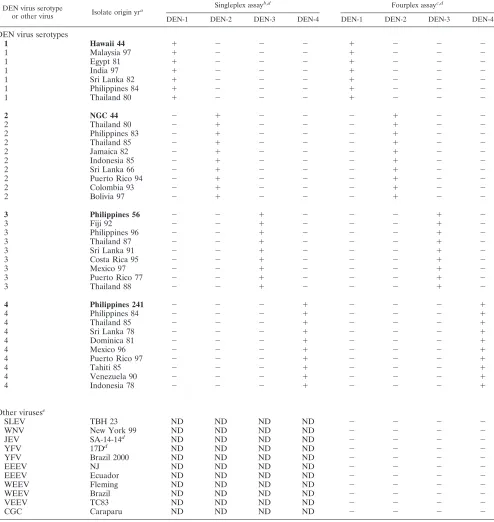
TABLE 3. Serotype specificities of DEN singleplex and fourplex real-time RT-PCR assays
DEN virus serotype
or other virus Isolate origin yr
a Singleplex assay
b,d Fourplex assayc,d
DEN-1 DEN-2 DEN-3 DEN-4 DEN-1 DEN-2 DEN-3 DEN-4
DEN virus serotypes
1 Hawaii 44 ⫹ ⫺ ⫺ ⫺ ⫹ ⫺ ⫺ ⫺
1 Malaysia 97 ⫹ ⫺ ⫺ ⫺ ⫹ ⫺ ⫺ ⫺
1 Egypt 81 ⫹ ⫺ ⫺ ⫺ ⫹ ⫺ ⫺ ⫺
1 India 97 ⫹ ⫺ ⫺ ⫺ ⫹ ⫺ ⫺ ⫺
1 Sri Lanka 82 ⫹ ⫺ ⫺ ⫺ ⫹ ⫺ ⫺ ⫺
1 Philippines 84 ⫹ ⫺ ⫺ ⫺ ⫹ ⫺ ⫺ ⫺
1 Thailand 80 ⫹ ⫺ ⫺ ⫺ ⫹ ⫺ ⫺ ⫺
2 NGC 44 ⫺ ⫹ ⫺ ⫺ ⫺ ⫹ ⫺ ⫺
2 Thailand 80 ⫺ ⫹ ⫺ ⫺ ⫺ ⫹ ⫺ ⫺
2 Philippines 83 ⫺ ⫹ ⫺ ⫺ ⫺ ⫹ ⫺ ⫺
2 Thailand 85 ⫺ ⫹ ⫺ ⫺ ⫺ ⫹ ⫺ ⫺
2 Jamaica 82 ⫺ ⫹ ⫺ ⫺ ⫺ ⫹ ⫺ ⫺
2 Indonesia 85 ⫺ ⫹ ⫺ ⫺ ⫺ ⫹ ⫺ ⫺
2 Sri Lanka 66 ⫺ ⫹ ⫺ ⫺ ⫺ ⫹ ⫺ ⫺
2 Puerto Rico 94 ⫺ ⫹ ⫺ ⫺ ⫺ ⫹ ⫺ ⫺
2 Colombia 93 ⫺ ⫹ ⫺ ⫺ ⫺ ⫹ ⫺ ⫺
2 Bolivia 97 ⫺ ⫹ ⫺ ⫺ ⫺ ⫹ ⫺ ⫺
3 Philippines 56 ⫺ ⫺ ⫹ ⫺ ⫺ ⫺ ⫹ ⫺
3 Fiji 92 ⫺ ⫺ ⫹ ⫺ ⫺ ⫺ ⫹ ⫺
3 Philippines 96 ⫺ ⫺ ⫹ ⫺ ⫺ ⫺ ⫹ ⫺
3 Thailand 87 ⫺ ⫺ ⫹ ⫺ ⫺ ⫺ ⫹ ⫺
3 Sri Lanka 91 ⫺ ⫺ ⫹ ⫺ ⫺ ⫺ ⫹ ⫺
3 Costa Rica 95 ⫺ ⫺ ⫹ ⫺ ⫺ ⫺ ⫹ ⫺
3 Mexico 97 ⫺ ⫺ ⫹ ⫺ ⫺ ⫺ ⫹ ⫺
3 Puerto Rico 77 ⫺ ⫺ ⫹ ⫺ ⫺ ⫺ ⫹ ⫺
3 Thailand 88 ⫺ ⫺ ⫹ ⫺ ⫺ ⫺ ⫹ ⫺
4 Philippines 241 ⫺ ⫺ ⫺ ⫹ ⫺ ⫺ ⫺ ⫹
4 Philippines 84 ⫺ ⫺ ⫺ ⫹ ⫺ ⫺ ⫺ ⫹
4 Thailand 85 ⫺ ⫺ ⫺ ⫹ ⫺ ⫺ ⫺ ⫹
4 Sri Lanka 78 ⫺ ⫺ ⫺ ⫹ ⫺ ⫺ ⫺ ⫹
4 Dominica 81 ⫺ ⫺ ⫺ ⫹ ⫺ ⫺ ⫺ ⫹
4 Mexico 96 ⫺ ⫺ ⫺ ⫹ ⫺ ⫺ ⫺ ⫹
4 Puerto Rico 97 ⫺ ⫺ ⫺ ⫹ ⫺ ⫺ ⫺ ⫹
4 Tahiti 85 ⫺ ⫺ ⫺ ⫹ ⫺ ⫺ ⫺ ⫹
4 Venezuela 90 ⫺ ⫺ ⫺ ⫹ ⫺ ⫺ ⫺ ⫹
4 Indonesia 78 ⫺ ⫺ ⫺ ⫹ ⫺ ⫺ ⫺ ⫹
Other virusese
SLEV TBH 23 ND ND ND ND ⫺ ⫺ ⫺ ⫺
WNV New York 99 ND ND ND ND ⫺ ⫺ ⫺ ⫺
JEV SA-14-14d ND ND ND ND ⫺ ⫺ ⫺ ⫺
YFV 17Dd ND ND ND ND ⫺ ⫺ ⫺ ⫺
YFV Brazil 2000 ND ND ND ND ⫺ ⫺ ⫺ ⫺
EEEV NJ ND ND ND ND ⫺ ⫺ ⫺ ⫺
EEEV Ecuador ND ND ND ND ⫺ ⫺ ⫺ ⫺
WEEV Fleming ND ND ND ND ⫺ ⫺ ⫺ ⫺
WEEV Brazil ND ND ND ND ⫺ ⫺ ⫺ ⫺
VEEV TC83 ND ND ND ND ⫺ ⫺ ⫺ ⫺
CGC Caraparu ND ND ND ND ⫺ ⫺ ⫺ ⫺
a
DEN viruses used to calculate virus titers are shown in boldface type. The year is shown as the last two digits (i.e., 44 for 1944).
b
Reactions for each DEN virus serotype were carried out in four separate wells containing one set of primer pairs and probe per reaction mixture. ND, not done.
c
The reaction was carried out in one well containing four sets of primer pairs and fluorogenic probes in one reaction mixture.
d⫹
,CTⱕ36;⫺,CT⬎36 or no signal. e
Abbreviations: NGC, New Guinea C virus; CGC, California group C virus.
on May 15, 2020 by guest
http://jcm.asm.org/
primer-probe sets was evaluated in the standard dilutions of the four prototype DEN viruses, in a collection of DEN virus isolates, and in human viremic serum specimens, in single reaction mixtures containing one primer-probe set, and in the fourplex mix of primers and probes. In both singleplex and fourplex assays of the standard dilutions, each DEN primer and probe set detected the single DEN virus serotype target for which they were designed (Table 2). DEN virus isolates chosen for the specificity analyses represented the geographical range and genotypes of each DEN virus serotype, based on phyloge-netic analyses and classification in the literature (2, 3, 6, 18, 19, 23, 29, 31, 32). Whenever possible, the most recent human isolate in the collection was chosen from each representative genotype (Table 3). All of the genotypes were detected, and the serotype was correctly identified by the corresponding primers and probe set.
The specificity of the DEN serotype-specific nucleotide de-tection assay was also evaluated against a panel of the sero-logically related flaviviruses including JEV, SLEV, WNV, and YFV. Other arthropod-borne viruses that may circulate in the same geographical range as the DEN viruses were also tested, including VEEV vaccine strain TC83, EEEV NJ/60, an EEEV isolate from Ecuador, WEEV strain Fleming, a WEEV isolate from Brazil; and a California group C Caraparu virus isolate from Brazil (5, 33). The singleplex and fourplex assays were specific for the DEN virus serotype target; no fluorogenic sig-nal was detected for any of the non-DEN flaviviruses or other arthropod-borne viruses (Table 3).
Evaluation of serotype-specific detection of DEN viral RNA
in acute-phase human serum.Human serum specimens from
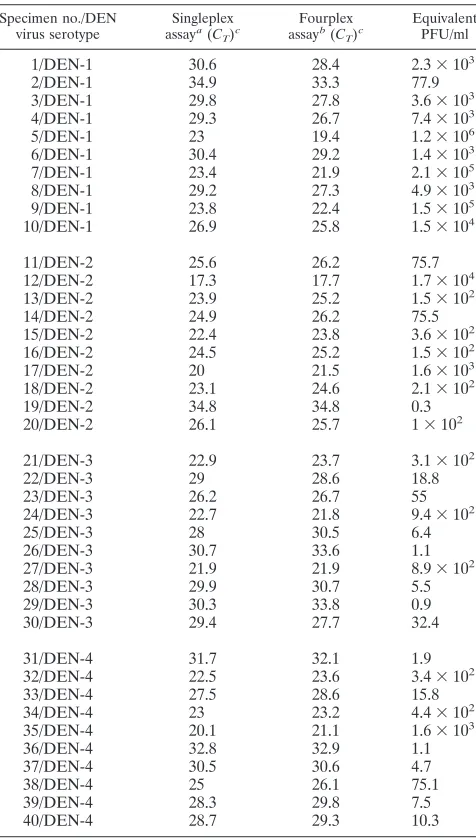
40 DEN virus infection cases, from which virus had been iso-lated and serotyped by indirect immunofluorescence assay with serotype-specific monoclonal antibodies, were tested against the four primer-probe sets by both singleplex and fourplex real-time RT-PCR assays and by the nested RT-PCR assay (Table 4). DEN viral RNA was detected and the correct sero-type was identified in all 40 of the samples by both the single-plex and foursingle-plex real-time RT-PCR assays (Table 4). No cross-reactive fluorescence was observed from one serotype to another (data not shown). The virus titers for the serum spec-imens were calculated from the DEN virus standard dilutions
and ranged from 77.9 to 106equivalent PFU/ml in DEN-1 virus
infections, from 0.3 to 1.7⫻104equivalent PFU/ml in DEN-2
virus, from 0.9 to 9.4⫻102PFU/ml in DEN-3 virus, and from
1.1 to 1.6 ⫻ 103 PFU/ml in DEN-4 virus. Viral RNA was
detected by nested RT-PCR, and the correct serotype was identified in the nested PCR in all serum samples as well (data not shown).
DISCUSSION
We report the development of a rapid DEN virus nucleic acid detection assay which can identify the serotype of the infecting DEN virus in a single reaction mixture. The fourplex real-time RT-PCR assay was optimized so that all four sets of primer pairs and the four probes labeled with the different fluorophores could be contained in a single master mixture and the real-time RT-PCR carried out in a single well, with the amplification efficiencies of the fourplex reaction equivalent to those in the singleplex reaction mixtures. Molecular methods
[image:5.585.302.540.88.508.2]for detecting DEN nucleic acid include nested RT-PCR and real-time RT-PCR, in which the serotype is identified in sep-arate reaction mixtures (1, 20, 22, 30). The nested RT-PCR assay that is widely used in laboratories to identify DEN sero-types was found to be 10-fold more sensitive than the fourplex real-time RT-PCR assay (11, 20, 27). However, the fourplex real-time PCR assay is faster than standard nested RT-PCR, as results from the real-time RT-PCR are available in approximately 3 h, compared to 10 h or more for the nested RT-PCR, which is the time required to run separate RT-PCR and PCRs and to visualize the PCR product by electrophoresis. In addition, amplification and detection of the DEN nucleic
TABLE 4. Detection of DEN virus nucleic acid in human serum specimens collected from dengue patients
Specimen no./DEN virus serotype
Singleplex assaya(C
T)c
Fourplex assayb(C
T)c
Equivalent PFU/ml
1/DEN-1 30.6 28.4 2.3⫻103
2/DEN-1 34.9 33.3 77.9
3/DEN-1 29.8 27.8 3.6⫻103
4/DEN-1 29.3 26.7 7.4⫻103
5/DEN-1 23 19.4 1.2⫻106
6/DEN-1 30.4 29.2 1.4⫻103
7/DEN-1 23.4 21.9 2.1⫻105
8/DEN-1 29.2 27.3 4.9⫻103
9/DEN-1 23.8 22.4 1.5⫻105
10/DEN-1 26.9 25.8 1.5⫻104
11/DEN-2 25.6 26.2 75.7
12/DEN-2 17.3 17.7 1.7⫻104
13/DEN-2 23.9 25.2 1.5⫻102
14/DEN-2 24.9 26.2 75.5
15/DEN-2 22.4 23.8 3.6⫻102
16/DEN-2 24.5 25.2 1.5⫻102
17/DEN-2 20 21.5 1.6⫻103
18/DEN-2 23.1 24.6 2.1⫻102
19/DEN-2 34.8 34.8 0.3
20/DEN-2 26.1 25.7 1⫻102
21/DEN-3 22.9 23.7 3.1⫻102
22/DEN-3 29 28.6 18.8
23/DEN-3 26.2 26.7 55
24/DEN-3 22.7 21.8 9.4⫻102
25/DEN-3 28 30.5 6.4
26/DEN-3 30.7 33.6 1.1
27/DEN-3 21.9 21.9 8.9⫻102
28/DEN-3 29.9 30.7 5.5
29/DEN-3 30.3 33.8 0.9
30/DEN-3 29.4 27.7 32.4
31/DEN-4 31.7 32.1 1.9
32/DEN-4 22.5 23.6 3.4⫻102
33/DEN-4 27.5 28.6 15.8
34/DEN-4 23 23.2 4.4⫻102
35/DEN-4 20.1 21.1 1.6⫻103
36/DEN-4 32.8 32.9 1.1
37/DEN-4 30.5 30.6 4.7
38/DEN-4 25 26.1 75.1
39/DEN-4 28.3 29.8 7.5
40/DEN-4 28.7 29.3 10.3
aReactions for each DEN virus serotype were carried out in four separate
wells containing one set of primer pairs and probe per reaction mixture.
bReaction carried out in one well containing four sets of primer pairs and
fluorogenic probes in one reaction mixture.
cC
T, the threshold cycle number at which fluorescence was detected above a
determined RFU. See Materials and Methods for the threshold RFU for each fluorophore.
on May 15, 2020 by guest
http://jcm.asm.org/
acid is carried out in a closed system in the fourplex real-time RT-PCR, which is an advantage over the two-step, nested RT-PCRs, where contamination of the PCR product can oc-cur. With the fourplex real-time RT-PCR assay, the DEN serotype can be identified in a single reaction mixture, com-pared to the separate reactions necessary in other DEN sero-type-specific nucleic acid amplification assays (1).
The assay was 100 times more sensitive for DEN-2, DEN-3, and DEN-4 viruses, with limits of detection from 0.0016 to 0.008 equivalent PFU, than for DEN-1 virus, in which the limit of detection was 0.5 equivalent PFU. This difference could be due to differences in the proportion of noninfectious RNA transcripts to infectious particles (PFU) between the DEN-1 virus and DEN-2, DEN-3, and DEN-4 viruses, as has been reported for other arboviruses (14, 15). The amplification ef-ficiencies of the DEN-1 primers and probe were evaluated with the seven different DEN-1 virus strains; efficiencies of the amplification reactions of the six DEN-1 isolates were gener-ally equal to or greater than that of the Hawaii 44 isolate used as a standard (data not shown). The DEN-1 Hawaii strain was collected in 1944, whereas the other six DEN-1 virus genotypes were isolated from 1981 to 1997; thus, they probably have greater sequence similarity to the DEN-1 virus strains cur-rently circulating and to the nucleotide sequences used in the design of the primers and probe. In addition, it should be noted that all DEN-1 virus strains tested were detected with these primers and probe by both the singleplex and fourplex assays; all serum samples containing DEN-1 virus were detected and the serotype was correctly identified.
DEN viruses are positive-strand RNA viruses and as such have a high potential for mutation, resulting in nucleotide differences between genotypes and also within a genotype. With the pan-distribution of the DEN viruses in the tropics and subtropics, many variant strains exist within each DEN virus serotype. Therefore, it was essential that all genotypes and strains within a DEN serotype be detected by the assay and, at the same time, that the assay be specific for the DEN serotype. The fourplex, real-time RT-PCR assay was serotype specific and was also shown to detect the range of representa-tive genotypes within the serotype in the study. No false pos-itives were observed between the DEN serotypes or with the other arboviruses tested in the assay.
In DEN virus infections, a patient is viremic for up to 7 days after the development of clinical symptoms, so that virus iso-lation or detection by RT-PCR has been a part of the differ-ential diagnosis. All of the 40 serum specimens were detected and correctly serotyped by both the singleplex and fourplex real-time RT-PCR assays and by the nested RT-PCR assay.
Dengue virus infections continue to be an important public health problem, and rapid, accurate diagnosis of DEN virus in acute infections is crucial for treatment of patients and for effective surveillance and control of DEN outbreaks. Because of cross-reactivity among flaviviruses in serological assays and anamnestic antibody response in secondary DEN virus infec-tions, antibody detection assays are not adequate diagnostic tools. In acute DEN virus infections, virus isolation has been the “gold standard”; however, many laboratories do not have virus culture capabilities, or viremia may be very low so that infectious virus cannot be isolated. This single-reaction, four-plex real-time RT-PCR nucleic acid detection assay can be
used as a method for differential diagnosis of a specific DEN serotype in viremic dengue patients and as a tool for rapid identification and serotyping of DEN virus isolates.
ACKNOWLEDGMENTS
We thank Kathy Wolff, Claire Huang, Shawn Silengo, and Duane Gubler at CDC/DVBID for providing the DEN viruses; Amy Lambert at CDC/DVBID for providing the other flaviviruses and alphaviruses; and Vance Vorndam from the CDC/DVBID, Dengue Branch, for providing the human serum specimens.
REFERENCES
1.Callahan, J. D., S.-J. Wu, A. Dion-Schultz, B. E. Mangold, L. F. Peruski, D. M. Watts, K. R. Porter, G. R. Murphy, W. Suharyono, C.-C. King, C. G. Hayes, and J. J. Temenak.2001. Development and evaluation of serotype-and group-specific fluorogenic reverse transcriptase PCR (TaqMan) assays for dengue virus. J. Clin. Microbiol.39:4119–4124.
2.Chu, M. C., E. J. O’Rourke, and D. W. Trent.1989. Genetic relatedness among structural protein genes of dengue 1 virus strains. J. Gen. Virol. 70:1701–1712.
3.Chungue, E., O. Cassar, M. T. Drouet, M. G. Guzman, M. Laille, L. Rosen, and V. Deubel.1995. Molecular epidemiology of dengue-1 and dengue-4 viruses. J. Gen. Virol.76:1877–1884.
4.Division of Disease Prevention and Control, Communicable Diseases Pro-gram, HCP/HCT, Pan American Health Organization.1997. Re-emergence of dengue in the Americas. Epidemiolog. Bull.18:1–6.
5.Ferreira, I. B., L. E. Pereira, I. M. Rocco, A. T. Marti, L. T. de Souza, and L. B. Iversson.1994. Surveillance of arbovirus infections in the Atlantic Forest region, State of Sao Paulo, Brazil. I. Detection of hemagglutination-inhibiting antibodies in wild birds between 1978 and 1990. Rev. Inst. Med. Trop. Sao Paulo36:265–274.
6.Goncalvez, A. P., A. A. Escalante, F. H. Pujol, J. E. Ludert, D. Tovar, R. A. Salas, and F. Liprandi.2002. Diversity and evolution of the envelope gene of dengue virus type 1. Virology303:110–119.
7.Gubler, D. J.1988. Dengue, p. 223–260.InT. P. Monath (ed.), The arbovi-ruses: epidemiology and ecology, vol. II. CRC Press, Boca Raton, FL. 8.Gubler, D. J.1998. Dengue and dengue hemorrhagic fever. Clin. Microbiol.
Rev.11:480–496.
9.Gubler, D. J.1998. The global pandemic of dengue/dengue haemorrhagic fever: current status and prospects for the future. Ann. Acad. Med. Singa-pore27:227–234.
10.Gubler, D. J.1998. Epidemic dengue and dengue hemorrhagic fever: a global public health problem in the 21st century, p. 1–14.InW. Scheld, D. Armstrong, and J. Hughes (ed.), Emerging infections 1. ASM Press, Washington, DC. 11.Ito, M., T. Takasaki, K. Yamada, R. Nerome, S. Tajima, and I. Kurane.2004.
Development and evaluation of fluorogenic TaqMan reverse transcriptase PCR assays for detection of dengue virus types 1 to 4. J. Clin. Microbiol. 42:5935–5937.
12.Johnson, A. J., D. A. Martin, N. Karabatsos, and J. T. Roehrig.2000. Detection of arboviral immunoglobulin G by using a monoclonal anti-body-based capture enzyme-linked immunosorbent assay. J. Clin. Microbiol. 38:1827–1831.
13.Johnson, B. W., T. V. Chambers, M. B. Crabtree, F. Guirakhoo, T. P. Monath, and B. R. Miller.2004. Analysis of the replication kinetics of the ChimeriVax-DEN 1, 2, 3, 4 tetravalent virus mixture inAedes aegyptiby real-time reverse transcriptase-polymerase chain reaction. Am. J. Trop. Med. Hyg.70:89–97.
14.Kramer, L. D., R. E. Chiles, T. D. Do, and H. M. Fallah.2001. Detection of St. Louis encephalitis and western equine encephalomyelitis RNA in mos-quitoes tested without maintenance of a cold chain. J. Am. Mosq. Control Assoc.17:213–215.
15.Lambert, A. J., D. A. Martin, and R. S. Lanciotti.2003. Detection of North American eastern and western equine encephalitis viruses by nucleic acid amplification assays. J. Clin. Microbiol.41:379–385.
16.Lanciotti, R. S.2003. Molecular amplification assays for the detection of flaviviruses. Adv. Virus Res.61:67–99.
17.Lanciotti, R. S., and A. J. Kerst.2001. Nucleic acid sequence-based ampli-fication assays for rapid detection of West Nile and St. Louis encephalitis viruses. J. Clin. Microbiol.39:4506–4513.
18.Lanciotti, R. S., D. J. Gubler, and D. W. Trent.1997. Molecular evolution and phylogeny of dengue-4 viruses. J. Gen. Virol.78:2279–2284. 19.Lanciotti, R. S., J. G. Lewis, D. J. Gubler, and D. W. Trent.1994. Molecular
evolution and epidemiology of dengue-3 viruses. J. Gen. Virol.75:65–75. 20.Lanciotti, R. S., C. H. Calisher, D. J. Gubler, G. J. Chang, and A. V.
Vorndam.1992. Rapid detection and typing of dengue viruses from clinical samples by using reverse transcriptase-polymerase chain reaction. J. Clin. Microbiol.30:545–551.
21.Lanciotti, R. S., A. J. Kerst, R. S. Nasci, M. S. Godsey, C. J. Mitchell, H. M. Savage, N. Komar, N. A. Panella, B. C. Allen, K. E. Volpe, B. S. Davis, and
on May 15, 2020 by guest
http://jcm.asm.org/
J. T. Roehrig.2000. Rapid detection of West Nile virus from human clinical specimens, field-collected mosquitoes, and avian samples by a TaqMan re-verse transcriptase-PCR assay. J. Clin. Microbiol.38:4066–4071. 22.Laue, T., P. Emmerich, and H. Schmitz.1999. Detection of dengue virus
RNA in patients after primary or secondary dengue infection by using the TaqMan automated amplification system. J. Clin. Microbiol.37:2543–2547. 23.Lewis, J. A., G. J. Chang, R. S. Lanciotti, R. M. Kinney, L. W. Mayer, and D. W. Trent.1993. Phylogenetic relationships of dengue-2 viruses. Virology 197:216–224.
24.Martin, D. A., B. J. Biggerstaff, B. Allen, A. J. Johnson, R. S. Lanciotti, and J. T. Roehrig.2002. Use of immunoglobulin M cross-reactions in differential diagnosis of human flaviviral encephalitis infections in the United States. Clin. Diagn. Lab. Immunol.9:544–549.
25.Martin, D. A., D. A. Muth, T. Brown, A. J. Johnson, N. Karabatsos, and J. T. Roehrig. 2000. Standardization of immunoglobulin M capture enzyme-linked immunosorbent assays for routine diagnosis of arboviral infections. J. Clin. Microbiol.38:1823–1826.
26.Miller, B. R., C. J. Mitchell, and M. E. Ballinger.1989. Replication, tissue tropisms and transmission of yellow fever virus inAedes albopictus. Trans. R. Soc. Trop. Med. Hyg.83:252–255.
27.Poersch Cde, O., D. P. Pavoni, M. H. Queiroz, L. Borba, S. Goldenberg, C. N.
Santos, and M. A. Krieger.2005. Dengue virus infections: comparison of methods for diagnosing the acute disease. J. Clin. Virol.32:272–277. 28.Porterfield, J. S.1986. Antibody-dependent enhancement of viral infectivity.
Adv. Virus Res.31:335–355.
29.Rico-Hesse, R.1990. Molecular evolution and distribution of dengue viruses type 1 and 2 in nature. Virology174:479–493.
30.Shu, P. Y., and J. H. Huang.2004. Current advances in dengue diagnosis. Clin. Diagn. Lab. Immunol.11:642–650.
31.Twiddy, S. S., J. J. Farrar, N. Vinh Chau, B. Wills, E. A. Gould, T. Gritsun, G. Lloyd, and E. C. Holmes.2002. Phylogenetic relationships and differen-tial selection pressures among genotypes of dengue-2 virus. Virology 298:63–72.
32.Twiddy, S. S., C. H. Woelk, and E. C. Holmes.2002. Phylogenetic evidence for adaptive evolution of dengue viruses in nature. J. Gen. Virol. 83: 1679–1689.
33.Woodall, J. P.1979. Transmission of group C arboviruses (Bunyaviridae), p. 123–138.InE. Kurstak (ed.), Arctic and tropical arboviruses. Academic Press, New York, N.Y.
34.World Health Organization.1997. Dengue haemorrhagic fever: diagnosis, treatment, prevention and control, 2nd ed., p. 12–47. World Health Orga-nization, Geneva, Switzerland.