SEPT, Vol. I, ISSUE-II www.srjis.com Page 150 MANAGING GLOBAL CHANGES THROUGH SME
Mousumi Majumdar, Vasanth Kiran, Krishna Kishore
Vanguard Business School, Bangalore
Received: 11 August 2012 Accepted: 28 August 2012
The 21st century is touted to be the Asian age, belonging to China and India. India was viewed predominantly as a poor developing country and had a low visibility on the global political and especially global economic front. But, change is natural. Change is inevitable. However, since the last decade India appears to be writing a dynamic new future for itself. Since the economic liberalization of the 1990s, which lead to growth rates of 6-7 percent p.a., India's global presence has been steadily visible. Two issues are shaping India’s rise – the political dividend it has garnered as the world’s largest democracy and its growing economic status, which, according to projections, will cause it to emerge, along with China, as a key economic driver of the future. This paper focusses on strategy or the political and economic values the new evolving India endorses in the context of global governance. This paper highlights promotion of SME sector as the solution to the change in the socio-economic changes that a nation goes through.
Keywords: SME, Global Change, Globalization, Strategy, Policy.
“Change for the better is never realized without the realization that the change could be better”. - Anonymous
Introduction
The increasing importance of Small and Medium Enterprises (SMEs) has been acknowledged as a global phenomenon brought about by market forces, technological advances, personal career aspirations and the underlying demographic changes of the population (Curran and Blackburn
SEPT, Vol. I, ISSUE-II www.srjis.com Page 151 2001). In India, small and medium enterprises (SMEs) play a crucial socio-economic role by their contribution towards agro-industries, manufacturing, services, exports, import-substituting products and to GDP (Mukherjee, 2000-2001). However, despite the strategic significance of SMEs to both national employment and economic sustainability, there remains paucity in research on SMEs (McAdam 2002). Though statistically, small-scale industries play an important role in the development of India, still the large-scale industries occupy the core area of industrial economy. India has had a long-term policy to promote and protect small firms. Mahatma Gandhi’s historical remark, that ‘the poor of the world cannot be helped by mass production but only by production by the masses’ guided the industrial policies in India since independence. Constant support to SSI sector by the Government in terms of infrastructure development, fiscal and monetary policies helped this sector to emerge as dynamic and vibrant sector of Indian economy. The rationale behind this was based on their labour intensive characteristics, hence creating jobs with minimum demand on scarce capital. The existence of small firms was viewed as a type of public good, and the need for government intervention was based on the idea that without the government there would be too few firms.
Small-scale sector always enjoyed a special patronage from the Government of India. This led to a strong performance of small enterprises in terms of output, employment and exports. Since the time of independence, the small-scale sector in India has been a major contributor to country’s Gross Domestic Product (GDP). By its less capital intensive and high labour absorption nature, SSI sector has made significant contributions to employment generation. It plays a major role in India's present export performance. When the performance of this sector is viewed against the growth in the manufacturing and the industry sector as a whole, it shows confidence in the flexibility of the small-scale sector. 95% of all industrial units in India are in the small-scale sector. And 49% of manufacturing output in the country is from this sector. 80% of the employment in manufacturing is in the small scale. 35% of the country’s exports are from these units. Clearly, after agriculture, this is the single biggest group in the country.
SEPT, Vol. I, ISSUE-II www.srjis.com Page 152 Factors such as globalisation, advances in technology, and labour market conditions have created an external environment dominated by increasing competition (Anthony, Perrewe and Kacmar 1996). A key to managing these challenges is via the effective development and management of people through appropriate change capabilities which could create competitive advantage within SMEs (Caudron 1999; Wright McMahan and Williams 1994). Globalization means letting foreign capital in, with or without strings. It involves centralized planning by large companies with worldwide markets, but it also provides new chances for decentralized production by a myriad of smaller firms and local clusters, using local skills and new technologies to supply world markets. This paper focuses on how the small scale sector comes out as a crucial differentiating factor in the development process through managing the strategic change.
Change Aspect
Change is a departure from the status quo. Change implies movement towards a goal, an idealized state, or a vision of possibility with anticipated results. Change can come in an individual, organization or even for any nation. The change is proactive, reactive, incremental, radical, complex, competitive, mandated, painful, or quantum in nature, organization engages with leaders to translate strategic change plans into successful action that consider the fundamental aspects of change. The events that happen inside or outside of a company are potential triggers for change (O’Regan and Ghobadian, 2005). A competitive strategy, i.e., a long-term plan to achieve and sustain a competitive advantage, influences its structures and processes, the importance of environmental elements (i.e., customers, suppliers, competitors, and government), and the relevance of the attributes and behaviors. If the strategy changes, then so does the importance of these elements and how to deal with them. This paper will highlight the issues of change, in case of India as a nation.
Stages of Change: Stage I: Denial
An early strategy that people use to cope with change is to deny that it is happening, or to deny that it will continue or last. People in the denial stage are trying to avoid dealing with the fear and uncertainty of prospective change. They are hoping they won't have to adapt. The denial stage is difficult because it is hard to involve people in planning for the future, when they will not acknowledge that the future is going to be any different than the present. People tend to move out of the denial stage when they see solid, tangible indicators that things are different. Even with these indicators some people can remain in denial for some time.
Stage II: Anger & Resistance
SEPT, Vol. I, ISSUE-II www.srjis.com Page 153 stage may last indefinitely, perhaps much longer than even the memory of the change itself. Actually people say far stronger things, but we need to be polite.
Stage III: Exploration & Acceptance
This is the stage where people begin to get over the hump. They have stopped denying, and while they may be somewhat angry, the anger has moved out of the spotlight. They have a better understanding of the meaning of the change and are more willing to explore further, and to accept the change. They act more open-mindedly, and are now more interested in planning around the change and being participants in the process. The implication of the steps discussed is that change tends to happen over an extended period of time, as people adapt and incorporate change. That means that those involved in facilitating or leading any change must expect there will be extended periods of adjustment.
Change Strategy of India
Taking about the global change in Indian economy, we discuss about the two historical changes that took place in the year 1947 and 1991 in the form of Independence and (LPG) (Liberalization, Globalization, and Privatization) respectively. We can divide the Indian economy into two phases the pre – LPG era and the post LPG era. In this we are going to focus on the globalization aspect. Any national story is often a tale of turning points. When a catastrophe takes place, the mindset of a nation changes and it decides the course of its destiny. If August 15, 1947 marked the Indian Independence - from political slavery to colonial power, then necessarily, the August of 1991 can be marked as the beginning of Indian Economic Freedom. This paper will discuss on the change strategy by supporting SME in the post-independence era and opening up and making SME more competitive in the post liberalization era adopted by India to fight the historical changes.
Post-Independence / Pre- Planning Debate
When the planning process was initiated in India, there was a legacy of pre-independence debate on India’s development approach. This debate centered on the Gandhian approach, at one pole, and the ‘modernizing’ approach of Nehru at the other.
The Gandhian approach always spoke about the voluntary limitation of wants, the need for having self-reproducing village communities, and about issues bearing on a better balance between man and nature. Gandhi was strongly in favour of small enterprises for their ca pacity to generate employment based on indigenous and appropriate technology and the relatively lower level of environmental degradation and social instability caused by such technology (Little, et.al, 1987). The Gandhian thought emphasized the desirable social and employment consequences of promoting village and small-scale enterprises.
SEPT, Vol. I, ISSUE-II www.srjis.com Page 154 diverse assortment of goods available for consumption (Little, et.al, 1987). Nehruvian thought projected a vision of industrial India.
The Mahalanobis Model, which laid the framework of India's policy of planned development, supported Nehru's vision of public sector led capital intensive industrialisation; it supported the Gandhian ideology by upholding the importance of the small and informal sector in creating employment and producing inexpensive consumer goods (Little, et.al, 1987). The model saw the large-scale import-substituting heavy industry as the keystone of development arch whereas the small enterprise sector with few investment or development expenditures was viewed primarily as the source of an elastic supply of consumer goods to support the development of heavy industry.
The Mahalanobis Model, which inspired the Second Five-Year Plan and set the stage for India’s heavy industrial scene, reserved a place for the small and household industries for supplying the increased demand for consumer goods with very little investment and greatly increased employment.
Gang (1998) explained the long-term policy of India was to promote and protect small firms. The rationale behind this, in India, is based on their labour using and labour intensive characteristics, hence creating jobs with minimum demand on scarce capital. The existence of small firms is viewed as a type of public good, and the need for government intervention is based on the feeling that without the government there would be too few firms. Bhavani (1991a) finds that though it has lower labour cost, the industry is not an employment generator in the sense of substituting labour for capital.
Post Liberalization / Globalization impact
Globalization, of course, is as much as an opportunity as it is a challenge. An opportunity of specializing in areas of comparative advantage, achieving the benefits of skill especially as there is now increasingly the possibility of gradual access to world’s best technology determined by commercial terms of trade rather than patronizing the terms of aid.
In the Indian industrial sector, since Independence, the important policy instruments were industrial licensing, capital issues control, price controls and distribution controls. External policies were guided by the principle of import substitution, the use of policy instruments like import licensing, quantitative restrictions on imports and high tariff rates In addition, there were restrictions on foreign direct investment, import of technology and foreign collaborations of industrial units. All these policies together provided complete protection to Indian industry by eliminating the scope for foreign as well as internal competition (Bhagawati and Desai 1970; Tendulkar 1993). Small-scale enterprises were characterised by lack of specialization in management, absence of dominant position in the market and handicaps in obtaining capital and credit (Nanjunden, 1962).
SEPT, Vol. I, ISSUE-II www.srjis.com Page 155 vulnerable under the fast-changing policy-scenario of liberalisation and globalisation, thus making rules of business compatible with agreements under WTO. For Indian SME's, the new millennium came as structurally different from the earlier decades in terms of the geo-politico-economic environment within which they are required to operate. Naik (2002) thinks that the post-liberalisation business environment has become harsh for the small-scale industries (SSI) sector because of increased internal and external competition.
Economic reforms were initiated in 1991 to reverse the poor growth performance. It was expected that rapid and sustained growth of output and employment would reduce poverty. According to Chaudhuri (2001), the growth record during the reforms of the 1990s has been worse than that during the reforms of the 1980s, when an attempt was made to reform the control mechanism without ignoring the role of the government. A basic reason behind the disappointing performance is the adverse impact of import liberalization and the decline in the role of the government on demand (Nambiar et al 1999, Patnaik 1999). Poor export growth since the mid-1990s has made it worse. Import liberalization should result in higher efficiency, exports, production, and employment. But if import liberalization (and other policies) result not in more efficient production but lower demand and hence lower production and employment, then the policy needs to be seriously re-examined rather than being blindly followed. Ultimately, what is economically important for a country is more production, more employment.
We can get a different outlook on Indian industries after liberalization from the study of Unni, et.al, (2001). The growth of value added, employment and capital in the organized manufacturing sector in the country as a whole increased after the introduction of economic reforms. This growth in value added, employment and capital was reflected in consumer durable goods in the organised sector. This was accompanied by a decline in capital intensity and an increase in capital productivity as well as in labour productivity. Goldar (2000) observed a similar acceleration in employment growth in organised manufacturing during the reform period, which he attributes to the liberalisation of industrial and trade policies. He observed that the entire increase in employment in organised manufacturing in the 1990s was accounted for by private sector factories and was not specific to any industry group but across-the-board in all industries.
Nagaraj (2000) noted that such growth of employment in small-sized factories should also be reflected in the unorganised manufacturing sector. The scale of production in the unorganised sector may not be equipped it to handle the pressures of competition under liberal industrial and trade policies. Bhavani (1992) finds that policies intended to favour small industry (reservation, financial incentives, etc.) are neither promoting employment nor improving the competitiveness of small firms. Rather these policies worked as strong disincentives for growth of small firms. Moreover, selective incentives have also been provided to large firms and public sector undertakings which deteriorated the growth of small scale firms further.
SEPT, Vol. I, ISSUE-II www.srjis.com Page 156 The growth pattern of the SME sector in India during post-independence/pre-liberalisation and post-post-independence/pre-liberalisation phase, clearly discuss how India has overcome the changes of ‘Political Freedom’ and ‘Economic Freedom’ through SMEs.
Post-Independence and Pre-Liberalization Phase:
After independence, Indian Industrial Resolution in 1948 placed an emphasis on heavy industry. The primary role of the small-scale industrial sector was primarily the production of consumer goods, as heavy industry takes time to establish itself. The Resolution of Industries Conference had requested the Central Government to investigate the ways in which these industries can be made complementary to large-scale industries.
1950s: In the First Five Year Plan (1951-56) agriculture was promoted. In the field of small-scale industries, progress during the Second Five Year Plan (1956-61) was quite impressive. In spite of shortages of certain basic raw materials, many small industries, notably machine tools, sewing machines, electric fans and motors, bicycles, builders' hardware and hand tools had expanded considerably, the increase in production being as much as 25 to 50% per annum. Import restrictions gave an impetus to the growth of these industries. The number of registered companies, with authorised capital of less than Rs. 5 lakhs each and engaged in processing and manufacturing, increased during 1957-61 by about 1160. In the programme of industrial estates, considerable progress was made. For example, by 1960-61 about 60 industrial estates was completed, of which 52 with about 1035 factory sheds employing about 13,000 persons. The small-scale industrial sector as a whole provided full-time employment to about 3 lakh persons. 1960s: The growth of modern small scale industries had taken place largely over this decade, up to the end of 1968-69 about 140,000 small scale units had been registered with the States Industries Directorates, as compared to about 36,000 units at the beginning of 1962. The value of purchases by the Central Government departments from small industries increased from Rs. 6.5 crores in 1960-61 to about Rs.28.6 crores in 1968-69. Apart from quantitative growth, there had been significant improvement in the quality of the products of many small-scale industries. This was reflected in the increased variety of items produced to the standards and specifications prescribed by the defence services, railways and several large-scale industries. Products of some of these industries were exported. Production of a number of new items parts and components requiring high technology and precision had been successfully undertaken in the small-scale sector.
SEPT, Vol. I, ISSUE-II www.srjis.com Page 157 incentives, special emphasis was laid on the development of agro-based industries. The Fifth Five-year Plan (1974-78) initiated an intensive programme for the development of ancillary industries as feeder industries to large-scale units. In the six years period 1974—80, the estimated value of production growth rate was 6.8% per annum. The gross value added at factor cost rose from around Rs. 2800 crores in 1973-74 to Rs. 4100 crores in 1979-80 (at 1970-71 prices) registering a growth rate of 6.6%. The share of the Very Small Industries (VSI) Sector in the contribution made by the manufacturing sector was around 49% in terms of gross value of output and 51% in terms of value added in 1979-80. This sector created employment opportunities for about 23.58 million persons (both part-time and full-time), where as only around 4.5 million persons were engaged on full-time basis in the large and medium industries sector. In the field of exports, this sector accounted for more than one-third of the total exports of the country. According to a survey conducted by the Reserve Bank of India, out of the units financially assisted by the commercial banks upto June 1976, about 69% of the total credit flow was availed of by 11 percent of the bigger units in the small industries sector, which accounted for 55% of the production. Taking into account the number of units, the disproportionate supply of credit became more pronounced. During the period 1974—80, the production in the small-scale industries (under SIDO) went up from Rs. 7200 crores to Rs. 19060 crores, at a growth rate of 9.5 percent per annum. Employment increased from 39.65 lakh to 64.60 lakh persons and exports increased from Rs. 538 crores to Rs. 1050 crores.
1980s: The overall output at 1984-85 prices in the sector was targeted to increase from about Rs. 65,730 crores in 1984-85 to Rs. 1,00,100 crores by the terminal year 1989-90 of the Seventh Plan, registering an annual growth rate of 8.8%. During the same period, employment coverage (both full-time and part-time) was estimated to increase from 315 lakh persons to 400 lakh persons. The target for export by 1989-90 was set at Rs. 7444 crores envisaging an annual growth rate of 10.2% during the Seventh Plan. By the end of this Plan period, the SSI sector accounted for nearly 35% of the gross value of output in the manufacturing sector and over 40% of the total exports from the country. It also provided employment opportunities to around 12 million people. The value of output in this sector increased, at constant prices, at a compound rate of 12.06% between 1984-85 and 1989-90. However, the production of khadi, village industries, handloom cloth and coir yarn and coir products fell short of their respective target. Exports from this sector increased, at current prices, at a compound rate of 26.57%. In the case of employment coverage (full time and part time employment), the compound growth rate was 4.43%, which was short of the Seventh Plan target. The growth rate achieved during the Seventh Plan was not likely to be maintained during 1990- 91 and 1991-92 on account of constraint of foreign exchange affecting the availability of imported raw materials, components and capital goods, credit squeeze, high rates of interest, recession in foreign markets, etc.
Importance of SME sector as employment generator:
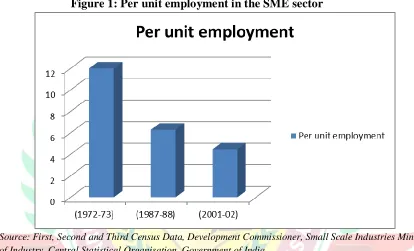
SEPT, Vol. I, ISSUE-II www.srjis.com Page 158 country’s population. From a social angle, it helps in solving the unemployment and under-employment problem in the society (Lokhande, 2011). The figure-1 shows the per unit employment of SME sector over the three periods. The 1972-73 shows the data of the post-independence regime, whereas 2001-02 shows the data of the post liberalization period. The figure displays the labour intensiveness of the SME sector in post-independence era thus solving the problem of unemployment to a large extent.
Figure 1: Per unit employment in the SME sector
Source: First, Second and Third Census Data, Development Commissioner, Small Scale Industries Ministry of Industry, Central Statistical Organisation, Government of India
Post-Liberalization Phase:
1990s: For village and small-scale industries, the Eighth Five-Year Plan (1992-97) aimed at a growth rate of 5.6%. During 1993-94, 31,800 beneficiaries were provided financial assistance by the banks. The number of loans sanctioned was 1,94,292 in 1994-95, 2,99,265 in 1995-96 and 2,18,327 in 1996-97. During 1997-98 and 1998-99 (upto September 1998) the number of loans sanctioned was 2,64,696 and 32,840 respectively. The village & small industries (VSI) sector grew at the rate of about two to three percentage points higher than the large and medium industries sector. It contributed more than 40% of value-added in the manufacturing sector and 80% of total employment in the industries sector. Its contribution to exports was significant and accounts for more than 40% (both direct and indirect). For village and small-scale industries, the Ninth Five-Year Plan (1997-2002) had the Prime Minister's Rozgar Yojana (PMRY), under which, during 1997-98 and 1998-99 (upto September 1998) the number of loans sanctioned was 2,64,696 and 32,840 respectively.
SEPT, Vol. I, ISSUE-II www.srjis.com Page 159 2002, there were over 3.4 million small-scale industrial units in the country accounting for more than 40% of the gross value of output in the manufacturing sector and about 35% of the total exports of the country. They provided employment to over 19.2 million persons, which is second only to agriculture. During the Ninth Plan period, SSIs created over 3.2 million jobs. Over the next four years (end 2005-06), SSI sector had 12.3 million units providing employment to 29.5 million persons. This represented an average annual growth rate of 4.33% in the number of these units and, more importantly, an average annual growth rate of 4.57% in employment. The output of the segment has recorded a real growth rate of 8.87% annually. Employment intensity of the segment (registered units) is 1 person for every 1.49 lakh of rupees invested in fixed assets, as against 1 person per Rs. 5.56 lakh in the large scale sector. And, the rate of growth of employment in this segment is well above that of the population of India (1.5%) or, that in the large industries segment (0.85%).
Contribution of SME exports
Small and Medium Enterprises (SMEs) play a vital role for the growth of Indian economy by contributing 45% of industrial output, 40% of exports, employing 60 million people, create 1.3 million jobs every year and produce more than 8000 quality products for the Indian and international markets. SME's Contribution towards GDP in 2011 was 17% which is expected to increase to 22% by 2012 (MSME Overview, 2007). SMEs constitute over 90% of all enterprises in most economies including India and are engines of economic growth and equitable development. They are credited with generating the highest rates of employment growth and account for a major share of industrial production and exports (CII Report, 2010)
According to the last census on SSI’s, in spite of their sizeable contribution to exports, less than 0.5% of the SSI’s are actually engaged in exports. On macro policy front, while over the years India’s foreign exchange reserves have swelled to more than US$ 250 Billion - and the need for exports looks less pressing, the ballooning trade gap stands a reminder on the need for continued thrust on exports. This came as a life saver in the post liberalization phase.
Beyond macro-economic needs, the engagement with exports is very important for SME’s for three major reasons.
Firstly, in today’s globalized world with increased lowering of trade barriers and massive competition in domestic markets, it is essential for SME’s to keep benchmarking their competitiveness. Ability to export is a reliable barometer of their competitiveness vis a vis their counterparts in other countries.
Secondly, active participation in exports exposes SME’s to evolving market trends, quality and standards enabling them make informed decisions.
Thirdly, it has been observed that participation in exports induce positive externalities in the firms in the form of better management practices, higher wages and better working conditions. Conclusion
SEPT, Vol. I, ISSUE-II www.srjis.com Page 160 dreaming up new visions of the future. Execution is all about translating strategies into action programs and measuring their results. Proper execution involves building measurable targets and holding people accountable for them. When a change comes in a nation like India in the socio-political or socio-economic scenario, the spell is huge. Building strategy and overcoming that comes as a huge challenge. SME sector came as a solution to both of the major changes in the economy. The political leaders through appropriate policies were able to execute the strategy successfully to overcome the challenges.
The main problem that India faced with the change in ‘Political Freedom’ in 1947 was that of creation of employment opportunities. SMEs stood apart and turned out to be the employment generator in a country like India. The next major change in the socio-economic scenario that India faced was that of ‘Economic Freedom’ in 1991. The challenge was that the foreign exchange reserves dwindled to a level of less than one billion dollars and the nation was on the verge of bankruptcy. Today the foreign exchange problem is solved to a large extent when we see that more than 40% of the exports come from the SME sector.
Reference
Anthony, WP, Perrewe, PL & Kacmar, KM (1996) Strategic Human Resource Management, 2nd edition, The Dryden Press, Harcourt Brace College Publishers, Florida.
Bhagwati, J. and P. Desai (1970): India: Planning for Industrialization, Oxford University Press, New Delhi.
Bhavani, T.A. (1991a): Factor substitution and factor demand in Indian Small Enterprise: A case study of Metal Products, Artha Vijnana 33, 41-45.
Bhavani, T.A. (1992): Small Industry Policy, (mimeo.) Delhi: Institute of Economic Growth.
Caudron, S. (1999) ‘Nothing's trivial about people issues’, Workforce, vol. 78, no. 1, pp. 23-26.
CII Report: Enhancing role of SMEs in Indian defence industry. Retrived from
http://www.cii.in/webcms/Upload/Enhancing%20role%20of%20SMEs%20in%20Indian %20defence%20industry1.pdf (accessed on 29th July, 2012)
Chaudhuri, S (2001): Economic reforms and industrial structure in India, Economic and Political
Weekly, January 12, 2001.
Curran, J & Blackburn, R. A. (2001) Researching the Small Enterprise, Sage Publications, London.
Gang Ira N. (1998): Small Firms in India: A discussion of some issues, in D. Mookhejee (Ed.), Indian Industry: Policies and Performance, New Delhi: Oxford University Press.
Goldar, B N (2000): Employment Growth in Organised Manufacturing in India, Economic and Political Weekly, 35(14), p 1191-95.
Little, Ian M.D.; Dipak Mazumdar, John M. Page, Jr. (1987), Small Manufacturing Enterprises: a comparative Study of India and other enterprises, New Delhi: Oxford University Press. Lokhande, M. A (2011): Evolution of the MSMEs in India, Journal of Social and Development
SEPT, Vol. I, ISSUE-II www.srjis.com Page 161 McAdam, R. (2002) ‘Large-scale innovation-reengineering methodology in SMEs: Positivistic and phenomenological approaches’, International Small Business Journal, London, Feb. 2002.
MSME Overview, 2007 at http://msme.gov.in/MSME_Development_Gazette.htm accessed on June 11, 2012 at 1930 hours IST)
Mukherjee, N (2000-2001): World trade organisation and small & medium enterprises from a developing country's perspective: a study of Indian small-scale industries, The Indian Economic Journal, 48(2), October- December 2000-2001.