www.ijsrp.org
Design, Development and Testing of Parking
Availability System Based on Vehicular Ad hoc Network
PATIL V.P.
Smt. Indira Gandhi college of Engineering, New Mumbai, India
Abstrac
t—Vehicle Ad Hoc Networks (VANETs) have been received particular attention both in industrial and academic levels. Searching for a vacant parking space in a congested area or a large parking lot and preventing auto theft are major concerns to our daily lives. In this paper, an efficient parking scheme for large parking lots through vehicular communication isdescribed. The proposed scheme can provide the drivers with real-time parking navigation service, and friendly parking
information dissemination. Performance analysis via extensive simulations demonstrates its efficiency and practicality. The system is designed, developed and tested using network simulator NS-2. AODV protocol is used for implementation and found that the system works satisfactory.
Index Terms
— Vehicular communications, Efficient parking, NS-2, Ad hoc network, AODV.I. INTRODUCTION
[image:1.612.44.490.374.540.2]A Vehicular Ad-Hoc network is a form of Mobile ad-hoc Networks, to provide communication among nearby vehicles and between vehicles and nearby fixed equipment i.e. roadside equipment. Each vehicle equipped with VANET device will be a node in the Ad-hoc network and can receive & relay other messages through the wireless network.
Fig 1.1: Vehicular Ad-Hoc Networks. Fig 2.1: VANET Infrastructure.
Vehicle Ad Hoc Networks (VANETs), as shown in have been received particular attention both in industrial and academic levels [1-4]. With the advance and wide deployment of wireless communication technologies, many major car manufactories and telecommunication industries gear up to equip each car with the On Board Unit (OBU) communication device, which allows different cars to communicate with each other as well as roadside infrastructure, i.e., Roadside Units (RSUs), in order to improve not only road safety but also better driving experience [5]. Searching for a vacant parking space in a congested area or a large parking lot especially in peak hours is the major concerns to our daily lives. Finding a vacant parking space in a congested area or a large parking lot, especially, in peak hours, is always time consuming and frustrating to drivers. It is common for drivers to keep circling parking lot and look for a vacant parking space. In this paper development of a smart parking scheme using Vehicular Ad-Hoc Network is described which helps drivers to find the vacant parking space efficiently.
First objective of the proposed system is to provide real-time parking navigation service to drivers in large parking lots. With the real-time parking navigation, the drivers can find the vacant parking space quickly. Therefore, the fuel and time wasted in search of vacant parking space can be reduced.
www.ijsrp.org Responsibility of the proposed system is:
1. Parking availability information passing on an ad-hoc network.
2. Recognition of Vehicles.
3. Path changing of vehicles on unavailability of parking space.
II. PREVIOUS RELATED WORK.
To minimize hassle and inconvenience to the drivers parking guidance systems based on Vehicular Ad Hoc Networks (VANETs) have been developed over the past decade [6-8], where the system provides accurate, real-time car park space availability to the drivers looking for parking spaces and then guides them to the available spaces by dynamically updated guide signs. Besides searching for available parking spaces, vehicle theft in large parking lots also has become a serious concern facing our lives. It becomes possible to track the parking space occupancy, guide drivers to the empty parking spaces near the places like
shopping mall, stadium or railway stations. Recently, several previous research works related to the parking lots have been
appeared in [9, 10]. VANET-based approach for parking space availability is shown in [9] .In this approach, the parking lots are managed by RSUs, and these RSUs can provide open parking space information to the drivers, which is very similar as the proposed SPARK scheme. In addition, the approach also provides security architecture to solve some possible security vulnerabilities. However, the approach doesn’t provide the real-time parking navigation in large parking lots, nor any anti-theft protection function [10]. During the last years several attempts to combine inter-vehicle networking and vehicular traffic simulation were presented. These proposals either suggested to incorporate disciplines, vehicular traffic and networking, into a single simulation engine (cf. e.g., [11]) or to couple and synchronize two simulators of the respective area (cf. e.g.[12,13]). The majority of the works following the latter approach used the network simulator NS-2 and interlinked it with diverse traffic simulators. The studies present results on traffic performance (e.g., average speed) and on network characteristics (e.g., latency), however, their focus is not primarily on scalability.
III. VEHICULAR AD HOC NETWORK USED FOR PROPOSED SYSTEM.
Vehicular Ad hoc Networks (VANET) is the subclass of Mobile Ad Hoc Networks (MANETs). VANET is one of the influencing areas for the improvement of Intelligent Transportation System (ITS) in order to provide safety and comfort to the road users. VANET assists vehicle drivers to communicate and to coordinate among themselves in order to avoid any critical situation through Vehicle to Vehicle communication e.g. road side accidents, traffic jams, speed control, free passage of emergency vehicles and unseen obstacles etc. Besides safety applications VANET also provide comfort applications to the road users. Fig 2.1 shows the overall working structure of VANET.
Each node within VANET act as both, the participant and router of the network as the nodes communicates through other intermediate node that lies within their own transmission range. VANET are self organizing network. It does not rely on any fixed network infrastructure. Although some fixed nodes act as the roadside units to facilitate the vehicular networks for serving geographical data or a gateway to internet etc. Higher node mobility, speed and rapid pattern movement are the main characteristics of VANET. This also causes rapid changes in network topology. VANET is a special type of MANET, in which vehicles act as nodes.
Unlike MANET, vehicles move on predefined roads, vehicles velocity depends on the speed signs and in addition these vehicles also have to follow traffic signs and traffic signals. There are many challenges in VANET that are needed to be solved in order to provide reliable services. Stable & reliable routing in VANET is one of the major issues. Hence more research is needed to be conducted in order to make VANET more applicable. As vehicles have dynamic behavior, high speed and mobility that make routing even more challenging.
Vehicular ad hoc networks present a promising way to build up a decentralized parking guidance system. Designing such an application can be decomposed into major issues: (1) which information on a parking place needs to be known by the vehicles and thus has to be distributed in the vehicular ad hoc network? And finally, (2) how can this information be used to maximize the benefit for the driver?
The working of the occupancy information is collected at the respective parking lot, e. g. by parking meters or parking fee payment terminals. This information is broadcasted, received by vehicles within communication range, and then disseminated within the vehicular ad hoc network.
The vehicle can communicate with other vehicle within its range. Vehicles on their way to some destination area can then use it to make their decision amongst several possible parking opportunities. This phenomenon in VANET is used in our objective of friendly parking system.
IV. ROUTING PROTOCOLS USED IN VANET
www.ijsrp.org rapid topology changes, frequent fragmentation of the network, small effective network diameter and limited temporal and functional redundancy
A routing protocol governs the way that two communication entities exchange information; it includes the procedure in establishing a route, decision in forwarding, and action in maintaining the route or recovering from routing failure. This section describes recent unicast routing protocols proposed in the literature where a single data packet is transported to the destination Node without any duplication due to the overhead concern. Some of these routing protocols have been introduced in MANETs but have been used for comparison purposes or adapted to suit VANETs’ unique characteristics. Because of the plethora of MANET routing protocols and surveys written on them, we will only restrict our attention to MANET routing protocols used in the VANET context. VANET routing protocols can be classified as topology-based and geographic (position-based) in VANET.
4.1 Topology-based Routing Protocols
These routing protocols use links’ information that exists in the network to perform packet forwarding. They can further be divided into proactive (table-driven) and reactive (on-demand) routing.
4.2 Proactive (table-driven) Routing protocols
Proactive routing carries the distinct feature: the routing information such as the next forwarding hop is maintained in the background regardless of communication requests. Control packets are constantly broadcast and flooded among nodes to maintain the paths or the link states between any pair of nodes even though some of paths are never used. A table is then constructed within a node such that each entry in the table indicates the next hop node toward a certain destination. The advantage of the proactive routing protocols is that there is no route discovery since route to the destination is maintained in the background and is always available upon lookup. Despite its good property of providing low latency for real-time applications, the maintenance of unused paths occupies a significant part of the available bandwidth, especially in highly mobile VANETs.
4.3 Ad Hoc On Demand Distance Vector Routing- AODV
Ad Hoc On Demand Distance Vector Routing (AODV) is an example of pure reactive routing protocol. AODV belongs to multihop type of reactive routing. AODV routing protocol works purely on demand basis when it is required by network, which is fulfilled by nodes within the network. Route discovery and route maintenance is also carried out on demand basis even if only two nodes need to communicate with each other. AODV cuts down the need of nodes in order to always remain active and to continuously update routing information at each node. In other words, AODV maintains and discovers routes only when there is a need of communication among different nodes.
AODV uses an efficient method of routing that reduces network load by broadcasting route discovery mechanism and by dynamically updating routing information at each intermediate node. Change in topology and loop free routing is maintained by using most recent routing information lying among the intermediate node by utilizing Destination Sequence Numbers of DSDV.
4.3.1 AODV Route Discovery
Route discovery is one of the most important characteristics of any protocol in wireless communication. The need for basic route discovery arises when a source node wants to communicate with any particular destination node in order to forward data packet. AODV uses route discovery by broadcasting RREQ to all its neighboring nodes. The broadcasted RREQ contains addresses of source and destination nodes in order identify those particular nodes for whom route has been demanded. RREQ also contains source and destination nodes sequence numbers to maintain recent fresh route information from source to destination and vice versa. Moreover, RREQ also contains broadcast ID and a counter, which counts how many times RREQ has been generated from a specific node. When a source node broadcast a RREQ to its neighbors it acquires RREP either from its neighbors or that neighbor(s) rebroadcasts RREQ to their neighbors by increment in the hop counter. If node receives multiple route requests from same broadcast ID, it drops repeated route requests to make the communication loop free.
RREQ is generated from one source towards different destinations in order to reach at particular destination. If RREP is not received by the source node, it automatically setups reverse path to the source node. A reverse path is settled only when each node keeps the record of its neighbor from which it gets the RREQ. Reverse path is used to send a reply to source node, if any intermediate node does not satisfies the RREQ, moreover reverse path is settled for only the limited period of time.
All intermediate nodes stored the particular destination sequence number information and compare it with the RREQ destination sequence number. If RREQ sequence number is greater than or equal to stored sequence number of the intermediate node. Then the RREP is generated to source node following the same route from destination node to source node. This method is also known as the forward path discovery. And in this way a route is discovered for two nodes that need to communicate.
4.3.2AODV Route Maintenance
www.ijsrp.org start the process of rebroadcasting RREQ or the source node stop sending data through invalid route . Moreover, AODV uses the active neighbor’s information to keep tracking of currently used route.
4.4.3 AODV Features
AODV reduces several problems that occurred in proactive routing protocols. It provides support by reacting at on demand needs
for communication for such ad hoc network where large numbers of nodes and this can help when the sudden change in topology happens. AODV updates the information of active nodes in the routing table. This feature can help maintaining the routing tables with the related number of entries and Nodes only have the information of currently active routes for communication. AODV reduces flooding of messages in the network as compared to proactive routing protocols so AODV reduces the network overhead. AODV also minimizes the route redundancy and large memory requirements. AODV eliminates the loop-free routes by using destination node sequence numbers. If the route become invalid for a particular communication then the source node resend the RREQ with the greater destination sequence number in order to rebuild the route.
V. DESIGN AND IMPLEMENTATION OF PROPOSED SYSTEM.
The current parking guidance systems obtain the availability of parking spaces using the sensors installed across the whole parking lot. However, deploying sensors in a large parking lot can be very expensive. Furthermore, the sensors can become inaccurate and would stop functioning easily when time passes. Therefore, it is highly desired to have a reliable and cost effective way to track available parking spaces and guide drivers to the available parking spaces.
Besides searching for available parking spaces, Recently, Vehicle Ad Hoc Networks (VANETs), as shown in Fig. 1.1, have been received particular attention both in industrial and academic levels. With the advance and wide deployment of wireless communication technologies, many major car manufactories and telecommunication industries gear up to equip each car with the On Board Unit (OBU) communication device, which allows different cars to communicate with each other .
[image:4.612.92.526.415.581.2]Roadside infrastructure, i.e., Roadside Units (RSUs), in order to improve not only road safety but also better driving experience. Therefore, it becomes possible to track the parking space occupancy, guide drivers to the empty parking spaces, through vehicular communications. The system model consists of a trusted authority (TA), OBUs equipped on the vehicles, stationary parking lot RSUs and a large number of parking spaces. TA is a trust and powerful entity, whose responsibility is in charge of the registration of both OBUs and the parking lot RSUs. OBUs are installed on the vehicles, which can communicate with each other and RSUs for achieving useful information, i.e., traffic information and parking lot information. Each OBU has a unique identifier IDi. In order to protect the privacy of the OBU, when an OBU with IDi registers itself to TA,
Fig 5.1 Parking lot model under consideration Fig 5.2 A typical Efficient parking lot
RSUs are important components for smart parking lots. As shown in Fig.5.1, three RSUs, i.e., RSU0 at position (0, 0), RSUa at position (xa, ya) and RSUb at position (xb, yb), are erected in the parking lot. With this deployment, the whole parking lot (including the parking spaces, in reality, there may exist more than three RSUs in a parking lot to coordinate the tracking of the vehicle if the parking lot is extremely large.)
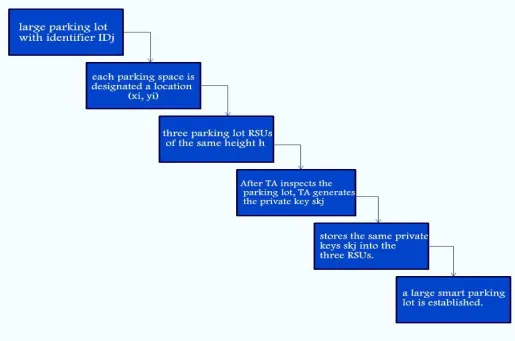
5.1 Initialization
www.ijsrp.org Fig 5.3: Initialization process
5.2 Parking space records
Parking space is a spatio-temporal resource recorded by the RSUs in a smart parking lot. Each parking space record, as shown in Fig 5.4, has the following attributes.
Fig 5.4: Parking space record. The meaning of each attribute is given below.
Position (POS): Each parking space can derive its position (xi, yi) on the unique Euclidean plane determined by the three parking lot RSUs, as shown in Fig.5.1.
Reservation (RES): This field denotes the reservation status of the parking space. If the parking space is reserved, RES = 1, otherwise, RES = 0.
Occupancy (OCC): The field denotes the occupancy status of the parking space. If the parking space is occupied, OCC = 1. Else if the parking space is vacant, OCC = 0.
Unique Id (Uid): this is the unique id of an OBU which give the identification of that specific OBU. This Uid use to recognize the vehicle in large parking lot.
Starting time (Tstart): This field records the OBU’s start parking time at the parking space.
Counter (COUNT): This field record the time after the reservation of the parking space by an OBU till the space is occupied. In a smart parking lot, since all parking space records are stored at the parking lot RSUs, the parking lot’s RSUs can conveniently manage the whole parking lot by using these records.
The algorithm for finding the position of the OBU in large parking lot and the information about the routing protocols is given in next topic.
www.ijsrp.org
5.3 Coding and Implementation:
Coding is done using network simulator NS-2 [4]. This consists of following steps- i) Path creation for the simulation. ii)TCL script coding for dynamic nodes (vehicles).iii)TCL script coding for message delivery and response.
All the mobile nodes in NS-2 quickly assume that they are the part of Ad-hoc network and the simulation mobile nodes connected with infrastructure networks are not really possible. For simulating a wireless node the physical layer, the link layer and MAC (media access control) protocol are all included at the same time. But despite this NS-2 is unable to simulate multiple radio interfaces. NS-2 only supports Bi-directional (antenna that radiates or receives most of its energy in two directions) and Omni-directional (radiates signal equally in all direction) antenna for signal propagation and waypoint mobility model for node movement. While simulating wireless networks using NS-2, the nodes need to be programmed manually to sense and transmit data among each other. There is no built-in scanning facility available to sense other nodes that are floating around. Another constraint associated with NS-2 is that it cannot be extended to simulate a large mobile network. In order to determine whether the frame has been transmitted successfully or not NS-2 relies on signal’s strength. The Signal to Noise interference Ratio (SNR) is determined through the difference in strength of the two signals. The current distribution of NS-2 has limited scalability and does not provide any support for distributed and federated simulation tasks.
The existing traffic library and protocol suite are outdated and lack complete support for IEEE 802.11 standards. The newly added
modules cannot find their place in the outdated documentation.
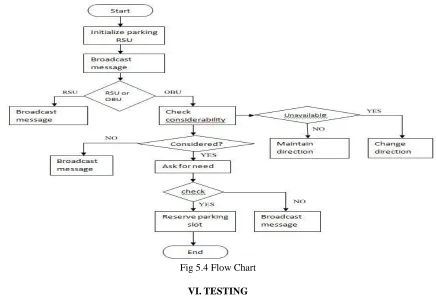
5.4 Flow chart:
[image:6.612.88.524.299.598.2]The flow chart of the working of the designed and developed parking system is as shown in fig 5.4.
Fig 5.4 Flow Chart
VI. TESTING
Testing is done for finding the defects and fixing them and verifying system according to requirements.
6.1 Snapshots of simulation
www.ijsrp.org
Fig 6.1: Initial position of vehicles. Fig 6.2: message by RSU1 and RSU2.
Parking available message passed by RSU1 and parking not available message passed by RSU2 as shown in fig 6.2.
[image:7.612.47.490.206.375.2]
Fig 6.3: message by RSU1 parking full. Fig 6.4: vehicles moving towards RSU2
Two vehicles are parked at RSU1 occupies all parking slots.RSU1 sends message parking not available. At same instance RSU2 sends message parking is available. All vehicles start moving towards RSU2.
[image:7.612.53.494.417.570.2]Graphs of Throughput and an Average Throughput for AODV is as shown in fig.6.5 and fig 6.6
Fig 6.5: Throughput of AODV Fig 6.6: Average throughput vs number of nodes
6.2 Test cases
A test case normally consists of a unique identifier, requirement references from a design specification, preconditions, events, a series of steps (also known as actions) to follow, input, output, expected result, and actual result. Clinically defined a test case is an input and an expected result. This can be as pragmatic as 'for condition x your derived result is y', whereas other test cases described in more detail the input scenario and what results might be expected. It can occasionally be a series of steps.
In this project following test cases are used for testing purpose.
Test case 1: On accepting “Available” message from RSU; vehicles should move towards that RSU.
www.ijsrp.org
Fig 6.7: Test case1 Fig 6.8: Test case2
Test case 2: If parking lot is full with vehicles RSU will send message “Not Available”.
On accepting Available signal form RSU vehicles start moving towards that RSU. Each parking lot having finite number of parking spaces. Vehicles will occupy the spaces as the reach the parking lot. After some time no vacant space is remaining and at that instance parking lot RSU sends “Not Available” message. Snapshot given below give the idea about this test case.
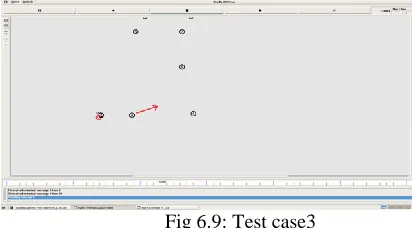
Test Case 3: On accepting “Not Available” message from RSU; vehicles should move away from that RSU.
On unavailability of parking space message “Not Available” is send by RSU. On receiving that message vehicles willing the parking lot can change their direction towards different parking lot instead of waiting at one place for parking availability. In the snapshot given below we can visualize the scenario. The red arrow indicates the direction of the vehicle.
Fig 6.9: Test case3
VII. CONCLUSION
In this paper, a new VANET-based friendly and efficient parking scheme for large parking lots is designed, developed and tested using network simulator NS-2.With friendly parking scheme, RSUs installed across a parking lot can survey the whole parking lot, and provide two convenient services for drivers: 1) real-time parking navigation,2) friendly parking information dissemination. Extensive simulations have also been conducted to demonstrate that the proposed scheme can efficiently reduce the searching time delay for an available parking space, and subsequently save the fuels and driver’s parking time. In this paper simulation of Vehicular Ad-Hoc Network used for friendly parking system is implemented and tested satisfactory. Different test cases are generated to test the system and performance of AODV protocol for its throughput is also tested for efficiency of the system. With the help of this simulation we can conclude behavior of friendly parking system in different situations.
REFERENCES
[1] Y. Peng, Z. Abichar, and J. M. Chang, “Roadside-aided routing (RAR) in vehicular networks”, in Proc. IEEE ICC 2006, Vol. 8, pp. 3602-3607, Istanbul, Turkey, June 2006.
[2] J. P. Hubaux, S. Capkun, and J. Luo, “The security and privacy of smart vehicles”, IEEE Security and Privacy Magazine, Vol. 2, No. 3, pp. 49- 55, 2004. [3] M. Lott, R. Halfmann, E. Schultz, and M. Radimirsch, “Medium access and radio resource management for ad hoc networks based on UTRA TDD”, in Proc.
ACM MobiHoc 2001, pp. 76-86, October 2001.
[4] Q. Xu, T. Mak, J. Ko, and R. Sengupta, “Medium access control protocol design for vehicle-vehicle safety messages”, IEEE Transaction on Vehicular Technology, Vol. 56, No. 2, pp. 499-518, 2007.
[5] M. Raya and J. P. Hubaux, “Securing vehicular ad hoc networks”,Journal of Computer Security, Vol. 15, No. 1, pp. 39-68, 2007.
[6] V. Tang, Y. Zheng, and J. Cao, “An intelligent car park management system based on wireless sensor networks,” in Proc. of the First International Symposium on Pervasive Computing and Applications, Urumchi, Xinjiang, P.R. China, pp. 65-70, August 2006.
[7] J. Chinrungrueng, U. Sunantachaikul, and S. Triamlumlerd, “Smart parking: an application of opticalwireless sensor network,” in Proc. Of the the 2007 International Symposium on Applications and the Internet Workshops (SAINTW’07), Hiroshima, Japan, pp. 66-69, January 2007.
[image:8.612.44.250.312.426.2]www.ijsrp.org [9] R. Panayappan, J. Trivedi, A. Studer, and A. Perrig, “VANET-based approach for parking space availability,” in Proc. of the Fourth ACM International
Workshop on Vehicular Ad Hoc Networks (VANET 2007),Montr´eal, Qu´ebec, Canada, pp. 75-76, Sept. 2007. [10] Conestoga Mall. [online] Available at: http://conestoga.shopping.ca/
[11] C. Gorgorin, V. Gradinescu, R. Diaconescu,V. Cristea, and L. Iftode, “An integrated vehicular and network simulator for vehicular ad-hoc networks,”in Proc. 20th European Simulation and Modelling Conference (ESM), Toulouse, France, Oct. 2006.
[12] S. Eichler, B. Ostermaier, C. Schroth, and T. Kosch,“Simulation of car-to-car messaging: analyzing the impact on road traffic,” in Proc. 13th IEEE Int. Symposium on Modeling, Analysis, and Simulation of 36 Computer and Telecommunication Systems (MASCOTS), Atlanta, GA, USA, pp. 507–510,Sept. 2005. [13] C. Lochert, M. Caliskan, B. Scheuermann, A. Barthels, A. Cervantes, and M. Mauve, “Multiple simulator interlinking environment for inter vehicle
communication,” in Proc. 2nd ACM Int. Workshop on Vehicular Ad Hoc Networks (VANET), Cologne,Germany, pp. 87–88, Sept. 2005. [14] Network Simulator-2 Information .Available: http://www.isi.edu/nsnam/ns/
AUTHOR
PATIL V.P. is currently working as a faculty member in Electronics and Telecommunication Engineering department in smt.
Indira Gandhi college of Engineering .New Mumbai. He is graduate in B.E. and post graduate in M.TECH (ELECTRONICS DESIGN
AND TECHNOLOGY). He is having 25 years of experience in teaching in engineering colleges. His area of research is in computer communication networking and microwave engineering.
Correspondence Address: Smt. Indira Gandhi college of Engineering, New Mumbai, India ,