FEB-MAR, 2017, VOL. 4/20 www.srjis.com
Page 4754
GAINING CUSTOMER LOYALTY: THE INTERRELATION BETWEEN
CONSUMER ATTITUDE AND CONSUMER BEHAVIOR
Prof. Harshada S. Kale
Asst. Prof. D. G. Tatkare Mahavidyalay, Mangaon
All over the world every business and profit earning firm want to make their consumer loyal. There are many factors responsible for this customer loyalty but two of them are prominent. This research study is focused on that how customer satisfaction and customer retention contribute towards customer loyalty. For analysis part of this study, Universities students of Central Mumbai Region were targeted. A sample of 120 were selected. Analysis was conducted with the help of SPSS 19. Results of the study shows that customer loyalty is more dependent upon Customer satisfaction in comparison of customer retention. Customer perceived value and customer perceived quality are the major factors which contribute for the customer loyalty of Universities students for mobile handsets. Keywords: Customer Loyalty, Customer Satisfaction, Customer Retention
Introduction
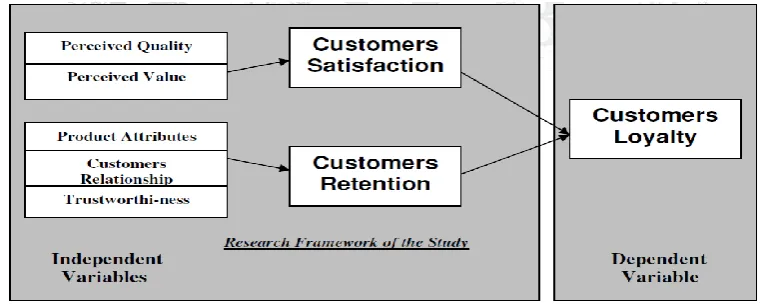
In Current market the concept of customer loyalty is a key factor. While making consumer loyal toward a company product is not an easy job. Customer loyalty plays a very important role to achieve competitiveadvantage and maintain it. The main two variables Customer satisfaction and Customer retention are very important. These two variables are depending on some other variables. Customer satisfaction is depended on perceived quality and perceived value. Customer retention depends on product attributes, customer relationship and trustworthiness. Every firm in the competitive market struggles to maximize their profits. So they can maximize their profitability by providing attractive products and services to their loyal customers. Although there are a number of studies which exist with respect to customer loyalty. It needs more analysis to analyze the mobile handset industry in India with respect to Customer loyalty. The aim of this research is to analyze the role of customer satisfaction and retention on customer loyalty in the mobile handset industry in India especially in Central Mumbai. Research is bases on a framework that allows the marketers to decide that between R4Z Scholarly Research Journal's is licensed Based on a work at www.srjis.com
FEB-MAR, 2017, VOL. 4/20 www.srjis.com
Page 4755
customer retention and customer satisfaction which factor is more important and has greater influence on customer loyalty.Literature Review
Customer Loyalty :
FEB-MAR, 2017, VOL. 4/20 www.srjis.com
Page 4756
acompany because continuous use and frequent suggesting of a product can enhance the sale and all this possible if the existence customers are loyal towards company products.Customer Satisfaction :
Previous researches have given significant importance to customer satisfaction. Satisfaction can be defined as a features or characteristics that can full the either a need or want of a consumer in more better way than competitors. Although this satisfaction explained by different researchers in different ways. If a company provide a product according to the requirements of their consumers it will lead the satisfaction of those consumers. The higher or lower satisfaction of a consumer will depends upon the quality of brand characteristics that offered by a company (Gerpott, Rams & Schindler,2001). This is the consumer satisfaction which contribute for the future money making for a company (Hauser, Semester &Wernerfelt, 1994). For the retention of consumer, it is important to satisfied consumers (Guo, Xiao &Tang, 2009). The unsatisfied consumers of a company do not take time to switch that brand (Lin & Wu, 2011). Low quality services can also lead dissatisfaction. A low quality service is such type of service which does not fulfill the requirements (Rust &Zahorik, 1993). However its all depends upon that which segments a company is targeting and what are their expectations for that product (Auh& Johnson, 2005). In the study of Anderson (1994) he explain that customer satisfaction is the key factor which is used to measure the company internal and external performances and assigning funds to each and every activity. Service is a key factor for consumer satisfaction although this is not the only factor which is responsible (Lin &Wu, 2011). Rust and Zahorik (1993) discuss in their study that customer satisfaction has positive relationship on loyalty. Auh and Johnson (2005) discuss in their study that there are strong relations between satisfaction and loyalty. Bodet (2008) describe that affiliation exist between customer satisfaction and customer loyalty. Shankar, Smith and Rangaswamy (2003) also examine that there is certain relationship between satisfaction and loyalty. As Kim, Jeong, Park, Park, Kim, and Kim (2007) stated that customer satisfaction lead customer loyalty. Vesel and Zabkar (2009) describe in their study that customer satisfaction is an important indicator for the customer loyalty.
Perceived Value:
FEB-MAR, 2017, VOL. 4/20 www.srjis.com
Page 4757
greater benefits from a product. There are four types of benefits and four types of cost related to a product. The four benefits are product benefit, Service benefit, Personnel benefit and image benefits. While the four types of cost include monetary cost, psyche cost, time cost and energy cost. There are two ways that a firm can increase customer value either increasing customer benefits or either reducing customer cost. The monetary cost is important is compare to the non-monetary cost related to a product. Similarly as compare to Service benefit, Personnel benefit and image benefits the product benefit is more important. But its depends upon product nature and segment. Although this is a crucial factor for a company to decide that which factor is more important for their consumer because these factors depends and vary from person to person (Oliver & Swan, 1989). This is the customer value which leads customer satisfaction. And customer satisfaction later converted intoloyalty. Hence it is important for a company to keep the concept of consumer value if they want to make their consumer loyal towards their brand Sirdeshmukh, Singh, and Sabol (2002).Perceived Quality :
The customer perception about a product is another important dimension which is under consideration now days in eyes of marketers. What customer thinks about the quality of a product is an important factor. The word quality is defined by Shahzad (2012) freedom from defects. It is the totality of features and characteristics that exist in a product which can satisfy a customer need or want. Quality is a direct influence on customer satisfaction which leads a customer towards loyalty then. Improvement in customer perceived quality will increase customer satisfaction, loyalty, and profitability (E.Gummesson, 1998). But does each and every segment in the market accept the same quality? The issue arises by Grönroos (1997) that each and every segment in the market wants different quality products depending on their purchasing power and requirements.
Product Attributes and Customer Relationships
FEB-MAR, 2017, VOL. 4/20 www.srjis.com
Page 4758
that only because of brand image a customer can be retain. There can be too many other factors which can contribute towards customer retention and loyalty and these factors can vary from product to product and market to market. Keller, (1993) defined that brand image refers to a particular frame of reference by which the consumer is associating a particular brand. A good image enhances the value of the brand in the eyes of the consumer by increasing its likeability/desirability and differentiating it from other competing brands (Hsieh, Pan, and Setiono, 2004). The outcome of the favorable image is the increase in loyalty, equity, consumer buying behavior and overall performance of brand (Koo, 2003; Keller, 1993: Hsieh et al., 2004, Roth, 1995). Brand image is measured in terms of benefits a brand is offering or some attributes the brand is having or the usage of the brand. Shahram, Hasanali, and Seyyed (2011) good relationships with consumers are also an important factor in current market situations. For customer retention it is important to have good relationship with the consumers. The long lasting profitable relationship can only be maintain if company have good relationshipwith their consumers. Once a good relationship is broken the retention of a consumer is not possible as consumer are the kings and firms need to keep good relationship with them.Trustworthiness :
The word trust explained by Mayer, Davis and Schoorman, F. D. (1995) that this an expectation that another party will perform a particular action. Buyers have expectation from the sellers. It is important for the firm to provide goods and services according to the expectations of their consumers. First, trust is based on a cognitive process which discriminates among persons and institutions that are trustworthy, distrusted, and unknown. In this sense, we cognitively choose whom we will trust in which respects and under which circumstances, and we base the choice on what we take to be “good reasons,” constituting evidence of trustworthiness. In the words of Flores and Solomon (1998), does firm has the ability to produce the same which consumers are looking. So for the trust it is important to have the ability to perform that particular task Jason, Scott, and Jeffery (2007).
Theoretical framework
FEB-MAR, 2017, VOL. 4/20 www.srjis.com
Page 4759
and customer retention. Customer satisfaction were further operationalize into perceived value and Perceived Quality. While customer retention is further operationalize into Product Attribute, Customer Relationship and trustworthiness.Hypothesis of the study
An overview of the hypothesis related to the relationship of customer loyalty and customer satisfaction and customer retention. Study shows that there is significant relationship between the brand equity and following hypothesis. Below table I Show five hypotheses between customer loyalty and perceived value, Perceived Quality, Product Attribute, Customer Relationship and trustworthiness.
Objectives Hypothesis Table I
Relationship between customer loyalty and customer satisfaction and
Customer Retention.
H:1 There is a positive relationship between customer loyalty and perceived value.
H:2 Perceived quality has an impact on customer loyalty.
H:3 There is a positive relationship between product attributes and customer loyalty.
H:4 Customer relationship has an impact on customer loyalty. H:5 Trustworthi-ness has a significant impact on customer loyalty.
Methodology
The research paper demonstrates to discover the factors that influence customer loyalty. The research user following research methodology.
Questionnaire
[image:6.595.101.483.132.285.2]FEB-MAR, 2017, VOL. 4/20 www.srjis.com
Page 4760
For data collection the students in Central Mumbai region were focused. A sample of 120 was contacted for data collection. 104 questionnaires were received back. 6 were discarded because of incompleteness. For the final analysis 98 responses were considered.Table III Regression Co-Efficient
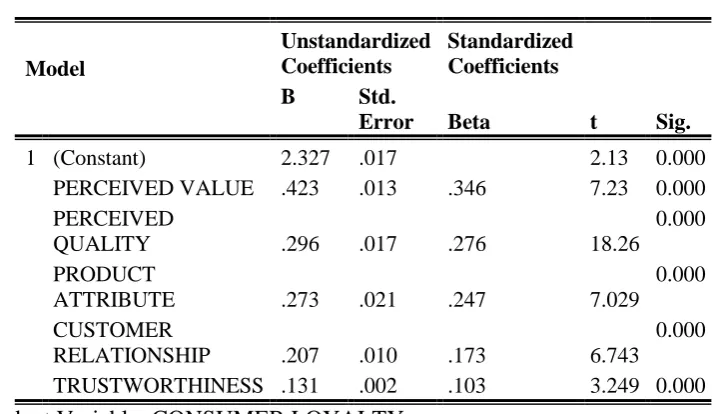
In this table, the un-standardized co-efficient explain that the factors are positively influencing the buying behavior.
[image:7.595.116.477.374.581.2]From below table it is obvious that all the factors are significantly associated to “customer loyalty of students for mobile handsets”. From the standardize co-efficient is proved that “Perceived Value” is the vital & most essential factor influencing the customer loyalty of students for mobile handsets with standardize co-efficient if 0.346. The next important variable is “Perceived Quality” with a standardize coefficient of 0.276. The third important variable is” Product Attribute” with a standardize co-efficient of 0.247. So there are three main important factors that are liable in respect of customer loyalty of University Students in Central Mumbai region.
Table IV Coefficientsa
Model
Unstandardized Coefficients
Standardized Coefficients
t Sig.
B Std.
Error Beta
1 (Constant) 2.327 .017 2.13 0.000
PERCEIVED VALUE .423 .013 .346 7.23 0.000
PERCEIVED
QUALITY .296 .017 .276 18.26
0.000
PRODUCT
ATTRIBUTE .273 .021 .247 7.029
0.000
CUSTOMER
RELATIONSHIP .207 .010 .173 6.743
0.000
TRUSTWORTHINESS .131 .002 .103 3.249 0.000
a. Dependent Variable: CONSUMER LOYALTY
The rest of factors have weak impact on customer loyalty such as „Customer Relationship‟ (b=0.173), and Trustworthiness (b=0.103). This table demonstrate positive values and factors are significant at value = 0.05. It is approved from the above list of hypothesis is correct and valid.
Conclusion
FEB-MAR, 2017, VOL. 4/20 www.srjis.com
Page 4761
is drawn. It is concluded that Perceived Value, Perceived Quality and Product Attribute are the key factors for contributing towards customer loyalty. Keeping the findings of this research it is very obvious that the companies should always continue to emphasize on Perceived Value, Perceived Quality and Product Attribute in order to make customer loyal towards their products.Secondly it is also clear from the result of the study that Customer satisfaction has more contribution for customer loyalty in comparison of customer retention. As the theoretical framework of the study shows that customer satisfaction is based on customer perceived value and customer perceived quality. So hence it is concluded that university students of Central MumbaiIndia become loyal for mobile handsets because of customer satisfaction as company provide them better customer value and quality. Hence it is concluded that firms should emphasize on customer value (The cost benefit side) and customer perceived Quality because these two dimensions has greater influence on customer loyalty. Greater the customer satisfaction greater the students will be loyal towards mobile handsets and vise versa.
References
Auh, S., & Johnson, M. D. (2005). Compatibility effects in evaluations of satisfaction and loyalty. Journal of Economic psychology, 26, 35-57.
Bodet, G. (2008). Customer satisfaction and loyalty in service: two concepts, four construct several relationships. Journal of retailing and consumer services, 15, 156-162.
Chen, P. T., & Hu, H. H. (2010). The effect of relational benefits on perceived value in relation to customer loyalty: An empirical study in the Australian coffee outlets industry. International journal of hospitality management, 29, 405-412.
Gerpott,T. J., Rams,W., & Schindler, A. (2001) Customer retention, loyalty, and satisfaction in the German mobile cellular telecommunications market Telecommunications Policy, 25, 249-269.
Gronroos Christian (1997). From marketing Mix to Relationship Marketing – Towards a Paradigm Shift in Marketing, Management Decision, 35/4, 322-339.