Development of Learning Tools Based on Realistic
Mathematics Education Approach (RME) to Improve
Creative Thinking Skills of 4th Grade Elementary School
Students
Rinda Puspitasari , Wiryanto , Neni Mariana
Primary Education, Postgraduate, State University of Surabaya
DOI: 10.29322/IJSRP.9.08.2019.p92128 http://dx.doi.org/10.29322/IJSRP.9.08.2019.p92128
Abstract- The low student learning outcomes and the lack of learning activities that stimulate the ability to think creatively are problems that must be overcome. This study aims to develop and test the feasibility, practicality, and effectiveness of learning tools based on the Realistic Mathematics Education (RME) approach to improve the creative thinking skills of students in grade four. This study uses a Thiagarajan development research which is known as 4D (define, design, develop, & disseminate). Validity learning tools is based on the results of expert validation. Practicality of learning tools is based on observations of the implementation of learning and student activities. While the effectiveness of the learning tools is based on the results of the questionnaire responses of students and test results of learning (mastery of concepts test and creative thinking test ) using one group pretest-posttest design . The results of the study show that Realistic Mathematics Education-based learning tools are feasible, practical and effective to improve students' creative thinking abilities. So the RME -based learning tool is recommended to be used as a learning tool in improving the creative thinking skills of students in grade four.
Index Terms- Learning tools based on Realistic Mathematics Education Approach, creative thinking ability, elementary school.
I. INTRODUCTION
ased on Law No. 20 of 2003, the purpose of the National Education System is to improve students' ability to become the faithful man and devoted to God Almighty, noble, healthy, knowledgeable, creative, independent, and become democratic citizens and has the responsibility. [1. Based on the objectives of the National Education system has been properly that learning to form creative thinking abilities should be developed in the Indonesia education. To improve the quality of education, the active role of the Government especially the Education Office, is urgently needed. Efforts that the government can make in improving the quality of education include giving training to teachers, providing teaching aids and learning media for schools, conducting mathematical guidance and providing relevant textbooks and making changes to the learning curriculum. Not only that, to advance the quality of education needed changes in various aspects ranging from preparation, implementation, to the evaluation of learning must be changed including the way teachers deliver learning.
The paradigm of the obligation teachers not only provide some information to students but facilitate students to improve the ability to think logically, analytical, systematic, critical, and creative, as well as the ability to cooperate that has been mandated by the State [2]. When we learn and practice mathematical thinking it means we learn to think analytically, logically, systematically so that it indirectly fosters student’s creativity [3]. Based on the description, it can be said that one of the capabilities that must be developed and owned by the students is the ability to think creatively.
In the background section of 2006 curriculum explains that to master and create technology, creative thinking skills are needed [4]. In a global era that full of competition and challenges, a high level of thinking ability is also needed, one of which is creative thinking .The characteristics of creative thinking itself include (a) Originality (the originality of composing something new); (b)Fluency (to analyze many ideas); (c) Flexibility (flexibility of changing perspective easily) ; and (d) Elaboration (development of an idea from other forming ideas) [5]. The results of creative thinking are creative products that have the following characteristics: novelty, completion, detail and synthesis [6].
Based on the results of the observations, researchers are still often find teacher-centered in mathematics learning process even though the books used in teaching already tried suitable with context in the child's environment. Teachers are more likely to conduct textbook learning process. Learning like those seems to require students to memorize and if it left unchecked, students' creative thinking skills will not increase.
In addition, based on researcher’s experience of teaching in mathematics, 80% of the students are not able to process the information (the formula). 70% of students are only able to use information (formulas) from teachers and only 20% of the number of students is able to develop that information. Especially in working on story problems, 20% of students are only able to work on problems such as the example given by their teacher. If the problem is developed or improved by teacher, so 80% of students have difficulty. As a result, the average completeness of student learning outcomes during tests is below the minimum criteria which is 70. From the data described, it shows that the mastery of student concepts is still lacking especially the ability to think creatively in elaborating formula into daily activities.
From the description above, the formation of creative thinking abilities in the process of learning mathematics is lacking. It has implication that we urgently need developing a learning process which encourages and helps students be able to develop creative thinking skills. So we need an innovative development that can stimulate students' creative thinking abilities.
Based on these problems, the teacher must be able to choose the right learning approach. The selection of these approaches must be in accordance with the material and condition of students, so that it is hoped that learning can improve students' creative thinking skills.
One of the solutions is to provide a new approach. A new approach that can be used to overcome these problems is the Realistic Mathematics Education (RME) approach. Through the RME approach, teachers can apply mathematics learning that is fun and more meaningful to students. The RME learning approach emphasizes open problems related to real life so that this will stimulate students' creative thinking abilities to find ways to solve these open problems. So that the RME approach requires students to use higher- order thinking, one of high-order thinking is the ability to think creatively, and students are no longer required to memorize formulas.
From the explanation above it is clear that the RME approach prioritizes the learning process rather than learning outcomes. This approach is very useful in learning mathematics, especially for elementary students, because using this approach, learning can be very fun and can eliminate the assumption of students in general that mathematics is not a scary subject. In addition, materials that are considered difficult for students to understand become easier because students find their own concepts. That kind of thing is the significance of mathematics learning.
RME approach has several characteristics, namely the principle of activity, reality, stages of understanding, intertwinement, interaction, and guidance [7]. The application of RME approach is one of the ways to solve any problem related to mathematics. Each student has different abilities in solving each problem. RME -based learning stages begin with the preparation of learning tools that refer to these characteristics.
This study aims to (1) Describe the validity of fourth grade elementary school mathematics learning tools using the Realistic Mathematics Education (RME) approach; (2) Explain the practicality of mathematics learning tools for fourth grade elementary schools students using the Realistic Mathematics Education (RME) approach; and (3) Determine the potential effects of mathematics learning tools using the Realistic Mathematics Education (RME) approach of fourth grade elementary school students.
II. IDENTIFY, RESEARCH AND COLLECT IDEA
This type of research is development research. The product produced in this study is a learning tools with a learning model based on Realistic Mathematics Education (RME) to improve the creative thinking abilities of elementary school students. The learning tools that are developed are syllabus, lesson plan, Student Worksheet and Learning Outcomes Test that includes concept mastery test and creative thinking ability test and teaching material. The development model used is the 4D model developed by Thiagarajan [8] which consists of the stages of define, design, develop, and disseminate. The subjects of this study were students of fourth grade of SDN Sidotopo I/48 Surabaya in the 2018/2019 academic year, which has 32 students. Trials were conducted on several students using the One Group Pretest-Posttest Design Design [9].
criteria. While the effectiveness of RME -based learning tools can be measured based on student response questionnaires, learning achievement tests (concept mastery tests and creative thinking skills tests).
III. RESULTS AND DISCUSSION
[image:3.612.85.522.212.344.2]The validity test results of RME -based learning tools were obtained from validation sheets from two valuators. Based on the results of the validation sheet, it shows that the developed RME-based learning tool is valid (worth using with a little improvement). As for some of the suggestions given by the valuator, those are in the formulation of syllabus indicators it is better to include indicators and determine the allocation of clear written time; the lesson plan writing words should follow the rules; teaching material should present material related to the student environment; and the concept mastery ability test should use a clear sentences. The results of the validation sheet can be seen in the following table.
Table 1. The Result of Validator
Learning tools Rating result Average Category
V1 V2
Syllabus 3 3 3
Valid (can be used, slightly revised)
Lesson plan 4 4 4
Valid (can be used)
Teaching materials 3 3 3
Valid (can be used, slightly revised)
Studentsworksheet
3 3 3
Valid (can be used, slightly revised)
Concept mastery Test
3 3 3
Valid (can be used, slightly revised)
[image:3.612.81.523.432.482.2]The practicality of RME -based learning tools can be seen from the results of the observation sheet of the implementation of learning and student activities. The results of the learning outcomes were obtained from the observation sheets conducted by two observers showing their performance well. While student activities during the implementation of learning using the RME -based learning model based on observations obtained positive results. In more detail the results of the observation sheet on the implementation of learning and student activities can be explained in the following table.
Table 2. Practicality of Learning Devices
Validation Observation Results Average Category
Observer 1 Observer 2
Implementation of learning 4 4 4 Very good
Student Activity 3 3 3 Well
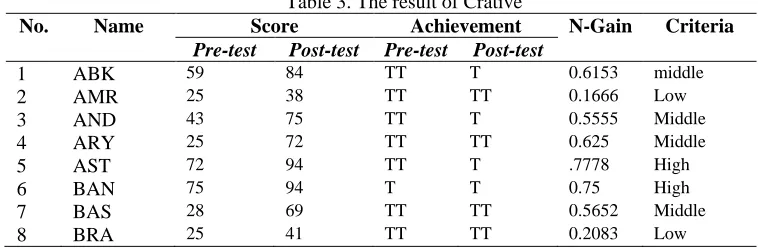
The effectiveness of RME -based learning tools to improve students' creative thinking abilities is obtained from the results of the questionnaire and the results of the learning achievement test (the test of mastery of concepts and tests of creative thinking ability). Student responses are presented in the form of a questionnaire and are given after learning is finished. The results of student questionnaires showed an average student response of 3.43 in good categories. The test of creative thinking ability is measured by two questions. This test was given to 32 students before being given treatment (pre-test) and after being given treatment (post-test). Data on students' problem solving ability test results will be described in the following table.
.
Table 3. The result of Crative
No. Name Score Achievement N-Gain Criteria Pre-test Post-test Pre-test Post-test
1 ABK 59 84 TT T 0.6153 middle
2 AMR 25 38 TT TT 0.1666 Low
3 AND 43 75 TT T 0.5555 Middle
4 ARY 25 72 TT TT 0.625 Middle
5 AST 72 94 TT T .7778 High
6 BAN 75 94 T T 0.75 High
7 BAS 28 69 TT TT 0.5652 Middle
[image:3.612.104.483.618.742.2]9 BUD 38 78 TT T 0.65 Middle
10 CER 25 44 TT TT 0.25 Low
11 CIN 25 66 TT TT 0.5417 Middle
12 DAN 53 91 T T 0.8 High
13 DON 47 78 TT T 0.5882 Middle
14 FAN 78 94 TT T 0.7143 High
15 HAR 50 84 TT T .6875 Middle
16 HEN 75 91 T T 0.625 Middle
17 HER 47 81 TT T 0.6470 Middle
18 IND 34 75 TT T 0.6190 Middle
19 JAL 47 81 TT T 0.6470 Middle
20 JAN 56 91 TT T 0.7857 High
21 KEN 38 66 TT TT 0.45 Middle
22 LAN 34 78 TT T .6667 Middle
23 MIS 47 81 TT T 0.6471 Middle
24 MUH 44 81 TT T .6667 Middle
25 MUS 37 78 TT T 0.65 Middle
26 NUR 34 53 TT TT 0.2857 Low
27 PIT 47 81 TT T 0.6470 Middle
28 PUR 34 50 TT TT 0.2380 Low
29 RAT 69 88 TT T 0.6 Middle
30 ROS 78 88 T T 0.4285 Middle
31 SAR 47 81 TT T 0.6470 Middle
32 WAN
Average 25 46 44 75 TT TT 0.25 0,5623 Low Middle
Based on table 3, it is known that in the pretest, the ability to think creatively students results is 9 % of students complete. While on posttest the ability to think creatively results is 69% of students completed. The table also shows the average score N-gain is 0.56 with medium category.
The application of RME -based learning tools in learning has proven to be effective in increasing the ability to think creatively of students in four grade elementary school students on the topics perimeter and area. This is according to research by Zulkardi, et al [10] which states that the learning process based RME forced to be more creative and critical thinking in order to be able to understand mathematical concepts. Based on the results of validation, the development of RME-based learning tools is in the valid category. The validity of the learning tools developed is based on the results of expert validation (syllabus validation, lesson plan, student’s worksheet, teaching materials and learning outcomes tests (tests of mastery of concepts and tests of creative thinking skills)). The learning tools is declared valid can be seen from the suitability of the device with the model and learning material, as well as all components of the learning tools related consistently with one another [11]. After going through the validation stage and declared worthy of use, the RME -based learning tools can be continued at the small group trial stage. Based on the results of the feasibility analysis, then the learning tools based RME approach is suitable for use in increasing the ability of creative thinking of students in the four grade elementary school students with the material perimeter and area.
IV. CONCLUSION AND SUGGESTION
Based on the results of research and discussion of research results can be concluded: (1) Learning tools based on Realistic Mathematics Education (RME) to improve the ability to think creatively is declared valid based on the score of the valuator and can be used in the learning process. (2) The practicality of learning tools based on Realistic Mathematics Education (RME) developed is seen from the implementation of the lesson plan that is going well and student activities are in the good category which means students carry out almost all activities needed in learning. (3) The effectiveness of learning tools can be seen from the increase in the ability to think creatively as indicated by the n-gain score in the medium category and the response of the majority of students stated well towards learning based on Realistic Mathematics Education (RME) which was followed.
Based on these conclusions can be suggested that learning tools based Realistic Mathematics Education (RME) can be used and distributed for teaching perimeter and area in four grade elementary school students, especially in training and improving the ability of creative thinking of students.
ACKNOWLEDGMENT
We are especially grateful to the Surabaya city government, Surabaya State University postgraduate lecturer, Sidotopo I/48 Surabaya elementary school students, and all those who directly and indirectly helped us in this research.
REFERENCES [1] Undang-undang No 20 tahun 2003 tentang Sisitem Pendidikan Nasional.
[2] Depdiknas. Kurikulum Tingkat Satuan Pendidikan Standar Akademik dan Kompetensi Guru. Jakarta: Depdiknas, 2007. [3] Suparno, P. Reformasi Pendidikan: Sebuah Rekomendasi. Yogyakarta: Kanisius, 2003.
[4] BSNP. Standar Isi dan Standar Kompetensi Lulusan SD/MI. Jakarta: Kemendiknas.2006.
[5] Munandar, U. Kreativitas & Keberbakatan Strategi Mewujudkan Potensi Kreatif & Bakat. Jakarta: PT Gramedia Pustaka Utama. 2002. [6] Basuki, H. Pengembangan Kreativitas. Prosiding mata kuliah (tidak diterbitkan. 2012.
[7] Tim Pengembang Ilmu Pendidikan. Ilmu dan Aplikasi Pendidikan. Bandung: PT. IMTIMA. Cet 3. 2009.
[8] S. Thiagarajan, D. S. Semmel, and M. I. Semmel, Instructional development for training teachers of exceptional children: a sourcebook, no. Mc. Indiana: Indiana University Bloomington, 1974.
[9] J. R. Fraenkel and N. E. Wallen, How to Design and Evaluate Research in Education Seventh Edition. New York: McGraw-Hill, 2006.
[10] Zulkardi. (2001). Realistic Mathematics Education (RME). Teori, contoh pembelajaran, dan teman belajar di internet. Makalah disajikan dalam seminar sehari tentang Realistic Mathematics Education tanggal 4 April 2001. Bandung
[11] N. Nieveen, "Prototype to reach product quality. Dlm. Van Den Akker, J., Branch, R.M., Gustafson, K., Nieveen, N., & Plomp, T. (pnyt)," Design Approaches and Tools in Educational and Training. Dordrecht: Kluwer Academic Publisher, 1999
[12] M. Nur, Teori Pembelajaran Kognitif. Surabaya: PSMS Unesa, 2008.
AUTHORS
First Author – Rinda Puspitasari, Postgraduate Student, Primary Education program, The state university of Surabaya, E-mail:
Second Author – Wiryanto, Doctorate, Primary Education Study Program, State University of Surabaya and email: [email protected]
Third Author – Neni Mariana, Ph.D, Primary Education program, The state university of Surabaya, E-mail: [email protected]