M o d e r n m e t h o d of c o n s t r u c ti o n :
a n e x p e r i e n c e fr o m UK
c o n s t r u c ti o n i n d u s t r y
N a w i, M N M , H a n if a, FAA, Ka m ar, KAM, L e e , A a n d Az m a n , M NA
T i t l e
M o d e r n m e t h o d of c o n s t r u c ti o n : a n e x p e r i e n c e f r o m UK
c o n s t r u c ti o n in d u s t r y
A u t h o r s
N a w i, M N M , H a n if a, FAA, K a m ar, KAM, L e e, A a n d Az m a n ,
M NA
Typ e
Ar ticl e
U RL
T hi s v e r si o n is a v ail a bl e a t :
h t t p :// u sir. s alfo r d . a c . u k /i d/ e p ri n t/ 4 9 7 7 2 /
P u b l i s h e d D a t e
2 0 1 4
U S IR is a d i gi t al c oll e c ti o n of t h e r e s e a r c h o u t p u t of t h e U n iv e r si ty of S alfo r d .
W h e r e c o p y ri g h t p e r m i t s , f ull t e x t m a t e r i al h el d i n t h e r e p o si t o r y is m a d e
f r e ely a v ail a bl e o nli n e a n d c a n b e r e a d , d o w nl o a d e d a n d c o pi e d fo r n o
n-c o m m e r n-ci al p r iv a t e s t u d y o r r e s e a r n-c h p u r p o s e s . Pl e a s e n-c h e n-c k t h e m a n u s n-c ri p t
fo r a n y f u r t h e r c o p y ri g h t r e s t r i c ti o n s .
Australian Journal of Basic and Applied Sciences, 8(5) Special 2014, Pages: 527-532
AENSI Journals
Australian Journal of Basic and Applied Sciences ISSN:1991-8178
Journal home page: www.ajbasweb.com
Corresponding Author: Nawi, M.N.M., School Of Technology Management & Logistic, Universiti Utara Malaysia. E-mail: [email protected]
Modern Method of Construction: An Experience from UK Construction Industry
1
Mohd Nasrun Mohd Nawi, 2Faizatul Akmar Abu Hanifa, 3Kamarul Anuar Mohamad Kamar, 4Angela Lee and 5Mohamed Nor Azhari Azman
1,2School of Technology Management & Logistics, Universiti Utara Malaysia,06010 Sintok, Kedah, Malaysia
3Lafarge's Regional Construction Development Laboratory (CDL) (Structural System), Lafarge Malaysia Berhad, Malaysia 4
School of Built and Human Environment, University of Salford, Greater Manchester M5 4WT, United Kingdom 5Pendidikan Teknikal dan Vokasional, Universiti Pendidikan Sultan Idris, 35900 Tanjong Malim, Malaysia
A R T I C L E I N F O A B S T R A C T
Article history:
Received 25 January 2014 Received in revised form 12 March 2014
Accepted 14 April 2014 Available online 25 April 2014
Keywords:
Industrialised Building System (IBS); Modern Method of Construction (MMC), Industrialised Building
System (IBS); Malaysian
Construction; UK Construction Industry
Industrialised Building Systems (IBS) is commonly used interchangeably with other terms such as offsite construction, prefabrication, offsite manufacturing, modern method of construction (MMC), industrialised building and industrialised construction. However, the term modern method of construction (MMC) is used to collectively describe both offsite-based construction technologies and innovative onsite technologies in the United Kingdom. It is evident that there exist a wide range of contextual issues which stems from the definition of these terminologies. Nonetheless, no previous research has explored the relationship between these terminologies. This paper highlights the contrasting concepts of IBS and MMC, and concludes that ill-defining the MMC-IBS terms leads to misunderstanding, uncertainty and prejudice of the IBS concept and its benefits, which will be detrimental to efforts promoting the use of IBS in the construction industry.
© 2014 AENSI Publisher All rights reserved. To Cite This Article: Mohd Nasrun Mohd Nawi, Faizatul Akmar Abu Hanifa, Kamarul Anuar Mohamad Kamar, Angela Lee and Mohamed Nor Azhari Azman., Modern Method of Construction: An Experience from UK Construction Industry. Aust. J. Basic & Appl. Sci., 8(5): 527-533, 2014
INTRODUCTION
In United Kingdom (UK), the number of households is predicted to rise by 3 million by 2016, on average 230,000 per year and this has lead to an acute need for affordable housing (Barker, 2004; The Housing Forum,
2002; Pan et al., 2008). In 2002, however, the number of new houses completed was around 145,000, which was
less than the predicted target (Barker, 2004; ODPM, 2003). Barker‟s Report (2004) indicated that the current practice of traditional build method would be unable to cope with this demand. Accordingly, Modern Methods of Construction (MMC) was suggested as an initiative by house builders in order to address the shortfall in the supply and poor quality building of housing (Barker, 2004). Several government reports (such as NAO, 2005;
BURA, 2005; Vanebles et al., 2004; Egan, 1998; and Latham, 1994) had also previously supported this
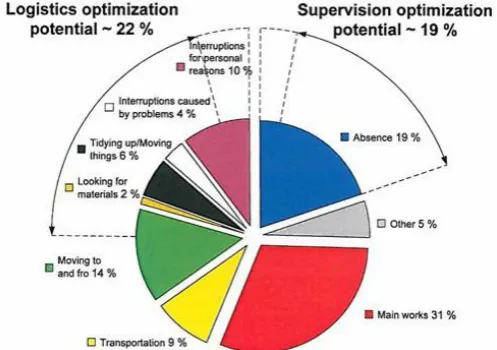
initiative. Industrialised construction does have apparent advantages that drive the industry players to consider and adopt them in their project. This technology offers numerous benefits to the adopters which ultimately lead to a cost advantage. Figure 1, compiled from CIB recent research (CIB, 2010), clearly reveals streamlining potential for better work preparation, logistics optimisation and continuous improvements which have a major impact on the cost structure of a project. For example, the cost saving that could be achieved by optimising construction logistics is more than 20% of the total labour costs. It also has potential to optimise construction supervision by up to 19% by moving the works away from the construction site to the manufacturing floor.
The Concept of Industrialised:
The concept of prefabrication and industrialised construction is not new to the construction industry. The building blocks from the great Egyptian pyramids were prefabricated to the correct size at the quarry to reduce the weight for transportation. Traditional farm houses in Europe since the Middle Ages were partly prefabricated
in a 3-feet module (Sumadi et al. 2001). The historical data can be traced back to the 19th century, where there
528 Nawi, M.N.M. et al, 2014
Australian Journal of Basic and Applied Sciences, 8(5) Special 2014, Pages: 527-532
author mentioned that the Crystal Palace built in 1851 was the starting point for industrialised buildings (Sumadi
et al. 2001).
[image:3.595.175.424.191.366.2]From the perspective of construction, industrialisation is part of a wider modernisation process through the development of modern methods of production and technology systems, mainly factory production, where work is centrally organised and production operations are mechanised and focused on mass production (Lessing, 2006). Warszawski (1999) highlighted the fact that an industrialisation process is an investment in equipment, facilities and technology with the objective of maximising production output, minimising labour resources, and improving quality. Industrialisation has demonstrated a high capacity to reduce the costs, improve the quality and make complex products available to the vast majority of people.
Fig. 1: Potential cost reduction of industrialised construction (CIB, 2010).
Industrialised construction is a generic process of standardisation and rationalisation of the work processes in the industry to reach cost efficiency, higher productivity and quality (CIB, 2010). A more elaborate definition for industrialised construction is a change of thinking and practices to improve the production of construction to produce a high-quality, custom-built environment, through an integrated process, optimising standardisation, organisation, cost, value, mechanisation and automation (CIB, 2010).
One of the efforts made in construction industrialisation is Industrialised Building System (IBS). The term building system is defined by Warszawski (1999) as a set of interconnected elements that are joined together to enable the designated performance of building. A building system is also characterised as a set of interrelated elements that act together to enable designated performance of building. It may include various procedures (technological and managerial) for the production and assembling of these elements for this purpose (Sarja, 1998).
Though many of the prefabrication and industrialisation terminologies are still in use, Industrialised Building System (IBS) has become a term used to represent those terminologies due to the research context of the Malaysian construction industry. The term IBS is widely used by the government, practitioners and researchers in this country to represent industrialisation in construction.
In the literature review, IBS is used interchangeably with other terms like offsite construction, prefabrication, offsite manufacturing, Modern Method of Construction (MMC) industrialised building and industrialised construction. Each terminology provides a rich historical account of the development of the concept. So far, however, there has been little discussion about MMC that has tended to focus on the definition and concept of IBS (such as Abdullah and Egbu (2009); Kamar et al., 2009) rather than exploration the relationship between both terminologies. Therefore, the primary goal of this study was to discover this subject matter in more detail with expectantly can reduce the gap towards enhancement of MMC-IBS uptake in the current construction industry.
Regardless of the terms, this study indicates that the idea is the same, which is to move some effort away from the construction site to a more controlled environment of the manufacturing floor. Modern Method of Construction (MMC) is a term adopted in the United Kingdom as a collective description for both offsite-based construction technologies and innovative onsite technologies. The former represents prefabrication and manufacturing technology and the latter includes techniques such as thin-joint block work and tunnel-form construction (Goodier and Gibb, 2006). The next section will discuss the experience of UK construction industry in implementing MMC.
Modernising the construction processes through industrialisation is a worldwide agenda to improve construction performance. The experiences in developed countries indicate that there is a great potential for IBS to progress, as evidenced by their market share. In the UK, both Latham and Egan reports emphasised the advantages of standardisation and preassembly and stressed the importance of modular and industrialised systems to improve construction performance (Latham, 1994 and Egan, 1998). The UK construction industry has often been described as fragmented, adversarial and inefficient requiring significant improvement. In the impetus of the reports, the Modern Method of Construction (MMC) and offsite construction were introduced to address the under supply, skills shortage and poor build quality of housing (DCLG, 2007; DCLG 2008 and NAO, 2005). Promotion of offsite construction has therefore seen as a mechanism for overcoming some of these problems. The Barker Review (2004) suggested that offsite technologies could both improve the quality of construction and address skills constraints in the industry. It has been widely documented that offsite technologies offer potential for reductions in cost, time, defects, health and safety risks and environmental impact and improve predictability, whole life performance and profits. Currently, offsite and prefabricated construction is a preferred mode of construction of hospitals, military accommodation, hostels and prisons in the
UK (Goodier and Gibb, 2007; Pan et al. 2008 and Pan et al. 2007).
The following are the key events of Modern Method of Construction (MMC) initiatives taken by UK Government:
Constructing Excellence was established by the Office of the Deputy Prime Minister (ODPM) in response
to the reports by Sir Michael Latham (1994) and Sir John Egan (1998). Constructing Excellence is a cross sector, cross-supply chain organisation charged with driving the agenda for change in construction including the promotion of MMC through R&D, benchmarking, workshop series and networking.
The Housing Forum has been established as the only housing organisation which provides a network across
all housing construction sectors: public, private and social and across their supply chains. The Housing Forum works closely with the Department of Trade (DTI), Housing Corporation, the House Builders Federation and CITB Construction Skills and others as well as its industry partners and sponsors to encourage MMC adoption.
Buildoffsite is an industry-wide campaigning organisation of clients, designers, constructors,
manufacturers, suppliers, government advisors and researchers promoting uptake of offsite construction solutions. This campaign, established in 2005, exclusively and uniquely focused on off-site construction solution facilitation and supporting the government in the implementation process (Buildoffsite, 2008). Buildoffsite engages in two-way communication to promote offsite and MMC through stakeholders‟ events, workshops, technology showcases and awareness.
The Office of the Deputy Prime Minister (ODPM) has gathered information from 50 leading expert sector
practitioners and published a National Audit Office (NAO) report on MMC in 2005. This report is an independent examination to identify how to get the best value by using MMC offsite (NAO, 2005). Barker 33 a cross-industry group was established in 2006 to examine the barriers to greater use of MMC in the provision of new housing and the mechanisms to overcome them (Barker, 2006).
MMC is fully utilised in the public sector by ODPM‟s Housing Corporation (Social House Regulator for
England & Wales) and English Partnership (Urban Regeneration). Large-scale development schemes such as the Thames Gateway and the seven Millennium Community initiatives run by English Partnerships are allowing housing associations to use MMC to promote efficiency in construction (NAO, 2005). In 2004, The Housing Corporation stated that 25% of all new grant aided construction by housing associations should use MMC (5000 homes per year which is equivalent to 3% of total new UK housing) (POSTNOTE, 2003).
The government and industry sponsored, Rethinking Construction programme, has encouraged the use of
MMC by promoting best practice and providing information. Government research initiative such as the £1.5 million Department of Trade and Industry (DTI) funded „PROSPA‟ (Promoting Off-site Production Applications) programme has been aimed at investigating the views of the UK industry concerning offsite MMC.
In spite of favourable recommendation reports and strong support from the government, the UK construction industry has been, and continues to be slow to innovate and adopt innovative building technologies such as offsite construction solutions (Buildoffsite, 2008; Goodier & Gibb, 2004; Barlow 1999). The level of uptake of MMC usage in the UK is found to be around 2.1% of all construction, or 3.6% of all new build
(Buildoffsite, 2008; Pan et al., 2005). The National House Building Council (NHBC) also estimated that about
10% of new homes in the UK are built using timber frames and 5% using other MMC solutions, this is
equivalent to about 25,000 MMC homes in 2003 (POSTNOTE, 2003). A few studies (Pan et al., 2005; Goodier
& Gibb, 2004) have been undertaken to look at this problem in order to identify the barriers of MMC adoption in the UK construction industry.
530 Nawi, M.N.M. et al, 2014
Australian Journal of Basic and Applied Sciences, 8(5) Special 2014, Pages: 527-532
compared to traditional construction. Longer lead in times was also a significant barrier especially for contractors, presumably because the use of offsite solutions could delay the beginning of the project on site (Goodier & Gibb, 2004). On the other hand, most of the house builders are generally satisfied with their own,
in-house, traditional construction methods (Pan et al., 2005). This result may be affected by the relatively low
uptake of offsite technologies to date.
Generally, it has been observed that tender packages are sent out too late in the design process and with overly restrictive design information (Buildoffsite, 2008). This inhibits the offsite suppliers from fully exploiting their skill and expertise to deliver efficient economic solutions to meet clients specifies needs. A survey by Pan
et al (2005) suggested that most house builders were aware of the principle of integrating Offsite-MMC early on
but, in practice, adhered to conventional procurement methods. Another study conducted by Kamar et al (2011)
summarised that the real advantages of MMC can only be realised through a thorough understanding of the principles underpinning manufacturing, whilst also appreciating the constraints and pitfalls that come with a fragmented construction industry.
According to BURA (2005); Gibbs (2001); Gibbs (2000); and Warszawski (1999), the key principle that underpins Offsite-MMC manufacturing is that manufacturers and suppliers must be integrated into the decision-making process as early as possible to allow tolerance into the design thus avoiding time wasting redesign work. CIRIA workshops supported the idea that the early involvement of offsite specialists or manufacturers during the design stages is needed in order to improve the performance of the UK Offsite-MMC construction industry, particularly its efficiency, quality, value and safety (Buildoffsite, 2008). Furthermore, previous studies (e.g. Pan
et al., 2008; Blissmas, 2007; Haas & Fangerlund, 2002) suggested that effective communication which incorporates distribution of information regarding decisions, designs, transportation requirements and schedules is highly important for enhancing Offsite-MMC project coordination. The literature clearly stated that an effective communication channel across the supply chain is needed in order to coordinate processes and deal with critical scheduling from the beginning until project completion (Pan et al., 2008; Blissmas, 2007; and BSRIA, 1998).
Currently, however, cooperation processes and relationships between house builders and manufacturers/
suppliers are in many cases weak (Pan et al., 2005). Current practice shows that manufacturers are involved only
after the tendering stage of the value chain (Blissmas et al., 2006). This lack of integration among relevant players (e.g. house builders and manufacturers/ suppliers) at the design stage has resulted in a need for redesign and additional costs to be incurred if Offsite-MMC is adopted (Kamar, 2011; Buildoffsite, 2008). This is because some of the MMC stakeholders still adhere to conventional procurement methods in the Offsite-MMC projects. Unfortunately, the Offsite-Offsite-MMC building procurement is slightly different from conventional methods which include planning and purchasing of materials in advance of actual site progress (BSRIA, 1998). Therefore, Offsite-MMC adoption requires an improvement in conventional procurement and management of
the supply chain for integrated practice (Venables et al., 2004). For example, the early involvement of
manufacturer initiatives can be achieved by establishing an integrated team during the Offsite-MMC construction process (Buildoffsite, 2008).
In addition, many house builders suggest that partnering or the Strategic Partnering Alliances (SPA) concept should be fully understood and applied by the industry (Buildoffsite, 2008). As stated in the report, high quality design in residential building using Offsite-MMC will only come from designers adopting a partnering
approach. Neala et al (1993) and Malik (2006) further suggested that Offsite-MMC should move towards a
collaborative and centralised procurement approach that allows Offsite-MMC contractors and manufacturers to contribute their expertise in order to produce detailed designs at the beginning of a project, as operated in design
and build (D&B), direct negotiation and turnkey contract routes. Other researchers (BSRIA, 1998; and Lessing,
2006) recommended that Just in Time (JIT) and Lean Construction should be applied in Offsite-MMC design in order to improve the design process and limit logistical, defective and wasteful issues.
Discussion:
Based on the discussions, it clearly shows that the need for greater collaboration in Offsite-MMC design project delivery is paramount. This approach is similar to the traditional/ conventional construction industry (general construction) that has been challenged by fully integrated practices. The challenge is clearly stated in previous industry-led reports (such as UKCG, 2009; Strategic Forum for Construction, 2003; Bourn, 2001; Egan, 2002; Egan, 1998; Latham, 1994;) which have all called on the industry to change from its traditional modus operandi (fragmented approach) and perform better through increased integration. Accordingly, research into integrated practices is necessary in order to enhance the level of integration and communication among stakeholders involved during the design stage if the full potential of Offsite-MMC for both the industry and its clients is to be realised.
This study was undertaken to explore the relationship between the terms of MMC-IBS and its modus operandi implementation process. Though many of the prefabrication and industrialisation terminologies are still in use, MMC-IBS is becoming a term used to represent those terminologies due to the research context which is the UK and Malaysian construction industry. Nonetheless, the term IBS is ill defined, often interchangeably with other terms like offsite and prefabrication, and their precise definitions depend heavily on the user‟s experience and understanding. The lack of a uniform definition and uncertainty in the context and boundary of IBS contributed to the prejudices and misunderstanding. The need for a standardization of terminology is paramount, to ensure accurate understanding of its advantages as well as to provide certainties with the risk and barriers related to IBS, especially for a developing country such as Malaysia which is just beginning to embrace the IBS techniques to efforts made in its construction industry.
ACKNOWLEGMENTS
The authors wish to thank the Ministry of Education Malaysia for providing the funding under Research Acculturation Grant Scheme (RAGS), Universiti Utara Malaysia (UUM) and Construction Research Institute of Malaysia (CREAM) for supporting this IBS research.
REFERENCES
Abdullah, M.R. and C. Egbu, 2009. IBS in Malaysia: Issues for Research in a Changing Financial and
Property Market In BuHu 9th International Postgraduate Research Conference (IPGRC) (Eds., Alshawi, M.,
Ahmed, V., Egbu, C. and Sutrisna, M.) Salford, United Kingdom, pp: 15-25.
Barker, K., 2004. Review of Housing Supply, ODPM, UK.
Barlow, J., P. Childerhouse, D. Gann, S. Hong-Minh, M. Naim and R. Ozaki, 2003. Choice and Delivery in Housebuilding: Lessons from Japan for UK Housebuilders. Building Research &Information, 31(2): 134-45.
Blismas, N., 2007. Off-site manufacture in Australia: Current state and future directions Cooperative Research Centre for Construction Innovation, Brisbane, Australia, pp: 1-37.
Blismas, N., G.C. Pasquire, A.F.G. Gibb, 2006. Benefit Evaluation of Offsite Production in Construction,
Construction Management & Economics, 24: 121-30.
Bohari, A.A.M., N. Mahat and K. Kipli, 2012. Industrialised Building System (IBS) in Sarawak
Construction Industry. International Conference on Innovation, Management and Technology Research
(ICIMTR2012), Malacca, Malaysia.
Bourn, J., 2001. Modernising Construction (HC87 Session 2000-2001). London: National Audit Office. BSRIA, 1998. Prefabrication and Preassembly - applying the technique to building engineering services In
Advance Construction Technique ACT 1/99 (Ed. Wilson, D. G., Smith, M. H. and Deal, J.) Department of Environment Transport Region (DETR) and the Building Services Research and Information Association (BSRIA).
Buildoffsite, 2008. Your guide to specifying Modular Buildings Maximizing value and minimizing risk Buildoffsite & BAA, London.
BURA, 2005. Modern Method of Construction Evolution or Revolution? A BURA Steering and
Development Forum Report, London.
CIB, 2010. Industrialised Construction: state of the art report, TG 57 Publication, International Council for Research and Innovation in Buildings and Construction.
DCLG, 2008. Innovative Construction Products and Techniques (Report BD 2503), Department for Communities and Local Government (DCLG), London.
DCLG, 2007. Homes for the future: more affordable, more sustainable (Report CM 7191) Department for Communities and Local Government (DCLG), London.
Egan, J., 2002. Accelerating Change, Strategic Forum for Construction, London.
Egan, J., 1998. Rethinking construction, report of the construction task force on the scope for improving the quality and efficiency of UK construction industry, Department of the Environment, Transport and the Regions, London.
Gibbs, A., 1997. Focus Groups. Social research update, Issue 19 © University of Surrey, UK.
Gibb, A., 2000. Standardisation and Pre-assembly - Client‟s Guide and Toolkit, Construction Industry Research and Information Association (CIRIA), London.
Gibb, A., 2001. Pre-assembly in construction: A review of recent and current industry and research initiatives on pre-assembly in construction, CRISP Consultancy Commission - 00/19, May 2001.
Goodier, C. and A. Gibb, 2007. Future opportunities for offsite in the UK, Construction Management and
Economics, 25(6): 585-595.
Goodier, C., A. Gibb, 2006. Future opportunities for off-site in the UK, Construction Management and
532 Nawi, M.N.M. et al, 2014
Australian Journal of Basic and Applied Sciences, 8(5) Special 2014, Pages: 527-532
Goodier, C., A. Gibb, 2004. Barriers and Opportunities for Offsite Production, PROSPA, Loughborough University, Loughborough.
IBS Roadmap 2003-2010, 2003. Construction Industry Development Board (CIDB), Kuala Lumpur.
Kamar, K.A.M., 2011. An Investigation into the Critical Success Factors of Industrialised Building System
(IBS) Contractors: The Malaysian Case, PhD Thesis, University of Salford, UK.
Kamar, K.A.M., M. Alshawi, Z.A. Hamid, M.N.M. Nawi, M.R. Abdullah and A.T. Haron, 2009. “Industrialised Building System (IBS): Revisiting the Issues on Definition, Classification and the Degree of
Industrialisation,” Proceedings in 2nd Construction Industry Research Achievement International Conference
(CIRIAC 2009), CIDB, Kuala Lumpur, Malaysia, 3rd – 5th November 2009.
Latham, M., 1994. Constructing the Team, Final report on joint review of procurement and contractual agreements in the UK construction industry. HMSO, London.
Lessing, J., 2006. Industrialised House-Building - Concept and Processes, PhD Thesis, Department of
Construction Sciences Lund Institute of Technology, Sweden.
Malik, N.F.N., 2006. Supply Chain Management in IBS Industry. Proceedings in Malaysian International
IBS Exhibition, Kuala Lumpur.
NAO, 2005. Using modern methods of construction to build homes more quickly and efficiently, National Audit Office, London.
Neala, R., A. Price and W. Suer, 1993. Prefabricated modules in construction, Bourn Press Limited,
Bournemouth.
Office of the Deputy Prime Minister (ODPM), 2003. Sustainable Communities: Building for the Future, ODPM, London.
Pan, W., A.G.F. Gibb and A.R.J. Dainty, 2005. Offsite Modern Methods of Construction, Housebuilding Perspectives and Practices of Leading UK.
Pan, W., A. Gibb, A.R.J. Dainty, 2007. Perspectives of UK housebuilders on the use of off-site modern
method of construction. Construction Management and Economic, 25(2): 183-194.
Pan, W., A. Gibb, A.R.J. Dainty, 2008. Leading UK housebuilders utilization of off-site construction
method. Building Research & Information, 36(1): 56-67.
Postnote, 2003. Modern Method of House Building. In POSTNOTE Number 209, Parliamentary Office of
Science and Technology, London, United Kingdom.
Sarja, A., 1998. Open and Industrialised Building, International Council for Building Research, E&FN Spoon, London.
Strategic Forum for Construction, 2003. The integration toolkit guide: Integrated project team, London:
Strategic Forum for Construction.
Sumadi, S.R., 2001. Promotion strategy and future research and development on IBS, National Seminar on Industrialised Building System, Construction Industry development Board (CIDB) Kuala Lumpur.
UKCG Report, 2009. Construction in the UK Economy: The Benefits of Investment, UK Contractors
Group, Construction in the UK economy.
Venables, T., J. Barlow and D. Gann, 2004. Manufacturing Excellence: UK Capacity in Offsite Manufacturing, The Housing Forum, London.
Warszawski, A., 1999. Industrialised and automated building systems, Technion-Israel Institute of