RESEARCH ON MUSIC EDUCATION PERFORMANCE
EVALUATION BASED ON BP NEURAL NETWORK
1WANG YANG
1 Assoc. Prof., Art and Design College, Nanchang University, Nanchang, China
E-mail: [email protected]
ABSTRACT
Implementing music education performance management is an effective way to enhance the comprehensive quality education for universities, and music education performance evaluating for universities is one of the difficulties and hot research fields for the researchers related. The paper presents a new model for evaluating music education performance based on improved BP neural network. First an evaluation indicator system of music education performance is designed through analyzing the characteristics of learners’ behavior with more details; Second, aiming at the shortages of the existing BP neural network algorithm of data-mining for evaluating music education performance, immune genetic algorithm is used to correct BP neural network to speed up the convergence and simplify the structure and to improve evaluating accuracy of the original BP model. Finally the experimental results verify that the new algorithm can guarantee the effectiveness and validity of performance evaluation for music education of different universities in its engineering application.
Keywords: Comprehensive Quality Education (CQE), Music Education Performance Management
(MEPM), BP Neural Network (BPNN), Immune Genetic (IG)
1. INTRODUCTION
Modern society is in a world with rapid development of economy and technology, dramatic change of society and culture. To implement comprehensive ability education and quality education in college education and strengthen students’ comprehensive ability is the new requirement and new challenge put forward by the society on higher education talent training. Taking training comprehensive talents as core target, domestic higher institutions actively launch the construction and practice of music ability training system for college students, constantly deepening reform in education, promoting the reform and music of talent training mode in colleges, having explored and carried out such classic research-based learning mode as college students study plan, college students seminar program, technological music activity. Therefore, to establish music education evaluation indicator system for college students and study on music education evaluation methods for college students are of great theoretical value and practical significance.
Section 2 presents literature review of the music education performance evaluation including evaluation system research and evaluation methods;
In section 3, an evaluation indicator system for evaluating music education performance is designed; In the second section 4, the evaluation algorithm for evaluation music education performance is derived which is realized through improving BP neural network with immune genetic; Section 5, the realization of the model presented in the paper is given with the data from three universities; Section 6 gives a conclusion of the whole paper.
2. LITERATURE REVIEW
2.1 Literature Review of Evaluation System Research
The evaluation schemes of music education performance with relatively high recognition in the world mainly include the following ones. ① In 2004, Doctor Lynette Gillis put forward music study certification standard, which adopts such three first-class indicators as availability, technicality and teaching to carry out evaluation on music education performance, and these three indicators contains 32 second-class evaluation
indicators[2]; ②Sandy Britain and
put forward Laurillard conversational framework and cybernetic model respectively from the perspective of evaluating strategy; the former mainly takes the interaction between teachers and students, students and students, students and environment through media as evaluation objects, evaluating and analyzing music education performance through interactivity of various kinds of learning tools provided; the latter carries out analysis and evaluation on music education performance from such six aspects as resources circulation, cooperation, monitoring, personalization, autonomous organization and
variability of structure[3]; ③ The Institute for Higher Education Policy in the US and Black Board
Company jointly put forward evaluation system of
music learning quality, which includes such 7 aspects as education system structure, curriculum development, teaching/learning, curriculum structure, student support system, teacher support system, evaluation and appraisal system; these 7 aspects are detailed into 24 necessary core indicators and 21 non-necessary optional sub-indicators[4]; ④emote education Russian r evaluation standard divides evaluation system of music education performance into seven specific indicators, such as teaching program and syllabus of remote education, teaching database, guarantee of technology, method and process for implementing curriculum, capacity of production system, guarantee of personnel and organization[5,6].
Table 2 Evaluation Results Of First-Grade Indicator Of Different Universities
Education Management System
Education Investment
Education Contents
Educational Effect
PKU 4.351 3.651 4.126 4.641
SHJTU 3.672 3.411 3.786 4.145
SCUT 3.672 3.215 3.341 4.651
N number of hidden node
Weight value corresponding to the
first hidden node
Weight value corresponding to the
second hidden node …
Weight value corresponding to the N hidden node
Fig.1 Antibody Code
Study on evaluation indicator system of music education performance in China mainly establishes evaluation system from two perspectives as process
monitoring and overall monitoring. ① The former mainly includes that Wang Chunlian, (2006) carries
out whole-process multiple evaluation, combining formative evaluation with summative evaluation, combining self-evaluation, teacher evaluation and group evaluation, combining knowledge evaluation with multi-dimensional evaluation, combining individual evaluation with overall evaluation[7]; Cheng Hua (2008) put forward the idea of satisfaction evaluation of learning process of remote education, having established satisfaction evaluation indicator system of learning process[8].
② The latter mainly includes that Li Baoping.
(2011), based on building learning theory, have established evaluation system of music education performance, which includes such three major indicators as learning environment, learning behavior tracking and learning behavior analysis and evaluation generation[9]; Ya-Yueh (2008), on the basis of reference to evaluation on higher education undergraduate teaching work, from a
global point of view, mainly carries out analysis on music education performance from such 7 aspects as talent training target, teachers construction, teaching process management, support service environment and resources, construction and management of off-campus learning center, teaching effect and climate for learning[10].
In conclusion, structures of evaluation indicator system of music education built at home and abroad are relatively complicated with lots of evaluation indicators; moreover, there are both quantitative indicators and qualitative indicators in evaluation indicators, which lead to a difficult choice in subsequent evaluation method and non-guarantee of evaluation accuracy.
2.2 Literature Review of Evaluation Methods Up to now, mathematical models adopted by evaluation of music education performance mainly
include the following categories. ① Analytic hierarchy process is a good method for quantitative
structure of actually-built value by evaluated object; however, the method has strong limitations and subjectivity, with large personal error, not suitable for complicated system with lots of evaluation
indicators[6]. ② BP neural network evaluation
method makes use of its strong capability in processing nonlinear problems to carry out evaluation of music education performance; the method has advantages like self-learning, strong fault tolerance and adaptability; however, the algorithm is easy to be trapped into defects like local minimum, over-learning, strong operation
specialization[8]; ③ Fuzzy com
[image:3.612.126.498.248.704.2]evaluation is a method carrying out comprehensive evaluation and decision on system through fuzzy set theory, the greatest advantage of which is that it works well on system evaluation of multi-factor and multi-level complicated problems. However, the membership of fuzzy evaluation method as well as the definition and calculation of membership function are too absolute, difficult to reflect the dynamics and intermediate transitivity of evaluation indicators of music education performance [11-16].
Table 1 Evaluation Indicator System of Music Education Performance
Target Hierarchy
First-grade Indicator
Second-grade
Indicator Third-grade Indicator
College Music Education Evaluation
Education Management System
Music Education Program
Program Quality Program Implementation
Music Education System
Management System
Evaluation and Supervision System
Assessment System Music Education
Team
Management Team Implementation Team
Education Investment
Human Resources Investment
Music Education Teachers Training for Teachers
Teachers Proportion Participating Music Education
Material Resources Investment
School Music Education Investment Proportion
In-campus Music Base Construction
Off-campus Music Base Construction
Utilization Efficiency of Music Funds
Education Contents
Music Education Course
Construction of Music Course System
Innovative Lecture Music Education
Learning
Learning Method Learning Effect
Educational Effect
Effect of Specific Student
Passion of Students for Participating Extracurricular Technological Activities
Awards of Student Music Competition
Effect of School Music Education
Theoretical Achievement of School Music Education
Practical Achievement of School Music Education
The paper uses immune genetic algorithm to correct and modify BPNN model to overcome the
of BPNN has been solved, but also the simplicity of the model structure and the accuracy of the transformation are ensured, and a new performance evaluation model is advanced to evaluation music education performance for universities.
3. EVALUATION INDICATOR SYSTEM DESIGN
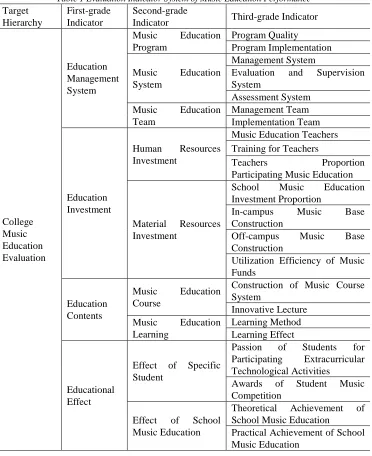
While designing the indicator system for college music education evaluation, this thesis first considers the characteristics of college music education. Higher education as a teaching activity transferring advanced knowledge and training advanced professional talents, college music education, besides having the common characteristics of higher education and in conformity with common rules, has characteristics different from general education process. Thus, this thesis, first taking pertinent literature and experts’ opinions as reference, relevant principles of education and surveying as basis, determines the influence range of college music education activity by combining domain-based framework with goal-based framework, and takes effective behavioral characteristics of music education as the evaluation indicator of college music education, thus establishing evaluation system for college music education. The system includes above-mentioned 4 first-class indicators and all the second-class indicators under all the first-class indicators, and establishes 22 third-class indicators according to practical situation as the observation point of evaluation, as shown in Table 1.
4. DERIVATION OF ALGORITHM
4.1 Simultaneous Analysis and Design.
De Castro indicated that there were similarities among the quality of weight value initialization of back-propagation neutral network and the relationship of network output and the quality of antibody instruction system initialization in the immune system and the quality of immune response. A simultaneous analysis and design---SAND algorithm was advanced to solve the problem regarding the weight value initialization in the back-propagation network [6]. In SAND algorithm, each antibody corresponds to a weight value vector of neuron given in one of several layers of neural networks, the length is
l
, and the affinityaff
(
x
i,
x
j)
between antibodyx
i andantibody
x
j is shown by their derivative ofEuclidean distance function
D
(
x
i,
x
j)
in Formula1. In which,
ε
is a positive of value adoption 0.001. The definition of Euclidean distance functionD
(
x
i,
x
j)
is shown in Formula 2[6].ε
+
=
)
,
(
1
)
,
(
j i j
i
x
x
D
x
x
aff
(1)∑
=
−
l
k
jk ik j
i
x
x
x
x
D
1
2
)
(
)
,
(
=
(2)SAND algorithm aims to reduce the similarities between the antibodies and produce the antibody repertoire to cover the entire form space with the best, so energy function is maximized. The energy function is shown in Formula 3.
∑ ∑
= =+
=
Ni N
i j
j i
x
x
D
E
1 1
)
,
(
(3)In the method of Eculidean form space, the energy function is not percentage. With a view to the diversity of the vector, SAND algorithm has to define the stop condition. Given vector
x
i,
i
=
1
,
2
,...
N
, its standardization is unitvector
I
i,
i
=
1
,
2
,...
N
, −I
shows to calculate the average vector. Therefore, Formula 4 shows thediversity of unit vector, in which,
I
− means theaverage vector distance from the origin of coordinate. Formula 5 shows the stop condition
U
of SAND algorithm.2 / 1
)
(
I
I
I
=
T−
(4)
)
1
(
100
−
−
×
=
I
U
(5)
4.2 BP Neural Network Design Based on Immune Genetic Algorithm.
According to the actual application, providing that both the input and output number of node and the input and output values in BPNN have been confirmed, activation function adopts
S
type function. The following steps show BP neural network design based on immune genetic algorithm.value initialization separately by SAND algorithm.
(2) Antibody code. The initial weight value derived by SAND algorithm constructs the structures of BPNN. Each antibody corresponds to a structure of BP neural network. The number of hidden node and network weight value carry on the mixture of real code. Each antibody serials are shown in Fig.1.
(3)Fitness function design. Fitness function
f
(
x
i)
is defined as the mean valuefunction of squared error of neural network in Formula 6, in which,
E
(
x
i)
is shown by Formula7. In Formula 7,
p
is the total training sample,o
isthe number of node of output layer,
T
jnandY
jnarethe
n
training sample’s expected output and actual output in thej
output node separately, andξ
is the constant larger than zero.(6)
(7)
(4) Genetic operation. The model here adopts the Gaussian compiling method to go on the genetic operation so as that each antibody decoding is the corresponding network structure and change the network weight value as shown in Formula 8, in
which,
x
i andx
im are the antibodies before andafter the variation,
µ
(
0
,
1
)
shows that the mean value is zero and squared error is normal distribution random variable ofl
, and∂
∈
(
−
1
,
1
)
is the individual variation rate. It is seen in Formula 8 that the variation degree varies inversely as the fitness, i.e. the lower the fitness is (the less the fitness value of objective function is), the higher the individual variation rate is, or vice versa. After the variation, all the hidden node and weight value components constitute a new antibody again.)
1
,
0
(
))
(
exp(
−
×
µ
∂
+
=
i im
i
x
f
x
x
(8)(5)Group renewal based on density. In order to guarantee the antibody diversity, improve the entire searching ability of the algorithm, the model adopts the Euclidean distance and the fitness based on the antibodies to calculate the similarity and density of the antibody. Providing that there
are
x
iandx
jantibodies, andη
0
andt
0
,given constants, the fact that Formula 9 is satisfied indicates that
x
iandx
jantibodies are similar, thenumber of antibody similar to the antibody
x
i isthe density of
x
i marked byC
i. The probability ofselecting antibody
x
i isp
(
x
i)
as shown in Formula10, in which,
α
andβ
is the adjustable parameters between (0, 1), andM
(
x
)
is the maximum fitness value of all the antibodies. It is seen in Formula 10 that while the antibody density is high, the probability of selecting the antibody with high fitness is low, and conversely high. Therefore, excellent individual is not only retained, but the selection of similar antibodies is reduced, and the individual diversity is guaranteed.(9)
(10)
5. EXPERIMENT CONFIRMATION
5.1 Sample Data
Experimental data come from database of Peiking University (referred to as PKU), and Shanghai Jiaotong University (referred to as SHJTU) and South China University of Technology (referred to as SCUT). Relevant data of 500 learner of each university who receive the music education of their university are selected as the basis for data training and experimental verification in the paper, totally 1500 learns’ data for study data that come from practical investigation and visit of two specific music education institutions and students. In order to make the selected learners’ data representatives, 300 learners (100 learners from each university) with more than 3 years learning experience, 900 learners with 2 years learning experience, 300 learners with less than 2 years learning experience.
5.2 Experimental Results
Limited to paper space, hers only provides part of intermediate evaluation results and final evaluation results see table 2 and table 3.
6. STUDY CONCLUSION
This paper, on the basis of the analysis of the behaviors of learners, analyzes and builds indicator
≤
−
≤
t
x
f
x
f
x
x
D
j i j i)
(
)
(
,
(
η
)
(
)
(
]
)
(
)
(
1
[
)
(
x
M
x
f
x
M
x
f
C
x
p
i ii
i
=
α
−
+
β
ξ
+
)
(
1
)
(
i ix
E
x
f
=
2 1 1)
(
2
1
)
(
jnp N o j n j
i
T
Y
p
x
E
=
∑∑
−
system of music education evaluation for different universities, makes use of immune genetic to improve BP neural network to overcome the shortage of original BP neural network to evaluate music education performance also carries out case study taking the data of three universities for example to realize the evaluation process of the model presented in the paper, meanwhile, the evaluation method built in this paper can be reference for the analysis and evaluation of other multi-factor systems.
Table 3 Final Evaluation Results of Three Universities
PKU SHJTU SCUT
Final
Evaluation 4.376 3.673 3.871
REFRENCES:
[1] J. S. Smart and G. Z. Joe “Music Education Management and Evaluation”, International Journal of Information Management, Vol.21, No.7, April 2011, pp. 76-82.
[2] P. Bao, “Design on the Evaluation System for Education”, Chinese Education, Vol.24, No. 9, September 2011, pp. 54-59.
[3] S.Y. Cui and A. F. Xu “An Approach to Evaluating the Education Management Information System with Intuitionistic Fuzzy Information”, International Journal of Advancements in Computing Technology,
Vol.4, No. 4, April 2012, pp. 49-55.
[4] X. Y. Qu and, “Application of K-means Based on Commercial Bank Customer Subdivision”,
Computer Simulation, Vol. 28, No. 6, July 2011, pp. 357-360.
[5] D. Z. Tao “Research on Education Performance Evaluation Based on Fuzzy Theory”, Science and Technology Management Research, Vol. 27, No. 12, December 2011, pp. 342-349.
[6] J. Tatte. “A New Algorithm for Education Performance Evaluation”, Journal Digital Information Management Research, Vol. 23, No. 12, December 2010, pp. 246-254.
[7] C. Wu Ding and H. X. Huang, “Evaluation and Research on Sports Psychology based on BP Neural Network Model”, Advances in Information Sciences and Service Sciences,
Vol. 4, No. 10, October 2012, pp. 355-363.
[8] Y. Chen, “Study on the Application of Data Mining-Based BP Neural Network Forecasting Model in Physical Training”, International Journal of Digital Content Technology and its Applications, Vol. 6, No. 17, September 2012, pp. 204-213.