http://dx.doi.org/10.4236/jbise.2014.75027
How to cite this paper: Wiener-Megnazi, Z., et al. (2014) Synchronous and Asynchronous Blastomere Cleavage at Cryopre-servation: Effect on Subsequent Embryo Survival, Pregnancy and Live Birth Rates. J. Biomedical Science and Engineering, 7, 243-251. http://dx.doi.org/10.4236/jbise.2014.75027
Synchronous and Asynchronous Blastomere
Cleavage at Cryopreservation: Effect on
Subsequent Embryo Survival, Pregnancy and
Live Birth Rates
Zofnat Wiener-Megnazi1, Maria Fridman1, Mara Koifman1, Shirly Lahav-Baratz1, Nili Stein2, Ron Auslender2, Martha Dirnfeld1*
1Fertility and IVF Unit, Department of Obstetrics and Gynecology, Carmel Medical Centre, Rappaport, Faculty
of Medicine, Technion, Haifa, Israel
2Department of Community Medicine and Epidemiology, Carmel Medical Centre, Rappaport, Faculty of
Medicine, Technion, Haifa, Israel Email: *[email protected]
Received 13 February 2014; revised 17 March 2014; accepted 26 March 2014 Copyright © 2014 by authors and Scientific Research Publishing Inc.
This work is licensed under the Creative Commons Attribution International License (CC BY).
http://creativecommons.org/licenses/by/4.0/
Abstract
Capsule: Although embryos with synchronous blastomere cleavage showed higher post-thaw sur-vival rates, pregnancy rates did not differ. Thus, embryos with all cleavage patterns may be safely cryopreserved. Objective: To compare post-thaw embryo survival, pregnancy and live birth rates of embryos with synchronous vs asynchronous blastomere cleavage in frozen embryo transfer (FET) cycles. Design: Retrospective study. Setting: University-affiliated IVF unit. Patients: One thousand and sixty FET cycles performed from 2004-2006. Interventions: Cycles were divided into 3 groups: 1: cycles in which only embryos with synchronous blastomere cleavage were frozen; 2: cycles in which only embryos with asynchronous blastomere cleavage were frozen; 3: cycles in which both embryos with synchronous and asynchronous blastomere cleavage were frozen. Clini-cal and laboratory data were recorded and analyzed. Main Outcome Measures: Post-thaw embryo survival, morphologic grading, pregnancy and live birth rates. Results: A total of 1863 embryos were analyzed. Synchronous embryos had higher blastomere survival rates and morphological grading at thawing. Pregnancy and birth rates did not differ among groups. In a multivariant logis-tic regression analysis, a number of transferred embryos and embryo morphological grading at thawing were the only parameters that affected pregnancy and live birth rates. Conclusions: Em-bryos with both synchronous and asynchronous blastomere cleavage can be selected by classical embryo grading and safely cryopreserved.
Keywords
Embryo Survival; Blastomere Cleavage; Frozen-Thawed Embryos; IVF; Pregnancy; Synchronicity
1. Introduction
The introduction of time-lapse imaging in the field of IVF has contributed an insight to various patterns of emb-ryo development.
Several studies have demonstrated that morphokinetic variables may predict embryo viability and implanta-tion potential [1].
However, the combination of the embryo morphology and kinetics are still in a process of prospective rando-mized analysis with an aim of discovering an alogarithm that will provide an accurate tool to choose the best fresh single embryo for transfer. Cryopreservation of surplus embryos is emerging as an important asset to IVF centers who are taking steps towards a single embryo transfer (SET) policy and increasing cumulative pregnan-cy rates while using GnRH trigger and avoiding exposure of patients to the risks of ovarian hyperstimulation syndrome [2].
Recently, cryopreservation of Blastocyst and SET was suggested as an embryo selection method [3].
Since the first successful pregnancy after FET of a human embryo in 1983 [4], identification of factors that predict embryo survival, pregnancy and live birth following FET has been a major challenge. Maternal age, embryo cleavage stage [i.e. a number of blastomeres on days 2 and 3] and a number of embryos transferred have been found to influence success rates in FET cycles [5]. Other factors reported are the etiology of infertility and outcome of the corresponding fresh cycle [6] protocol type, endometrial thickness, a number of oocytes and number and quality of thawed embryos [7]. The two main parameters considered upon embryo selection for cryopreservation are morphological grading and cleavage stage.
Routine morphological grading of embryos is widely used by embryologists to select the “best” embryos for transfer or cryopreservation [8] [9].
While most morphologic parameters are estimated subjectively, a number of blastomeres and the distinction between synchronous and asynchronous blastomere cleavage are objective parameters. Embryos with syn-chronous blastomere cleavage are usually preferred for transfer or cryopreservation, though there is no evidence in the literature of their superiority.
The objective of this study was to evaluate the effect of blastomere synchronicity of embryos at cryopreserva-tion on post-thaw survival and outcome in FET cycles in day 2 and day 3 embryos.
2. Material and Methods
This study analyzed retrospectively consecutive FET cycles (and their corresponding cryopreservation cycles) performed in Carmel Medical Center since 2004 through 2006. Demographic, clinical and laboratory data were obtained from the patients’ medical records. The study was approved by the Institutional Review Board.
Inclusion criteria were: FET cycle in which 1: Number of thawed embryos was equal to the number of frozen embryos in the corresponding freezing cycle. 2: Number of cryopreserved embryos at the corresponding cycle was ≤6.3: Thawed embryos were transferred on the same day.
Patient’s age, type of infertility, insemination protocol (IVF or intra cytoplasmic sperm injection-ICSI) and number of frozen, thawed and transferred embryos were recorded. For each frozen embryo, embryo age, number of cleaving blastomeres and morphological grading at freezing and thawing were recorded. Ovarian stimulation of the corresponding freezing cycles was performed according to a long down-regulation GnRH Analogue pro-tocol or a short propro-tocol with GnRH antagonists, as previously described [10] [11]. Fertilization was confirmed 16 - 20 hours after insemination. Cleavage was assessed 48 - 72 hours later. Embryos were classified according to their morphological appearance.
A total grade of 2.5 - 3.0 indicated high quality embryo (equal and regular blastomeres, no fragmentation), 2 for intermediate quality embryos (irregularity of blastomeres, up to 20% fragmentation) and 1 - 1.5 for poor quality embryos (unequal blastomeres, 20% to 50% fragmentation, abnormal cytoplasm).
Cryopreservation: Embryos were cryopreserved 2 or 3 days after oocyte aspiration as previously described
[8] [12] using a standard slow freezing protocol in a programmed biological freezer (Planner Cryo II: Planner product Ltd., England) using Medi Cult 1, 2 Propandiol and Sucrose Kit. Embryos were stored in cryotubes con-taining 0.25 ml of freezing medium (Nunc, Roskilde, Denmark). Embryos were graded upon freezing and thawing. Poor quality embryos with more than 50% fragmentation and/or ≤4 cells on day 3 were not eligible for freezing.
Thawing: Embryos were thawed according to thawing protocol [8]. Embryo transfer: consisted of either of two:
1) Monitoring of a natural menstrual cycle by serial measurements of serum levels of estradiol (E2), Proge-sterone and LH, coupled with transvaginal sonography for measurement of the leading follicle and endometrial appearance and thickness, in order to detect the day of LH surge;
2) Hormonal preparation protocol by oral administration of 6 mg estradiol valerate daily from cycle day 3 and serial monitoring of endometrial appearance and thickness by transvaginal sonography. Embryo transfer of day 2 or 3 embryos was performed 3 or 4 days after the LH surge in the natural cycle or 2 - 3 days after the demon-stration of an endometriium of ≥7 mm thick on transvaginal sonography. This was followed (In hormonal prep-aration cycles) by luteal phase supplementation (administration of intramuscular Progesterone in oil, (Gestone, Paines & Byrne, Surrey, UK) 100 mg/d, or vaginal tablets of 900 mg/day of micronized progesterone (Utero-gestan, Laboratoires Besins, France) 2 or 3 days prior to embryo transfer for day 2 and 3 embryos, respectively.
Embryos were considered to be surviving when at least half of the initial number of blastomeres was intact. The number of transferred embryos was determined in accordance with the guidelines of the Israeli Ministry of Health from 2004. Up to 3 thawed embryos were selected for transfer (≤3 frozen-thawed embryos during first 3 cycles, and no more than 4 embryos at any case). Pregnancy tests were performed 12 days after embryo transfer. Serum levels of BHCG > 5IU/L were considered a chemical pregnancy, and the demonstration of an intrauterine gestational sac on transvaginal sonography was considered a clinical pregnancy. Live birth data was taken from routine patient follow up records.
2.1. Study Design and Variables
All FET cycles were divided into 3 groups:
Group 1: Only embryos with synchronous blastomere cleavage (2, 4 and 8 blatomeres) were frozen. Group 2: Only embryos with asynchronous blastomere cleavage (3, 5, 6, 7 or 9 blastomeres) were frozen. Group 3: Embryos with both synchronous and asynchronous blastomere cleavage were frozen.
2.2. Embryo Survival
Blastomere survival rate was defined as the sum of surviving/cryopreserved (thawed) blastomers (in %) in a given FET cycle.
Full embryo survival rate was defined as the % of FET cycles among which all embryos survived.
Embryo survival rate was defined as the total number of surviving embryos divided by the number of frozen- thawed embryos in a given FET cycle.
Since embryos were cryopreserved and thawed in groups, blastomere survival parameters were always calcu-lated regarding total number of blastomeres in the cryopreserved embryo cohort, since it was impossible to iden-tify individual embryos after thawing when embryos of identical number of blastomeres were frozen.
Full blastomere survival rate was defined as the % of FET cycles during which total number of blastomeres at thawing was equal to the number at cryopreservation.
2.3. Statistical Analysis
Parameters of the 3 groups were compared using one-way ANOVA followed by the independent T-test for continuous variables, Kruskal-Wallis test followed by Mann-Whitney test for ordinal variables and Chi square test for the categorical variables. P < 0.05 was considered significant. The significant variables regarding preg-nancy and survival of at least one embryo were entered into a multivariate logistic regression model.
3. Results
3.1. Cycle Parameters
During the study period, 1060 cryopreservation cycles were performed; of them, 620 frozen-thawed cycles, comprising 1863 frozen embryos, met the inclusion criteria. The number of frozen-thawed embryos was 1, 2, 3, 4, 5 and 6 in 4.8% (n = 30), 37.1% (n = 230), 27.3% (n = 169), 19.7% (n = 122), 5.8% (n = 36), 5.3% (n = 33) cycles respectively. Overall embryo survival rate was 1265/1863 (68%); In 558 (90%), at least one embryo sur-vived. Groups 1(synchronized blastomere cleavage), 2 (Mixed) and 3 (asynchronous blastomere cleavage) con-sisted of 225 (40.3%), 130 (23.3%) and 203 (36.4%) cycles respectively.
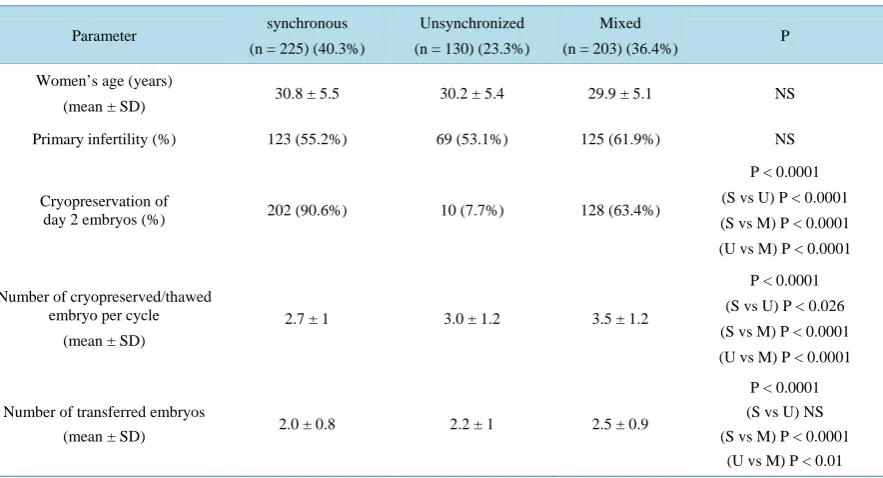
In 342 (61.2%) cycles, embryos were frozen on day 2 and the rest on day 3. Woman’s age and prevalence of primary infertility did not differ between all groups (Table 1).
[image:4.595.96.538.470.709.2]Mean number of cryopreserved (thawed) embryos and transferred embryos was 3.06 ± 1.2 and 2.28 ± 0.95, respectively. The number of cryopreserved (thawed) and transferred embryos was lower in the synchronous group (2.7 ± 1, 3 ± 1.2, 3.5 ± 1.2, respectively, P = 0.00001; 2 ± 0.8, 2.2 ± 1, 2.5 ± 0.9, respectively P < 0.0001,
Table 1).
3.2. Embryo Survival
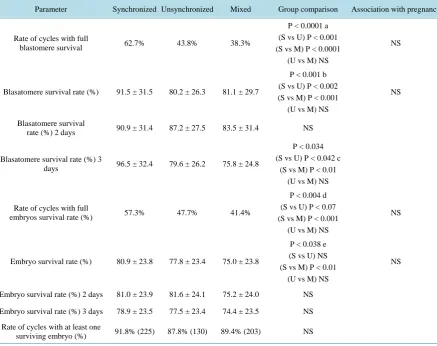
Full blastomere survival rate was higher among the synchronous group (62.7%, 43.3%, 38.3% respectively, P = < 0.0001,Table 2). When controlled for number of frozen (thawed) embryos, difference remained significant for 3 thawed embryos (P = 0.013) and a trend was observed for 2 thawed embryos (P = 0.069) (Table 2).
Blastomere survival rate was higher in the synchronous group.
When controlled for number of frozen (thawed) embryos, difference became insignificant (Table 2). When Blastomere survival rate analyzed according to embryo’s age, was higher among the synchronous group for day 2 embryos, but differences disappeared after Bonferroni correction.
Table 1.Demographic and clinical characteristics of cryopreservation cycle among study groups.
Parameter synchronous (n = 225) (40.3%)
Unsynchronized
(n = 130) (23.3%)
Mixed
(n = 203) (36.4%) P
Women’s age (years)
(mean ± SD) 30.8 ± 5.5 30.2 ± 5.4 29.9 ± 5.1 NS
Primary infertility (%) 123 (55.2%) 69 (53.1%) 125 (61.9%) NS
Cryopreservation of
day 2 embryos (%) 202 (90.6%) 10 (7.7%) 128 (63.4%)
P < 0.0001
(S vs U) P < 0.0001
(S vs M) P < 0.0001
(U vs M) P < 0.0001
Number of cryopreserved/thawed embryo per cycle
(mean ± SD)
2.7 ± 1 3.0 ± 1.2 3.5 ± 1.2
P < 0.0001
(S vs U) P < 0.026
(S vs M) P < 0.0001
(U vs M) P < 0.0001
Number of transferred embryos
(mean ± SD) 2.0 ± 0.8 2.2 ± 1 2.5 ± 0.9
P < 0.0001
(S vs U) NS (S vs M) P < 0.0001
(U vs M) P < 0.01
Table 2.Embryo survival parameters according to the blastomere synchronicity group.
Parameter Synchronized Unsynchronized Mixed Group comparison Association with pregnancy
Rate of cycles with full
blastomere survival 62.7% 43.8% 38.3%
P < 0.0001 a (S vs U) P < 0.001 (S vs M) P < 0.0001
(U vs M) NS
NS
Blasatomere survival rate (%) 91.5 ± 31.5 80.2 ± 26.3 81.1 ± 29.7
P < 0.001 b (S vs U) P < 0.002 (S vs M) P < 0.001
(U vs M) NS
NS
Blasatomere survival
rate (%) 2 days 90.9 ± 31.4 87.2 ± 27.5 83.5 ± 31.4 NS
Blasatomere survival rate (%) 3
days 96.5 ± 32.4 79.6 ± 26.2 75.8 ± 24.8
P < 0.034 (S vs U) P < 0.042 c
(S vs M) P < 0.01 (U vs M) NS
Rate of cycles with full
embryos survival rate (%) 57.3% 47.7% 41.4%
P < 0.004 d (S vs U) P < 0.07 (S vs M) P < 0.001
(U vs M) NS
NS
Embryo survival rate (%) 80.9 ± 23.8 77.8 ± 23.4 75.0 ± 23.8
P < 0.038 e (S vs U) NS (S vs M) P < 0.01
(U vs M) NS
NS
Embryo survival rate (%) 2 days 81.0 ± 23.9 81.6 ± 24.1 75.2 ± 24.0 NS
Embryo survival rate (%) 3 days 78.9 ± 23.5 77.5 ± 23.4 74.4 ± 23.5 NS
Rate of cycles with at least one
surviving embryo (%) 91.8% (225) 87.8% (130) 89.4% (203) NS
S = synchronized blastomere cleavage group. U = unsynchronized blastomere cleavage group. M = mixed blastomere cleavage group. Values are mean ± SD. a: When controlled for number of thawed embryos (n = 2 - 6), differences were non-significant except for n = 2 (P < 0.069) and n = 3 (P < 0.013). b: When controlled for number of thawed embryos, differences were non-significant for all numbers of thawed embryos. Nevertheless, rates were higher in the synchronized group for 2 and 3 thawed embryos. c: After Bonferroni correction differences were non-significant. d: When con-trolled for number of thawed embryos, differences were non-significant for all numbers of thawed embryos. An Association was found between cycles with full embryo survival rate and number of thawed embryos, (P < 0.0001). e: When controlled for number of thawed embryos, differences were non-significant for all numbers of thawed embryos. An Association was found between embryo survival rate and number of thawed embryos, (P < 0.0001). Lower numbers of thawed embryos in the synchronized groups affects the association between embryo survival rates and group.
No difference was noted between the three study groups among 2 days embryos Full embryo survival rate
was higher among the synchronous group (P = 0.004,Table 2). When controlled for number of frozen (thawed) embryos, difference became insignificant for all numbers of frozen (thawed) embryos. A positive correlation was found between number of frozen-thawed embryos and full embryo survival rate (P = 0.0001,Table 2).
Embryo survival rate was higher among the synchronous group (P = 0.038,Table 2). When controlled for number of frozen (thawed) embryos, differences were non-significant for all numbers of thawed embryos. A positive correlation was found between number of frozen–thawed embryos and embryo survival rate (P = 0.0001,
Table 2). The rate of FET cycles where at least one embryo survived was similar among all three study groups.
3.3. Embryo Grading
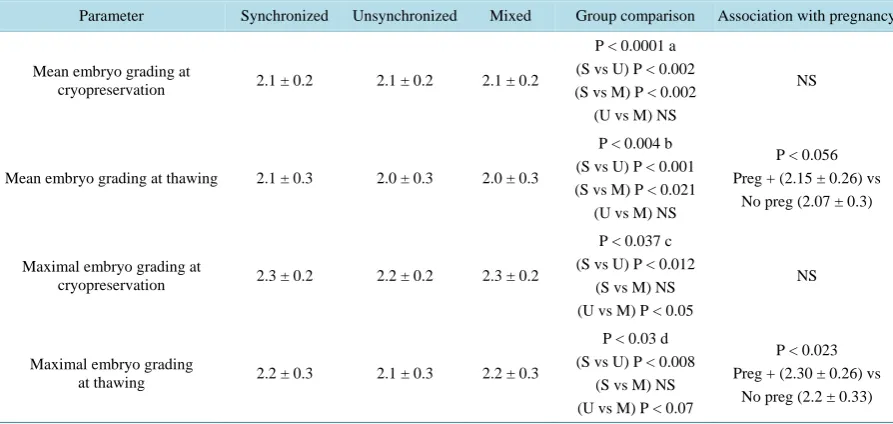
Table 3.Embryo grading parameters according to the blastomere synchronicity group and their association with pregnancy.
Parameter Synchronized Unsynchronized Mixed Group comparison Association with pregnancy
Mean embryo grading at
cryopreservation 2.1 ± 0.2 2.1 ± 0.2 2.1 ± 0.2
P < 0.0001 a (S vs U) P < 0.002 (S vs M) P < 0.002
(U vs M) NS
NS
Mean embryo grading at thawing 2.1 ± 0.3 2.0 ± 0.3 2.0 ± 0.3
P < 0.004 b (S vs U) P < 0.001 (S vs M) P < 0.021
(U vs M) NS
P < 0.056 Preg + (2.15 ± 0.26) vs
No preg (2.07 ± 0.3)
Maximal embryo grading at
cryopreservation 2.3 ± 0.2 2.2 ± 0.2 2.3 ± 0.2
P < 0.037 c (S vs U) P < 0.012
(S vs M) NS (U vs M) P < 0.05
NS
Maximal embryo grading
at thawing 2.2 ± 0.3 2.1 ± 0.3 2.2 ± 0.3
P < 0.03 d (S vs U) P < 0.008
(S vs M) NS (U vs M) P < 0.07
P < 0.023 Preg + (2.30 ± 0.26) vs
No preg (2.2 ± 0.33)
S = synchronized blastomere cleavage group. U = unsynchronized blastomere cleavage group. M = mixed blastomere cleavage group. a: The associa-tion between number of thawed embryos and mean embryo grading at cryopreservaassocia-tion was negative. P < 0.002. When controlled for number of thawed embryos, differences were non-significant for all numbers of thawed embryos. b: The association between number of thawed embryos and mean embryo grading at thawing P < 0.116. When controlled for number of thawed embryos, differences were non-significant for all numbers of thawed embryos except n = 2 (P < 0.006). c: When controlled for number of thawed embryos, differences were non-significant for all numbers of thawed embryos. d: When controlled for number of thawed embryos (n = 2 - 6), differences were non-significant except for n = 2 (P < 0.028).
3.4. Pregnancy and Live Birth Rates
Overall clinical pregnancy rate per transfer was 12% (67/558) and live birth rate 7.7% (43/558). No difference was found between the three embryo groups regarding pregnancy rate, miscarriage rates, twin pregnancy or live birth rates (Table 4).
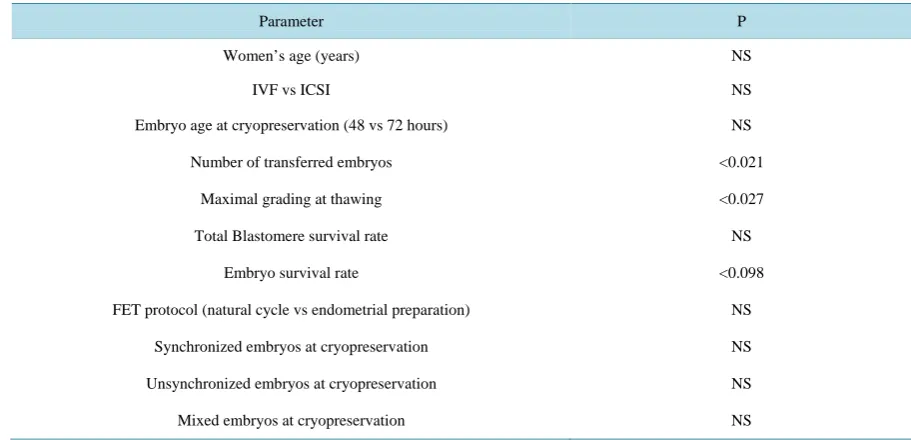
Parameters affecting the occurrence of pregnancy, were analysed by a multivariate logistic regression analysis. Both number of transferred embryos and maximal embryo grading at thawing were found to positively correlate with linical pregnancy rates (P = 0.014, P = 0.008, respectively, Table 5). Women’s age at cryopreservation, ICSI procedure, age of embryo at cryopreservation, FET protocol (i.e. natural cycle vs. endometrial preparation), total blastomere survival rate, embryo survival rate and study group did not affect the pregnancy rates (Table 5).
4. Discussion
In the present study, we have addressed three major clinical outcome parameters of cryopreserved-thawed em-bryos, according to synchronicity of blastomere cleavage; survival, morphological grading and pregnancy and live birth rates.
To our knowledge this is the first report addressing this issue.
The overall embryo survival rate was 68%, and delivery rates 7.4%, comparable to those mentioned in the li-terature [17]. Embryo age at cryopreservation/thawing was not found to affect the chances for conception when using a multivariate logistic regression analysis. The results of the present study show that blastomere survival parameters of the FET cohorts were higher in the synchronous embryos group.
These differences which may suggest superiority of synchronous embryo freezing cohorts (when frozen at day 2 or day 3 embryo cohorts), do not seem to have a clinical implication regarding the chance for implanta-tion.
Table 4.Treatment outcome according to the synchronicity group.
Parameter Group 1 synchronized Group 2 unsynchronized Group 3 mixed P
Pregnancy rate 10.2% (23) 10.8% (14) 14.9% (30) NS
Abortion rate (%) 2.7% (6) 6.2% (8) 4.9% (10) NS
Twin pregnancy 9% (2) 1.5% (2) 0.5% (1) NS
Live delivery 7.6% (17) 4.6% (6) 9.9% (20) NS
Table 5.Multi variant logistic regression analysis of clinical and laboratory parameters affecting the occurrence of pregnancy.
Parameter P
Women’s age (years) NS
IVF vs ICSI NS
Embryo age at cryopreservation (48 vs 72 hours) NS
Number of transferred embryos <0.021
Maximal grading at thawing <0.027
Total Blastomere survival rate NS
Embryo survival rate <0.098
FET protocol (natural cycle vs endometrial preparation) NS
Synchronized embryos at cryopreservation NS
Unsynchronized embryos at cryopreservation NS
Mixed embryos at cryopreservation NS
confirmed the occurrence of a normal asynchronous division process during early embryo development. They have also proposed a model representing a normal asynchronous division process from the 2 pronuclear stage through the 1 - 8 cell stages. In addition, they have found association between embryos with normal asynchro-nous division process and the potential for implantation [14] [15].
In the present study, despite better embryo survival parameters among synchronous embryos. This was not found to be associated with the chances of implantation or delivery rates. We note that the fraction of day 2 em-bryos was highest among the synchronous group, compared with asynchronous and the mixed groups but as an asymmetry is statistically more likely to with 4 - 8 blastomeres than with 2 blastomeres this may explain the rel-ative superiority of synchronous embryo freezing cohorts.
Our study suggests that synchronicity of blastomere cleavage at cryopreservation/thawing is not a good para-meter for selection embryos for freezing.
We have also found that embryo grading parameters both at cryopreservation and thawing were higher among the cohorts of synchronous embryos.
However, when a multivariate logistic regression analysis was applied, the only parameters correlated with clinical pregnancy and live birth were the number of transferred embryos and a good embryo grading by the embryologist at thawing.
[image:7.595.82.538.214.434.2]Another limitation is the law variability in morphological grading of embryos which may reflect freezing of many embryos that were not the highest quality morphologically. This may also explain the relative low delivery rates, but still within the ranges of the ESHRE report in 2013 [17].
Time-lapse analysis of fresh embryos in IVF may give more insight to the significance of embryo synchronic-ity. Meseguer et al. found that the time of division to 5 cells, an asynchronous cleavage embryo, was the most predictive parameter of subsequent implantation [1]. However even in the most recent study done by the same group, it is perceived that that embryo appearance (morphology) has to be combined with morphokinetics and further studies are requested to find the relative contribution of morphokinetics [18].
Therefore there is still place for analysis of simple morphology in the lab and particularly when synchronicity is considered as our results showed viable pregnancies in both types of cryopreserved embryos.
5. Summary
In summary, implantation potential, pregnancy rates and live birth rates resulting from synchronized and un-synchronized frozen-thawed embryos are similar.
Until proven otherwise, we suggest that unsynchronized embryos should not be discarded but similar to syn-chronized embryonic division, they should be selected for cryopreservation on the basis of other standard mor-phological criteria.
References
[1] Meseguer, M., Herrero, J., Tejera, A., Hilligsøe, K.M., Ramsing, N.B. and Remohí, J. (2011) The Use of Morphoki-netics as a Predictor of Embryo Implantation. Human Reproduction, 26, 2658-2671.
http://dx.doi.org/10.1093/humrep/der256
[2] Griesinger, G., Schultz, L., Bauer, T., Broessner, A., Frambach, T. and Kissler, S. (2011) Ovarian Hyperstimulation Syndrome Prevention by Gonadotropin-Releasing Hormone Agonist Triggering of Final Oocyte Maturation in a Go-nadotropin-Releasing Hormone Antagonist Protocol in Combination with a “Freeze-All” Strategy: A Prospective Mul-ticentric Study. Fertility and Sterility, 95, 2029-2033. http://dx.doi.org/10.1016/j.fertnstert.2011.01.163
[3] Van Landuyt, L., Stoop, D., Verheyen, G., Verpoest, W., Camus, M., Van de Velde, H., Devroey, P. and Van den Ab-beel, E. (2011) Outcome of Closed Blastocyst Vitrification in Relation to Blastocyst Quality: Evaluation of 759 Warm- ing Cycles in a Single-Embryo Transfer Policy. Human Reproduction, 26, 527-534.
http://dx.doi.org/10.1093/humrep/deq374
[4] Trounson, A. and Mohr, L. (1983) Human Pregnancy Following Cryopreservation, Thawing and Transfer of an 8-Cell Embryo. Nature, 305, 707-709. http://dx.doi.org/10.1038/305707a0
[5] Lahav-Baratz, S., Koifman, M., Shiloh, H., Ishai, D., Wiener-Megnazi, Z. and Dirnfeld, M. (2003) Analyzing Factors Affecting the Success Rate of Frozen-Thawed Embryos. Journal of Assisted Reproduction and Genetics, 11, 444-448. http://dx.doi.org/10.1023/B:JARG.0000006705.46147.a2
[6] Wang, J.X., Yap, Y.Y. and Matthews, C.D. (2001) Frozen-Thawed Embryo Transfer: Influence of Clinical Factors on Implantation Rate and Risk of Multiple Conception. Human Reproduction, 16, 2316-2319.
http://dx.doi.org/10.1093/humrep/16.11.2316
[7] Ashrafi, M., Jahangiri, N., Hassani, F., Akhoond, M.R. and Madani, T. (2011) The Factors Affecting the Outcome of Frozen-Thawed Embryo Transfer Cycle. Taiwanese Journal of Obstetrics and Gynecology, 50, 159-164.
http://dx.doi.org/10.1016/j.tjog.2011.01.037
[8] Ebner, T., Moser, M., Sommergruber, M. and Tews, G. (2003) Selection Based on Morphological Assessment of Oo-cytes and Embryos at Different Stages of Preimplantation Development: A Review. Human Reproduction, 3, 251-262. http://dx.doi.org/10.1093/humupd/dmg021
[9] Giorgetti, C., Terriou, P., Auquier, P., et al. (1995) Embryo Score to Predictimplantation after In-Vitro Fertilization: Based on 957 Single Embryo Transfers. Human Reproduction, 10, 2427-2431.
http://dx.doi.org/10.1093/oxfordjournals.humrep.a136312
[10] Dirnfeld, M., Paz, M., Yshai, D., Calderon, I., Lahav-Baratz, S., Koifman, M., Shiloh, H., Abramovici, H. and Bider, D. (2003) The Impact of Early Testicular Sperm Extraction or Cryopreservation on the Outcome of Intra Cytoplasmic Sperm Injection—A Randomized Controlled Study. Journal of Assisted Reproduction and Genetics, 20, 205-209. http://dx.doi.org/10.1023/A:1024116326465
[12] Menezo, Y. (2004) Cryopreservation of IVF Embryos: Which Stage? European Journal of Obstetrics & Gynecology
and Reproductive Biology, 113, S28-S32. http://dx.doi.org/10.1016/j.ejogrb.2003.11.007
[13] Hardarson, T., Hanson, C., Sjögren, A. and Lundin, K. (2001) Human Embryos with Unevenly Sized Blastomeres Have Lower Pregnancy and Implantation Rates: Indications for Aneuploidy and Multinucleation. Human Reproduction, 2, 313-318. http://dx.doi.org/10.1093/humrep/16.2.313
[14] Roux, C., Joanne, C., Agnani, G., Fromm, M., Clavequin, M.C. and Bresson, J.L. (1995) Morphometric Parameters of Living Human In-Vitro Fertilization Embryos; Importance of the Asynchronous Division Process. Human Reproduc-tion, 10, 1201-1207.
[15] Roux, C., Borodkine, R., Joanne, C., Bresson, J.L. and Agnani, G. (1995) Morphological Classification of Human
In-Vitro Fertilization Embryos Based on the Regularity of the Asynchronous Division Process. Human Reproduction, 1,
488-496. http://dx.doi.org/10.1093/humupd/1.5.488
[16] AbdelHafez, F.F., Desai, N., Abou-Setta, A.M., Falcone, T. and Goldfarb, J. (2010) Slow Freezing, Vitrification and Ultra-Rapid Freezing of Human Embryos: A Systematic Review and Meta-Analysis. Reproductive BioMedicine Online, 20, 209-222. http://dx.doi.org/10.1016/j.rbmo.2009.11.013
[17] Ferraretti, A.P., Goossens, V., Kupka, M., Bhattacharya, S., de Mouzon, J., Castilla, J.A., Erb, K., Korsak, V., Nyboe Andersen, A., European IVF-Monitoring (EIM); Consortium, for The European Society of Human Reproduction and Embryology (ESHRE) (2013) Assisted Reproductive Technology in Europe, 2009: Results Generated from European Registers by ESHRE. Human Reproduction, 28, 2318-2331. http://dx.doi.org/10.1093/humrep/det278