BIROn - Birkbeck Institutional Research Online
Fletcher, G.H.L. and Peters, J. and Poulovassilis, Alexandra (2016) Efficient
regular path query evaluation using path indexes.
In:
Pitoura, E.
and Maabout, S. and Koutrika, G. and Marian, A. and Tanca, L. and
Manolescu, I. and Stefanidis, K. (eds.) 19th International Conference on
Extending Database Technology Bordeaux, France, March 15–18, 2016
Proceedings. Bordeaux, France: OpenProceedings.org, pp. 636-639. ISBN
9783893180707.
Downloaded from:
Usage Guidelines:
Please refer to usage guidelines at
or alternatively
Efficient regular path query evaluation using path indexes
George H. L. Fletcher
Eindhoven University of Technology The Netherlands
[email protected]
Jeroen Peters
Eindhoven University of Technology The Netherlands
[email protected]
Alexandra Poulovassilis
London Knowledge Lab Birkbeck, University of
London, UK
[email protected]
ABSTRACT
We demonstrate the use of localized path indexes in gener-ating efficient execution plans for regular path queries. This study is motivated by both the practicality of this class of queries and by the current dearth of scalable solutions for their evaluation. Our proposed solution leverages widely available relational database technology and is often orders of magnitude faster than currently known approaches. We aim in this hands-on demonstration to both highlight the promise of our approach and to stimulate further discus-sion and study of engineering solutions for this practical yet challenging class of graph queries.
1.
INTRODUCTION
Massive graph-structured data collections are ubiquitous in contemporary data management scenarios such as so-cial networks, linked open data, and chemical compound databases. A fundamental paradigm in graph query lan-guages are the so-called regular path queries (RPQs) [16]. RPQs specify a regular expression over the edge labels in a graph, and the query answer consists of every path in the graph such that the sequence of edge labels along the path forms a word in the language recognized by the regular ex-pression. Variations and extensions of RPQs are supported in recent query languages such as SPARQL 1.1 [8] and the Cypher language of the Neo4j graph database.1
State of the art.
Indexing of paths occurring in data has been shown to be effective for query processing in the context of object-oriented and semistructured databases [1, 15]. To our knowledge, however, there has been no investigation of using path indexing for the evaluation of RPQs over graph databases. In particular, three general approaches to RPQ evaluation have been proposed in the literature:1. Automata- and search-based processing (e.g., [5, 10, 13]), where queries are evaluated by strategies such
1
http://neo4j.com
Permission to make digital or hard copies of all or part of this work for personal or classroom use is granted without fee provided that copies are not made or distributed for profit or commercial advantage and that copies bear this notice and the full citation on the first page. To copy otherwise, to republish, to post on servers or to redistribute to lists, requires prior specific permission and/or a fee.
Copyright 20XX ACM X-XXXXX-XX-X/XX/XX ...$15.00.
as breadth-first-search pattern matching of the query graph on the data graph;
2. Datalog-based processing (e.g., [3, 17]), where the Kleene star operator is translated into recursive Datalog pro-grams or recursive SQL views;
3. Reachability-index-based processing (e.g., [6]), where restricted uses of Kleene star are translated into reach-ability queries, which are then evaluated using off-the-shelf reachability indexes.
Contributions.
We present an overview of our ongoing study of the use of path indexes for generating efficient execution plans for RPQs. Our approach supports the evaluation of arbitrary RPQs (unlike approach (3) above), and exhibits significant improvement (often by several orders of magni-tude) in query processing times over approaches (1) and (2). In the next section we briefly define the problem. In Sec-tion 3 we introduce the main data structures used in our solution. We then discuss query plan generation and execu-tion in Secexecu-tion 4. We conclude in Secexecu-tion 6 with an overview of our system demonstration.2.
PRELIMINARIES
2.1
Data Model
We consider finite, directed, edge-labeled graphs. Agraph vocabulary is a finite non-empty setLof edge labelsdrawn from some universe of labels. LetN be an infinite universe of atomic data objects. Anedge relationis a finite subset of
N×N. Agraphover vocabularyLis an assignmentGof an edge relation`Gto each`∈ L, i.e., there is an edge labeled
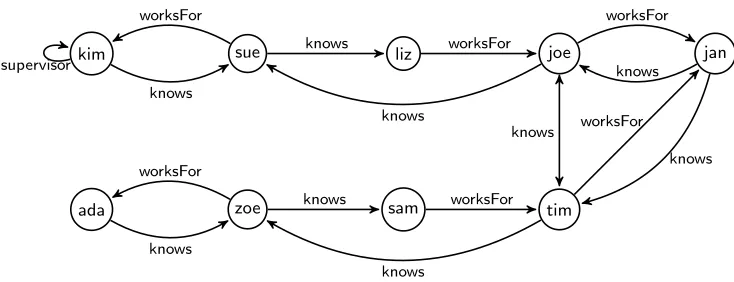
`fromm ton if (m, n)∈`G. In the sequel, we will some-times denote this by`(m, n) orm−→` n. As an example, a graphGexover the vocabulary{supervisor,knows,worksFor}
is shown in Figure 1.
Thenode setofGis the collectionnodes(G) ={n| ∃m∈
N, ` ∈ L : (n, m) ∈ `Gor (m, n) ∈ `G}. For example, the node set of the example graph contains nine elements:
nodes(Gex) ={ada,jan, . . . ,zoe}.
Letk be a natural number. Ifk = 0, we say there is a
k-path from s tos, for every s ∈ nodes(G). If k > 0, for
s, t∈nodes(G), we say there is ak-path fromstotif there exist n0, . . . , nk ∈nodes(G) and edge labels`1, . . . , `k ∈ L
such thatn0=s,nk=t, and, for 0< i≤k, (ni−1, ni)∈`Gi
sue liz joe
zoe sam tim
kim
ada
jan
knows knows
worksFor
worksFor
knows
worksFor
knows
knows worksFor
worksFor
knows
worksFor knows
supervisor knows
[image:3.628.121.488.52.193.2]knows
Figure 1: A graphGex over vocabularyL={supervisor,knows,worksFor}.
We denote by pathsk(G) the set of all pairs of nodes
(s, t) ∈ nodes(G)×nodes(G) such that there is ani-path fromstot, for somei≤k.
As an example, in the graphGexwe have that (sam,ada)∈
paths2(Gex) via the paths sam
knows
←−−− zoe −−−−→worksFor ada and
sam←−−−knows zoe←−−−knows ada,but (sam,ada)6∈paths1(Gex).
2.2
Regular Path Queries
Fix a vocabulary L. A regular path query (RPQ) is a regular expressionRover the alphabet{`, `−|`∈ L}, i.e.,
Ris generated by the grammar
R ::= |`|`−|R◦R|R∪R|Ri,j
for`∈ Land natural numbersiand j wherei≤j. Intu-itively, “” is the identity transition, “`” is forward navigation along an edge with that label, “`−” is backwards navigation, “◦” is path composition, “∪” is path disjunction (i.e., union
of paths), and “Ri,j” is bounded path recursion.
Given graph G over L, the semantics of evaluating an RPQ R onGis a set R(G) consisting of all pairs (a, b) in
paths(G) such that there exists a path from nodeato node
binGwhose label sequence `1· · ·`n defines a word in the
regular language specified byR.
As examples, we have in the graphGexof Figure 1 that:
supervisor◦worksFor−(Gex) = {(kim,sue)}
and
(supervisor∪worksFor∪worksFor−)4,5(Gex) =
{(kim,kim),(kim,sue),(sue,kim),(sue,sue),
(ada,zoe),(ada,ada),(zoe,ada)}.
Note that we deviate from the traditional syntax of regular expressions by replacing Kleene star “∗” with bounded recur-sion. This is motivated by the following two observations. First, bounded recursion is supported (and encouraged) in practical graph query languages such as Neo4j’s Cypher.2 Second, since we focus in this work on index construction and use, we are interested in query evaluation on a given graph. It is easy to establish that for any graph G there exists a natural numbern(G) such that for every RPQRit is the case thatR∗(G) =R0,n(G)(G).
2
http://neo4j.com/docs/stable/, Section 8.8
3.
INDEXES AND HISTOGRAMS
Given a graphGand a fixed k >0, we now present our indexing and selectivity estimation approaches for paths in
Glocalized to neighborhoods of sizek.
3.1
k-path indexing
Alabel pathis a sequencep=`1· · ·`n, wheren >0 is the
lengthofp, and`i∈ {`, `−|`∈ L}for each 1≤i≤n.
Our index onGis based on an ordered dictionary (which can be implemented, for example, as a B+tree). In particu-lar, we indexpathsk(G) using an orderedk-path indexIG,k
having search keyhlabel path, sourceID, targetIDi. Specif-ically, for each label path p of length at most k, and for each pair of nodes (a, b)∈p(G), we insert (p, a, b) intoIG,k.
Given a non-empty prefixpof a search key,IG,k returns an
ordered listIG,k(p) of all matching entries.
Example 3.1. In the graph of Figure 1, we have
IG,k(hknows·knows·worksFori) =
h(ada,tim),(jan,ada),(jan,jan),(jan,kim),
(joe,ada),(joe,jan),(joe,joe),(kim,joe),
(tim,jan),(tim,kim),(tim,tim)i,
IG,k(hknows·knows·worksFor,jani) =
h(ada),(jan),(kim)i,
IG,k(hknows·knows·worksFor,jan,adai) = h()i,
IG,k(hknows·knows·worksFor,jan,joei) = hi.
We have developed a prototype k-path index implemen-tation that leverages the B+ tree index support of Post-greSQL3. We translate RPQs into equivalent SQL state-ments overIG,kimplemented as a relational table and backed
by a B+tree (see [12] for full implementation details). In building on mature relational technologies, we are following an emerging trend in this direction [4, 7, 9] with practi-cal benefits such as simplicity, ease of integration with and deployment within existing IT ecosystems, and leveraging field-proven technologies.
Notwithstanding the fact that we have described here an implementation of our proposedk-path indexing technique 3
using existing RDBMS technologies, other recent work [14] describes an implementation of a B+tree-basedk-path index “from scratch”, focusing on issues such as index size, com-pression and performance, and undertaking a comparative performance study with the Neo4j graph DBMS over several real and synthetic datasets and query workloads. That eval-uation too demonstrates the potential of ourk-path index-ing approach (showindex-ing speed-ups in query evaluation times ranging from 2 times to 8,000 times faster compared with Neo4j). Detailed performance comparison between these ap-proaches to path indexing is an area of future work.
3.2
k-path histogram
For query plan generation overIG,k, it is useful to have a
data structureselG,k which, given a label pathpof length
at mostk, returns an estimate of the selectivity ofp inG, i.e., the fraction of paths inpathsk(G) which satisfyp.
As an example, we have in the graphGexof Figure 1 that
selGex,2(supervisor◦knows)≈0.02, since only one of the 53 paths inpaths2(Gex) is insupervisor◦knows(Gex).
There is a rich literature on statistics for query optimiza-tion [2]. Here, we adopt the well-established histogram data structure, since it is easy to deploy and extremely success-ful in practice. In particular, we implement selG,k as an
equi-depth histogram. As with the path indexes, in our pro-totype implementation we store and access our histogram as a PostgreSQL table; see [12] for full implementation details.
4.
QUERY EVALUATION WITH
PATH INDEXES
The processing of a RPQRproceeds in three steps: The
first stepis to replace each occurrence of bounded recursion inRas a union over its expansion. The result is a semanti-cally equivalent queryR0 involving only edge labels or their inverses, compositions, and unions. In thesecond step, all unions in R0 are “pulled up” to the top level of the query, resulting in a semantically equivalent queryR00 consisting of a union of expressions each free of unions and bounded recursion, i.e.,R00=R1∪ · · · ∪Rn where eachRi is a label
path. In thethird step, each disjunctRi is processed in
turn, with the aim of generating a physical execution plan for eachRiin which a merge-join is used whenever possible
(to make the best use of the physical sort order of the index) and a hash-join is used otherwise.
As an illustrative example, consider the query R = k◦
(k◦w)2,4◦w, wherekandwabbreviateknowsandworksFor, resp. Query plan generation proceeds as follows, where for clarity of presentation we drop explicit use of the concate-nation operation◦:
1. (kb)2,4 is expanded, giving
R0 = k(kwkw ∪ kwkwkw ∪ kwkwkwkw)w.
2. Nested unions are pulled up to the top level, giving
R00 = kkwkww ∪ kkwkwkww ∪ kkwkwkwkww.
3. Finally, physical execution plans are generated for each of the disjuncts of R00. In particular, suppose that
k = 3; then processing each of the disjuncts proceeds as follows:
• kkwkwwis processed, from left to right, generat-ing the physical plan
IG,k(w
−
k−k−)1IG,k(kww)
in which1is implemented as a merge join. Note the subexpressionkkwhas been inverted to obtain the correct sort order to perform a merge join.
• kkwkwkww is processed from left to right, gener-ating the physical plan
[IG,k(w−k−k−)11IG,k(kwk)]12IG,k(ww)
in which11 is implemented as a merge join and
12 as a hash join.
• kkwkwkwkwwis processed from left to right, gen-erating the physical plan
[(IG,k(w−k−k−)11IG,k(kwk))
12 IG,k(wkw)]13IG,k(w)
in which11 is implemented as a merge join and
12 and13 as hash joins.
We term this evaluation strategysemi-naive. The com-plete physical plan is formed as a union of these three sub-plans.
The third step can be optimized by using the histogram
selG,k, as follows. For each disjunctDofR00
1. if|D| ≤k, returnIG,k(D).
2. Find the most selectivek-path subqueryD0 ofD(i.e., thek-path with smallestselG,kvalue). There aren−
k−1 such subqueries to consider.
3. Let D = Dleft◦D0◦Dright, and recur onDleft and
Dright, to generate query plans for respective output streamsLEF T andRIGHT.
4. Determine the cost of each of the following alternative query plans, and return the cheapest plan:
• [LEF T 1IG,k(D0)]1RIGHT,
• LEF T 1[IG,k(D0)1RIGHT],
• [LEF T 1IG,k(D0−)]1RIGHT, or
• LEF T 1[IG,k(D0−)1RIGHT].
We term this evaluation strategyminSupport.
As an illustration of this strategy, consider again the first disjunct kkwkww of our example query. Suppose we find that the subquerykwkis the most selective amongst all four subqueries of length k = 3 and that the subquery ww is more selective than the subqueryk. Then the physical plan generated by the minSupport strategy would be
IG,k(k)12[IG,k(kwk)11IG,k(w
−
w−)]
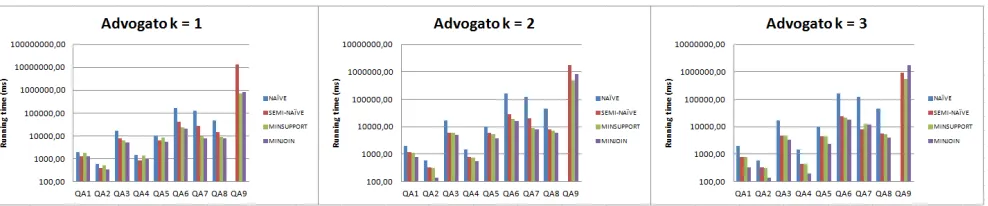
Figure 2: Advogato query execution times (ms)
5.
EMPIRICAL EVALUATION
We refer the reader to [12] for full details of an empirical evaluation of our system with respect to a broad spectrum of RPQs over four different real and synthetic datasets. In ad-dition to the semi-naive and minSupport evaluation methods described above, two other methods are investigated: naive, in whichk is fixed at 1 (so indexing is on edge labels, not path labels), which corresponds to automaton-based evalu-ation (approach 1, discussed in the Introduction); and min-Join, which is similar to minSupport but also aims to mini-mize the number of joins.
As an indicative subset of the empirical results obtained, the three graphs in Figure 2 show the run-times of 8 queries over the Advogato data set, for each of the four evaluation methods, with values ofkranging from 1 to 3. Advogato is a real-world social network having 6,541 nodes and 51,127 edges with|L|= 3, where edges indicate varying degrees of trust between users in the network [11].4
We observe that the naive method always performs worst, that the semi-naive method is generally outperformed by minSupport and minJoin, and that the latter two perform similarly. This demonstrates the value of the lightweight histogram data structure for selectivity estimation. We also see that increasing the value ofkgenerally improves the run-times for all methods (apart from naive, wherekis fixed at 1 throughout).
6.
DEMONSTRATION OVERVIEW
We give participants a hands-on overview of the life of a regular path query, from its submission to our system, through parsing and optimization, to execution. We fur-ther demonstrate the speed-ups achieved by our approach compared with Datalog-based evaluation (approach (2), dis-cussed in the Introduction), where our solution is on average 1200x faster on the Advogato queries [12].
Through these interactive activities, we hope to both demon-strate the promise of our approach to RPQ evaluation and to stimulate further broader discussion and study in the re-search community of engineering strategies for this challeng-ing practical class of graph queries. A system demonstration is an excellent setting in which to accomplish these goals.
7.
REFERENCES
[1] E. Bertino et al. Object-oriented databases. In E. Bertino et al, editor,Indexing Techniques for Advanced Database Systems, pages 1–38. Kluwer, 1997.
4The data set is publicly available at http://konect. uni-koblenz.de/networks/advogato
[2] G. Cormode, M. N. Garofalakis, P. J. Haas, and C. Jermaine. Synopses for massive data: Samples, histograms, wavelets, sketches.Foundations and Trends in Databases, 4(1-3):1–294, 2012.
[3] S. C. Dey et al. On implementing provenance-aware regular path queries with relational query engines. In
GraphQ, pages 214–223, Genoa, 2013.
[4] J. Fan, G. S. Raj, and J. M. Patel. The case against specialized graph analytics engines. InCIDR, Asilomar, California, 2015.
[5] W. Fan, J. Li, S. Ma, N. Tang, and Y. Wu. Adding regular expressions to graph reachability and pattern queries.Frontiers of Comp. Sci., 6(3):313–338, 2012. [6] A. Gubichev, S. J. Bedathur, and S. Seufert. Sparqling
kleene: fast property paths in RDF-3X. InGRADES, New York, NY, 2013.
[7] A. Gubichev and M. Then. Graph pattern matching – do we have to reinvent the wheel? InGRADES, Snowbird, Utah, 2014.
[8] S. Harris and A. Seaborne, editors.SPARQL 1.1 Query Language, W3C Recomm., 2013.
[9] A. Jindal and S. Madden. GRAPHiQL: A graph intuitive query language for relational databases. In
Big Data, pages 441–450, Washington, DC, 2014. [10] A. Koschmieder and U. Leser. Regular path queries on
large graphs. InSSDBM, pages 177–194, Chania, Crete, Greece, 2012.
[11] P. Massa, M. Salvetti, and D. Tomasoni. Bowling alone and trust decline in social network sites. In
DASC, pages 658–663, Chengdu, China, 2009. [12] J. Peters. Regular path query evaluation using path
indexes. Master’s thesis, Eindhoven University of Technology, 2015.
[13] P. Selmer, A. Poulovassilis, and P. T. Wood. Implementing flexible operators for regular path queries. InGraphQ, Brussels, 2015.
[14] J. Sumrall, G. H. L. Fletcher, and
A. Poulovassilis et al. Investigations on path indexing for neo4j, 2015. Under review.
[15] K.-F. Wong, J. X. Yu, and N. Tang. Answering XML queries using path-based indexes: A survey.World Wide Web, 9(3):277–299, 2006.
[16] P. T. Wood. Query languages for graph databases.
SIGMOD Record, 41(1):50–60, 2012.