http://dx.doi.org/10.4236/ns.2016.87036
How to cite this paper: Ma, Z.Q., Wang, G.R., Tian, Y.F., Xu, D.L., Miao, X.F., Zhang, Y., Meng, J., Ni, H. and Sun, W.W. (2016) Effect of Electroplating Waste Water on Immune Function in Kunming Mice. Natural Science, 8, 315-320.
http://dx.doi.org/10.4236/ns.2016.87036
Effect of Electroplating Waste Water on
Immune Function in Kunming Mice
Zongqi Ma
1*, Guirong Wang
1*, Yufen Tian
2*, Deli Xu
1#, Xiaofeng Miao
1, Ying Zhang
1,
Jiao Meng
1, Hong Ni
1, Weiwei Sun
11College of Life Sciences, Qufu Normal University, Qufu, China 2Library, Qufu Normal University, Qufu, China
Received 19 May 2016; accepted 9 July 2016; published 12 July 2016
Copyright © 2016 by authors and Scientific Research Publishing Inc.
This work is licensed under the Creative Commons Attribution International License (CC BY).
http://creativecommons.org/licenses/by/4.0/
Abstract
Electroplating waste water is considered to be harmful to health of animals. In the present study, we tested the hypothesis that electroplating waste water would suppress immune functions in Kunming mice. Twenty-six mice were randomly divided into the control group (n = 13) and the experimental group (n = 13), in which the latter drank electroplating waste water. We found that body mass and most organ wet masses (heart, lungs, liver, kidneys, stomach, caecum, colon, testes, epididymis, seminal vesicals) were not influenced by electroplating waste water. However, sto-mach with its content, small intestine, small intestine with its contents and colon with its contents were higher in the experimental group than in the control group. As expected, phytohaemaggluti-nin (PHA) response indicative of cellular immunity was suppressed by electroplating waste water. White blood cells, thymus and spleen mass were all not response to electroplating waste water. Taken together, electroplating waste water had different effects on distinct components of im-mune system in Kunming mice.
Keywords
Electroplating Waste Water, Mice, Phytohaemagglutinin (PHA) Response, Immune Function
1. Introduction
Electroplating waste water is produced in the electroplating industries such as the machinery manufactured, light and electronic industries. Due to its harmful components such as chromium, cadmium and cyanide and other
toxic chemicals, it is considered to pollute the environments and impair human health [1][2].
Some researchers have reported the harmful effects of electroplating waste water in shrimps and fishes. For example, electroplating waste water has harmful influence on the embryos and juveniles of shrimps and fishes [3]-[6]. Many fishes died in a river near the city of Guanzhou in China in February 2006, which was mainly caused by electroplating waste water [7]. However, influence of electroplating waste water on small mammals receives little attention.
Phytohaemagglutinin (PHA) response has been used to evaluate mammalian cellular immunity [8][9]. Im-mune organs such as thymus and spleen are also indicative of imIm-mune function [10]-[12]. Thymus is crucial for primary T cell development [10], and a larger spleen implies a stronger immune system [12]. In addition, total white blood cells (WBC), which are important for immune response against pathogens, are also useful to assess the overall health [11]. Due to the scarce research about the effect of electroplating waste water on rodents, we tested the hypothesis that electroplating waste water would suppress immune function in mice in the present study.
2. Materials and Methods
2.1. Animals and Experimental Design
All animal procedures were licensed under the Institutional Animal Care and Use Committee of Qufu Normal University. Adult male Kunming mice (age: 5 - 6 months) used in this study were obtained from Experiment Animal Center in Shandong Lukang Pharmaceutical Co., Ltd. The animals were housed individually in plastic cages (30 cm × 15 cm × 20 cm) with sawdust as bedding under a natural light. The experiment was carried out from May 10th to June 15th in 2014. Standard rat pellets chow (Shandong Lukang Pharmaceutical Co., Ltd., Jin-ing, China) and water were provided ad libitum. After body mass stabilized, 26 male mice were randomly di-vided into the control group (n = 13) and the experimental group (n = 13). Mice in the control group had free access to water, whereas mice in the experimental group had free access to the electroplating waste water (chromium (Cr): 0.0784 µg/ml, nickel (Ni): 36.4 µg/ml, lead (Pb): 277 µg/ml, Copper (Cu): 153.2 µg/ml, Zinc (Zn): 12.6 µg/ml). Food was provided ad libitum throughout the experiment and the experimental course lasted for 27 days. One mouse in the control group and another in the experimental group died after 8 days and 22 days respectively. These two mice were not included in the subsequent statistical analysis. Day 0 and day n repre- sented initial day and n days of treatment, respectively.
2.2. Organs and Body Composition
Organs were examined as described previously [13]. In brief, after mice were killed, the visceral organs, includ-ing heart, thymus, lungs, liver, spleen, kidneys, adrenal glands, testes, epididymis, seminal vesicals and the di-gestive organs with contents (i.e., stomach, small intestine, caecum and colon) were dissected and weighed (±1 mg). The stomach, small intestine, caecum and colon were rinsed with saline to eliminate all the gut contents, before being weighed.
2.3. Cellular Immunity Assays
PHA response was assessed as described previously [13]. Specifically, Kunming mice in the control and expe-rimental groups on day 24were caught, then we measured their footpad thickness of the left hind foot with a micrometer (Digimatic Indicator ID-C Mitutoyo Absolute cod. 547-301, Japan) to ±0.01 mm. Immediately the-reafter, mice in the control and experimental groups were injected subcutaneously 0.1 mg of PHA (PHA-P, Sigma L-8754) dissolved in 0.03 mL of sterile saline (pH 7.4) in the middle of the footpad. After 6 h, 12 h, 24 h, 48 h and 72 h injection, we measured footpad thickness. The PHA response (i.e., cellular immunity) was calcu-lated as the difference between pre- and post-injection measurements divided by initial footpad thickness (PHA response = (post PHA − pre PHA)/pre PHA). Six measures of footpad thickness were taken to obtain the value of each mouse [13].
2.4. White Blood Cells Assays
and the leukocytes were counted in an improved Neubauer chamber using microscope. The total number of WBC was determined by counting all leucocytes in the four corner large-squares of the Neubauer chamber, and multiplying the raw data by 5 × 10⁷ to obtain the final values (109 cells/L).
2.5. Statistical Analysis
Data were analyzed using SPSS 13.0 software (SPSS Inc., Chicago, IL, USA). Prior to all statistical analyses, data were examined for normality and homogeneity of variance, using Kolmogorov-Smirnov and Levene tests, respectively. The ratio values including PHA response were subjected to arcsine transformation. The differences of body mass between the control and experimental groups at any time point were analyzed by independent- samples t-test. Group differences in wet organ mass with body mass as the covariate were analyzed by General Linear Model multivariate analysis followed by Bonferroni post hoc tests. Group differences in other parameters (body compositions, PHA response, WBC) were analyzed by independent-samples t-test. Results were ex-pressed as mean ± SE, and P < 0.05 was considered to be statistically significant.
3. Results
3.1. Body Mass
Body mass did not differ between the control and experiment groups from the beginning to the end of the expe-riment (day 0: t = −0.592, df = 21, P = 0.560; day 27: t = 0.829, df = 21, P = 0.417) (Figure 1).
3.2. Organs
Electroplating waste water increased the masses of stomach with its content, small intestine, small intestine with its contents and colon with its contents (Table 1). However, masses of immune organs (i.e., thymus and spleen) and other organs were not influenced by electroplating waste water (Table 1).
3.3. Cellular Immunity
Electroplating waste water suppressed 6 h (t = 2.781, df = 21, P = 0.011) and 12 h (t = 2.185, df = 21, P = 0.040) of PHA responses (Figure 2). PHA responses of 24 h (t = 1.547, df = 21, P = 0.137), 48 h (t = 1.787, df = 21, P = 0.088), 72 h (t = 1.303, df = 21, P = 0.207) did not differ between the experimental and control groups.
3.4. White Blood Cells
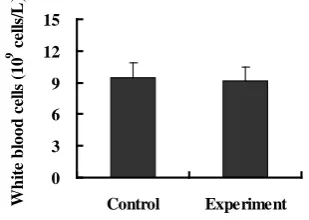
WBC in the experiment group was not different from the control group (t = 0.140, df = 21, P = 0.890) (Figure 3).
4. Discussion
As expected, cellular immunity in Kunming mice was impaired by electroplating waste water, however other
Figure 1. Effect of electroplating waste water on body mass in
Kunming mice. 0
10 20 30 40
0 3 6 9 12 15 18 21 24 27
Time (day)
B
od
y m
as
s (
g)
[image:3.595.195.435.576.692.2]Figure 2. Effect of electroplating waste water on PHA response in Kunming mice. An asterisk (*) indicates statistical differences at P <
[image:4.595.182.445.85.210.2]0.05.
Figure 3. Effect of electroplating waste water on total white blood cells
in Kunming mice.
immunological parameters including white blood cells, thymus and spleen mass did not differ between the con-trol and experimental mice.
4.1. Body Mass, Organs and Waste Water
Electroplating waste water had no effect on body mass and most organ masses. Stomach with its content, small intestine, small intestine with its contents and colon with its contents increased upon electroplating waste water, implying that the digestive capacity of mice might improve.
4.2. Immunity and Waste Water
Cellular immunity in mice was impaired by electroplating waste water, indicating their capacity of fighting against pathogens decreased. Other immunological parameters including white blood cells, thymus and spleen mass were all not response to electroplating waste water. These results demonstrated that different components of immune system had distinct sensitivities to electroplating waste water. Due to the complex components of electroplating waste water in our study, it was difficult to clarify which component played the major role in af-fecting immune function in mice. Effect of single heavy metal on immunity has been conducted in some re-searches. For example, dietary chromium can increase the levels of immunoglobulin M in juvenile rockfish [14]. Lower dietary nickel concentrations suppressed while higher nickel concentrations increased immune responses of Fabricius larvae [15]. In addition, negative correlation was observed between elevated lead levels and the percentage of natural killer cells, blood hepatitis B surface antibody levels in children from an electronic waste recycling area [16][17]. Although copper is recognized as an essential trace element, uncertainties remain re-garding copper reference values for humans. For instance, very low copper intake may impair immune function in human [18]. However, low levels of copper contamination may enhance immunity of estuarine bivalves [19]. Zinc is an essential trace element which is important for maintenance and development of immune cells of both the innate and adaptive immune system [20]. Synergistic or antagonistic actions among different metals in elec-troplating waste water on immunity in mice need further researches in the future.
* * 0.0 0.2 0.4 0.6 0.8 1.0
6 12 24 48 72
Hours post-PHA injection
P H A r esp o n se Control Experiment 0 3 6 9 12 15 Control Experiment W h it e b lo o d c ells ( 1 0
9 c
ells
/L
[image:4.595.236.391.262.372.2]Table 1. Effect of electroplating waste water on wet organ mass in Kunming mice.
Parameters Control Experiment Statistical summary
Sample size 12 12
Heart (g) 0.153 ± 0.005 0.151 ± 0.005 0.715
Lungs (g) 0.342 ± 0.033 0.322 ± 0.033 0.671
Liver (g) 1.777 ± 0.049 1.750 ± 0.049 0.703
Spleen (g) 0.113 ± 0.009 0.089 ± 0.009 0.085
Kidneys (g) 0.459 ± 0.019 0.473 ± 0.019 0.614
Stomach with contents (g) 0.655 ± 0.069b 0.976 ± 0.069a 0.004
Stomach (g) 0.189 ± 0.008 0.202 ± 0.008 0.232
Small intestine with contents (g) 1.828 ± 0.075b
2.070 ± 0.075a 0.034
Small intestine (g) 0.880 ± 0.051b 1.078 ± 0.051a 0.012
Small intestine length (cm) 56.5 ± 1. 3 58.5 ± 1.3 0.287
Caecum with contents (g) 0.493 ± 0.040 0.575 ± 0.040 0.169
Caecum (g) 0.225 ± 0.052 0.122 ± 0.052 0.173
Caecum length (cm) 2.530 ± 0.099 2.795 ± 0.099 0.073
Colon with contents (g) 0.555 ± 0.039b 0.689 ± 0.039a 0.024
Colon (g) 0.298 ± 0.025 0.283 ± 0.025 0.676
Colon length (cm) 10.572 ± 1.235 74.262 ± 5.623 0.360
Total digestive tract (g) 1.403 ± 0.089 1.483 ± 0.089 0.534
Total digestive tract length (cm) 69.6 ± 4.7 135.6 ± 4.9 0.339
Epedidymus (g) 0.072 ± 0.007 0.066 ± 0.007 0.548
Testes (g) 0.271 ± 0.018 0.239 ± 0.018 0.222
Seminal vesical (g) 0.166 ± 0.013 0.152 ± 0.013 0.437
Values are means ± SE. Values for a specific parameter that share different superscripts are significantly different at P < 0.05, determined by General Linear Model multivariate analysis followed by Bonferroni post hoc tests with body mass as the covariate ns, not significant.
5. Conclusion
In summary, electroplating waste water harmed cellular immunity in mice, whereas other immunological para-meters (i.e., white blood cells, thymus and spleen mass) were not response to electroplating waste water. Due to the complex constituents of electroplating waste water, further research is required to study synergistic or anta-gonistic actions among different metals of electroplating waste water on immune function in the future. Taken together, electroplating waste water had distinct impacts on different immunological parameters.
Acknowledgements
The present study was supported by grants from the National Natural Science Foundation of China (No. 31370427), Natural Science Foundation of Shandong province (ZR2013CM019) and Undergraduate Scientific Research and Training Program of Qufu Normal University (2014A054) and the Crosswise Project (hxkj- 2014001).
References
[1] Cai, Y. (2010) Effect of Electroplating Wastewater on Human Health and Its Centralized Processing. Agricultural Journal of Environmental Science, 29, 205-208.
Counter-measures. Environmental Protection, 5, 206-207.
[3] Ma, S. and Qu, K. (2004) Acute Toxicity Effect of Three Kinds of Industrial Wastewater on Chinese Shrimp Larva and Postlarva. Chinese Fisheries Science, 3, 220-225.
[4] Qu, K., Chen, M., Ma, S. and Xin, F. (2003) Toxicity Effect of Three Kinds of Industrial Wastewater on Flounder Em-bryos. Chinese Fisheries Science, 2, 155-160.
[5] Qu, K., Chen, M., Ma, S. and Xin, F. (2002) Acute Toxic Effect and Joint Toxicity of Several Kinds of Industrial Wastewater on Flounder Larvaes. Marine Fisheries Research, 23, 40-46.
[6] Qu, K., Ma, S., Qi, M., Bu, X., Qiao, X. and Yuan, J. (2004) Toxic Effects of Three Kinds of Industrial Waste Water on Chinese Prawn Embryo. Marine Fisheries Research, 25, 29-35.
[7] Zhu, D., Hu, D., Yu, W. and Liang, Y. (2008) The Application of Acute Toxic Test in Fish on the Dead Fish Events Arbitration Monitoring. Environment and Ecology in the Three Gorges, 1, 19-22.
[8] Smits, J.E., Bortolotti, G.R. and Tella, J.L. (1999) Simplifying the Phytohaemagglutinin Skin-Testing Technique in Studies of Avian Immunocompetence. Functional Ecology, 13, 567-572.
http://dx.doi.org/10.1046/j.1365-2435.1999.00338.x
[9] Bellocq, J.G., Krasnov, B.R., Khokhlova, I.S. and Pinshow, B. (2006) Temporal Dynamics of a T-Cell Mediated Im-mune Response in Desert Rodents. Comparative and Biochemical Physiology Part A, 145, 554-559.
http://dx.doi.org/10.1016/j.cbpa.2006.08.045
[10] Savino, W. and Dardenne, M. (2000) Neuroendocrine Control of Thymus Physiology. Endocrine Reviews, 21, 412- 443. http://dx.doi.org/10.1210/er.21.4.412
[11] Calder, P.C. and Kew, S. (2002) The Immune System: A Target for Functional Foods? British Journal of Nutrition, 88, S165-S176. http://dx.doi.org/10.1079/BJN2002682
[12] Smith, K.G. and Hunt, J.L. (2004) On the Use of Spleen Mass as a Measure of Avian Immune System Strength. Oeco-logia, 138, 28-31. http://dx.doi.org/10.1007/s00442-003-1409-y
[13] Xu, D.L. and Wang, D.H. (2010) Fasting Suppresses T Cell-Mediated Immunity in Female Mongolian Gerbils ( Me-riones unguiculatus). Comparative and Biochemical Physiology Part A, 155, 25-33.
http://dx.doi.org/10.1016/j.cbpa.2009.09.003
[14] Kim, J.H. and Kang, J.C. (2016) The Toxic Effects on the Stress and Immune Responses in Juvenile Rockfish, Se-bastes schlegelii Exposed to Hexavalent Chromium. Environmental Toxicology and Pharmacology, 43, 128-133. http://dx.doi.org/10.1016/j.etap.2016.03.008
[15] Sun, H.X., Dang, Z., Xia, Q., Tang, W.C. and Zhang, G.R. (2011) The Effect of Dietary Nickel on the Immune Res-ponses of Spodoptera litura Fabricius Larvae. Journal of Insect Physiology, 57, 954-961.
http://dx.doi.org/10.1016/j.jinsphys.2011.04.008
[16] Xu, X., Chen, X., Zhang, J., Guo, P., Fu, T., Dai, Y., Lin, S.L. and Huo, X. (2015) Decreased Blood Hepatitis B Sur-face Antibody Levels Linked to E-Waste Lead Exposure in Preschool Children. Journal of Hazardous Materials, 298, 122-128. http://dx.doi.org/10.1016/j.jhazmat.2015.05.020
[17] Zhang, Y., Huo, X., Cao, J., Yang, T., Xu, L. and Xu, X. (2016) Elevated Lead Levels and Adverse Effects on Natural Killer Cells in Children from an Electronic Waste Recycling Area. Environmental Pollution, 213, 143-150.
http://dx.doi.org/10.1016/j.envpol.2016.02.004
[18] Bost, M., Houdart, S., Oberli, M., Kalonji, E., Huneau, J. and Margaritis, I. (2016) Dietary Copper and Human Health: Current Evidence and Unresolved Issues. Journal of Trace Elements in Medicine and Biology, 35, 107-115.
http://dx.doi.org/10.1016/j.jtemb.2016.02.006
[19] Ivanina, A.V., Hawkins, C. and Sokolova, I.M. (2016) Interactive Effects of Copper Exposure and Environmental Hypercapnia on Immune Functions of Marine Bivalves Crassostrea virginica and Mercenaria mercenaria. Fish & Shellfish Immunology, 49, 54-65. http://dx.doi.org/10.1016/j.fsi.2015.12.011
[20] Bonaventura, P., Benedetti, G., Albarède, F. and Miossec, P. (2015) Zinc and Its Role in Immunity and Inflammation.
Submit or recommend next manuscript to SCIRP and we will provide best service for you:
Accepting pre-submission inquiries through Email, Facebook, LinkedIn, Twitter, etc. A wide selection of journals (inclusive of 9 subjects, more than 200 journals) Providing 24-hour high-quality service
User-friendly online submission system Fair and swift peer-review system
Efficient typesetting and proofreading procedure
Display of the result of downloads and visits, as well as the number of cited articles Maximum dissemination of your research work