The VAM Application: A New
Test of Visual & Audio Working
Memory
_________
Colm Daniel Moore
_________
Thesis submitted in accordance with the requirements for the degree of
Doctor of Philosophy
Presented to
The School of Computer Science and Statistics
The University of Dublin,
Trinity College
March 2012
D
D
e
e
c
c
l
l
a
a
r
r
a
a
t
t
i
i
o
o
n
n
I, Colm Daniel Moore, declare, in relation to the thesis titled “The VAM
Application: A New Test of Visual & Audio Working Memory” that:
1. This thesis has not been submitted as an exercise for a degree at this
or any other university and it is entirely my own work.
2. I agree to deposit this thesis in the University’s open access
institutional repository or allow the library to do so on my behalf,
subject to Irish Copyright Legislation and Trinity College Library
conditions of use and acknowledgement.
Signed:
---
iii
S
S
u
u
m
m
m
m
a
a
r
r
y
y
The VAM application (Visual & Audio Memory) is a new computer based
tool for examining Working Memory. The VAM is a versatile, configurable
application that produces detailed results on the nature of audio and visual
Working Memory and can be completed independently, without the need for
direct human administration.
A review of the current research surrounding the nature of Working Memory
is presented in Chapter 2. In particular, the multicomponent model proposed
by Baddeley and Hitch is examined. Baddeley's model is one of the most
widely accepted theories of Working Memory, with a lot of evidence to
support it. Baddeley's model is still evolving and there are still several issues
regarding the exact structure and functionality of Working Memory that need
to be resolved.
There are many different methods of examining Working Memory, and a
review of some of the more popular ones is provided in Chapter 3. The
differences between traditional testing methods and newer computer based
methods are also explored, along with the advantages and disadvantages
inherent in each.
The design and implementation of the VAM application is discussed in
Chapter 4. The VAM application is composed of five separate sub-tests: two
sub-tests focusing on visual stimuli, two sub-tests focusing on audio stimuli
and one sub-test focusing on a mixture of both visual and audio stimuli.
The rigorous testing process used to examine the VAM application is
discussed in Chapter 5. The test re-test reliability of the VAM was found to
computer based test of Working Memory, at r = 0.33, although problems with the IPI may have impacted this result. The VAM correlated with Raven's
Progressive Matrices at r = 0.36, a result consistent with similar studies in the area. These results indicate that the VAM provides a reliable, valid measure
of Working Memory.
The role of Working Memory and the VAM application in associated fields of
research is also explored. In Chapter 6, long-term Working Memory
impairment is shown to be an important indicator of several medical
conditions, including ADHD and Alzheimer's disease. Short-term Working
Memory impairment can also indicate severe anxiety or dangerous levels of
fatigue. The VAM application is discussed as a diagnostic aid in these areas.
In Chapter 7, the concept of cognitive training is introduced. Cognitive
training aims to improve mental processing capacity by exercising cognitive
systems like Working Memory. The cognitive training industry is growing
fast, though concerns about its effectiveness have been raised. The VAM
application is proposed as a benchmark research tool that investigates
changes in Working Memory capacity related to cognitive training.
Another area where the study of Working Memory and the VAM application
can be useful is that of e-learning. E-learning involves the use of computer
based technologies to enhance traditional learning methods. E-learning is
discussed in Chapter 8. Working Memory plays an important role in the
learning process and is an important factor when designing e-learning
courses. The VAM application can assist in this process and even help to
design adaptable courses that take advantage of Working Memory capacity.
In Chapter 9, the contributions provided by this thesis are discussed, along
with an examination of some of the problems and limitations that occurred
v
A
A
c
c
k
k
n
n
o
o
w
w
l
l
e
e
d
d
g
g
e
e
m
m
e
e
n
n
t
t
s
s
I would first like to express my eternal gratitude to my supervisor Dr Tony
Redmond, without whom this thesis would never have been possible. Thank
you for all your support, advice and most of all, your eternal patience and
good cheer. I am also indebted to Dr Adrian Parkinson for helping me get
started on this long path and for all his advice since.
I would like to thank my family for their constant support and assistance
throughout this process. Kevin and Dympna, your love and steadfast belief
in me have helped me to achieve things I never thought I could. Thank you
for always being there. Sean, I look up to you in so many ways, thank you for
always being such a supportive big brother.
Thank you to all my friends, who have been there through the good times
and the bad. I'll try to never use you as guinea pigs again.
Finally I would like to thank all those who provided assistance over the
course of this study. In particular the students who agreed to be part of the
testing process and the staff of the School of Computer Science and Statistics
who are always willing to help with any problems that arise.
T
T
a
a
b
b
l
l
e
e
o
o
f
f
C
C
o
o
n
n
t
t
e
e
n
n
t
t
s
s
Declaration ... ii
Summary ... iii
Acknowledgements ... v
Table of Contents ... 1
List of Figures ... 6
List of Tables ... 7
Chapter 1: Introduction ... 8
1.1 Introduction ... 8
1.2 Background to the Study ... 8
1.3 Rationale of Study ... 10
1.4 Research Question ... 11
1.5 Methodology ... 11
1.6 Strengths and Limitations of the Study ... 12
1.7 Chapter Summaries ... 14
Chapter 2: Working Memory ... 16
2.1 Introduction ... 16
2.2 An Overview of Memory ... 17
2.3 The Memory System ... 17
2.4 Sensory Memory ... 19
2.5 Long-Term Memory ... 21
2.6 Working Memory ... 24
2.7 Baddeley’s Model of Working Memory ... 26
2.7.1 The Phonological Loop... 28
2.7.2 The Visuospatial Sketchpad ... 31
2.7.3 The Central Executive... 33
2.7.4 The Episodic Buffer... 35
2.9 Conclusions ... 40
2.10 Review ... 41
Chapter 3: Testing Working Memory ... 43
3.1 Introduction ... 43
3.2 Digit Span and the Magical Number Seven ... 44
3.3 Complex Working Memory Span ... 47
3.4 Recognition Tests ... 49
3.5 The Wechsler Scales ... 51
3.6 Advantages of Traditional Testing Methods... 54
3.7 Disadvantages of Traditional Testing Methods... 55
3.8 Computerised Tests of Working Memory ... 57
3.9 Riding’s IPI ... 58
3.9.1 Advantages of Riding’s IPI ... 60
3.9.2 Disadvantages of Riding’s IPI ... 60
3.10 Automated Working Memory Assessment... 62
3.10.1 Advantages of AWMA ... 64
3.10.2 Disadvantages of AWMA ... 65
3.11 Conclusions ... 66
3.12 Review ... 67
Chapter 4: Design & Implementation of the VAM ... 69
4.1 Introduction ... 69
4.2 Application Design Goals ... 70
4.3 Layout of the VAM Application ... 75
4.3.1 Test 1: Visual Memory Test (Letters) ... 76
4.3.2 Test 2: Visual Memory Test (Images) ... 79
4.3.3 Test 3: Audio Memory Test (Letters) ... 81
4.3.4 Test 4: Audio Memory Test (Images) ... 82
4.3.5 Test 5: Audio-Visual Memory Test (Letters) ... 84
4.3.6 Finishing the Tests ... 85
4.5 Implementation of the VAM Application ... 90
4.6 The VAM Application Development Cycle ... 92
4.7 Review ... 94
Chapter 5: Testing and Results ... 96
5.1 Introduction ... 96
5.2 Testing the Application ... 96
5.2.1 Methodology ... 97
5.2.2 Sample Selection ... 100
5.2.3 Data Collection and Collation ... 100
5.2.4 Bias and considerations ... 101
5.3 Results ... 103
5.3.1 Study 1: Reliability of the VAM Application ... 104
5.3.1.1 Analysis of Results………...105
5.3.2 Study 2: Validity of the VAM Application ... 106
5.3.2.1 Analysis of Results………...107
5.3.3 Study 3: The VAM and Raven’s Progressive Matrices ... 110
5.3.3.1 Analysis of Results………...111
5.3.4 Study 4: Reliability of Riding’s IPI Application ... 113
5.3.4.1 Analysis of Results………...114
5.3.5 Further Studies with the VAM ... 116
5.3.5.1 Reliability Results of the Individual Tests………116
5.3.5.2 Analysis of Audio and Visual Working Memory…………119
5.3.5.3 Individual Differences in Working Memory Capacity…...122
5.4 Conclusions ... 124
5.5 Review ... 125
Chapter 6: Working Memory as a Diagnostic Aid ... 127
6.1 Introduction ... 127
6.2 Long Term Working Memory Impairment ... 128
6.2.1 Causes of Long Term Working Memory Impairment ... 129
6.3.1 Working Memory and ADHD ... 130
6.4 Alzheimer's Disease ... 131
6.4.1 Working Memory and Alzheimer's Disease ... 132
6.5 Short term Working Memory Impairment ... 134
6.6 Fatigue ... 135
6.6.1 What is Fatigue?... 136
6.6.2 Diagnosis of fatigue ... 137
6.6.3 Dangers of Fatigue ... 138
6.6.4 Working Memory and Fatigue... 139
6.7 The VAM Application as a Diagnostic Tool ... 140
6.8 Conclusions ... 142
6.9 Review ... 142
Chapter 7: Cognitive Training ... 144
7.1 Introduction ... 144
7.2 What is Cognitive Training? ... 145
7.3 Neurogenesis and Neuroplasticity ... 146
7.4 Nintendo and the Rise of Cognitive Training ... 148
7.5 Popular Cognitive Training Systems ... 149
7.6 Issues Regarding Cognitive Training ... 152
7.7 A New Study ... 153
7.8 Working Memory and Cognitive Training ... 155
7.8.1 Working Memory and Intelligence ... 156
7.9 The Role of the VAM Application in Cognitive Training ... 158
7.10 Conclusions ... 159
7.11 Review ... 160
Chapter 8: E-Learning ... 162
8.1 Introduction ... 162
8.2 What is E-learning? ... 163
8.2.1 Tier 1: Computer Assisted Learning ... 163
8.2.3 Tier 3: Computer Supported Collaborative Learning ... 165
8.3 The Rise and Fall and Rise of E-Learning ... 166
8.4 Advantages and Disadvantages of E-Learning ... 169
8.4.1 Advantages ... 169
8.4.2 Disadvantages ... 170
8.5 Working Memory and E-Learning ... 172
8.6 The VAM Application and E-Learning ... 177
8.7 Conclusions ... 178
8.8 Review ... 179
Chapter 9: Discussion ... 181
9.1 Introduction ... 181
9.2 Summary of Thesis ... 182
9.3 Contributions to Knowledge ... 186
9.4 Limitations and Problems ... 188
9.5 Future Research Directions ... 190
9.6 Concluding Remarks ... 193
Bibliography: ... 194
Appendix A: Reaction Time Tests ... 231
A.1 Introduction... 231
A.2 Layout of the Reaction Time Tests ... 232
A.2.1 Simple Reaction Test ... 233
A.2.2 Go/No Go Reaction Test ... 233
A.2.3 Choice Reaction Test ... 234
A.3 Conclusions ... 235
L
L
i
i
s
s
t
t
o
o
f
f
F
F
i
i
g
g
u
u
r
r
e
e
s
s
Figure 1: Overview of human memory system ... 18
Figure 2: Baddeley’s updated model of Working Memory ... 26
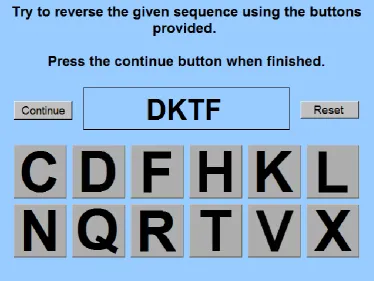
Figure 3: Example sequence of letters generated by the VAM application ... 77
Figure 4: Screenshot of the test interface for the visual memory test with letters ... 78
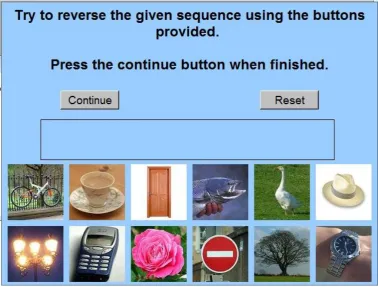
Figure 5: Screenshot of the test interface for the visual memory test with images ... 80
Figure 6: Scatterplot of overall results in the VAM test and the VAM retest ... 105
Figure 7: Scatterplot of overall result in the VAM and the IPI... 108
Figure 8: Scatterplot of overall result in the VAM and RPM ... 112
Figure 9: Scatterplot of overall results in the IPI test and the IPI retest ... 114
Figure 10: Box plot displaying the average result in each sub-test in the VAM ... 120
L
L
i
i
s
s
t
t
o
o
f
f
T
T
a
a
b
b
l
l
e
e
s
s
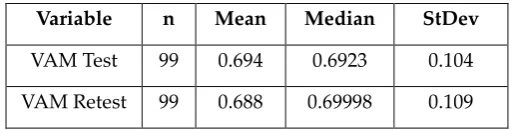
Table 1: Summary of overall results in the VAM test and retest ... 105
Table 2: Correlation between overall results in the VAM test and retest ... 106
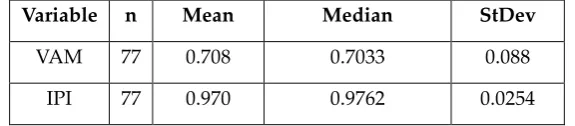
Table 3: Summary of overall results in the VAM and the IPI ... 107
Table 4: Correlation between overall results in the VAM and the IPI ... 108
Table 5: Summary of overall results in the VAM and RPM ... 111
Table 6: Correlation between overall results in the VAM and RPM ... 112
Table 7: Summary of overall results in the IPI test and retest ... 114
Table 8: Summary of overall results in the IPI with outliers removed ... 115
Table 9: Correlation between overall results in the IPI test and retest ... 115
Table 10: Correlation between overall results in Test 1 test and retest... 117
Table 11: Correlation between overall results in Test 2 test and retest... 117
Table 12: Correlation between overall results in Test 3 test and retest... 117
Table 13: Correlation between overall results in Test 4 test and retest... 118
Table 14: Correlation between overall results in Test 5 test and retest... 118
Table 15: Overall summary of reliability analyses of the five tests in the VAM ... 118
Table 16: The mean results achieved in the five tests in the VAM. ... 120
C
C
h
h
a
a
p
p
t
t
e
e
r
r
1
1
:
:
I
I
n
n
t
t
r
r
o
o
d
d
u
u
c
c
t
t
i
i
o
o
n
n
1.1 Introduction
This thesis documents the development of the VAM (Visual & Audio Memory)
application. The VAM is a new computer based testing application designed to examine audio and visual Working Memory. The VAM is based on the model of Working Memory proposed by Baddeley and Hitch in 1974. In this introductory
chapter the reasons for and goals of this study will be discussed along with the design and implementation of the study. The chapter will end with a look forward at the contents of this thesis.
1.2 Background to the Study
Working Memory is the portion of the human mind concerned with the short-term storage of information, the manipulation of that information for further use, the
retrieval of relevant information from other sources and several other functions besides. Working Memory controls the processing of both internal information retrieved from Long-Term Memory and external information gathered from our
information processing play a large role in a person’s ability to learn successfully
[Baddeley & Hitch, 1974], [Baddeley, 1986].
By better understanding the nature of Working Memory and by being able to examine it quickly and efficiently, many possibilities are opened up. Problems with Working Memory will be able to be identified quickly, assisting in the diagnosis of
dementia, a symptom of many terrible conditions including Alzheimer's disease [Baddeley, 1986]. In younger children, Working Memory impairments are often linked to conditions like ADHD [Barkley, 1997], [Klingberg, Forssberg, Westerberg,
2002] and reduced academic performance [Alloway & Alloway, 2010]. Temporary impairment of Working Memory can also indicate that a person is suffering from
severe fatigue which can impair performance and lead to accidents, particularly in the motor industry [Nilsson, Nelson, Carlson, 1997], [Lal & Craig, 2001].
Working Memory can be used as more than a diagnostic tool though. There is a school of thought that believes that training Working Memory can help manage conditions like ADHD [Klingberg et al, 2005] and may even help delay the onset of
Alzheimer’s when accompanied by a social and active lifestyle [Stern, 2006]. The rise
of cognitive training games like Brain Age for the Nintendo DS have also brought these techniques to a wider audience than ever before. The cognitive training
industry is still in its early days, and not everyone is optimistic about the results so far [Owen et al, 2010], [Shipstead, Redick, Engle, 2010]. Nevertheless, it is still a fast
growing industry [SharpBrains, 2010] with a lot of potential, and Working Memory lies at the heart of it.
Working Memory is also strongly connected to our ability to learn [Alloway, 2009b], [Alloway & Alloway, 2010]. By identifying a person's strengths and weaknesses in Working Memory, multimedia rich computer applications can be designed
specifically to work with a person's ability to process information [Mayer & Moreno, 1998]. Such applications will help focus attention on the task in hand while
minimising distractions. The applications would be easy to learn with and intuitive
applications can be designed that live up to the term ‘user friendly’.
1.3 Rationale of Study
The term Working Memory was first used by Miller, Galanter and Pribam in 1960 and research into its exact nature and functionality has been going on ever since. Every
year there are approximately 800 papers published with Working Memory in their title and approximately 3,700 with it mentioned in their title, abstract or keywords [Baddeley, 2007]. There are many different tools and tests available to examine
different aspects of Working Memory. Since most of these methods have likewise been around for decades, they are generally conducted on a one-to-one basis and use paper based media as part of the testing process. As a result of this, large scale
research projects often spend exorbitant amounts of time and effort administering these tests and collating the results for analysis.
With this in mind, digitising the testing process seems to be an obvious solution. Computerised testing can allow multiple candidates to be tested at once, can gather accurate and detailed information for analysis and can store that information in a
format that can be easily imported into common computer based statistical packages. Despite this, there appear to be very few computerised tests of Working Memory
readily available.
By examining the available research in the literature it became clear that in order to
qualify as a recognised, computer based test of Working Memory, an application must:
1. Stand on a solid theoretical basis.
2. Have been designed and built according to those theories with reference to previous efforts in the field.
3. Have been rigorously tested in order to determine their reliability and
While the above requirements were derived from studying the current state of the art research into Working Memory, several further requirements were also decided upon. These requirements were chosen in order to expand current efforts in the field and
build on the potential offered by computer based testing. With this in mind, it was decided that a new test of Working Memory should also:
4. Not be custom built for a single study, but instead be designed to be used in
as wide a range of areas as possible.
5. Be fully automated and not rely on a human administrator to carry them out. 6. Be extensively configurable in order to suit a number of different ability
levels and research goals.
As this thesis describes, the design and implementation of the VAM application fulfils all these requirements and more.
1.4 Research Question
Can a new computerised test of audio and visual Working Memory be specifically
designed and implemented to become a new versatile research tool for multiple fields associated with Working Memory?
By building a series of tests designed to probe various audio and visual aspects of Working Memory, evidence of how each component works individually and as part
of a larger system can be gathered. This evidence can then be used to investigate the nature of audio and visual Working Memory and can be applied to a number of different research areas.
1.5 Methodology
and based on a solid theoretical base. The development process for this approach is composed of four main stages:
1. The theory behind the Working Memory system and the current methods
used to examine it will be discussed in order to form a solid scientific base for the new application.
2. An application to evaluate several aspects of the candidate’s audio and visual
Working Memory will be designed and built. This application will be composed of the following tests:
Two tests focusing primarily on visual Working Memory.
Two tests focusing primarily on audio Working Memory.
A final test that subjects the candidate to a mixture of both audio and visual stimuli with a view to determining how they interact or interfere with each other.
3. Once the application has been built, it will be put through an extensive
testing regime in order to test the reliability and validity of the application and see if the results conform to the current theories of Working Memory.
4. To explore some of the main areas where the application can be of particular
use in the future. Working Memory is an important aspect of many diverse research areas. Three important and growing areas were chosen where this
application can be especially useful:
As a medical diagnostic and safety tool.
The popular but relatively unproven area of cognitive training.
E-learning, where information technology and educational theory combine to improve the learning experience.
1.6 Strengths and Limitations of the Study
Strengths of this study include:
1) The VAM application is a powerful research tool that was designed and built based on a solid theoretical model and by examining popular methods of
testing Working Memory, both traditional and computer based. It is
designed to be easy to use and to provide detailed results so as to be useful in a number of diverse research areas.
2) The VAM application is fully automated and can be completed without direct supervision from an administrator. It is extensively configurable so it can be
varied in terms of both functionality and difficulty. It is designed to be homogeneous so that the results of the various tests can be directly compared
and analysed.
3) The VAM was tested and proven to be a reliable, valid test of Working Memory using a large sample size.
The combination of all the above strengths makes the VAM application unique. With so few widely recognised computer based tests of Working Memory available, the
VAM can play an important role in the future of Working Memory research and its associated areas.
Limitations of the study include:
1) Locating a benchmark test against which to validate the VAM application
proved to be very difficult. To be appropriate, the benchmark test needed to be a well-recognised, already validated, computer based test of Working Memory. It also needed to be fully automated, not require individual
administration and not be too expensive to procure. These conditions severely limited the options available for the validation process.
2) Similarly, the level of resources required to rigorously test the VAM application in terms of test subjects and funds available made follow-up
3) Many of the alternative tests of Working Memory used as reference points in this study are available only to clinical psychologists or cost considerable amounts of money to obtain. As such, some of the details come from second
hand sources such as academic papers or text books. All available effort was made to double-check and validate these sources.
The above weaknesses are largely a result of the small scale and limited resources of this project. Hopefully they can be rectified in future studies when the VAM application is more widespread and has more recognition behind it.
1.7 Chapter Summaries
Chapter 1 - Introduction: A brief overview of the reasoning behind this thesis and the goals to be achieved.
Chapter 2 - Working Memory: State of the art research into the human memory system focusing on the theory of Working Memory as proposed by Baddeley and
Hitch [1974]. This is the theory on which the new application is based. This chapter also contains a discussion of some of the current issues surrounding the study of
Working Memory.
Chapter 3 – Tests of Working Memory: An analysis of past and present methods used
to examine Working Memory. This analysis focuses on both traditional and computer based testing methods and the advantages, disadvantages and availability of each.
Chapter 4 – Design and Implementation of the VAM: Detailed information on the purpose and layout of each test within the VAM application. This chapter also contains information on how each of the tests was implemented and the additional
features that are available in the application.
carried out on the VAM application along with analyses of the results that were generated.
Chapter 6 – Working Memory as a Diagnostic Aid: Examination of how Working Memory can be used in the diagnoses of a number of medical conditions including
Alzheimer’s and ADHD. This chapter also examines the concept of fatigue, the
dangers associated with it and how the VAM application can help expose fatigue and limit those dangers.
Chapter 7 – Cognitive Training: Examination of the concept of cognitive training, what it does, what results it produces and how the study of Working Memory and
the VAM application can help explore this area further.
Chapter 8 – E-learning: Examination of the concept of e-learning, its advantages and
disadvantages and how the study of Working Memory and the VAM application can improve e-learning application design and implementation.
Chapter 9 - Discussion: A review of the thesis is presented here along with what the thesis has contributed to the body of knowledge. This chapter also contains a discussion of some of the problems encountered, suggestions for future research on
C
C
h
h
a
a
p
p
t
t
e
e
r
r
2
2
:
:
W
W
o
o
r
r
k
k
i
i
n
n
g
g
M
M
e
e
m
m
o
o
r
r
y
y
2.1 Introduction
In this chapter, the concept of human memory is explored; what it is, what it does
and exactly how important memory is to one's concept of self. In particular, Working Memory, the memory of the 'here and now' is focused on. Working Memory is the
cognitive system that allows the temporary storage of information received from one's environment or from one's own Long-Term Memory. Working Memory is also concerned with the manipulation of that information for use in other cognitive
processes. Working Memory stores and processes different forms of information in different ways; of particular interest to this study is how it stores and processes audio and visual stimuli.
The following sections provide an overview of how human memory is thought to work. Here, some of the current theories regarding Working Memory are introduced,
2.2 An Overview of Memory
When commonly used, the term memory usually refers to one of two things. In
many instances it is used to refer to Long-Term Memory - reminiscing over memories of events past and lessons learned. In others, it refers to Short-Term Memory - memories of the present such as memorising a phone number you just heard. While
these are indeed aspects of our memory, in truth human memory encompasses a whole range of other important functions; far more than most people would suspect.
From the very beginning, our memory system was essential to our survival and growth as a species. Memory was the faculty that reminded us which foods were safe to eat and which were poisonous. Memory allowed us to interpret what our
senses were telling us about our environment and helped us work out our options in any given situation.
As our memory systems grew in response to specific environmental threats, it is likely that these systems were adapted for new purposes which, in turn, allowed us
to grow and evolve even further [Sherry & Schacter, 1987]. Memory allowed us to manipulate information in our heads. Memory allowed us to master useful skills such as reading and writing. Perhaps most importantly, memory allowed us to learn
from our past and use this information to change our future.
2.3 The Memory System
The study of human memory goes back many centuries. Back in ancient Greece,
philosophers recognised the important role memory had to play in growth and learning. Mnemosyne, the Titan goddess of memory, was worshipped as mother of
the Muses of the arts and sciences. When the field of psychology began to grow in the nineteenth century, memory was one of the first areas it focused on. Despite this, it wasn't until the mid-twentieth century that researchers came to think of memory as
In 1968, Atkinson & Shiffrin proposed the multi component model of memory depicted above. They theorised that human memory could be broken down into
three main components, each with its own set of important functions. These components are: Sensory Memory, Long-Term Memory and Short-Term Memory (which is often incorporated into Working Memory in modern theories).
While this study focuses on the important role played by Working Memory, it is still important to understand the main functions of the other two components and how
they interact with Working Memory. As such, in the next section, a brief description of the composition and functions of Sensory Memory and Long-Term Memory is
given, while Working Memory will be discussed separately and in more detail later on.
It is important to note that the study of memory has crossed over into many different scientific fields over the years, usually with little or no interaction between them. Only in the last few decades have neuroscientists studying the physical structure of
[image:23.595.76.452.100.303.2]memory joined forces with cognitive psychologists studying the traits and functions of memory to create the field of cognitive neuroscience [Brook & Mandik, 2004]. Because of this division, there are still very few certainties regarding human memory.
Therefore the sections below are composed of, for the most part, working theories based on the information currently available.
2.4 Sensory Memory
Sensory Memory is the name given to the very short-term storage system that allows
us to retain impressions of sensory information after the stimuli themselves have ceased. In other words, it refers to the memory involved in allowing us to perceive the world around us.
Sensory Memory is thought to have many different components including ‘echoic
memory’ for audio information, ‘iconic memory’ for visual information and ‘haptic
memory’ for touch. Despite our presumably having a memory type for all five
senses, few of the mechanisms involved are really understood. There are however
several factors that all forms of sensory memory have in common [Cowan 1988], [Winkler & Cowan, 2005]:
1. Sensory Memory functions independently of a person’s attention.
2. Each form of Sensory Memory (iconic, echoic etc.) stores a single type of information (visual, audio etc.).
3. Each form of Sensory Memory has an extremely high resolution, taking in an
enormous amount of detail.
4. Information stored in Sensory Memory only lasts for a very brief period, although this period varies between different types.
Among other things, Sensory Memory is the memory that allows a person to hold an
image in mind for the split-second needed to understand it. An example of this occurs in the cinema. The iconic memory facilitates the viewing of a continuous moving image even though, in reality, a series of still images is being viewed with a
how fast the Sensory Memory can work. In fact, the maximum storage time for Sensory Memory is thought to be under a second and certainly less than two seconds [Sperling, 1960].
One of the earliest studies of Sensory Memory was attempted in the early eighteenth century by a German physicist - Johann Andreas Von Segner [Segner, 1740, (as
described in Baddeley, 1999)]. Segner used a very simple technique to measure the length of the iconic memory store. He observed that by quickly moving a burning ember or sparkler around in a dark room, it was possible to see a trail left behind in
the air. Segner experimented with this by tying an ember to a wheel in a darkened room and then spinning it at various speeds in order to create a circular trail in the
air. When turning the wheel slowly only a partial circle was seen, but by turning at a fast enough speed, an entire circle was left. Segner then measured the speed needed to maintain a full circle and used this to deduce that the length of time the image was
maintained in iconic memory was approximately one tenth of a second.
There are thought to be two main components to iconic memory, visible persistence
and informational persistence. Visible persistence refers to the visual impression that briefly remains after the initial stimulus is removed. Informational persistence refers to the information that remains after the initial stimulus is removed. [Colthart, 1980]
A similar type of memory exists for perceiving audio stimuli. It is sometimes referred
to as echoic memory due to the fact that it functions like an echo, temporarily living on after the sound that caused it has ceased. Like iconic memory, echoic memory has a brief lifespan, although research indicates that it is more durable than its visual
counterpart [Crowder & Morton, 1969], [Darwin, 1972].
Echoic Memory is most commonly used when trying to pinpoint the location of a
noise. When a noise is heard, one unconsciously uses the time difference between the sound hitting each ear to locate it [Darwin, 1972]. When a sound hits one ear it must be stored until it is heard by the other ear and the two versions can be compared.
demonstrates the existence of some form of echoic memory.
Due to the brief storage period involved in Sensory Memory, care must be taken not
to confuse it with Working Memory which is discussed later. The major difference between Sensory Memory and other types of memory is that storage and retrieval from Sensory Memory is entirely unconscious, whereas Working Memory and
Long-Term Memory both allow a conscious exchange of information.
There are assumed to be many other types of Sensory Memory, but they fall outside
the scope of this study. It is enough to be aware that some form of audio and visual Sensory Memory is involved – but only in a passive role - when analysing or testing
Working Memory.
2.5 Long-Term Memory
Long-Term Memory is the system that allows memories to be stored for a prolonged if not indefinite period of time. Its primary function is the storage of large amounts
of information, unlike Sensory Memory or Working Memory whose storage capacity and duration are both extremely limited. Long-Term Memory potentially contains the details of every single thing we have experienced in our lives; the way things
smell, taste and sound, the way people look, each skill or ability we've acquired, each bit of information we've learned and so much more. Long-Term Memory contains the record of our lives and can be drawn upon as needed when dealing with the
world around us.
As with the other types of memory, it is not yet fully established if Long-Term Memory is composed of a single system or is made up of several subsystems. There are, however, several distinct types of Long-Term Memory and each are briefly
discussed below.
(implicit) and ‘declarative’ (explicit) Long-Term Memory [Graf & Schacter, 1985]. Procedural memory usually refers to the learning of skills such as walking and talking. It also plays a role in cognitive tasks such as playing chess. These are the
skills that can only be improved by practising. After the initial learning period, no new memories are created while practising these activities. Instead one
unconsciously draws and builds on previous experiences [Roediger, 1990].
Implicit memory is particularly vulnerable to priming; an effect in which exposure to a particular stimulus can influence response to a later stimulus. This means that
performance in a particular task can be improved by prior subconscious preparation for the task [Graf & Schacter, 1985]. Another aspect of priming is that people are also
more likely to consider a plausible statement true if they have heard it before,
regardless of its actual veracity [Hasher, Goldstein, Toppino, 1977]. This is referred to as the illusion-of-truth and is again largely unconscious.
In contrast, declarative memory is about the retention of facts. This form of memory requires conscious recall. In other words, some event must trigger the recall process.
For this reason it is also known as explicit memory, since information is explicitly stored and recalled [Graf & Schacter, 1985].
Declarative memory itself can be further divided into episodic and semantic memory [Tulving, 1972]. Episodic memory refers to personal memories; remembering details
about particular incidents such as going on a night out with friends. On the other hand, semantic memory is concerned with knowledge of the world around us, such as knowing the capital of Germany or the meaning of a road sign. It is still not
certain if these are different parts of the same system or are two altogether separate systems. There is a clear difference in how these two types of memory are handled, but research suggests that the processes are linked and can affect and complement
each other [Howard & Kahana, 2002].
One of the largest and most contentious questions regarding Long-Term Memory at
would begin to fade if not accessed for a long time and eventually may even
disappear completely. This is referred to as decay theory and has largely fallen out of favour in terms of Long-Term Memory [Jenkins & Dallenbach, 1924]. There is
evidence to suggest it plays a small role in forgetting in Working Memory though [Berman, Jonides, Lewis, 2009]. Instead, popular theory favours the interference theory where forgetting occurs because one memory interferes with the recall of
another [Underwood, 1957].
Interference comes in two main varieties. Retroactive interference occurs when new
information interferes with old information already stored in memory. Proactive interference is the reverse, where existing knowledge can interfere with the storage of
new information [Underwood, 1957]. Exactly how interference works is still debateable, both on a psychological and neurological level [Wixted, 2004], but it is enough to know that the process exists and has a major impact on the way we store
information.
In the case of forgetting skills, the situation is even more complex. Although it seems
that procedural memory is more durable then declarative memory, apparently some skills can be lost. According to the popular phrase ‘it’s like riding a bike, you never
forget’, apparently there is some truth to this. Studies have shown that closed-loop
skills such as riding a bicycle or flying a plane are virtually permanent, even if they haven’t been practised in a long time [Fleischman & Parker, 1962]. On the other hand,
open-loop skills such as typing or performing CPR (Cardiopulmonary Resuscitation) tend to degrade significantly in quality if left unattended [McKenna & Glendon, 1985]. The difference between closed-loop and open-loop skills is that closed-loop
skills tend to be practised unconsciously with one action automatically following the other, whereas open-loop skills involve reacting to a stimulus and so can never really become a habit.
Long-Term Memory is still something of a mystery to scientists, with more questions than answers. However, it is an expanding area and currently it is the focus of
For the moment it is enough to be aware that Long-Term Memory acts as an internal encyclopaedia that is consulted at need for both knowledge and skills. As such, it plays an important role when used in conjunction with Working Memory, allowing
us to draw on past knowledge and experiences to help affect current situations.
2.6 Working Memory
“Working Memory allows us to know that the 'here and now' is 'here' and is happening
'now'” [LeDoux, 1998].
As has already been described, each sub-system of human memory has its own specific set of functions. Sensory Memory is primarily concerned with the perception
of the immediate surroundings. Long-Term Memory is in charge of storing and retrieving knowledge and skills so that past experiences can be used as an aid in the
present. The third and final system, known as Working Memory, is believed to function between these two systems. Working Memory is primarily concerned with the temporary storage and manipulation of information so that it can be used in
complex cognitive tasks and processes [Baddeley & Hitch, 1974].
While Sensory Memory allows the perception of one’s surroundings, it is Working
Memory that allows one to think about and react to them. Working Memory is used every time one reads a book or performs mental arithmetic. It is the memory used when one ‘works things out’ e.g. comparing different faces and objects or mentally
reorganising the furniture in a room. Working Memory is all about interacting with the environment and as such plays an important role in human consciousness and
the learning process.
The term ‘Working Memory’ was first proposed by Miller, Galanter and Pribam
[1960] in the book ‘Plans and the Structure of Behavior’ and soon spread across
unitary short-term store for information. As further research in the area was carried out, the definition of Working Memory evolved to encompass not just short-term storage and retrieval, but the manipulation of information to be used in high level
cognitive functions as well. The more information that is gathered on Working Memory, the clearer its importance becomes.
It should be noted that although Working Memory has largely subsumed the previously established system of Short-Term Memory, there is generally
acknowledged to be a difference [Engle et al, 1999]. Short-Term Memory refers to the
temporary storage and retrieval of information; Working Memory is concerned with the manipulation and organisation of that information for use in other cognitive
processes. Therefore while the exact relationship between Working Memory and Short-Term Memory varies depending on the theory, Working Memory can be generally thought of as applied or focused Short-Term Memory [Cowan, 2008].
As with the other aspects of human memory, the study of Working Memory is still largely in the theoretical phase. In fact some researchers claim that it is not an actual
independent system, but merely a sub-system of Long-Term Memory [Cowan, 1995]. Even amongst those who do believe Working Memory is a separate system, there is still disagreement about its composition and its function. One of the most popular
and well supported theories is that Working Memory is composed of several
subsystems all working in unison: the phonological loop, the visuospatial sketchpad,
the central executive and the episodic buffer. It was proposed by Alan D. Baddeley and Graham J. Hitch [1974] and has been updated and revised by Baddeley many times since.
Baddeley’s theory is both elegant and thematically fitting for a study focusing on the
potential of interactive computer based testing. There are approximately 800 papers
published every year with the term Working Memory in their title, and
approximately 3,700 with it mentioned in their title, abstract or keywords [Baddeley, 2007]. The overwhelming majority of papers in the field of Working Memory
it. Baddeley’s model has been used and referenced in many diverse fields of research. These include studies into education [Alloway & Alloway, 2010], medicine [Baddeley et al, 1986], linguistics [Baddeley, Gathercole & Papagno, 1998] and neuroscience
[Dehaene & Naccache, 2000].
There have been many studies that provide evidence validating Baddeley’s model
and the model itself is still being refined as new information becomes available [Baddeley, 2003]. Baddeley’s model is not without its critics and the main criticisms levelled at it will be discussed later, but it still provides a solid theoretical basis for a
new test of Working Memory.
[image:31.595.74.455.391.688.2]2.7 Baddeley’s Model of Work
ing Memory
The basis of Baddeley’s theory is that Working Memory is not only a separate system
from Long-Term and Sensory Memory, but is itself made up of several component systems. The first two components are known as the ‘phonological loop’ and the
‘visuospatial sketchpad’. These two components act as Short-Term Memory stores
for audio and visual stimuli respectively. The other two components are known as the ‘central executive’ and the 'episodic buffer'. The central executive acts as a control
system for Working Memory, focusing primarily on attention span and information processing and manipulation. The episodic buffer acts as an additional information store and a link between the other components of Working Memory and Long-Term
Memory [Baddeley, 2000, 2002].
The theory of a non-unitary Working Memory system originally developed as the result of an experiment to establish exactly which cognitive functions Working Memory controlled. The experiment was composed of a series of tests that Baddeley
performed on deep-sea divers. The divers were asked to complete a series of verbal reasoning tasks while underwater. Previous experiments had shown that at about
thirty metres below sea level, divers experience a kind of ‘drunkenness’ known as
nitrogen narcosis which results from breathing air at high pressure. Baddeley felt that this might have an interesting effect on cognitive reasoning [Baddeley et al, 1968, (as described in Baddeley, 1999)].
In Baddeley’s experiment he measured the number of quick verbal-reasoning
questions that a group of divers could answer correctly in three minutes while they were submerged at a great enough depth for nitrogen narcosis to occur. Having achieved this, he had another set of divers perform the same task under the same
conditions, but this time they had to remember and rehearse a six-digit number at the same time. Surprisingly, the divers found that they were still able to complete the verbal-reasoning task and repeat the six-digit number with few errors, but Baddeley
noticed that the time taken by this group was significantly higher than the first. This indicated to Baddeley that the Short-Term Memory store was involved in the
cognitive system that controlled reasoning, comprehension and learning. Baddeley
Short-Term Memory system must play a far more important role than previously believed. Realising this, Short-Term Memory seemed an inadequate name for such a system and so his current theory of Working Memory was born.
The fact that the divers were able to complete both the verbal-reasoning and the digit store tasks simultaneously indicated that verbal reasoning and comprehension were
not totally dependent on the same temporary store as the one used to keep the six-digit number in mind. This in turn led to his belief that there must be several components to Working Memory, that each component had its own individual role
and that these components were slaved to a common control centre [Baddeley & Hitch, 1974].
2.7.1 The Phonological Loop
One of the two main short-term storage systems of Working Memory, the phonological loop, is responsible not only for the temporary storage of auditory stimuli but also for one of the main techniques used to aid memory, known as
subvocalization [Baddeley & Hitch, 1974], [Baddeley, 1986]. Subvocalizing refers to the technique of repeating information under one's breath in order to mentally refresh it. In fact, as one reads this sentence one may become aware that the tendency
is to ‘hear’ what is being read inside one’s head. Some people even mutter what they
read under their breath as they read it [Baddeley & Wilson, 1985].
Baddeley theorises that the phonological loop developed as a response to the essential task of learning a language, and therefore is very important for young
children learning to speak and for anyone learning a second language [Baddeley, Gathercole & Papagno, 1998],[Baddeley, 2003a]. The capacity of the phonological loop is popularly thought to be about seven items long [Miller, 1956] as measured by
Like Working Memory itself, the phonological loop can be further divided into separate components. These components are known as the passive ‘phonological
store’ and the active ‘rehearsal process’ [Baddeley, 1986]. The phonological store
represents the temporary memory store in which information is held in a phonological code. Unfortunately this information will fade quickly if not used. Information within the phonological loop tends to decay over a period of about two
seconds unless reinforced. The job of the rehearsal process is therefore to refresh the decaying information held in the store [Baddeley, 1986].
There is significant evidence available to justify the existence of a separate phonological loop. The storage of words or noises whether presented visually or
vocally has been found to be greatly dependent on the sound and complexity of the information being remembered. For instance, a sequence of letters such as ‘V, C, D, E,
G, P’ is generally much more difficult to remember then a sequence like ‘G, K, L, R, S,
H’ [Conrad & Hull, 1964]. This is because the first sequence of letters all sound the same; whereas the second sequence all sound different. This is referred to as the phonological similarity effect. Similarity of meaning appears to have little effect on
short-term storage and retrieval [Baddeley, 1966a] but appears to play a larger role when subjects are presented with longer lists containing ten or more items. Baddeley attributes this to differentiation between Working Memory and Long-Term Memory
(where semantic coding is more important than phonological coding) [Baddeley, 1966b].
Evidence for the rehearsal component of the phonological loop is seen when a person is asked to remember a sequence of words. The longer the words, the more difficult
they are to remember. A much smaller word span is observed when storing and recalling from a list containing words like hippopotamus, university and refrigerator than from a list containing words like cat, ball and tree [Baddeley, Thomson &
Buchanan, 1975]. This is known as the word length effect.
The retrieval of words has also been shown to be dependent on some form of
background can disrupt the recall of visually presented letters. It has been shown that this disruption takes place regardless of whether the speech is in the person’s
own native tongue or not. This is turn, indicates that the disruption occurs at the
level of sound as opposed to the level of meaning [Salamé & Baddeley, 1982].
Even though the phonological loop is one of the elements most associated with
Baddeley’s model of Working Memory it is still far from universally accepted. There
have been several challenges to its validity over the years, largely based on evidence that doesn’t readily fit in with Baddeley’s model [Nairne, 2002], [Jones, Macken,
Nicholls, 2004].
Nairne’s critiques of Baddeley’s modelfocus on the ‘activation’ of memory or how memory is maintained over short periods. Nairne argues that there is evidence that short-term retention is cue driven much like long-term Memory and that Baddeley’s
Phonological loop relies too much on the rehearsal and decay of information as a method of remembering over the short term. Nairne also claims that Baddeley has an overly simplistic view of subvocal rehearsal which he refers to as central to ‘the
standard model’ of remembering [Nairne, 2002]. To back these claims up, Nairne presents evidence that rehearsal is impacted by a host of external factors including list length, modality of presentation, presentation rate and similarity of sound.
Baddeley in turn believes that it is Nairne who has an overly simplistic view of
Baddeley’s model, treating the phonological loop as nothing more than a rehearsal
process and not acknowledging that it has its own separate phonological store as well as the ability to interact both with other aspects of Working Memory and with
Long-Term Memory too. Baddeley, however, also acknowledges that Nairne’s criticism of the complexity of the rehearsal process does have merit and that it mostly identifies mechanisms of the phonological loop that need to be further developed rather than
2.7.2 The Visuospatial Sketchpad
The second main short-term storage system of Working Memory, the visuospatial
sketchpad, handles the processing and interpretation of images and spatial
information gathered either from Sensory or Long-Term Memory [Baddeley & Hitch, 1974], [Baddeley, 1986]. The visuospatial sketchpad grants the ability not only to
visualise an image in the mind, but also to manipulate that image in terms of rotating, zooming etc. [Kosslyn & Shwartz, 1981]. It also allows a person to coalesce visual information together with similar information of a motor, tactile or
kinaesthetic nature [Baddeley, 1999].
The capacity of the visuospatial sketchpad appears to be about 4 items [Sperling,
1960], [Cowan, 2001], [Vogel et al, 2001]. The problem occurs in trying to identify what exactly counts as an item when it comes to visual stimuli. Is capacity limited by
the number of items or the amount of information stored in those items? A 1997 study by Luck and Vogel used a selection of different coloured bars displayed at different orientations as a source of stimulus. Bars were chosen in order to rule out
verbal encoding as a method of storage and rehearsal. Luck and Vogel found that subjects were able to retain about four objects, regardless of whether they were asked about colour, orientation or both. They found similar results when the number of
features associated with each bar was increased to four. This indicated that visual memory appeared to be based on objects rather than information. A later study using a wider array of visual stimuli however, indicated that even though the number of
objects able to be stored does appear to be limited to about four or five, this figure is inversely proportional to the detail level of the objects being remembered. This
indicates that the overall amount of visual information does have an impact [Alvarez & Cavanagh, 2004].
The spatial aspect of the visuospatial sketchpad is far less researched than its visual component, possibly due to the inherent difficulties in isolating it. There is evidence that it is a functionally separate subcomponent from visual Working Memory [Della
still unclear. One theory proposes a distinction between two separate pathways. A visual one concerned with the 'what' of an object, and a spatial one concerned with the 'where' [Mishkin et al, 1983]. Another theory is that the distinction is between
dynamic (spatial) and static (pattern) objects [Pickering, 2001]. The question of the relationship between spatial Working Memory and kinaesthetic or movement based coding complicated matters even further [Smyth & Pendleton, 1990].
Like the phonological loop, the visuospatial sketchpad can be further divided into separate components. In this instance it breaks down into the passive 'visual cache'
and the active 'inner scribe' [Logie, 1995]. While the visual cache equates to the phonological store in terms of its function of temporarily retaining visual input, the
rehearsal mechanism for the visuospatial sketchpad is less clear. The inner scribe may play some role in this, but is primarily concerned with recording sequential locations and spatial movement. Another feature of Logie’s model is that information
enters the visuospatial sketchpad after being processed in Long-Term Memory as opposed to directly from sensory memory. This is consistent with his view that the visuospatial sketchpad should be primarily regarded as a mental workspace [Della
Sala & Logie, 2002].
Baddeley now believes that the rehearsal system for the visuospatial sketchpad stems
primarily from the central executive and episodic buffer and is somewhat analogous to attention span [Baddeley, 2002]. According to Baddeley, this is the typical
mechanism of rehearsal. The phonological loop has its own self-contained rehearsal process mainly as a by-product of humans’ capacity to reproduce incoming verbal signals and, with familiar forms such as digits and words, to correct errors on the
basis of prior knowledge [Baddeley, 2002, 2007].
Baddeley also regards the notion that the visuospatial sketchpad can only be accessed
As with the phonological loop, there is significant evidence that the visuospatial sketchpad is a separate system. A good example was shown in an experiment performed by psychologist Lee Brooks [1968]. Brooks showed subjects a
two-dimensional block representation of the letter ‘F’, and asked them to visualise it in
their minds’ eye. Then, starting at the bottom left corner, Brooks asked the subjects to
move clockwise around the letter and at each corner answer ‘yes’ if that corner
touched the top or bottom line of the letter and ‘no’ if it did not. The correct sequence
here would be ‘yes, yes, yes, no, no, no, no, no, no, yes’. The subjects in this test were first asked to answer verbally and then by pointing to the words ‘yes’ or ‘no’ printed
on a page. Brooks discovered that his subjects found it much easier to vocalise their answers than to point to them, indicating that a visuospatial task, such as pointing,
interfered with the imaging process.
Many other experiments have used similar approaches and these have shown that
performing a visual or spatial task interferes with the visualisation process but not that with the vocalisation process [Logie, 1986], [Quinn & McConnell 1996]. Further evidence can be found in [Della Sala and Logie 2002] which detail a number of
neuropsychological patients who have preserved verbal span but impaired visuospatial span or vice-versa. Developmental evidence for separate systems can also be found in [Alloway, Gathercole, Pickering, 2006] which details the use of a
battery of audio and visuospatial tests to examine Working Memory in children. All these studies indicate that images are processed in a separate system to sound.
2.7.3 The Central Executive
The central executive is considered by many to be the core of Baddeley's model of Working Memory [Baddeley, 2007]. It is assumed to be an attention based system that acts as a control centre for both the phonological loop and the visuospatial
individuals to store and manipulate information simultaneously [Baddeley & Della Sala, 1996], [Tronsky, 2005].
The problem with the theory of the central executive is the temptation to treat it as a dumping ground for any unexplained features of Working Memory. Because it is difficult to test the limits of the central executive, it has tended to be used to explain
away any awkward questions about determining when the visuospatial sketchpad and phonological loop are used and how they are combined. Baddeley broadly admits to these charges, sometimes referring to the central executive as a
homunculus, or 'the little man in the head who makes all the decisions' [Baddeley, 1996]. He claims the best way to handle this problem is by explicitly defining and
analysing the functions of the homunculus until a clearer pattern for the individual sub-systems involved in the central executive emerges [Baddeley, 2007].
The main functions that [Baddeley 1986, 1996, 2002, 2007] has attributed to the central executive are as follows:
1. The ability to focus attention on a single task while actively ignoring
irrelevant information.
2. The ability to process multiple cognitive tasks at once and switch between them as needed.
3. The ability to manage and allocate resources to other subsystems in Working Memory as needed.
4. The ability to control access to Long-Term Memory. 5. The ability to select and execute plans and strategies.
Humans are by nature creatures of routine. They navigate through their day-to-day lives using what are essentially an extensive series of schemata and habits that permit the use of external cues to perform daily tasks [Newell & Simon, 1972]. Researchers
believe that the central executive comes into play when something is encountered which is not familiar - something new. The central executive then combines experience from Long-Term Memory (via the episodic buffer) with the existing
Supervisory Attentional System or a Supervisory Advisory System [Shallice, 1982], [Baddeley, 1996]. This infers the ability not only to focus attention on the external stimuli, but also to split attention between the external stimuli and the information
from Long-Term Memory and to switch back and forth between them to compare past and present experiences and so make informed decisions [Baddeley, 1996].
The exact nature of the central executive is still under debate. Neuroimaging studies suggest that the structures behind the central executive all largely reside in the prefrontal cortex of the brain [Kane & Engle, 2002]. On the other hand, there is
evidence to suggest that it is not a single centralised system at all, but instead a series of separate executive functions that vary between individuals [Miyake et al, 2000].
Miyake et al identify three main executive processes: ‘shifting’, ‘updating’ and
‘inhibition’. Shifting refers to the ability to shift between tasks. Updating is the ability
to monitor and update items in Working Memory and inhibition is the ability to override automatic responses to stimuli when necessary. While these tasks work together in the service of higher cognitive processes, they are nonetheless distinct
systems in themselves, and are likely not the only ones.
2.7.4 The Episodic Buffer
The final component in Baddeley’s model of Working Memory, the episodic buffer, is
a late addition [Baddeley, 2000]. Initially, Baddeley believed the central executive
was responsible for storing and manipulating information from multiple sources as well as connecting Working Memory to Long-Term Memory [Baddeley, 1996].
However, these tasks seemed at odds with the other processes attributed to the central executive which are all to do with attention [Baddeley & Logie, 1999]. Instead, Baddeley decided to disassociate all storage from the central executive and
into a new component, the episodic buffer [Baddeley, 2000].
integrates information from the phonological loop and visuospatial sketchpad as well as from Long-Term Memory and Sensory Memory so that they can be maintained and manipulated [Baddeley, 2000]. It is currently believed that the episodic buffer
also acts as a temporary store for large amounts of information that exceed the capacity of the phonological loop and visuospatial sketchpad [Baddeley, 2002]. This allows information from multiple sources and senses to be merged together to act as
an aid when making decisions or reacting to stimuli.
A central feature of the episodic buffer is its role in binding information from
different sources into coherent chunks or episodes [Baddeley, 2003b, 2007]. These episodes are comprised of multiple different types of information: audio, visual,
semantic etc. Several theorists have suggested that one of the primary functions of consciousness is to bind together information taken from different perceptual sources [Dehaene & Naccache, 2001], [Baars, 2002]. As such, it could be argued that the
episodic buffer acts as a basis for conscious awareness itself.
Baddeley believes that much like the visuospatial sketchpad and the phonological
loop can be broken down into active rehearsal and passive storage components, the episodic buffer could be viewed as the passive storage component of the active central executive [Baddeley, 2003b]. He is also quick to note that, at the moment, the
episodic buffer is purely a conceptual tool and not a specified model [Baddeley, 2007]. Baddeley believes that extensive further research is needed to demonstrate how it
actually functions.
Because Working Memory is theorised to control attention span, many researchers
now believe that it can also provide a better way of measuring general intelligence [Kyllonen & Christal, 1990], [Engle et al, 1999], [Conway et al, 2002], [Ackerman, Beier, Boyle 2005] and learning ability [Alloway, 2009b], [Alloway & Alloway, 2010].
Standard intelligence tests tend to rely heavily on the subject’s level of education. A
![Figure 1: Overview of human memory system adapted from the Atkinson and Shiffrin Model [1968]](https://thumb-us.123doks.com/thumbv2/123dok_us/8809865.918059/23.595.76.452.100.303/figure-overview-human-memory-adapted-atkinson-shiffrin-model.webp)
![Figure 2: Baddeley’s updated model of Working Memory [Baddeley, 2000]](https://thumb-us.123doks.com/thumbv2/123dok_us/8809865.918059/31.595.74.455.391.688/figure-baddeley-s-updated-model-working-memory-baddeley.webp)