Multi-Hole Waveguide Directional
Couplers
Moghavvemi, Mahmoud and Ameri Mahabadi, Hossein and
Alijani, Farhang
2012
Online at
https://mpra.ub.uni-muenchen.de/46048/
Multi-Hole Waveguide Directional Couplers
Mahmoud Moghavvemi,
Hossein Ameri Mahabadi and Farhang Alijani
Additional information is available at the end of the chapter
http://dx.doi.org/10.5772/51355
1. Introduction
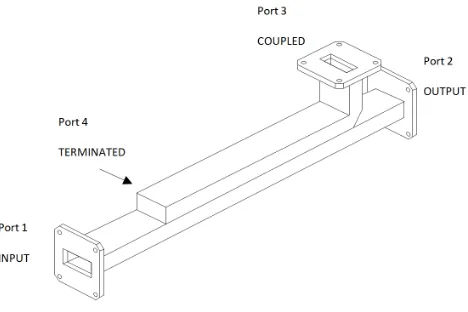
The directional couplers are inherently assumed as four-port devices, which consisted of two transmission lines that are electromagnetically coupled to each other. The first port is named as input, and the second one as output or transmitted, the third one as sampling or coupled and the fourth one as isolated or terminated. By using a special design the input power is divided between output and coupled port in a certain ratio named coupling factor. The required value for coupling factor P1/P3 defines the range of applications for directional
couplers. Based on the application, coupling factor could be any value like 3, 6, 10, 20 dB and even more. The performance of the directional coupler is usually evaluated by its direc‐ tivity between port 3 and 4.The directivity is a calculated parameter from isolation and cou‐ pling factor and shows how the two components of wave cancel each other at port 4. Though we prefer to have high value for directivity as much as possible, but in real situation this could be happened only around center frequency of designing band. The waveguide di‐ rectional couplers have a good directivity compared to microstrip or stripline couplers and in spite of their bulky size, give us a low loss, high power handling, good characteristics and low cost due to use of just a simple waveguide.
Nowadays the numerical methods are widely used for simulation and optimization of high frequency structures. Some of them such as HFSS and FEKO, are well commercialized and used widely by researchers and engineers.. But for designing procedure and for starting point we need an initialization value to input into simulator and then optimize the parame‐ ters by its internal routines.
In this chapter we focus on the waveguide directional couplers and we try to give a good reference as well as finalized designing formulas in closed form and tables to be used indi‐ vidually or as initial values for numerical software. The full generalized field theory and its
equations for designing based on multi-hole coupling structure will be introduced, though more detailed basic information could be found in given references.
[image:3.482.132.366.219.375.2]Moreover, by solving the equations, the recursive procedure is employed in a computer pro‐ gram to adjust the required directivity, coupling and frequency or waveguide type to speci‐ fy the number of coupling holes, individual diameters and locations of holes in waveguide’s coordinate. Besides of those parameters, the length of coupler, matched load and other sizes of structure for fabricating, will be defined too. By using the different methods like bino‐ mial, Chebyshev, and super imposed to calculate the coupling of each hole, the wide band‐ width response is achieved. At the end, a number of books and papers are given as good references for further study.
Figure 1. An Ordinary Broad-Wall Waveguide Directional Coupler and its ports
1.1. Definitions
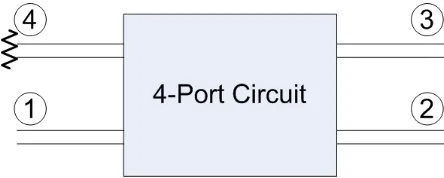
As mentioned, couplers are considered as 4-port passive devices in which, a part of input wave reaches to output port 2 and the remained would be coupled to the coupled port 3. Port 4 usually internally is matched to damp the residual internally reflected waves from port 2 and port 3. Ideally there is no wave reach port 4. Port 4 usually is terminated by a full band load as shown in Figure1 and Figure2.
Figure 2. An equivalent 4-Port configuration for a directional coupler
Since 1945, extensive studies have been conducted on the issue and many researchers have tried to optimize the designing equations to make the result more accurate. For instance, dif‐ ferent slot shapes had been introduced to increase the bandwidth and modifying the specifi‐ cations. [12, 25, 27]
In order to start the calculations, there are three major parameters that we need to define for each coupler:
• Coupling factor “C” in dB, that represents the power received by port 3 as:
C=10log Pi
Pf or C= - 10log
Pf
Pi (1)
The coupling factor shows the ratio of power at port 3 to input power at port 1. Typically we prefer to have one of the 3, 6, 10, 20 or 30 dB as standard values but for specific appli‐ cation it also can be defined freely.
• Directivity “D”, is the ratio of output power at port 3 to received power at port 4. Since we prefer to eliminate the power at port 4, therefore the high values for “D” is more inter‐ ested. The ”D” in terms of dB is defined as:
D=10log Pf
Pb or D= - 10log
Pb
Pf (2)
• Bandwidth “BW”, which depends on directivity. By increasing the number of coupling apertures, the order of coupler increases ( similar to the order of filter) hence the directivi‐ ty is increased. Meanwhile, higher bandwidth is also achieved. Therefore, by choosing the required minimum directivity, Dmin, the available bandwidth is calculated.
For a 10 dB coupling or having a 0.1 of input power to port 3, we would have:
10log Pf
Pb =10 → Pf= 1
In the same way, for a 3dB coupling, half of input power will receive to port 3:
10log Pi
Pf =3 → Pf= 1
2Pi (4)
And if we consider D = 40 dB for directivity:
10log Pf
Pb =40 → Pf=10000Pb (5)
It is the adequate value for designing a good directional coupler.
A number of references, which have studied the couplers and have given the relationship between number of aperture holes “n” and directivity “D” are listed in references [12, 25, 23]. In addition to number of aperture holes”n”, in the designing procedure for directional couplers, certain parameters should be well defined as:
• Distances between the holes
• Distances between holes to side-wall (holes center offset from waveguide axis)
• The holes dimensions (diameter of holes for circular holes).
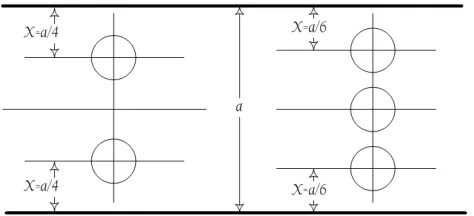
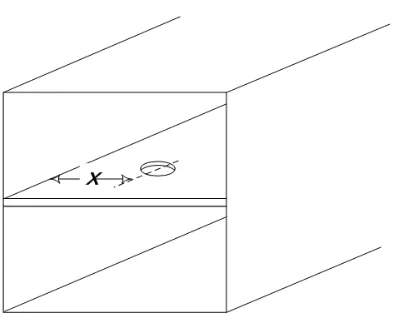
It has been shown that to have an optimum coupling around a certain frequency, the criteria (6) should be kept in which “x” is the distance between the holes centers to the side-wall and “a” is the broad wall size of waveguide: [24]
x
a ≤0.25 (6)
Furthermore, by precise study, the best design value for ratio of (6) is given as [23]
x
[image:5.482.124.364.467.513.2]a=0.203 (7)
Figure 3. Cross section of the directional coupler and coupling holes
The distances between holes should be about λg/4 however a question remains, what is the
1. λg is the average of wavelength of lower band λg1 and upper band λg2 so:
λg= λg1+λg2
2 →
λg
4 =18
(
λg1+λg2)
(8)2. λg can be considered as geometric mean between λg1 and λg2 :
λg= λg1.λg2→
λg
4 =14 λg1.λg2 (9)
3. λg can be considered as mean value between λg1 and λg2:
2
λg= 1
λg1 +
1
λg2 →λg=
2λg1λg2
λg1+λg2 →
λg 4 =
λg1λg2
2(λg1+λg2) (10) The best choice for defining the centers of two holes is the 3rd definition since it has been
practically approved too [23]. So the wavelength would be derived from (10). Therefore, in order to define the dimensions of each hole (or diameter in case of circular hole type), the each hole’s coupling should be calculated first, and the hole’s diameter would be derived consequently.
1.2. Fields Equations
In order to calculate the coupling of each hole and by using the required Dmin that we need‐
here, the number of holes “n” will be derived in two different ways:
i- The coupling coefficient mapped to coefficients of nth order of Chebyshev polynomial.
ii- The coupling coefficient mapped to coefficients of nth order of Binomial polynomial.
By assuming the same order for polynomials “i” and “ii” and by noticing that the directivity slope in case of “i” is higher, we expect to have higher bandwidth in comparizon to “ii” and limited ripple in pass-band. In case of “ii” though there is no ripple in pass-band but the slope of directivity is lower than “i” with same order of polynomial, therefore the band‐ width is lower than “i”. For years many of manufacturers chose the “i” method and consid‐ ering the number of holes n = 20. Here, the “i” method is chosen, however the number of holes “n” would be defined from Dmin and it will be not fixed anymore.
In special case, if we require high directivity “D”, like “D = 50 dB” for small bandwidth like 8.9 to 9 GHz, only 2 holes are needed to synthesis the coupler.
For calculating the distance of holes’ centers to side-wall “x”, the equation sinπxa = λ0
6a is used
in which “a” is broad-side of waveguide and λ0 is the wavelength in the middle of the band. [2]
The coupled wave equations for incident wave A1 and reflected B1by assuming the same
amplitude for waves are as follows:
A1=jabλ2πg MxHx (1)H
x(2)+MzHz(1)Hz(2)-PEy(1)Ey(2) (11)
B1=jabλ2πg -MxHx (1)H
x(2)+MzHz(1)Hz(2)-PEy(1)Ey(2) (12)
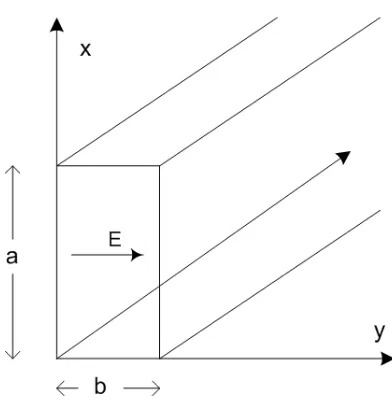
In which, “a” and “b” are the waveguide dimensions, Mx and Mz are the magnetic polariza‐
tion components in “x” and “z” axis and P is electrical polarization. The Hx(1)is the ampli‐
tude’s wave component in the first waveguide and Hx(2)is for second and so on. If two
waveguides are identical then Hx(1)=H(2)x and Hz(1)=H(2)z . Then the fields’ components are ex‐
pressed as:
Hx= -Sinπxa e-jγz (13)
Hz=j λg
2aCosπxa e-jγz (14)
Ey= λg
λSinπxa e-jγz (15)
The field equations are given separately for “Narrow wall” and “Broad wall” cases. Here, we briefly introduce them and give the relations for our interested one (i.e., Broad wall):
1.2.1. Narrow wall
By referring to Figure 5, since x=0, the equations could be simplified as:
A1=A2=
-jλgMz
2a3b (16)
In which, Mz is independent from frequency. In other words, “Narrow wall” coupling has
Figure 4. The geometry of field equations and waveguide
Figure 5. Narrow wall coupling
1.2.2. Broad wall
This case is shown in Fig.6 and equations are expressed as following:
A1=abλj2πg
{
Mx-(
λg
λ
)
2
.P
}
sin2 πxa +Mz
(
λg 2a)
2
cos2 πx
a (17)
B1=abλj2πg
{
Mx+(
λg
λ
)
2
.P
}
sin2πxa -Mz
(
λg 2a)
2
cos2πx
[image:8.482.127.356.358.433.2]Figure 6. Broad-wall coupling
If the holes are circular with a diameter “d” the parameters “P, Mx and Mz ” are cal‐
culated as:
Mx=Mz=d
3
6 (19)
P=d123 (20)
By putting (19 & 20) in (17 &18) we will have simplified form:
A1= jπd
3
12a2b
2a λg +
λg 2a
-aλg
λ2 (21)
B1= jπd
3
12a2b λ2ag
-λg 2a +
aλg
λ2 (22)
And if we put λ12=
1 λg2
-1
(2a)2 we will have:
A1= jπd
3
24a2b
2a λg +
λg
2a (23)
B1= jπd
3
24a2b
6a λg
-λg
2a (24)
A10= jπd
3
12a2b (25)
And coupling variation to frequency changing is:
ΔC=20log 2a λg + λg2a
2 (26)
On the other hand, variation of directivity to frequency is given by:
D=20logA1
B1=20log 2a λg +
λg
2a
6a λg
-λg
2a
(27)
The solved equations for R100 waveguide is given in Fig.7
Figure 7. Theoretical coupling variation and directivity for transverse arrangements of 1, 2 or 3 holes in common broad-wall of R100 waveguide.[14]
When a number of single holes are aligned in a row, the array’s directivity will be added to basic value of directivity.
[image:10.482.122.365.295.450.2]1.3. Coupling by big holes
The equations given in section 1.3 were valid for small holes. By considering the wall-thick‐ ness “t” and big hole’s by surface size of “A”, the equations should be corrected. This has already done and the results will be used now. [15]
1.3.1. Corrections for wall thickness “t”
When the coupling holes have thickness “t”, it equals to a short-length circular waveguide, which is working under its cut-off frequency (when frequency is lower than resonance fre‐ quency). Therefore the amplitude of the coupled wave attenuates by following term:
exp
{
-2πtAλc 1 -(
λc
λ
)
212
}
(28)In which, the λc is the cut-off wavelength of hole and λ is the wavelength in operating fre‐
quency, “t ” is the wall-thickness and “A” is the correction factor which includes the interac‐ tions of adjacent fields and is defined practically. [15] For elliptic holes (Narrow slot) the “A” factor is in 3rd order but for circular holes it is close to first order. If the fields have multi
components, correction factor (28) should be applied on all of the Bethe’s equations. It means that in equations (17) and (18) the magnetic field correction factor for coupling have a parameter λc that is due to excitation by TE11 mode so for this mode λc→λH=1.705d and
correction factor for electric field coupling uses a λc, which relates to TM01 mode and equals
to λc→λE=1.305d.
1.3.2. Corrections for big size holes
A good study for such big size holes have been done by an equivalent circuit. [15] In this way, the hole’s effect will be simulated by a two port network in parallel or in series be‐ tween two waveguides which have mutual coupling. This network is a lossless and should be defined by Foster’s reactance theorem. Here, the impedance will be defined by locations of its zeroes and poles in addition to the multiplications coefficients.
In simple expression of Bethe’s small sized coupling hole theory, this impedance has a sim‐ ple form. For example the reactance of a small hole in a thin diaphragm at the cross section of a rectangular waveguide, working in TE10 is:
X=4πM Z0
abλg (29)
The term λg is the guided wavelength, “M” magnetic polarization, Z0 characteristic impe‐
dance of the waveguide. The Z0 has a direct relation to term λg
λ, which shows that lumped
reactance “X” has a direct relation to frequency (X∝f) too.
Therefore the small hole coupling theory assumes that the “X” would be a constant reac‐ tance but it is not true. Because, there are a few numbers of unwanted resonances occurred in the frequency band. For this reason the (29) would be a good definition when the operat‐ ing frequency is somehow lower than the first resonance. For considering the resonance ef‐ fect in equation (29), the corrected “M” would be expressed by introducing a new term that considers the effect of cut-off wavelength M
1 -
(
f cf22)
and the result is as follows:
X Z0=
4πM abλg
(
1 -(
f2
f c2
))
(30)From measurements, it has been shown that the above correction factor gives a good ap‐ proximation.
The attenuation definition (28) can be combined to (30) to give us a general correction factor for big size holes:
exp
{
-2λcπtA 1 -(
f cf22)
12
}
1 -
(
ff c22)
(31)
1.4. Multi holes coupling
A longitudinal coupling consists of a series of holes by center distance of λg
4 that has a great
coupling in forward and weak coupling in backward direction.
The slight coupling for a single hole has been studied and the directivity introduced by:
Directivity (dB)=20log A1
B1 (32)
In which: [15]
A1
B1=
∫
-L/2
L/2
ϕ(x)dx
∫
-L/2
L/2
ϕ(x)exp(- 2jβx)dx
(33)
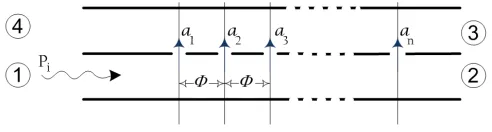
Figure 8. The cross section of n-Hole array and coupling coefficients
All the hole’s center distances and electrical length are the same and are considered in the middle of the band. If the input wave to port 1 has constant amplitude and matched to other 3 ports, the reflected wave can be expressed by:
B1=a1+a2Exp(-2jϕ) +a3Exp(-4jϕ) + … +anExp(-2(n- 1)jϕ) (34)
The interesting and useful case is when the coefficients of the series being symmetrical from center. Therefore:
a1=an, a2=an-1, aK=an-K+1 (35)
So by putting the values (35) into (34):
B1=
{
2a1cos (n- 1)ϕ+ 2a2cos (n- 2)ϕ+ … + 2an/2cosϕ ej(n-1)ϕ n even
2a1cos (n- 1)ϕ+ 2a2cos (n- 2)ϕ+ … +
an+1
2 ej(n-1)ϕ n odd
(36)
The direct coupled wave at port 3 will be:
A1=∑rn=1a
r ej(n-1)ϕ (37)
And the directivity “D” is calculated by normalizing B1 to A1 in (36) by dividing the sum of
each coupling voltages. In special case if there are “n” identical holes, therefore:
B1
A1=
sin nϕ
2. Design methods based on arrays
2.1. Chebyshev Array
If the minimum voltage over the full bandwidth to reach a good directivity “D” is needed, the Chebyshev polynomial can be used for distribution function of each hole’s voltage. Such coefficients are derived by putting the B1 in (36) by considering the following equal ripple’s
directivity function as following:
B1=amTn-1
(
coscosϕϕ0)
(39)In which the am is the maximum of B1 over the coupling bandwidth that given by following:
ϕ0≤ϕ≤π-ϕ0 (40)
The am is calculated by putting the ϕ=0 in (39):
am=
∑ r=1
n
ar
Tn-1
(
1 cosϕ0)
=|A1|
Tn-1
(
1 cosϕ0)
(41)
In (36) if we put ϕ=0:
B1=r∑=1
n
ar (42)
Therefore the minimum directivity over the bandwidth would be:
Dmin=20log Tn-1
(
cos1ϕ0)
(43)Comparing this method to method of Binomial polynomial is very informative that has been done by Levi. In this case we should have: [16]
B1=am'
(
coscosϕϕ0)
n-1 (44)In which:
am'= ∑ r=1
n
ar
(
1cosϕ0
)
n-1=|A1|
(
1cosϕ0
)
The minimum directivity at the edge of the band for this case is:
Dmin=20log
(
cos1ϕ0)
n-1 (46)
Obviously the (46) always is significantly lower than the value for Chebyshev case (43). The coupling equation for Chebyshev case is derived by putting the identical coefficients of cosϕ in (36). Young gave such coefficients for 3≤n≤8 [3]. But here, the generalized case is obtained by a computer program for 1≤n≤25.
For coupling C=0 these coefficients are changed into Pascal’s triangle that for C=0 the infin‐ ite directivity over a zero bandwidth obtained.
The hole’s size is derived by coupling of each hole in dB. That relation for r th hole
is as follows:
Cr=20log
(
∑ r=1
n
ar
ar
)
(47)
Since ∑
r=1
n
Cr=1, all the theoretically given hole couplings, transferred all power by assum‐
ing the 0dB in the formula. Therefore in order to design a “C dB” coupler the “C” is added to C r in (47). The entire hole sizes by this way and by given theory for small
size holes (or if we need by using the correction coefficient curves given by referen‐ ces) can be computed. [17, 18]
In addition to both mentioned series for calculating the coefficients (Chebyshev and Bi‐ nomial), there is another method that actually derived from them. It is named “Super Imposed Arrays”.
2.2. Super Imposed Array
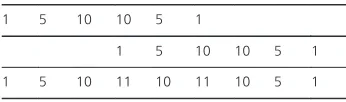
When the strong coupling is needed, i.e. 3dB or 6dB, it is not possible to use the one row of holes (single array), since diameter of holes will be increased. Therefore it is more conven‐ ient to have approximately same diameter for all to get good coupling quality. For this case the super imposed array is used. As first step, we need the coefficient series in which the holes get bigger. It would be happened when n>4. For starting we can use Chebyshev or binomial coefficient series in one line. Then the same series should be written in second line but in shifted position. It means, first coefficient of line 2 in under the 4th coefficient of line 1
and so on. By adding the two lines we would have a new series that its coefficients (or holes’ diameters) alternately are the same. For example by a 6-element binomial series, we can make a 9-element super imposed series:
1 5 10 10 5 1
[image:16.482.154.327.69.120.2]1 5 10 10 5 1 1 5 10 11 10 11 10 5 1
Table 1. A 9-element super imposed array based on 6-element binomial array
1 5 10 11 10 11 10 5 1
1 5 10 10 5 1 1 5 10 11 10 11 11 10 11 10 5 1
Table 2. Added more number of elements to table 1.
For special characteristics of Chebyshev series, hereinafter, it will be used as basic polyno‐ mial for further design. In super imposed method the number of elements can be any value and we would have longer coupler. If we chose other two methods the the holes diameter get bigger and bigger and it may exceeds the broad-wall size of waveguide. By considering the ∑
r=1
n
Cr=1it is cleared that each Crmust be less than 1 and in super imposed this would be
happened.
For strong couplings and the holes with the same shape the following relation is proposed by Cohn: [14]
Am=sin
(
4mπm3dB)
(48)In (48) the m3dB is the number of series for obtaining the 3 dB coupling. For example, if a
6-element series is needed for 3dB coupling, therefore the coupling for one series will be:
A1=sin
(
24π)
=0.1305 (49)That equals to 17.68 dB. The directivity for Chebyshev-based super imposed array is greater than the single array. The reason can be explained by this fact that returned waves are add‐ ed in phase and amplitude, so the maximum amplitude for returned wave will not exceed from single array in any case and it will damped soon.
2.3. Transverse groups of holes
[image:16.482.124.357.154.202.2]Figure 9. Groups of two or three rows holes.
The test results of multi-hole couplers are as following:
A 6dB coupler by 1" ×1 / 2" waveguide in 8.2~12.4GHz band is designed by 21-elements su‐ per imposed array based on 6-element Chebyshev in two rows (totally 42 holes). The dis‐ tance from side-wall for circular-holes is x=0.25a=a/ 4 and distance between hole centers is
λg
/
4. The obtained directivity “D” is more than 40dB and coupling deviation ∆C is about±0.5dB. [19]
Shelton has tested multi-rows couplers and has given the coupling curve in terms of holes diameters for X and Ku bands waveguides. His efforts by using 3 rows were not successful. [20] For 1" ×1 / 2" waveguide, Cohn used rounded rectangular holes in two rows. His re‐ search approved that 2-rows is better than 3-rows and for shortening the length it is not pos‐ sible to use 3-rows holes.
It was also declared that in case of 3-rows, the resonance in upper band will happen. The reason is, where the electric vector is in parallel to broad wall, the even mode is excited and coupler acts as side wall coupler. Such case is not happened for 2-rows couplers. By reduc‐ ing the height of “b” it is possible to put the resonance frequency of even modes out of oper‐ ating frequency band. Only a slight reduction in “b” is needed since the resonance is occurred when the coupling region has length of λg
/
2 and it is near cut-off for even modes.Indeed, as an example, the “b” should be reduced from 0.4” to 1/16”. This reduction in “b” increases the coupling of each hole. See (17). So a few number of holes needed to make 3dB coupling. As an example, a 2nd order Chebyshev transformer has a theoretical VSWR of 1.01
3. Practical designing
3.1. A real sample
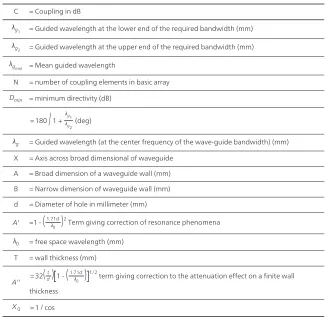
After reviewing the basics of directional coupler, we start to design a coupler practically. First of all it is better to introduce the abbreviations that we use. They are listed in following table:
C = Coupling in dB
λg1 = Guided wavelength at the lower end of the required bandwidth (mm)
λg2 = Guided wavelength at the upper end of the required bandwidth (mm)
λgmid = Mean guided wavelength
N = number of coupling elements in basic array
Dmin = minimum directivity (dB)
=180
/
1 +λg1λg2 (deg)
λg = Guided wavelength (at the center frequency of the wave-guide bandwidth) (mm)
X = Axis across broad dimensional of waveguide A = Broad dimension of a waveguide wall (mm) B = Narrow dimension of waveguide wall (mm) d = Diameter of hole in millimeter (mm)
A' =1 -
(
1.71λ0d)
2 Term giving correction of resonance phenomena
λ0 = free space wavelength (mm)
T = wall thickness (mm)
A'' =32
(
td
)
1 -(
1.71λ0d)
1/2
term giving correction to the attenuation effect on a finite wall thickness
[image:18.482.78.404.168.487.2]X0 =1/cos
Table 3. The terms and abbreviations that used in design procedure.
As it is mentioned before in (10):
λgmid
4 =
λg1λg2
2(λg1+λg2) (50)
n=1 + cosh-1 10 Dmin
20
cosh-1
(
1 cosϕ)
(51)
The starting coefficient in Chebyshev argument is calculated as:
X0=cos1ϕ=cos
(
1180 1 +λg1 λg2
)
(52)
For X-band that we have λg1=6.089 Cm and λg2=2.489 Cmthe X0=1.853 is obtained. Next step is to find the Chebyshev polynomial coefficients by computer program that gives:
{40.507, 172.277, 355.449, 445.373} (Notice that, only a half of the coefficients are enough due to symmetric specification of Chebyshev polynomial).
Then the coefficients are normalized to least element that gives following table:
A B C D
1.0 4.253 8.775 10.995
Table 4. Normalizing the Chebyshev coefficients.
Therefore the whole structure of the holes will be as follows:
A B C D C B A
Table 5. Sequence of holes and its related Chebyshev coefficients for coupler synthesis.
Now we add them all together:
2(A+B+C) +D=39.051 (53)
The coupling for each hole will be defined in dB as follows: Coupling for Holes A=20log39.0511 dB=31.832 dB
Coupling for Holes B=20log39.0514.253 dB=19.259 dB
Coupling for Holes C=20log 39.0518.775 dB=13.968 dB
Coupling for Holes D=20log39.05110.051 dB=11.776 dB
CA=41.832 dB, Holes CB=29.259 dB, Holes CC=23.968 dB, Holes CD=21.776 dB
Finally the achieved numbers should be inserted into Bethe’s formula for small size holes: [12]
C=20log
{
12πda23b 1 -(
1.71λ0d)
2}
+ 20log{
32(
dt)
1 -(
1.71λ0d)
1/2}
(54) Now we solve the above equation (for each hole) by iteration method and the diameter of each hole would be determined. By considering the distance of circle centers to side wall asx=0.203a (7) following values for diameters would be obtained: A=0.234 inch, B=0.343 inch, C=0.397 inch, D=0.421 inch
Note that the solved example is for single array. If we wanted to have the double rows we should put the (C+6) dB instead of C dB (that we considered 10 dB in above example). Notice: an approximation way to define the number of holes “n” is using the Dmin in equal
to maximum coupling between holes plus 3 ~ 5 dB. For instance in the solved example, the maximum coupling is belonged to “A” that was CA=41.832 dB. So:
Dmin=CA+ 5=47 dB (55)
And the number of holes would be:
n=1 + cosh-1 10
47 20
cosh-1X
0 ≈6.9 →n=7
(56)
Therefore if we wanted to have a good directivity, a directivity higher than 47dB then we should have 7 holes in the coupler.
In practice, for eliminating the effect of wall thickness “t”, it is possible to remove one broad wall of a waveguide and mill- the next wall to have half thickness between to waveguides. [23] The real designed 20 dB coupler by R70 waveguide and 14 holes in two rows (each row has 7 holes) is fabricated and tested. The results are given in Fig.10
In Fig. 11 and 12, another directional coupler for C = 10 dB is sketched. The diameter of cir‐ cles for its five categories of holes, are:
Holes number 4 =4.16 mm Holes number 3 =6.45 mm Holes number 2 =8.00 mm Holes number 1 =8.66 mm Holes number 0 =8.94 mm
Figure 10. The test result for a multi-hole waveguide R70, directional coupler C=20dB
Figure 11. The R70 directional coupler, C = 10 dB by two rows of 9-elements
[image:21.482.147.320.348.494.2]Figure 13. Cross section for a 38-holes (double rows of 19-elements) directional coupler. The lossy load maching using ferro-based materials (courtesy H. Mottaghi: [email protected])
The port-4 in the couplers is matched by a conical or pyramidal load. To obtain the lowest reflection from this port, the tapered structure is used to make a slight change in characteris‐ tic impedance of the waveguide along its length. Since the power loss at this port, naturally is not significant, the medium or low power absorber or load is enough.
Author details
Mahmoud Moghavvemi, Hossein Ameri Mahabadi and Farhang Alijani
References
[1] Gandhi, O. P. (1981). Microwave Engineering and Applications, Pergamon Press. [2] Collin, R. E. (1966). Foundations for Microwave Engineering, Mc. Graw Hill. [3] Young, Leo. (1966). Advances in Microwave, volume I, Academic Press.
[4] Miller, S. E. (1954). Coupled Wave Theory and Waveguide Applications. Bell system Tech. J., 33, 661.
[5] Riblet, H. J. (1954). The short- slot hybrid Junction. Proc, IRE, 40, 180.
[6] Tomiyasu, K., & Cohn, S. B. (1953). The Transvar Directional Coupler. Proc. IRE, 41, 922.
[7] Cook, J. S. (1955). Tapered velocity couplers. Bell system Tech. J., 34, 807-822.
[8] Fox, A. G. (1955). Wave coupling by warped normal modes. Bell System Tech. J., 34, 823.
[9] Louisell, W. H. (1955). Analysis of a single tapered mode. Bell System Tech. J., 34, 853. [10] Miller, S. E., & Mumford, W. W. (1952). Multi-element directional couplers. Proc. IRE,
40, 1070.
[11] Bethe, H. A. (1943). Theory of side windows wave guides. Mass. Inst. Technology Radi‐ ation Lab Report [43].
[12] Bethe, H. A. (1944). Theory of diffraction by small holes. Phy. Rev. , 66, 163.
[13] Surdin, M. (1946). Directive couplers in wave guides. J. Inst. Elec. Engrs (London) , 93(IIIA), 725.
[14] Cohn, S. B., Knootz, R. H. S., & Wehn, S. L. (1962). Microwave hybrid coupler study program. Rantec- Corporation Report [61], 361-363.
[15] Cohn, S. B. (1952). Microwave coupling by large aperture. Proc IRE, 40, 697.
[16] Levy, R. H. (1959). Guide to the practical application of Chebyshev functions to the design of microwave components. Proc. Inst. Elec. Engrs. (London) C, 106, 193.
[17] Harrison, J. R. (1945). Design considerations for directional couplers. MIT Radiation Lab. Rept. [724].
[18] Saad, T. (1964). The Microwave Engineers handbook. 109 Boston, Massachusetts. [19] Hensperger, E. S. (1959). The design of multi-hole coupling arrays. Microwave J., 2, 38. [20] Shelton, W. (1961). Compact multi-hole waveguide directional couplers. Microwave J.,
4, 89.
[22] Alison, W. B. W. A. (1987). A handbook for the mechanical tolerance of waveguide components. Artech house.
[23] Hancock, K. E. (1967). The design and manufacture of waveguide Tchebyshev direc‐ tional-coupler. Electron. Eng , 39, 292.
[24] Liang, C. H., & Cheng, D. K. (1982). On performance limitations of aperture coupling between rectangular waveguide. MTT-30 [5].
[25] Levy, R. (1968). Analysis and synthesis of waveguide multi-aperture directional cou‐ plers. MTT-16 [12].
[26] Mc Donald, N. A. (1972). Electric and Magnetic coupling through small apertures in shield wall of any thickness. MTT-20 [10].
[27] Levy, R. (1980). Improved single and multi- aperture waveguide coupling theory in‐ cluding explanation of mutual interactions. MTT-28 [4].
[28] Riblet, H. J. (1947). A Mathematical theory of differential coupler. Proc. IRE, 35, 1307. [29] Crompton, J. W. (1957). A contribution to the design of multi-element directional
couplers. Proc. IEE, 104C(6TD), 398-402.
[30] Matthaei, G. L. (1964). Microwave Filters impedance matching networks and coupling structures, Mc Graw Hill.
[31] Wheeler, H. A. (1964). Coupling holes between resonant cavities or waveguides eval‐ uation terms of volume ratios. MTT, 231.
[32] Sangster, A. J. (1973). Slot Coupling between uniform rectangular waveguides.
MTT-27 [7], 705.
[33] Pandhuri, Pande. V. H., & Das, B. W. (1979). comments on coupling of waveguides through large aperture. MTT-27 [7], 702.
[34] Pandhuri, Pande. V. H., & Das, B. W. (1978). coupling of waveguide through large aperture. MTT-26 [3], 209.
[35] Schmiedel, H., & Arndt, F. (1986). Field Theory Design of Rectangular Waveguide Multiple-Slot Narrow-Wall couplers. MTT-34 [7], 791.
[36] Oliner, A. H. (1960). Equivalent circuits for small symmetrical longitudinal aperture and obstacles, . IRE MTT, 72.
[37] Hakkak, M., & Barakat, F. (1984). Waveguide bend characteristics. ITRC publication‐ sTehran, Iran.
[38] Mottaghi, H. (2010). Measuring the Load absorption parameters in waveguide.

![Figure 7. Theoretical coupling variation and directivity for transverse arrangements of 1, 2 or 3 holes in commonbroad-wall of R100 waveguide.[14]](https://thumb-us.123doks.com/thumbv2/123dok_us/7790909.725749/10.482.122.365.295.450/theoretical-coupling-variation-directivity-transverse-arrangements-commonbroad-waveguide.webp)