R E S E A R C H
Open Access
A new two-step iterative method for
solving absolute value equations
Jingmei Feng
1,2*and Sanyang Liu
1*Correspondence: [email protected] 1School of Mathematics and
Statistics, Xidian University, Xi’an, China
2School of Engineering and
Architecture, Shaanxi Radio and TV University, Xi’an, China
Abstract
We describe a new two-step iterative method for solving the absolute value equationsAx–|x|=b, which is an NP-hard problem. This method is globally convergent under suitable assumptions. Numerical examples are given to demonstrate the effectiveness of the method.
Keywords: Absolute value equations; Iterative method; Global convergence
1 Introduction
We consider a kind of important absolute value equations (AVEs):
Ax–|x|=b, (1)
whereA∈Rn×n,b∈Rn, and| · |indicates absolute value. Another general form of the
AVEs (1):
Ax+B|x|=b, (2)
whereB∈Rn×nwas introduced and investigated in [1]. The unique solvability of AVEs (2) was given in [2]. The algorithm which can compute all solutions of AVEs (2) (A,Bsquare) with several steps, was proposed in [3]. Using the relationship between the absolute value equations and second order cone, a generalized Newton algorithm was introduced in [4] for solving AVEs (2). When the matrixBis reversible, AVEs (2) can be converted into AVEs (1), so some scholars have begun to study AVEs (1) instead of AVEs (2). AVEs (1) was investigated in theoretical detail in [5], when the smallest singular value ofAis not less than 1, AVEs (1) is equivalent to the generalized LCP, the standard LCP and the bilinear program, based on the LCP, Mangasarian introduced the sufficient conditions of the exis-tence of unique solution, 2nsolutions and nonnegative solutions and the nonexistence of
solutions. Rohn [6] proposed a new sufficient condition for unique solvability which is su-perior to that presented by Mangasarian and Meyer in [5], conflating these two sufficient conditions to a new one, and using it. An iterative method based on minimization tech-nique for solving AVEs (1) was proposed in [7]; compared with the linear complementary problem, this method is simple in structure and easy to implement. Iqbal et al. [8] showed the Levenberg–Marquardt method which combines the advantages of both steepest de-scent method and Gauss–Newton method for solving AVEs (1). When the AVEs (1) has
multiple solutions, Hossein el at. [9] shown that the AVEs (1) is equivalent to a bilinear programming problem, they solved AVEs (1) via the principle of simulated annealing, and then found the minimum norm solution of the AVEs (1). The sparse solution of the AVEs (1) with multiple solutions was found in [10] by an optimization problem. Yong proposed a hybrid evolutionary algorithm which integrates biogeography and differential evolution for solving AVEs (1) in [11]. Abdallah et al. [12] converted AVEs (1) into a horizontal lin-ear complementarity problem, and solved it by a smoothing technique, meanwhile, this paper can provide some error estimation for the solutions of AVEs (1). A modified gener-alized Newton method was proposed in [13], this method has second order convergence and the convergence conditions are better than existing methods, but only as regards lo-cal convergence. Mangasarian proposed some new sufficient solvability and unsolvability conditions for AVEs (1) in [14], and focused on theoretical research.
According to the advantages and disadvantages of the above algorithms, we will present a two-step iterative method for effectively solving AVEs (1). Firstly, we present a new iter-ative formula, which absorbs the advantages of both the classic Newton and the two-step Traub iterative formulas, it has the characteristics of fast iteration and good convergence. In addition, we incorporate the good idea of solving 1-dimensional nonlinear equations to our iterative formula. Then a new algorithm for solving AVEs (1) is designed, we can prove that this method can converge to the global optimal solution of AVEs (1). Finally, numerical results and comparison with the classic Newton and two-step Traub iterative formulas show that our method converges faster and the solution accuracy is higher.
This article is arranged as follows. Section2is the preliminary about AVEs (1). We give a new two-step iterative method and prove the global convergence of the proposed method in Sect.3. In Sect.4we present the numerical experiments. Some concluding remarks to end the paper in Sect.5.
2 Preliminaries
We now describe our notations and some background materials. LetI andebe a unit matrix and a unit vector, respectively.x,ydenotes the inner product of vectorsxandy
(x,y∈Rn).xis the two-norm (xTx)12, while|x|denotes the vector whoseith component
is|xi|.sign(x) also can be seen as a vector with components equal to –1, 0 or 1 depending
on whether the corresponding component ofxis negative, zero or positive. In addition,
diag(sign(x)) is a diagonal matrix whose diagonal elements aresign(x). A generalized Ja-cobian∂|x|is given by the following diagonal matrixD(x) in [11,15]:
D(x) =∂|x|=diagsign(x). (3) We define a functionf(x) as follows:
f(x) =Ax–|x|–b.
A generalized Jacobian off(x) atxis
∂f(x) =A–D(x),
For solving AVEs (1), Mangasarian [16] presented a new Newton iteration formula which is given by
xk+1=A–Dxk–1b, k= 0, 1, 2, . . . . (4) By calculating 100 randomly generated 1000-dimensional AVEs (1), Mangasarian proved that this Newton iteration is an effective method, when the singular values of
Aare not less than 1. The vector iterations{xk}linearly converge to the true solution of
AVEs (1),
Haghani [17] extended the well-known two-step Traub method and solved AVEs (1), the iterative formula is given in Eq. (5):
yk=A–Dxk–1b,
xk+1=yk–A–Dxk–1A–Dykyk–b, k= 0, 1, 2, . . . .
(5)
Although the computation time of the iterative formula (4) is greater than that of (5), the experiment’s results obtained by the iterative formula (4) are better than that of (5).
Some iterative methods with higher order convergence and high precision for solving nonlinear equationsg(x) = 0, whereg:D⊂R→R, are in [18], which give us some inspira-tion and motivate us to extend those methods to then-dimensional problem, especially the high-dimensional absolute value equations. Combining with the above-mentioned meth-ods, we designed the following effective methods.
3 Algorithm and convergence
In this section, we introduce a new two-step iterative method for solving AVEs (1), the iterative formula is given as follows:
yk=xk+A–Dxk–1fxk,
xk+1=xk–A–Dxk–1fyk–fxk, k= 0, 1, 2, . . . .
(6)
Based on the iterative formula (6), we design Algorithm3.1for solving AVEs (1).
Algorithm 3.1
Step 1. Randomly generated an initial vectorxk∈Rnto AVEs (1), setk= 0.
Step 2. Computexk+1by (6).
Step 3. IfAxk+1–|xk+1|–b= 0, stop, otherwise go to Step 4.
Step 4. Setk:=k+ 1, go to Step 2.
Next, we prove the global convergence of Algorithm3.1.
Lemma 3.1 The singular values of the matrix A∈Rn×nexceed1if and only if the minimum
eigenvalue of AA exceeds1.
Proof See [5].
Lemma 3.2 If all the singular values of A∈Rn×nexceed1for the method(6),then,for any
Proof If (A–D) is singular, then (A–D)x= 0, for somex= 0. Now, according to this and Lemma3.1, we have the following contradiction:
xx<xAAx= (Ax)Ax= (Dx)Dx=xDDx≤xx. (7) Hence, (A–D) is nonsingular, and the sequence{xk}produced by (6) is well defined for any initial vectorx0∈Rn. This proof is similar to [16].
Lemma 3.3(Lipschitz continuity of the absolute value) Let the vectors x,y∈Rn,then
|x|–|y|≤2x–y. (8)
Proof The proof follows the lines of [16]. Letdk1= (A–D(xk))–1f(xk),dk
2= –(A–D(xk))–1(f(yk) –f(xk)), then the new two-step
iteration (6) can be written in a simple form:
yk=xk+dk1,
xk+1=xk+dk2, k= 0, 1, 2, . . . .
(9)
Lemma 3.4 If the singular values of symmetric matrix A∈Rn×nexceed1,then the direc-tion dk2of(9)is a descent direction for the objective function F(x),where F(x) =12f(x)2.
Proof Sincef(x) =Ax–|x|–b,f(x) =∂f(x) =A–D(x), (A–D(x))–1exists for any diagonal
matrixD, whose diagonal elementsDii= +1, 0, –1,i= 1, 2, . . . ,n, and (f(x))T=f(x),F(x) = 1
2f(x)
2,F(x) =f(x)f(x).
So, for∀k∈Z,
Fxk,d1k=fxkfxk,A–Dxk–1fxk
=fxkfxk,fxk–1fxk
=fxkTfxkTfxk–1fxk
=fxk)Tfxk
> 0. (10)
Thus,dk
1is not a descent direction ofF(x), we havef(yk)>f(xk).
Also,
Fxk,dk2=fxkfxk, –A–Dxk–1fyk–fxk
=fxkfxk, –fxk–1fyk–fxk
= –fxkTfxkTfxk–1fyk–fxk
= –fxkTfyk–fxk
= –fxkTfyk+fxkTfxk
where the last inequality holds according tof(yk)>f(xk),k= 0, 1, 2, . . . . Hencedk 2is a
descent direction ofF(x), thenf(xk) →0, ask→ ∞.
Theorem 3.1(Global convergence) If the norm of the symmetric matrix A exists,then the norm of A–D is existent for any diagonal matrix D whose diagonal elements are±1
or o.Consequently,the sequence{xk}is a Cauchy series,thus{xk}converges to the unique
solutionx of AVEs¯ (1).
Proof For∀k∈Z,f(xk) =Axk–|xk|–b,f(yk) =Ayk–|yk|–b. So
xk+1–xk=A–Dxk–1fxk–fyk,
=A–Dxk–1Axk–yk–xk–yk,
≤A–Dxk–1Axk–yk+xk–yk,
≤A–Dxk–1Axk–yk+ 2xk–yk, =A–Dxk–1A+ 2xk–yk,
=A–Dxk–1A+ 2–A–Dxk–1fxk,
≤A–Dxk–12A+ 2fxk. (12)
Then, for∀m∈Z,
xk+m–xk=xk+m–xk+m–1+xk+m–1–xk+m–2+· · ·+xk+1–xk,
≤xk+m–xk+m–1+xk+m+1–xk+m–2+· · ·+xk+1–xk,
≤A+ 2A–Dxk+m–1–12fxk+m–1+A–Dxk+m–2–12 ×fxk+m–2+· · ·+A–Dxk–12fxk .
So,f(xk) →0, ask→ ∞, we getxk+m–xk →0, ask→ ∞. Consequently,{xk}is a
Cauchy series, and it converges to the unique solution of AVEs (1).
4 Numerical results
In this section we consider some examples to illustrate the feasibility and effectiveness of Algorithm3.1. All the experiments are performed by Matlab R2010a. We compare the pro-posed method (TSI) with the generalized Newton method (4) (GNM) and the generalized Traub method (5) (GTM).
Example1 LetA= (aij)n×n, each element inAis given as follows:
aii= 4n, ai,i+1=ai+1,i, aij= 0.5 (i= 1, 2, . . . ,n).
Example2 We choose a random matrixAfrom a uniform distribution on [–10, 10] and a random vectorxfrom a uniform distribution on [–2, 2]. All the information are generated by the following MATLAB procedure:
A= –10 +rand(n,n)∗20; x= –2 +rand(n, 1)∗4; b=A∗x–abs(x).
In order to guarantee that the minimum singular value ofA is greater than 1, we first calculate the minimum singular value:σmin(A), then adjustAbyσmin(A) multiplied by a
random numberγ ∈[1, 2].
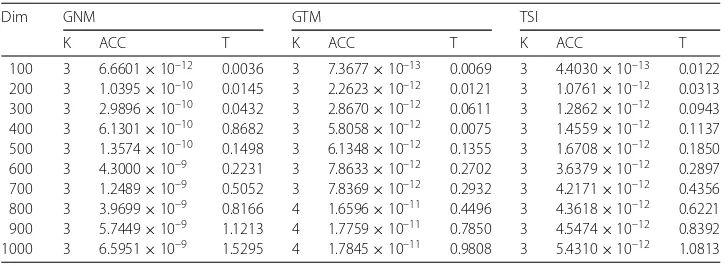
Algorithm3.1is used to solve Example1and2; Tables1and2record the experiment results.
In Tables1and2, Dim, K, ACC and T denote the dimension of the problem, the number of iterations,Axk–|xk|–b
2and time(s), respectively. It is clear from Tables1and2that
the new two-step iterative method is very effective in solving absolute value equations, especially the high dimension problem.
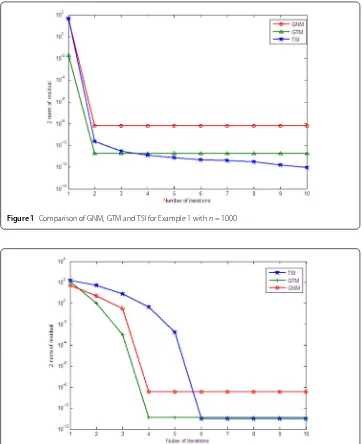
Figures1and2show the convergence curves of three algorithms for solving Examples1
[image:6.595.117.481.429.562.2]and2. For Example1, We find that the convergence of the TSI is the best among three methods, obviously. For Example2, the convergence of the TSI is litter better than GTM, they are both better than GNM. So Algorithm3.1is superior in convergence and the qual-ity of solution for solving AVEs (1).
Table 1 The comparison of GNM, GTM and TSI in Example1
Dim GNM GTM TSI
K ACC T K ACC T K ACC T
[image:6.595.117.482.599.732.2]100 3 6.6601×10⁻¹² 0.0036 3 7.3677×10⁻¹³ 0.0069 3 4.4030×10⁻¹³ 0.0122 200 3 1.0395×10⁻¹⁰ 0.0145 3 2.2623×10⁻¹² 0.0121 3 1.0761×10⁻¹² 0.0313 300 3 2.9896×10⁻¹⁰ 0.0432 3 2.8670×10⁻¹² 0.0611 3 1.2862×10⁻¹² 0.0943 400 3 6.1301×10⁻¹⁰ 0.8682 3 5.8058×10⁻¹² 0.0075 3 1.4559×10⁻¹² 0.1137 500 3 1.3574×10⁻¹⁰ 0.1498 3 6.1348×10⁻¹² 0.1355 3 1.6708×10⁻¹² 0.1850 600 3 4.3000×10⁻⁹ 0.2231 3 7.8633×10⁻¹² 0.2702 3 3.6379×10⁻¹² 0.2897 700 3 1.2489×10⁻⁹ 0.5052 3 7.8369×10⁻¹² 0.2932 3 4.2171×10⁻¹² 0.4356 800 3 3.9699×10⁻⁹ 0.8166 4 1.6596×10⁻¹¹ 0.4496 3 4.3618×10⁻¹² 0.6221 900 3 5.7449×10⁻⁹ 1.1213 4 1.7759×10⁻¹¹ 0.7850 3 4.5474×10⁻¹² 0.8392 1000 3 6.5951×10⁻⁹ 1.5295 4 1.7845×10⁻¹¹ 0.9808 3 5.4310×10⁻¹² 1.0813
Table 2 The comparison of GNM, GTM and TSI in Example2
Dim GNM GTM TSI
K ACC T K ACC T K ACC T
Figure 1Comparison of GNM, GTM and TSI for Example1withn= 1000
Figure 2Comparison of GNM, GTM and TSI for Example2withn= 1000
5 Conclusions
In this paper, we propose a new two-step iterative method for solving non-differentiable and NP-hard absolute value equationsAx–|x|=b, when the minimum singular value ofA
is greater than 1. Compared with the existing methods GNM and GTM, our new method has some nice convergence properties and better calculation consequences. In the future, we have the confidence to continue an in-depth study.
Acknowledgements
The authors are very grateful to the editors and referees for their constructive advice.
Funding
Competing interests
The authors declare that they have no competing interests.
Authors’ contributions
All authors contributed equally to the manuscript, and they read and approved the final manuscript.
Publisher’s Note
Springer Nature remains neutral with regard to jurisdictional claims in published maps and institutional affiliations.
Received: 20 September 2018 Accepted: 15 January 2019
References
1. Rohn, J., Hooshyarbakhsh, V., Farhadsefat, R.: An iterative method for solving absolute value equations and sufficient conditions for unique solvability. Optim. Lett.8(1), 35–44 (2014)
2. Rohn, J.: On unique solvability of the absolute value equation. Optim. Lett.3(4), 603–606 (2009)
3. Rohn, J.: An algorithm for computing all solutions of an absolute value equation. Optim. Lett.6(5), 851–856 (2012) 4. Hu, S.L., Huang, Z.H., Zhang, Q.: A generalized Newton method for absolute value equations associated with second
order cones. J. Comput. Appl. Math.235(5), 1490–1501 (2011)
5. Mangasarian, O.L., Meyer, R.R.: Absolute value equations. Linear Algebra Appl.419(2), 359–367 (2006)
6. Rohn, J., Hooshyarbakhsh, V., Farhadsefat, R.: An iterative method for solving absolute value equations and sufficient conditions for unique solvability. Optim. Lett.8(1), 35–44 (2014)
7. Noor, M.A., Iqbal, J., Noor, K.I., et al.: On an iterative method for solving absolute value equations. Optim. Lett.6(5), 1027–1033 (2012)
8. Iqbal, J., Iqbal, A., Arif, M.: Levenberg–Marquardt method for solving systems of absolute value equations. J. Comput. Appl. Math.282(10), 134–138 (2015)
9. Moosaei, H., Ketabchi, S., Jafari, H.: Minimum norm solution of the absolute value equations via simulated annealing algorithm. Afr. Math.26(7–8), 1221–1228 (2015)
10. Zhang, M., Huang, Z.H., Li, Y.F.: The sparsest solution to the system of absolute value equations. J. Oper. Res. Soc. China 3(1), 31–51 (2015)
11. Yong, L.Q.: Hybrid differential evolution with biogeography-based optimization for absolute value equation. J. Inf. Comput. Sci.10(8), 2417–2428 (2013)
12. Abdallah, L., Haddou, M., Migot, T.: Solving absolute value equation using complementarity and smoothing functions. J. Comput. Appl. Math.327(1), 196–207 (2018)
13. Zainali, N., Lotfi, T.: On developing a stable and quadratic convergent method for solving absolute value equation. J. Comput. Appl. Math.330(4), 742–747 (2018)
14. Mangasarian, O.L.: Sufficient conditions for the unsolvability and solvability of the absolute value equation. Optim. Lett.11(7), 1–7 (2017)
15. Polyak, B.T.: Introduction to Optimization. Optimization Software Inc., New York (1987)
16. Mangasarian, O.L.: A generalized Newton method for absolute value equations. Optim. Lett.3(1), 101–108 (2009) 17. Haghani, F.K.: On generalized Traub’s method for absolute value equations. J. Optim. Theory Appl.166(2), 619–625
(2015)