Proceedings of the Asia Pacific Industrial Engineering & Management Systems Conference 2012 V. Kachitvichyanukul, H.T. Luong, and R. Pitakaso Eds.
. † : Corresponding Author
1822
Process Construct in the Virtual R&D Teams
Nader Ale Ebrahim†, Shamsuddin Ahmed
Department of Engineering Design and Manufacture, Faculty of Engineering, University of Malaya
Kuala Lumpur, Malaysia
Salwa Hanim Abdul Rashid
Centre for Product Design and Manufacturing Department of Engineering Design and Manufacture
Faculty of Engineering, University of Malaya Kuala Lumpur, Malaysia
Zahari Taha
Faculty of Manufacturing Engineering and Management Technology, University Malaysia Pahang,
26300 Gambang, Pahang, Malaysia
Marjan Mohammadjafari,
Department of Engineering Design and Manufacture, Faculty of Engineering, University of Malaya
Kuala Lumpur, Malaysia
Abstract: literature proves the importance of the process role in the effectiveness of virtual research and development (R&D) teams for new product development (NPD). However, the factors that make process construct in a virtual R&D team are still unclear. The manager of virtual R&D teams for NPD does not know which items of process should be used. To address the gap and answer the question, the study presents a set of factors that make a process construct. The proposed construct modified by finding of the field survey. We empirically examine the relationship between construct, dimensions and its factors by employing the Structural Equation Modeling (SEM). A measurement model built based on the 13 preliminary factors that extracted from the literature review. The result shows 9 factors out of 13 factors maintaining to make process construct. These factors can be grouped into two dimensions namely generating report and collaborative system. The findings can help new product development managers of enterprises to concentrate on the main factors for leading an effective virtual R&D team. In addition, it provides a guideline for future research.
Key words: Collaboration teams, questionnaires performance, cross-functional teams, product development, measurement model, virtual team
1.
INTRODUCTION
A virtual team is defined as “a small temporary group of geographically, organizationally and/or time dispersed knowledge workers who coordinate their work, mainly with electronic information and communication technologies to carry out one or more organization tasks” (Ale Ebrahim et al., 2009b). The virtual R&D team is a form of a virtual team, which includes the features of virtual teams and concentrates on R&D activities (Ale Ebrahim et al., 2011). “We are becoming more virtual all the time!” is heard in many global
1823 Tatikonda, 2004).
Virtualization in NPD has recently begun to make a serious headway due to the rapid growth of a large variety of technologies. This means that virtuality in NPD is now technically possible (Leenders et al., 2003). Due to increasing and changing product features, generally product development has become more complex, with increasing complexity in the supply chain. Therefore, more close collaboration between customers, developers, and suppliers has become vital. The foretold collaborations often involve individuals from different geographical locations that could now be brought together by using the various types of information technology. Although the process of new product development in virtual teams for many purposes has received notable attention in the literature, little has been said about collaborative tools and effective virtual teams for NPD (Ale Ebrahim et al., 2009a). In addition, the literature did not reveal an adequate focus on the factors which can construct a process role for a virtual R&D team for NPD.
This paper is structured as follows. Firstly, based on prior research, we extracted the 13 factors of process construct in the virtual R&D teams. Next, Structural Equation Modeling (SEM) was used as an analytical tool for testing the estimations and testing the process construct measurement models. Then, we adjusted the preliminary process construct model by fitting the model according to the SEM fitness indices and made a final measurement model. The paper infers with a discussion and future guidelines.
2.
PROCESS ROLE IN THE LITERATURE
The company’s processes need to be re-aligned with the capabilities of virtual teams as opposed to face-to-face teams. This involves an understanding of the virtual team and existing processes (Bal and Gundry, 1999). However, the key elements in knowledge sharing are not only the hardware and software, but also the ability and willingness of team members to actively participate in the knowledge sharing process (Rosen et al., 2007). Proximity enables team members to engage in informal work (Furst et al., 2004). Virtual team members are more likely to treat one another formally, and less likely to reciprocate requests from one another (Wong and Burton, 2000). Shin (2005) argued that the lack of physical interactions and informal relationships decrease the cohesiveness of virtual teams. Formal practices and routines designed to formally structure tasks were reported to lead to higher quality output of virtual team (Massey et al., 2003). The physical absence of a formal leader exacerbates the lack of extrinsic motivation (Kayworth and Leidner, 2002). In virtual teams which rarely meet face-to-face, team leaders often have no choice but to implement a
formal team structure. Synchronous written documents helped virtual teams to overcome challenges associated with spoken language, and this enabled teams to overcome challenges associated with asynchronous and lean written communication (Shachaf, 2008).
Kirkman, et al. (2004) demonstrated a positive correlation between empowerment and virtual team performance. High performance teams are distinguished by a passionate dedication to goals, identifying and emotional bonding among team members, and a balance between unity and respect for individual differences.
Virtual team members must have clear roles and accountabilities. Lack of visibility may cause virtual team members to feel less accountable for results, and therefore, explicit facilitation of teamwork takes on heightened importance for virtual teams. Temporal coordination mechanisms such as scheduling deadlines and coordinating the pace of effort are recommended to increase vigilance and accountability (Massey et al., 2003).
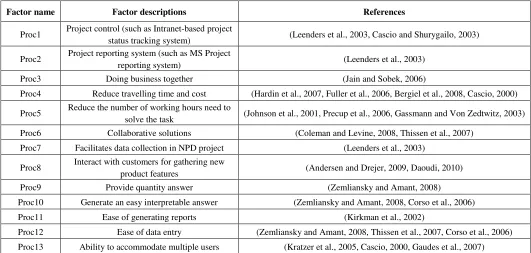
From the process point of view, the items which are required for effective virtual teams are ambiguous. The researcher extracted 13 items related to the process construct based on reviewed papers (Table 1).
3.
RESEARCH METHODOLOGY AND DATA
COLLECTION
To build a measurement model of process construct in virtual R&D teams for new product development, we conducted a Web-based survey mainly in Malaysian and Iranian manufacturing enterprises, in a random sample of small and medium enterprises. Web-based survey method was selected because it is a cost-effective and quick method to obtain feedbacks from the beliefs of the respondents. The rapid expansion of Internet users has given Web-based surveys the potential to become a powerful tool in survey research (Sills and Song, 2002, Ebrahim et al., 2010). A Likert scale from one to five was used. This setup provided the respondents with a series of attitude dimensions. For each factor, the respondents were asked whether the factor is unimportant or extremely important using a Likert scale rating. The questionnaires were e-mailed to the managing director, R&D manager, new product development manager, project and design manager and appropriate personnel who were most familiar with the R&D activities within the firm.
Ale Ebrahim et. al.
1824
Table 1 Items related to the process construct in virtual teams
Factor name Factor descriptions References
Proc1 Project control (such as Intranet-based project
status tracking system) (Leenders et al., 2003, Cascio and Shurygailo, 2003)
Proc2 Project reporting system (such as MS Project
reporting system) (Leenders et al., 2003)
Proc3 Doing business together (Jain and Sobek, 2006)
Proc4 Reduce travelling time and cost (Hardin et al., 2007, Fuller et al., 2006, Bergiel et al., 2008, Cascio, 2000)
Proc5 Reduce the number of working hours need to
solve the task (Johnson et al., 2001, Precup et al., 2006, Gassmann and Von Zedtwitz, 2003)
Proc6 Collaborative solutions (Coleman and Levine, 2008, Thissen et al., 2007)
Proc7 Facilitates data collection in NPD project (Leenders et al., 2003)
Proc8 Interact with customers for gathering new
product features (Andersen and Drejer, 2009, Daoudi, 2010)
Proc9 Provide quantity answer (Zemliansky and Amant, 2008)
Proc10 Generate an easy interpretable answer (Zemliansky and Amant, 2008, Corso et al., 2006)
Proc11 Ease of generating reports (Kirkman et al., 2002)
Proc12 Ease of data entry (Zemliansky and Amant, 2008, Thissen et al., 2007, Corso et al., 2006)
[image:3.595.42.573.106.359.2]Proc13 Ability to accommodate multiple users (Kratzer et al., 2005, Cascio, 2000, Gaudes et al., 2007)
Table 2 Summary of online survey data collection
Numbers of emails sent to enterprises 3625
Total responses (Clicked the online web page) 972
Total responses / received questionnaire (%) 26.8
Total completed 240
Total completed / received questionnaire (%) 24.7
4.
ANALYSIS AND RESULTS
Gerbing and Anderson (1988) suggested using confirmatory factor analysis (CFA) for scale development because it affords stricter interpretation of uni-dimensionality than what is provided by traditional approaches such as coefficient alpha, item-total correlations, and exploratory factor analysis. The evidence that the measures were uni-dimensional, whereby a set of indicators (factors) shares only a single underlying construct, was assessed using CFA (Anderson and Gerbing, 1988). According to Anderson and Gerbing (1988), after data collection, the measures’ purification procedures should be used to assess their reliability, uni-dimensionality, discriminant validity, and convergent validity. For reliability analysis, Cronbach’s alpha was employed to each factor. From Table 3, all items with Cronbach’s α greater than the threshold value of 0.6 were included in the analysis and the rest were omitted from analysis. Hence, the factors Tech1, Tech10, Tech11 and Tech13 were excluded from further
analysis. In general, the reliability of the contents in the questionnaire exhibits good reliability across the samples.
Structural Equation Modeling (SEM) using AMOS 18 was employed for validating the measurement model. The statistical analysis was estimated simultaneously for both measurement and structural models (Dibrell et al., 2008). In order to ensure that the factors made the right construct, the measurement model was examined for its fit. Given this, the model was assessed for convergent and discriminant validity.
Convergent validity was established using a calculation of the factor loading, average variance extracted (AVE) and composite reliability (CR). The factors which have standardized loadings exceeding 0.50, were retained (Dibrell et al., 2008).
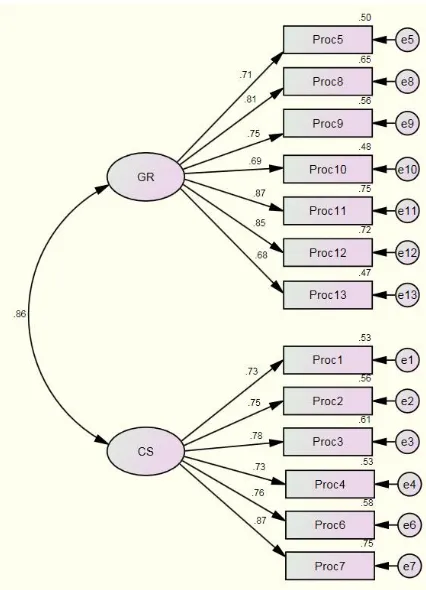
Factor analysis on 13 process construct items reduced them into two dimensions (Table 4). The first dimension includes Proc5, Proc8, Proc9, Proc10, Proc11, Proc12 and Proc13 was named “Generate report (GR)”, and the second dimension consists of Proc1, Proc2, Proc3, Proc4, Proc6 and Proc7 was named “Collaborative solutions (CS)”.
1825 Table 3 Virtual team process items reliability analysis and
standardized regression weights (factor loadings)
Factor name Corrected Item-Total Correlation
Cronbach's Alpha if Item
Deleted
Standardized Factor Load
Proc1 .668 .937 .726
Proc2 .682 .936 .746
Proc3 .708 .935 .781
Proc4 .717 .935 .730
Proc5 .726 .935 .710
Proc6 .713 .935 .763
Proc7 .817 .932 .867
Proc8 .786 .933 .807
Proc9 .704 .935 .746
Proc10 .667 .937 .693
Proc11 .754 .934 .866
Proc12 .742 .934 .850
[image:4.595.331.544.231.526.2]Proc13 .630 .938 .684
Table 4 Rotated Component Matrixa of virtual team process construct items
Factor name
Raw Component
Rescaled Component
1 2 1 2
Proc11 .777 .282 .815 .295
Proc12 .704 .266 .792 .299
Proc13 .772 .194 .767 .193
Proc9 .657 .271 .737 .304
Proc8 .599 .445 .663 .492
Proc10 .609 .329 .650 .351
Proc5 .571 .520 .575 .524
Proc2 .219 .823 .222 .836
Proc3 .269 .749 .287 .798
Proc1 .281 .828 .266 .784
Proc7 .520 .623 .551 .659
Proc6 .408 .590 .441 .638
Proc4 .545 .550 .542 .546
Extraction Method: Principal Component Analysis. Rotation Method: Varimax with Kaiser Normalization.
a. Rotation converged in 3 iterations.
For model fitting, AMOS for model version 1 (Figure 1) was used, and there was a lack of model fit, whereby RMSEA = 0.164, GFI = 0.751 and CFI = 0.823. Based on MI, Proc1, Proc5, Proc12 and Proc13 were dropped. From the MI, Proc1 equals to Proc2, Proc11 equals to Proc12 and Proc3 equals to Proc13. Therefore, the remaining items
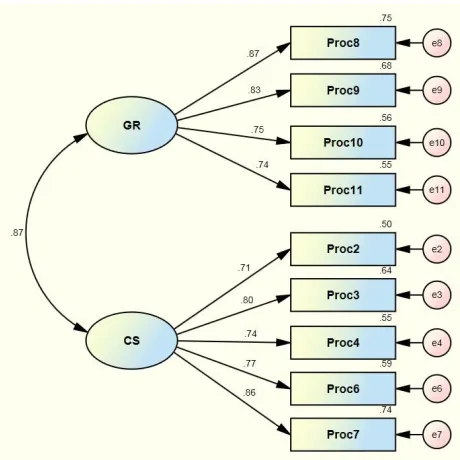
represent some of the dropped items. Items which had a lower factor load for any equality cases were omitted. With this modification, the final measurement model was developed (Figure 2) and the model was well fitted (CMIN/DF = 1.905, GFI = 0.920, RMR = 0.035, NFI = 0.932, CFI = 0.966, IFI = 0.966 and RMSEA = 0.085). The factor loading in the final virtual team benefit measurement model was above 0.74, which was quite significant.
Figure 1 Virtual team process measurement model version1with standardized factor loading
5.
DISCUSSION ON VERIFIED MODEL
[image:4.595.42.297.401.611.2]Ale Ebrahim et. al.
1826 discarded items had equality with the remaining items, and
the ones which had a less factor load were deleted. Modification indices (MI) based on regression weights shows that Proc1 equals to Proc2, Proc11 equals to Proc12 and Proc13 equals to Proc3. Therefore, in future research, similar items can be deleted from the questionnaires.
The results for the final measurement model of process construct in virtual R&D teams show the share of two dimensions that are strongly correlated to each other. The first dimension includes Proc8, Proc9, Proc10 and Proc11 was named “Generate report (GR)” whereas the second dimension consists of Proc2, Proc3, Proc4, Proc6 and Proc7 was named “Collaborative solutions (CS)” (Table 5). Therefore, the two dimensions that make up the process constructs in virtual R&D teams should be taken into account by NPD Manager to have an effective team.
6.
CONCLUSIONS
This research explores the 13 factors related to NPD process in a virtual team environment and extract two dimensions with nine factors. However, the factors which
mainly contribute to the process construct in virtual R&D teams’ for new product development were unknown in the preceding literature. The findings of this study will contribute some knowledge in the literature and build a foundation for further understanding of the process elements in virtual R&D teams for new product development. The measurement model shows two dimensions (“Generate report” and “Collaborative solutions”) with nine factors that made the process constructs. These dimensions and factors can be sorted by their factor loading, which reflects the factor’s weight. Therefore, the managers of NPD are able to provide a better platform for virtual teams by concentrating on the two dimensions and their main relevant nine factors.
[image:5.595.54.284.383.613.2]Future research is needed to examine the effects of each factor to perform the virtual R&D teams whereas the other constructs of virtual teams such as people and technology are taken into account. A new SEM is needed to demonstrate the relationships between factors-construct and construct-construct, which are not yet investigated.
Figure 2 Final virtual team process measurement model with standardized factor loading
REFERENCES
Ale Ebrahim, N., Abdul Rashid, S. H., Ahmed, S. & Taha, Z. 2011. The Effectiveness of Virtual R&D Teams in SMEs: Experiences of Malaysian SMEs. Industrial Engineering & Management Systems, 10 (ARTICLE IN PRESS).
Ale Ebrahim, N., Ahmed, S. & Taha, Z. 2009a. Modified Stage-Gate: A Conceptual Model of Virtual Product Development Process. African Journal of Marketing Management, 1, 211-219.
Ale Ebrahim, N., Ahmed, S. & Taha, Z. 2009b. Virtual R & D teams in small and medium enterprises: A literature review. Scientific Research and Essay, 4, 1575–1590.
Andersen, P. H. & Drejer, I. 2009. Together we share? Competitive and collaborative supplier interests in product development. Technovation, 29, 690-703.
Anderson, J. C. & Gerbing, D. W. 1988. Structural equation modeling in practice: A review and recommended two-step approach. Psychological Bulletin 103, 411-423.
Bal, J. & Gundry, J. 1999. Virtual teaming in the automotive supply chain. Team Performance Management, 5, 174 - 193.
1827
Table 5 Two dimensions of virtual team process construct
Dimensions Factor name Main items Equal items
Generate report (GR)
Proc8 Interact with customers for gathering new product features
Proc9 Provide quantity answer
Proc10 Generate an easy interpretable answer
Proc11 Ease of generating reports Proc12 - Ease of data entry
Collaborative solutions (CS)
Proc2 Project reporting system Proc1 - Project control
Proc3 Doing business together Proc13 - Ability to accommodate
multiple users
Proc4 Reduce travelling time and cost
Proc6 Collaborative solutions
Proc7 Facilitates data collection in new product development project
Byrne, B. M. 2010. Structural equation modeling with AMOS: Basic concepts, applications, and programming, New York, Taylor and Francis Group, LLC.
Cascio, W. F. 2000. Managing a virtual workplace. The Academy of Management Executive, 14, 81-90.
Cascio, W. F. & Shurygailo, S. 2003. E-Leadership and Virtual Teams. Organizational Dynamics, 31, 362-376.
Chudoba, K. M., Wynn, E., Lu, M., Watson-Manheim & Beth, M. 2005. How virtual are we? Measuring virtuality and understanding its impact in a global organization. Information Systems Journal, 15, 279-306.
Coleman, D. & Levine, S. 2008. Collaboration 2.0: Technology and Best Practices for Successful Collaboration in a Web 2.0 World, Silicon Valley, California, USA, Happy About®.
Corso, M., Martini, A., Pellegrini, L., Massa, S. & Testa, S. 2006. Managing dispersed workers: the new challenge in Knowledge Management. Technovation, 26, 583-594.
Daoudi, J. 2010. Dynamique de collaboration au sein des équipes dispersées: Le cas des projets d'ingénierie. PhD Du Diplôme De Philosophiae Doctor (Ph.D.), Université De Montréal.
Dibrell, C., Davis, P. S. & Craig, J. 2008. Fueling Innovation through Information Technology in SMEs. Journal of Small Business Management, 46, 203-218.
Ebrahim, N. A., Ahmed, S. & Taha, Z. 2010. Virtual R&D teams and SMEs growth: A comparative study between Iranian and Malaysian SMEs. African Journal of Business Management, 4, 2368-2379.
Fuller, M. A., Hardin, A. M. & Davison, R. M. 2006. Efficacy in Technology-Mediated Distributed Team Journal of Management Information Systems, 23, 209-235.
Furst, S. A., Reeves, M., Rosen, B. & Blackburn, R. S. 2004. Managing the life cycle of virtual teams. Academy of
Management Executive, 18, 6-20.
Gassmann, O. & Von Zedtwitz, M. 2003. Trends and determinants of managing virtual R&D teams. R&D Management, 33, 243-262.
Gaudes, A., Hamilton-Bogart, B., Marsh, S. & Robinson, H. 2007. A Framework for Constructing Effective Virtual Teams The Journal of E-working 1, 83-97
Hardin, A. M., Fuller, M. A. & Davison, R. M. 2007. I Know I Can, But Can We?: Culture and Efficacy Beliefs in Global Virtual Teams. Small Group Research, 38, 130-155.
Jain, V. K. & Sobek, D. K. 2006. Linking design process to customer satisfaction through virtual design of experiments. Research in Engineering Design, 17, 59-71.
Johnson, P., Heimann, V. & O’neill, K. 2001. The “wonderland” of virtual teams. Journal of Workplace Learning, 13, 24 - 30.
Kayworth, T. R. & Leidner, D. E. 2002. Leadership Effectiveness in Global Virtual Teams Management Information Systems, 18, 7 - 40
Kirkman, B. L., Rosen, B., Gibson, C. B., Tesluk, P. E. & Mcpherson, S. O. 2002. Five challenges to virtual team success: lessons from Sabre Inc. Academy of Management Executive, 16, 67-79.
Kirkman, B. L., Rosen, B., Tesluk, P. E. & Gibson, C. B. 2004. The Impact Of Team Empowerment On Virtual Team Performance: The Moderating Role Of Face-To-Face Interaction. Academy of Management Journal, 47, 175-192.
Kratzer, J., Leenders, R. & Engelen, J. V. 2005. Keeping Virtual R&D Teams Creative. Research Technology Management, 1, 13-16.
Lam, P.-K., Chin, K.-S., Yang, J.-B. & Liang, W. 2007. Self-assessment of conflict management in client-supplier collaborative new product development. Industrial Management & Data Systems, 107, 688 - 714.
Ale Ebrahim et. al.
1828 for value creation and project success: A case study.
International Journal of Project Management 26, 51–62. Leenders, R. T. A. J., Engelen, J. M. L. V. & Kratzer, J. 2003. Virtuality, communication, and new product team creativity: a social network perspective. Journal of Engineering and Technology Management, 20, 69–92.
Massey, A. P., Montoya-Weiss, M. M. & Yu-Ting, H. 2003. Because Time Matters: Temporal Coordination in Global Virtual Project Teams. Journal of Management Information Systems, 19, 129-155.
Precup, L., O'sullivan, D., Cormican, K. & Dooley, L. 2006. Virtual team environment for collaborative research projects. International Journal of Innovation and Learning, 3, 77 - 94
Rosen, B., Furst, S. & Blackburn, R. 2007. Overcoming Barriers to Knowledge Sharing in Virtual Teams. Organizational Dynamics, 36, 259–273.
Shachaf, P. 2008. Cultural diversity and information and communication technology impacts on global virtual teams: An exploratory study. Information & Management, 45, 131-142.
Shin, Y. 2005. Conflict Resolution in Virtual Teams. Organizational Dynamics, 34, 331-345.
Sills, S. J. & Song, C. 2002. Innovations in Survey Research: An Application of Web-Based Surveys. Social Science Computer Review, 20, 22-30.
Stock, G. N. & Tatikonda, M. V. 2004. External technology integration in product and process development. International Journal of Operations & Production Management, 24, 642-665.
Thissen, M. R., Jean, M. P., Madhavi, C. B. & TOYIA, L. A. 2007. Communication tools for distributed software development teams. Proceedings of the 2007 ACM SIGMIS CPR conference on Computer personnel research: The global information technology workforce. St. Louis, Missouri, USA: ACM.
Wong, S. S. & Burton, R. M. 2000. Virtual Teams: What are their Characteristics, and Impact on Team Performance? Computational & Mathematical Organization Theory, 6, 339-360.
Zemliansky, P. & Amant, K. S. 2008. Handbook of Research on Virtual Workplaces and the New Nature of Business Practices, New York, IGI Global; illustrated edition edition (April 7, 2008).
AUTHOR BIOGRAPHIES
Nader Ale Ebrahim is a Technology Management PhD candidate in the Department of Engineering Design and Manufacture, Faculty of Engineering, University of Malaya. He holds a Master of Science in Mechanical Engineering from University of Tehran with distinguished honors. His
research interests focus on managing virtual teams for new product development in SMEs R&D centers. His research has been published in several refereed journals.
Shamsuddin Ahmed is currently an Associate Professor in the Department of Engineering Design and Manufacture at University of Malaya (UM), Malaysia. He has been in graduate level teaching since 1986. He offered a good number subjects for both undergraduate and postgraduate studies and supervised many students. He published more than 50 ISI and other journal papers and more than 100 conference and seminar articles. He is a reviewer of some ISI and other regional journals.
Salwa Hanim Abdul Rashid is currently a Lecturer in the Department of Engineering Design and Manufacture, University of Malaya, Malaysia. She was awarded Bachelor of Engineering and Master of Science degrees in Manufacturing Management from Salford University and Loughborough University, respectively. She then completed her research and obtained her PhD in Sustainable Manufacturing from Cranfield University, United Kingdom. Other than Sustainable Manufacturing, her research interests focus on organizational change and development of manufacturing companies.
Zahari Taha is currently a Professor of Faculty of Manufacturing Engineering at Universiti Malaysia Pahang. He obtained his PhD in Dynamics and Control of Robots from the University of Wales Institute of Science and Technology in 1987. From 1995 to 1998, he completed his postdoctoral at the University of Wales Institute College Cardiff in Engineering Design and Ergonomics. Prof. Zahari has published more than 100 papers in academic books, journals and proceedings. His major research interests include mobile robots, underwater robots, surgical robots, ergonomics design, ergonomics at work, software development for traffic applications and motion analysis.