Technology (IJRASET)
An Enhanced Face Recognition Using Modified
Feature Extarction and Sparese Representation
Aadhya Dani1 , Kapil Nagwanshi2 1,2
Department of Computer Science & Engineering Rungta College of Engineering & Technology, Bhilai, Chhattisgarh
Abstract— Face recognition system is put-fourth a significant challenge to the pattern recognition researchers. Generally human faces are very similar in structure which is difficult to differentiate. Change of facial expression, pose variation and change of lighting condition makes face recognition more difficult. Recent research shows that sparse representation is successfully used in face recognition problems. Local features extractions have been done in past using statistical feature like Local Binary Pattern (LBP). This paper proposed an adaptive method for face recognition which uses LBP in combination with sparse representation for vigorous face recognition. We also proposed modified feature extraction method to avoid face misalignment. Face recognition model is implemented in MATLAB software. Widespread testing of the proposed model is done using AR database. Result analysis on the AR database shows that proposed model is good performing compared to stat-of-art methods.
Keywords— Face Recognition, Person Identification, Biometrics, SVM, kernel Representation
I. INTRODUCTION
Automatic face recognition is the active research topic in field of computer vision from last 30 years due to large number of application like video surveillance, robotics, automatic security clearance and many more. Face recognition is a biometric approach that employs automated methods to verify or recognize the identity of a living person based on his/her physiological characteristics. In general, a biometric identification system makes use of either physiological characteristics (such as a fingerprint, iris pattern, or face) or behavior patterns (such as hand-writing, voice, or key-stroke pattern) to identify a person. Because of human inherent protectiveness of his/her eyes, some people are reluctant to use eye identification systems. Face recognition has the benefit of being a passive, non-intrusive system to verify personal identity in a “natural” and friendly way. Face recognition system in these days encountered lot of challenges like deviation of facial image of same subject over time, occlusion, misalignment and different lighting conditions etc[13]. Most of the automated face recognition system follow same process face detection, alignment, appearance normalization, feature extraction and classification or matching. Classification is an online process and feature extraction for training is generally an offline process.
In comprehensive methodologies, the whole face image is considered for face representation without considering any particular geometrical components of the face. A face picture could be considered as a point in a high-dimensional picture space. To stay away from computational complexities and to diminish excess information, a face image is first straightly changed into a low-dimensional subspace before separating a component vector. Appearance based Face Recognition system has been widely used in fast researches. Appearance based model generally uses lower dimensional subspaces and method includes Linear Discriminant Analysis(LDA)[7], Principal Component Analysis(PCA)[8], Locality Preserving Projections(LPP)[9] etc. LPP and LDA method overcome the limitations of the classical methods of the face recognition like Eigen faces and Fisher faces. These methods consider universal features of facial images which are very sensitive for pose and light variations[10-12]. The execution of appearance-based face recognition techniques is vigorously influenced by the number of samples per individual in the training set[4]. Places such as college admit card, passport, bank passbook where large database or samples is not possible these methods cannot be used of will fail to recognize.
Technology (IJRASET)
located at a number of facial landmarks[1]. All of these methods can be classified as investigative methodologies since the local features extracted from selected points in faces are used for recognition.
Another kind of neighborhood highlight broadly utilized as a part of face recognition is statistical local features (SLF, for example, histogram of Local Binary Pattern (LBP) [14]. The principle thought is that a face picture can be seen as a piece of small scale designs [15]. By parceling the face picture into a few obstructs, the measurable component (e.g., histogram of LBP) of these squares is separated, lastly the portrayal of the image is framed by connecting the extricated components in all pieces. Compared to the holistic feature approaches such as Eigenface and FisherFace, Sensitivity of Gabor filtering is lesser to image variations (e.g., illumination, expression). Another type of local feature widely used in face recognition is statistical local feature (SLF), such as histogram of local binary pattern (LBP) [14].
Aside from the features, the utilized classifier is additionally imperative to the execution of face recognition. Classifiers such as Nearest Neighbor (NN) and Support Vector Machine (SVM) is broadly used in face recognition system. In addition, to better use the prior information that face images from the same subject build a subspace, nearest subspace (NS) classifiers were additionally created, which are typically better than the well-known NN classifier [16].
Recently a classifier sparse representation based classifier (SRC) has been proposed in [17]. This SRC makes a robust face recognition and it uses normalization on the test image which is sparsely coded in the entire training set. By accepting that the exception pixels in the face images are meager and by utilizing a character lattice to code the anomalies, SRC indicates great power to face occlusion and corruption. SRC has been drawing in much intrigue and has been broadly concentrated on in the vision research group. In [18] normalization is replaced by normalization which is named as collaborative representation based classification (CRC). CRC gives similar result as SRS but the time consumption is less. Various methods have been presented to improve the performance for occlusion and misalignment but there is a scope for improved method.
In this paper we presented an improved system for face recognition system which combines unique feature extraction method which extracts features using max poling on various scale. Histogram of Local Binary Pattern is used as feature. Classification is done with robust sparse representation. Proposed approach is presented a solution for image misalignment and pose variation.
II. METHODOLOGY
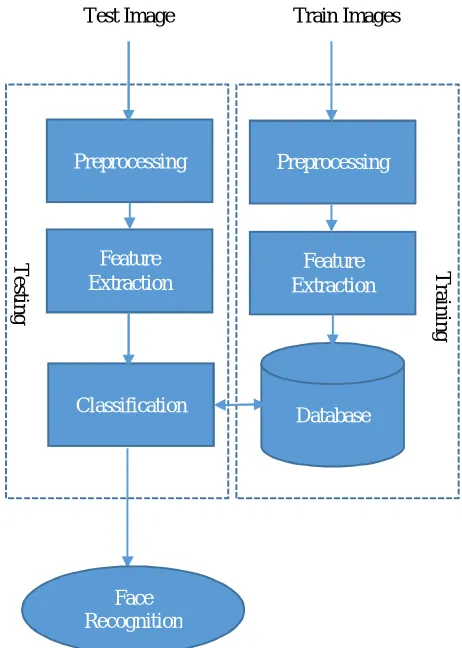
Figure 1 shows the block diagram of proposed face recognition system. Proposed face recognition system has two main parts. One is testing part which is online mode and second Training part which is offline mode. Training part consist of three steps preprocessing, feature extraction and Database. Testing part consists of preprocessing, feature extraction and classification. The input image to the face recognition system is a color image. Training images are taken more than one sample per subject to training database with different pose and conditions of a subject. This ensure good result for different variations in the subject image at the time of testing. Three blocks namely preprocessing, feature extraction and classification from the proposed block diagram needs explanation.
A. Preprocessing
Histogram normalization is the most successfully used preprocessing step in face recognition. In equalizing a histogram the progressive histogram is expanded on and redistributed using the entire range of discrete levels of the image, so that contrast enhancement is achieved. We are using histogram equalization which redistribute the histogram levels constant for all brightness level for the entire image. For image ( , ) with discrete k gray values histogram is defined by i.e. the probability of occurrence of the gray level i is given by[19]:
( ) =
Where ∈0, 1 … −1grey level and N is total number of pixels in the image. Transformation to a new intensity value is defined by:
= = ( )
Technology (IJRASET)
B. Feature Extraction
Main Feature-set for face recognition greatly affect the efficiency of face recognition. Small changes in the feature extraction method can make the system immune to misalignment and increase robustness of the face recognition system. We proposed a new pooling technique which will improve the feature extraction for robust face recognition. Pooling practices are widely used in object and image classification to extract invariant features. Commonly, there are two categories of pooling methods, sum pooling [20] and max pooling [21]. Let the feature vector is denoted by and is the ith feature vector in the pool and{ } is the jth element of the feature vector . Then in case of sum pooling the feature vector is represented by
{ } = { }
But in case of max pooling the feature vector is represented by
{ } = max { }
Study shows that max pooling is more strong to the changes image as compared to the sum pooling. Papers [21] and [22] shows that dividing the image into various scale gives the spatial discrimination information.
Preprocessing
Feature Extraction
Classification
Preprocessing
Feature Extraction
Database
T
e
st
ing
T
ra
ini
n
g
Test Image Train Images
[image:4.612.183.414.114.438.2]Face Recognition
Technology (IJRASET)
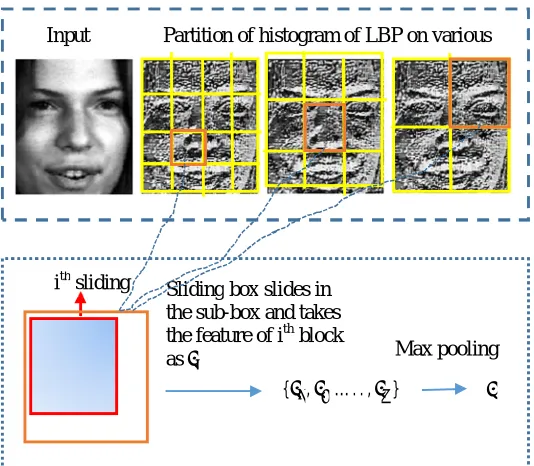
So we proposed an adaptive feature extraction method with max pooling in the various part of the images at various scales. We have taken L scales of partition and in each scale the image is divided into × partition and each partition is then further divided into
× partition. In each partition we first create a system of sliding boxes. Then features are calculated of each sliding box in a sub block. Statistical local features generally calculated in face recognition is Local Binary Pattern. We calculated histogram of the local binary pattern instead of LBP. Feature vectors of each of the partition is derived from the max pooling technique. Max pooling compare the features of all the sliding boxes and take out the max feature as selected feature. Figure 2 shows the feature extraction of the proposed method. Concatenation of all the feature vectors can be taken as the descriptor of the input image.
C. Classification
Robust sparse representation is used for classification. Let × = [ , , , … … . , ]∈ ℜ × denote the set of training samples of ith
object class, where _( , ), = 1,2, … . . is m dimensional vector stretched by the jth sample of the ith class. Let ∈ ℜ be a query sample to be classified. The representation model of normalization based sparse representation is given as
= argmin{‖ − ‖ + ‖ ‖ }
Where = [ , … … . , ] and c is the number of classes; ‖.‖ is the norm, where p=2 [23].
The classification of is done by
( ) = argmin{‖ − ( )‖ }
Where (. ):ℜ → ℜ is the characteristic function that selects from the coefficient associated with the ith class[24]. norm has very competing accuracy with the norm in face recognition without occlusion but with much faster speed. In the case of occlusion or corruption, Robust-sparse [24] classifies the occluded face image y by
( ) = argmin{‖ − ( )− ‖ }
Where
[ ; ] = argmin
, {
‖ − − ‖ + ‖ ; ‖ }
ith sliding
box Sliding box slides in the sub-box and takes the feature of ith block
as Max pooling
{ , … . . , }
Input image
[image:5.612.36.303.86.319.2]Partition of histogram of LBP on various scale
Technology (IJRASET)
and is an occlusion dictionary to code the outliers. is just set as the identity matrix which is represented as I in [24].
This robust sparse representation is changed to weighted sparse representation where norm is replaced by MLE-like estimator.
III. RESULT
A GUI based MATLAB software is implemented using proposed method. We used AR face database to compare experimental results and to prove the efficiency of our method. In feature extraction, the histogram of LBP encoded on the input image is used as the features, and the number of histogram bins for each sub-block is set to 16. In the proposed pooling method, we set S=0, M=5, and N=4 for face recognition with well aligned images. For face recognition with registration error (e.g., misalignment and pose), we set S=3, and (M, N)={(5,4), (3,2), (4,2), (2,1)} for s={0, 1, 2, 3}.
[image:6.612.43.577.450.737.2]Linear Regression for Classification (LRC) [38], histogram intersection kernel based Support Vector Machine (HISVM) and Nearest Neighbor (NN) with histogram intersection as its similarity measurement, are compared with proposed method as shown in Table 1.
Table 1: Comparison of Recognition Result
S. N. Method Recognition
Results (%)
1 SLF+NN 98
2 SLF+LRC 93.7
3 SLF+HISVM 96.6
4 Proposed method 99.4
IV. CONCLUSION
We have presented a novel solution for robust, image misalignment and pose variation. Proposed method combines feature extraction using pooling method at various scale and robust sparse representation for classification. We have evaluated the proposed method on different situation at benchmark face database. Comparison between state-of-art methods and proposed method shows that our method gives better result. Potential application can be implemented using proposed method.
REFERENCES
[1] Wiskott L et al (1997) Face recognition by elastic bunch graph matching. IEEE Trans PAMI 19(7):775–779
[2] C. Liu and H. Wechsler, “Gabor feature based classification using the enhanced fisher linear discriminant model for face recognition,” IEEE Trans. Image Processing, vol. 11, no. 4, pp.467-476, 2002.
[3] L. Shen and L. Bai, “A review on Gabor wavelets for face recognition”, Pattern Analysis and Application, vol. 9, no. 10, pp.273-292, 2006.
[4] A. Jain and B. Chandrasekaran, “Dimensionality and sample size considerations in pattern recognition practice,” Handbook Statistics, vol. 2, pp. 835–855, 1982.
[5] Lades M et al (1993) Distortion invariant object recognition in the Dynamic Link Architecture. IEEE Trans Comput 42(3):300–311
[6] W.Y. Zhao, R. Chellppa, P.J. Phillips, and A. Rosenfeld, “Face recognition: A literature survey,” ACM Computing Survey, vol. 35, no. 4, pp. 399-458, 2003. [7] P. N. Belhumeur, J. Hespanha, and D. J. Kriegman, “Eigenfaces versus fisherfaces: Recognition using class specific linear projection,” IEEE Trans. Pattern
Anal. Mach. Intell., vol. 19, no. 7, pp. 711–720, Jul. 1997.
[8] M. Turk and A. Pentland, “Eigenfaces for recognition,” J. Cognitive Neurosci., vol. 3, no. 1, pp. 71–86, 1991.
[9] X. He, S. Yan, Y. Hu, P. Niyogi, and H. J. Zhang, “Face recognition using Laplacianfaces,” IEEE Trans. Pattern Anal. Mach. Intell., vol. 27, no. 3, pp. 328– 340, Mar. 2005.
[10] M. Lades, J.C. Vorbrüggen, J. Buhmann, J. Lange, C.v.d. Malsburg, R.P. Würtz and W. Konen, “Distortion invariant object recognition in the dynamic link architecture,” IEEE Transactions on Computers, vol. 42, no. 3, pp.300-311, 1993.
[11] C. Liu and H. Wechsler, “Gabor feature based classification using the enhanced fisher linear discriminant model for face recognition,” IEEE Trans. Image Processing, vol. 11, no. 4, pp.467-476, 2002.
[12] L. Shen and L. Bai, “A review on Gabor wavelets for face recognition”, Pattern Analysis and Application, vol. 9, no. 10, pp.273-292, 2006.
[13] H. Huang and H.T. He, “Super-Resolution Method for Face Recognition Using Nonlinear Mappings on Coherent Features,” IEEE Trans. Neural Networks, vol. 22, no. 1, pp. 121-130, 2011.
[14] A. Timo, H. Abdenour, and P. Matti, “Face recognition with local binary patterns,” Proc. European Conf. Computer Vision, 2004.
[15] T. Ahonen, A. Hadid, and M. Pietikainen, “Face description with local binary patterns: Application to face recognition,” IEEE Trans. Pattern Anal. Mach. Intell., vol. 28, no. 12, pp. 2037-2041, 2006.
Technology (IJRASET)
2, pp. 210 – 227, 2009.[18] L. Zhang, M. Yang, and X. C. Feng, “Sparse representation or collaborative representation which helps face recognition?” Proc. Int’l Conf. Computer Vision, 2011.
[19] S.Anila & Dr.N.Devarajan, "Preprocessing Technique for Face Recognition Applications under Varying Illumination Conditions" Global Journal of Computer Science and Technology Graphics & Vision Volume 12 Issue 11 Version 1.0 Year 2012.
[20] S. Lazebnik, C. Schmid, and J. Ponce, “Beyond bags of features: Spatial pyramid matching for recognizing natural scene categories,” Proc. IEEE Conf. Computer Vision and Pattern Recognition, 2007.
[21] J.C. Yang, K. Yu, Y. Gong, and T. Huang, “Linear spatial pyramid matching using sparse coding for image classification,” Proc. IEEE Conf. Computer Vision and Pattern Recognition, 2009.
[22] J.C. Yang, K. Yu, T. Huang, “Supervised translation invariant sparse coding,” Proc. IEEE Conf. Computer Vision and Pattern Recognition, 2010.
[23] L. Zhang, M. Yang, and X. C. Feng, “Sparse representation or collaborative representation which helps face recognition?” Proc. Int’l Conf. Computer Vision, 2011.
[24] J. Wright, A. Yang, A. Ganesh, S. Sastry, and Y. Ma, “Robust face recognition via sparse representation,” IEEE Trans. Pattern Anal. Mach. Intell., vol. 31, no. 2, pp. 210 – 227, 2009.
[25] S.G. Shan, Y. Chang, W. Gao, B. Cao, and P. Yang, “Curse of misalignment in face recognition: Problem and a novel misalignment learning solution,” Proc. IEEE Int’l Conf. Automatic Face and Gesture Recognition, 2004.
[26] Lanitis, C. Taylor, and T. Cootes, “Automatic interpretation and coding of face images using flexible models,” IEEE Transactions on Pattern Analysis and Machine Intelligence, vol. 19, no. 7, pp. 743 – 756, 1997.
[27] K. Jonsson, J. Matas, J. Kittler, and Y. Li, “Learning support vectors for face verification and recognition,” In Proc. IEEE International Conference on Automatic Face and Gesture Recognition, pp. 208–213, 2000.
[28] R. Brunelli and T. Poggio, “Face recognition: Features versus templates,” IEEE Transactions on Pattern Analysis and Machine Intelligence, vol. 15, no. 10, pp. 1042–1052, 1993.
[29] . M. Lades, J.C. Vorbrüggen, J. Buhmann, J. Lange, C.v.d. Malsburg, R.P. Würtz and W. Konen, “Distortion invariant object recognition in the dynamic link architecture,” IEEE Transactions on Computers, vol. 42, no. 3, pp.300-311, 1993.
[30] C. Liu and H. Wechsler, “Gabor feature based classification using the enhanced fisher linear discriminant model for face recognition,” IEEE Trans. Image Processing, vol. 11, no. 4, pp.467-476, 2002.
[31] L. Shen and L. Bai, “A review on Gabor wavelets for face recognition”, Pattern Analysis and Application, vol. 9, no. 10, pp.273-292, 2006.
[32] Y.G. Liu, S.Z. Sam Ge, C.G. Li, and Z.S. You, “K-NS: A classifier by the distance to the nearest subspace,” IEEE Trans. Neural Networks, vol. 22, no. 8, pp. 1256-1268, 2011.
[33] A.Georghiades, P. Belhumeur, and D. Kriegman, “From few to many: Illumination cone models for face recognition under variable lighting and pose,” IEEE Trans. Pattern Anal. Machine Intell., vol. 23, no. 6, pp. 643- 660, 2001.
[34] A. Martinez and R. benavente, “The AR face database,” CVC Tech. Report No. 24, 1998.
[35] P.J. Phillips, H. Wechsler, J. Huang, P. Rauss, “The FERET database and evaluation procedure for face recognition algorithms,” Image and Vision Computing, vol. 16, no. 5, pp. 295-306, 1998.
[36] P.J. Phillips, H. Moon, S.A. Rizvi, P.J. Rauss, “The FERET evaluation methodology for face recognition algorithms,” IEEE Trans. Pattern Anal. Mach. Intell., vol. 22, no. 10, pp. 1090-1104, 2000.
[37] L. Wolf, T. Hassner, and Y. Taigman, “Similarity scores based on background samples,” Proc. Asian Conf. Computer Vision, 2009.
[38] N. Kumar, A.C. Berg, P.N. Belhumeur, and S.K. Nayar, “Attribute and simile classifiers for face verification,” Proc. Int’l Conf. Computer Vision, 2009. [39] T. Ahonen, A. Hadid, and M. Pietikainen, “Face description with local binary patterns: Application to face recognition,” IEEE Trans. Pattern Anal. Mach.
Intell., vol. 28, no. 12, pp. 2037-2041, 2006.
[40] D. Bouchaffra, “Conformation-based hidden markov models: Application to human face identification,” IEEE Trans. Neural Networks, vol. 21, no. 4, pp. 595-608, 2010.
[41] S.H. Gao, I.W-H. Tsang, and L-T. Chia, “Kernel sparse representation for image classification and face recognition,” Proc. European Conf. Computer Vision, 2010.
[42] Z. Zhou, A. Wagner, H. Mobahi. J. Wright, and Y. Ma, “Face recognition with contiguous occlusion using markov random fields,” Proc. Int’l Conf. Computer Vision, 2009.