© 2018, IRJET | Impact Factor value: 6.171 | ISO 9001:2008 Certified Journal | Page 79
Economic Load Dispatch Problem of power plant in thermal electric
generation system using swarm optimization Technique
Sushil Kumar
1, Harkamal Deep Singh
21M.tech. Research Scholar, Department of EEE, IKGPTU University, Punjab 2Assistant professor, Department of EEE, IKGPTU University, Punjab
---***---Abstract- Economic Load Dispatch is basic research
challenges and critical advancement work in the everyday operational arranging of age framework. It is here and now determination of the most ideal yield of various generators units, to meet the power framework stack, at the base conceivable cost, topic to operational requirements and transmissions. This research paper tries to show the numerical detailing of Economic load dispatch issue arrangement utilizing delicate registering method in electric era structure considering different physical and power induced system imperatives.
Index Terms- Economic Load Dispatch problem (ELDP), Basic mathematical formulation, Swarm Optimization.
1. Introduction
In the current electric power frameworks, there are distinctive creating units e.g. hydro, steam, and biomass and so on. Likewise, the heap request vacillates for the time of a day and achieves diverse pinnacle esteems. In this way, it is basic to settle on which producing unit to off/on and furthermore the request in which the units must be closed down remembering the cost benefit of turning on and stopping. The entire work of figure and making these evaluations is known as load dispatch. The financial load dispatch implies that the generator's yield is permitted to change inside persuaded restrains so that to take care of a specific load demand contained by least fuel cost.
2. Economic load Dispatch
Monetary Load Dispatch issue is vital in electric power framework activity and control. The principle target of the Monetary Load Dispatch issues is to make the best plan of energy yields of all creating units in order to gather the required request at least working expense while fulfilling the balance and imbalance constraints. Typically, the cost work for every unit in Financial Load Dispatch issues has been around characterized by a quadratic capacity and is settled utilizing Matlab programming procedures planning of the units together Monetary load dispatch
3. Problem Formulation
In electric generation system, load dispatch problem is a constrained optimization problem and it can be expressed as
Follows.[1-4]
Objective function to Minimize fuel cost (F),
2
1
( ) ( ) $ /
NG
i i i i i i
i
F P a P b P c h
(1)Where, ai (Rs/MW2h), bi (Rs/MWh) and ci (Rs/h) are
consumption coefficients of ith unit. Subject to
(i) The energy balance equation
1 NG
i D L
i
P P P
(2)(ii) The inequality constraints
min max i 1,2,3,..., NG
i i i
P P P (3)
Wherea bi, i ci are fuel cost coefficients
D
P is Load Demand.
L
P is power transmission Loss.
NG is the number of generation buses.
i
Pis real power generation and will act as decision variable.
The very simple and fairly accurate method of expressing
power transmission loss, PL as a function of generator
powers is through George's Formula using B-coefficients and mathematically can be expressed as:
1 1
i j
NG NG
L g ij g
i j
P P B P
MWwhere, Pgiand Pgj are the real power of generations at the
ith and jth buses, respectively.
ij
B are the loss coefficients
which are constant under certain assumed conditions. NG is the number of generation buses.
4. Thermal constraints
© 2018, IRJET | Impact Factor value: 6.171 | ISO 9001:2008 Certified Journal | Page 80
controlled. So a team part is required to play out this errand in activity. This prompts great deals of confinements in the power framework activity of thermal generation and along these lines it give ascend to numerous requirements.
5. Generation Constraints
In order to convince the forecasted in power system load demand, the sum of all generating units on-line must equal the power system load over the time horizon.
Where, Dh is load demand at hth hour.
ih
P is the power output of ith unit at hth hour
ih
U is the On/Off status of the ith unit at the hth hour.
NG is the number of thermal generating units
6. Unit Generation restrictions
The power output generated by the individual units must be within max. and min. generation limits i.e.
Where, Pi(min) and Pi(max) is the minimum and maximum power output of the ith unit.
7. Particle Swarm optimization
Particle Swarm Optimization (PSO) is a swarm-based intelligence algorithm influenced by the social behaviour of animals such as a flock of birds finding a food source or a school of fish protecting them from a predator. This soft computing technique first described by James Kennedy and Russell C. Eberhart in 1995 derives from two separate concepts ,the idea of swarm intelligence based off the surveillance of swarming habits by certain kinds of animals(such as fish & birds) and field of evolutionary computation.
A particle in PSO is analogous to a bird or fish flying through a search (problem) space. The movement of each particle is co-ordinate by a velocity which has both magnitude and direction. Each particle position at any instance of time is influenced by its best position and the position of the best particle in a problem space. The performance of a particle is measured by a fitness value, which is problem specific.
8. Mathematics formulation
The swarm enhancement calculation works by independently keeping up various competitor arrangements in the hunt space. For the (Pij) is time of every emphasis of the calculation, each competitor arrangement is computed by the target work being advanced, deciding wellness of that
arrangement. Each contender arrangement can be thought of as particle ‘flying’ through the wellness scene finding the maximum or on the other hand minimum of the goal work toward the begin, the PSO calculation picks hopeful arrangements arbitrarily inside the pursuit space
P is the current position of
j
thmember ofi
thparticle atu
th iterationC
1,
C
2are the acceleration constantsw is the weighing function or inertia weight factor NP is the
number of particles in a group
NG is the number of members in a particle R1
,
R
2is random number between 0 and 1Initial state of a four-particle PSO algorithm seeking the global maximum in a one-dimensional search space. The search space is composed of all the possible solutions along with objective function. It should be well-known that the PSO algorithm has no information of the essential objective function, and thus has no way of knowing if some of the candidate solutions are near to or distance from a local or global max.
PSO Algorithm and Flow Chart:
The PSO algorithm have just three steps, which are repeated in anticipation of some stopping condition is meet up.
1.Evaluate the fitness of each particle
2.Update individual and global best fitness and positions
3.Update velocity and position of each particle
Flow Chart of Proposed PSO Algorithm
The velocity is generally limited to a certain maximum value. PSO using Eq. (4) is called the model. The particles in the swarm are accelerated to new positions by adding new velocities to their present positions. The new velocities are calculated using Eq. (4) and positions of the particles are updated using Eq. (5).
Implementation of Classical PSO for ELD solution
The main objective of ELD is to obtain the amount of real power to be generated by each committed generator, while 1
NG
i ih ih h
P U
D
(min) (max)
i ih i
© 2018, IRJET | Impact Factor value: 6.171 | ISO 9001:2008 Certified Journal | Page 81
Achieving a minimum generation cost within the constraints. The details of the implementation of PSO components are summarized in the following subsections.
The search procedure for calculating the optimal generation quantity of each unit is summarized as follows:
1. Initialization of the swarm: For a population size P, the particles are randomly generated in the range 0-1 and located between the maximum and the minimum operating limits of the generators. If there are N generating units, the ith particle is represented as
Pi = (Pi1, Pi2, Pi3………... N).
The jth dimension of the ith particle is allocated a value of Pij as given below to satisfy the constraints.
Pij = Pjmin + r (Pjmax - Pjmin ) Here r [0,1]
2. Defining the evaluation function: The merit of each individual particle in the swarm is found using a fitness function called evaluation function. The popular penalty function method employs functions to reduce the fitness of the particle in proportion to the magnitude of the equality constraint violation. The evaluation function is defined to minimize the non-smooth cost function given by equation The evaluation function is given as Min f(x)=f(x)+ lambda (equality constraints)
FIGURE-I
3. Initialization of P-best and G-best: The fitness values obtained above for the initial particles of the swarm are set as the initial Pbest values of the particle. The best value among all the Pbest values is identified as G-Best.
4. Evaluation of velocity: The update in velocity is done by equation (6).
5. Check the velocity constraints of the members of each individual from the following conditions.
If, Vid (k+1) > Vd max, then Vid (k+1) = vd max, (6) Vid (k+1) < Vd min then, Vid (k+1)=vd min
Where, Vdmin = -0.5 Pgmin, Vdmax = +0.5 Pg max
6. Modify the member position of each individual Pg according to the equation
Pgid (k+1) = Pgid (i) + Vid (k+1)
Pgid (k+1) must satisfy the constraints, namely the generating limits. If Pgid (k+1) violates the constraints, then Pgid (k+1) must be modified towards the nearest margin of the feasible solution.
7. If the evaluation value of each individual is better than previous P-best, the current value is set to be P-best. If the best P-best is better than G-best, the best P-best is set to be G-best. The corresponding value of fitness function is saved.
8. If the number of iterations reaches the maximum, then go to step 10. Otherwise, go to step-2.
9. Test system, result and discussion
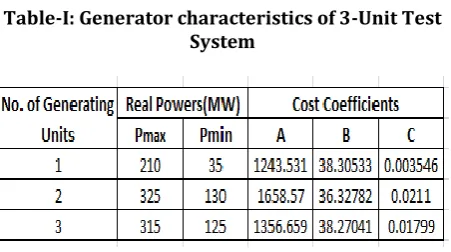
In order to show the effectiveness of the Proposed PSO Algorithm for Short-term Load dispatch Problem, three different types of test systems have been taken into consideration: 3 Units, 5 Units and 6 Units
o The first test system consists of 5-Generating units
has been taken from IEEE 14-Bus System with a time varying load demand for one day.
o The second test system consists of 3 and 6
Generating units has been taken from other research technique in power System with a time varying load demand.
© 2018, IRJET | Impact Factor value: 6.171 | ISO 9001:2008 Certified Journal | Page 82 Test System-I
Table-I: Generator characteristics of 3-Unit Test System
The loss coefficient matrix for 3-unit system:
Table-II: Result of 3-Unit generation System
Table-III: Comparison of result of 3-Unit generation System
Test System-II
Table-IV: Generator characteristics of 6-Unit test System
[image:4.595.50.276.103.229.2]The loss coefficient matrix for 6-unit system
Table-V: Result of 6-Unit generation System
Table-VI: Comparison of result of 6-Unit generation System
Table-VII: Generator characteristics of 5-Unit Test System
UNITS Pmax Pmin A B C
Unit1 250 10 0.00315 2 0
Unit2 140 20 0.0175 1.75 0
Unit3 100 15 0.0625 1 0
Unit4 120 10 0.00834 3.25 0
[image:4.595.321.547.548.612.2]Unit5 45 10 0.025 3 0
Table-VIII: Result of 5-Unit generation System 0.000071 0.000030 0.000025
0.000030 0.000069 0.000032
0.000025 0.000032 0.000080
B
0.000022 0.000020 0.000019 0.000025 0.000032 0.000085 0.000026 0.000015 0.000024 0.000030 0.000069 0.000032 0.000019 0.000016 0.000017 0.000071 0.000030 0.000025 0.000015 0.000013 0.000065 0.000017 0.000024 0.000019 0.0000
B
17 0.000060 0.000013 0.000016 0.000015 0.000020 0.00014 0.000017 0.000015 0.000019 0.000026 0.000022
© 2018, IRJET | Impact Factor value: 6.171 | ISO 9001:2008 Certified Journal | Page 83 10. Conclusion
In this research paper, researchers have presented the solution of Economic load dispatch Problem solution using Swarm Optimization technique. The results of 3units, 5 units and 6 Generating units have been successfully evaluated using Swarm Optimization technique. The following important points are observed throughout the research findings:
o By proposed Swarm Optimization technique, Fuel
cost (FC) is less than multi verse optimization technique.
o Proposed algorithm has simple implementation,
require less computational time and very few algorithm parameters.
11. Future Scope
(1) Swarm Optimization technique is based on the intelligence. It can be applied into both scientific research and engineering use.
(2) This technique has no overlapping and mutation calculation so calculation of generation parameter can easy calculate. During the development of several generations, only the most optimist particle can transmit information on to the matlab programe.
REFERENCES:
[1] Ebrahimi,J.Hosseinian, S.H.(2011),‘‘Unit Commitment Problem Solution using Shuffled Frog Leaping Algorithm’’IEEE Transactions on Power Systems, Vol. 26, Year 2011, pp. 573 -581.
[2] Swarup, K.S and D.N. (2011), ‘‘A Hybrid Interior Point Assisted Differential Evolution Algorithm for Economic Dispatch ’’ IEEE Transactions on Power Systems, Vol.: 26, Year 2011, pp. 541 – 549.
[3] Manteaw E.D and Odero N.A (2012) , “Multi Objective Environmental/Economic Dispatch Solution ABC_PSO Hybrid Algorrithm ”, International Journal of Science and research publication , volume 2 issue 12, December 2012 pp. 1-7.
[4] K. Sudhakara Reddy and Dr. M. Damodar Reddy (2012), ‘‘Economic Load Dispatch using Firefly Algorithm’’ International Journal of Engineering Research and Applications (IJERA) Vol. 2, July-August 2012, pp.2325-2330
[5] Taher Niknam and Faranak Golestaneh (2013), ‘‘Enhanced Bee Swarm Optimization Algorithm for Dynamic Economic Dispatch ’’IEEE Transactions on Power Systems, Vol 7, Year 2013, pp. 754 – 762
[6] Prof. Vikrant Sharma, Tung N.S , Rana R., and Guleria V. (2013), ‘‘Fuzzy Logic Controller Modelling for Economic Dispatch and Unit Commitment in Electrical Power System’’ International Journal ,Volume-2, Issue-10, October 2013 pp. 34-40